GAS CHROMATOGRAPHY
Presented by : Dr. Vijaya U. Barge
( Vice Principal & Professor)
1
Pune District Education
Association’s Shankarrao Ursal
College of Pharmaceutical
Sciences & Research Centre.
Learning Objectives :
After completing this sub-unit the students should be able:
 To study the principle and types of Gas Chromatography.
 To study the instrumentation involved in Gas Chromatography.
 To study the derivatization in Gas Chromatography.
 To study the applications of Gas Chromatography.
 To study system suitability parameters used in GC/HPLC.
 To study Rate and Plate theory.
2
CONTENTS
 Introduction
 Principle
 Instrumentation
 Applications
 Conclusion
 References
3
INTRODUCTION
 Chromatography dates to 1903 in the work of Russian scientist
Mikhail Tswett.
 German graduate student Fritz Prior developed solid state gas
chromatography in 1947.
 Archer John Porter Martin was awarded the Nobel Prize for his
work in developing gas chromatography and he later produced
liquid-gas chromatography (1950).
 Gas chromatography (GC) is an analytical technique used to
separate the chemical components of a sample mixture and then
detect them to determine their presence or absence and/or how much
is present. These chemical components are usually organic
molecules or gases.
4
PRINCIPLE
 Gas Chromatography is a chromatographic technique that can be
used to separate volatile organic compounds.
 The sample solution injected into the instrument enters a gas stream
which transports the sample into a separation tube known as the
"column." (Helium or nitrogen is used as the so-called carrier gas.)
The various components are separated inside the column. The
detector measures the quantity of the components that exit the
column. To measure a sample with an unknown concentration, a
standard sample with known concentration is injected into the
instrument. The standard sample peak retention time (appearance
time) and area are compared to the test sample to calculate the
concentration.
5
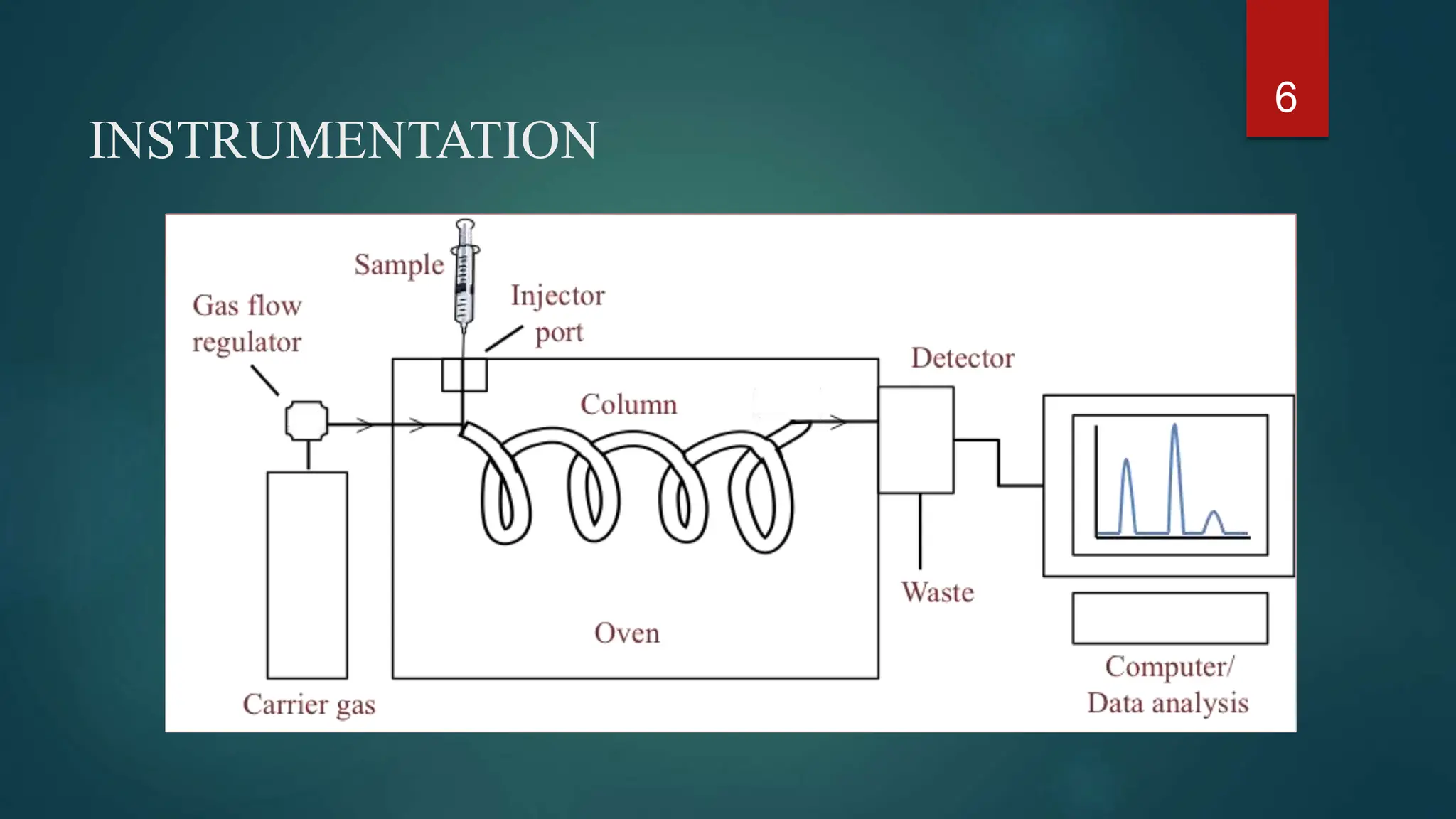
INSTRUMENTATION
6
CARRIER GAS
 It is the mobile phase that runs in column.
 Hydrogen, helium, argon or nitrogen is mostly used as carrier gas.
 The helium gas is mostly preferred because of its efficiency and
safety.
 The carrier gas is filled in reservoir tank and regulator controls the
flow of gas.
 The carrier gas must be pure.
 It is equipped with molecular sieve for filtering and removal of
moisture and other impurities if present.
7
SAMPLE INJECTOR
 The sample that needs to be analyzed is injected in gas
chromatography through sample injector.
 To inject the sample, calibrated syringe is used.
 As the sample needs to travel with mobile phase they both should be
in same physical state. In gas chromatography, the mobile phase is in
gaseous state hence sample also need to be gaseous state.
 The sample injector is equipped with heater that allows the
vaporization of liquid sample.
 If sample is in solid state, it is crushed and grinded and converted to
liquid state.
8
COLUMN
 The column consists of stationary phase (liquid adsorbed on inert solid
support).
 The column is mostly made from stainless steel.
 The column can be packed with stationary phase called as packed
column or thin layer of stationary phase is bonded on the inner walls of
column forming hollow tube called open tubular column
 The length of column used in gas chromatography is in range from 1.5
to 10m with diameter of 2 -4 mm. It is present in the form of coil.
 The column is present inside the oven. The temperature of oven is
controlled and monitored by the software.
 The temperature of oven increases gradually.
9
COLUMN
 The high temperature of oven ensures the sample to stay in gaseous
state.
 The optimum temperature of oven is depends on sample’s boiling point
and hence it is varies from sample to sample.
 When the sample is injected via injector, it travels with carrier gas
(mobile phase) in column filled with stationary phase. The components
of mixture (sample) interact with both immiscible phases in differently.
 Due to difference in the interaction with stationary and mobile phase,
the time taken by individual components to travel the column is
different.
 The time spend by individual component in the column is called as
retention time. This characteristic is used for identification of sample.
10
DETECTOR
 The detector measures the quantity of the components or ingredients
of sample.
 There are different types of detectors available. The working
mechanism of different detectors varies. They also differ in
selectivity i.e. ability to quantify based on molecule’s physical and
chemical property.
 The most commonly used detectors are Flame Ionization and
Thermal conductivity detector.
11
FLAME IONIZATION DETECTOR
When the carrier gas that carries the sample in column and
enters the detectors and passes through hydrogen air flame. It
causes chemical decomposition and ionization of sample.
The collector collects the produced ions. It causes increase
in the current. The current is directly proportional to quantity
of sample that is burned.
Hence, the number of ions (produced during ionization)
depicts the concentration or quantity of sample. The produced
current is converted into digital form and present in the output
device.
As the works on ionization caused by burning of sample in
hydrogen flame, the detector is called as Flame Ionization
detector.
12
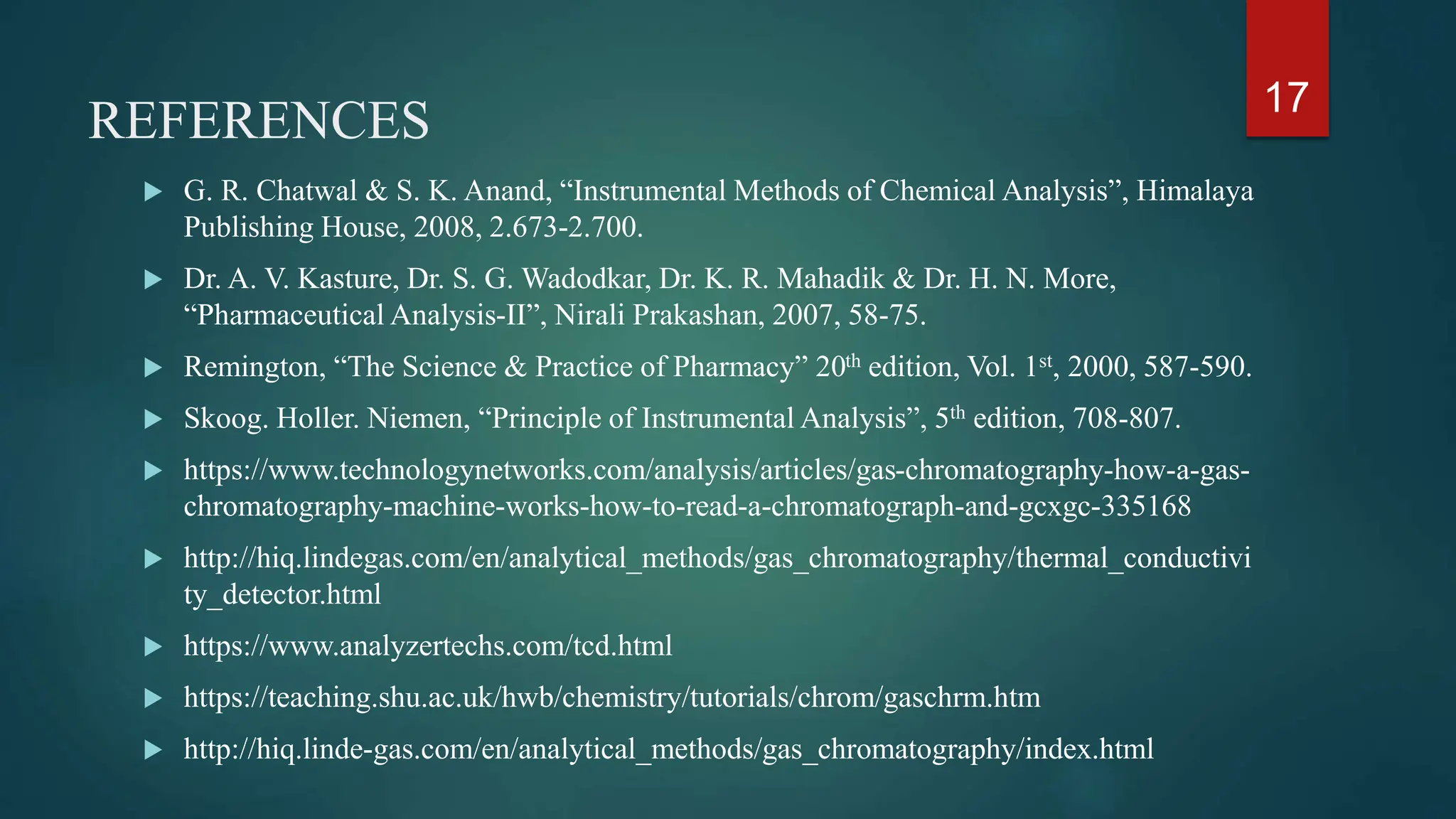
THERMAL CONDUCTIVITY DETECTOR
This detector works by measuring the difference in thermal conductivity
caused by flow on carrier gas with sample with reference to flow of only
carrier gas.
TCD is located at the end of the column consisting a paired tube like
thermistors. When carrier gas and sample travels through tube, it causes
change in the temperature. This change is temperature is sensed by
Wheatstone bridge.
When pure carrier gas is passed through both the tubes, there is no
difference in the temperature of the tubes and hence bridge is balanced.
When one tube carries pure carrier gas while carries carrier gas with sample,
the bridge become unbalanced. It is because of difference in temperature of
both the tubes.
The extent of difference of temperature is directly proportional to the
concentration of sample. The difference in the temperature is measured and
recorded and converted to digital signal and presented in output device.
13
APPLICATIONS
Gas chromatography is exclusively used for isolation, identification and
quantification of volatile compounds or mixtures. Such analytical studies need to
be conducted in pharmaceutical and cosmetic industries, medical fields and
environmental studies.
Qualitative:
The supplement identification of unknown by retention data.
To derivatives the unknown & see if the retention time of derivative
compares with that of known derivatives.
It is useful for analysis of compound in a mixture of known composition.
Quantitative:
External standardization
Internal standardization
14
APPLICATIONS
In pharmaceutical analysis:
Used in quality control, analysis of new product and in monitoring
metabolites in biological fluids. E.g.: antibiotics – penicillin & derivatives,
gentamicin, kanamicin.
 Food analysis.
 Quality control.
 Research.
 Forensics.
 Measuring air pollution.
 Blood alcohol analysis.
15
CONCLUSION
This technique is having very high resolution power so complex
mixture can be resolved into it’s components by this method.
Sensitivity in detection is very high with thermal conductivity
detectors.
The speed of analysis is high and fast.
 It gives relatively good precision and accuracy.
Qualitative and Quantitative analysis at a time is possible.
16
REFERENCES
 G. R. Chatwal & S. K. Anand, “Instrumental Methods of Chemical Analysis”, Himalaya
Publishing House, 2008, 2.673-2.700.
 Dr. A. V. Kasture, Dr. S. G. Wadodkar, Dr. K. R. Mahadik & Dr. H. N. More,
“Pharmaceutical Analysis-II”, Nirali Prakashan, 2007, 58-75.
 Remington, “The Science & Practice of Pharmacy” 20th edition, Vol. 1st, 2000, 587-590.
 Skoog. Holler. Niemen, “Principle of Instrumental Analysis”, 5th edition, 708-807.
 https://www.technologynetworks.com/analysis/articles/gas-chromatography-how-a-gas-
chromatography-machine-works-how-to-read-a-chromatograph-and-gcxgc-335168
 http://hiq.lindegas.com/en/analytical_methods/gas_chromatography/thermal_conductivi
ty_detector.html
 https://www.analyzertechs.com/tcd.html
 https://teaching.shu.ac.uk/hwb/chemistry/tutorials/chrom/gaschrm.htm
 http://hiq.linde-gas.com/en/analytical_methods/gas_chromatography/index.html
17
18

Gas Chromatography.pptx principle, instrumentation

  • 1.
    GAS CHROMATOGRAPHY Presented by: Dr. Vijaya U. Barge ( Vice Principal & Professor) 1 Pune District Education Association’s Shankarrao Ursal College of Pharmaceutical Sciences & Research Centre.
  • 2.
    Learning Objectives : Aftercompleting this sub-unit the students should be able:  To study the principle and types of Gas Chromatography.  To study the instrumentation involved in Gas Chromatography.  To study the derivatization in Gas Chromatography.  To study the applications of Gas Chromatography.  To study system suitability parameters used in GC/HPLC.  To study Rate and Plate theory. 2
  • 3.
    CONTENTS  Introduction  Principle Instrumentation  Applications  Conclusion  References 3
  • 4.
    INTRODUCTION  Chromatography datesto 1903 in the work of Russian scientist Mikhail Tswett.  German graduate student Fritz Prior developed solid state gas chromatography in 1947.  Archer John Porter Martin was awarded the Nobel Prize for his work in developing gas chromatography and he later produced liquid-gas chromatography (1950).  Gas chromatography (GC) is an analytical technique used to separate the chemical components of a sample mixture and then detect them to determine their presence or absence and/or how much is present. These chemical components are usually organic molecules or gases. 4
  • 5.
    PRINCIPLE  Gas Chromatographyis a chromatographic technique that can be used to separate volatile organic compounds.  The sample solution injected into the instrument enters a gas stream which transports the sample into a separation tube known as the "column." (Helium or nitrogen is used as the so-called carrier gas.) The various components are separated inside the column. The detector measures the quantity of the components that exit the column. To measure a sample with an unknown concentration, a standard sample with known concentration is injected into the instrument. The standard sample peak retention time (appearance time) and area are compared to the test sample to calculate the concentration. 5
  • 6.
  • 7.
    CARRIER GAS  Itis the mobile phase that runs in column.  Hydrogen, helium, argon or nitrogen is mostly used as carrier gas.  The helium gas is mostly preferred because of its efficiency and safety.  The carrier gas is filled in reservoir tank and regulator controls the flow of gas.  The carrier gas must be pure.  It is equipped with molecular sieve for filtering and removal of moisture and other impurities if present. 7
  • 8.
    SAMPLE INJECTOR  Thesample that needs to be analyzed is injected in gas chromatography through sample injector.  To inject the sample, calibrated syringe is used.  As the sample needs to travel with mobile phase they both should be in same physical state. In gas chromatography, the mobile phase is in gaseous state hence sample also need to be gaseous state.  The sample injector is equipped with heater that allows the vaporization of liquid sample.  If sample is in solid state, it is crushed and grinded and converted to liquid state. 8
  • 9.
    COLUMN  The columnconsists of stationary phase (liquid adsorbed on inert solid support).  The column is mostly made from stainless steel.  The column can be packed with stationary phase called as packed column or thin layer of stationary phase is bonded on the inner walls of column forming hollow tube called open tubular column  The length of column used in gas chromatography is in range from 1.5 to 10m with diameter of 2 -4 mm. It is present in the form of coil.  The column is present inside the oven. The temperature of oven is controlled and monitored by the software.  The temperature of oven increases gradually. 9
  • 10.
    COLUMN  The hightemperature of oven ensures the sample to stay in gaseous state.  The optimum temperature of oven is depends on sample’s boiling point and hence it is varies from sample to sample.  When the sample is injected via injector, it travels with carrier gas (mobile phase) in column filled with stationary phase. The components of mixture (sample) interact with both immiscible phases in differently.  Due to difference in the interaction with stationary and mobile phase, the time taken by individual components to travel the column is different.  The time spend by individual component in the column is called as retention time. This characteristic is used for identification of sample. 10
  • 11.
    DETECTOR  The detectormeasures the quantity of the components or ingredients of sample.  There are different types of detectors available. The working mechanism of different detectors varies. They also differ in selectivity i.e. ability to quantify based on molecule’s physical and chemical property.  The most commonly used detectors are Flame Ionization and Thermal conductivity detector. 11
  • 12.
    FLAME IONIZATION DETECTOR Whenthe carrier gas that carries the sample in column and enters the detectors and passes through hydrogen air flame. It causes chemical decomposition and ionization of sample. The collector collects the produced ions. It causes increase in the current. The current is directly proportional to quantity of sample that is burned. Hence, the number of ions (produced during ionization) depicts the concentration or quantity of sample. The produced current is converted into digital form and present in the output device. As the works on ionization caused by burning of sample in hydrogen flame, the detector is called as Flame Ionization detector. 12
  • 13.
    THERMAL CONDUCTIVITY DETECTOR Thisdetector works by measuring the difference in thermal conductivity caused by flow on carrier gas with sample with reference to flow of only carrier gas. TCD is located at the end of the column consisting a paired tube like thermistors. When carrier gas and sample travels through tube, it causes change in the temperature. This change is temperature is sensed by Wheatstone bridge. When pure carrier gas is passed through both the tubes, there is no difference in the temperature of the tubes and hence bridge is balanced. When one tube carries pure carrier gas while carries carrier gas with sample, the bridge become unbalanced. It is because of difference in temperature of both the tubes. The extent of difference of temperature is directly proportional to the concentration of sample. The difference in the temperature is measured and recorded and converted to digital signal and presented in output device. 13
  • 14.
    APPLICATIONS Gas chromatography isexclusively used for isolation, identification and quantification of volatile compounds or mixtures. Such analytical studies need to be conducted in pharmaceutical and cosmetic industries, medical fields and environmental studies. Qualitative: The supplement identification of unknown by retention data. To derivatives the unknown & see if the retention time of derivative compares with that of known derivatives. It is useful for analysis of compound in a mixture of known composition. Quantitative: External standardization Internal standardization 14
  • 15.
    APPLICATIONS In pharmaceutical analysis: Usedin quality control, analysis of new product and in monitoring metabolites in biological fluids. E.g.: antibiotics – penicillin & derivatives, gentamicin, kanamicin.  Food analysis.  Quality control.  Research.  Forensics.  Measuring air pollution.  Blood alcohol analysis. 15
  • 16.
    CONCLUSION This technique ishaving very high resolution power so complex mixture can be resolved into it’s components by this method. Sensitivity in detection is very high with thermal conductivity detectors. The speed of analysis is high and fast.  It gives relatively good precision and accuracy. Qualitative and Quantitative analysis at a time is possible. 16
  • 17.
    REFERENCES  G. R.Chatwal & S. K. Anand, “Instrumental Methods of Chemical Analysis”, Himalaya Publishing House, 2008, 2.673-2.700.  Dr. A. V. Kasture, Dr. S. G. Wadodkar, Dr. K. R. Mahadik & Dr. H. N. More, “Pharmaceutical Analysis-II”, Nirali Prakashan, 2007, 58-75.  Remington, “The Science & Practice of Pharmacy” 20th edition, Vol. 1st, 2000, 587-590.  Skoog. Holler. Niemen, “Principle of Instrumental Analysis”, 5th edition, 708-807.  https://www.technologynetworks.com/analysis/articles/gas-chromatography-how-a-gas- chromatography-machine-works-how-to-read-a-chromatograph-and-gcxgc-335168  http://hiq.lindegas.com/en/analytical_methods/gas_chromatography/thermal_conductivi ty_detector.html  https://www.analyzertechs.com/tcd.html  https://teaching.shu.ac.uk/hwb/chemistry/tutorials/chrom/gaschrm.htm  http://hiq.linde-gas.com/en/analytical_methods/gas_chromatography/index.html 17
  • 18.