Inflammation
and Repair - 5

  Dr.CSBR.Prasad, M.D.


       v3-CSBRP-May-2012
Sequence of events in
        Inflammation
Vascular                     Cellular
• Vasodilation               • Margination
• Increased vascular         • Rolling
  permeability               • Adhesion
                             • Diapedesis
                             • Chemotaxis
                             • Phagocytosis
                             • Killing & degradation

                   v3-CSBRP-May-2012
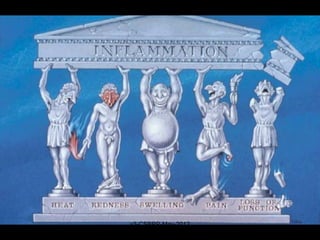
Events are reflected clinically by
 Cardinal signs of inflammation

            •    Rubor
            •    Calor
            •    Dolar
            •    Tumor
            •    Loss of function


                v3-CSBRP-May-2012
Chemical Mediators
 of Inflammation


      v3-CSBRP-May-2012
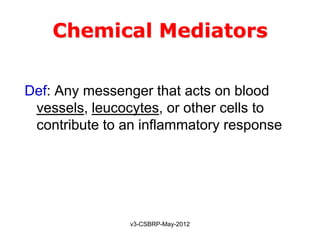
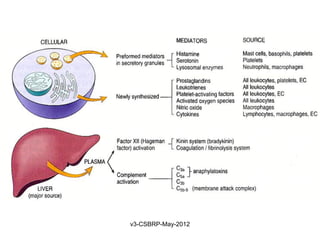
Chemical Mediators

Def: Any messenger that acts on blood
 vessels, leucocytes, or other cells to
 contribute to an inflammatory response


               v3-CSBRP-May-2012
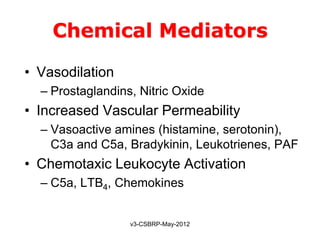
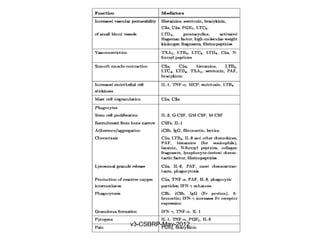
Chemical Mediators

• Vasodilation
  – Prostaglandins, Nitric Oxide
• Increased Vascular Permeability
  – Vasoactive amines (histamine, serotonin),
    C3a and C5a, Bradykinin, Leukotrienes, PAF
• Chemotaxic Leukocyte Activation
  – C5a, LTB4, Chemokines


                  v3-CSBRP-May-2012
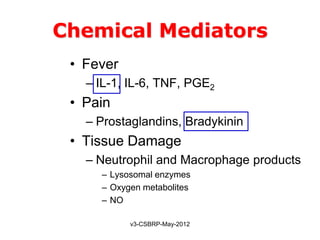
Chemical Mediators
 • Fever
   – IL-1, IL-6, TNF, PGE2
 • Pain
   – Prostaglandins, Bradykinin
 • Tissue Damage
   – Neutrophil and Macrophage products
     – Lysosomal enzymes
     – Oxygen metabolites
     – NO

           v3-CSBRP-May-2012
Chemical Mediators
General properties:

• They are generated from:
     Cells
     Plasma proteins

• Mediators are produced in response to various stimuli

• One mediator can stimulate the release of other
  [Guarantees amplification and maintenance of inflammatory response]

• Mediators vary in their range of cellular targets

• Majority are short-lived [Short t ½ and are harmful]
                           v3-CSBRP-May-2012
v3-CSBRP-May-2012
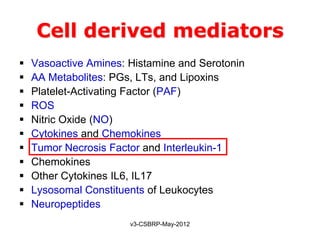
Cell derived mediators
   Vasoactive Amines: Histamine and Serotonin
   AA Metabolites: PGs, LTs, and Lipoxins
   Platelet-Activating Factor (PAF)
   ROS
   Nitric Oxide (NO)
   Cytokines and Chemokines
   Tumor Necrosis Factor and Interleukin-1
   Chemokines
   Other Cytokines IL6, IL17
   Lysosomal Constituents of Leukocytes
   Neuropeptides
                       v3-CSBRP-May-2012
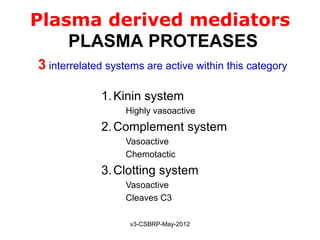
Plasma derived mediators
    PLASMA PROTEASES
3 interrelated systems are active within this category

             1. Kinin system
                   Highly vasoactive
             2. Complement system
                   Vasoactive
                   Chemotactic
             3. Clotting system
                   Vasoactive
                   Cleaves C3

                    v3-CSBRP-May-2012
Cell derived mediators
   Vasoactive Amines: Histamine and Serotonin
   AA Metabolites: PGs, LTs, and Lipoxins
   Platelet-Activating Factor (PAF)
   ROS
   Nitric Oxide (NO)
   Cytokines and Chemokines
   Tumor Necrosis Factor and Interleukin-1
   Chemokines
   Other Cytokines IL6, IL17
   Lysosomal Constituents of Leukocytes
   Neuropeptides
                       v3-CSBRP-May-2012
Cell derived mediators
Vasoactive Amines: Histamine and Serotonin
• Increase Vascular Permeability
• Histamine and Serotonin
   Mediators in the immediate active phase of
   increased permeability
    – Promotes contraction of smooth muscle
    – Stimulates to cells to produce eotaxins


                    v3-CSBRP-May-2012
Cell derived mediators
Vasoactive Amines: Histamine and Serotonin
• Releasing Stimulators
  – Direct physical or chemical injury
  – Binding of IgE- Ag- complexes
  – Fragments of C3a and C5a
  – Histamine releasing factors (pmn’s and θ)
  – Cytokines (IL-1, IL-8)
  – Neuropeptides

                   v3-CSBRP-May-2012
ARACHIDONIC ACID
              METABOLITES
• Roles in many biologic and           • Via activation of cellular
  pathologic processes                   phospholipases
   – Inflammation                              – By mechanical, chemical
• 20-carbon polyunsaturated                      and physical stimuli or by
                                                 other mediators
  fatty acid
   – Derived directly from dietary     • 2 major pathways
     sources or by conversion of               – Cyclooxygenase pathway
     essential fatty acid linoleic             – Lipoxygenase pathway.
     acid
• Esterified in membrane
  phospholipids
   – Must first be released from
     phospholipids

                           v3-CSBRP-May-2012
v3-CSBRP-May-2012
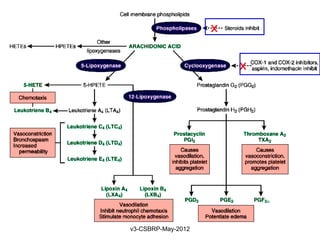
CYCLOOXYGENASE PATHWAY
• 2 cyclooxygenase enzymes
  – COX-1
  – COX-2
• 3 important products
  – Thromboxane A2
    – Aggregates platelets and causes vasoconstriction
  – Prostacyclin (PGI2)
    – Endothelial cells inhibits platelet aggregation and causes
      vasodilation
  – Prostaglandins PGE2, PGF2 and PGD2
    – Variety of actions on vascular tone and permeability

                        v3-CSBRP-May-2012
LIPOXYGENASE PATHWAY
Leukotrienes - LT
• LT B4 is a potent chemotactic agent
• Leukotrienes C4, D4, E4
  – Potent vasoconstrictors
  – Potent mediators of increased vascular
    permeability on venules only
  – Up to 1000 times as potent as histamine in
    producing increased vascular permeability

                   v3-CSBRP-May-2012
NOTE:
 Some anti-inflammatory drugs interfere
  with arachidonic acid metabolism
   – Corticosteroids interfere with phospholipase
   – Aspirin interferes with cyclooxygenase


                   v3-CSBRP-May-2012
PLATELET ACTIVATING
           FACTOR - PAF

•   Aggregate platelets and cause release
•   Bronchoconstriction and Vasoconstriction
•   ↑ vascular permeability
•   ↑ leukocyte adhesion
•   Leukocyte chemotaxis


                   v3-CSBRP-May-2012
CYTOKINES

• Transmitters for cell-to-cell chatting
  – Modulate cell function
• Primarily from activated macrophages and
  lymphocytes
• IL-1, IL-8, TNF


                   v3-CSBRP-May-2012
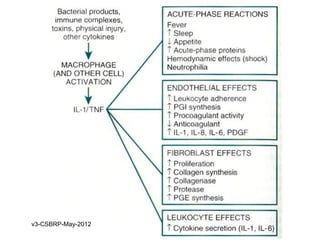
IL-I and TNF
“Master Cytokines”
• Origin
    – Monocytes
    – Macrophages
•   Similar in action
•   Endothelium
•   Acute phase proteins
•   Fibroblasts
       v3-CSBRP-May-2012
v3-CSBRP-May-2012
Other Cytokines
• IL-5
  – Eosinophils
• IL-6
  – B and T cells
• IL-8
  – Neutrophils
  – Lesser degree monocytes and eosinophils


                    v3-CSBRP-May-2012
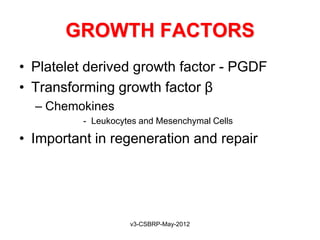
GROWTH FACTORS
• Platelet derived growth factor - PGDF
• Transforming growth factor β
  – Chemokines
          - Leukocytes and Mesenchymal Cells

• Important in regeneration and repair


                    v3-CSBRP-May-2012
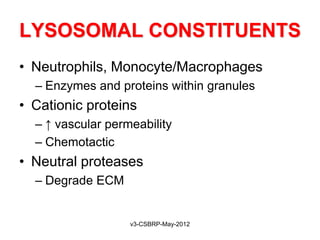
LYSOSOMAL CONSTITUENTS
• Neutrophils, Monocyte/Macrophages
  – Enzymes and proteins within granules
• Cationic proteins
  – ↑ vascular permeability
  – Chemotactic
• Neutral proteases
  – Degrade ECM


                   v3-CSBRP-May-2012
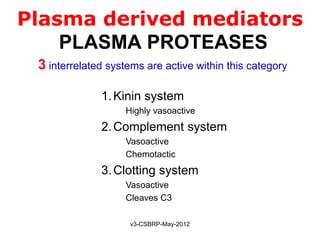
Plasma derived mediators
    PLASMA PROTEASES
 3 interrelated systems are active within this category

              1. Kinin system
                    Highly vasoactive
              2. Complement system
                    Vasoactive
                    Chemotactic
              3. Clotting system
                    Vasoactive
                    Cleaves C3

                     v3-CSBRP-May-2012
v3-CSBRP-May-2012
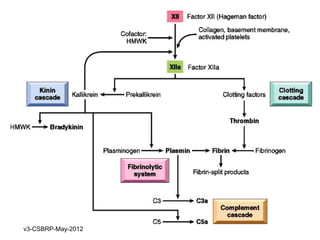
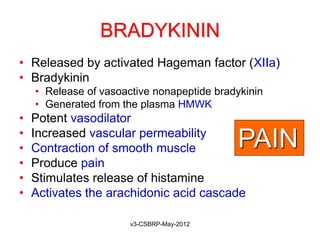
BRADYKININ
• Released by activated Hageman factor (XIIa)
• Bradykinin
    • Release of vasoactive nonapeptide bradykinin
    • Generated from the plasma HMWK
•   Potent vasodilator
•   Increased vascular permeability
•   Contraction of smooth muscle            PAIN
•   Produce pain
•   Stimulates release of histamine
•   Activates the arachidonic acid cascade

                       v3-CSBRP-May-2012
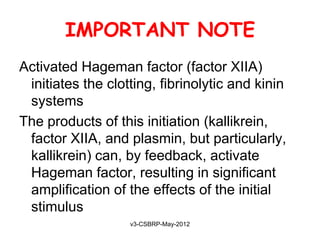
IMPORTANT NOTE
Activated Hageman factor (factor XIIA)
 initiates the clotting, fibrinolytic and kinin
 systems
The products of this initiation (kallikrein,
 factor XIIA, and plasmin, but particularly,
 kallikrein) can, by feedback, activate
 Hageman factor, resulting in significant
 amplification of the effects of the initial
 stimulus
                   v3-CSBRP-May-2012
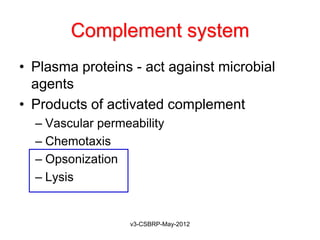
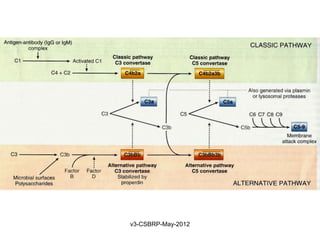
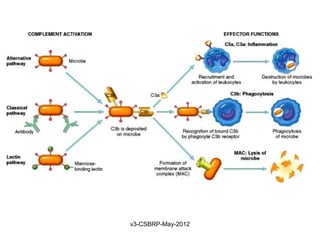
Complement system
• Plasma proteins - act against microbial
  agents
• Products of activated complement
  – Vascular permeability
  – Chemotaxis
  – Opsonization
  – Lysis


                  v3-CSBRP-May-2012
v3-CSBRP-May-2012
v3-CSBRP-May-2012
v3-CSBRP-May-2012
v3-CSBRP-May-2012
END


v3-CSBRP-May-2012
v3-CSBRP-May-2012

Inflammation 5

  • 1.
    Inflammation and Repair -5 Dr.CSBR.Prasad, M.D. v3-CSBRP-May-2012
  • 2.
    Sequence of eventsin Inflammation Vascular Cellular • Vasodilation • Margination • Increased vascular • Rolling permeability • Adhesion • Diapedesis • Chemotaxis • Phagocytosis • Killing & degradation v3-CSBRP-May-2012
  • 3.
    Events are reflectedclinically by Cardinal signs of inflammation • Rubor • Calor • Dolar • Tumor • Loss of function v3-CSBRP-May-2012
  • 4.
    Chemical Mediators ofInflammation v3-CSBRP-May-2012
  • 5.
    Chemical Mediators Def: Anymessenger that acts on blood vessels, leucocytes, or other cells to contribute to an inflammatory response v3-CSBRP-May-2012
  • 6.
    Chemical Mediators • Vasodilation – Prostaglandins, Nitric Oxide • Increased Vascular Permeability – Vasoactive amines (histamine, serotonin), C3a and C5a, Bradykinin, Leukotrienes, PAF • Chemotaxic Leukocyte Activation – C5a, LTB4, Chemokines v3-CSBRP-May-2012
  • 7.
    Chemical Mediators •Fever – IL-1, IL-6, TNF, PGE2 • Pain – Prostaglandins, Bradykinin • Tissue Damage – Neutrophil and Macrophage products – Lysosomal enzymes – Oxygen metabolites – NO v3-CSBRP-May-2012
  • 8.
    Chemical Mediators General properties: •They are generated from: Cells Plasma proteins • Mediators are produced in response to various stimuli • One mediator can stimulate the release of other [Guarantees amplification and maintenance of inflammatory response] • Mediators vary in their range of cellular targets • Majority are short-lived [Short t ½ and are harmful] v3-CSBRP-May-2012
  • 9.
  • 10.
    Cell derived mediators  Vasoactive Amines: Histamine and Serotonin  AA Metabolites: PGs, LTs, and Lipoxins  Platelet-Activating Factor (PAF)  ROS  Nitric Oxide (NO)  Cytokines and Chemokines  Tumor Necrosis Factor and Interleukin-1  Chemokines  Other Cytokines IL6, IL17  Lysosomal Constituents of Leukocytes  Neuropeptides v3-CSBRP-May-2012
  • 11.
    Plasma derived mediators PLASMA PROTEASES 3 interrelated systems are active within this category 1. Kinin system Highly vasoactive 2. Complement system Vasoactive Chemotactic 3. Clotting system Vasoactive Cleaves C3 v3-CSBRP-May-2012
  • 12.
    Cell derived mediators  Vasoactive Amines: Histamine and Serotonin  AA Metabolites: PGs, LTs, and Lipoxins  Platelet-Activating Factor (PAF)  ROS  Nitric Oxide (NO)  Cytokines and Chemokines  Tumor Necrosis Factor and Interleukin-1  Chemokines  Other Cytokines IL6, IL17  Lysosomal Constituents of Leukocytes  Neuropeptides v3-CSBRP-May-2012
  • 13.
    Cell derived mediators VasoactiveAmines: Histamine and Serotonin • Increase Vascular Permeability • Histamine and Serotonin Mediators in the immediate active phase of increased permeability – Promotes contraction of smooth muscle – Stimulates to cells to produce eotaxins v3-CSBRP-May-2012
  • 14.
    Cell derived mediators VasoactiveAmines: Histamine and Serotonin • Releasing Stimulators – Direct physical or chemical injury – Binding of IgE- Ag- complexes – Fragments of C3a and C5a – Histamine releasing factors (pmn’s and θ) – Cytokines (IL-1, IL-8) – Neuropeptides v3-CSBRP-May-2012
  • 15.
    ARACHIDONIC ACID METABOLITES • Roles in many biologic and • Via activation of cellular pathologic processes phospholipases – Inflammation – By mechanical, chemical • 20-carbon polyunsaturated and physical stimuli or by other mediators fatty acid – Derived directly from dietary • 2 major pathways sources or by conversion of – Cyclooxygenase pathway essential fatty acid linoleic – Lipoxygenase pathway. acid • Esterified in membrane phospholipids – Must first be released from phospholipids v3-CSBRP-May-2012
  • 16.
  • 17.
    CYCLOOXYGENASE PATHWAY • 2cyclooxygenase enzymes – COX-1 – COX-2 • 3 important products – Thromboxane A2 – Aggregates platelets and causes vasoconstriction – Prostacyclin (PGI2) – Endothelial cells inhibits platelet aggregation and causes vasodilation – Prostaglandins PGE2, PGF2 and PGD2 – Variety of actions on vascular tone and permeability v3-CSBRP-May-2012
  • 18.
    LIPOXYGENASE PATHWAY Leukotrienes -LT • LT B4 is a potent chemotactic agent • Leukotrienes C4, D4, E4 – Potent vasoconstrictors – Potent mediators of increased vascular permeability on venules only – Up to 1000 times as potent as histamine in producing increased vascular permeability v3-CSBRP-May-2012
  • 19.
    NOTE: Some anti-inflammatorydrugs interfere with arachidonic acid metabolism – Corticosteroids interfere with phospholipase – Aspirin interferes with cyclooxygenase v3-CSBRP-May-2012
  • 20.
    PLATELET ACTIVATING FACTOR - PAF • Aggregate platelets and cause release • Bronchoconstriction and Vasoconstriction • ↑ vascular permeability • ↑ leukocyte adhesion • Leukocyte chemotaxis v3-CSBRP-May-2012
  • 21.
    CYTOKINES • Transmitters forcell-to-cell chatting – Modulate cell function • Primarily from activated macrophages and lymphocytes • IL-1, IL-8, TNF v3-CSBRP-May-2012
  • 22.
    IL-I and TNF “MasterCytokines” • Origin – Monocytes – Macrophages • Similar in action • Endothelium • Acute phase proteins • Fibroblasts v3-CSBRP-May-2012
  • 23.
  • 24.
    Other Cytokines • IL-5 – Eosinophils • IL-6 – B and T cells • IL-8 – Neutrophils – Lesser degree monocytes and eosinophils v3-CSBRP-May-2012
  • 25.
    GROWTH FACTORS • Plateletderived growth factor - PGDF • Transforming growth factor β – Chemokines - Leukocytes and Mesenchymal Cells • Important in regeneration and repair v3-CSBRP-May-2012
  • 26.
    LYSOSOMAL CONSTITUENTS • Neutrophils,Monocyte/Macrophages – Enzymes and proteins within granules • Cationic proteins – ↑ vascular permeability – Chemotactic • Neutral proteases – Degrade ECM v3-CSBRP-May-2012
  • 27.
    Plasma derived mediators PLASMA PROTEASES 3 interrelated systems are active within this category 1. Kinin system Highly vasoactive 2. Complement system Vasoactive Chemotactic 3. Clotting system Vasoactive Cleaves C3 v3-CSBRP-May-2012
  • 28.
  • 29.
    BRADYKININ • Released byactivated Hageman factor (XIIa) • Bradykinin • Release of vasoactive nonapeptide bradykinin • Generated from the plasma HMWK • Potent vasodilator • Increased vascular permeability • Contraction of smooth muscle PAIN • Produce pain • Stimulates release of histamine • Activates the arachidonic acid cascade v3-CSBRP-May-2012
  • 30.
    IMPORTANT NOTE Activated Hagemanfactor (factor XIIA) initiates the clotting, fibrinolytic and kinin systems The products of this initiation (kallikrein, factor XIIA, and plasmin, but particularly, kallikrein) can, by feedback, activate Hageman factor, resulting in significant amplification of the effects of the initial stimulus v3-CSBRP-May-2012
  • 31.
    Complement system • Plasmaproteins - act against microbial agents • Products of activated complement – Vascular permeability – Chemotaxis – Opsonization – Lysis v3-CSBRP-May-2012
  • 32.
  • 33.
  • 34.
  • 35.
  • 36.
  • 37.