CHEMICAL
MEDIATORS
DR.N.MANJULA
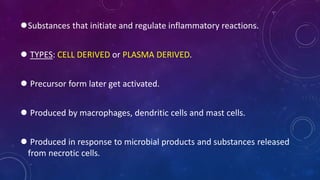
Substances that initiate and regulate inflammatory reactions.
 TYPES: CELL DERIVED or PLASMA DERIVED.
 Precursor form later get activated.
 Produced by macrophages, dendritic cells and mast cells.
 Produced in response to microbial products and substances released
from necrotic cells.
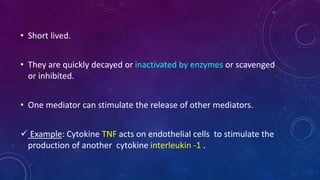
• Short lived.
• They are quickly decayed or inactivated by enzymes or scavenged
or inhibited.
• One mediator can stimulate the release of other mediators.
 Example: Cytokine TNF acts on endothelial cells to stimulate the
production of another cytokine interleukin -1 .
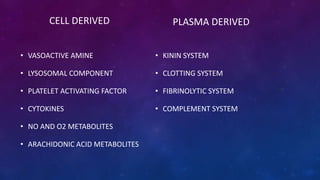
CELL DERIVED
• VASOACTIVE AMINE
• LYSOSOMAL COMPONENT
• PLATELET ACTIVATING FACTOR
• CYTOKINES
• NO AND O2 METABOLITES
• ARACHIDONIC ACID METABOLITES
PLASMA DERIVED
• KININ SYSTEM
• CLOTTING SYSTEM
• FIBRINOLYTIC SYSTEM
• COMPLEMENT SYSTEM
CELL DERIVED MEDIATORS
• Intracellular granules.
 Rapidly secreted by granule exocytosis.
• EXAMPLE: Histamine from Mast cell granules .
Synthesized de novo.
• EXAMPLE: prostaglandin , leukotrienes , cytokines in response to a
stimulus.
PLASMA DERIVED MEDIATORS
• Complement proteins -produced in liver.
• Present in the circulation - inactive precursors.
• Activated by proteolytic cleavage.
• Then acquires their biologic properties.
VASOACTIVE AMINES
• Major action on blood vessels.
• Stored as preformed molecules in cells.
• First mediators to be released during inflammation.
• Mast cells are the richest source of histamine .
• It is also found in blood basophils and platelets.
• Histamine stored in mast cell granules are release by
degranulation in response to various stimuli:
1. Physical injuries such as trauma cold heat
2. Antibody mediated hypersensitivity allergic reaction
3. Complement products C3a, C5a [ anaphylatoxin ]
4. Neuropeptides [substance P]
5. Cytokines [ interleukin 1 interleukin 8]
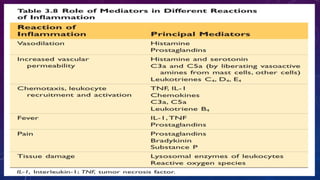
• Histamine causes dilation of arteriole and increases the permeability of
venule.
• It increases vascular permeability by producing interendothelial gap in
venule.
• It acts via H1 receptors present on microvascular endothelial cells.
• Anti histamine used to treat inflammatory reactions such as allergy.
• It also causes contraction of some smooth muscles.
SEROTONIN 5 - HYDROXYTRYPTAMINE
• It is preformed mediator
• It is present in platelets and certain neuroendocrine cells GIT.
• The primary function as a neurotransmitter is vasoconstrictor.
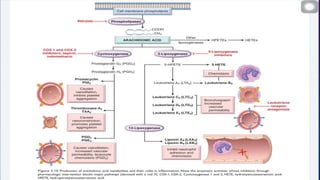
ARACHIDONIC ACID METABOLITES
• Prostaglandins and leukotrienes are produced from arachidonic
acid(AA) present in membrane phospholipids.
• Stimulate vascular and cellular reactions in acute inflammation.
• Phospholipase A2 activation occur via increase in cytosolic calcium.
• AA derived mediators are called as eicosanoids.
• Synthesized from two major classes of enzymes:
① Cyclooxygenase which generates prostaglandin.
② Lipoxygenase which produce leukotrienes and lipoxins .
PROSTAGLANDIN
• Produced by mast cells , macrophages and endothelial cells.
• Cox 1 and Cox 2 pathways are involved in synthesis of
prostaglandin.
• Prostaglandin are divided into series based on structural features.
• The most important ones in inflammation are:-
• PGE2 , PGD2 , PGF2alpha , PGE2 , TXA2 .
THROMBOXANE A2
• Derived by action of thromboxane synthase present in platelets.
• Function: 1.platelet aggregation
2.vaso constriction.
• It is unstable and converted to inactive form TxB2.
PROSTACYCLIN (PGI2)
• Formed by action of prostacyclin synthase present in vascular
endothelium.
• It is the stable end product of PGF1alpha.
• Functions:
1. Vasodilator.
2. Potent inhibitor of platelet aggregation.
3. Increases vascular permeability by increasing the
chemo tactic effect of other mediators.
• PGD2: produced by mast cells along with PGE2.
• Causes vasodilation and increases the permeability of post capillary
venules, thus potentiating edema formation.
• It is a chemoattractant for neutrophils.
• PGF2alpha: stimulates contraction of uterine and bronchial smooth
muscle and small arterioles.
• PGE2: It is hyperalgesic and makes the skin hypersensitive to painful
stimuli.
• In addition prostaglandins are involved in pathogenesis of pain and
fever in inflammation.
LEUKOTRIENE AND LIPOXIN
• Produced by leukocytes and mast cells by the action of
Lipoxygenase.
• It is involved in vascular and smooth muscle reactions and
leukocyte recruitment.
 Types of lipo oxygenase:
 5-lipoxygenase - chemotactic for neutrophils
LTB4 - chemotactic and neutrophil activator.
• Aggregation and adhesion of cells to venular endothelium.
• Generation of reactive oxygen species.
• Release of lysosomal enzymes.
CYSTEINYL CONTAINING LEUKOTRIENES
 LTC4, LTD4, LTE4 causes intense vasoconstriction ,
bronchospasm (Br.asthma) and increase the permeability
of venules.
• Leukotrienes are more potent than histamine in increasing
the vascular permeability and causing bronchospasm.
LIPOXINS
• Generated from archidonic acid by the Lipoxygenase pathway.
• It suppresses the inflammation by inhibiting recruitment of
leukocytes.
• Inhibit neutrophil chemotaxis and adhesion to endothelium.
CYTOKINE AND CHEMOKINE
• CYTOKINE are proteins produced by activated lymphocytes,
macrophages, dendritic cells and endothelial cells.
• Mediate and regulate immune and inflammatory reactions.
TUMOR NECROSIS FACTOR AND INTERLEUKIN 1
ROLES OF CYTOKINES IN INFLAMMATION
• Endothelial activation by TNF and interleukin 1.
• Increased expression of adhesion molecules (P and E selectins)
and ligands for leukocytes integrity.
• Increase the production of various mediators -other cytokine ,
chemokine , growth factors and eicosanoids.
• Increased procoagulant activity of the endothelium.
• Activation of leukocytes - stimulates microbicidal activity of
macrophages.
• Induce production of NO.
• IL1 - Activates fibroblasts to synthesise collagen.
• Systemic acute phase response induced by interleukin 1, TNF ,
interleukin 6 are associated with infection , injury , fever.
CHEMOKINE
• Chemokines are family of small (8 to 10 kilodalton) protein.
• Acts primarily as chemo attractants for specific type of leukocytes.
• About 40 different chemokines and 20 different receptors for
chemokines have been identified.
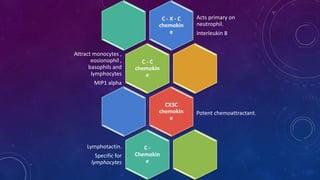
C - X - C
chemokin
e
Acts primary on
neutrophil.
Interleukin 8
C - C
chemokin
e
Attract monocytes ,
eosionophil ,
basophils and
lymphocytes
MIP1 alpha
CX3C
chemokin
e
C -
Chemokin
e
Lymphotactin.
Specific for
lymphocytes
Potent chemoattractant.
• Functions of chemokines:-
 In acute inflammation
• Stimulates leukocyte attachment to endothelium by increasing the affinity
of integrins.
• Chemotaxis.(migration of leucocytes).
 Maintenance of tissue architecture.
• Hemostatic chemokine.
• These organize T and B lymphocytes in discrete areas of spleen and lymph
nodes.
OTHER CYTOKINES IN ACUTE INFLAMMATION
• Interleukin 6 - secreted by macrophages involved in local and systemic
reaction
• Interleukin 17 - produced by T lymphocytes promotes neutrophil
recruitment
• Antagonist for both efficacious in treatment of inflammatory diseases.
• Type 1 interferon - some systemic manifestations(normally inhibits viral
replication).
COMPLEMENT SYSTEM
• The complement system is the collection of soluble proteins and
membrane receptors, that function mainly in host defence against
microbes and in pathologic inflammatory reactions.
• The system consists of more than 20 proteins some of which are
numbered from C1 to C9
• Functions in both innate and adaptive immunity.
• Complement proteins are present in inactive forms in the plasma .
• The critical step in complement activation is the proteolysis of third
component C3.
• Cleavage of C3 which can occur by one of the three ways:
• Classical pathway triggered by fixation of C1 to antibody ( IgM or IgG )
that has combined with antigen.
• Alternative pathway triggered by microbial surface molecules example
(endotoxin or LPS) , complex polysaccharide , Cobra venom and other
substance in the absence of antibody .
• The Lectin pathway plasma mannose-binding lectin binds to
carbohydrates on microbes and directly activates C1.
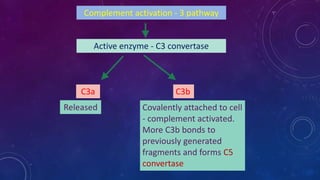
Complement activation - 3 pathway
Active enzyme - C3 convertase
C3a C3b
Released Covalently attached to cell
- complement activated.
More C3b bonds to
previously generated
fragments and forms C5
convertase
C5 convertase
Cleaves C5 into
C5a released C5b - attached to cell surface
C5b binds to late
components(C6 to C9). Thus
forming membrane attack
complex[composed of
multiple C9 molecules].
FUNCTIONS OF COMPLEMENT SYSTEM
• Inflammation:- C3a , C5a , C4a - stimulate histamine release.
• They are called anaphylatoxins.
• C5a chemotactic to neutrophils, monocytes, eosinophil, basophils.
• Activates Lipoxygenase pathway.
• Opsonization and phagocytosis:- C3b, inactive C3b acts as poisonings
and promotes phagocytosis by macrophages.
• Cell lysis :- deposition of MAC on cells makes these cells permeable to
water and ions and result in death of the cell by lysis.NEISSERIA BACTERIA.
• The activation of complement is tightly controlled by cell associated and
circulating regulatory proteins:
• C1 inhibitor - block C1 activation.
• Inherited deficiency of this inhibitor is the cause of hereditary
angioedema .
• Decay accelerating factor ( DAF) and CD 59
• DAF inhibits C3 convertase formation .
• CD59 inhibits formation of membrane attack complex.(MAC)
• An acquired deficiency leads to PNH.(PAROXYSMAL NOCTURNAL
HEMOGLOBINURIA)
OTHER MEDIATORS OF INFLAMMATION
• Platelet activating factor - phospholipid derived mediator .
• Secreted by platelets , basophil , mast cell , neutrophil ,
macrophage and endothelial cell.
• It causes platelet aggregation , vasoconstriction and
bronchoconstriction.
• At low concentration it induces vasodilation and increased
venular permeability
PRODUCTS OF COAGULATION
• Protease activated receptors (PAR) activated by thrombus cleaves
fibrinogen to fibrin and forms clot .
• It is expressed on platelets and leukocytes.
• The major role of PAR is platelet activation during clotting.
• Inflammation causes changes in endothelial cells that increase
abnormal clotting THROMBOSIS.
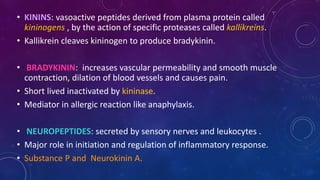
• KININS: vasoactive peptides derived from plasma protein called
kininogens , by the action of specific proteases called kallikreins.
• Kallikrein cleaves kininogen to produce bradykinin.
• BRADYKININ: increases vascular permeability and smooth muscle
contraction, dilation of blood vessels and causes pain.
• Short lived inactivated by kininase.
• Mediator in allergic reaction like anaphylaxis.
• NEUROPEPTIDES: secreted by sensory nerves and leukocytes .
• Major role in initiation and regulation of inflammatory response.
• Substance P and Neurokinin A.
Substance P - prominent in nerve fibres in lungs and GIT.
 Functions :-
• Transmission of pain signals.
• Regulation of blood pressure.
• Stimulation of hormone secretion by endocrine cells.
• Increasing vascular permeability.
OUTCOMES OF ACUTE INFLAMMATION
Resolution:
• It is the process of complete return of tissue architecture to
normal following acute inflammation.
• It occurs:-
• When the injury is limited or short-lived
• With no or minimal tissue damage
• When injured tissue is capable of regeneration.
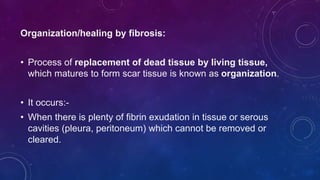
Organization/healing by fibrosis:
• Process of replacement of dead tissue by living tissue,
which matures to form scar tissue is known as organization.
• It occurs:-
• When there is plenty of fibrin exudation in tissue or serous
cavities (pleura, peritoneum) which cannot be removed or
cleared.
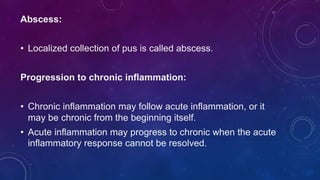
Abscess:
• Localized collection of pus is called abscess.
Progression to chronic inflammation:
• Chronic inflammation may follow acute inflammation, or it
may be chronic from the beginning itself.
• Acute inflammation may progress to chronic when the acute
inflammatory response cannot be resolved.
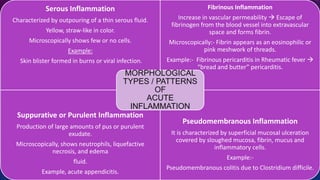
Serous Inflammation
Characterized by outpouring of a thin serous fluid.
Yellow, straw-like in color.
Microscopically shows few or no cells.
Example:
Skin blister formed in burns or viral infection.
Fibrinous Inflammation
Increase in vascular permeability  Escape of
fibrinogen from the blood vessel into extravascular
space and forms fibrin.
Microscopically:- Fibrin appears as an eosinophilic or
pink meshwork of threads.
Example:- Fibrinous pericarditis in Rheumatic fever 
“bread and butter” pericarditis.
Suppurative or Purulent Inflammation
Production of large amounts of pus or purulent
exudate.
Microscopically, shows neutrophils, liquefactive
necrosis, and edema
fluid.
Example, acute appendicitis.
Pseudomembranous Inflammation
It is characterized by superficial mucosal ulceration
covered by sloughed mucosa, fibrin, mucus and
inflammatory cells.
Example:-
Pseudomembranous colitis due to Clostridium difficile.
MORPHOLOGICAL
TYPES / PATTERNS
OF
ACUTE
INFLAMMATION
THANK YOU

chemical mediators AHS cls.pptx

  • 1.
  • 2.
    Substances that initiateand regulate inflammatory reactions.  TYPES: CELL DERIVED or PLASMA DERIVED.  Precursor form later get activated.  Produced by macrophages, dendritic cells and mast cells.  Produced in response to microbial products and substances released from necrotic cells.
  • 3.
    • Short lived. •They are quickly decayed or inactivated by enzymes or scavenged or inhibited. • One mediator can stimulate the release of other mediators.  Example: Cytokine TNF acts on endothelial cells to stimulate the production of another cytokine interleukin -1 .
  • 4.
    CELL DERIVED • VASOACTIVEAMINE • LYSOSOMAL COMPONENT • PLATELET ACTIVATING FACTOR • CYTOKINES • NO AND O2 METABOLITES • ARACHIDONIC ACID METABOLITES PLASMA DERIVED • KININ SYSTEM • CLOTTING SYSTEM • FIBRINOLYTIC SYSTEM • COMPLEMENT SYSTEM
  • 5.
    CELL DERIVED MEDIATORS •Intracellular granules.  Rapidly secreted by granule exocytosis. • EXAMPLE: Histamine from Mast cell granules . Synthesized de novo. • EXAMPLE: prostaglandin , leukotrienes , cytokines in response to a stimulus.
  • 6.
    PLASMA DERIVED MEDIATORS •Complement proteins -produced in liver. • Present in the circulation - inactive precursors. • Activated by proteolytic cleavage. • Then acquires their biologic properties.
  • 7.
    VASOACTIVE AMINES • Majoraction on blood vessels. • Stored as preformed molecules in cells. • First mediators to be released during inflammation. • Mast cells are the richest source of histamine . • It is also found in blood basophils and platelets.
  • 8.
    • Histamine storedin mast cell granules are release by degranulation in response to various stimuli: 1. Physical injuries such as trauma cold heat 2. Antibody mediated hypersensitivity allergic reaction 3. Complement products C3a, C5a [ anaphylatoxin ] 4. Neuropeptides [substance P] 5. Cytokines [ interleukin 1 interleukin 8]
  • 9.
    • Histamine causesdilation of arteriole and increases the permeability of venule. • It increases vascular permeability by producing interendothelial gap in venule. • It acts via H1 receptors present on microvascular endothelial cells. • Anti histamine used to treat inflammatory reactions such as allergy. • It also causes contraction of some smooth muscles.
  • 10.
    SEROTONIN 5 -HYDROXYTRYPTAMINE • It is preformed mediator • It is present in platelets and certain neuroendocrine cells GIT. • The primary function as a neurotransmitter is vasoconstrictor.
  • 11.
    ARACHIDONIC ACID METABOLITES •Prostaglandins and leukotrienes are produced from arachidonic acid(AA) present in membrane phospholipids. • Stimulate vascular and cellular reactions in acute inflammation. • Phospholipase A2 activation occur via increase in cytosolic calcium.
  • 13.
    • AA derivedmediators are called as eicosanoids. • Synthesized from two major classes of enzymes: ① Cyclooxygenase which generates prostaglandin. ② Lipoxygenase which produce leukotrienes and lipoxins .
  • 14.
    PROSTAGLANDIN • Produced bymast cells , macrophages and endothelial cells. • Cox 1 and Cox 2 pathways are involved in synthesis of prostaglandin. • Prostaglandin are divided into series based on structural features. • The most important ones in inflammation are:- • PGE2 , PGD2 , PGF2alpha , PGE2 , TXA2 .
  • 15.
    THROMBOXANE A2 • Derivedby action of thromboxane synthase present in platelets. • Function: 1.platelet aggregation 2.vaso constriction. • It is unstable and converted to inactive form TxB2.
  • 16.
    PROSTACYCLIN (PGI2) • Formedby action of prostacyclin synthase present in vascular endothelium. • It is the stable end product of PGF1alpha. • Functions: 1. Vasodilator. 2. Potent inhibitor of platelet aggregation. 3. Increases vascular permeability by increasing the chemo tactic effect of other mediators.
  • 17.
    • PGD2: producedby mast cells along with PGE2. • Causes vasodilation and increases the permeability of post capillary venules, thus potentiating edema formation. • It is a chemoattractant for neutrophils.
  • 18.
    • PGF2alpha: stimulatescontraction of uterine and bronchial smooth muscle and small arterioles. • PGE2: It is hyperalgesic and makes the skin hypersensitive to painful stimuli. • In addition prostaglandins are involved in pathogenesis of pain and fever in inflammation.
  • 19.
    LEUKOTRIENE AND LIPOXIN •Produced by leukocytes and mast cells by the action of Lipoxygenase. • It is involved in vascular and smooth muscle reactions and leukocyte recruitment.  Types of lipo oxygenase:  5-lipoxygenase - chemotactic for neutrophils
  • 20.
    LTB4 - chemotacticand neutrophil activator. • Aggregation and adhesion of cells to venular endothelium. • Generation of reactive oxygen species. • Release of lysosomal enzymes.
  • 21.
    CYSTEINYL CONTAINING LEUKOTRIENES LTC4, LTD4, LTE4 causes intense vasoconstriction , bronchospasm (Br.asthma) and increase the permeability of venules. • Leukotrienes are more potent than histamine in increasing the vascular permeability and causing bronchospasm.
  • 22.
    LIPOXINS • Generated fromarchidonic acid by the Lipoxygenase pathway. • It suppresses the inflammation by inhibiting recruitment of leukocytes. • Inhibit neutrophil chemotaxis and adhesion to endothelium.
  • 23.
    CYTOKINE AND CHEMOKINE •CYTOKINE are proteins produced by activated lymphocytes, macrophages, dendritic cells and endothelial cells. • Mediate and regulate immune and inflammatory reactions.
  • 24.
    TUMOR NECROSIS FACTORAND INTERLEUKIN 1
  • 25.
    ROLES OF CYTOKINESIN INFLAMMATION • Endothelial activation by TNF and interleukin 1. • Increased expression of adhesion molecules (P and E selectins) and ligands for leukocytes integrity. • Increase the production of various mediators -other cytokine , chemokine , growth factors and eicosanoids. • Increased procoagulant activity of the endothelium.
  • 26.
    • Activation ofleukocytes - stimulates microbicidal activity of macrophages. • Induce production of NO. • IL1 - Activates fibroblasts to synthesise collagen. • Systemic acute phase response induced by interleukin 1, TNF , interleukin 6 are associated with infection , injury , fever.
  • 27.
    CHEMOKINE • Chemokines arefamily of small (8 to 10 kilodalton) protein. • Acts primarily as chemo attractants for specific type of leukocytes. • About 40 different chemokines and 20 different receptors for chemokines have been identified.
  • 28.
    C - X- C chemokin e Acts primary on neutrophil. Interleukin 8 C - C chemokin e Attract monocytes , eosionophil , basophils and lymphocytes MIP1 alpha CX3C chemokin e C - Chemokin e Lymphotactin. Specific for lymphocytes Potent chemoattractant.
  • 29.
    • Functions ofchemokines:-  In acute inflammation • Stimulates leukocyte attachment to endothelium by increasing the affinity of integrins. • Chemotaxis.(migration of leucocytes).  Maintenance of tissue architecture. • Hemostatic chemokine. • These organize T and B lymphocytes in discrete areas of spleen and lymph nodes.
  • 30.
    OTHER CYTOKINES INACUTE INFLAMMATION • Interleukin 6 - secreted by macrophages involved in local and systemic reaction • Interleukin 17 - produced by T lymphocytes promotes neutrophil recruitment • Antagonist for both efficacious in treatment of inflammatory diseases. • Type 1 interferon - some systemic manifestations(normally inhibits viral replication).
  • 31.
    COMPLEMENT SYSTEM • Thecomplement system is the collection of soluble proteins and membrane receptors, that function mainly in host defence against microbes and in pathologic inflammatory reactions. • The system consists of more than 20 proteins some of which are numbered from C1 to C9 • Functions in both innate and adaptive immunity. • Complement proteins are present in inactive forms in the plasma . • The critical step in complement activation is the proteolysis of third component C3.
  • 32.
    • Cleavage ofC3 which can occur by one of the three ways: • Classical pathway triggered by fixation of C1 to antibody ( IgM or IgG ) that has combined with antigen. • Alternative pathway triggered by microbial surface molecules example (endotoxin or LPS) , complex polysaccharide , Cobra venom and other substance in the absence of antibody . • The Lectin pathway plasma mannose-binding lectin binds to carbohydrates on microbes and directly activates C1.
  • 33.
    Complement activation -3 pathway Active enzyme - C3 convertase C3a C3b Released Covalently attached to cell - complement activated. More C3b bonds to previously generated fragments and forms C5 convertase
  • 34.
    C5 convertase Cleaves C5into C5a released C5b - attached to cell surface C5b binds to late components(C6 to C9). Thus forming membrane attack complex[composed of multiple C9 molecules].
  • 35.
    FUNCTIONS OF COMPLEMENTSYSTEM • Inflammation:- C3a , C5a , C4a - stimulate histamine release. • They are called anaphylatoxins. • C5a chemotactic to neutrophils, monocytes, eosinophil, basophils. • Activates Lipoxygenase pathway. • Opsonization and phagocytosis:- C3b, inactive C3b acts as poisonings and promotes phagocytosis by macrophages. • Cell lysis :- deposition of MAC on cells makes these cells permeable to water and ions and result in death of the cell by lysis.NEISSERIA BACTERIA.
  • 36.
    • The activationof complement is tightly controlled by cell associated and circulating regulatory proteins: • C1 inhibitor - block C1 activation. • Inherited deficiency of this inhibitor is the cause of hereditary angioedema . • Decay accelerating factor ( DAF) and CD 59 • DAF inhibits C3 convertase formation . • CD59 inhibits formation of membrane attack complex.(MAC) • An acquired deficiency leads to PNH.(PAROXYSMAL NOCTURNAL HEMOGLOBINURIA)
  • 37.
    OTHER MEDIATORS OFINFLAMMATION • Platelet activating factor - phospholipid derived mediator . • Secreted by platelets , basophil , mast cell , neutrophil , macrophage and endothelial cell. • It causes platelet aggregation , vasoconstriction and bronchoconstriction. • At low concentration it induces vasodilation and increased venular permeability
  • 38.
    PRODUCTS OF COAGULATION •Protease activated receptors (PAR) activated by thrombus cleaves fibrinogen to fibrin and forms clot . • It is expressed on platelets and leukocytes. • The major role of PAR is platelet activation during clotting. • Inflammation causes changes in endothelial cells that increase abnormal clotting THROMBOSIS.
  • 39.
    • KININS: vasoactivepeptides derived from plasma protein called kininogens , by the action of specific proteases called kallikreins. • Kallikrein cleaves kininogen to produce bradykinin. • BRADYKININ: increases vascular permeability and smooth muscle contraction, dilation of blood vessels and causes pain. • Short lived inactivated by kininase. • Mediator in allergic reaction like anaphylaxis. • NEUROPEPTIDES: secreted by sensory nerves and leukocytes . • Major role in initiation and regulation of inflammatory response. • Substance P and Neurokinin A.
  • 40.
    Substance P -prominent in nerve fibres in lungs and GIT.  Functions :- • Transmission of pain signals. • Regulation of blood pressure. • Stimulation of hormone secretion by endocrine cells. • Increasing vascular permeability.
  • 42.
    OUTCOMES OF ACUTEINFLAMMATION Resolution: • It is the process of complete return of tissue architecture to normal following acute inflammation. • It occurs:- • When the injury is limited or short-lived • With no or minimal tissue damage • When injured tissue is capable of regeneration.
  • 43.
    Organization/healing by fibrosis: •Process of replacement of dead tissue by living tissue, which matures to form scar tissue is known as organization. • It occurs:- • When there is plenty of fibrin exudation in tissue or serous cavities (pleura, peritoneum) which cannot be removed or cleared.
  • 44.
    Abscess: • Localized collectionof pus is called abscess. Progression to chronic inflammation: • Chronic inflammation may follow acute inflammation, or it may be chronic from the beginning itself. • Acute inflammation may progress to chronic when the acute inflammatory response cannot be resolved.
  • 45.
    Serous Inflammation Characterized byoutpouring of a thin serous fluid. Yellow, straw-like in color. Microscopically shows few or no cells. Example: Skin blister formed in burns or viral infection. Fibrinous Inflammation Increase in vascular permeability  Escape of fibrinogen from the blood vessel into extravascular space and forms fibrin. Microscopically:- Fibrin appears as an eosinophilic or pink meshwork of threads. Example:- Fibrinous pericarditis in Rheumatic fever  “bread and butter” pericarditis. Suppurative or Purulent Inflammation Production of large amounts of pus or purulent exudate. Microscopically, shows neutrophils, liquefactive necrosis, and edema fluid. Example, acute appendicitis. Pseudomembranous Inflammation It is characterized by superficial mucosal ulceration covered by sloughed mucosa, fibrin, mucus and inflammatory cells. Example:- Pseudomembranous colitis due to Clostridium difficile. MORPHOLOGICAL TYPES / PATTERNS OF ACUTE INFLAMMATION
  • 46.