Infectious Laryngotracheitis (ILT)
Disease Overview
Plan of Talk
 Introduction
 Etiology
 Epidemiology
 Clinical signs
 Diagnosis
 Prevention and control
Definition
 Infectious laryngotracheitis is a viral respiratory infection of
chickens that may result in severe economic losses as a result
of mortality and/or decreased egg production.
Geographical Distribution
 Although ILT is distributed world-wide, the disease may be
present only in certain localities within a country or
geographic region.
 The greatest incidence of disease is generally seen in areas of
highly intensive poultry production.
Historical Overview
1. ILT was first confirmed in 1925 in canada
2. Followed by the united states in 1926
3. Australia & Great Britain in 1935
4. Europe in 1940 (cover, 1996).
 By 1962, ILT was described in at least 40 countries in the FAO-
WHO-OIE Animal Health Yearbook (Pulsford, 1963).
Plan of Talk
 Introduction
 Etiology
 Epidemiology
 Clinical signs
 Diagnosis
 Prevention and control
Etiology
The disease is caused by Gallid herpesvirus I, commonly known
as infectious laryngotracheitis virus (ILTV).
Etiology
Strain Differentiation
Based on virus neutralization (VN), immunofluorescence (IF) and
cross-protection studies, ILTV strains are considered to be
antigenically homogeneous.
Cont. …
However, strains have been differentiated on the basis of:
1. Virulence for chickens or chicks.
2. Plaque size.
3. Morphology in cell cultures.
4. Pock size on the chorioallantoic membranes (CAMS) of
chicken embryos.
Etiology
Resistance to Chemical and Physical Agents
 In an in vitro environment, ILTV infectivity can be readily
inactivated by:
1. Low heat (e.g. 60°C for 15 minutes or less)
2. Freeze-thawing in a medium which is free of organic
materials or protein.
 Chemical disinfectants, such as coal tar derivatives, formalin,
hypochlorite and iodophors, effectively inactivate ILTV on
contact.
 ILTV in the laboratory is also susceptible to lipolytic solvents,
such as ether or chloroform, and to extremes of pH.
Cont. …
 In tracheal exudates and tissues, ILTV infectivity can persist for
weeks or months in enclosed poultry production
environments at relatively low temperatures (e.g. 10°C-20°C).
 However, the presence of 50% glycerol broth or sterile skim
milk will greatly increase the time of survival possible for ILTV
infectivity on swabs.
 However, putrefaction processes in the carcasses of dead
chickens will shorten ILTV survival.
Etiology
In vitro cultivation
Infectious laryngotracheitis virus can be grown in fertile chicken
eggs and several avian primary cell cultures.
Etiology
In vitro cultivation - CE Inoculation
Inoculation of the dropped CAM of eggs after incubation for 10-
12 days results in pock formation and embryo death between
two and twelve days post inoculation.
Etiology
In vitro cultivation - TC Inoculation
 The virus can be propagated in avian cell cultures derived
from Chick embryo (liver, lung, kidney and tissues) where the
typical cytopathic effect is syncytium formation.
 Chick embryo liver has been found to be the most sensitive
system for primary isolation of virus from clinical material.
Cont. …
 Chick embryo fibroblasts, Vero cells and cells of quail origin
have been shown to be relatively insensitive for ILTV growth
from field material.
Etiology
Virus Kinetics
 The target organs for ILTV infection and disease are the
respiratory tract, the epithelium of the trachea and larynx.
 Other mucous membranes such as the conjunctiva, as well as
respiratory sinuses, air sacs and lung tissue, may also become
infected periodically.
Etiology
Virus Kinetics - Acute Phase of Infection
During the first week of infection
 Active virus replication occurs only during this week
 Although low levels of ILTV infectivity can be detected
sporadically up to ten days post infection.
7-10 days after infection
 Chickens usually recover from primary ILT disease within 7-10
days of showing clinical signs.
 These are matching with active ILTV replication in the trachea.
Cont. …
10 days – 4 weeks after infection
 Shedding of infectious ILTV may have ceased
 Latent phase of infection is established through ILTV invasion
of nervous tissues.
Etiology
Latent infection
Onset of latent ('hidden') phase of ILTV infection
 Invasion of the trigeminal ganglion (TRG) by ILTV has been
found to occur from 3-6 days of acute phase of ILT infections
by field and vaccine strains.
 The latent infection starts from the immediate post-acute
phase of infection
 7-10 after tracheal exposure.
Cont. …
Route on latent infection
 The exact route of infection of the TRG is not known, but
thought to be the neural migration as this ganglion provides
the main sensory innervation to the tissues of the upper
respiratory tract, the mouth and the eyes.
 Williams et al. has confirmed, by PCR, that the tracheal
ganglion is the main site of ILTV latency.
Cont. …
Detecting latent infection
 Latent ILTV infections are not readily demonstrable during the
first few months after infection, probably reflecting initially
high levels of host immune control and surveillance.
 Subsequently, sporadic reactivation of latent ILTV infection
with shedding of low levels of infectious virus into the trachea
will recur throughout life.
Cont. …
Importance of latent infection
 A landmark study which helped to explain how apparently
spontaneous outbreaks of ILT can occur in field situations
showed that rates of shedding of ILTV into the trachea could
be significantly increased by the stresses of either the onset of
lay or mixing with unfamiliar birds.
 In this case, the latently infected chicken can act as an
unsuspected reservoir host and enable ILTV to infect further
susceptible chickens.
Cont. …
Latent infection, the key for ILTV survival
 It should be understood that establishment of latency by ILTV,
in common with other herpes viruses, is the biological survival
mechanism which enables ILTV to evade host immune
surveillance and to persist, even in small flocks of chickens,
over generations.
Plan of Talk
 Introduction
 Etiology
 Epidemiology
 Clinical signs
 Diagnosis
 Prevention and control
Epidemiology
 The primary host species for ILTV is the chicken.
The sources of ILTV are as follows:
1. Clinically affected fowls.
2. Fowls which are latent 'carriers' of infection.
3. Fomites and poultry farm personnel contaminated with
ILTV.
Cont. …
 Natural transmission occurring by:
1. Horizontal transmission
• Direct contact with upper respiratory and discharge.
2. Vertical transmission
• No evidence for vertical ILTV transmission to the egg or for
shedding ILTV on shells of eggs laid by infected hens.
Plan of Talk
 Introduction
 Etiology
 Epidemiology
 Clinical signs
 Diagnosis
 Prevention and control
Clinical Signs
Sub Acute Form
It can also be a sub acute disease with:
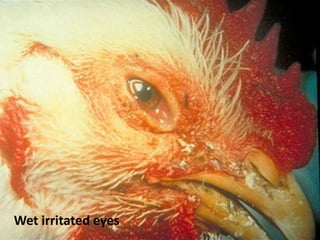
1. Nasal and ocular discharge
2. Tracheitis
3. Conjunctivitis
4. Mild rales
Clinical signs
Acute Form
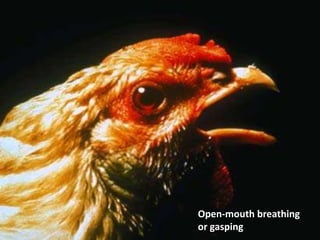
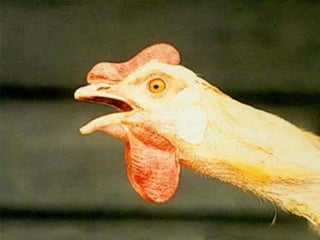
1. Gasping, coughing, rattling, and extension of the neck during
inspiration are seen 5–12 days after natural exposure.
2. Reduced productivity is a varying factor in laying flocks.
3. Affected birds are anorectic and inactive.
4. The mouth and beak may be blood stained from the tracheal
exudate.
Cont. …
5. Mortality varies but may reach 50% in adults and is usually
due to occlusion of the trachea by hemorrhage or exudate.
6. Signs usually subside after 2 weeks, although some birds may
show signs for longer periods.
7. Strains of low virulence produce little or no mortality with
mild respiratory signs and a slight decrease in egg
production.
Cont. …
 After recovery, birds remain carriers for life and become a
source of infection for susceptible birds, upon stress.
 The latent virus can be reactivated under stressful conditions.
 Infection also may be spread mechanically.
 Several epidemics have been traced to the transport of birds
in contaminated crates, and the practice of litter spread in
pastures is believed to be related to epidemics of the disease.
Open-mouth breathing
or gasping
Wet irritated eyes
Plan of Talk
 Introduction
 Etiology
 Epidemiology
 Clinical signs
 Diagnosis
 Prevention and control
Diagnosis
PM lesions
The acute disease is characterized by:
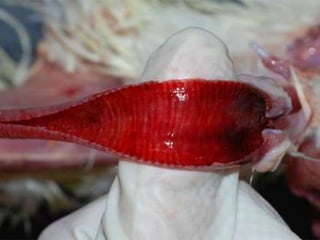
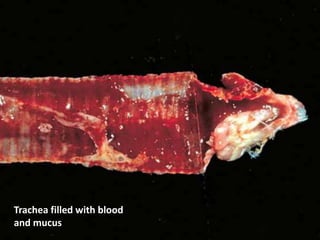
1. Presence of blood, mucus, yellow caseous exudates, or a
hollow caseous cast in the trachea.
2. Microscopically, a desquamative, necrotizing tracheitis is
characteristic of acute disease.
In the sub acute form:
1. Punctiform hemorrhagic areas in the trachea and larynx.
2. Mild conjunctivitis with lacrimation may be detected.
Trachea filled with blood
and mucus
Plan of Talk
 Introduction
 Etiology
 Epidemiology
 Clinical signs
 Diagnosis
 Prevention and control
Prevention and Control
 Broiler production,
– Strict biosecurity and the short growth cycle can obviate
the need for prophylactic vaccination.
 Layer and breeder flocks.
– Biosecurity and vaccination using modified-live vaccines.
Cont. …
Important note
 Since ILTV infections or vaccination will result in latently
infected carrier birds, it is extremely important to avoid
mixing vaccinated or recovered birds with susceptible
chickens.
 Special precautions should be taken to obtain a complete
history when mixing breeding stock.
Controlling ILT Outbreak
1. Rapid diagnosis
2. Institute a vaccination program and prevent further virus
spread. Vaccination in the event of an outbreak will:
1. Limit virus spread.
2. Shorten duration of the disease.
3. Strict biosecurity procedures to prevent spread of ILTV
4. Adequate cleaning and disinfecting
– The virus is readily inactivated outside the host chicken by
disinfectants and low levels of heat, thus spread of disease between
successive flocks housed in the same building can be prevented.
Immune Responses
A variety of responses are generated by the immune system
following infection by ILTV;
1. Humoral virus neutralizing antibodies:
1. Become detectable in the serum within 5-7 days of
tracheal exposure.
2. Peak around 21 days.
3. Wane over the next several months to low levels at which
they can persist for a year or more.
Cont. …
 Numerous laboratory and field studies have independently
confirmed that immune protection to ILTV challenge is neither
indicated by the presence of serum or maternally-derived
antibody.
Cont. …
2. Mucosal virus neutralizing antibodies:
7 days post infection, mucosal antibodies and low levels of
virus-neutralizing and enzyme-linked immunosorbent
assay (ELISA) antibody activity become detectable in
tracheal secretions and washings.
Plateau at 10-28 days.
Cont. …
3. Cell-mediated immunity
It is known to be the protective immune response in ILT
infection and for vaccination.
Studies by Fahey and York, using vaccinated bursectomised
chickens, have demonstrated that even tracheal mucosal
antibody is not essential in preventing the replication of
virus in vaccinated chickens. Rather, the effector
mechanism of protection from ILT is likely to be the local
cell-mediated immune response in the trachea.
ILT Vaccination
Vaccination is done with either;
1. Live attenuated vaccines.
2. Viral vector recombinant vaccines.
ILT Vaccination
Live Vaccines
 Originated from virulent isolates that were attenuated by
consecutive passages in embryos or tissue culture.
 These are applied via eye drop or through mass vaccination by
water or spray.
ILT Vaccination
Viral Vector Recombinant Vaccines
 Viral vector recombinant vaccines in fowl pox and herpes virus
of turkeys have been designed to express ILTV immunogenic
proteins and are administered to individual birds by in ovo,
SC, or wing-web vaccination.
ILT Vaccination
 At present, only modified-live vaccine viruses are available for
prophylactic vaccination.
 Modified live virus vaccines are prepared by propagation of
vaccine strains in either:
1. Cell culture (tissue culture-origin)
• Low post vaccine reaction, suitable for priming dose.
2. Embryonated eggs (chick embryo-origin)
• High post vaccine reaction, suitable for booster dose.
ILT Vaccination
 ILT vaccines are generally administered to chickens by either:
1. Eye drop.
2. Orally (through drinking water).
3. Spray.
 However, problems have been associated with routes of
inoculation :
1. Drinking water (titer).
2. Spray (reaction).
ILT Vaccination
Primary Vaccination
 Primary vaccination with current modified-live ILT vaccine
strains will confer:
 Partial protection against challenge by 3-4 days post
exposure.
 Complete protection after one week.
 High levels of protection occur between 15-20 weeks post
vaccination, with variable degrees of protection within a flock
over the following year.
ILT Vaccination
Revaccination
 Revaccination with live vaccines may or may not assist in
maintaining protection levels, as the infectivity of any vaccine
virus may be neutralized and replication prevented at the
portal of entry into the host chicken.
ILT Vaccination
Virus Shedding
 Whilst the chickens on a particular site may have been
vaccinated adequately, it is important to remember that
reactivation and excretion of ILTV will be occurring continually
in a small proportion of these chickens.
Cont. …
 On multiple age production sites, stressful events, such as
entering into lay, or shifting and mixing of flocks will occur
regularly, causing an even higher proportion of hens in a flock
to shed virus into the environment.
 After exposure of a flock to live ILT vaccine, or after an ILT
outbreak, active ILTV shedding cannot be assumed to have
ceased until approximately two weeks after vaccination or the
onset of the last clinical cases in a naturally infected flock.

Infectious Laryngotrachitis ILT

  • 1.
  • 2.
    Plan of Talk Introduction  Etiology  Epidemiology  Clinical signs  Diagnosis  Prevention and control
  • 3.
    Definition  Infectious laryngotracheitisis a viral respiratory infection of chickens that may result in severe economic losses as a result of mortality and/or decreased egg production.
  • 4.
    Geographical Distribution  AlthoughILT is distributed world-wide, the disease may be present only in certain localities within a country or geographic region.  The greatest incidence of disease is generally seen in areas of highly intensive poultry production.
  • 5.
    Historical Overview 1. ILTwas first confirmed in 1925 in canada 2. Followed by the united states in 1926 3. Australia & Great Britain in 1935 4. Europe in 1940 (cover, 1996).  By 1962, ILT was described in at least 40 countries in the FAO- WHO-OIE Animal Health Yearbook (Pulsford, 1963).
  • 6.
    Plan of Talk Introduction  Etiology  Epidemiology  Clinical signs  Diagnosis  Prevention and control
  • 7.
    Etiology The disease iscaused by Gallid herpesvirus I, commonly known as infectious laryngotracheitis virus (ILTV).
  • 8.
    Etiology Strain Differentiation Based onvirus neutralization (VN), immunofluorescence (IF) and cross-protection studies, ILTV strains are considered to be antigenically homogeneous.
  • 9.
    Cont. … However, strainshave been differentiated on the basis of: 1. Virulence for chickens or chicks. 2. Plaque size. 3. Morphology in cell cultures. 4. Pock size on the chorioallantoic membranes (CAMS) of chicken embryos.
  • 10.
    Etiology Resistance to Chemicaland Physical Agents  In an in vitro environment, ILTV infectivity can be readily inactivated by: 1. Low heat (e.g. 60°C for 15 minutes or less) 2. Freeze-thawing in a medium which is free of organic materials or protein.  Chemical disinfectants, such as coal tar derivatives, formalin, hypochlorite and iodophors, effectively inactivate ILTV on contact.  ILTV in the laboratory is also susceptible to lipolytic solvents, such as ether or chloroform, and to extremes of pH.
  • 11.
    Cont. …  Intracheal exudates and tissues, ILTV infectivity can persist for weeks or months in enclosed poultry production environments at relatively low temperatures (e.g. 10°C-20°C).  However, the presence of 50% glycerol broth or sterile skim milk will greatly increase the time of survival possible for ILTV infectivity on swabs.  However, putrefaction processes in the carcasses of dead chickens will shorten ILTV survival.
  • 12.
    Etiology In vitro cultivation Infectiouslaryngotracheitis virus can be grown in fertile chicken eggs and several avian primary cell cultures.
  • 13.
    Etiology In vitro cultivation- CE Inoculation Inoculation of the dropped CAM of eggs after incubation for 10- 12 days results in pock formation and embryo death between two and twelve days post inoculation.
  • 14.
    Etiology In vitro cultivation- TC Inoculation  The virus can be propagated in avian cell cultures derived from Chick embryo (liver, lung, kidney and tissues) where the typical cytopathic effect is syncytium formation.  Chick embryo liver has been found to be the most sensitive system for primary isolation of virus from clinical material.
  • 15.
    Cont. …  Chickembryo fibroblasts, Vero cells and cells of quail origin have been shown to be relatively insensitive for ILTV growth from field material.
  • 16.
    Etiology Virus Kinetics  Thetarget organs for ILTV infection and disease are the respiratory tract, the epithelium of the trachea and larynx.  Other mucous membranes such as the conjunctiva, as well as respiratory sinuses, air sacs and lung tissue, may also become infected periodically.
  • 17.
    Etiology Virus Kinetics -Acute Phase of Infection During the first week of infection  Active virus replication occurs only during this week  Although low levels of ILTV infectivity can be detected sporadically up to ten days post infection. 7-10 days after infection  Chickens usually recover from primary ILT disease within 7-10 days of showing clinical signs.  These are matching with active ILTV replication in the trachea.
  • 18.
    Cont. … 10 days– 4 weeks after infection  Shedding of infectious ILTV may have ceased  Latent phase of infection is established through ILTV invasion of nervous tissues.
  • 19.
    Etiology Latent infection Onset oflatent ('hidden') phase of ILTV infection  Invasion of the trigeminal ganglion (TRG) by ILTV has been found to occur from 3-6 days of acute phase of ILT infections by field and vaccine strains.  The latent infection starts from the immediate post-acute phase of infection  7-10 after tracheal exposure.
  • 20.
    Cont. … Route onlatent infection  The exact route of infection of the TRG is not known, but thought to be the neural migration as this ganglion provides the main sensory innervation to the tissues of the upper respiratory tract, the mouth and the eyes.  Williams et al. has confirmed, by PCR, that the tracheal ganglion is the main site of ILTV latency.
  • 21.
    Cont. … Detecting latentinfection  Latent ILTV infections are not readily demonstrable during the first few months after infection, probably reflecting initially high levels of host immune control and surveillance.  Subsequently, sporadic reactivation of latent ILTV infection with shedding of low levels of infectious virus into the trachea will recur throughout life.
  • 22.
    Cont. … Importance oflatent infection  A landmark study which helped to explain how apparently spontaneous outbreaks of ILT can occur in field situations showed that rates of shedding of ILTV into the trachea could be significantly increased by the stresses of either the onset of lay or mixing with unfamiliar birds.  In this case, the latently infected chicken can act as an unsuspected reservoir host and enable ILTV to infect further susceptible chickens.
  • 23.
    Cont. … Latent infection,the key for ILTV survival  It should be understood that establishment of latency by ILTV, in common with other herpes viruses, is the biological survival mechanism which enables ILTV to evade host immune surveillance and to persist, even in small flocks of chickens, over generations.
  • 24.
    Plan of Talk Introduction  Etiology  Epidemiology  Clinical signs  Diagnosis  Prevention and control
  • 25.
    Epidemiology  The primaryhost species for ILTV is the chicken. The sources of ILTV are as follows: 1. Clinically affected fowls. 2. Fowls which are latent 'carriers' of infection. 3. Fomites and poultry farm personnel contaminated with ILTV.
  • 26.
    Cont. …  Naturaltransmission occurring by: 1. Horizontal transmission • Direct contact with upper respiratory and discharge. 2. Vertical transmission • No evidence for vertical ILTV transmission to the egg or for shedding ILTV on shells of eggs laid by infected hens.
  • 27.
    Plan of Talk Introduction  Etiology  Epidemiology  Clinical signs  Diagnosis  Prevention and control
  • 28.
    Clinical Signs Sub AcuteForm It can also be a sub acute disease with: 1. Nasal and ocular discharge 2. Tracheitis 3. Conjunctivitis 4. Mild rales
  • 29.
    Clinical signs Acute Form 1.Gasping, coughing, rattling, and extension of the neck during inspiration are seen 5–12 days after natural exposure. 2. Reduced productivity is a varying factor in laying flocks. 3. Affected birds are anorectic and inactive. 4. The mouth and beak may be blood stained from the tracheal exudate.
  • 30.
    Cont. … 5. Mortalityvaries but may reach 50% in adults and is usually due to occlusion of the trachea by hemorrhage or exudate. 6. Signs usually subside after 2 weeks, although some birds may show signs for longer periods. 7. Strains of low virulence produce little or no mortality with mild respiratory signs and a slight decrease in egg production.
  • 31.
    Cont. …  Afterrecovery, birds remain carriers for life and become a source of infection for susceptible birds, upon stress.  The latent virus can be reactivated under stressful conditions.  Infection also may be spread mechanically.  Several epidemics have been traced to the transport of birds in contaminated crates, and the practice of litter spread in pastures is believed to be related to epidemics of the disease.
  • 32.
  • 33.
  • 35.
    Plan of Talk Introduction  Etiology  Epidemiology  Clinical signs  Diagnosis  Prevention and control
  • 36.
    Diagnosis PM lesions The acutedisease is characterized by: 1. Presence of blood, mucus, yellow caseous exudates, or a hollow caseous cast in the trachea. 2. Microscopically, a desquamative, necrotizing tracheitis is characteristic of acute disease. In the sub acute form: 1. Punctiform hemorrhagic areas in the trachea and larynx. 2. Mild conjunctivitis with lacrimation may be detected.
  • 38.
    Trachea filled withblood and mucus
  • 39.
    Plan of Talk Introduction  Etiology  Epidemiology  Clinical signs  Diagnosis  Prevention and control
  • 40.
    Prevention and Control Broiler production, – Strict biosecurity and the short growth cycle can obviate the need for prophylactic vaccination.  Layer and breeder flocks. – Biosecurity and vaccination using modified-live vaccines.
  • 41.
    Cont. … Important note Since ILTV infections or vaccination will result in latently infected carrier birds, it is extremely important to avoid mixing vaccinated or recovered birds with susceptible chickens.  Special precautions should be taken to obtain a complete history when mixing breeding stock.
  • 42.
    Controlling ILT Outbreak 1.Rapid diagnosis 2. Institute a vaccination program and prevent further virus spread. Vaccination in the event of an outbreak will: 1. Limit virus spread. 2. Shorten duration of the disease. 3. Strict biosecurity procedures to prevent spread of ILTV 4. Adequate cleaning and disinfecting – The virus is readily inactivated outside the host chicken by disinfectants and low levels of heat, thus spread of disease between successive flocks housed in the same building can be prevented.
  • 43.
    Immune Responses A varietyof responses are generated by the immune system following infection by ILTV; 1. Humoral virus neutralizing antibodies: 1. Become detectable in the serum within 5-7 days of tracheal exposure. 2. Peak around 21 days. 3. Wane over the next several months to low levels at which they can persist for a year or more.
  • 44.
    Cont. …  Numerouslaboratory and field studies have independently confirmed that immune protection to ILTV challenge is neither indicated by the presence of serum or maternally-derived antibody.
  • 45.
    Cont. … 2. Mucosalvirus neutralizing antibodies: 7 days post infection, mucosal antibodies and low levels of virus-neutralizing and enzyme-linked immunosorbent assay (ELISA) antibody activity become detectable in tracheal secretions and washings. Plateau at 10-28 days.
  • 46.
    Cont. … 3. Cell-mediatedimmunity It is known to be the protective immune response in ILT infection and for vaccination. Studies by Fahey and York, using vaccinated bursectomised chickens, have demonstrated that even tracheal mucosal antibody is not essential in preventing the replication of virus in vaccinated chickens. Rather, the effector mechanism of protection from ILT is likely to be the local cell-mediated immune response in the trachea.
  • 47.
    ILT Vaccination Vaccination isdone with either; 1. Live attenuated vaccines. 2. Viral vector recombinant vaccines.
  • 48.
    ILT Vaccination Live Vaccines Originated from virulent isolates that were attenuated by consecutive passages in embryos or tissue culture.  These are applied via eye drop or through mass vaccination by water or spray.
  • 49.
    ILT Vaccination Viral VectorRecombinant Vaccines  Viral vector recombinant vaccines in fowl pox and herpes virus of turkeys have been designed to express ILTV immunogenic proteins and are administered to individual birds by in ovo, SC, or wing-web vaccination.
  • 50.
    ILT Vaccination  Atpresent, only modified-live vaccine viruses are available for prophylactic vaccination.  Modified live virus vaccines are prepared by propagation of vaccine strains in either: 1. Cell culture (tissue culture-origin) • Low post vaccine reaction, suitable for priming dose. 2. Embryonated eggs (chick embryo-origin) • High post vaccine reaction, suitable for booster dose.
  • 51.
    ILT Vaccination  ILTvaccines are generally administered to chickens by either: 1. Eye drop. 2. Orally (through drinking water). 3. Spray.  However, problems have been associated with routes of inoculation : 1. Drinking water (titer). 2. Spray (reaction).
  • 52.
    ILT Vaccination Primary Vaccination Primary vaccination with current modified-live ILT vaccine strains will confer:  Partial protection against challenge by 3-4 days post exposure.  Complete protection after one week.  High levels of protection occur between 15-20 weeks post vaccination, with variable degrees of protection within a flock over the following year.
  • 53.
    ILT Vaccination Revaccination  Revaccinationwith live vaccines may or may not assist in maintaining protection levels, as the infectivity of any vaccine virus may be neutralized and replication prevented at the portal of entry into the host chicken.
  • 54.
    ILT Vaccination Virus Shedding Whilst the chickens on a particular site may have been vaccinated adequately, it is important to remember that reactivation and excretion of ILTV will be occurring continually in a small proportion of these chickens.
  • 55.
    Cont. …  Onmultiple age production sites, stressful events, such as entering into lay, or shifting and mixing of flocks will occur regularly, causing an even higher proportion of hens in a flock to shed virus into the environment.  After exposure of a flock to live ILT vaccine, or after an ILT outbreak, active ILTV shedding cannot be assumed to have ceased until approximately two weeks after vaccination or the onset of the last clinical cases in a naturally infected flock.

Editor's Notes

  • #18 This limited period of active replication of ILTV has a critical bearing on prospects for achieving isolation of infectious virus from chickens with suspect ILT disease.
  • #27 The chicken is the only significant primary host species for ILTV, and no other reservoir host species is known to exist, although some other avian species, such as pheasants and peafowl, can sometimes be naturally infected by contact with chickens actively shedding ILTV.
  • #51 When used correctly, these modified-live vaccines are highly effective in controlling ILT disease when the virus is later introduced into susceptible chicken populations.