Infectious Bronchitis
Disease Overview
Plan of talk
 Introduction
 Etiology
 Transmission
 Economic importance
 Pathogenesis
 Clinical signs
 Post mortem lesions
 Diagnosis
Plan of talk
 Introduction
 Etiology
 Transmission
 Economic importance
 Pathogenesis
 Clinical signs
 Post mortem lesions
 Diagnosis
Introduction
 Infectious Bronchitis (IB) is a viral disease affecting chickens of
all ages worldwide.
 Infectious Bronchitis virus (IBV) targets:
Respiratory tract
Urogenital tract.
Cont. …
IBV mainly causes:
Respiratory disease in the infected birds.
Drops in egg production in layers and breeders.
False layers.
Kidney damage can also occur.
IB … First Recognized
United States of America in the 1930s
 An acute respiratory disease mainly of young chickens.
 A viral etiology was established, and the agent was termed
avian infectious bronchitis virus (IBV).
IB … Different Forms
IB occurs world-wide and assumes a variety of clinical forms:
1. Infection of respiratory tract.
2. Infection of the oviduct of:
1. Immature birds, leading to permanent damage.
2. Laying hens, leading to:
1. Cessation of egg-laying, sudden drop in egg
production.
2. Production of thin-walled and misshapen shells with
loss of shell pigmentation.
Cont. …
3. Infection of the urinary system
 IB can be nephropathogenic causing acute nephritis and
urolithiasis (Cavanagh & Gelb, 2008).
 After apparent recovery, chronic nephritis can lead to
death at a later time.
 IBV has also been reported to produce disease of the
proventriculus (Yu et al., 2001).
IB … Host Affinity
 IB affects chickens of all ages.
 They are the only species reported to be naturally affected.
IB … Virus Shedding
Vaccine and field strains of IBV may persist in the caecal tonsils
of the intestinal tract and be excreted in faeces for weeks or
longer in clinically normal chickens (Alexander et al., 1978).
Plan of talk
 Introduction
 Etiology
 Transmission
 Economic importance
 Pathogenesis
 Clinical signs
 Post mortem lesions
 Diagnosis
Etiology
The Infectious Bronchitis Virus
Plan of talk
 Introduction
 Etiology
 Transmission
 Economic importance
 Pathogenesis
 Clinical signs
 Post mortem lesions
 Diagnosis
Transmission
 IB is highly contagious.
 The incubation period is relatively short, 18 - 36 hours.
 Disease spreading through an entire flock within one or two
days.
Horizontal Transmission
The IB virus spreads horizontally by:
1. Aerosol transmission (sneezing)
2. Contaminated organic material, drinking water and
equipment.
Vertical Transmission
 Vertical transmission (from the hen to their progeny through
the egg) has not been shown to be important.
 However, surface contamination of eggs with the IB virus is a
possible way by which the virus can be spread in hatcheries or
egg packing stations.
Plan of talk
 Introduction
 Etiology
 Transmission
 Economic importance
 Pathogenesis
 Clinical signs
 Post mortem lesions
 Diagnosis
Broilers
1. Poor food conversion rate.
2. Reduced weight gain.
3. Predisposing factor for secondary infections.
Future Layers and Breeders
When birds are infected in the first few days of life with a very
virulent IB virus:
1. Permanent damage in the oviduct may occur.
These birds may mature like normal hens but produce no
eggs.
These so-called false layers have in the meantime
consumed their full share of the investment in food and
housing without any return.
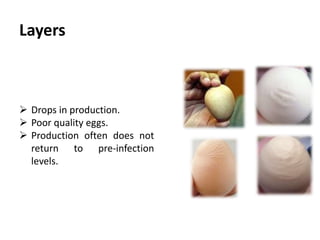
Layers
 Drops in production.
 Poor quality eggs.
 Production often does not
return to pre-infection
levels.
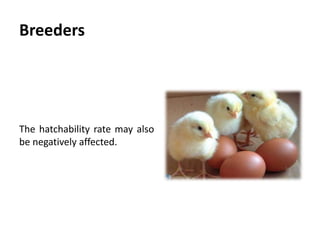
Breeders
The hatchability rate may also
be negatively affected.
Plan of talk
 Introduction
 Etiology
 Transmission
 Economic importance
 Pathogenesis
 Clinical signs
 Post mortem lesions
 Diagnosis
Pathogenesis
 Infectious bronchitis virus initially infects and replicates in the
upper respiratory tract causing the loss of protective cells
lining the sinuses and trachea.
 After a brief viraemia, the virus can be detected in the
kidneys, reproductive tract, and caecal tonsils.
Pathogenesis
 Some strains of IBV, which are referred to as
nephropathogenic are known to cause lesions in the kidney.
 Renal damage associated with different IB strains is an
increasingly important feature of IB infections, especially in
broilers.
Plan of talk
 Introduction
 Etiology
 Transmission
 Economic importance
 Pathogenesis
 Clinical signs
 Post mortem lesions
 Diagnosis
Clinical Signs
1. Young chickens are depressed and huddle under the heat
source.
2. Respiratory signs:
1. Gasping
2. Coughing
3. Tracheal rales
4. Nasal discharge
3. When the kidneys are affected, increased water intake,
depression, scouring and wet litter are commonly observed.
Cont. …
3. Birds in lay have a marked drop in egg production and an
increased number of poor quality eggs may be produced.
4. The external and internal quality of the eggs may be affected,
resulting in misshapen or soft-shelled eggs with watery
content.
5. The hatchability rate of the eggs may be affected.
Cont. …
 The most severe clinical signs are seen in chickens younger
than 6 weeks of age.
 The morbidity rate is extremely high.
 The mortality rate is dependent on:
1. Age of the chickens when infected.
2. Presence of secondary invading organisms such as E. coli.
Plan of talk
 Introduction
 Etiology
 Transmission
 Economic importance
 Pathogenesis
 Clinical signs
 Post mortem lesions
 Diagnosis
Post Mortem Lesions
 Post mortally, lesions are found in the respiratory tract and
urogenital tract.
 Renal damage associated with different IB strains is an
increasingly important feature of IB infections, especially in
broilers.
Cont. …
Respiratory
1. Serous, catarrhal, or caseous exudates in the trachea, nasal
passages and sinuses.
2. Cloudy air sacs which may contain yellow caseous exudates.
3. Caseous plug may be found in the trachea.
4. Pneumonia.
Cont. …
Urogenital
1. Swollen, pale kidneys, with distended tubules and ureters
containing urate crystals in nephropathogenic cases.
2. Fluid yolk material may be found in the abdomen of birds in
production (egg peritonitis)
3. Degeneration of the ovary and swollen oviducts.
Plan of talk
 Introduction
 Etiology
 Transmission
 Economic importance
 Pathogenesis
 Clinical signs
 Post mortem lesions
 Diagnosis
Diagnosis
Isolation or identification of the causative agent is required for a
definitive diagnosis of IB.
Diagnosis
Clinical signs
Diagnosis of Infectious Bronchitis on the basis of clinical
signs alone is very difficult.
Cont. …
Respiratory signs
Respiratory signs similar to IB are observed in many other
respiratory diseases such as:
1. Newcastle Disease
2. Infectious Laryngotracheitis
3. Pneumovirus infections.
Often these diseases may present themselves in milder forms
making it impossible to distinguish one from the other.
Cont. …
Decreased egg production and poor egg quality
 The sign “egg drop” is even less specific.
 Post mortem findings are often not conclusive.
Cont. …
Laboratory tests
 Laboratory tests to identify the viral genome, viral antigen
(proteins) or antibodies against the virus are important to
confirm IBV infections.
 Testing serum samples at intervals (for example at the time of
the clinical signs and 2 or 3 weeks later) provide the best basis
for serological diagnosis. This is also applicable for monitoring
vaccination results.

Avian Infectious Bronchitis IB Disease

  • 1.
  • 2.
    Plan of talk Introduction  Etiology  Transmission  Economic importance  Pathogenesis  Clinical signs  Post mortem lesions  Diagnosis
  • 3.
    Plan of talk Introduction  Etiology  Transmission  Economic importance  Pathogenesis  Clinical signs  Post mortem lesions  Diagnosis
  • 4.
    Introduction  Infectious Bronchitis(IB) is a viral disease affecting chickens of all ages worldwide.  Infectious Bronchitis virus (IBV) targets: Respiratory tract Urogenital tract.
  • 5.
    Cont. … IBV mainlycauses: Respiratory disease in the infected birds. Drops in egg production in layers and breeders. False layers. Kidney damage can also occur.
  • 6.
    IB … FirstRecognized United States of America in the 1930s  An acute respiratory disease mainly of young chickens.  A viral etiology was established, and the agent was termed avian infectious bronchitis virus (IBV).
  • 7.
    IB … DifferentForms IB occurs world-wide and assumes a variety of clinical forms: 1. Infection of respiratory tract. 2. Infection of the oviduct of: 1. Immature birds, leading to permanent damage. 2. Laying hens, leading to: 1. Cessation of egg-laying, sudden drop in egg production. 2. Production of thin-walled and misshapen shells with loss of shell pigmentation.
  • 8.
    Cont. … 3. Infectionof the urinary system  IB can be nephropathogenic causing acute nephritis and urolithiasis (Cavanagh & Gelb, 2008).  After apparent recovery, chronic nephritis can lead to death at a later time.  IBV has also been reported to produce disease of the proventriculus (Yu et al., 2001).
  • 9.
    IB … HostAffinity  IB affects chickens of all ages.  They are the only species reported to be naturally affected.
  • 10.
    IB … VirusShedding Vaccine and field strains of IBV may persist in the caecal tonsils of the intestinal tract and be excreted in faeces for weeks or longer in clinically normal chickens (Alexander et al., 1978).
  • 11.
    Plan of talk Introduction  Etiology  Transmission  Economic importance  Pathogenesis  Clinical signs  Post mortem lesions  Diagnosis
  • 12.
  • 13.
    Plan of talk Introduction  Etiology  Transmission  Economic importance  Pathogenesis  Clinical signs  Post mortem lesions  Diagnosis
  • 14.
    Transmission  IB ishighly contagious.  The incubation period is relatively short, 18 - 36 hours.  Disease spreading through an entire flock within one or two days.
  • 15.
    Horizontal Transmission The IBvirus spreads horizontally by: 1. Aerosol transmission (sneezing) 2. Contaminated organic material, drinking water and equipment.
  • 16.
    Vertical Transmission  Verticaltransmission (from the hen to their progeny through the egg) has not been shown to be important.  However, surface contamination of eggs with the IB virus is a possible way by which the virus can be spread in hatcheries or egg packing stations.
  • 17.
    Plan of talk Introduction  Etiology  Transmission  Economic importance  Pathogenesis  Clinical signs  Post mortem lesions  Diagnosis
  • 18.
    Broilers 1. Poor foodconversion rate. 2. Reduced weight gain. 3. Predisposing factor for secondary infections.
  • 19.
    Future Layers andBreeders When birds are infected in the first few days of life with a very virulent IB virus: 1. Permanent damage in the oviduct may occur. These birds may mature like normal hens but produce no eggs. These so-called false layers have in the meantime consumed their full share of the investment in food and housing without any return.
  • 20.
    Layers  Drops inproduction.  Poor quality eggs.  Production often does not return to pre-infection levels.
  • 21.
    Breeders The hatchability ratemay also be negatively affected.
  • 22.
    Plan of talk Introduction  Etiology  Transmission  Economic importance  Pathogenesis  Clinical signs  Post mortem lesions  Diagnosis
  • 23.
    Pathogenesis  Infectious bronchitisvirus initially infects and replicates in the upper respiratory tract causing the loss of protective cells lining the sinuses and trachea.  After a brief viraemia, the virus can be detected in the kidneys, reproductive tract, and caecal tonsils.
  • 24.
    Pathogenesis  Some strainsof IBV, which are referred to as nephropathogenic are known to cause lesions in the kidney.  Renal damage associated with different IB strains is an increasingly important feature of IB infections, especially in broilers.
  • 25.
    Plan of talk Introduction  Etiology  Transmission  Economic importance  Pathogenesis  Clinical signs  Post mortem lesions  Diagnosis
  • 26.
    Clinical Signs 1. Youngchickens are depressed and huddle under the heat source. 2. Respiratory signs: 1. Gasping 2. Coughing 3. Tracheal rales 4. Nasal discharge 3. When the kidneys are affected, increased water intake, depression, scouring and wet litter are commonly observed.
  • 27.
    Cont. … 3. Birdsin lay have a marked drop in egg production and an increased number of poor quality eggs may be produced. 4. The external and internal quality of the eggs may be affected, resulting in misshapen or soft-shelled eggs with watery content. 5. The hatchability rate of the eggs may be affected.
  • 28.
    Cont. …  Themost severe clinical signs are seen in chickens younger than 6 weeks of age.  The morbidity rate is extremely high.  The mortality rate is dependent on: 1. Age of the chickens when infected. 2. Presence of secondary invading organisms such as E. coli.
  • 29.
    Plan of talk Introduction  Etiology  Transmission  Economic importance  Pathogenesis  Clinical signs  Post mortem lesions  Diagnosis
  • 30.
    Post Mortem Lesions Post mortally, lesions are found in the respiratory tract and urogenital tract.  Renal damage associated with different IB strains is an increasingly important feature of IB infections, especially in broilers.
  • 31.
    Cont. … Respiratory 1. Serous,catarrhal, or caseous exudates in the trachea, nasal passages and sinuses. 2. Cloudy air sacs which may contain yellow caseous exudates. 3. Caseous plug may be found in the trachea. 4. Pneumonia.
  • 32.
    Cont. … Urogenital 1. Swollen,pale kidneys, with distended tubules and ureters containing urate crystals in nephropathogenic cases. 2. Fluid yolk material may be found in the abdomen of birds in production (egg peritonitis) 3. Degeneration of the ovary and swollen oviducts.
  • 33.
    Plan of talk Introduction  Etiology  Transmission  Economic importance  Pathogenesis  Clinical signs  Post mortem lesions  Diagnosis
  • 34.
    Diagnosis Isolation or identificationof the causative agent is required for a definitive diagnosis of IB.
  • 35.
    Diagnosis Clinical signs Diagnosis ofInfectious Bronchitis on the basis of clinical signs alone is very difficult.
  • 36.
    Cont. … Respiratory signs Respiratorysigns similar to IB are observed in many other respiratory diseases such as: 1. Newcastle Disease 2. Infectious Laryngotracheitis 3. Pneumovirus infections. Often these diseases may present themselves in milder forms making it impossible to distinguish one from the other.
  • 37.
    Cont. … Decreased eggproduction and poor egg quality  The sign “egg drop” is even less specific.  Post mortem findings are often not conclusive.
  • 38.
    Cont. … Laboratory tests Laboratory tests to identify the viral genome, viral antigen (proteins) or antibodies against the virus are important to confirm IBV infections.  Testing serum samples at intervals (for example at the time of the clinical signs and 2 or 3 weeks later) provide the best basis for serological diagnosis. This is also applicable for monitoring vaccination results.