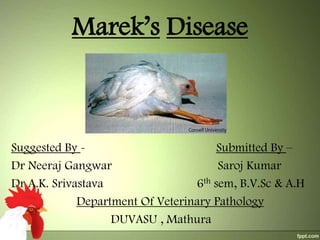
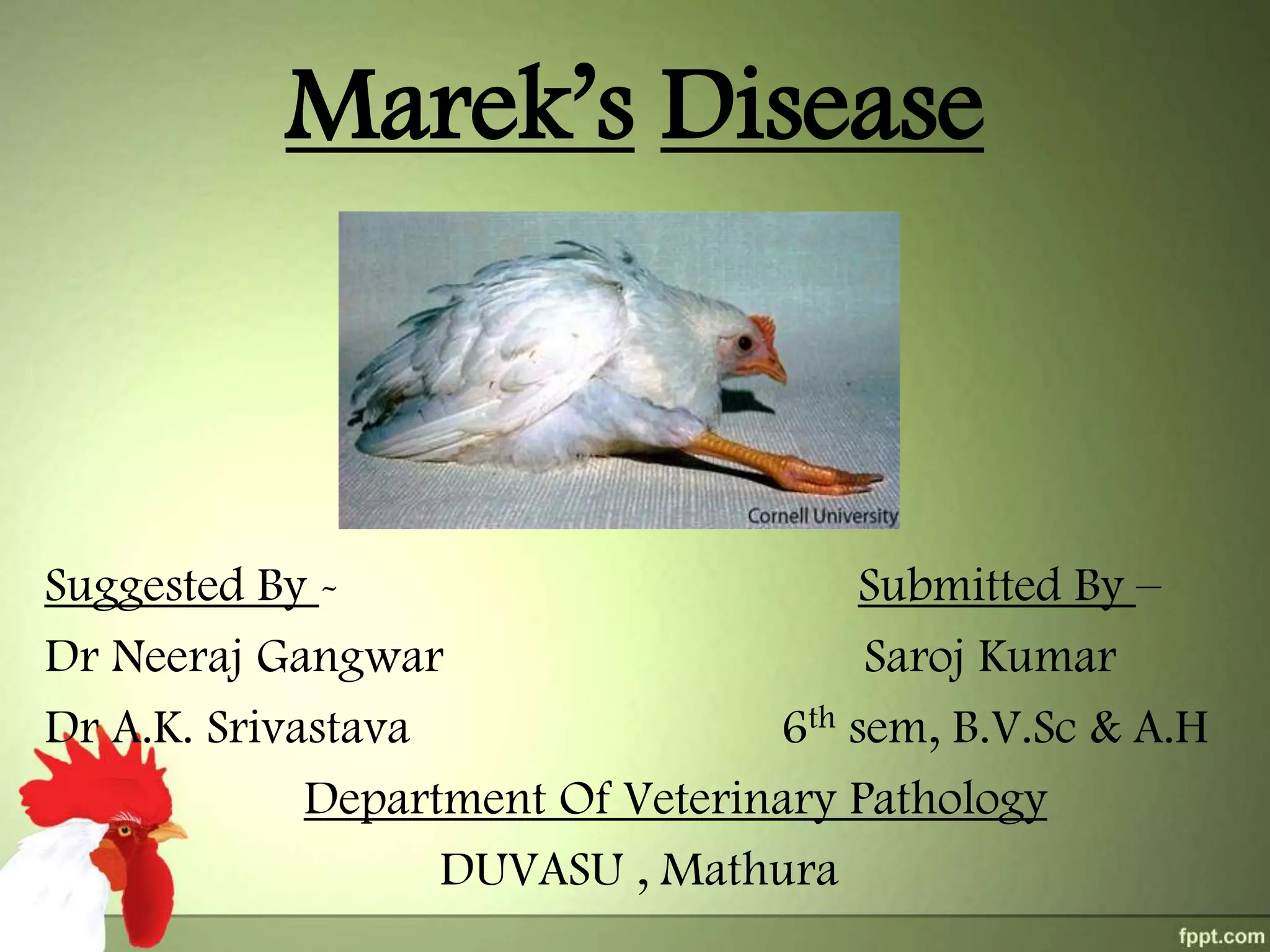
Marek’s Disease

Suggested By Submitted By –
Dr Neeraj Gangwar
Saroj Kumar
Dr A.K. Srivastava
6th sem, B.V.Sc & A.H
Department Of Veterinary Pathology
DUVASU , Mathura
Introduction
• Marek’s Disease – A lymphoproliferative disease
of chickens characterised by mononuclear
infilteration of PNS, other tissues & visceral
organs.
• First described by Jozsef Marek of Hungary in
1907.
• Due to neuronal involvement, synonyms used
are – Polyneuritis, Fowl Paralysis, Range Paralysis
& Neurolymphomatosis.
Aetiology
• MD – caused by Herpes Virus – enveloped, dsDNA
virus.
• MDV – classified into 3 serotypes –
• Serotype 1 – includes oncogenic strains of MDV.
• Serotype 2 – includes naturally non pathogenic
strains.
• Serotype 3 – antigenically related to herpes virus of
turkey (HVT) . Used for production of vaccine k/a
HVT 126.
•
•
•
•
•

Serotype 1 – subdivided into 3 pathotypes –
Mildly Virulent (mMDV)
Virulent (vMDV )
Very Virulent (vvMDV )
Virus infectivity is strictly cell associated except in
feather follicles epithelium where cell free virus are
produced.
Spread
• Virus is present in desquamated feather follicle
epithelial cells, oral, nasal, tracheal secretions.
• Feather follicles – main source of infectivity of
dander.
• Air borne route – most important route.
• Virus is not transmitted through egg.
• Infected birds continue to contaminate the
environment by shedding virus.
Epidemiology
• Genetic constitution – greatly influences pathology
& incidence of disease.
• Genetic resistance is of 2 types –
• Associated with major histocompatibility complex
allele. (B21)
• Susceptibility of T cells to transformation.
• Females are more susceptible than males.
• Stress – main environmental factor.
Pathogenesis
MD Virus enters into body in lymphoid organs

Proliferate & cause viremia
Reaches site of prediliction

Virus after proliferation get depositted in feather
Follicle
Here dander like material is produced which acts as
source of infection
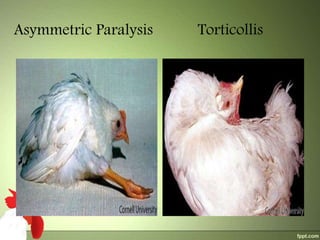
Asymmetric Paralysis

Torticollis
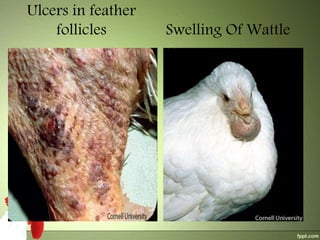
Ulcers in feather
follicles

Swelling Of Wattle
• MD Virus effect T cells & cause their
pleomorphy.
• 2 types of cells are produced –
• Immature pleomorphic type leucocytes
• MD cells – Degenerating lymphoblast cells
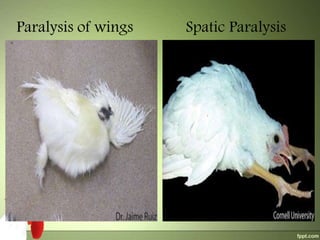
Paralysis of wings

Spatic Paralysis
Forms Of Disease
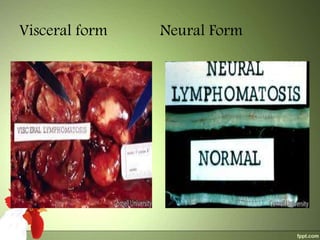
• Visceral form –
• Proliferation of lymphocytes & are depositted in
visceral organs ( kidney, liver, spleen, gonads).
• Tumor may be nodular or diffused.
• Organs – very much enlarged & hard in consistency.
• Neural form –
• Proliferating lymphocytes depositted in PNS effecting
sciatic & brachial plexus.
• Nodular formation in nerve cause unilateral /
bilateral paralysis , striations are lost in nerves.
Visceral form

Neural Form
• Cutaneous form –
• Proliferating lymphocytes get depositted in skin
producing nodular type lesions.
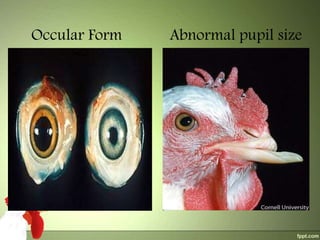
• Occular form –
• Protusion of eye ball, looks pearl like.
Occular Form

Abnormal pupil size
Diagnosis
•
•
•
•
•

PM Findings
Age
Symptoms
Radial Immunodiffusion Test
MATSA ( MD Associated Transforming Surface
Antigen) – Non specific MD virus Ag, also present in
HVT vaccinated chicken. It is diagnostic Ag.
Thank You

Marek’s disease

  • 1.
    Marek’s Disease Suggested BySubmitted By – Dr Neeraj Gangwar Saroj Kumar Dr A.K. Srivastava 6th sem, B.V.Sc & A.H Department Of Veterinary Pathology DUVASU , Mathura
  • 2.
    Introduction • Marek’s Disease– A lymphoproliferative disease of chickens characterised by mononuclear infilteration of PNS, other tissues & visceral organs. • First described by Jozsef Marek of Hungary in 1907. • Due to neuronal involvement, synonyms used are – Polyneuritis, Fowl Paralysis, Range Paralysis & Neurolymphomatosis.
  • 3.
    Aetiology • MD –caused by Herpes Virus – enveloped, dsDNA virus. • MDV – classified into 3 serotypes – • Serotype 1 – includes oncogenic strains of MDV. • Serotype 2 – includes naturally non pathogenic strains. • Serotype 3 – antigenically related to herpes virus of turkey (HVT) . Used for production of vaccine k/a HVT 126.
  • 4.
    • • • • • Serotype 1 –subdivided into 3 pathotypes – Mildly Virulent (mMDV) Virulent (vMDV ) Very Virulent (vvMDV ) Virus infectivity is strictly cell associated except in feather follicles epithelium where cell free virus are produced.
  • 5.
    Spread • Virus ispresent in desquamated feather follicle epithelial cells, oral, nasal, tracheal secretions. • Feather follicles – main source of infectivity of dander. • Air borne route – most important route. • Virus is not transmitted through egg. • Infected birds continue to contaminate the environment by shedding virus.
  • 6.
    Epidemiology • Genetic constitution– greatly influences pathology & incidence of disease. • Genetic resistance is of 2 types – • Associated with major histocompatibility complex allele. (B21) • Susceptibility of T cells to transformation. • Females are more susceptible than males. • Stress – main environmental factor.
  • 7.
    Pathogenesis MD Virus entersinto body in lymphoid organs Proliferate & cause viremia Reaches site of prediliction Virus after proliferation get depositted in feather Follicle Here dander like material is produced which acts as source of infection
  • 8.
  • 9.
  • 10.
    • MD Viruseffect T cells & cause their pleomorphy. • 2 types of cells are produced – • Immature pleomorphic type leucocytes • MD cells – Degenerating lymphoblast cells
  • 11.
  • 12.
    Forms Of Disease •Visceral form – • Proliferation of lymphocytes & are depositted in visceral organs ( kidney, liver, spleen, gonads). • Tumor may be nodular or diffused. • Organs – very much enlarged & hard in consistency. • Neural form – • Proliferating lymphocytes depositted in PNS effecting sciatic & brachial plexus. • Nodular formation in nerve cause unilateral / bilateral paralysis , striations are lost in nerves.
  • 13.
  • 14.
    • Cutaneous form– • Proliferating lymphocytes get depositted in skin producing nodular type lesions. • Occular form – • Protusion of eye ball, looks pearl like.
  • 15.
  • 16.
    Diagnosis • • • • • PM Findings Age Symptoms Radial ImmunodiffusionTest MATSA ( MD Associated Transforming Surface Antigen) – Non specific MD virus Ag, also present in HVT vaccinated chicken. It is diagnostic Ag.
  • 17.