Avian Mycoplasmosis
Disease Overview
Plan of talk
 Introduction
 Etiology
 Species affected
 Geographical distribution
 Transmission
 Clinical signs
 Post mortem lesions
 Treatment
 Prevention
Plan of talk
 Introduction
 Etiology
 Species affected
 Geographical distribution
 Transmission
 Clinical signs
 Post mortem lesions
 Treatment
 Prevention
Introduction
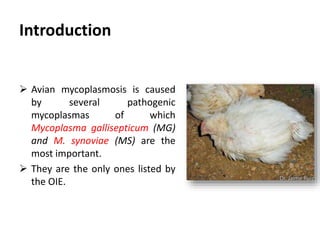
 Avian mycoplasmosis is caused by
several pathogenic mycoplasmas,
the most common are;
1. Mycoplasma gallisepticum (MG)
2. M. synoviae (MS)
 They are the only strains listed by
the OIE.
Cont. …
 MG causes chronic respiratory disease CRD of domestic
poultry, especially in the presence of management stresses
and/or other respiratory pathogens.
 MS may cause respiratory disease, synovitis, or may result in
a silent infection.
Importance
 Mycoplasma gallisepticum is the most economically
significant mycoplasma pathogen of poultry.
 Mycoplasma gallisepticum infections causes significant
economic losses on poultry farms from:
1. Chronic respiratory disease (CRD).
2. Reduced feed efficiency.
3. Decreased growth rate.
4. Decreased egg production.
5. Carcasses downgrades.
Plan of talk
 Introduction
 Etiology
 Species affected
 Geographical distribution
 Transmission
 Clinical signs
 Post mortem lesions
 Treatment
 Prevention
Etiology
Class mollicutes
Order mycoplasmatales
Family mycoplasmataceae including:
1. M. gallisepticum
2. M. Synoviae
3. M. meleagridis
4. M. iowae.
Cont. …
 M. gallisepticum infections are also known as:
1. Chronic respiratory disease (CRD) of chickens.
2. Infectious sinusitis of turkeys.
 Several strains of M. gallisepticum have been reported,
including the R strain in poultry.
Plan of talk
 Introduction
 Etiology
 Species affected
 Geographical distribution
 Transmission
 Clinical signs
 Post mortem lesions
 Treatment
 Prevention
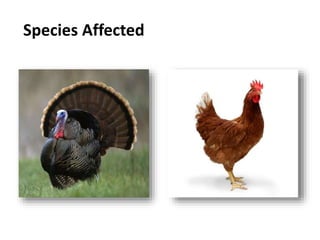
Species Affected
Plan of talk
 Introduction
 Etiology
 Species affected
 Geographical distribution
 Transmission
 Clinical signs
 Post mortem lesions
 Treatment
 Prevention
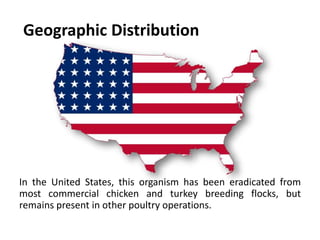
Geographic Distribution
In the United States, this organism has been eradicated from
most commercial chicken and turkey breeding flocks, but
remains present in other poultry operations.
Plan of talk
 Introduction
 Etiology
 Species affected
 Geographical distribution
 Transmission
 Clinical signs
 Post mortem lesions
 Treatment
 Prevention
Transmission
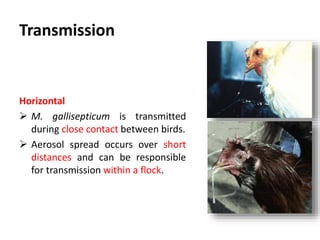
Horizontal
 M. gallisepticum is transmitted
during close contact between birds.
 Aerosol spread occurs over short
distances and can be responsible
for transmission within a flock.
Cont. …
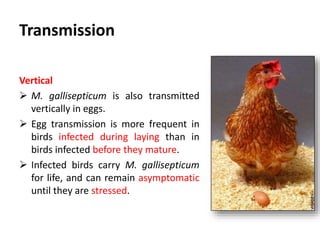
Vertical
 M. gallisepticum is also transmitted
vertically in eggs.
 Egg transmission is more frequent in
birds infected during laying than in
birds infected before they mature.
 Infected birds carry M. gallisepticum
for life, and can remain asymptomatic
until they are stressed.
Incubation Period
 Experimentally infected poultry develop symptoms after 6 -21
days.
 In natural infections, the incubation period is variable;
infected birds may be asymptomatic for days or months until
stressed.
Cont. …
Stressors such as:
1. Viral infections
2. Vaccination with live viruses
3. Cold weather
4. Crowding
Can trigger disease outbreaks in infected flocks.
Morbidity and Mortality
 In chickens with uncomplicated infections, the morbidity rate
is high and the mortality rate low.
 More severe disease occurs if the birds are concurrently
infected with other viruses or bacteria.
Plan of talk
 Introduction
 Etiology
 Species affected
 Geographical distribution
 Transmission
 Clinical signs
 Post mortem lesions
 Treatment
 Prevention
Clinical Signs
 M. gallisepticum infections vary from asymptomatic to severe,
depending on the infecting strain and other factors, such as
the infection with other respiratory pathogen;
1. NDV
2. IBV
3. E. coli
Cont. …
Infected chickens usually develop respiratory symptoms that
may include:
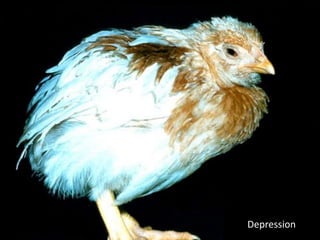
1. Depression
2. Rales
3. Coughing
4. Sneezing
5. Nasal discharges
6. Dyspnea
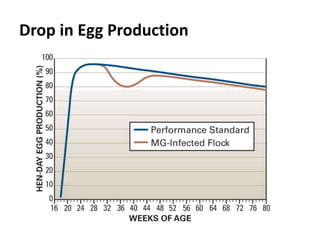
7. Decreased weight gain, feed efficiency and egg production
Depression
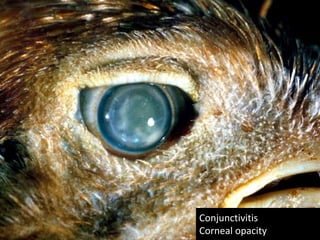
Conjunctivitis
Corneal opacity
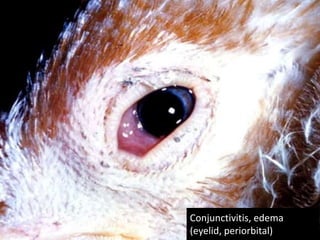
Conjunctivitis, edema
(eyelid, periorbital)
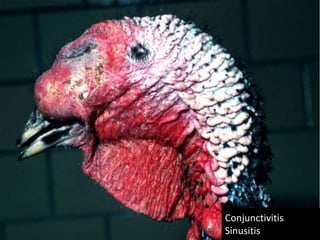
Conjunctivitis
Sinusitis
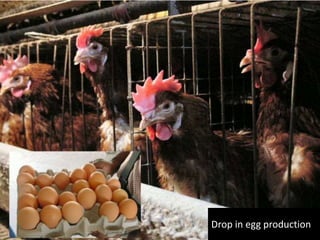
Drop in egg production
Drop in Egg Production
Plan of talk
 Introduction
 Etiology
 Species affected
 Geographical distribution
 Transmission
 Clinical signs
 Post mortem lesions
 Treatment
 Prevention
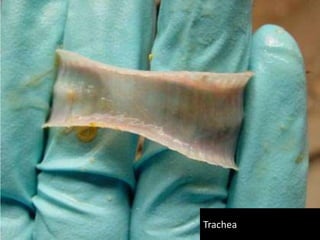
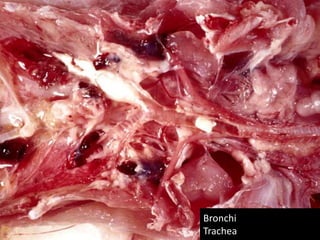
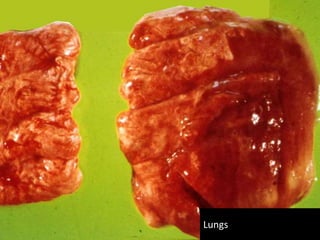
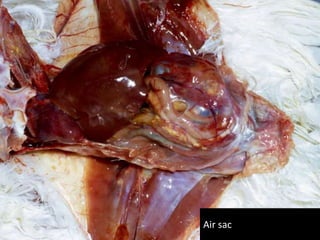
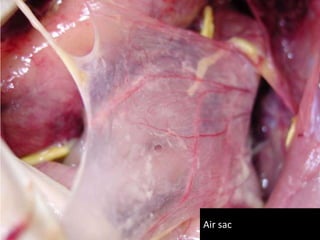
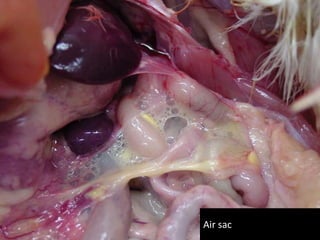
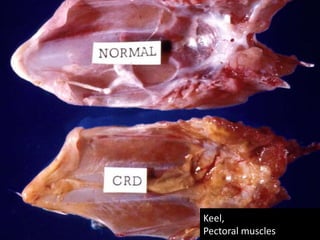
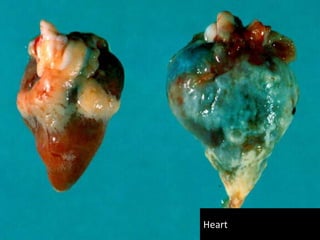
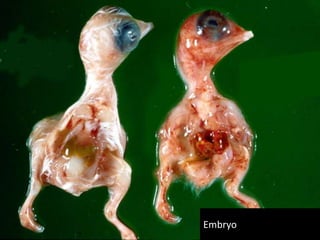
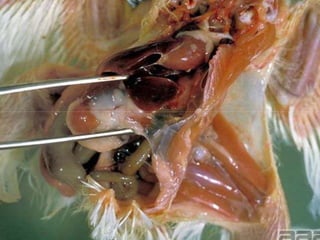
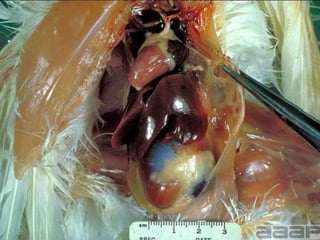
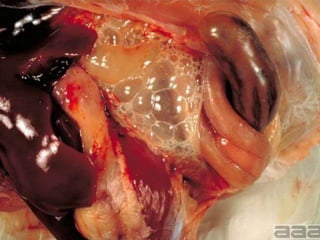
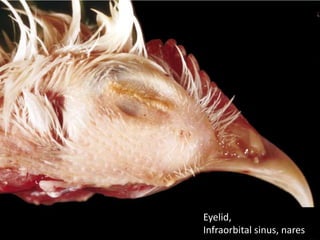
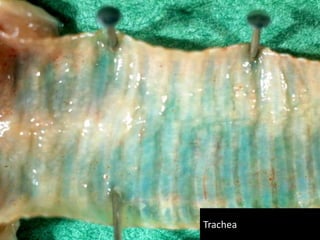
Post Mortem Lesions
In uncomplicated cases in chickens, the lesions typically
include:
1. Mild sinusitis
2. Tracheitis
3. Airsacculitis
If chicken is infected concurrently with E. coli:
1. Thickening and turbidity of the air sacs
2. Exudative accumulations
3. Fibrinopurulent pericarditis
4. Perihepatitis
Eyelid,
Infraorbital sinus, nares
Trachea
Trachea
Bronchi
Trachea
Lungs
Air sac
Keel,
Pectoral muscles
Air sac
Air sac
Heart
Embryo
Plan of talk
 Introduction
 Etiology
 Species affected
 Geographical distribution
 Transmission
 Clinical signs
 Post mortem lesions
 Treatment
 Prevention
Treatment – Live Bird
 The (semi) permanent use of antibiotics (Tylan ®,
Lincospectin®, Baytril®) can reduce the damage of a M.G.
infection, but it will never really solve the problem, because
the flocks are still infected.
 In broilers, at the first 4 days of life, then at 19th day for 2
successive days.
 In breeders, following any respiratory vaccination, especially
ND for 2 successive days.
 As soon as one stops the medication the disease increases
again
Cont. …
Limitations of treatment:
1. Mycoplasma develops resistance against the antibiotics
2. Expensive
3. Medication can not fully prevent an infection.
4. It is useful for a relatively short period of time, but in the
meantime other control systems have to be developed.
Treatment – Egg Transmission
If a flock proves to be positive for M.G. there are several
possibilities to prevent vertical transmission to the broiler flocks:
Cont. …
1. The P.S. Flock can be killed.
– This is the only completely safe procedure to prevent further spread of
the disease, but of course it is not always practical.
2. Treatment of the hatching egg with tylan® (or baytril®):
– Injection into the hatching eggs with 0.2 mg tylosine by hand or
automatic.
3. Egg dipping in a 2500 ppm containing tylan solution, using the
temperature-difference method or the pressure difference
method.
4. Egg-heating method (yoder) eggs are heated, before setting,
at 46 C during 12-14 hours. This system is not very reliable.
Plan of talk
 Introduction
 Etiology
 Species affected
 Geographical distribution
 Transmission
 Clinical signs
 Post mortem lesions
 Treatment
 Prevention
Biosecurity
Very strict hygienic system is essential to keep a flock free:
1. Limit visitors and movement of vehicles between farms to the
absolute minimum.
2. Make sure that all visitors change clothes and footwear on the
entrance of the farm and disinfect their hands.
3. Showering is even better, and certainly recommended for Grand
Parent Farms.
4. As most Mycoplasma’s are killed within two days, we keep two days
as a minimum safety period between visiting possibly infected farm
and visiting a M.G. clean farm.
5. Staff should not be allowed to have any contact with poultry
outside their work. Otherwise, the same period of two days counts.
Cont. …
 On multi-age farms, it is difficult to control M.G..
 On a single-age farm, M.G. control mainly means control of
movement of staff and material.
Vaccination
Various vaccines are used:
1. Live vaccines
2. Killed vaccines
Vaccination - Live vaccines
F-strain (Avipro MGF, LAH)
 Can produce immunity.
 Profits in such flocks are less than in unvaccinated flocks that
maintained their freedom from M.G.
 The vaccine can spread up to 8 weeks after vaccination.
6/85 strain (Mycovac-L, Intervet)
 Is not spreading and safe.
 It can be differentiated from field strains by plate
agglutination test.
Vaccination - Killed Vaccines
 Killed vaccines are safe to use and give generally a reasonable
protection.
 They should be given by injection and are rather expensive.

Avian Mycoplasmosis_Disease Overview

  • 1.
  • 2.
    Plan of talk Introduction  Etiology  Species affected  Geographical distribution  Transmission  Clinical signs  Post mortem lesions  Treatment  Prevention
  • 3.
    Plan of talk Introduction  Etiology  Species affected  Geographical distribution  Transmission  Clinical signs  Post mortem lesions  Treatment  Prevention
  • 4.
    Introduction  Avian mycoplasmosisis caused by several pathogenic mycoplasmas, the most common are; 1. Mycoplasma gallisepticum (MG) 2. M. synoviae (MS)  They are the only strains listed by the OIE.
  • 5.
    Cont. …  MGcauses chronic respiratory disease CRD of domestic poultry, especially in the presence of management stresses and/or other respiratory pathogens.  MS may cause respiratory disease, synovitis, or may result in a silent infection.
  • 6.
    Importance  Mycoplasma gallisepticumis the most economically significant mycoplasma pathogen of poultry.  Mycoplasma gallisepticum infections causes significant economic losses on poultry farms from: 1. Chronic respiratory disease (CRD). 2. Reduced feed efficiency. 3. Decreased growth rate. 4. Decreased egg production. 5. Carcasses downgrades.
  • 7.
    Plan of talk Introduction  Etiology  Species affected  Geographical distribution  Transmission  Clinical signs  Post mortem lesions  Treatment  Prevention
  • 8.
    Etiology Class mollicutes Order mycoplasmatales Familymycoplasmataceae including: 1. M. gallisepticum 2. M. Synoviae 3. M. meleagridis 4. M. iowae.
  • 9.
    Cont. …  M.gallisepticum infections are also known as: 1. Chronic respiratory disease (CRD) of chickens. 2. Infectious sinusitis of turkeys.  Several strains of M. gallisepticum have been reported, including the R strain in poultry.
  • 10.
    Plan of talk Introduction  Etiology  Species affected  Geographical distribution  Transmission  Clinical signs  Post mortem lesions  Treatment  Prevention
  • 11.
  • 12.
    Plan of talk Introduction  Etiology  Species affected  Geographical distribution  Transmission  Clinical signs  Post mortem lesions  Treatment  Prevention
  • 13.
  • 14.
    Geographic Distribution In theUnited States, this organism has been eradicated from most commercial chicken and turkey breeding flocks, but remains present in other poultry operations.
  • 15.
    Plan of talk Introduction  Etiology  Species affected  Geographical distribution  Transmission  Clinical signs  Post mortem lesions  Treatment  Prevention
  • 16.
    Transmission Horizontal  M. gallisepticumis transmitted during close contact between birds.  Aerosol spread occurs over short distances and can be responsible for transmission within a flock.
  • 17.
    Cont. … Vertical  M.gallisepticum is also transmitted vertically in eggs.  Egg transmission is more frequent in birds infected during laying than in birds infected before they mature.  Infected birds carry M. gallisepticum for life, and can remain asymptomatic until they are stressed.
  • 18.
    Incubation Period  Experimentallyinfected poultry develop symptoms after 6 -21 days.  In natural infections, the incubation period is variable; infected birds may be asymptomatic for days or months until stressed.
  • 19.
    Cont. … Stressors suchas: 1. Viral infections 2. Vaccination with live viruses 3. Cold weather 4. Crowding Can trigger disease outbreaks in infected flocks.
  • 20.
    Morbidity and Mortality In chickens with uncomplicated infections, the morbidity rate is high and the mortality rate low.  More severe disease occurs if the birds are concurrently infected with other viruses or bacteria.
  • 21.
    Plan of talk Introduction  Etiology  Species affected  Geographical distribution  Transmission  Clinical signs  Post mortem lesions  Treatment  Prevention
  • 22.
    Clinical Signs  M.gallisepticum infections vary from asymptomatic to severe, depending on the infecting strain and other factors, such as the infection with other respiratory pathogen; 1. NDV 2. IBV 3. E. coli
  • 23.
    Cont. … Infected chickensusually develop respiratory symptoms that may include: 1. Depression 2. Rales 3. Coughing 4. Sneezing 5. Nasal discharges 6. Dyspnea 7. Decreased weight gain, feed efficiency and egg production
  • 24.
  • 25.
  • 26.
  • 27.
  • 28.
    Drop in eggproduction
  • 29.
    Drop in EggProduction
  • 30.
    Plan of talk Introduction  Etiology  Species affected  Geographical distribution  Transmission  Clinical signs  Post mortem lesions  Treatment  Prevention
  • 31.
    Post Mortem Lesions Inuncomplicated cases in chickens, the lesions typically include: 1. Mild sinusitis 2. Tracheitis 3. Airsacculitis If chicken is infected concurrently with E. coli: 1. Thickening and turbidity of the air sacs 2. Exudative accumulations 3. Fibrinopurulent pericarditis 4. Perihepatitis
  • 32.
  • 33.
  • 34.
  • 35.
  • 36.
  • 37.
  • 38.
  • 39.
  • 40.
  • 41.
  • 42.
  • 46.
    Plan of talk Introduction  Etiology  Species affected  Geographical distribution  Transmission  Clinical signs  Post mortem lesions  Treatment  Prevention
  • 47.
    Treatment – LiveBird  The (semi) permanent use of antibiotics (Tylan ®, Lincospectin®, Baytril®) can reduce the damage of a M.G. infection, but it will never really solve the problem, because the flocks are still infected.  In broilers, at the first 4 days of life, then at 19th day for 2 successive days.  In breeders, following any respiratory vaccination, especially ND for 2 successive days.  As soon as one stops the medication the disease increases again
  • 48.
    Cont. … Limitations oftreatment: 1. Mycoplasma develops resistance against the antibiotics 2. Expensive 3. Medication can not fully prevent an infection. 4. It is useful for a relatively short period of time, but in the meantime other control systems have to be developed.
  • 49.
    Treatment – EggTransmission If a flock proves to be positive for M.G. there are several possibilities to prevent vertical transmission to the broiler flocks:
  • 50.
    Cont. … 1. TheP.S. Flock can be killed. – This is the only completely safe procedure to prevent further spread of the disease, but of course it is not always practical. 2. Treatment of the hatching egg with tylan® (or baytril®): – Injection into the hatching eggs with 0.2 mg tylosine by hand or automatic. 3. Egg dipping in a 2500 ppm containing tylan solution, using the temperature-difference method or the pressure difference method. 4. Egg-heating method (yoder) eggs are heated, before setting, at 46 C during 12-14 hours. This system is not very reliable.
  • 51.
    Plan of talk Introduction  Etiology  Species affected  Geographical distribution  Transmission  Clinical signs  Post mortem lesions  Treatment  Prevention
  • 52.
    Biosecurity Very strict hygienicsystem is essential to keep a flock free: 1. Limit visitors and movement of vehicles between farms to the absolute minimum. 2. Make sure that all visitors change clothes and footwear on the entrance of the farm and disinfect their hands. 3. Showering is even better, and certainly recommended for Grand Parent Farms. 4. As most Mycoplasma’s are killed within two days, we keep two days as a minimum safety period between visiting possibly infected farm and visiting a M.G. clean farm. 5. Staff should not be allowed to have any contact with poultry outside their work. Otherwise, the same period of two days counts.
  • 53.
    Cont. …  Onmulti-age farms, it is difficult to control M.G..  On a single-age farm, M.G. control mainly means control of movement of staff and material.
  • 54.
    Vaccination Various vaccines areused: 1. Live vaccines 2. Killed vaccines
  • 55.
    Vaccination - Livevaccines F-strain (Avipro MGF, LAH)  Can produce immunity.  Profits in such flocks are less than in unvaccinated flocks that maintained their freedom from M.G.  The vaccine can spread up to 8 weeks after vaccination. 6/85 strain (Mycovac-L, Intervet)  Is not spreading and safe.  It can be differentiated from field strains by plate agglutination test.
  • 56.
    Vaccination - KilledVaccines  Killed vaccines are safe to use and give generally a reasonable protection.  They should be given by injection and are rather expensive.

Editor's Notes

  • #14 finches عصافير
  • #15 finches عصافير