INFECTIOUS
CANINE HEPATITIS
ABHIJITH SP
CVAS POOKODE
INTRODUCTION
• Infectious canine hepatitis is a worldwide, contagious disease of dogs with signs that
vary from a slight fever and congestion of the mucous membranes to severe
depression, severe reduction in white blood cells, and deficiency of blood clotting.
• In recent years, the disease has become uncommon in areas where routine
vaccination is used.
• Discovered in early 1950s by a Veterinarian Carl Steven Rubarth.
• ICH was first distinguished from canine distemper by Rubarth in 1947 using ferrets;
ferrets are resistant to ICH but susceptible to canine distemper.
• ICH occurs worldwide.
24-09-2020ABHIJITH SP CVAS POOKODE 2
AETIOLOGY
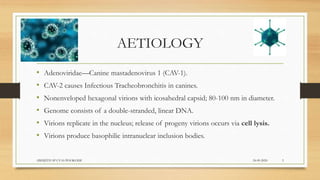
• Adenoviridae—Canine mastadenovirus 1 (CAV-1).
• CAV-2 causes Infectious Tracheobronchitis in canines.
• Nonenveloped hexagonal virions with icosahedral capsid; 80-100 nm in diameter.
• Genome consists of a double-stranded, linear DNA.
• Virions replicate in the nucleus; release of progeny virions occurs via cell lysis.
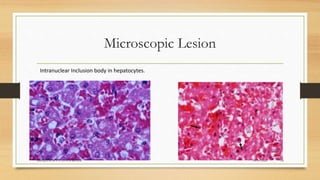
• Virions produce basophilic intranuclear inclusion bodies.
24-09-2020ABHIJITH SP CVAS POOKODE 3
SUSCEPTIBLE HOST
• Dogs are main hosts.
• Immunocompromised dogs get easily affected in endemic areas.
• Also wild animals like foxes, coyotes, bears, wolves get affected.
24-09-2020ABHIJITH SP CVAS POOKODE 4
TRANSMISSION
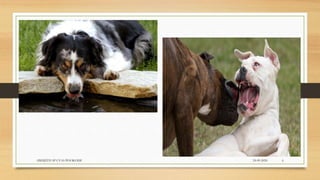
• Urine/Feces/Nasal Secretions/Vomitus etc. can act as transmission agents
since they contain numerous copies of viral particles.
• Recovered dogs shed virus in their urine for ≥ 6 months.
• Ingestion of urine, feces, or saliva of infected dogs is the main route of
infection.
• However, virus may be acquired via conjunctival or aerosol routes.
24-09-2020ABHIJITH SP CVAS POOKODE 5
24-09-2020ABHIJITH SP CVAS POOKODE 6
INCUBATION PERIOD
• 4-9 days.
• ICH is most frequently seen in dogs less than one year of age, although
unvaccinated dogs of all ages can be affected.
• Biphasic fever occurs sometimes.
• First fever due to viremia and second fever due to bacterial infection or due
to toxins .
24-09-2020ABHIJITH SP CVAS POOKODE 7
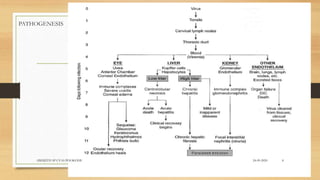
PATHOGENESIS
24-09-2020ABHIJITH SP CVAS POOKODE 8
CLINICAL SIGNS
• Most infections are asymptomatic.
• In systemic infections, there are 3 overlapping syndromes which are usually seen in puppies less
than 6 months old.
• Per-acute disease. Dog is found dead either without apparent preceding illness or after an illness
lasting only 3 or 4 hours. Due to massive destruction of hepatocytes.
• Acute disease. Dogs that survive the viremic phase. Fever, depression, vomiting, bloody diarrhea,
petechial and ecchymotic hemorrhages of the gums, pale mucous membranes, and jaundice.
• Mild cases.
• Clinical signs in uncomplicated ICH last 5-7 days prior to improvement.
• Encephalitis. Common in foxes [fox encephalitis] but less common in dogs.
24-09-2020ABHIJITH SP CVAS POOKODE 9
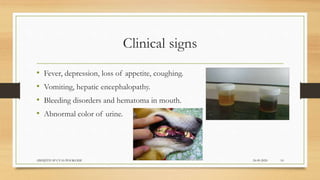
Clinical signs
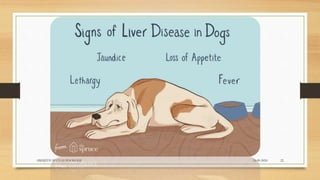
• Fever, depression, loss of appetite, coughing.
• Vomiting, hepatic encephalopathy.
• Bleeding disorders and hematoma in mouth.
• Abnormal color of urine.
24-09-2020ABHIJITH SP CVAS POOKODE 10
Clinical Signs
• Kidney [glomerulonephritis]. Chronic kidney lesions result from immune
complex reactions after recovery from acute or subclinical disease.
• Disseminated intravascular coagulation [DIC]. A frequent complication
of ICH, it begins in the early viremic phase of the disease.
• DIC may be triggered by exposure of subendothelial collagen and
subsequent platelet aggregation and/or inability of the damaged liver to
remove activated clotting factors.
• The urine gets abnormal colour due to liver damage and kidney damage.
24-09-2020ABHIJITH SP CVAS POOKODE 11
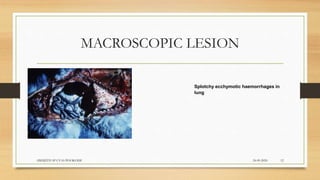
MACROSCOPIC LESION
24-09-2020ABHIJITH SP CVAS POOKODE 12
Splotchy ecchymotic haemorrhages in
lung
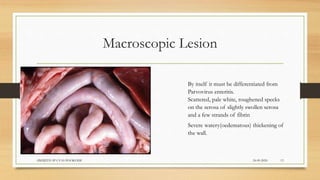
Macroscopic Lesion
24-09-2020ABHIJITH SP CVAS POOKODE 13
By itself it must be differentiated from
Parvovirus enteritis.
Scattered, pale white, roughened specks
on the serosa of slightly swollen serosa
and a few strands of fibrin
Severe watery(oedematous) thickening of
the wall.
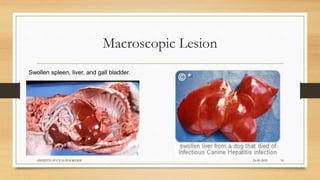
Macroscopic Lesion
24-09-2020ABHIJITH SP CVAS POOKODE 14
Swollen spleen, liver, and gall bladder.
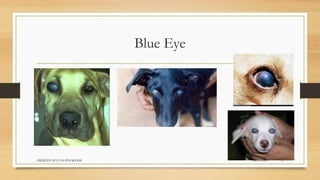
Blue Eye
24-09-2020ABHIJITH SP CVAS POOKODE 15
Why Blue Eye?
• This type III hypersensitivity may be seen during the convalescent phase in about 20% of
clinical cases of infectious canine hepatitis, or 2-3 weeks following vaccination with
modified live canine adenovirus. It is characterized by an anterior uveitis with severe damage
to corneal endothelium, causing profound corneal oedema.
• On or about day 4, virus enters the aqueous humor from the blood and replicates in corneal
endothelial cells.
• By day 7. Severe anterior uveitis and corneal edema develop. Circulating immune complexes
deposited on corneal endothelium [immune complex hypersensitivity] results in complement
activation, neutrophil chemotaxis, frustrated phagocytosis, and corneal endothelial damage.
• Disruption of the corneal endothelium results in accumulation of edematous fluid in the
corneal stroma.
24-09-2020ABHIJITH SP CVAS POOKODE 16
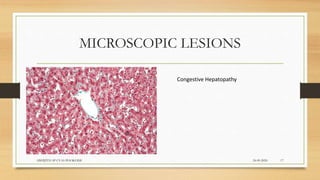
MICROSCOPIC LESIONS
24-09-2020ABHIJITH SP CVAS POOKODE 17
Congestive Hepatopathy
Microscopic Lesion
24-09-2020ABHIJITH SP CVAS POOKODE 18
Intranuclear Inclusion body in hepatocytes.
DIAGNOSIS
• 1.Tentative Diagnosis-Based on clinical signs, history, vaccination schedule
and details from owner.
• 2. Virus isolation in cell culture: Urine, blood, tissue homogenates, etc.
• 3. Antigen detection in tissues: Fluorescent antibody test; PCR.
• 4. Gross and histopathology; hematology [leukopenia].
• 5. Paired sera: Employs virus neutralization, ELISA, or hemagglutination-
inhibition tests.
24-09-2020ABHIJITH SP CVAS POOKODE 19
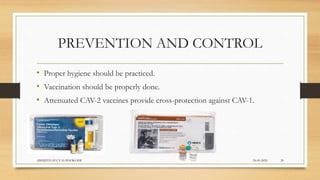
PREVENTION AND CONTROL
• Proper hygiene should be practiced.
• Vaccination should be properly done.
• Attenuated CAV-2 vaccines provide cross-protection against CAV-1.
24-09-2020ABHIJITH SP CVAS POOKODE 20
24-09-2020ABHIJITH SP CVAS POOKODE 21
24-09-2020ABHIJITH SP CVAS POOKODE 22
24-09-2020ABHIJITH SP CVAS POOKODE 23
FACTS.
• 1.Adeno=Gland
• 2.Double stranded linear, non-enveloped, Icosahedral capsid.
• 3. Some adenoviruses are oncogenic.
• 4. Made up of 252 structural capsomeres.
• 5. Adenovirus serotype 14 (Ad14) is a serovar of adenovirus which, unlike other
adenovirus serovars, is known to cause potentially fatal adenovirus infections.
According to the United States Centers for Disease Control and Prevention (CDC),
as of September 2007, outbreaks have been identified in four states in the U.S., with
ten identified deaths since May 2006.
24-09-2020ABHIJITH SP CVAS POOKODE 24
THANK YOU

Infectious Canine Hepatitis

  • 1.
  • 2.
    INTRODUCTION • Infectious caninehepatitis is a worldwide, contagious disease of dogs with signs that vary from a slight fever and congestion of the mucous membranes to severe depression, severe reduction in white blood cells, and deficiency of blood clotting. • In recent years, the disease has become uncommon in areas where routine vaccination is used. • Discovered in early 1950s by a Veterinarian Carl Steven Rubarth. • ICH was first distinguished from canine distemper by Rubarth in 1947 using ferrets; ferrets are resistant to ICH but susceptible to canine distemper. • ICH occurs worldwide. 24-09-2020ABHIJITH SP CVAS POOKODE 2
  • 3.
    AETIOLOGY • Adenoviridae—Canine mastadenovirus1 (CAV-1). • CAV-2 causes Infectious Tracheobronchitis in canines. • Nonenveloped hexagonal virions with icosahedral capsid; 80-100 nm in diameter. • Genome consists of a double-stranded, linear DNA. • Virions replicate in the nucleus; release of progeny virions occurs via cell lysis. • Virions produce basophilic intranuclear inclusion bodies. 24-09-2020ABHIJITH SP CVAS POOKODE 3
  • 4.
    SUSCEPTIBLE HOST • Dogsare main hosts. • Immunocompromised dogs get easily affected in endemic areas. • Also wild animals like foxes, coyotes, bears, wolves get affected. 24-09-2020ABHIJITH SP CVAS POOKODE 4
  • 5.
    TRANSMISSION • Urine/Feces/Nasal Secretions/Vomitusetc. can act as transmission agents since they contain numerous copies of viral particles. • Recovered dogs shed virus in their urine for ≥ 6 months. • Ingestion of urine, feces, or saliva of infected dogs is the main route of infection. • However, virus may be acquired via conjunctival or aerosol routes. 24-09-2020ABHIJITH SP CVAS POOKODE 5
  • 6.
  • 7.
    INCUBATION PERIOD • 4-9days. • ICH is most frequently seen in dogs less than one year of age, although unvaccinated dogs of all ages can be affected. • Biphasic fever occurs sometimes. • First fever due to viremia and second fever due to bacterial infection or due to toxins . 24-09-2020ABHIJITH SP CVAS POOKODE 7
  • 8.
  • 9.
    CLINICAL SIGNS • Mostinfections are asymptomatic. • In systemic infections, there are 3 overlapping syndromes which are usually seen in puppies less than 6 months old. • Per-acute disease. Dog is found dead either without apparent preceding illness or after an illness lasting only 3 or 4 hours. Due to massive destruction of hepatocytes. • Acute disease. Dogs that survive the viremic phase. Fever, depression, vomiting, bloody diarrhea, petechial and ecchymotic hemorrhages of the gums, pale mucous membranes, and jaundice. • Mild cases. • Clinical signs in uncomplicated ICH last 5-7 days prior to improvement. • Encephalitis. Common in foxes [fox encephalitis] but less common in dogs. 24-09-2020ABHIJITH SP CVAS POOKODE 9
  • 10.
    Clinical signs • Fever,depression, loss of appetite, coughing. • Vomiting, hepatic encephalopathy. • Bleeding disorders and hematoma in mouth. • Abnormal color of urine. 24-09-2020ABHIJITH SP CVAS POOKODE 10
  • 11.
    Clinical Signs • Kidney[glomerulonephritis]. Chronic kidney lesions result from immune complex reactions after recovery from acute or subclinical disease. • Disseminated intravascular coagulation [DIC]. A frequent complication of ICH, it begins in the early viremic phase of the disease. • DIC may be triggered by exposure of subendothelial collagen and subsequent platelet aggregation and/or inability of the damaged liver to remove activated clotting factors. • The urine gets abnormal colour due to liver damage and kidney damage. 24-09-2020ABHIJITH SP CVAS POOKODE 11
  • 12.
    MACROSCOPIC LESION 24-09-2020ABHIJITH SPCVAS POOKODE 12 Splotchy ecchymotic haemorrhages in lung
  • 13.
    Macroscopic Lesion 24-09-2020ABHIJITH SPCVAS POOKODE 13 By itself it must be differentiated from Parvovirus enteritis. Scattered, pale white, roughened specks on the serosa of slightly swollen serosa and a few strands of fibrin Severe watery(oedematous) thickening of the wall.
  • 14.
    Macroscopic Lesion 24-09-2020ABHIJITH SPCVAS POOKODE 14 Swollen spleen, liver, and gall bladder.
  • 15.
  • 16.
    Why Blue Eye? •This type III hypersensitivity may be seen during the convalescent phase in about 20% of clinical cases of infectious canine hepatitis, or 2-3 weeks following vaccination with modified live canine adenovirus. It is characterized by an anterior uveitis with severe damage to corneal endothelium, causing profound corneal oedema. • On or about day 4, virus enters the aqueous humor from the blood and replicates in corneal endothelial cells. • By day 7. Severe anterior uveitis and corneal edema develop. Circulating immune complexes deposited on corneal endothelium [immune complex hypersensitivity] results in complement activation, neutrophil chemotaxis, frustrated phagocytosis, and corneal endothelial damage. • Disruption of the corneal endothelium results in accumulation of edematous fluid in the corneal stroma. 24-09-2020ABHIJITH SP CVAS POOKODE 16
  • 17.
    MICROSCOPIC LESIONS 24-09-2020ABHIJITH SPCVAS POOKODE 17 Congestive Hepatopathy
  • 18.
    Microscopic Lesion 24-09-2020ABHIJITH SPCVAS POOKODE 18 Intranuclear Inclusion body in hepatocytes.
  • 19.
    DIAGNOSIS • 1.Tentative Diagnosis-Basedon clinical signs, history, vaccination schedule and details from owner. • 2. Virus isolation in cell culture: Urine, blood, tissue homogenates, etc. • 3. Antigen detection in tissues: Fluorescent antibody test; PCR. • 4. Gross and histopathology; hematology [leukopenia]. • 5. Paired sera: Employs virus neutralization, ELISA, or hemagglutination- inhibition tests. 24-09-2020ABHIJITH SP CVAS POOKODE 19
  • 20.
    PREVENTION AND CONTROL •Proper hygiene should be practiced. • Vaccination should be properly done. • Attenuated CAV-2 vaccines provide cross-protection against CAV-1. 24-09-2020ABHIJITH SP CVAS POOKODE 20
  • 21.
  • 22.
  • 23.
  • 24.
    FACTS. • 1.Adeno=Gland • 2.Doublestranded linear, non-enveloped, Icosahedral capsid. • 3. Some adenoviruses are oncogenic. • 4. Made up of 252 structural capsomeres. • 5. Adenovirus serotype 14 (Ad14) is a serovar of adenovirus which, unlike other adenovirus serovars, is known to cause potentially fatal adenovirus infections. According to the United States Centers for Disease Control and Prevention (CDC), as of September 2007, outbreaks have been identified in four states in the U.S., with ten identified deaths since May 2006. 24-09-2020ABHIJITH SP CVAS POOKODE 24
  • 25.