
Choline
In Transition Diary
Cows
› Choline has been shown to be a required nutrient for many animals including rats, mice,
dogs, pigs, guinea pigs, chickens, and trout.
› Choline is often referred to as a vitamin, although, it doesn’t fit any of the classical
definitions for a vitamin;
1. It is not a co-factor in enzymatic reactions
2. it can be synthesized endogenously as phosphatidylcholine (PC), butThis ability does not mean it is
a dispensable or non-essential nutrient.
3. it is required in larger amounts than vitamins.
What is Choline?
› Choline functions in 4 broad categories in the animal body:
1. It is a metabolic essential for building and maintaining cell structure.
2. Choline plays an essential role in fat metabolism in the liver.
3. Choline is essential for the formation of acetylcholine
4. Choline acts methyl donor
Functions of Choline
› Choline functions in 4 broad
categories in the animal body:
1. It is a metabolic essential for building
and maintaining cell structure.
2. Choline plays an essential role in fat
metabolism in the liver.
3. Choline is essential for the formation of
acetylcholine
4. Choline acts methyl donor
Functions of Choline
› As a component of phospholipid, choline is a
structural part of lecithin
(phosphatidylcholine), of;
1. Certain plasmologens (type of phospholipids
present in immune,CNS, andCVS)
2. Sphingomyelins (type of phospholipids present in
CNS)
› Lecithin is a part of animal cell membranes and
lipid transport moieties in cell plasma
membranes.
› Choline is required as a constituent of the
phospholipids needed for normal maturation
of the cartilage matrix of the bone.
› Choline functions in 4 broad
categories in the animal body:
1. It is a metabolic essential for building
and maintaining cell structure.
2. Choline plays an essential role in fat
metabolism in the liver.
3. Choline is essential for the formation of
acetylcholine
4. Choline acts methyl donor
Functions of Choline
› It prevents abnormal accumulation of fat (fatty
livers) by;
1. Promoting its transport as lecithin
2. Increasing the utilization of fatty acids in the liver
itself
› Choline is thus referred to as a “lipotropic”
factor due to its function of acting on fat
metabolism by accelerating the removal or
decreasing the deposition of fat in liver.
› In broiler liver, fat content was reduced by
adding choline at 760 mg per kg of diet for
birds fed different energy sources.
› Choline functions in 4 broad
categories in the animal body:
1. It is a metabolic essential for building
and maintaining cell structure.
2. Choline plays an essential role in fat
metabolism in the liver.
3. Choline is essential for the formation of
acetylcholine
4. Choline acts methyl donor
Functions of Choline
› Acetylcholine is a substance that makes
possible the transmission of nerve impulses.
› Acetylcholine is released at the termination of
the parasympathetic nerves.
› With acetylcholine, there is transmission of
nerve impulses from presynaptic to
postsynaptic fibers of sympathetic and
parasympathetic nervous systems.
› Choline functions in 4 broad
categories in the animal body:
1. It is a metabolic essential for building
and maintaining cell structure.
2. Choline plays an essential role in fat
metabolism in the liver.
3. Choline is essential for the formation of
acetylcholine
4. Choline acts methyl donor
Functions of Choline
› Choline furnishes labile methyl groups for
formation of;
1. Methionine from homocysteine
2. Creatine from guanidoacetic acid
› Methyl groups function in the synthesis of
purine and pyrimidine, which are used in the
production of DNA.
› Choline functions in 4 broad
categories in the animal body:
1. It is a metabolic essential for building
and maintaining cell structure.
2. Choline plays an essential role in fat
metabolism in the liver.
3. Choline is essential for the formation of
acetylcholine
4. Choline acts methyl donor
Functions of Choline
› Methionine is converted to S-adenosylmethionine
in a reaction catalysed by methionine adenosyl
transferase.
› S-adenosylmethionine is the active methylating
agent for many enzymatic methylations.
› A disturbance in folic acid or methionine
metabolism results in changes in choline
metabolism and vice versa.
› The involvement of folic acid, vitamin B12, and
methionine in methyl group metabolism, and of
methionine in de novo choline synthesis, may allow
these substances to substitute in part for choline.
1. Choline is a critical part of:
a) Acetyl choline
b) Phosphatidylcholine
› Phosphatidylcholine (PC), a phospholipid that is a component of all cell membranes and lipoproteins that
function to transport lipids through the circulatory system
2. Choline is also utilized as a methyl donor to turn homocysteine to methionine.
3. Choline can be oxidized to betaine, which functions as a methyl donor and an
osmolyte.
4. Choline increases energy and protein utilization efficiency.
5. Choline decreases liver fat content in broiler breeders.
6. Choline increased egg size in layers.
Importance
› Deficiency symptoms include;
1. Development of fatty liver
2. Suppressed growth rates
3. Renal dysfunction
Choline Deficiency
› Several studies have shown 50% to 60% of transition cows experience moderate to
severe fatty liver.
› These studies have been conducted in numerous countries across different genetic lines
of cattle, different feedstuffs, and varying management systems and the data were not
generated from a population of problem cows or herds .
› The consistency amongst these studies suggests that development of fatty liver is a
“normal” part of the cow’s biology.
Transition Cow and Fatty Liver
› Because fatty liver is a classic symptom of choline deficiency, it is reasonable to question
Why transition cows are typically deficient in choline?
Cont. …
› At calving there are hormonal changes that trigger an intense period of lipid
mobilization from adipose tissue and resulting in;
1. Blood concentration of “non esterified fatty acid” (NEFA) increase by 5-10 fold.
› NEFA remain elevated, although to a lesser extent, during early lactation when
cows experience negative energy balance.
2. Blood flow to the liver doubles as a cow transitions from the dry period to lactation
(Reynolds et al., 2003).
› High NEFA concentration + increased blood flow to the liver are the two main factors
affecting how much NEFA is taken up by the liver.
Why Transition Dairy Cows Have Fatty
Liver?
› The daily fatty acid uptake by the liver at calving increases by 13-folds, from
approximately 100 g/day to 1300 g/day
› Not all of the fatty acids taken up by the liver will be stored and contribute to fatty liver.
› Drackely (2001) estimated that during peak blood NEFA concentration, approximately
600 g might be deposited in 24 hours, which would correspond to an increase in liver fat
of 6-7% by weight.
› As a reference, fat above 5% in the liver (wet basis) is considered by the veterinary
community to be moderate to severe fatty liver.
Cont. …
› It is important to understand that this dramatic increase in NEFA uptake by the liver is
part of the normal biology of transition cows and is not restricted to;
1. Fat cows
2. Poorly fed cows
3. Cows housed in suboptimal environments.
Cont. …
› The most desirable fate of fatty acids entering the liver would be;
1. Complete oxidation to provide energy to the liver
› Hepatic oxidation increases approximately 20% during the transition period.
› This increase does not represent a strategic move by the cow’s liver to cope with the sudden
surge of NEFA uptake at calving. It occurs because the liver becomes metabolically more active.
› Unfortunately, the increase in oxidation is not sufficient to cope with the increased load of fatty
acid being presented to the liver.
2. Re-esterification and export as triglyceride from the liver as part of a very low
density lipoprotein (VLDL).
› Research revealed that ruminants have a low capacity to export triglyceride from the liver as
very low density lipoprotein (VLDL) as compared to nonruminants.
Fate of Fatty Acids
› Why transition dairy cattle develop fatty liver?
1. They are subjected to elevated blood NEFA.
2. They have a low capacity to export triglyceride from the liver as very low density lipoprotein (VLDL)
as compared to nonruminants.
3. They are unable to markedly increase fatty acid oxidation
Fatty Liver – Transition Cows - Summary
› Sharma and Erdman (1988) demonstrated dietary choline is extensively degraded in the
rumen of dairy cows and very little is available to the small intestine for absorption.
› Increasing choline intake by 300gm/day would increase choline flow to the duodenum
by less than 2 g/day.
› Therefore, ruminants are more highly dependent than nonruminants on endogenous
synthesis of PC from PE.
Choline – Rumen Degradation
Is endogenous synthesis of PC from PE sufficient during the transition period or
do cows require choline supplementation?
› The high proportion of transition cows developing moderate to severe fatty liver during
the transition period suggests that endogenous synthesis is not sufficient in many cows.
Question
› Choline deficiency is a limiting factor forVLDL triglyceride export from the liver.
› There is no evidence that synthesis of any other phospholipid (rather than PC) is
required for hepaticVLDL assembly and secretion.
› It has been shown in many species that rate ofVLDL export is highly related to the rate
of hepatic PC synthesis.
› In addition to direct PC synthesis from dietary choline, there is endogenous hepatic
synthesis of PC via methylation of phosphotidylethanolamine(PE).
Choline Deficiency – Fatty Liver
› There are some solid evidences that choline limitation is a causative factor for
inadequate fat export out of the liver and leads to the fatty liver;
1. The development of fatty liver during the periparturient period.
2. The alleviation of fatty liver when supplying cows with rumen protected choline.
3. The greater gene expression for microsomal triglyceride transfer protein (MTTP) in liver of
transition cows supplemented with rumen protected choline (RPC).
› Microsomal triglyceride transfer protein (MTP) facilitates the transport of dietary and
endogenous fat by the intestine and liver by assisting in the assembly and secretion of
triglyceride-rich apolipoprotein B-containing lipoproteins.
› MTTP is an important protein required for hepaticVLDL synthesis.
Cont. …
› Recently, it was shown that choline, but not methionine, increasesVLDL secretion from
primary bovine.
› The reduction in liver fat content when feeding transition cows Rumen Protected
Choline (RPC) is accompanied by improved health and production.
› It has been known for years that elevated fat in the liver is associated with poor
reproductive performance.
Choline – Lipotropic Effect
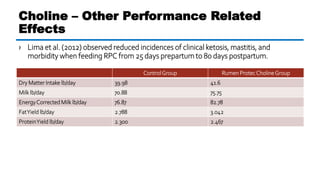
› Lima et al. (2012) observed reduced incidences of clinical ketosis, mastitis, and
morbidity when feeding RPC from 25 days prepartum to 80 days postpartum.
Choline – Other Performance Related
Effects
ControlGroup Rumen ProtecCholineGroup
Dry Matter Intake lb/day 39.98 41.6
Milk lb/day 70.88 75.75
EnergyCorrected Milk lb/day 76.87 82.78
FatYield lb/day 2.788 3.042
ProteinYield lb/day 2.300 2.467
› Things in common between choline and methionine;
– Methionine and choline both serve as methyl donors.
› Methionine methyl groups can be used for endogenous synthesis of PC from PE.
› Choline is oxidized to betaine and the methyl groups can be used for transforming homocysteine to
methionine.
› That’s why;
– Protected methionine has often been suggested as a possible alternative to protected choline for
supplementation to transition dairy cows.
– Protected choline is suggested to be alternative for protected methionine.
› Since, methionine is needed for the synthesis of apolipoproteins (Apolipoproteins are proteins
that bind lipids form lipoproteins.They transport lipids in blood, cerebrospinal fluid and lymph),
again …..
Can Protected Methionine Substitute For Protected Choline?
Can Protected Methionine Substitute For
Protected Choline?
› 6 feeding trials have been conducted to examine the effects of rumen-protected
methionine or methionine analog on liver total lipid or triglyceride content and none of
them showed a reduction.
The Answer is No
› The reason for methionine’s failure to prevent fatty liver in transition cows is not known.
Sone explanations may be;
1. As previously mentioned, choline, but not methionine, increasesVLDL secretion from primary
bovine hepatocytes.
2. Choline contains three methyl groups while methionine only contains one methyl group.
3. When putting in account differences in molecular weight between choline and methionine, choline
by weight is 4.3 times more “potent” than methionine as a methyl donor.
4. Therefore, assuming equal bioavailability of the rumen-protected products being fed, you need to
feed 64.5 g/d of methionine during the transition period to obtain a similar amount of methyl
groups as when feeding 15 g/d of choline.
The Reason
THANK YOU

Choline_Transition Dairy Cows_Fatty Liver.pptx

  • 1.
  • 2.
    › Choline hasbeen shown to be a required nutrient for many animals including rats, mice, dogs, pigs, guinea pigs, chickens, and trout. › Choline is often referred to as a vitamin, although, it doesn’t fit any of the classical definitions for a vitamin; 1. It is not a co-factor in enzymatic reactions 2. it can be synthesized endogenously as phosphatidylcholine (PC), butThis ability does not mean it is a dispensable or non-essential nutrient. 3. it is required in larger amounts than vitamins. What is Choline?
  • 3.
    › Choline functionsin 4 broad categories in the animal body: 1. It is a metabolic essential for building and maintaining cell structure. 2. Choline plays an essential role in fat metabolism in the liver. 3. Choline is essential for the formation of acetylcholine 4. Choline acts methyl donor Functions of Choline
  • 4.
    › Choline functionsin 4 broad categories in the animal body: 1. It is a metabolic essential for building and maintaining cell structure. 2. Choline plays an essential role in fat metabolism in the liver. 3. Choline is essential for the formation of acetylcholine 4. Choline acts methyl donor Functions of Choline › As a component of phospholipid, choline is a structural part of lecithin (phosphatidylcholine), of; 1. Certain plasmologens (type of phospholipids present in immune,CNS, andCVS) 2. Sphingomyelins (type of phospholipids present in CNS) › Lecithin is a part of animal cell membranes and lipid transport moieties in cell plasma membranes. › Choline is required as a constituent of the phospholipids needed for normal maturation of the cartilage matrix of the bone.
  • 5.
    › Choline functionsin 4 broad categories in the animal body: 1. It is a metabolic essential for building and maintaining cell structure. 2. Choline plays an essential role in fat metabolism in the liver. 3. Choline is essential for the formation of acetylcholine 4. Choline acts methyl donor Functions of Choline › It prevents abnormal accumulation of fat (fatty livers) by; 1. Promoting its transport as lecithin 2. Increasing the utilization of fatty acids in the liver itself › Choline is thus referred to as a “lipotropic” factor due to its function of acting on fat metabolism by accelerating the removal or decreasing the deposition of fat in liver. › In broiler liver, fat content was reduced by adding choline at 760 mg per kg of diet for birds fed different energy sources.
  • 6.
    › Choline functionsin 4 broad categories in the animal body: 1. It is a metabolic essential for building and maintaining cell structure. 2. Choline plays an essential role in fat metabolism in the liver. 3. Choline is essential for the formation of acetylcholine 4. Choline acts methyl donor Functions of Choline › Acetylcholine is a substance that makes possible the transmission of nerve impulses. › Acetylcholine is released at the termination of the parasympathetic nerves. › With acetylcholine, there is transmission of nerve impulses from presynaptic to postsynaptic fibers of sympathetic and parasympathetic nervous systems.
  • 7.
    › Choline functionsin 4 broad categories in the animal body: 1. It is a metabolic essential for building and maintaining cell structure. 2. Choline plays an essential role in fat metabolism in the liver. 3. Choline is essential for the formation of acetylcholine 4. Choline acts methyl donor Functions of Choline › Choline furnishes labile methyl groups for formation of; 1. Methionine from homocysteine 2. Creatine from guanidoacetic acid › Methyl groups function in the synthesis of purine and pyrimidine, which are used in the production of DNA.
  • 8.
    › Choline functionsin 4 broad categories in the animal body: 1. It is a metabolic essential for building and maintaining cell structure. 2. Choline plays an essential role in fat metabolism in the liver. 3. Choline is essential for the formation of acetylcholine 4. Choline acts methyl donor Functions of Choline › Methionine is converted to S-adenosylmethionine in a reaction catalysed by methionine adenosyl transferase. › S-adenosylmethionine is the active methylating agent for many enzymatic methylations. › A disturbance in folic acid or methionine metabolism results in changes in choline metabolism and vice versa. › The involvement of folic acid, vitamin B12, and methionine in methyl group metabolism, and of methionine in de novo choline synthesis, may allow these substances to substitute in part for choline.
  • 9.
    1. Choline isa critical part of: a) Acetyl choline b) Phosphatidylcholine › Phosphatidylcholine (PC), a phospholipid that is a component of all cell membranes and lipoproteins that function to transport lipids through the circulatory system 2. Choline is also utilized as a methyl donor to turn homocysteine to methionine. 3. Choline can be oxidized to betaine, which functions as a methyl donor and an osmolyte. 4. Choline increases energy and protein utilization efficiency. 5. Choline decreases liver fat content in broiler breeders. 6. Choline increased egg size in layers. Importance
  • 10.
    › Deficiency symptomsinclude; 1. Development of fatty liver 2. Suppressed growth rates 3. Renal dysfunction Choline Deficiency
  • 11.
    › Several studieshave shown 50% to 60% of transition cows experience moderate to severe fatty liver. › These studies have been conducted in numerous countries across different genetic lines of cattle, different feedstuffs, and varying management systems and the data were not generated from a population of problem cows or herds . › The consistency amongst these studies suggests that development of fatty liver is a “normal” part of the cow’s biology. Transition Cow and Fatty Liver
  • 12.
    › Because fattyliver is a classic symptom of choline deficiency, it is reasonable to question Why transition cows are typically deficient in choline? Cont. …
  • 13.
    › At calvingthere are hormonal changes that trigger an intense period of lipid mobilization from adipose tissue and resulting in; 1. Blood concentration of “non esterified fatty acid” (NEFA) increase by 5-10 fold. › NEFA remain elevated, although to a lesser extent, during early lactation when cows experience negative energy balance. 2. Blood flow to the liver doubles as a cow transitions from the dry period to lactation (Reynolds et al., 2003). › High NEFA concentration + increased blood flow to the liver are the two main factors affecting how much NEFA is taken up by the liver. Why Transition Dairy Cows Have Fatty Liver?
  • 14.
    › The dailyfatty acid uptake by the liver at calving increases by 13-folds, from approximately 100 g/day to 1300 g/day › Not all of the fatty acids taken up by the liver will be stored and contribute to fatty liver. › Drackely (2001) estimated that during peak blood NEFA concentration, approximately 600 g might be deposited in 24 hours, which would correspond to an increase in liver fat of 6-7% by weight. › As a reference, fat above 5% in the liver (wet basis) is considered by the veterinary community to be moderate to severe fatty liver. Cont. …
  • 15.
    › It isimportant to understand that this dramatic increase in NEFA uptake by the liver is part of the normal biology of transition cows and is not restricted to; 1. Fat cows 2. Poorly fed cows 3. Cows housed in suboptimal environments. Cont. …
  • 16.
    › The mostdesirable fate of fatty acids entering the liver would be; 1. Complete oxidation to provide energy to the liver › Hepatic oxidation increases approximately 20% during the transition period. › This increase does not represent a strategic move by the cow’s liver to cope with the sudden surge of NEFA uptake at calving. It occurs because the liver becomes metabolically more active. › Unfortunately, the increase in oxidation is not sufficient to cope with the increased load of fatty acid being presented to the liver. 2. Re-esterification and export as triglyceride from the liver as part of a very low density lipoprotein (VLDL). › Research revealed that ruminants have a low capacity to export triglyceride from the liver as very low density lipoprotein (VLDL) as compared to nonruminants. Fate of Fatty Acids
  • 17.
    › Why transitiondairy cattle develop fatty liver? 1. They are subjected to elevated blood NEFA. 2. They have a low capacity to export triglyceride from the liver as very low density lipoprotein (VLDL) as compared to nonruminants. 3. They are unable to markedly increase fatty acid oxidation Fatty Liver – Transition Cows - Summary
  • 18.
    › Sharma andErdman (1988) demonstrated dietary choline is extensively degraded in the rumen of dairy cows and very little is available to the small intestine for absorption. › Increasing choline intake by 300gm/day would increase choline flow to the duodenum by less than 2 g/day. › Therefore, ruminants are more highly dependent than nonruminants on endogenous synthesis of PC from PE. Choline – Rumen Degradation
  • 19.
    Is endogenous synthesisof PC from PE sufficient during the transition period or do cows require choline supplementation? › The high proportion of transition cows developing moderate to severe fatty liver during the transition period suggests that endogenous synthesis is not sufficient in many cows. Question
  • 20.
    › Choline deficiencyis a limiting factor forVLDL triglyceride export from the liver. › There is no evidence that synthesis of any other phospholipid (rather than PC) is required for hepaticVLDL assembly and secretion. › It has been shown in many species that rate ofVLDL export is highly related to the rate of hepatic PC synthesis. › In addition to direct PC synthesis from dietary choline, there is endogenous hepatic synthesis of PC via methylation of phosphotidylethanolamine(PE). Choline Deficiency – Fatty Liver
  • 21.
    › There aresome solid evidences that choline limitation is a causative factor for inadequate fat export out of the liver and leads to the fatty liver; 1. The development of fatty liver during the periparturient period. 2. The alleviation of fatty liver when supplying cows with rumen protected choline. 3. The greater gene expression for microsomal triglyceride transfer protein (MTTP) in liver of transition cows supplemented with rumen protected choline (RPC). › Microsomal triglyceride transfer protein (MTP) facilitates the transport of dietary and endogenous fat by the intestine and liver by assisting in the assembly and secretion of triglyceride-rich apolipoprotein B-containing lipoproteins. › MTTP is an important protein required for hepaticVLDL synthesis. Cont. …
  • 22.
    › Recently, itwas shown that choline, but not methionine, increasesVLDL secretion from primary bovine. › The reduction in liver fat content when feeding transition cows Rumen Protected Choline (RPC) is accompanied by improved health and production. › It has been known for years that elevated fat in the liver is associated with poor reproductive performance. Choline – Lipotropic Effect
  • 23.
    › Lima etal. (2012) observed reduced incidences of clinical ketosis, mastitis, and morbidity when feeding RPC from 25 days prepartum to 80 days postpartum. Choline – Other Performance Related Effects ControlGroup Rumen ProtecCholineGroup Dry Matter Intake lb/day 39.98 41.6 Milk lb/day 70.88 75.75 EnergyCorrected Milk lb/day 76.87 82.78 FatYield lb/day 2.788 3.042 ProteinYield lb/day 2.300 2.467
  • 24.
    › Things incommon between choline and methionine; – Methionine and choline both serve as methyl donors. › Methionine methyl groups can be used for endogenous synthesis of PC from PE. › Choline is oxidized to betaine and the methyl groups can be used for transforming homocysteine to methionine. › That’s why; – Protected methionine has often been suggested as a possible alternative to protected choline for supplementation to transition dairy cows. – Protected choline is suggested to be alternative for protected methionine. › Since, methionine is needed for the synthesis of apolipoproteins (Apolipoproteins are proteins that bind lipids form lipoproteins.They transport lipids in blood, cerebrospinal fluid and lymph), again ….. Can Protected Methionine Substitute For Protected Choline? Can Protected Methionine Substitute For Protected Choline?
  • 25.
    › 6 feedingtrials have been conducted to examine the effects of rumen-protected methionine or methionine analog on liver total lipid or triglyceride content and none of them showed a reduction. The Answer is No
  • 26.
    › The reasonfor methionine’s failure to prevent fatty liver in transition cows is not known. Sone explanations may be; 1. As previously mentioned, choline, but not methionine, increasesVLDL secretion from primary bovine hepatocytes. 2. Choline contains three methyl groups while methionine only contains one methyl group. 3. When putting in account differences in molecular weight between choline and methionine, choline by weight is 4.3 times more “potent” than methionine as a methyl donor. 4. Therefore, assuming equal bioavailability of the rumen-protected products being fed, you need to feed 64.5 g/d of methionine during the transition period to obtain a similar amount of methyl groups as when feeding 15 g/d of choline. The Reason
  • 27.

Editor's Notes