






Avian Salmonellosis
Part 1 - Introduction
Part 2 - Disease Overview
Part 3 - Control Strategies
Part 4 - Vaccination
Part 1 – Introduction
Plan of Talk
› Salmonella historical affections
› Typhoid Mary
› Salmonella recent outbreaks
› Fact about Salmonella
– Breeder and salmonella
– Laying hens and salmonella
– Role of males in vertical transmission
– Salmonella and rodents
– Chick early infection
– Salmonella transmission by egg contamination
Plan of Talk
› Salmonella historical affections
› Typhoid Mary
› Salmonella recent outbreaks
› Fact about Salmonella
– Breeder and salmonella
– Laying hens and salmonella
– Role of males in vertical transmission
– Salmonella and rodents
– Chick early infection
– Salmonella transmission by egg contamination
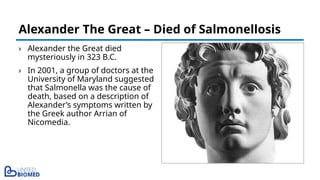
› Alexander the Great died
mysteriously in 323 B.C.
› In 2001, a group of doctors at the
University of Maryland suggested
that Salmonella was the cause of
death, based on a description of
Alexander’s symptoms written by
the Greek author Arrian of
Nicomedia.
Alexander The Great – Died of Salmonellosis
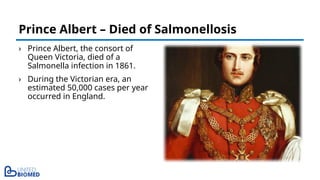
› Prince Albert, the consort of
Queen Victoria, died of a
Salmonella infection in 1861.
› During the Victorian era, an
estimated 50,000 cases per year
occurred in England.
Prince Albert – Died of Salmonellosis
› Scholars working on the history
of Jamestown, Virginia, believe
that a typhoid outbreak was
responsible for deaths of over
6,000 settlers between 1607 and
1624.
Jamestown Colony
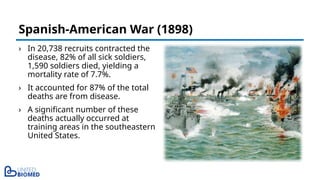
› In 20,738 recruits contracted the
disease, 82% of all sick soldiers,
1,590 soldiers died, yielding a
mortality rate of 7.7%.
› It accounted for 87% of the total
deaths are from disease.
› A significant number of these
deaths actually occurred at
training areas in the southeastern
United States.
Spanish-American War (1898)
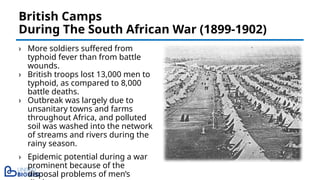
› More soldiers suffered from
typhoid fever than from battle
wounds.
› British troops lost 13,000 men to
typhoid, as compared to 8,000
battle deaths.
› Outbreak was largely due to
unsanitary towns and farms
throughout Africa, and polluted
soil was washed into the network
of streams and rivers during the
rainy season.
› Epidemic potential during a war
prominent because of the
disposal problems of men’s
British Camps
During The South African War (1899-1902)
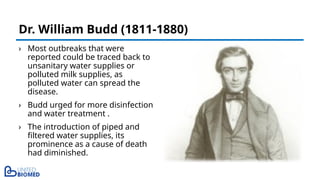
› Most outbreaks that were
reported could be traced back to
unsanitary water supplies or
polluted milk supplies, as
polluted water can spread the
disease.
› Budd urged for more disinfection
and water treatment .
› The introduction of piped and
filtered water supplies, its
prominence as a cause of death
had diminished.
Dr. William Budd (1811-1880)
Plan of Talk
› Salmonella historical affections
› Typhoid Mary
› Salmonella recent outbreaks
› Fact about Salmonella
– Breeder and salmonella
– Laying hens and salmonella
– Role of males in vertical transmission
– Salmonella and rodents
– Chick early infection
– Salmonella transmission by egg contamination
› Some individuals have natural immunity to Salmonella, they are known
as “chronic carriers”
› They have only mild or asymptomatic disease, but still carry the bacteria
in their body for a long time.
› These cases serve as natural reservoir for the disease.
› Approximately 3% of persons infected with S typhi and 0.1% of those
infected with non-typhoidal salmonellae become chronic carriers.
› The carrier state may last from many weeks to years. Thus, human as
well as animal reservoirs exist.
Salmonella Carriers
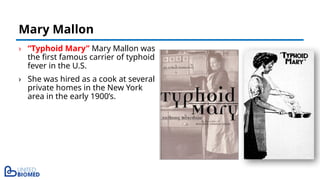
› “Typhoid Mary” Mary Mallon was
the first famous carrier of typhoid
fever in the U.S.
› She was hired as a cook at several
private homes in the New York
area in the early 1900’s.
Mary Mallon
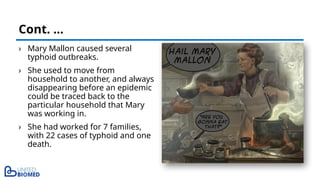
› Mary Mallon caused several
typhoid outbreaks.
› She used to move from
household to another, and always
disappearing before an epidemic
could be traced back to the
particular household that Mary
was working in.
› She had worked for 7 families,
with 22 cases of typhoid and one
death.
Cont. …
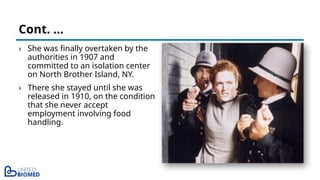
› She was finally overtaken by the
authorities in 1907 and
committed to an isolation center
on North Brother Island, NY.
› There she stayed until she was
released in 1910, on the condition
that she never accept
employment involving food
handling.
Cont. …
› But she was found to work as a
cook and to cause typhoid
outbreaks again.
› She was admitted back to North
Brother Island, where she lived
until her death in 1938.
Cont. …
Plan of Talk
› Salmonella historical affections
› Typhoid Mary
› Salmonella recent outbreaks
› Fact about Salmonella
– Breeder and salmonella
– Laying hens and salmonella
– Role of males in vertical transmission
– Salmonella and rodents
– Chick early infection
– Salmonella transmission by egg contamination
› More recently reported outbreaks in the U.S. involve different kinds of
Salmonella strains, predominantly S. enteritidis and S. typhimurium.
Recent Outbreaks
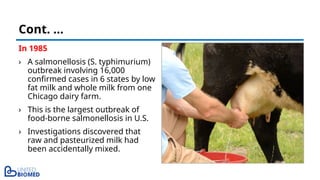
In 1985
› A salmonellosis (S. typhimurium)
outbreak involving 16,000
confirmed cases in 6 states by low
fat milk and whole milk from one
Chicago dairy farm.
› This is the largest outbreak of
food-borne salmonellosis in U.S.
› Investigations discovered that
raw and pasteurized milk had
been accidentally mixed.
Cont. …
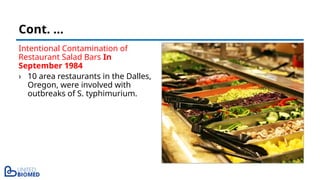
Intentional Contamination of
Restaurant Salad Bars In
September 1984
› 10 area restaurants in the Dalles,
Oregon, were involved with
outbreaks of S. typhimurium.
Cont. …
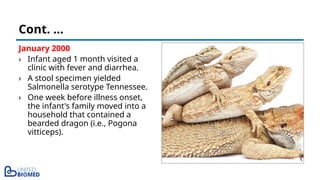
January 2000
› Infant aged 1 month visited a
clinic with fever and diarrhea.
› A stool specimen yielded
Salmonella serotype Tennessee.
› One week before illness onset,
the infant's family moved into a
household that contained a
bearded dragon (i.e., Pogona
vitticeps).
Cont. …
During June 2002
› A child aged 21 months was
admitted to a hospital with fever,
abdominal cramps, and bloody
diarrhea.
› Blood and stool cultures yielded
Salmonella serotype Poona (from
pet Iguana).
Cont. …
Plan of Talk
› Salmonella historical affections
› Typhoid Mary
› Salmonella recent outbreaks
› Fact about Salmonella
– Breeder and salmonella
– Laying hens and salmonella
– Role of males in vertical transmission
– Salmonella and rodents
– Chick early infection
– Salmonella transmission by egg contamination
Study Aim
› Many scientists have implicated
breeder chickens as vehicles for
vertical transmission of Salmonella to
the fertile egg.
Study Design
› In 1991, Cox et al. evaluated 6
commercial broiler breeder
hatcheries for the presence and level
of salmonellae in;
1. Egg fragments
2. Paper pads from chick boxes
3. Chick fluff
Breeder and Salmonella
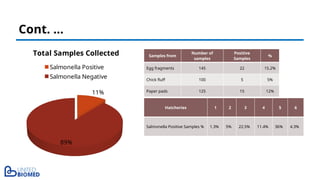
11%
89%
Total Samples Collected
Salmonella Positive
Salmonella Negative
Cont. …
Samples from
Number of
samples
Positive
Samples
%
Egg fragments 145 22 15.2%
Chick fluff 100 5 5%
Paper pads 125 15 12%
Hatcheries 1 2 3 4 5 6
Salmonella Positive Samples % 1.3% 5% 22.5% 11.4% 36% 4.3%
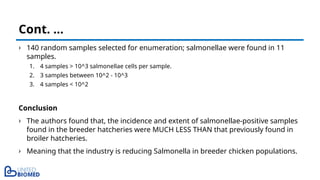
› 140 random samples selected for enumeration; salmonellae were found in 11
samples.
1. 4 samples > 10^3 salmonellae cells per sample.
2. 3 samples between 10^2 - 10^3
3. 4 samples < 10^2
Conclusion
› The authors found that, the incidence and extent of salmonellae-positive samples
found in the breeder hatcheries were MUCH LESS THAN that previously found in
broiler hatcheries.
› Meaning that the industry is reducing Salmonella in breeder chicken populations.
Cont. …
Plan of Talk
› Salmonella historical affections
› Typhoid Mary
› Salmonella recent outbreaks
› Fact about Salmonella
– Breeder and salmonella
– Laying hens and salmonella
– Salmonella serotypes in breeders house and in hatcheries
– Role of males in vertical transmission
– Salmonella and rodents
– Chick early infection
– Salmonella transmission by egg contamination
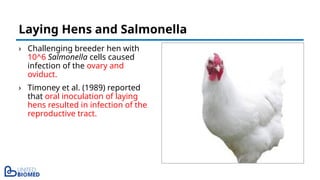
› Challenging breeder hen with
10^6 Salmonella cells caused
infection of the ovary and
oviduct.
› Timoney et al. (1989) reported
that oral inoculation of laying
hens resulted in infection of the
reproductive tract.
Laying Hens and Salmonella
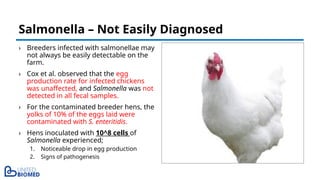
› Breeders infected with salmonellae may
not always be easily detectable on the
farm.
› Cox et al. observed that the egg
production rate for infected chickens
was unaffected, and Salmonella was not
detected in all fecal samples.
› For the contaminated breeder hens, the
yolks of 10% of the eggs laid were
contaminated with S. enteritidis.
› Hens inoculated with 10^8 cells of
Salmonella experienced;
1. Noticeable drop in egg production
2. Signs of pathogenesis
Salmonella – Not Easily Diagnosed
Plan of Talk
› Salmonella historical affections
› Typhoid Mary
› Salmonella recent outbreaks
› Fact about Salmonella
– Breeder and salmonella
– Laying hens and salmonella
– Role of males in vertical transmission
– Salmonella and rodents
– Chick early infection
– Salmonella transmission by egg contamination
› In 1995 Reiber et al. conducted
three experiments to determine
the bacteriological quality of
rooster semen.
› The most frequently isolated
genera of bacteria from rooster
semen included;
1. Escherichia
2. Staphylococcus
3. Micrococcus
4. Enterococcus
5. Salmonella
Role of Males in Vertical Transmission
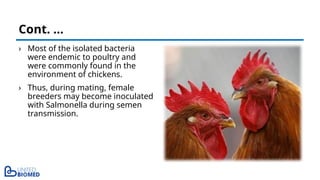
› Most of the isolated bacteria
were endemic to poultry and
were commonly found in the
environment of chickens.
› Thus, during mating, female
breeders may become inoculated
with Salmonella during semen
transmission.
Cont. …
Plan of Talk
› Salmonella historical affections
› Typhoid Mary
› Salmonella recent outbreaks
› Fact about Salmonella
– Breeder and salmonella
– Laying hens and salmonella
– Role of males in vertical transmission
– Salmonella and rodents
– Chick early infection
– Salmonella transmission by egg contamination
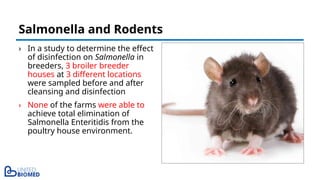
› In a study to determine the effect
of disinfection on Salmonella in
breeders, 3 broiler breeder
houses at 3 different locations
were sampled before and after
cleansing and disinfection
› None of the farms were able to
achieve total elimination of
Salmonella Enteritidis from the
poultry house environment.
Salmonella and Rodents
› The authors concluded that, in
each of the 3 breeder houses,
failure to eliminate mice from the
house that was infected with S.
Enteritidis was likely to be the
most important hazard for
transmission to the next flock
Cont. …
Plan of Talk
› Salmonella historical affections
› Typhoid Mary
› Salmonella recent outbreaks
› Fact about Salmonella
– Breeder and salmonella
– Laying hens and salmonella
– Role of males in vertical transmission
– Salmonella and rodents
– Chick early infection
– Salmonella transmission by egg contamination
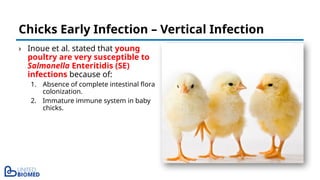
› Inoue et al. stated that young
poultry are very susceptible to
Salmonella Enteritidis (SE)
infections because of:
1. Absence of complete intestinal flora
colonization.
2. Immature immune system in baby
chicks.
Chicks Early Infection – Vertical Infection
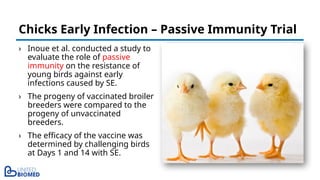
› Inoue et al. conducted a study to
evaluate the role of passive
immunity on the resistance of
young birds against early
infections caused by SE.
› The progeny of vaccinated broiler
breeders were compared to the
progeny of unvaccinated
breeders.
› The efficacy of the vaccine was
determined by challenging birds
at Days 1 and 14 with SE.
Chicks Early Infection – Passive Immunity Trial
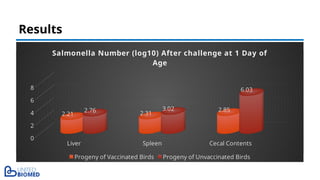
Liver Spleen Cecal Contents
0
2
4
6
8
2.21 2.31
2.85
2.76 3.02
6.03
Salmonella Number (log10) After challenge at 1 Day of
Age
Progeny of Vaccinated Birds Progeny of Unvaccinated Birds
Results
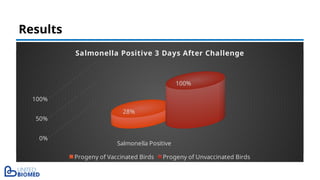
Salmonella Positive
0%
50%
100%
28%
100%
Salmonella Positive 3 Days After Challenge
Progeny of Vaccinated Birds Progeny of Unvaccinated Birds
Results
› Birds that were challenged at 14 days of age showed a lower number of
positive samples compared with those challenged at 1 day of age.
› Age influenced the susceptibility of birds to SE infections.
Conclusion
Plan of Talk
› Salmonella historical affections
› Typhoid Mary
› Salmonella recent outbreaks
› Fact about Salmonella
– Breeder and salmonella
– Laying hens and salmonella
– Role of males in vertical transmission
– Salmonella and rodents
– Chick early infection
– Salmonella transmission by egg contamination
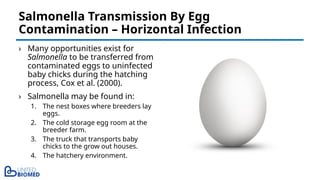
› Many opportunities exist for
Salmonella to be transferred from
contaminated eggs to uninfected
baby chicks during the hatching
process, Cox et al. (2000).
› Salmonella may be found in:
1. The nest boxes where breeders lay
eggs.
2. The cold storage egg room at the
breeder farm.
3. The truck that transports baby
chicks to the grow out houses.
4. The hatchery environment.
Salmonella Transmission By Egg
Contamination – Horizontal Infection
› One mechanism for natural contamination of the eggs is when moist,
freshly laid eggs are cooled from the body temperature of the hen to the
air temperature, the internal contents of the egg shrink, pulling bacteria
into the shell through pores …
› Once transferred
› Salmonella is carried on the surface of the shell or just beneath the shell
if it is able to penetrate the shell.
Cont. …
Part 2 – Disease Overview
Plan of Talk
› Etiology
› Salmonella life cycle
› Transmission
› Pathogenesis
› Clinical signs
› Post mortem lesions
› Treatment
Plan of Talk
› Etiology
› Salmonella life cycle
› Transmission
› Pathogenesis
› Clinical signs
› Post mortem lesions
› Treatment
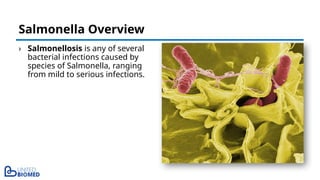
› Salmonellosis is any of several
bacterial infections caused by
species of Salmonella, ranging
from mild to serious infections.
Salmonella Overview
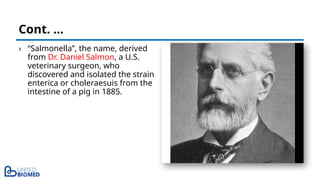
› “Salmonella”, the name, derived
from Dr. Daniel Salmon, a U.S.
veterinary surgeon, who
discovered and isolated the strain
enterica or choleraesuis from the
intestine of a pig in 1885.
Cont. …
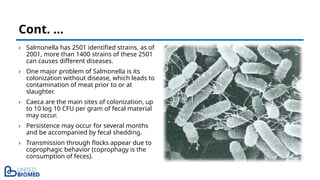
› Salmonella has 2501 identified strains, as of
2001, more than 1400 strains of these 2501
can causes different diseases.
› One major problem of Salmonella is its
colonization without disease, which leads to
contamination of meat prior to or at
slaughter.
› Caeca are the main sites of colonization, up
to 10 log 10 CFU per gram of fecal material
may occur.
› Persistence may occur for several months
and be accompanied by fecal shedding.
› Transmission through flocks appear due to
coprophagic behavior (coprophagy is the
consumption of feces).
Cont. …
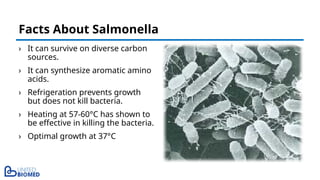
› It can survive on diverse carbon
sources.
› It can synthesize aromatic amino
acids.
› Refrigeration prevents growth
but does not kill bacteria.
› Heating at 57-60°C has shown to
be effective in killing the bacteria.
› Optimal growth at 37°C
Facts About Salmonella
1. Colonization of GIT + little or no systemic invasion.
– E.g. S. Hadar, S. Infantis
2. Colonization of GIT + transient systemic infection + occasional vertical
transmission
– E.g. S. Typhimurium, S. Enteritidis
3. Systemic infection + little or no colonization of GIT + vertical
transmission.
– E.g. S. Gallinarum, S. Pullorum.
Types Of Salmonella Infection In Poultry
› S. Gallinarum
– Causes sever systemic disease of all age (fowl typhoid).
– Fowl Typhoid has a mortality rate around 60%.
› S. Pullorum
– Causes sever systemic disease in chicks with mortality up to 90%.
– Characterized by white diarrhea.
– Disease is less sever in older birds.
– A carrier state leading to reproductive tract infection may occur in hens with S.
Pullorum leading to vertical transmission.
Systemic Disease of Poultry - Specific Serovars
› Salmonella is distributed worldwide and is endemic to areas where
animal husbandry is practiced.
› Serovars also vary in their distribution across the world, with ST and SE
being prevalent everywhere.
› Some serovars are host-specific, like;
1. Salmonella ser. Abortusovis in sheep
2. Salmonella ser. Choleraesuis in pigs
3. Salmonella ser. Dublin in cattle
Global Presence
› Salmonella is the leading cause of foodborne diseases worldwide that
infects the gastrointestinal tract in human and causes;
1. Diarrhea
2. Nausea
3. Cramps
› The Center for Disease Control and Prevention (CDC) estimates that
approximately 1.35 million infections and 420 deaths are reported
annually in the United States.
› Salmonella enterica ser. Enteritidis (S. Enteritidis), and Salmonella
enterica ser. Typhimurium (S. Typhimurium), belonging to the non-
typhoidal Salmonella group (NTS), is responsible for the majority of
human salmonellosis.
Salmonella in Human
› Globally, non-typhoidal Salmonella is responsible for approximately 93
million cases of gastroenteritis and 155,000 fatalities annually.
› The severity of human salmonellosis varies depending on factors such
as;
1. The strain causing the infection
2. Host health conditions
3. Host age
› It has been reported that the infective dose in a human infant is
reported to be 100 bacterial cells, and even fewer cells are required to
cause an infection in an immunocompromised individual.
Cont. …
› Typhoidal Salmonella serovars;
– Like S. Typhi and S. Paratyphi
– They are human pathogens
– They are transmitted via the fecal-oral route
› Non-Typhoidal-Salmonella (NTS)
– They are is zoonotic
– They can infect a wide range of animal reservoirs, including birds, reptiles, dogs,
cats, and rodents.
Salmonella Zoonotic Importance
› The primary reservoir for Salmonella in animals, particularly poultry, is
the primary source of food-borne human salmonellosis.
› Transmission occurs mainly through the consumption of contaminated
egg and meat products.
› During the production cycle, poultry can become infected with
Salmonella through various routes, including contact with carrier
animals like rodents, cats, and insects.
› Contaminated poultry feed, litter, water, and aerosol transmission also
contribute to the transmission of Salmonella.
Cont. …
› Salmonella spp. has the ability to form biofilms at room temperature on
surfaces in poultry environments and food processing plants.
› These biofilm cells are highly resistant to antimicrobials and contribute
to the increased virulence of the bacteria, thereby establishing a chronic
infection.
› The ability of Salmonella to survive in biofilm poses challenges for
disinfection procedures in poultry environments.
Salmonella Biofilm
Plan of Talk
› Etiology
› Salmonella life cycle
› Transmission
› Pathogenesis
› Clinical signs
› Post mortem lesions
› Treatment
› Salmonella pathogenesis can be divided into several stages, including;
1. Entrance
2. Adhesion
3. Invasion of gut epithelial cells
4. Survival
5. Multiplication within the host cells
6. Extraintestinal spread
7. Shedding
Salmonella Life Cycle
1. Entrance
2. Adhesion
3. Invasion of gut
epithelial cells
4. Survival
5. Multiplication
6. Extraintestinal
spread
7. Shedding
› Salmonella, being an enteric pathogen, reaches
the intestine via;
1. Oral ingestion (horizontal transmission) from
contaminated environments, feed, and water.
2. Yolk sac (vertical transmission)
› Even a very low infective dose of Salmonella
Enteritidis, as low as 1–5 bacteria cells, can lead
to infection in day-old chicks.
Salmonella Life Cycle
1. Entrance
2. Adhesion
3. Invasion of gut
epithelial cells
4. Survival
5. Multiplication
6. Extraintestinal
spread
7. Shedding
› Salmonella moves through the GIT
› The incubation period for Salmonella is usually 7
to 14 days.
› It can tolerate a pH of 3.7 in the stomach and
pass through to the intestine
Salmonella Life Cycle
1. Entrance
2. Adhesion
3. Invasion of gut
epithelial cells
4. Survival
5. Multiplication
6. Extraintestinal
spread
7. Shedding
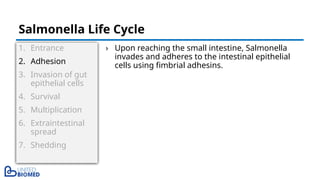
› Upon reaching the small intestine, Salmonella
invades and adheres to the intestinal epithelial
cells using fimbrial adhesins.
Salmonella Life Cycle
1. Entrance
2. Adhesion
3. Invasion of gut
epithelial cells
4. Survival
5. Multiplication
6. Extraintestinal
spread
7. Shedding
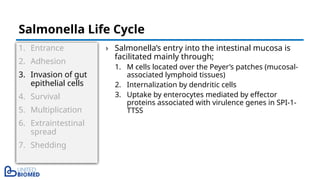
› Salmonella’s entry into the intestinal mucosa is
facilitated mainly through;
1. M cells located over the Peyer’s patches (mucosal-
associated lymphoid tissues)
2. Internalization by dendritic cells
3. Uptake by enterocytes mediated by effector
proteins associated with virulence genes in SPI-1-
TTSS
Salmonella Life Cycle
1. Entrance
2. Adhesion
3. Invasion of gut
epithelial cells
4. Survival
5. Multiplication
6. Extraintestinal
spread
7. Shedding
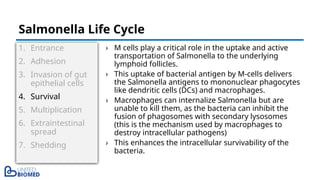
› M cells play a critical role in the uptake and active
transportation of Salmonella to the underlying
lymphoid follicles.
› This uptake of bacterial antigen by M-cells delivers
the Salmonella antigens to mononuclear phagocytes
like dendritic cells (DCs) and macrophages.
› Macrophages can internalize Salmonella but are
unable to kill them, as the bacteria can inhibit the
fusion of phagosomes with secondary lysosomes
(this is the mechanism used by macrophages to
destroy intracellular pathogens)
› This enhances the intracellular survivability of the
bacteria.
Salmonella Life Cycle
1. Entrance
2. Adhesion
3. Invasion of gut
epithelial cells
4. Survival
5. Multiplication
6. Extraintestinal
spread
7. Shedding
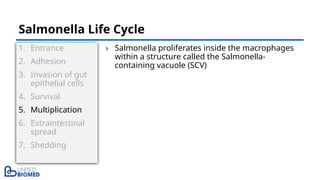
› Salmonella proliferates inside the macrophages
within a structure called the Salmonella-
containing vacuole (SCV)
Salmonella Life Cycle
1. Entrance
2. Adhesion
3. Invasion of gut
epithelial cells
4. Survival
5. Multiplication
6. Extraintestinal
spread
7. Shedding
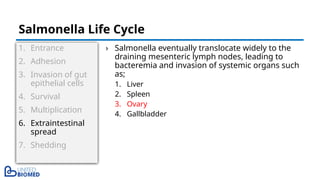
› Salmonella eventually translocate widely to the
draining mesenteric lymph nodes, leading to
bacteremia and invasion of systemic organs such
as;
1. Liver
2. Spleen
3. Ovary
4. Gallbladder
Salmonella Life Cycle
1. Entrance
2. Adhesion
3. Invasion of gut
epithelial cells
4. Survival
5. Multiplication
6. Extraintestinal
spread
7. Shedding
› Shedding through droppings
Salmonella Life Cycle
Plan of Talk
› Etiology
› Salmonella life cycle
› Transmission
› Pathogenesis
› Clinical signs
› Post mortem lesions
› Treatment
› Salmonella transmission may be;
1. Horizontal from bird to bird
2. Horizontal from egg contamination
3. Vertical or transovarial transmission
Transmission
1. Horizontal from
bird to bird
2. Horizontal from
egg
contamination
3. Vertical or
transovarial
transmission
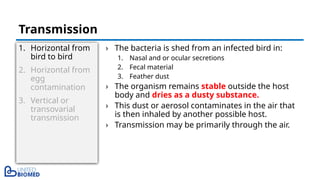
› The bacteria is shed from an infected bird in:
1. Nasal and or ocular secretions
2. Fecal material
3. Feather dust
› The organism remains stable outside the host
body and dries as a dusty substance.
› This dust or aerosol contaminates in the air that
is then inhaled by another possible host.
› Transmission may be primarily through the air.
Transmission
1. Horizontal from
bird to bird
2. Horizontal from
egg
contamination
3. Vertical or
transovarial
transmission
› Susceptibility as well as the amount of
contamination determine whether or not the
new host becomes infected with the disease.
› Salmonella spp. are mainly transmitted by the
fecal-oral route.
Transmission
1. Horizontal from
bird to bird
2. Horizontal from
egg
contamination
3. Vertical or
transovarial
transmission
› In this way of transmission, the eggs become
infected through eggshell penetration by
Salmonella;
1. Colonized gastrointestinal tract (GIT)
2. Excreted in feces during or after oviposition
› Feces serve as nutrient reservoirs for Salmonella’s
growth, contaminating the environment and
potentially infecting the rest of the flock in the
same enclosure.
› The bacterial penetration of the egg is more rapid
during the first few minutes post-oviposition, as
some cuticles are immature and few pores are
open.
Transmission
1. Horizontal from
bird to bird
2. Horizontal from
egg
contamination
3. Vertical or
transovarial
transmission
› Outer shell contamination by Salmonella is
evident in eggs collected from contaminated
nests and hatchery environments.
› Some studies reported that there is no direct
relationship between eggshell thickness and
Salmonella Typhimurium penetration, but eggs
with high specific gravity shells tend to offer
more resistance against S. Enteritidis
penetration.
Transmission
1. Horizontal from
bird to bird
2. Horizontal from
egg
contamination
3. Vertical or
transovarial
transmission
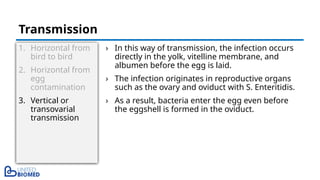
› In this way of transmission, the infection occurs
directly in the yolk, vitelline membrane, and
albumen before the egg is laid.
› The infection originates in reproductive organs
such as the ovary and oviduct with S. Enteritidis.
› As a result, bacteria enter the egg even before
the eggshell is formed in the oviduct.
Transmission
› Insects can act as vectors for Salmonella on poultry farms.
1. Cockroaches
– They have the potential to introduce foodborne pathogens like Salmonella into
poultry production facilities due to their ability to cross-contaminate and transmit
the pathogen to uninfected individuals within their group.
– Studies have indicated that cockroaches infected with S. Typhimurium can transfer
the bacteria to the surface of the table egg.
2. Flies
– Flies captured in poultry establishments have been shown to harbor Salmonella.
Salmonella and Insect Reservoir
3. Mites
– Poultry mite has been implicated as a biological vector of Salmonella Enteritidis.
– It has been reported to carry the bacteria within poultry premises.
– It is suggested that the primary source of infection could be oral ingestion of
crushed contaminated mites by the chicks, as well as the mite’s blood meal.
4. Rodents
– Rodents such as mice can act as carriers of Salmonella in layer flocks.
– Feral mice present in poultry farms may serve as a rich source of multiple
phenotypes and genotypes of S. Enteritidis.
– In African countries, S. Kentucky and S. Enteritidis were the major serovars isolated
from lizards and rodents inhabiting the poultry houses. It is hypothesized that the
feces of lizards and rodents could contaminate the feed and litter, posing a
biosecurity threat.
Cont. …
5. Wild birds
– Salmonella can colonize the intestines of wild birds, turning them into
asymptomatic reservoirs.
– Hughes et al. reported the isolation of different Salmonella serovars from wild
birds, mainly passerine birds, in northern England.
– S. Typhimurium strain DT160 caused significant mortality in wild birds and
gastrointestinal illness in humans in New Zealand in 2000, indicating a zoonotic
risk. Wild birds like one buff-necked ibis, red- legged seriema, and eared dove
captured near poultry facilities had Salmonella infection. Moreover, S. Typhimurium
dominated the serotype isolated from wild pigeons.
Cont. …
Plan of Talk
› Etiology
› Salmonella life cycle
› Transmission
› Pathogenesis
› Clinical signs
› Post mortem lesions
› Treatment
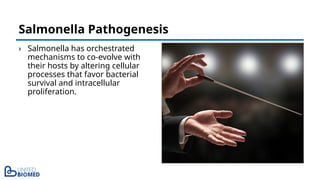
› Salmonella has orchestrated
mechanisms to co-evolve with
their hosts by altering cellular
processes that favor bacterial
survival and intracellular
proliferation.
Salmonella Pathogenesis
› Salmonella pathogenic factors are controlled by virulence genes and
plasmids, which are located within Salmonella pathogenicity islands
(SPIs).
› SPIs are a group of genes located in specific areas of the bacterial
chromosomes that encompass multiple virulence factors, including
invasins, adhesins, and toxins.
› Salmonella contains a total of 23 SPIs, the most critical ones are;
1. SPI-1
2. SPI-2
Salmonella Pathogenicity Islands (SPIs)
› Both of these SPIs encode a molecular apparatus called the type III
secretion system (TTSS) which is responsible for injecting effector
proteins produced by Salmonella into the host cell, thereby establishing
the intracellular survival and propagation of Salmonella inside the host.
› Salmonella has two types of type III secretion systems;
1. T3SS-1 found in SPI-1 and responsible for;
1) Transferring effector proteins needed for bacterial invasion
2) SCV (Salmonella containing vacuoles) biogenesis
2. T3SS-2 found in SPI-2 and responsible for;
1) Facilitating the transport of effector proteins that favor SCV maturation
2) SIF (Salmonella-induced filaments) biogenesis
3) Intracellular survival of the pathogen and its movement inside Salmonella-containing
vacuoles
Cont. …
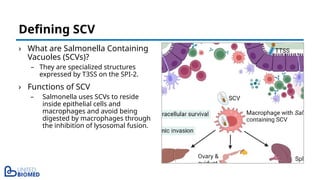
› What are Salmonella Containing
Vacuoles (SCVs)?
– They are specialized structures
expressed by T3SS on the SPI-2.
› Functions of SCV
– Salmonella uses SCVs to reside
inside epithelial cells and
macrophages and avoid being
digested by macrophages through
the inhibition of lysosomal fusion.
Defining SCV
› What are Salmonella-induced filaments (SIFs)?
– They are specialized endosomal tubule projections that extend from the SCV.
› Functions of SIFs
– The exact role of SIFs in Salmonella infection is still unknown but it has been
reported that the SifA-SKIP-Rab9 complex;
1. Decrease M6PR (late endosomal/lysosomal markers) recruitment to the SCV membrane
2. Reduce the movement of lysosomal enzymes to the SCV.
– This reduction in the recruitment and movement of lysosome enzymes allows for;
1. Expanding the SCV population
2. Protecting intracellular Salmonella from host defense mechanisms
Defining SIFs
› The effectors of SPI2-T3SS involved in SCV maturation and SIF biogenesis
are;
– SifA
– SseJ
– SopD2
– PipB2
– SseF
– SseG
– SpvB
– SteA
› These effectors are essential for converting early SCV (endosomes) to
late SCV, where bacterial replication occurs.
Cont. …
› SPI1 deletion led to a decreased colonization of Salmonella
Typhimurium in the cecum and spleen of chickens.
› SPI2-T3SS deletion did not significantly affect the cecal colonization by S.
Typhimurium.
› SPI2 mutation reduced S. Typhimurium’s ability to invade the spleen in
one-week-old chicks.
› Deletion of another gene, ssaU, that encodes major components of SPI-
2 T3SS did not affect bacterial colonization of the intestine but exhibited
significant reduction in S. Typhimurium dissemination to the liver.
› Deletion of SPI-1 and SPI-2 genes had a negative impact on the mutant
strain’s ability to colonize and cause systemic lesions in the cecum and
liver in one-day-old chickens.
What Will Happen if SPI is Removed?
Plan of Talk
› Etiology
› Salmonella life cycle
› Transmission
› Pathogenesis
› Clinical signs
› Post mortem lesions
› Treatment
› The severity of Salmonella infection varies according to many factors,
including;
1. Host age
2. Host immunity
3. The presence of coinfections
4. Environmental stress
5. The infective dose
› Older birds, for instance, tend to be less susceptible to Salmonellosis
even with concentrations of 10^6 CFU/mL of S. Typhimurium.
Clinical Signs
› General symptoms of Salmonella include:
1. Lethargy
2. Anorexia
3. Diarrhea
› In chronic cases
1. Arthritis may be present
› With high dose infections:
1. Excessive thirst
2. Conjunctivitis
3. Indications of liver, spleen, kidney or heart damage can occur
Clinical Signs
Plan of Talk
› Etiology
› Salmonella life cycle
› Transmission
› Pathogenesis
› Clinical signs
› Post mortem lesions
› Treatment
› In acute disease there may be few lesions.
1. Dehydration.
2. Enteritis.
3. Focal necrotic intestinal lesions.
4. Foci in liver.
5. Unabsorbed yolk.
6. Cheesy cores in caecae.
7. Pericarditis.
8. Perihepatitis.
9. Misshapen ovules in the ovaries in S.E. infection.
Post-mortem Lesions
Plan of Talk
› Etiology
› Salmonella life cycle
› Transmission
› Pathogenesis
› Clinical signs
› Post mortem lesions
› Treatment
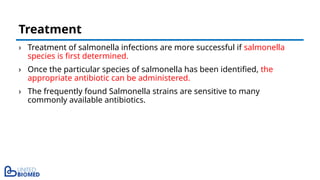
› Treatment of salmonella infections are more successful if salmonella
species is first determined.
› Once the particular species of salmonella has been identified, the
appropriate antibiotic can be administered.
› The frequently found Salmonella strains are sensitive to many
commonly available antibiotics.
Treatment
1. Antibiotics
2. Antidiarrheal
Treatment
Part 3 – Control Strategies
1. Biosecurity
2. Antibiotics
3. Prebiotics
4. Probiotics
5. Synbiotics
6. Postbiotics
7. Phytobiotics
8. Bacteriophages
Salmonella Control Strategies in Poultry
› Biosecurity
› Antibiotics
› Prebiotics
› Probiotics
› Synbiotics
› Postbiotics
› Phytobiotics
› Bacteriophages
› Implementing good biosecurity measures plays a
key role in combating the transmission of
Salmonella and improving food safety.
› Biosecurity controls include;
1. Disinfection in between flocks
2. Entry-level and site cleanliness
3. Boot dips
4. Hand hygiene of employees
5. Rodent and fly control
6. Red mite control
7. Reduce the prevalence of D. gallinae, a biological
vector of Salmonella
Salmonella Control Strategies in Poultry
› Biosecurity
› Antibiotics
› Prebiotics
› Probiotics
› Synbiotics
› Postbiotics
› Phytobiotics
› Bacteriophages
› Proper litter management has been associated
with a decreased risk of Salmonella detection in
poultry houses;
1. Higher Salmonella contamination was linked to the
use of fresh wood shavings than older litter.
2. Proper recycling of litter using methods like
composting is crucial in reducing the Salmonella count
in poultry litter.
› The seroprevalence of Salmonella increased
during the summer compared to the winter
season, accordingly, strict biosecurity measures
are required to combat the seasonal prevalence
of Salmonella among poultry flocks.
Salmonella Control Strategies in Poultry
› Biosecurity
› Antibiotics
› Prebiotics
› Probiotics
› Synbiotics
› Postbiotics
› Phytobiotics
› Bacteriophages
› Antibiotics have been used in poultry feed since
the 1940s, mainly due to their benefits on birds’
feed efficiency, enhanced growth performance,
and inhibition of enteric pathogens.
› The list of antibiotics used as feed additives to
combat enteric pathogens includes small
quantities of;
1. Penicillin
2. Tetracycline
3. Chloramphenicol.
Salmonella Control Strategies in Poultry
› Biosecurity
› Antibiotics
› Prebiotics
› Probiotics
› Synbiotics
› Postbiotics
› Phytobiotics
› Bacteriophages
› The subtherapeutic use of antibiotics in poultry feed
is being reconsidered because of;
1. The growing concern about antibiotic resistance in the
human food chain.
2. Resistant Salmonella serotypes have been reported
against antibiotics such as quinolones, chloramphenicol,
and cephalosporins worldwide.
3. The use of antibiotics is associated with the destruction of
beneficial gut bacteria that help fight enteric pathogens.
› Other control strategies like probiotics are given
importance as a viable substitute for antibiotics in
light of the European Union’s (EU) ban on their
usage and the US’s restricted use of them in the
production of chickens.
Salmonella Control Strategies in Poultry
› Biosecurity
› Antibiotics
› Prebiotics
› Probiotics
› Synbiotics
› Postbiotics
› Phytobiotics
› Bacteriophages
› Prebiotics can be defined as “a substrate that is
selectively utilized by host microorganisms
conferring a health benefit”.
› Probiotics is a “non-viable food component that
confers a health benefit on the host associated
with modulation of the microbiota”.
› Prebiotics and probiotics play important roles in
promoting gut health and supporting the
balance of beneficial intestinal flora in poultry.
Salmonella Control Strategies in Poultry
› Biosecurity
› Antibiotics
› Prebiotics
› Probiotics
› Synbiotics
› Postbiotics
› Phytobiotics
› Bacteriophages
› The prerequisite for a potential prebiotic are;
1. It can withstand hydrolysis by gastric acids and
enzymes
2. It resists absorption in the upper gastrointestinal
tract.
3. It is metabolizable by the gut microbiota
4. It is a selective compound that promotes the growth
of beneficial intestinal flora
5. It have the capacity to regulate the immune response
in favor of the host while suppressing pathogens,
thereby improving the host’s health and performance.
Salmonella Control Strategies in Poultry
› Biosecurity
› Antibiotics
› Prebiotics
› Probiotics
› Synbiotics
› Postbiotics
› Phytobiotics
› Bacteriophages
› Prebiotics like non-digestible oligosaccharides
and polysaccharides have been shown to inhibit
the survival and colonization of pathogens like
Salmonella by producing SCFA like butyrate and
acetate in the ceca, which helps lower the gut pH.
› Yeast cell wall-derived mannan oligosaccharides
(MOS), fructo-oligosaccharides (FOS), inulin, and
xylo-oligosaccharides are some examples of
prebiotics used in poultry production systems to
control various pathogens, including Salmonella.
Salmonella Control Strategies in Poultry
› Biosecurity
› Antibiotics
› Prebiotics
› Probiotics
› Synbiotics
› Postbiotics
› Phytobiotics
› Bacteriophages
› The composition of the yeast cell wall includes
MOS (40%), β-glucan (60%), and chitin (2%).
› Studies have demonstrated the benefits of yeast
cell product supplementation in poultry diets.
› Shanmugasundaram et al. reported that yeast
cell wall product supplementation in layer birds;
1. Reduced fecal and intestinal oocyst count
2. Up-regulated anti-inflammatory cytokine IL-10
production
3. Increased proliferation of beneficial bacteria like LAB
and their by-products of fermentation in the cecal
tonsils during post-coccidial challenge.
Salmonella Control Strategies in Poultry
› Biosecurity
› Antibiotics
› Prebiotics
› Probiotics
› Synbiotics
› Postbiotics
› Phytobiotics
› Bacteriophages
› Another study found that whole yeast cell
prebiotic supplementation in the diet of broiler
birds;
1. Modulates the immune response
2. Improving IL-10 (anti-inflammatory) mRNA expression
3. Reducing the pro-inflammatory cytokine (IL-1) mRNA
expression in the cecal tonsils of broiler birds.
Salmonella Control Strategies in Poultry
› Biosecurity
› Antibiotics
› Prebiotics
› Probiotics
› Synbiotics
› Postbiotics
› Phytobiotics
› Bacteriophages
› In layer birds challenged with SE, dietary FOS
supplementation at 1% revealed
1. Reduction in the cecal load of Salmonella Enteritidis
2. Upregulated ileal IgA cell titer
3. Increased expression of TLR-4 mRNA
Salmonella Control Strategies in Poultry
› Biosecurity
› Antibiotics
› Prebiotics
› Probiotics
› Synbiotics
› Postbiotics
› Phytobiotics
› Bacteriophages
› These results highlight the potential benefits of
supplementing poultry diets with prebiotics as an
alternative to antibiotic growth promoters for
controlling harmful bacteria like Salmonella,
ultimately improving production performance
and gut health.
Salmonella Control Strategies in Poultry
› Biosecurity
› Antibiotics
› Prebiotics
› Probiotics
› Synbiotics
› Postbiotics
› Phytobiotics
› Bacteriophages
› Probiotics, also known as direct-fed microbial (DFM)
› They are defined by FAO as “live microorganisms,
when administered in adequate amounts, confer a
health benefit on the host”.
› Lilly and Stillwell first used the term and defined
probiotics as “growth- promoting factors produced by
microorganisms”.
› Probiotics confer their beneficial effects on the host
growth and performance through;
1. Competitive exclusion
2. Improving barrier health and function
3. Immunomodulation
4. Digestion and absorption
Salmonella Control Strategies in Poultry
› Biosecurity
› Antibiotics
› Prebiotics
› Probiotics
› Synbiotics
› Postbiotics
› Phytobiotics
› Bacteriophages
› The characteristics of a potential probiotic are;
1. It originates from the same host
2. It is non-pathogenic and beneficial to the host by
adhering to the gut mucosa (biofilm formation)
3. It can tolerate of gastric acid and bile salts
4. It has antimicrobial properties against pathogens
5. It can survive post-processing and storage stress
Salmonella Control Strategies in Poultry
› Biosecurity
› Antibiotics
› Prebiotics
› Probiotics
› Synbiotics
› Postbiotics
› Phytobiotics
› Bacteriophages
› Probiotics used for poultry supplementation include;
1. Spore-forming Bacillus spp.
2. Saccharomyces yeast
3. Enterococcus spp.
4. Streptococcus spp.
5. Lactobacillus spp.
6. Bifidobacterium spp.
› The available probiotics on the market include
either;
1. Single-species
2. Multispecies preparations, which is preferred due to its
ability to act on multiple sites to bring out an overall
synergistic effect.
Salmonella Control Strategies in Poultry
› Biosecurity
› Antibiotics
› Prebiotics
› Probiotics
› Synbiotics
› Postbiotics
› Phytobiotics
› Bacteriophages
› The administration of probiotics to layers of
birds;
1. Improved egg production
2. Egg weight and egg quality
› In Salmonella-challenged Hy-line Brown laying
hens, colonization by the Bacillus subtilis CSL2
probiotic strain;
1. Normalized the level of fecal microbiota
2. Increased Lactobacillus
Salmonella Control Strategies in Poultry
› Biosecurity
› Antibiotics
› Prebiotics
› Probiotics
› Synbiotics
› Postbiotics
› Phytobiotics
› Bacteriophages
› Supplementation of probiotics containing
Lactobacillus fermentum and Saccharomyces
cerevisiae in broilers improved feed efficiency
and the percentage of intestinal T-lymphocytes
(CD4+ and CD8+).
› In free-laying birds challenged with S.
Typhimurium infection, continuous
supplementation of Bacillus-based probiotics;
1. Restored the gut microbiota
2. Decreased Salmonella load in the internal organs
3. Increased the level of butyrate
Salmonella Control Strategies in Poultry
› Biosecurity
› Antibiotics
› Prebiotics
› Probiotics
› Synbiotics
› Postbiotics
› Phytobiotics
› Bacteriophages
› Probiotic supplementation has also been
associated with increased anti-Salmonella bile IgA
in birds challenged with Salmonella, indicating
improved humoral immunity.
› Feed supplementation with Lactobacillus spp. and
Bifidobacterium spp. has been shown to increase
the production of proinflammatory cytokines IFN-γ
and TNF-α that favor the clearance of Salmonella
from the gut.
› Studies have shown that probiotic bacteria play a
role in maintaining a balance between pro-
inflammatory cytokines and anti-inflammatory
cytokines.
Salmonella Control Strategies in Poultry
› Biosecurity
› Antibiotics
› Prebiotics
› Probiotics
› Synbiotics
› Postbiotics
› Phytobiotics
› Bacteriophages
› In Salmonella- challenged broilers, the combination
of probiotics (Lactobacillus spp., Pediococcus spp.,
Saccharomyces spp., and Bacillus spp.) with the live
SE vaccine;
1. Enhanced the growth performance
2. Decreased mortality rate
3. Reduced fecal shedding of bacteria thereby limiting the
bacterial colonization of birds
› These findings suggest that probiotics could be a
potential alternative to antibiotics in poultry
infected with Salmonella since they positively
modulate the gut microbial population and enhance
the immune response against the pathogen.
Salmonella Control Strategies in Poultry
› Biosecurity
› Antibiotics
› Prebiotics
› Probiotics
› Synbiotics
› Postbiotics
› Phytobiotics
› Bacteriophages
› Synbiotics refers to the synergistic combination
of prebiotics and probiotics.
› This concept was first used by Gibson and
Roberfroid in 1995.
› The idea behind synbiotics is adding prebiotics to
support and sustain the probiotic
microorganisms by;
1. Enhancing the ability of probiotics to survive
2. Modifying the gut microflora
3. Inhibiting colonization of the gut epithelium by
pathogens
Salmonella Control Strategies in Poultry
› Biosecurity
› Antibiotics
› Prebiotics
› Probiotics
› Synbiotics
› Postbiotics
› Phytobiotics
› Bacteriophages
› The supplementation of synbiotics has shown
significant benefits to host animals compared to
using prebiotics and probiotics separately.
› The Food and Agriculture Organization (FAO)
recommends using the term synbiotics only if the
combined health effect is synergistic.
› Examples of synbiotics include combinations like;
1. Fructo-oligosaccharides with bifidobacteria
2. Lactitol with lactobacilli
Salmonella Control Strategies in Poultry
› Biosecurity
› Antibiotics
› Prebiotics
› Probiotics
› Synbiotics
› Postbiotics
› Phytobiotics
› Bacteriophages
Synbiotics and Salmonella
› Shanmugasundaram et al. investigated the effect of
symbiotics supplementation on Salmonella-
challenged layer birds in concern to;
1. Production performance
2. Immune parameters
3. Cecal Salmonella load
› They reported;
1. Improved body weight gain
2. Higher hen-day egg production both with and without a
Salmonella challenge
3. Decreased cecal Salmonella colonization
4. Increased bile anti-Salmonella IgA
Salmonella Control Strategies in Poultry
› Biosecurity
› Antibiotics
› Prebiotics
› Probiotics
› Synbiotics
› Postbiotics
› Phytobiotics
› Bacteriophages
› In addition, synbiotics may help to;
1. Modulate lymphoid organs (bursa, spleen)
2. Increase the size of bursal follicles
3. Stimulate the immunoglobulins, thereby improving
immunocompetence against Salmonella Typhimurium
infection in broilers.
Salmonella Control Strategies in Poultry
› Biosecurity
› Antibiotics
› Prebiotics
› Probiotics
› Synbiotics
› Postbiotics
› Phytobiotics
› Bacteriophages
› Postbiotics are non-viable bacterial products or
metabolic byproducts, either secreted by live
bacteria or derived after cell lysis from probiotic
microorganisms, that confer beneficial functions
on the host.
› The most common postbiotics used are
metabolites and their combinations produced by
strains of Lactobacillus plantarum.
Salmonella Control Strategies in Poultry
› Biosecurity
› Antibiotics
› Prebiotics
› Probiotics
› Synbiotics
› Postbiotics
› Phytobiotics
› Bacteriophages
› In general, postbiotics range from;
1. SCFA
2. Enzymes
3. Organic acids (propionic and 3-phenylacetic acid)
4. Peptides
5. Plasmalogens
6. Vitamins
7. Teichoic acids
8. Muropeptides
Salmonella Control Strategies in Poultry
› Biosecurity
› Antibiotics
› Prebiotics
› Probiotics
› Synbiotics
› Postbiotics
› Phytobiotics
› Bacteriophages
› Postbiotics mimic probiotics in their mode of
action, except that they are not alive.
› Postbiotics benefit the host by;
1. Producing immunomodulatory effects
2. Decreasing gut pH
3. Inhibiting pathogenic bacteria in the gut (pathogen
antagonism)
4. Enhancing antioxidant properties
5. Enhancing gut health
6. Protecting intestinal barrier integrity
7. Improving production performance
Salmonella Control Strategies in Poultry
› Biosecurity
› Antibiotics
› Prebiotics
› Probiotics
› Synbiotics
› Postbiotics
› Phytobiotics
› Bacteriophages
Postbiotics and Salmonella
› Postbiotics derived from Saccharomyces
cerevisiae fermentation reduced the cecal
colonization of Salmonella in broilers and layer
pullets.
Salmonella Control Strategies in Poultry
› Biosecurity
› Antibiotics
› Prebiotics
› Probiotics
› Synbiotics
› Postbiotics
› Phytobiotics
› Bacteriophages
Conclusion
› As antibiotic resistance becomes a growing
concern, postbiotics are a potential alternative
for combating enteric pathogens like Salmonella.
› Postbiotics can play a valuable role in enhancing
food safety practices and improving production
performance in poultry.
Salmonella Control Strategies in Poultry
› Biosecurity
› Antibiotics
› Prebiotics
› Probiotics
› Synbiotics
› Postbiotics
› Phytobiotics
› Bacteriophages
› Phytobiotics (phytogenics or phytochemicals) are
biologically active compounds obtained from plants
used in animal production as feed additives because
they offer health benefits and promote growth in
animal production.
› Phytobiotics include;
1. Saponins
2. Flavonoids
3. Terpenoids
4. Alkaloid
› These compounds are reported to have antioxidant,
antiviral, antimicrobial, anticoccidial, anti-parasitic,
immunomodulatory, anti-inflammatory, and endocrine
stimulatory activities.
Salmonella Control Strategies in Poultry
› Biosecurity
› Antibiotics
› Prebiotics
› Probiotics
› Synbiotics
› Postbiotics
› Phytobiotics
› Bacteriophages
› Dietary supplementation of poultry feed with
garlic powder, clove and cinnamon, peppermint
powder, and ginger has been shown to improve
overall production performance, feed conversion
ratio, and body weight gain.
› Other examples of plants used as phytobiotics
include black cumin, turmeric, calendula,
oregano, green tea, and fennel.
Salmonella Control Strategies in Poultry
› Biosecurity
› Antibiotics
› Prebiotics
› Probiotics
› Synbiotics
› Postbiotics
› Phytobiotics
› Bacteriophages
› Ziheng et al. found that oregano essential oil
(OEO) supplementation in drinking water;
1. Could inhibit and treat infection by S. Pullorum and S.
Gallinarum in commercial yellow-chicken breeders.
2. Was more effective in preventing infection than the
treatment.
› A diet containing 40-80 mg/mL of garlic extract
revealed antimicrobial properties in broiler chicks
challenged with S. Typhimurium by;
1. Reducing mortality
2. Improving body weight
Salmonella Control Strategies in Poultry
› Biosecurity
› Antibiotics
› Prebiotics
› Probiotics
› Synbiotics
› Postbiotics
› Phytobiotics
› Bacteriophages
› Phytogenic compounds like trans-cinnamaldehyde
and eugenol have decreased S. Enteritidis growth
and cecal colonization in challenged broiler birds
after ten days of infection.
› Natural capsaicin derived from chili pepper has
been reported to control the internal organ (liver,
spleen) invasion by S. Enteritidis in challenged
layer birds.
› All these studies indicate the great potential of
phytobiotics as an antimicrobial substitute against
Salmonella in poultry and its application in
commercial farms.
Salmonella Control Strategies in Poultry
› Biosecurity
› Antibiotics
› Prebiotics
› Probiotics
› Synbiotics
› Postbiotics
› Phytobiotics
› Bacteriophages
› Bacteriophages are viruses that infect bacteria and use
the host machinery to proliferate inside the host cell.
› First, these phages (viruses) penetrate their DNA into
the host cell (lysogenic) and undergo multiplication.
› Then, the release of a large number of new
bacteriophages, eventually leading to the lysis of the
bacterium to release the progeny bacteriophages.
› Bacteriophages are used as alternatives to antibiotics
because they are;
1. Target specific
2. Less allergic side effects
3. Harmlessness to the host’s normal flora
Salmonella Control Strategies in Poultry
› Biosecurity
› Antibiotics
› Prebiotics
› Probiotics
› Synbiotics
› Postbiotics
› Phytobiotics
› Bacteriophages
Bacteriophages and Salmonella
› The treatment of S. Enteritidis- contaminated poultry
carcass with a higher number of bacteriophages was
able to reduce the percentage of recoverable bacteria by
93%.
› The application of phage cocktail (F1055S, F12013S) as an
aerosol spray on fertile eggs challenged with S.
Enteritidis during their transfer from incubators to
hatchers reduced Salmonella’s horizontal transfer.
› The inoculation bacteriophage cocktail made from
phages isolated from chickens (UAB_Phi20, UAB_Phi87)
and pigs (UAB_Phi78) decreased the Salmonella load in
the cecum and mortality rate of white leghorn birds
challenged with S. Typhimurium.
Salmonella Control Strategies in Poultry
› Biosecurity
› Antibiotics
› Prebiotics
› Probiotics
› Synbiotics
› Postbiotics
› Phytobiotics
› Bacteriophages
› The administration of CTCBIO phage significantly
reduced the S. Enteritidis load in the cloacal swab,
liver, and spleen in broilers that are challenged with S.
Enteritidis.
› Broad-host-range phage (STP4-a) is beneficial over
specific phages since they can inhibit multiple serovars
of Salmonella with their polyvalent adsorption sites.
› Oral inoculation of S. Enteritidis and S. Typhimurium
phages reduced depression, loss of appetite, and
diarrhea in a Salmonella challenge model.
› There is a significant decrease in the cecal colonization
of Salmonella 7–15 days post-administration of phages
in infected chicks.
Salmonella Control Strategies in Poultry
› Biosecurity
› Antibiotics
› Prebiotics
› Probiotics
› Synbiotics
› Postbiotics
› Phytobiotics
› Bacteriophages
Conclusion
› These data suggest that bacteriophage treatment
could;
1. Improve the survival rate of Salmonella-infected
chickens
2. Reduce the bacterial colonization of internal organs
Disadvantages
1. The poor efficacy of phage to withstand the acidic
gastric pH of the birds on oral delivery, but this
can be overcome by the encapsulation technique.
2. Emergence of phage resistance
Salmonella Control Strategies in Poultry
Part 4 – Vaccination
Plan of Talk
› Aim of Salmonella vaccination
› Characteristics of an ideal Salmonella vaccine
› Types of salmonella vaccines
– Live attenuated
– Inactivated
– Subunit
› Immunoadjuvants
Plan of Talk
› Aim of Salmonella vaccination
› Characteristics of an ideal Salmonella vaccine
› Types of salmonella vaccines
– Live attenuated
– Inactivated
– Subunit
› Immunoadjuvants
› The aim of vaccination as part of a complex control programs for
Salmonella infections in poultry is to:
1. Reduce or prevent the intestinal colonization resulting in reduced fecal shedding
and egg shell contamination.
2. Prevent systemic infection resulting in a diminished localization in the
reproductive tissues.
Aim of Salmonella Vaccination
Plan of Talk
› Aim of Salmonella vaccination
› Characteristics of an ideal Salmonella vaccine
› Types of salmonella vaccines
– Live attenuated
– Inactivated
– Subunit
› Immunoadjuvants
1. High degree of protection against systemic and intestinal infection.
2. High protective potential against a variety of important serovars
(serogroups)
3. Adequate attenuated for poultry, other animal species, humans and
environment.
4. Inactivated and live vaccines should not affect growth of the animal.
5. Vaccine strains should not be resistant to antibiotics.
6. Vaccines should be easy to administer
7. Application of vaccines should not interfere with salmonella detection
methods.
8. Humoral antibody response after vaccination should be distinguishably
from a salmonella wild-type response to allow the use of serological
detection methods
9. Attenuated live salmonella vaccine strains should be able to induce the
Ideal Salmonella Vaccine Strain
10.Salmonella vaccine strains should have preserved the ability to invade
the gut as prerequisite to induce the invasion inhibition effect between
salmonella organisms
Cont. …
Plan of Talk
› Aim of Salmonella vaccination
› Characteristics of an ideal Salmonella vaccine
› Types of salmonella vaccines
– Live attenuated
– Inactivated
– Subunit
› Immunoadjuvants
› Live attenuated vaccines are vaccines with living bacterial pathogens
that have been rendered inactive or avirulent using attenuation
methods such as;
1. Chemical
2. Genetically engineered mutagenesis
› These vaccines mimic natural infection as they adhere to the intestinal
mucosa when administered orally, eliciting potent humoral and cell-
mediated immune responses.
› In newly hatched chicks with immature immune systems, Salmonella live
vaccines promote resistance to infection, inhibiting gut colonization or
competitive exclusion.
Live Attenuated Vaccine
› The aim of attenuation is to diminish the virulence of the pathogen,
but retaining its immunogenicity.
Live Virus Attenuation
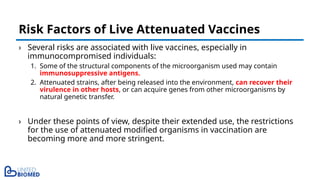
› Several risks are associated with live vaccines, especially in
immunocompromised individuals:
1. Some of the structural components of the microorganism used may contain
immunosuppressive antigens.
2. Attenuated strains, after being released into the environment, can recover their
virulence in other hosts, or can acquire genes from other microorganisms by
natural genetic transfer.
› Under these points of view, despite their extended use, the restrictions
for the use of attenuated modified organisms in vaccination are
becoming more and more stringent.
Risk Factors of Live Attenuated Vaccines
1. Easy administration.
2. Ability to carry heterologous antigens.
3. Capacity to induce cellular and humoral immune responses.
Advantages of Live Attenuated Vaccines
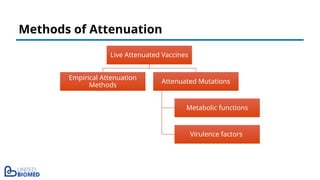
Live Attenuated Vaccines
Empirical Attenuation
Methods
Attenuated Mutations
Metabolic functions
Virulence factors
Methods of Attenuation
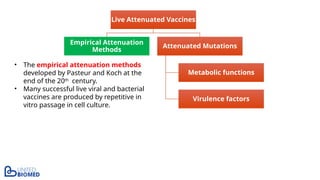
Live Attenuated Vaccines
Empirical Attenuation
Methods
Attenuated Mutations
Metabolic functions
Virulence factors
• The empirical attenuation methods
developed by Pasteur and Koch at the
end of the 20th
century.
• Many successful live viral and bacterial
vaccines are produced by repetitive in
vitro passage in cell culture.
Live Attenuated Vaccines
Empirical Attenuation
Methods
Attenuated Mutations
Metabolic functions
Virulence factors
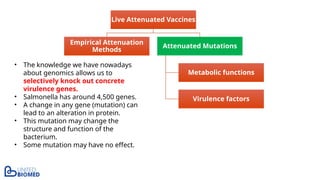
• The knowledge we have nowadays
about genomics allows us to
selectively knock out concrete
virulence genes.
• Salmonella has around 4,500 genes.
• A change in any gene (mutation) can
lead to an alteration in protein.
• This mutation may change the
structure and function of the
bacterium.
• Some mutation may have no effect.
Live Attenuated Vaccines
Empirical Attenuation
Methods
Attenuated Mutations
Metabolic functions
Virulence factors
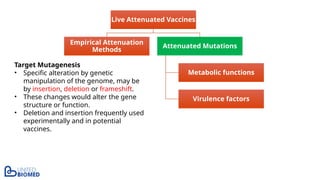
Target Mutagenesis
• Specific alteration by genetic
manipulation of the genome, may be
by insertion, deletion or frameshift.
• These changes would alter the gene
structure or function.
• Deletion and insertion frequently used
experimentally and in potential
vaccines.
Live Attenuated Vaccines
Empirical Attenuation
Methods
Attenuated Mutations
Metabolic functions
Virulence factors
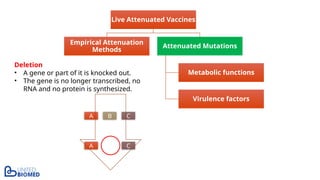
Deletion
• A gene or part of it is knocked out.
• The gene is no longer transcribed, no
RNA and no protein is synthesized.
A B C
A C
Live Attenuated Vaccines
Empirical Attenuation
Methods
Attenuated Mutations
Metabolic functions
Virulence factors
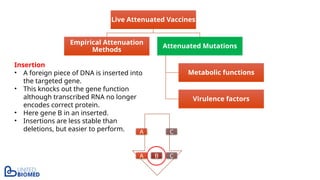
Insertion
• A foreign piece of DNA is inserted into
the targeted gene.
• This knocks out the gene function
although transcribed RNA no longer
encodes correct protein.
• Here gene B in an inserted.
• Insertions are less stable than
deletions, but easier to perform. A C
A C
B
Live Attenuated Vaccines
Empirical Attenuation
Methods
Attenuated Mutations
Metabolic functions
Virulence factors
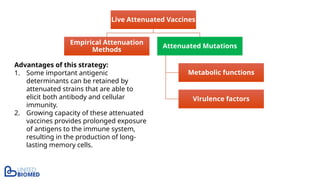
Advantages of this strategy:
1. Some important antigenic
determinants can be retained by
attenuated strains that are able to
elicit both antibody and cellular
immunity.
2. Growing capacity of these attenuated
vaccines provides prolonged exposure
of antigens to the immune system,
resulting in the production of long-
lasting memory cells.
Live Attenuated Vaccines
Empirical Attenuation
Methods
Attenuated Mutations
Metabolic functions
Virulence factors
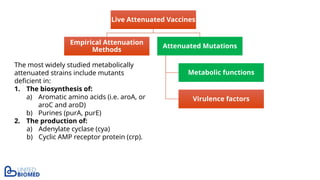
The most widely studied metabolically
attenuated strains include mutants
deficient in:
1. The biosynthesis of:
a) Aromatic amino acids (i.e. aroA, or
aroC and aroD)
b) Purines (purA, purE)
2. The production of:
a) Adenylate cyclase (cya)
b) Cyclic AMP receptor protein (crp).
Live Attenuated Vaccines
Empirical Attenuation
Methods
Attenuated Mutations
Metabolic functions
Virulence factors
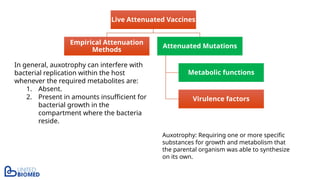
In general, auxotrophy can interfere with
bacterial replication within the host
whenever the required metabolites are:
1. Absent.
2. Present in amounts insufficient for
bacterial growth in the
compartment where the bacteria
reside.
Auxotrophy: Requiring one or more specific
substances for growth and metabolism that
the parental organism was able to synthesize
on its own.
Live Attenuated Vaccines
Empirical Attenuation
Methods
Attenuated Mutations
Metabolic functions
Virulence factors
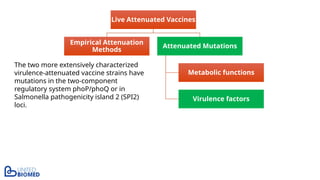
The two more extensively characterized
virulence-attenuated vaccine strains have
mutations in the two-component
regulatory system phoP/phoQ or in
Salmonella pathogenicity island 2 (SPI2)
loci.
› In a study by Lin et al., a live attenuated bivalently lyophilized vaccine
containing;
1. 6*10^8 CFU of ST strains
2. 1*10^8 CFU of SE strains
› It was inoculated into commercial layers at age of;
– 5 days
– 8 weeks
– 18 weeks
› At 25 weeks of age, birds were separately challenged with SE and ST
› 14 days-post-challenge, birds were humanely euthanized.
› Both vaccines successfully eliminated cloacal Salmonella shedding, as
observed from cloacal swabs collected on days 7 and 14 post-challenge.
Clinical Trials
› Triple vaccination with the ST vaccine significantly reduced the invasion
of Salmonella into the internal organs like the liver, spleen, and cecum in
90% of vaccinated birds.
Vaccination and Internal Organs Translocation
› However, despite the ability of live-attenuated vaccines to stimulate both
cell-mediated and mucosal immune responses, the biosecurity risk of
virulence reversal of the live vaccine strain is the major drawback of live-
attenuated vaccines
Note
Plan of Talk
› Aim of Salmonella vaccination
› Characteristics of an ideal Salmonella vaccine
› Types of salmonella vaccines
– Live attenuated
– Inactivated
– Subunit
› Immunoadjuvants
› To avoid the risk of live vaccines, the use of killed organisms was
introduced as safer vaccines.
› These vaccines are made from the entire organism but inactivated
(killed) by physical or chemical agents.
› However, protection induced by bacterins in poultry is generally modest .
› The limitations of these kinds of vaccines are:
1. Their immunogenicity usually has to be enhanced by co-administration with
adjuvants.
2. Multiple doses are necessary for obtaining long-term protective immunity;
besides, as live vaccines, they may contain immunosuppressive antigens.
Killed Whole Organisms
› Killed bacterin vaccines made from inactivated whole-cell preparations
of bacteria have been extensively used to control poultry Salmonella
infection.
› Commonly used inactivation agents for the preparation of killed
vaccines include;
1. Heat (60 C for 1 h)
◦
2. Formaldehyde
3. Acetone
4. Ethylene oxide
5. Beta-propiolactone
6. Radiation (ultraviolet or gamma)
Killed or Inactivated Vaccine
› The available Salmonella-killed vaccines are serovar-specific.
› Studies have shown that killed vaccines confer humoral immunity mostly
and do not elicit strong cell-mediated immune responses.
› Therefore, booster vaccination is required for long-term protection.
› Despite the absence of robust cell-mediated immunity, killed vaccines
are preferred over live vaccines due to biosecurity and safety reasons.
› Additionally, multivalent inactivated vaccines are required to contain the
spread of a wide range of Salmonella serovars present in poultry.
Cont. …
› It has been shown that greater levels of IgA and IgY antibodies were
produced in the bile and serum following the simultaneous use of live
attenuated and killed Salmonella vaccines in broilers.
› The combined use of both live and killed vaccination programs
successfully reduced S. Typhimurium and S. Infantis colonization in
young layers, providing broad protection.
Combination of Live and Killed Vaccines
Plan of Talk
› Aim of Salmonella vaccination
› Characteristics of an ideal Salmonella vaccine
› Types of salmonella vaccines
– Live attenuated
– Inactivated
– Subunit
› Immunoadjuvants
› Subunit vaccines are made of defined antigens.
› They contain immunodominant components of the bacteria such as;
1. Crude or purified extracts of the pathogen.
2. Synthetic peptides.
3. Obtained by the use of recombinant DNA technology, pure DNA or RNA.
› They are used in poultry
› They are claimed to be safer than live-attenuated or inactivated
vaccines.
Subunit Vaccines
› Vaccines derived from the outer membrane proteins (OMPs) and flagella
proteins (FliC protein) of Salmonella enterica serovar Enteritidis with
adjuvants have been used to;
– Decrease bacterial shedding in poultry
– Induce a significant antigen-specific immune response against Salmonella
› A trivalent subunit cochleate system-based vaccine has been evaluated
against 3 serovars of Salmonella in layers, this vaccine;
– Increased serum IgY
– Improved production performance
Cont. …
› Desin et al. showed the efficacy of a subunit vaccine based on the Type 3
secretion system encoded on a type 1 pathogenicity island, which
showed;
1. Increased titer of IgG antibodies in birds.
2. Reduced bacterial colonization in the liver
3. Bacterial colonization in the spleen or cecum were not reduced
Cont. …
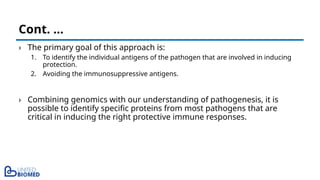
› The primary goal of this approach is:
1. To identify the individual antigens of the pathogen that are involved in inducing
protection.
2. Avoiding the immunosuppressive antigens.
› Combining genomics with our understanding of pathogenesis, it is
possible to identify specific proteins from most pathogens that are
critical in inducing the right protective immune responses.
Cont. …
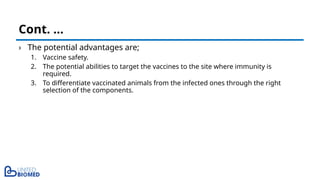
› The potential advantages are;
1. Vaccine safety.
2. The potential abilities to target the vaccines to the site where immunity is
required.
3. To differentiate vaccinated animals from the infected ones through the right
selection of the components.
Cont. …
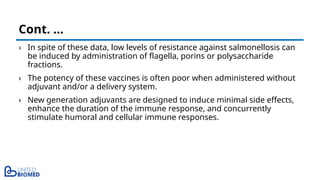
› In spite of these data, low levels of resistance against salmonellosis can
be induced by administration of flagella, porins or polysaccharide
fractions.
› The potency of these vaccines is often poor when administered without
adjuvant and/or a delivery system.
› New generation adjuvants are designed to induce minimal side effects,
enhance the duration of the immune response, and concurrently
stimulate humoral and cellular immune responses.
Cont. …
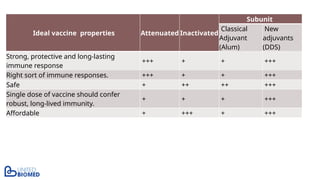
Ideal vaccine properties Attenuated Inactivated
Subunit
Classical
Adjuvant
(Alum)
New
adjuvants
(DDS)
Strong, protective and long-lasting
immune response
+++ + + +++
Right sort of immune responses. +++ + + +++
Safe + ++ ++ +++
Single dose of vaccine should confer
robust, long-lived immunity.
+ + + +++
Affordable + +++ + +++
› A good vaccine should stimulate a strong, protective and long-lasting
immune response.
› Through the induction of strong, long-lived immunological specific T and
B cell memory cells.
› Measurement of the specific subsets elicited by immunization may guide
vaccine development.
Strong, Protective and Long-lasting Immune
Response
› A good vaccine should induce the right sort of immune responses.
› The protective immune responses against extracellular pathogens seem
to be mediated by long-lived humoral immune responses through the
production of antibodies. However, in the control of intracellular
infection, cellular immune responses have been shown to be crucial in
mediating protection. Therefore, the development of a successful
vaccine against those diseases will be facilitated by a thorough
understanding of how cellular immune responses are generated and
maintained in vivo.
Right Sort of Immune Responses
› An ideal vaccine should be safe.
› Despite the success of vaccination in eliminating disease and death, the
public acceptance of even minor side effects of vaccination is very low.
› One major challenge faced in developing new vaccines is to achieve
strong immunogenicity without increasing reactogenicity.
Safe
› A single dose of vaccine should confer robust, long-lived immunity.
› Only a few live vaccines have achieved this goal.
› In contrast to the results with live vaccines, it has been difficult to
promote long lived immunity with a single dose of non-living antigen
vaccines.
› One goal of vaccine development is to rectify this using new adjuvants
and antigen delivery systems.
Single Dose of Vaccine Should Confer Robust,
Long-lived Immunity.
› An ideal vaccine should be affordable by the population at which they
are aimed and should be formulated to resist high and low
temperatures to facilitate distribution.
› This is a main problem for alive attenuated vaccines
Affordable
Plan of Talk
› Aim of Salmonella vaccination
› Characteristics of an ideal Salmonella vaccine
› Types of salmonella vaccines
– Live attenuated
– Inactivated
– Subunit
› Immunoadjuvants
Adjuvants
› They are defined as a group of structurally heterogenous compounds
that enhance or modulate the immunogenicity of the associated
antigens.
Immunoadjuvants
› Despite the recognition of many
different types of adjuvant,
however, little is known about
their mode of action.
› Janeway called adjuvants “the
immunologists dirty little
secret”, because their mode of
action is poorly understood.
› The events triggered by these
immunomodulators appear to
come from one or the combination
of several of the following effects:
Cont. …
Immunoadjuvants Effects
Adjuvant
Effect
Depot Effect
Effect On Antigen
Presenting Cells
(APC)
Nonspecific
Immunostimulantin
g Effect
Particulated
Carrier
Systems
Immunoadjuvants Effects
Adjuvant
Effect
Depot Effect
Effect On Antigen
Presenting Cells
(APC)
Nonspecific
Immunostimulantin
g Effect
Particulated
Carrier
Systems
The theory behind;
• If antigen is present in a solution, it is
mostly quickly removed by neutrophils
and macrophages.
• Subsequently, antigens are unable to
prime naive T cells.
• Following that, the antigens disappear
and the immune response is hardly
detectable.
• Adjuvants, such as:
1. Oil emulsions
2. Antigen absorbing aluminium salts
• Adjuvants retain antigen at the
injection site, then, it is released in
minute quantities over a prolonged
period of time.
• These compounds mainly stimulate the
production of antibodies by the induction
of Th2-lymphocytes.
› In the case of use of alum, the mechanism of action seems to be due to
the formation of a depot of free alum that will induce the recruitment
and activation of immune cells to the site of inoculation.
Cont. …
Immunoadjuvants Effects
Adjuvant
Effect
Depot Effect
Effect On Antigen
Presenting Cells
(APC)
Nonspecific
Immunostimulantin
g Effect
Particulated
Carrier
Systems
The theory behind;
• The adjuvant induced enhancement of an
immune response may be related to the
improved delivery of antigens into the
draining lymph nodes.
• This may be achieved by:
1. Facilitating the antigen uptake by
APCs.
2. Increasing the influx of APCs into the
injection site.
This results in:
1. Increase in the provision of antigen-
loaded APCs, and in turn, effective
priming of specific T cells.
2. Promoting the activation state of APCs by
upregulating costimulatory signals or
MHC expression.
3. This results in the corresponding cytokine
release, enhancing the speed, magnitude
and duration of the specific immune
response.
Immunoadjuvants Effects
Adjuvant
Effect
Depot Effect
Effect On Antigen
Presenting Cells
(APC)
Nonspecific
Immunostimulantin
g Effect
Particulated
Carrier
Systems
The theory behind;
• Some agents can stimulate the non-
specific component of the immune
system.
• Numerous microorganisms contain “alert
signals”, “pathogen associated molecular
patterns” PAMPs”, which is not present in
mammalian cells.
• These structures activate immune cells
through interaction with specific receptors
(toll like receptors, TLRs).
Some examples are:
1. Lipopolisaccharide (LPS)
2. Monophosphoryl lipid A (MPL)
3. Flagellin
4. Lipoproteins
5. Muramil dipeptide (MDP)
6. Trehalose dimycolate (TDM),
7. Cpg DNA, among others.
› Besides, the special chemical nature of some polymers used in the
formulation of vaccine delivery systems may also be recognized as
scavenger ligands for the APCs.
Cont. …
Immunoadjuvants Effects
Adjuvant
Effect
Depot Effect
Effect On Antigen
Presenting Cells
(APC)
Nonspecific
Immunostimulantin
g Effect
Particulated
Carrier
Systems
The theory behind;
• Particulated Carrier Systems have been proposed to
improve the mucosal bioavailability of antigens.
• These carriers protect labile molecules from degradation in
the gastrointestinal tract.
• Nanoparticles are submicron-sized colloidal systems that
may protect antigen against chemical, enzymatic or
immunological degradation, and facilitates targeting and
presentation of antigens to inductive sites of mucosal
immune system.
THANK YOU

Salmonella in Poultry_Complete Overview.pptx

  • 1.
    Avian Salmonellosis Part 1- Introduction Part 2 - Disease Overview Part 3 - Control Strategies Part 4 - Vaccination
  • 2.
    Part 1 –Introduction
  • 3.
    Plan of Talk ›Salmonella historical affections › Typhoid Mary › Salmonella recent outbreaks › Fact about Salmonella – Breeder and salmonella – Laying hens and salmonella – Role of males in vertical transmission – Salmonella and rodents – Chick early infection – Salmonella transmission by egg contamination
  • 4.
    Plan of Talk ›Salmonella historical affections › Typhoid Mary › Salmonella recent outbreaks › Fact about Salmonella – Breeder and salmonella – Laying hens and salmonella – Role of males in vertical transmission – Salmonella and rodents – Chick early infection – Salmonella transmission by egg contamination
  • 5.
    › Alexander theGreat died mysteriously in 323 B.C. › In 2001, a group of doctors at the University of Maryland suggested that Salmonella was the cause of death, based on a description of Alexander’s symptoms written by the Greek author Arrian of Nicomedia. Alexander The Great – Died of Salmonellosis
  • 6.
    › Prince Albert,the consort of Queen Victoria, died of a Salmonella infection in 1861. › During the Victorian era, an estimated 50,000 cases per year occurred in England. Prince Albert – Died of Salmonellosis
  • 7.
    › Scholars workingon the history of Jamestown, Virginia, believe that a typhoid outbreak was responsible for deaths of over 6,000 settlers between 1607 and 1624. Jamestown Colony
  • 8.
    › In 20,738recruits contracted the disease, 82% of all sick soldiers, 1,590 soldiers died, yielding a mortality rate of 7.7%. › It accounted for 87% of the total deaths are from disease. › A significant number of these deaths actually occurred at training areas in the southeastern United States. Spanish-American War (1898)
  • 9.
    › More soldierssuffered from typhoid fever than from battle wounds. › British troops lost 13,000 men to typhoid, as compared to 8,000 battle deaths. › Outbreak was largely due to unsanitary towns and farms throughout Africa, and polluted soil was washed into the network of streams and rivers during the rainy season. › Epidemic potential during a war prominent because of the disposal problems of men’s British Camps During The South African War (1899-1902)
  • 10.
    › Most outbreaksthat were reported could be traced back to unsanitary water supplies or polluted milk supplies, as polluted water can spread the disease. › Budd urged for more disinfection and water treatment . › The introduction of piped and filtered water supplies, its prominence as a cause of death had diminished. Dr. William Budd (1811-1880)
  • 11.
    Plan of Talk ›Salmonella historical affections › Typhoid Mary › Salmonella recent outbreaks › Fact about Salmonella – Breeder and salmonella – Laying hens and salmonella – Role of males in vertical transmission – Salmonella and rodents – Chick early infection – Salmonella transmission by egg contamination
  • 12.
    › Some individualshave natural immunity to Salmonella, they are known as “chronic carriers” › They have only mild or asymptomatic disease, but still carry the bacteria in their body for a long time. › These cases serve as natural reservoir for the disease. › Approximately 3% of persons infected with S typhi and 0.1% of those infected with non-typhoidal salmonellae become chronic carriers. › The carrier state may last from many weeks to years. Thus, human as well as animal reservoirs exist. Salmonella Carriers
  • 13.
    › “Typhoid Mary”Mary Mallon was the first famous carrier of typhoid fever in the U.S. › She was hired as a cook at several private homes in the New York area in the early 1900’s. Mary Mallon
  • 14.
    › Mary Malloncaused several typhoid outbreaks. › She used to move from household to another, and always disappearing before an epidemic could be traced back to the particular household that Mary was working in. › She had worked for 7 families, with 22 cases of typhoid and one death. Cont. …
  • 15.
    › She wasfinally overtaken by the authorities in 1907 and committed to an isolation center on North Brother Island, NY. › There she stayed until she was released in 1910, on the condition that she never accept employment involving food handling. Cont. …
  • 16.
    › But shewas found to work as a cook and to cause typhoid outbreaks again. › She was admitted back to North Brother Island, where she lived until her death in 1938. Cont. …
  • 17.
    Plan of Talk ›Salmonella historical affections › Typhoid Mary › Salmonella recent outbreaks › Fact about Salmonella – Breeder and salmonella – Laying hens and salmonella – Role of males in vertical transmission – Salmonella and rodents – Chick early infection – Salmonella transmission by egg contamination
  • 18.
    › More recentlyreported outbreaks in the U.S. involve different kinds of Salmonella strains, predominantly S. enteritidis and S. typhimurium. Recent Outbreaks
  • 19.
    In 1985 › Asalmonellosis (S. typhimurium) outbreak involving 16,000 confirmed cases in 6 states by low fat milk and whole milk from one Chicago dairy farm. › This is the largest outbreak of food-borne salmonellosis in U.S. › Investigations discovered that raw and pasteurized milk had been accidentally mixed. Cont. …
  • 20.
    Intentional Contamination of RestaurantSalad Bars In September 1984 › 10 area restaurants in the Dalles, Oregon, were involved with outbreaks of S. typhimurium. Cont. …
  • 21.
    January 2000 › Infantaged 1 month visited a clinic with fever and diarrhea. › A stool specimen yielded Salmonella serotype Tennessee. › One week before illness onset, the infant's family moved into a household that contained a bearded dragon (i.e., Pogona vitticeps). Cont. …
  • 22.
    During June 2002 ›A child aged 21 months was admitted to a hospital with fever, abdominal cramps, and bloody diarrhea. › Blood and stool cultures yielded Salmonella serotype Poona (from pet Iguana). Cont. …
  • 23.
    Plan of Talk ›Salmonella historical affections › Typhoid Mary › Salmonella recent outbreaks › Fact about Salmonella – Breeder and salmonella – Laying hens and salmonella – Role of males in vertical transmission – Salmonella and rodents – Chick early infection – Salmonella transmission by egg contamination
  • 24.
    Study Aim › Manyscientists have implicated breeder chickens as vehicles for vertical transmission of Salmonella to the fertile egg. Study Design › In 1991, Cox et al. evaluated 6 commercial broiler breeder hatcheries for the presence and level of salmonellae in; 1. Egg fragments 2. Paper pads from chick boxes 3. Chick fluff Breeder and Salmonella
  • 25.
    11% 89% Total Samples Collected SalmonellaPositive Salmonella Negative Cont. … Samples from Number of samples Positive Samples % Egg fragments 145 22 15.2% Chick fluff 100 5 5% Paper pads 125 15 12% Hatcheries 1 2 3 4 5 6 Salmonella Positive Samples % 1.3% 5% 22.5% 11.4% 36% 4.3%
  • 26.
    › 140 randomsamples selected for enumeration; salmonellae were found in 11 samples. 1. 4 samples > 10^3 salmonellae cells per sample. 2. 3 samples between 10^2 - 10^3 3. 4 samples < 10^2 Conclusion › The authors found that, the incidence and extent of salmonellae-positive samples found in the breeder hatcheries were MUCH LESS THAN that previously found in broiler hatcheries. › Meaning that the industry is reducing Salmonella in breeder chicken populations. Cont. …
  • 27.
    Plan of Talk ›Salmonella historical affections › Typhoid Mary › Salmonella recent outbreaks › Fact about Salmonella – Breeder and salmonella – Laying hens and salmonella – Salmonella serotypes in breeders house and in hatcheries – Role of males in vertical transmission – Salmonella and rodents – Chick early infection – Salmonella transmission by egg contamination
  • 28.
    › Challenging breederhen with 10^6 Salmonella cells caused infection of the ovary and oviduct. › Timoney et al. (1989) reported that oral inoculation of laying hens resulted in infection of the reproductive tract. Laying Hens and Salmonella
  • 29.
    › Breeders infectedwith salmonellae may not always be easily detectable on the farm. › Cox et al. observed that the egg production rate for infected chickens was unaffected, and Salmonella was not detected in all fecal samples. › For the contaminated breeder hens, the yolks of 10% of the eggs laid were contaminated with S. enteritidis. › Hens inoculated with 10^8 cells of Salmonella experienced; 1. Noticeable drop in egg production 2. Signs of pathogenesis Salmonella – Not Easily Diagnosed
  • 30.
    Plan of Talk ›Salmonella historical affections › Typhoid Mary › Salmonella recent outbreaks › Fact about Salmonella – Breeder and salmonella – Laying hens and salmonella – Role of males in vertical transmission – Salmonella and rodents – Chick early infection – Salmonella transmission by egg contamination
  • 31.
    › In 1995Reiber et al. conducted three experiments to determine the bacteriological quality of rooster semen. › The most frequently isolated genera of bacteria from rooster semen included; 1. Escherichia 2. Staphylococcus 3. Micrococcus 4. Enterococcus 5. Salmonella Role of Males in Vertical Transmission
  • 32.
    › Most ofthe isolated bacteria were endemic to poultry and were commonly found in the environment of chickens. › Thus, during mating, female breeders may become inoculated with Salmonella during semen transmission. Cont. …
  • 33.
    Plan of Talk ›Salmonella historical affections › Typhoid Mary › Salmonella recent outbreaks › Fact about Salmonella – Breeder and salmonella – Laying hens and salmonella – Role of males in vertical transmission – Salmonella and rodents – Chick early infection – Salmonella transmission by egg contamination
  • 34.
    › In astudy to determine the effect of disinfection on Salmonella in breeders, 3 broiler breeder houses at 3 different locations were sampled before and after cleansing and disinfection › None of the farms were able to achieve total elimination of Salmonella Enteritidis from the poultry house environment. Salmonella and Rodents
  • 35.
    › The authorsconcluded that, in each of the 3 breeder houses, failure to eliminate mice from the house that was infected with S. Enteritidis was likely to be the most important hazard for transmission to the next flock Cont. …
  • 36.
    Plan of Talk ›Salmonella historical affections › Typhoid Mary › Salmonella recent outbreaks › Fact about Salmonella – Breeder and salmonella – Laying hens and salmonella – Role of males in vertical transmission – Salmonella and rodents – Chick early infection – Salmonella transmission by egg contamination
  • 37.
    › Inoue etal. stated that young poultry are very susceptible to Salmonella Enteritidis (SE) infections because of: 1. Absence of complete intestinal flora colonization. 2. Immature immune system in baby chicks. Chicks Early Infection – Vertical Infection
  • 38.
    › Inoue etal. conducted a study to evaluate the role of passive immunity on the resistance of young birds against early infections caused by SE. › The progeny of vaccinated broiler breeders were compared to the progeny of unvaccinated breeders. › The efficacy of the vaccine was determined by challenging birds at Days 1 and 14 with SE. Chicks Early Infection – Passive Immunity Trial
  • 39.
    Liver Spleen CecalContents 0 2 4 6 8 2.21 2.31 2.85 2.76 3.02 6.03 Salmonella Number (log10) After challenge at 1 Day of Age Progeny of Vaccinated Birds Progeny of Unvaccinated Birds Results
  • 40.
    Salmonella Positive 0% 50% 100% 28% 100% Salmonella Positive3 Days After Challenge Progeny of Vaccinated Birds Progeny of Unvaccinated Birds Results
  • 41.
    › Birds thatwere challenged at 14 days of age showed a lower number of positive samples compared with those challenged at 1 day of age. › Age influenced the susceptibility of birds to SE infections. Conclusion
  • 42.
    Plan of Talk ›Salmonella historical affections › Typhoid Mary › Salmonella recent outbreaks › Fact about Salmonella – Breeder and salmonella – Laying hens and salmonella – Role of males in vertical transmission – Salmonella and rodents – Chick early infection – Salmonella transmission by egg contamination
  • 43.
    › Many opportunitiesexist for Salmonella to be transferred from contaminated eggs to uninfected baby chicks during the hatching process, Cox et al. (2000). › Salmonella may be found in: 1. The nest boxes where breeders lay eggs. 2. The cold storage egg room at the breeder farm. 3. The truck that transports baby chicks to the grow out houses. 4. The hatchery environment. Salmonella Transmission By Egg Contamination – Horizontal Infection
  • 44.
    › One mechanismfor natural contamination of the eggs is when moist, freshly laid eggs are cooled from the body temperature of the hen to the air temperature, the internal contents of the egg shrink, pulling bacteria into the shell through pores … › Once transferred › Salmonella is carried on the surface of the shell or just beneath the shell if it is able to penetrate the shell. Cont. …
  • 45.
    Part 2 –Disease Overview
  • 46.
    Plan of Talk ›Etiology › Salmonella life cycle › Transmission › Pathogenesis › Clinical signs › Post mortem lesions › Treatment
  • 47.
    Plan of Talk ›Etiology › Salmonella life cycle › Transmission › Pathogenesis › Clinical signs › Post mortem lesions › Treatment
  • 48.
    › Salmonellosis isany of several bacterial infections caused by species of Salmonella, ranging from mild to serious infections. Salmonella Overview
  • 49.
    › “Salmonella”, thename, derived from Dr. Daniel Salmon, a U.S. veterinary surgeon, who discovered and isolated the strain enterica or choleraesuis from the intestine of a pig in 1885. Cont. …
  • 50.
    › Salmonella has2501 identified strains, as of 2001, more than 1400 strains of these 2501 can causes different diseases. › One major problem of Salmonella is its colonization without disease, which leads to contamination of meat prior to or at slaughter. › Caeca are the main sites of colonization, up to 10 log 10 CFU per gram of fecal material may occur. › Persistence may occur for several months and be accompanied by fecal shedding. › Transmission through flocks appear due to coprophagic behavior (coprophagy is the consumption of feces). Cont. …
  • 51.
    › It cansurvive on diverse carbon sources. › It can synthesize aromatic amino acids. › Refrigeration prevents growth but does not kill bacteria. › Heating at 57-60°C has shown to be effective in killing the bacteria. › Optimal growth at 37°C Facts About Salmonella
  • 52.
    1. Colonization ofGIT + little or no systemic invasion. – E.g. S. Hadar, S. Infantis 2. Colonization of GIT + transient systemic infection + occasional vertical transmission – E.g. S. Typhimurium, S. Enteritidis 3. Systemic infection + little or no colonization of GIT + vertical transmission. – E.g. S. Gallinarum, S. Pullorum. Types Of Salmonella Infection In Poultry
  • 53.
    › S. Gallinarum –Causes sever systemic disease of all age (fowl typhoid). – Fowl Typhoid has a mortality rate around 60%. › S. Pullorum – Causes sever systemic disease in chicks with mortality up to 90%. – Characterized by white diarrhea. – Disease is less sever in older birds. – A carrier state leading to reproductive tract infection may occur in hens with S. Pullorum leading to vertical transmission. Systemic Disease of Poultry - Specific Serovars
  • 54.
    › Salmonella isdistributed worldwide and is endemic to areas where animal husbandry is practiced. › Serovars also vary in their distribution across the world, with ST and SE being prevalent everywhere. › Some serovars are host-specific, like; 1. Salmonella ser. Abortusovis in sheep 2. Salmonella ser. Choleraesuis in pigs 3. Salmonella ser. Dublin in cattle Global Presence
  • 55.
    › Salmonella isthe leading cause of foodborne diseases worldwide that infects the gastrointestinal tract in human and causes; 1. Diarrhea 2. Nausea 3. Cramps › The Center for Disease Control and Prevention (CDC) estimates that approximately 1.35 million infections and 420 deaths are reported annually in the United States. › Salmonella enterica ser. Enteritidis (S. Enteritidis), and Salmonella enterica ser. Typhimurium (S. Typhimurium), belonging to the non- typhoidal Salmonella group (NTS), is responsible for the majority of human salmonellosis. Salmonella in Human
  • 56.
    › Globally, non-typhoidalSalmonella is responsible for approximately 93 million cases of gastroenteritis and 155,000 fatalities annually. › The severity of human salmonellosis varies depending on factors such as; 1. The strain causing the infection 2. Host health conditions 3. Host age › It has been reported that the infective dose in a human infant is reported to be 100 bacterial cells, and even fewer cells are required to cause an infection in an immunocompromised individual. Cont. …
  • 57.
    › Typhoidal Salmonellaserovars; – Like S. Typhi and S. Paratyphi – They are human pathogens – They are transmitted via the fecal-oral route › Non-Typhoidal-Salmonella (NTS) – They are is zoonotic – They can infect a wide range of animal reservoirs, including birds, reptiles, dogs, cats, and rodents. Salmonella Zoonotic Importance
  • 58.
    › The primaryreservoir for Salmonella in animals, particularly poultry, is the primary source of food-borne human salmonellosis. › Transmission occurs mainly through the consumption of contaminated egg and meat products. › During the production cycle, poultry can become infected with Salmonella through various routes, including contact with carrier animals like rodents, cats, and insects. › Contaminated poultry feed, litter, water, and aerosol transmission also contribute to the transmission of Salmonella. Cont. …
  • 59.
    › Salmonella spp.has the ability to form biofilms at room temperature on surfaces in poultry environments and food processing plants. › These biofilm cells are highly resistant to antimicrobials and contribute to the increased virulence of the bacteria, thereby establishing a chronic infection. › The ability of Salmonella to survive in biofilm poses challenges for disinfection procedures in poultry environments. Salmonella Biofilm
  • 60.
    Plan of Talk ›Etiology › Salmonella life cycle › Transmission › Pathogenesis › Clinical signs › Post mortem lesions › Treatment
  • 61.
    › Salmonella pathogenesiscan be divided into several stages, including; 1. Entrance 2. Adhesion 3. Invasion of gut epithelial cells 4. Survival 5. Multiplication within the host cells 6. Extraintestinal spread 7. Shedding Salmonella Life Cycle
  • 62.
    1. Entrance 2. Adhesion 3.Invasion of gut epithelial cells 4. Survival 5. Multiplication 6. Extraintestinal spread 7. Shedding › Salmonella, being an enteric pathogen, reaches the intestine via; 1. Oral ingestion (horizontal transmission) from contaminated environments, feed, and water. 2. Yolk sac (vertical transmission) › Even a very low infective dose of Salmonella Enteritidis, as low as 1–5 bacteria cells, can lead to infection in day-old chicks. Salmonella Life Cycle
  • 63.
    1. Entrance 2. Adhesion 3.Invasion of gut epithelial cells 4. Survival 5. Multiplication 6. Extraintestinal spread 7. Shedding › Salmonella moves through the GIT › The incubation period for Salmonella is usually 7 to 14 days. › It can tolerate a pH of 3.7 in the stomach and pass through to the intestine Salmonella Life Cycle
  • 64.
    1. Entrance 2. Adhesion 3.Invasion of gut epithelial cells 4. Survival 5. Multiplication 6. Extraintestinal spread 7. Shedding › Upon reaching the small intestine, Salmonella invades and adheres to the intestinal epithelial cells using fimbrial adhesins. Salmonella Life Cycle
  • 65.
    1. Entrance 2. Adhesion 3.Invasion of gut epithelial cells 4. Survival 5. Multiplication 6. Extraintestinal spread 7. Shedding › Salmonella’s entry into the intestinal mucosa is facilitated mainly through; 1. M cells located over the Peyer’s patches (mucosal- associated lymphoid tissues) 2. Internalization by dendritic cells 3. Uptake by enterocytes mediated by effector proteins associated with virulence genes in SPI-1- TTSS Salmonella Life Cycle
  • 66.
    1. Entrance 2. Adhesion 3.Invasion of gut epithelial cells 4. Survival 5. Multiplication 6. Extraintestinal spread 7. Shedding › M cells play a critical role in the uptake and active transportation of Salmonella to the underlying lymphoid follicles. › This uptake of bacterial antigen by M-cells delivers the Salmonella antigens to mononuclear phagocytes like dendritic cells (DCs) and macrophages. › Macrophages can internalize Salmonella but are unable to kill them, as the bacteria can inhibit the fusion of phagosomes with secondary lysosomes (this is the mechanism used by macrophages to destroy intracellular pathogens) › This enhances the intracellular survivability of the bacteria. Salmonella Life Cycle
  • 67.
    1. Entrance 2. Adhesion 3.Invasion of gut epithelial cells 4. Survival 5. Multiplication 6. Extraintestinal spread 7. Shedding › Salmonella proliferates inside the macrophages within a structure called the Salmonella- containing vacuole (SCV) Salmonella Life Cycle
  • 68.
    1. Entrance 2. Adhesion 3.Invasion of gut epithelial cells 4. Survival 5. Multiplication 6. Extraintestinal spread 7. Shedding › Salmonella eventually translocate widely to the draining mesenteric lymph nodes, leading to bacteremia and invasion of systemic organs such as; 1. Liver 2. Spleen 3. Ovary 4. Gallbladder Salmonella Life Cycle
  • 69.
    1. Entrance 2. Adhesion 3.Invasion of gut epithelial cells 4. Survival 5. Multiplication 6. Extraintestinal spread 7. Shedding › Shedding through droppings Salmonella Life Cycle
  • 70.
    Plan of Talk ›Etiology › Salmonella life cycle › Transmission › Pathogenesis › Clinical signs › Post mortem lesions › Treatment
  • 71.
    › Salmonella transmissionmay be; 1. Horizontal from bird to bird 2. Horizontal from egg contamination 3. Vertical or transovarial transmission Transmission
  • 72.
    1. Horizontal from birdto bird 2. Horizontal from egg contamination 3. Vertical or transovarial transmission › The bacteria is shed from an infected bird in: 1. Nasal and or ocular secretions 2. Fecal material 3. Feather dust › The organism remains stable outside the host body and dries as a dusty substance. › This dust or aerosol contaminates in the air that is then inhaled by another possible host. › Transmission may be primarily through the air. Transmission
  • 73.
    1. Horizontal from birdto bird 2. Horizontal from egg contamination 3. Vertical or transovarial transmission › Susceptibility as well as the amount of contamination determine whether or not the new host becomes infected with the disease. › Salmonella spp. are mainly transmitted by the fecal-oral route. Transmission
  • 74.
    1. Horizontal from birdto bird 2. Horizontal from egg contamination 3. Vertical or transovarial transmission › In this way of transmission, the eggs become infected through eggshell penetration by Salmonella; 1. Colonized gastrointestinal tract (GIT) 2. Excreted in feces during or after oviposition › Feces serve as nutrient reservoirs for Salmonella’s growth, contaminating the environment and potentially infecting the rest of the flock in the same enclosure. › The bacterial penetration of the egg is more rapid during the first few minutes post-oviposition, as some cuticles are immature and few pores are open. Transmission
  • 75.
    1. Horizontal from birdto bird 2. Horizontal from egg contamination 3. Vertical or transovarial transmission › Outer shell contamination by Salmonella is evident in eggs collected from contaminated nests and hatchery environments. › Some studies reported that there is no direct relationship between eggshell thickness and Salmonella Typhimurium penetration, but eggs with high specific gravity shells tend to offer more resistance against S. Enteritidis penetration. Transmission
  • 76.
    1. Horizontal from birdto bird 2. Horizontal from egg contamination 3. Vertical or transovarial transmission › In this way of transmission, the infection occurs directly in the yolk, vitelline membrane, and albumen before the egg is laid. › The infection originates in reproductive organs such as the ovary and oviduct with S. Enteritidis. › As a result, bacteria enter the egg even before the eggshell is formed in the oviduct. Transmission
  • 77.
    › Insects canact as vectors for Salmonella on poultry farms. 1. Cockroaches – They have the potential to introduce foodborne pathogens like Salmonella into poultry production facilities due to their ability to cross-contaminate and transmit the pathogen to uninfected individuals within their group. – Studies have indicated that cockroaches infected with S. Typhimurium can transfer the bacteria to the surface of the table egg. 2. Flies – Flies captured in poultry establishments have been shown to harbor Salmonella. Salmonella and Insect Reservoir
  • 78.
    3. Mites – Poultrymite has been implicated as a biological vector of Salmonella Enteritidis. – It has been reported to carry the bacteria within poultry premises. – It is suggested that the primary source of infection could be oral ingestion of crushed contaminated mites by the chicks, as well as the mite’s blood meal. 4. Rodents – Rodents such as mice can act as carriers of Salmonella in layer flocks. – Feral mice present in poultry farms may serve as a rich source of multiple phenotypes and genotypes of S. Enteritidis. – In African countries, S. Kentucky and S. Enteritidis were the major serovars isolated from lizards and rodents inhabiting the poultry houses. It is hypothesized that the feces of lizards and rodents could contaminate the feed and litter, posing a biosecurity threat. Cont. …
  • 79.
    5. Wild birds –Salmonella can colonize the intestines of wild birds, turning them into asymptomatic reservoirs. – Hughes et al. reported the isolation of different Salmonella serovars from wild birds, mainly passerine birds, in northern England. – S. Typhimurium strain DT160 caused significant mortality in wild birds and gastrointestinal illness in humans in New Zealand in 2000, indicating a zoonotic risk. Wild birds like one buff-necked ibis, red- legged seriema, and eared dove captured near poultry facilities had Salmonella infection. Moreover, S. Typhimurium dominated the serotype isolated from wild pigeons. Cont. …
  • 80.
    Plan of Talk ›Etiology › Salmonella life cycle › Transmission › Pathogenesis › Clinical signs › Post mortem lesions › Treatment
  • 81.
    › Salmonella hasorchestrated mechanisms to co-evolve with their hosts by altering cellular processes that favor bacterial survival and intracellular proliferation. Salmonella Pathogenesis
  • 82.
    › Salmonella pathogenicfactors are controlled by virulence genes and plasmids, which are located within Salmonella pathogenicity islands (SPIs). › SPIs are a group of genes located in specific areas of the bacterial chromosomes that encompass multiple virulence factors, including invasins, adhesins, and toxins. › Salmonella contains a total of 23 SPIs, the most critical ones are; 1. SPI-1 2. SPI-2 Salmonella Pathogenicity Islands (SPIs)
  • 83.
    › Both ofthese SPIs encode a molecular apparatus called the type III secretion system (TTSS) which is responsible for injecting effector proteins produced by Salmonella into the host cell, thereby establishing the intracellular survival and propagation of Salmonella inside the host. › Salmonella has two types of type III secretion systems; 1. T3SS-1 found in SPI-1 and responsible for; 1) Transferring effector proteins needed for bacterial invasion 2) SCV (Salmonella containing vacuoles) biogenesis 2. T3SS-2 found in SPI-2 and responsible for; 1) Facilitating the transport of effector proteins that favor SCV maturation 2) SIF (Salmonella-induced filaments) biogenesis 3) Intracellular survival of the pathogen and its movement inside Salmonella-containing vacuoles Cont. …
  • 84.
    › What areSalmonella Containing Vacuoles (SCVs)? – They are specialized structures expressed by T3SS on the SPI-2. › Functions of SCV – Salmonella uses SCVs to reside inside epithelial cells and macrophages and avoid being digested by macrophages through the inhibition of lysosomal fusion. Defining SCV
  • 85.
    › What areSalmonella-induced filaments (SIFs)? – They are specialized endosomal tubule projections that extend from the SCV. › Functions of SIFs – The exact role of SIFs in Salmonella infection is still unknown but it has been reported that the SifA-SKIP-Rab9 complex; 1. Decrease M6PR (late endosomal/lysosomal markers) recruitment to the SCV membrane 2. Reduce the movement of lysosomal enzymes to the SCV. – This reduction in the recruitment and movement of lysosome enzymes allows for; 1. Expanding the SCV population 2. Protecting intracellular Salmonella from host defense mechanisms Defining SIFs
  • 86.
    › The effectorsof SPI2-T3SS involved in SCV maturation and SIF biogenesis are; – SifA – SseJ – SopD2 – PipB2 – SseF – SseG – SpvB – SteA › These effectors are essential for converting early SCV (endosomes) to late SCV, where bacterial replication occurs. Cont. …
  • 87.
    › SPI1 deletionled to a decreased colonization of Salmonella Typhimurium in the cecum and spleen of chickens. › SPI2-T3SS deletion did not significantly affect the cecal colonization by S. Typhimurium. › SPI2 mutation reduced S. Typhimurium’s ability to invade the spleen in one-week-old chicks. › Deletion of another gene, ssaU, that encodes major components of SPI- 2 T3SS did not affect bacterial colonization of the intestine but exhibited significant reduction in S. Typhimurium dissemination to the liver. › Deletion of SPI-1 and SPI-2 genes had a negative impact on the mutant strain’s ability to colonize and cause systemic lesions in the cecum and liver in one-day-old chickens. What Will Happen if SPI is Removed?
  • 88.
    Plan of Talk ›Etiology › Salmonella life cycle › Transmission › Pathogenesis › Clinical signs › Post mortem lesions › Treatment
  • 89.
    › The severityof Salmonella infection varies according to many factors, including; 1. Host age 2. Host immunity 3. The presence of coinfections 4. Environmental stress 5. The infective dose › Older birds, for instance, tend to be less susceptible to Salmonellosis even with concentrations of 10^6 CFU/mL of S. Typhimurium. Clinical Signs
  • 90.
    › General symptomsof Salmonella include: 1. Lethargy 2. Anorexia 3. Diarrhea › In chronic cases 1. Arthritis may be present › With high dose infections: 1. Excessive thirst 2. Conjunctivitis 3. Indications of liver, spleen, kidney or heart damage can occur Clinical Signs
  • 91.
    Plan of Talk ›Etiology › Salmonella life cycle › Transmission › Pathogenesis › Clinical signs › Post mortem lesions › Treatment
  • 92.
    › In acutedisease there may be few lesions. 1. Dehydration. 2. Enteritis. 3. Focal necrotic intestinal lesions. 4. Foci in liver. 5. Unabsorbed yolk. 6. Cheesy cores in caecae. 7. Pericarditis. 8. Perihepatitis. 9. Misshapen ovules in the ovaries in S.E. infection. Post-mortem Lesions
  • 93.
    Plan of Talk ›Etiology › Salmonella life cycle › Transmission › Pathogenesis › Clinical signs › Post mortem lesions › Treatment
  • 94.
    › Treatment ofsalmonella infections are more successful if salmonella species is first determined. › Once the particular species of salmonella has been identified, the appropriate antibiotic can be administered. › The frequently found Salmonella strains are sensitive to many commonly available antibiotics. Treatment
  • 95.
  • 96.
    Part 3 –Control Strategies
  • 97.
    1. Biosecurity 2. Antibiotics 3.Prebiotics 4. Probiotics 5. Synbiotics 6. Postbiotics 7. Phytobiotics 8. Bacteriophages Salmonella Control Strategies in Poultry
  • 98.
    › Biosecurity › Antibiotics ›Prebiotics › Probiotics › Synbiotics › Postbiotics › Phytobiotics › Bacteriophages › Implementing good biosecurity measures plays a key role in combating the transmission of Salmonella and improving food safety. › Biosecurity controls include; 1. Disinfection in between flocks 2. Entry-level and site cleanliness 3. Boot dips 4. Hand hygiene of employees 5. Rodent and fly control 6. Red mite control 7. Reduce the prevalence of D. gallinae, a biological vector of Salmonella Salmonella Control Strategies in Poultry
  • 99.
    › Biosecurity › Antibiotics ›Prebiotics › Probiotics › Synbiotics › Postbiotics › Phytobiotics › Bacteriophages › Proper litter management has been associated with a decreased risk of Salmonella detection in poultry houses; 1. Higher Salmonella contamination was linked to the use of fresh wood shavings than older litter. 2. Proper recycling of litter using methods like composting is crucial in reducing the Salmonella count in poultry litter. › The seroprevalence of Salmonella increased during the summer compared to the winter season, accordingly, strict biosecurity measures are required to combat the seasonal prevalence of Salmonella among poultry flocks. Salmonella Control Strategies in Poultry
  • 100.
    › Biosecurity › Antibiotics ›Prebiotics › Probiotics › Synbiotics › Postbiotics › Phytobiotics › Bacteriophages › Antibiotics have been used in poultry feed since the 1940s, mainly due to their benefits on birds’ feed efficiency, enhanced growth performance, and inhibition of enteric pathogens. › The list of antibiotics used as feed additives to combat enteric pathogens includes small quantities of; 1. Penicillin 2. Tetracycline 3. Chloramphenicol. Salmonella Control Strategies in Poultry
  • 101.
    › Biosecurity › Antibiotics ›Prebiotics › Probiotics › Synbiotics › Postbiotics › Phytobiotics › Bacteriophages › The subtherapeutic use of antibiotics in poultry feed is being reconsidered because of; 1. The growing concern about antibiotic resistance in the human food chain. 2. Resistant Salmonella serotypes have been reported against antibiotics such as quinolones, chloramphenicol, and cephalosporins worldwide. 3. The use of antibiotics is associated with the destruction of beneficial gut bacteria that help fight enteric pathogens. › Other control strategies like probiotics are given importance as a viable substitute for antibiotics in light of the European Union’s (EU) ban on their usage and the US’s restricted use of them in the production of chickens. Salmonella Control Strategies in Poultry
  • 102.
    › Biosecurity › Antibiotics ›Prebiotics › Probiotics › Synbiotics › Postbiotics › Phytobiotics › Bacteriophages › Prebiotics can be defined as “a substrate that is selectively utilized by host microorganisms conferring a health benefit”. › Probiotics is a “non-viable food component that confers a health benefit on the host associated with modulation of the microbiota”. › Prebiotics and probiotics play important roles in promoting gut health and supporting the balance of beneficial intestinal flora in poultry. Salmonella Control Strategies in Poultry
  • 103.
    › Biosecurity › Antibiotics ›Prebiotics › Probiotics › Synbiotics › Postbiotics › Phytobiotics › Bacteriophages › The prerequisite for a potential prebiotic are; 1. It can withstand hydrolysis by gastric acids and enzymes 2. It resists absorption in the upper gastrointestinal tract. 3. It is metabolizable by the gut microbiota 4. It is a selective compound that promotes the growth of beneficial intestinal flora 5. It have the capacity to regulate the immune response in favor of the host while suppressing pathogens, thereby improving the host’s health and performance. Salmonella Control Strategies in Poultry
  • 104.
    › Biosecurity › Antibiotics ›Prebiotics › Probiotics › Synbiotics › Postbiotics › Phytobiotics › Bacteriophages › Prebiotics like non-digestible oligosaccharides and polysaccharides have been shown to inhibit the survival and colonization of pathogens like Salmonella by producing SCFA like butyrate and acetate in the ceca, which helps lower the gut pH. › Yeast cell wall-derived mannan oligosaccharides (MOS), fructo-oligosaccharides (FOS), inulin, and xylo-oligosaccharides are some examples of prebiotics used in poultry production systems to control various pathogens, including Salmonella. Salmonella Control Strategies in Poultry
  • 105.
    › Biosecurity › Antibiotics ›Prebiotics › Probiotics › Synbiotics › Postbiotics › Phytobiotics › Bacteriophages › The composition of the yeast cell wall includes MOS (40%), β-glucan (60%), and chitin (2%). › Studies have demonstrated the benefits of yeast cell product supplementation in poultry diets. › Shanmugasundaram et al. reported that yeast cell wall product supplementation in layer birds; 1. Reduced fecal and intestinal oocyst count 2. Up-regulated anti-inflammatory cytokine IL-10 production 3. Increased proliferation of beneficial bacteria like LAB and their by-products of fermentation in the cecal tonsils during post-coccidial challenge. Salmonella Control Strategies in Poultry
  • 106.
    › Biosecurity › Antibiotics ›Prebiotics › Probiotics › Synbiotics › Postbiotics › Phytobiotics › Bacteriophages › Another study found that whole yeast cell prebiotic supplementation in the diet of broiler birds; 1. Modulates the immune response 2. Improving IL-10 (anti-inflammatory) mRNA expression 3. Reducing the pro-inflammatory cytokine (IL-1) mRNA expression in the cecal tonsils of broiler birds. Salmonella Control Strategies in Poultry
  • 107.
    › Biosecurity › Antibiotics ›Prebiotics › Probiotics › Synbiotics › Postbiotics › Phytobiotics › Bacteriophages › In layer birds challenged with SE, dietary FOS supplementation at 1% revealed 1. Reduction in the cecal load of Salmonella Enteritidis 2. Upregulated ileal IgA cell titer 3. Increased expression of TLR-4 mRNA Salmonella Control Strategies in Poultry
  • 108.
    › Biosecurity › Antibiotics ›Prebiotics › Probiotics › Synbiotics › Postbiotics › Phytobiotics › Bacteriophages › These results highlight the potential benefits of supplementing poultry diets with prebiotics as an alternative to antibiotic growth promoters for controlling harmful bacteria like Salmonella, ultimately improving production performance and gut health. Salmonella Control Strategies in Poultry
  • 109.
    › Biosecurity › Antibiotics ›Prebiotics › Probiotics › Synbiotics › Postbiotics › Phytobiotics › Bacteriophages › Probiotics, also known as direct-fed microbial (DFM) › They are defined by FAO as “live microorganisms, when administered in adequate amounts, confer a health benefit on the host”. › Lilly and Stillwell first used the term and defined probiotics as “growth- promoting factors produced by microorganisms”. › Probiotics confer their beneficial effects on the host growth and performance through; 1. Competitive exclusion 2. Improving barrier health and function 3. Immunomodulation 4. Digestion and absorption Salmonella Control Strategies in Poultry
  • 110.
    › Biosecurity › Antibiotics ›Prebiotics › Probiotics › Synbiotics › Postbiotics › Phytobiotics › Bacteriophages › The characteristics of a potential probiotic are; 1. It originates from the same host 2. It is non-pathogenic and beneficial to the host by adhering to the gut mucosa (biofilm formation) 3. It can tolerate of gastric acid and bile salts 4. It has antimicrobial properties against pathogens 5. It can survive post-processing and storage stress Salmonella Control Strategies in Poultry
  • 111.
    › Biosecurity › Antibiotics ›Prebiotics › Probiotics › Synbiotics › Postbiotics › Phytobiotics › Bacteriophages › Probiotics used for poultry supplementation include; 1. Spore-forming Bacillus spp. 2. Saccharomyces yeast 3. Enterococcus spp. 4. Streptococcus spp. 5. Lactobacillus spp. 6. Bifidobacterium spp. › The available probiotics on the market include either; 1. Single-species 2. Multispecies preparations, which is preferred due to its ability to act on multiple sites to bring out an overall synergistic effect. Salmonella Control Strategies in Poultry
  • 112.
    › Biosecurity › Antibiotics ›Prebiotics › Probiotics › Synbiotics › Postbiotics › Phytobiotics › Bacteriophages › The administration of probiotics to layers of birds; 1. Improved egg production 2. Egg weight and egg quality › In Salmonella-challenged Hy-line Brown laying hens, colonization by the Bacillus subtilis CSL2 probiotic strain; 1. Normalized the level of fecal microbiota 2. Increased Lactobacillus Salmonella Control Strategies in Poultry
  • 113.
    › Biosecurity › Antibiotics ›Prebiotics › Probiotics › Synbiotics › Postbiotics › Phytobiotics › Bacteriophages › Supplementation of probiotics containing Lactobacillus fermentum and Saccharomyces cerevisiae in broilers improved feed efficiency and the percentage of intestinal T-lymphocytes (CD4+ and CD8+). › In free-laying birds challenged with S. Typhimurium infection, continuous supplementation of Bacillus-based probiotics; 1. Restored the gut microbiota 2. Decreased Salmonella load in the internal organs 3. Increased the level of butyrate Salmonella Control Strategies in Poultry
  • 114.
    › Biosecurity › Antibiotics ›Prebiotics › Probiotics › Synbiotics › Postbiotics › Phytobiotics › Bacteriophages › Probiotic supplementation has also been associated with increased anti-Salmonella bile IgA in birds challenged with Salmonella, indicating improved humoral immunity. › Feed supplementation with Lactobacillus spp. and Bifidobacterium spp. has been shown to increase the production of proinflammatory cytokines IFN-γ and TNF-α that favor the clearance of Salmonella from the gut. › Studies have shown that probiotic bacteria play a role in maintaining a balance between pro- inflammatory cytokines and anti-inflammatory cytokines. Salmonella Control Strategies in Poultry
  • 115.
    › Biosecurity › Antibiotics ›Prebiotics › Probiotics › Synbiotics › Postbiotics › Phytobiotics › Bacteriophages › In Salmonella- challenged broilers, the combination of probiotics (Lactobacillus spp., Pediococcus spp., Saccharomyces spp., and Bacillus spp.) with the live SE vaccine; 1. Enhanced the growth performance 2. Decreased mortality rate 3. Reduced fecal shedding of bacteria thereby limiting the bacterial colonization of birds › These findings suggest that probiotics could be a potential alternative to antibiotics in poultry infected with Salmonella since they positively modulate the gut microbial population and enhance the immune response against the pathogen. Salmonella Control Strategies in Poultry
  • 116.
    › Biosecurity › Antibiotics ›Prebiotics › Probiotics › Synbiotics › Postbiotics › Phytobiotics › Bacteriophages › Synbiotics refers to the synergistic combination of prebiotics and probiotics. › This concept was first used by Gibson and Roberfroid in 1995. › The idea behind synbiotics is adding prebiotics to support and sustain the probiotic microorganisms by; 1. Enhancing the ability of probiotics to survive 2. Modifying the gut microflora 3. Inhibiting colonization of the gut epithelium by pathogens Salmonella Control Strategies in Poultry
  • 117.
    › Biosecurity › Antibiotics ›Prebiotics › Probiotics › Synbiotics › Postbiotics › Phytobiotics › Bacteriophages › The supplementation of synbiotics has shown significant benefits to host animals compared to using prebiotics and probiotics separately. › The Food and Agriculture Organization (FAO) recommends using the term synbiotics only if the combined health effect is synergistic. › Examples of synbiotics include combinations like; 1. Fructo-oligosaccharides with bifidobacteria 2. Lactitol with lactobacilli Salmonella Control Strategies in Poultry
  • 118.
    › Biosecurity › Antibiotics ›Prebiotics › Probiotics › Synbiotics › Postbiotics › Phytobiotics › Bacteriophages Synbiotics and Salmonella › Shanmugasundaram et al. investigated the effect of symbiotics supplementation on Salmonella- challenged layer birds in concern to; 1. Production performance 2. Immune parameters 3. Cecal Salmonella load › They reported; 1. Improved body weight gain 2. Higher hen-day egg production both with and without a Salmonella challenge 3. Decreased cecal Salmonella colonization 4. Increased bile anti-Salmonella IgA Salmonella Control Strategies in Poultry
  • 119.
    › Biosecurity › Antibiotics ›Prebiotics › Probiotics › Synbiotics › Postbiotics › Phytobiotics › Bacteriophages › In addition, synbiotics may help to; 1. Modulate lymphoid organs (bursa, spleen) 2. Increase the size of bursal follicles 3. Stimulate the immunoglobulins, thereby improving immunocompetence against Salmonella Typhimurium infection in broilers. Salmonella Control Strategies in Poultry
  • 120.
    › Biosecurity › Antibiotics ›Prebiotics › Probiotics › Synbiotics › Postbiotics › Phytobiotics › Bacteriophages › Postbiotics are non-viable bacterial products or metabolic byproducts, either secreted by live bacteria or derived after cell lysis from probiotic microorganisms, that confer beneficial functions on the host. › The most common postbiotics used are metabolites and their combinations produced by strains of Lactobacillus plantarum. Salmonella Control Strategies in Poultry
  • 121.
    › Biosecurity › Antibiotics ›Prebiotics › Probiotics › Synbiotics › Postbiotics › Phytobiotics › Bacteriophages › In general, postbiotics range from; 1. SCFA 2. Enzymes 3. Organic acids (propionic and 3-phenylacetic acid) 4. Peptides 5. Plasmalogens 6. Vitamins 7. Teichoic acids 8. Muropeptides Salmonella Control Strategies in Poultry
  • 122.
    › Biosecurity › Antibiotics ›Prebiotics › Probiotics › Synbiotics › Postbiotics › Phytobiotics › Bacteriophages › Postbiotics mimic probiotics in their mode of action, except that they are not alive. › Postbiotics benefit the host by; 1. Producing immunomodulatory effects 2. Decreasing gut pH 3. Inhibiting pathogenic bacteria in the gut (pathogen antagonism) 4. Enhancing antioxidant properties 5. Enhancing gut health 6. Protecting intestinal barrier integrity 7. Improving production performance Salmonella Control Strategies in Poultry
  • 123.
    › Biosecurity › Antibiotics ›Prebiotics › Probiotics › Synbiotics › Postbiotics › Phytobiotics › Bacteriophages Postbiotics and Salmonella › Postbiotics derived from Saccharomyces cerevisiae fermentation reduced the cecal colonization of Salmonella in broilers and layer pullets. Salmonella Control Strategies in Poultry
  • 124.
    › Biosecurity › Antibiotics ›Prebiotics › Probiotics › Synbiotics › Postbiotics › Phytobiotics › Bacteriophages Conclusion › As antibiotic resistance becomes a growing concern, postbiotics are a potential alternative for combating enteric pathogens like Salmonella. › Postbiotics can play a valuable role in enhancing food safety practices and improving production performance in poultry. Salmonella Control Strategies in Poultry
  • 125.
    › Biosecurity › Antibiotics ›Prebiotics › Probiotics › Synbiotics › Postbiotics › Phytobiotics › Bacteriophages › Phytobiotics (phytogenics or phytochemicals) are biologically active compounds obtained from plants used in animal production as feed additives because they offer health benefits and promote growth in animal production. › Phytobiotics include; 1. Saponins 2. Flavonoids 3. Terpenoids 4. Alkaloid › These compounds are reported to have antioxidant, antiviral, antimicrobial, anticoccidial, anti-parasitic, immunomodulatory, anti-inflammatory, and endocrine stimulatory activities. Salmonella Control Strategies in Poultry
  • 126.
    › Biosecurity › Antibiotics ›Prebiotics › Probiotics › Synbiotics › Postbiotics › Phytobiotics › Bacteriophages › Dietary supplementation of poultry feed with garlic powder, clove and cinnamon, peppermint powder, and ginger has been shown to improve overall production performance, feed conversion ratio, and body weight gain. › Other examples of plants used as phytobiotics include black cumin, turmeric, calendula, oregano, green tea, and fennel. Salmonella Control Strategies in Poultry
  • 127.
    › Biosecurity › Antibiotics ›Prebiotics › Probiotics › Synbiotics › Postbiotics › Phytobiotics › Bacteriophages › Ziheng et al. found that oregano essential oil (OEO) supplementation in drinking water; 1. Could inhibit and treat infection by S. Pullorum and S. Gallinarum in commercial yellow-chicken breeders. 2. Was more effective in preventing infection than the treatment. › A diet containing 40-80 mg/mL of garlic extract revealed antimicrobial properties in broiler chicks challenged with S. Typhimurium by; 1. Reducing mortality 2. Improving body weight Salmonella Control Strategies in Poultry
  • 128.
    › Biosecurity › Antibiotics ›Prebiotics › Probiotics › Synbiotics › Postbiotics › Phytobiotics › Bacteriophages › Phytogenic compounds like trans-cinnamaldehyde and eugenol have decreased S. Enteritidis growth and cecal colonization in challenged broiler birds after ten days of infection. › Natural capsaicin derived from chili pepper has been reported to control the internal organ (liver, spleen) invasion by S. Enteritidis in challenged layer birds. › All these studies indicate the great potential of phytobiotics as an antimicrobial substitute against Salmonella in poultry and its application in commercial farms. Salmonella Control Strategies in Poultry
  • 129.
    › Biosecurity › Antibiotics ›Prebiotics › Probiotics › Synbiotics › Postbiotics › Phytobiotics › Bacteriophages › Bacteriophages are viruses that infect bacteria and use the host machinery to proliferate inside the host cell. › First, these phages (viruses) penetrate their DNA into the host cell (lysogenic) and undergo multiplication. › Then, the release of a large number of new bacteriophages, eventually leading to the lysis of the bacterium to release the progeny bacteriophages. › Bacteriophages are used as alternatives to antibiotics because they are; 1. Target specific 2. Less allergic side effects 3. Harmlessness to the host’s normal flora Salmonella Control Strategies in Poultry
  • 130.
    › Biosecurity › Antibiotics ›Prebiotics › Probiotics › Synbiotics › Postbiotics › Phytobiotics › Bacteriophages Bacteriophages and Salmonella › The treatment of S. Enteritidis- contaminated poultry carcass with a higher number of bacteriophages was able to reduce the percentage of recoverable bacteria by 93%. › The application of phage cocktail (F1055S, F12013S) as an aerosol spray on fertile eggs challenged with S. Enteritidis during their transfer from incubators to hatchers reduced Salmonella’s horizontal transfer. › The inoculation bacteriophage cocktail made from phages isolated from chickens (UAB_Phi20, UAB_Phi87) and pigs (UAB_Phi78) decreased the Salmonella load in the cecum and mortality rate of white leghorn birds challenged with S. Typhimurium. Salmonella Control Strategies in Poultry
  • 131.
    › Biosecurity › Antibiotics ›Prebiotics › Probiotics › Synbiotics › Postbiotics › Phytobiotics › Bacteriophages › The administration of CTCBIO phage significantly reduced the S. Enteritidis load in the cloacal swab, liver, and spleen in broilers that are challenged with S. Enteritidis. › Broad-host-range phage (STP4-a) is beneficial over specific phages since they can inhibit multiple serovars of Salmonella with their polyvalent adsorption sites. › Oral inoculation of S. Enteritidis and S. Typhimurium phages reduced depression, loss of appetite, and diarrhea in a Salmonella challenge model. › There is a significant decrease in the cecal colonization of Salmonella 7–15 days post-administration of phages in infected chicks. Salmonella Control Strategies in Poultry
  • 132.
    › Biosecurity › Antibiotics ›Prebiotics › Probiotics › Synbiotics › Postbiotics › Phytobiotics › Bacteriophages Conclusion › These data suggest that bacteriophage treatment could; 1. Improve the survival rate of Salmonella-infected chickens 2. Reduce the bacterial colonization of internal organs Disadvantages 1. The poor efficacy of phage to withstand the acidic gastric pH of the birds on oral delivery, but this can be overcome by the encapsulation technique. 2. Emergence of phage resistance Salmonella Control Strategies in Poultry
  • 133.
    Part 4 –Vaccination
  • 134.
    Plan of Talk ›Aim of Salmonella vaccination › Characteristics of an ideal Salmonella vaccine › Types of salmonella vaccines – Live attenuated – Inactivated – Subunit › Immunoadjuvants
  • 135.
    Plan of Talk ›Aim of Salmonella vaccination › Characteristics of an ideal Salmonella vaccine › Types of salmonella vaccines – Live attenuated – Inactivated – Subunit › Immunoadjuvants
  • 136.
    › The aimof vaccination as part of a complex control programs for Salmonella infections in poultry is to: 1. Reduce or prevent the intestinal colonization resulting in reduced fecal shedding and egg shell contamination. 2. Prevent systemic infection resulting in a diminished localization in the reproductive tissues. Aim of Salmonella Vaccination
  • 137.
    Plan of Talk ›Aim of Salmonella vaccination › Characteristics of an ideal Salmonella vaccine › Types of salmonella vaccines – Live attenuated – Inactivated – Subunit › Immunoadjuvants
  • 138.
    1. High degreeof protection against systemic and intestinal infection. 2. High protective potential against a variety of important serovars (serogroups) 3. Adequate attenuated for poultry, other animal species, humans and environment. 4. Inactivated and live vaccines should not affect growth of the animal. 5. Vaccine strains should not be resistant to antibiotics. 6. Vaccines should be easy to administer 7. Application of vaccines should not interfere with salmonella detection methods. 8. Humoral antibody response after vaccination should be distinguishably from a salmonella wild-type response to allow the use of serological detection methods 9. Attenuated live salmonella vaccine strains should be able to induce the Ideal Salmonella Vaccine Strain
  • 139.
    10.Salmonella vaccine strainsshould have preserved the ability to invade the gut as prerequisite to induce the invasion inhibition effect between salmonella organisms Cont. …
  • 140.
    Plan of Talk ›Aim of Salmonella vaccination › Characteristics of an ideal Salmonella vaccine › Types of salmonella vaccines – Live attenuated – Inactivated – Subunit › Immunoadjuvants
  • 141.
    › Live attenuatedvaccines are vaccines with living bacterial pathogens that have been rendered inactive or avirulent using attenuation methods such as; 1. Chemical 2. Genetically engineered mutagenesis › These vaccines mimic natural infection as they adhere to the intestinal mucosa when administered orally, eliciting potent humoral and cell- mediated immune responses. › In newly hatched chicks with immature immune systems, Salmonella live vaccines promote resistance to infection, inhibiting gut colonization or competitive exclusion. Live Attenuated Vaccine
  • 142.
    › The aimof attenuation is to diminish the virulence of the pathogen, but retaining its immunogenicity. Live Virus Attenuation
  • 143.
    › Several risksare associated with live vaccines, especially in immunocompromised individuals: 1. Some of the structural components of the microorganism used may contain immunosuppressive antigens. 2. Attenuated strains, after being released into the environment, can recover their virulence in other hosts, or can acquire genes from other microorganisms by natural genetic transfer. › Under these points of view, despite their extended use, the restrictions for the use of attenuated modified organisms in vaccination are becoming more and more stringent. Risk Factors of Live Attenuated Vaccines
  • 144.
    1. Easy administration. 2.Ability to carry heterologous antigens. 3. Capacity to induce cellular and humoral immune responses. Advantages of Live Attenuated Vaccines
  • 145.
    Live Attenuated Vaccines EmpiricalAttenuation Methods Attenuated Mutations Metabolic functions Virulence factors Methods of Attenuation
  • 146.
    Live Attenuated Vaccines EmpiricalAttenuation Methods Attenuated Mutations Metabolic functions Virulence factors • The empirical attenuation methods developed by Pasteur and Koch at the end of the 20th century. • Many successful live viral and bacterial vaccines are produced by repetitive in vitro passage in cell culture.
  • 147.
    Live Attenuated Vaccines EmpiricalAttenuation Methods Attenuated Mutations Metabolic functions Virulence factors • The knowledge we have nowadays about genomics allows us to selectively knock out concrete virulence genes. • Salmonella has around 4,500 genes. • A change in any gene (mutation) can lead to an alteration in protein. • This mutation may change the structure and function of the bacterium. • Some mutation may have no effect.
  • 148.
    Live Attenuated Vaccines EmpiricalAttenuation Methods Attenuated Mutations Metabolic functions Virulence factors Target Mutagenesis • Specific alteration by genetic manipulation of the genome, may be by insertion, deletion or frameshift. • These changes would alter the gene structure or function. • Deletion and insertion frequently used experimentally and in potential vaccines.
  • 149.
    Live Attenuated Vaccines EmpiricalAttenuation Methods Attenuated Mutations Metabolic functions Virulence factors Deletion • A gene or part of it is knocked out. • The gene is no longer transcribed, no RNA and no protein is synthesized. A B C A C
  • 150.
    Live Attenuated Vaccines EmpiricalAttenuation Methods Attenuated Mutations Metabolic functions Virulence factors Insertion • A foreign piece of DNA is inserted into the targeted gene. • This knocks out the gene function although transcribed RNA no longer encodes correct protein. • Here gene B in an inserted. • Insertions are less stable than deletions, but easier to perform. A C A C B
  • 151.
    Live Attenuated Vaccines EmpiricalAttenuation Methods Attenuated Mutations Metabolic functions Virulence factors Advantages of this strategy: 1. Some important antigenic determinants can be retained by attenuated strains that are able to elicit both antibody and cellular immunity. 2. Growing capacity of these attenuated vaccines provides prolonged exposure of antigens to the immune system, resulting in the production of long- lasting memory cells.
  • 152.
    Live Attenuated Vaccines EmpiricalAttenuation Methods Attenuated Mutations Metabolic functions Virulence factors The most widely studied metabolically attenuated strains include mutants deficient in: 1. The biosynthesis of: a) Aromatic amino acids (i.e. aroA, or aroC and aroD) b) Purines (purA, purE) 2. The production of: a) Adenylate cyclase (cya) b) Cyclic AMP receptor protein (crp).
  • 153.
    Live Attenuated Vaccines EmpiricalAttenuation Methods Attenuated Mutations Metabolic functions Virulence factors In general, auxotrophy can interfere with bacterial replication within the host whenever the required metabolites are: 1. Absent. 2. Present in amounts insufficient for bacterial growth in the compartment where the bacteria reside. Auxotrophy: Requiring one or more specific substances for growth and metabolism that the parental organism was able to synthesize on its own.
  • 154.
    Live Attenuated Vaccines EmpiricalAttenuation Methods Attenuated Mutations Metabolic functions Virulence factors The two more extensively characterized virulence-attenuated vaccine strains have mutations in the two-component regulatory system phoP/phoQ or in Salmonella pathogenicity island 2 (SPI2) loci.
  • 155.
    › In astudy by Lin et al., a live attenuated bivalently lyophilized vaccine containing; 1. 6*10^8 CFU of ST strains 2. 1*10^8 CFU of SE strains › It was inoculated into commercial layers at age of; – 5 days – 8 weeks – 18 weeks › At 25 weeks of age, birds were separately challenged with SE and ST › 14 days-post-challenge, birds were humanely euthanized. › Both vaccines successfully eliminated cloacal Salmonella shedding, as observed from cloacal swabs collected on days 7 and 14 post-challenge. Clinical Trials
  • 156.
    › Triple vaccinationwith the ST vaccine significantly reduced the invasion of Salmonella into the internal organs like the liver, spleen, and cecum in 90% of vaccinated birds. Vaccination and Internal Organs Translocation
  • 157.
    › However, despitethe ability of live-attenuated vaccines to stimulate both cell-mediated and mucosal immune responses, the biosecurity risk of virulence reversal of the live vaccine strain is the major drawback of live- attenuated vaccines Note
  • 158.
    Plan of Talk ›Aim of Salmonella vaccination › Characteristics of an ideal Salmonella vaccine › Types of salmonella vaccines – Live attenuated – Inactivated – Subunit › Immunoadjuvants
  • 159.
    › To avoidthe risk of live vaccines, the use of killed organisms was introduced as safer vaccines. › These vaccines are made from the entire organism but inactivated (killed) by physical or chemical agents. › However, protection induced by bacterins in poultry is generally modest . › The limitations of these kinds of vaccines are: 1. Their immunogenicity usually has to be enhanced by co-administration with adjuvants. 2. Multiple doses are necessary for obtaining long-term protective immunity; besides, as live vaccines, they may contain immunosuppressive antigens. Killed Whole Organisms
  • 160.
    › Killed bacterinvaccines made from inactivated whole-cell preparations of bacteria have been extensively used to control poultry Salmonella infection. › Commonly used inactivation agents for the preparation of killed vaccines include; 1. Heat (60 C for 1 h) ◦ 2. Formaldehyde 3. Acetone 4. Ethylene oxide 5. Beta-propiolactone 6. Radiation (ultraviolet or gamma) Killed or Inactivated Vaccine
  • 161.
    › The availableSalmonella-killed vaccines are serovar-specific. › Studies have shown that killed vaccines confer humoral immunity mostly and do not elicit strong cell-mediated immune responses. › Therefore, booster vaccination is required for long-term protection. › Despite the absence of robust cell-mediated immunity, killed vaccines are preferred over live vaccines due to biosecurity and safety reasons. › Additionally, multivalent inactivated vaccines are required to contain the spread of a wide range of Salmonella serovars present in poultry. Cont. …
  • 162.
    › It hasbeen shown that greater levels of IgA and IgY antibodies were produced in the bile and serum following the simultaneous use of live attenuated and killed Salmonella vaccines in broilers. › The combined use of both live and killed vaccination programs successfully reduced S. Typhimurium and S. Infantis colonization in young layers, providing broad protection. Combination of Live and Killed Vaccines
  • 163.
    Plan of Talk ›Aim of Salmonella vaccination › Characteristics of an ideal Salmonella vaccine › Types of salmonella vaccines – Live attenuated – Inactivated – Subunit › Immunoadjuvants
  • 164.
    › Subunit vaccinesare made of defined antigens. › They contain immunodominant components of the bacteria such as; 1. Crude or purified extracts of the pathogen. 2. Synthetic peptides. 3. Obtained by the use of recombinant DNA technology, pure DNA or RNA. › They are used in poultry › They are claimed to be safer than live-attenuated or inactivated vaccines. Subunit Vaccines
  • 165.
    › Vaccines derivedfrom the outer membrane proteins (OMPs) and flagella proteins (FliC protein) of Salmonella enterica serovar Enteritidis with adjuvants have been used to; – Decrease bacterial shedding in poultry – Induce a significant antigen-specific immune response against Salmonella › A trivalent subunit cochleate system-based vaccine has been evaluated against 3 serovars of Salmonella in layers, this vaccine; – Increased serum IgY – Improved production performance Cont. …
  • 166.
    › Desin etal. showed the efficacy of a subunit vaccine based on the Type 3 secretion system encoded on a type 1 pathogenicity island, which showed; 1. Increased titer of IgG antibodies in birds. 2. Reduced bacterial colonization in the liver 3. Bacterial colonization in the spleen or cecum were not reduced Cont. …
  • 167.
    › The primarygoal of this approach is: 1. To identify the individual antigens of the pathogen that are involved in inducing protection. 2. Avoiding the immunosuppressive antigens. › Combining genomics with our understanding of pathogenesis, it is possible to identify specific proteins from most pathogens that are critical in inducing the right protective immune responses. Cont. …
  • 168.
    › The potentialadvantages are; 1. Vaccine safety. 2. The potential abilities to target the vaccines to the site where immunity is required. 3. To differentiate vaccinated animals from the infected ones through the right selection of the components. Cont. …
  • 169.
    › In spiteof these data, low levels of resistance against salmonellosis can be induced by administration of flagella, porins or polysaccharide fractions. › The potency of these vaccines is often poor when administered without adjuvant and/or a delivery system. › New generation adjuvants are designed to induce minimal side effects, enhance the duration of the immune response, and concurrently stimulate humoral and cellular immune responses. Cont. …
  • 170.
    Ideal vaccine propertiesAttenuated Inactivated Subunit Classical Adjuvant (Alum) New adjuvants (DDS) Strong, protective and long-lasting immune response +++ + + +++ Right sort of immune responses. +++ + + +++ Safe + ++ ++ +++ Single dose of vaccine should confer robust, long-lived immunity. + + + +++ Affordable + +++ + +++
  • 171.
    › A goodvaccine should stimulate a strong, protective and long-lasting immune response. › Through the induction of strong, long-lived immunological specific T and B cell memory cells. › Measurement of the specific subsets elicited by immunization may guide vaccine development. Strong, Protective and Long-lasting Immune Response
  • 172.
    › A goodvaccine should induce the right sort of immune responses. › The protective immune responses against extracellular pathogens seem to be mediated by long-lived humoral immune responses through the production of antibodies. However, in the control of intracellular infection, cellular immune responses have been shown to be crucial in mediating protection. Therefore, the development of a successful vaccine against those diseases will be facilitated by a thorough understanding of how cellular immune responses are generated and maintained in vivo. Right Sort of Immune Responses
  • 173.
    › An idealvaccine should be safe. › Despite the success of vaccination in eliminating disease and death, the public acceptance of even minor side effects of vaccination is very low. › One major challenge faced in developing new vaccines is to achieve strong immunogenicity without increasing reactogenicity. Safe
  • 174.
    › A singledose of vaccine should confer robust, long-lived immunity. › Only a few live vaccines have achieved this goal. › In contrast to the results with live vaccines, it has been difficult to promote long lived immunity with a single dose of non-living antigen vaccines. › One goal of vaccine development is to rectify this using new adjuvants and antigen delivery systems. Single Dose of Vaccine Should Confer Robust, Long-lived Immunity.
  • 175.
    › An idealvaccine should be affordable by the population at which they are aimed and should be formulated to resist high and low temperatures to facilitate distribution. › This is a main problem for alive attenuated vaccines Affordable
  • 176.
    Plan of Talk ›Aim of Salmonella vaccination › Characteristics of an ideal Salmonella vaccine › Types of salmonella vaccines – Live attenuated – Inactivated – Subunit › Immunoadjuvants
  • 177.
    Adjuvants › They aredefined as a group of structurally heterogenous compounds that enhance or modulate the immunogenicity of the associated antigens. Immunoadjuvants
  • 178.
    › Despite therecognition of many different types of adjuvant, however, little is known about their mode of action. › Janeway called adjuvants “the immunologists dirty little secret”, because their mode of action is poorly understood. › The events triggered by these immunomodulators appear to come from one or the combination of several of the following effects: Cont. …
  • 179.
    Immunoadjuvants Effects Adjuvant Effect Depot Effect EffectOn Antigen Presenting Cells (APC) Nonspecific Immunostimulantin g Effect Particulated Carrier Systems
  • 180.
    Immunoadjuvants Effects Adjuvant Effect Depot Effect EffectOn Antigen Presenting Cells (APC) Nonspecific Immunostimulantin g Effect Particulated Carrier Systems The theory behind; • If antigen is present in a solution, it is mostly quickly removed by neutrophils and macrophages. • Subsequently, antigens are unable to prime naive T cells. • Following that, the antigens disappear and the immune response is hardly detectable. • Adjuvants, such as: 1. Oil emulsions 2. Antigen absorbing aluminium salts • Adjuvants retain antigen at the injection site, then, it is released in minute quantities over a prolonged period of time. • These compounds mainly stimulate the production of antibodies by the induction of Th2-lymphocytes.
  • 181.
    › In thecase of use of alum, the mechanism of action seems to be due to the formation of a depot of free alum that will induce the recruitment and activation of immune cells to the site of inoculation. Cont. …
  • 182.
    Immunoadjuvants Effects Adjuvant Effect Depot Effect EffectOn Antigen Presenting Cells (APC) Nonspecific Immunostimulantin g Effect Particulated Carrier Systems The theory behind; • The adjuvant induced enhancement of an immune response may be related to the improved delivery of antigens into the draining lymph nodes. • This may be achieved by: 1. Facilitating the antigen uptake by APCs. 2. Increasing the influx of APCs into the injection site. This results in: 1. Increase in the provision of antigen- loaded APCs, and in turn, effective priming of specific T cells. 2. Promoting the activation state of APCs by upregulating costimulatory signals or MHC expression. 3. This results in the corresponding cytokine release, enhancing the speed, magnitude and duration of the specific immune response.
  • 183.
    Immunoadjuvants Effects Adjuvant Effect Depot Effect EffectOn Antigen Presenting Cells (APC) Nonspecific Immunostimulantin g Effect Particulated Carrier Systems The theory behind; • Some agents can stimulate the non- specific component of the immune system. • Numerous microorganisms contain “alert signals”, “pathogen associated molecular patterns” PAMPs”, which is not present in mammalian cells. • These structures activate immune cells through interaction with specific receptors (toll like receptors, TLRs). Some examples are: 1. Lipopolisaccharide (LPS) 2. Monophosphoryl lipid A (MPL) 3. Flagellin 4. Lipoproteins 5. Muramil dipeptide (MDP) 6. Trehalose dimycolate (TDM), 7. Cpg DNA, among others.
  • 184.
    › Besides, thespecial chemical nature of some polymers used in the formulation of vaccine delivery systems may also be recognized as scavenger ligands for the APCs. Cont. …
  • 185.
    Immunoadjuvants Effects Adjuvant Effect Depot Effect EffectOn Antigen Presenting Cells (APC) Nonspecific Immunostimulantin g Effect Particulated Carrier Systems The theory behind; • Particulated Carrier Systems have been proposed to improve the mucosal bioavailability of antigens. • These carriers protect labile molecules from degradation in the gastrointestinal tract. • Nanoparticles are submicron-sized colloidal systems that may protect antigen against chemical, enzymatic or immunological degradation, and facilitates targeting and presentation of antigens to inductive sites of mucosal immune system.
  • 186.

Editor's Notes

  • #6 consort زوج
  • #7 Scholars علماء