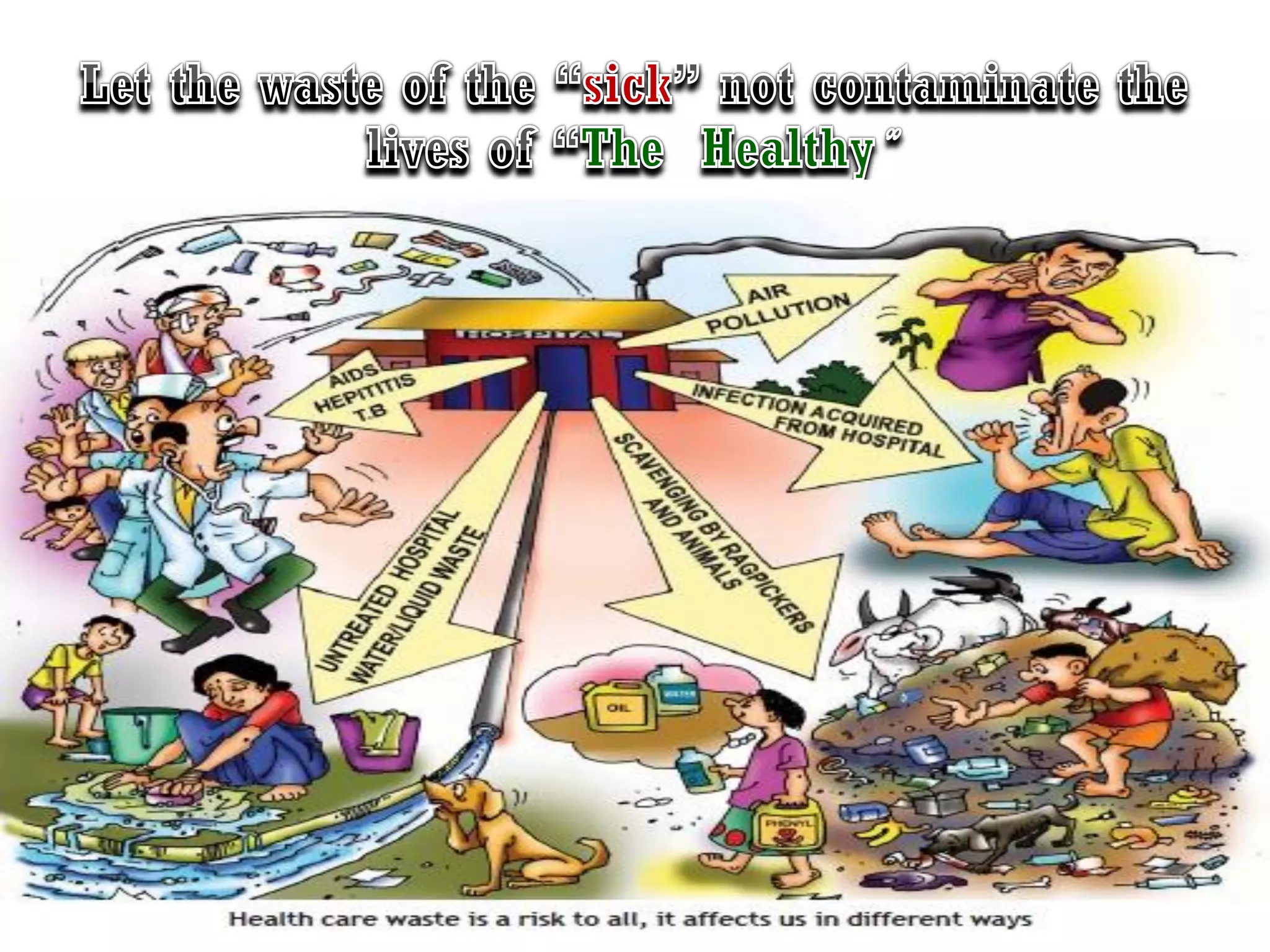
HEALTH CARE WASTE
MANAGEMENT
OBJECTIVES:
1. To provide an overview of the different categories of health
care waste
2. To inform healthcare workers of the proper waste segregation,
collection, disposal, and transport of healthcare waste
3. To develop awareness of environmental issues relating to
health care waste
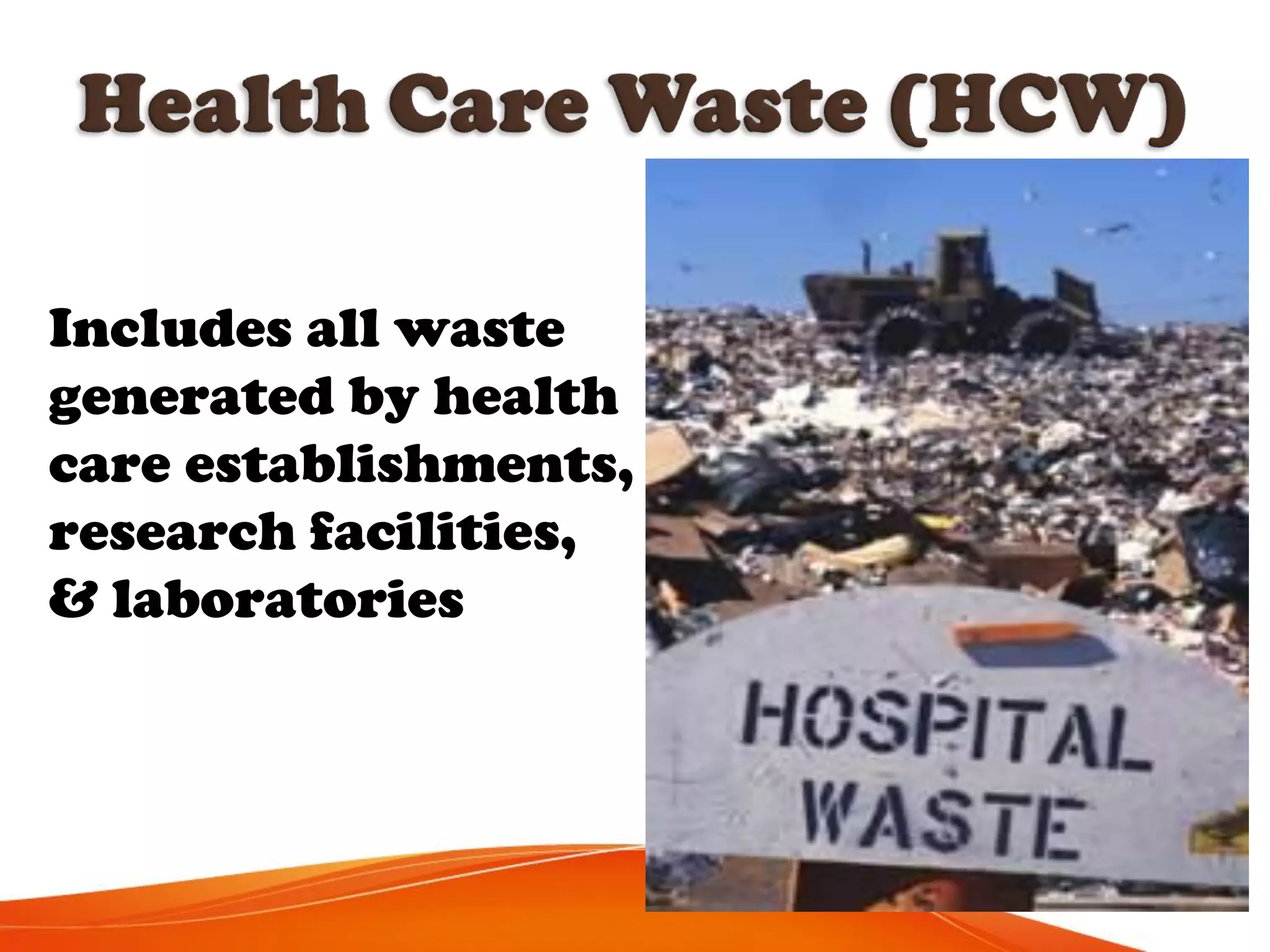
Includes all waste
generated by health
care establishments,
research facilities,
& laboratories
 General waste
 Infectious waste
 Pathological waste
 Sharps
 Pharmaceutical waste
 Genotoxic waste
 Waste with high content of heavy
metal
 Pressurized container
 Radioactive waste
GENERAL WASTE
• Comparable to
domestic waste
• Does not pose special
handling problems or
hazards to human
health or to the
environment
• Mostly from
administrative &
housekeeping
functions of health
care establishments,
e.g., office paper, food
waste
INFECTIOUS
WASTE
• Contains pathogens
(bacteria, viruses,
parasites, or fungi) in
sufficient amount
• 10% to 15% of
hospital waste
COLLECTION/DISPOSAL
• Should be placed in
yellow leakproof
container
• Collected by
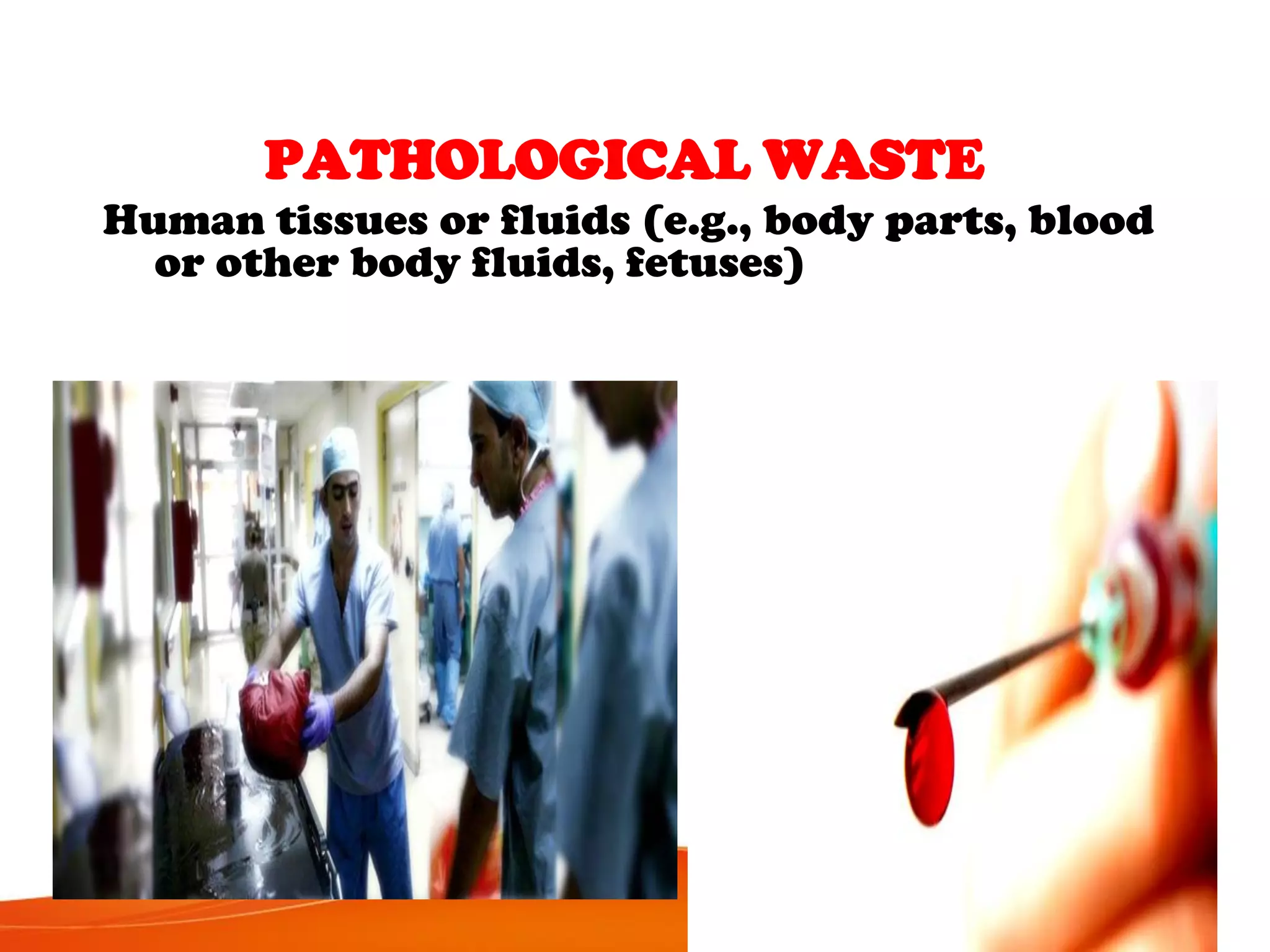
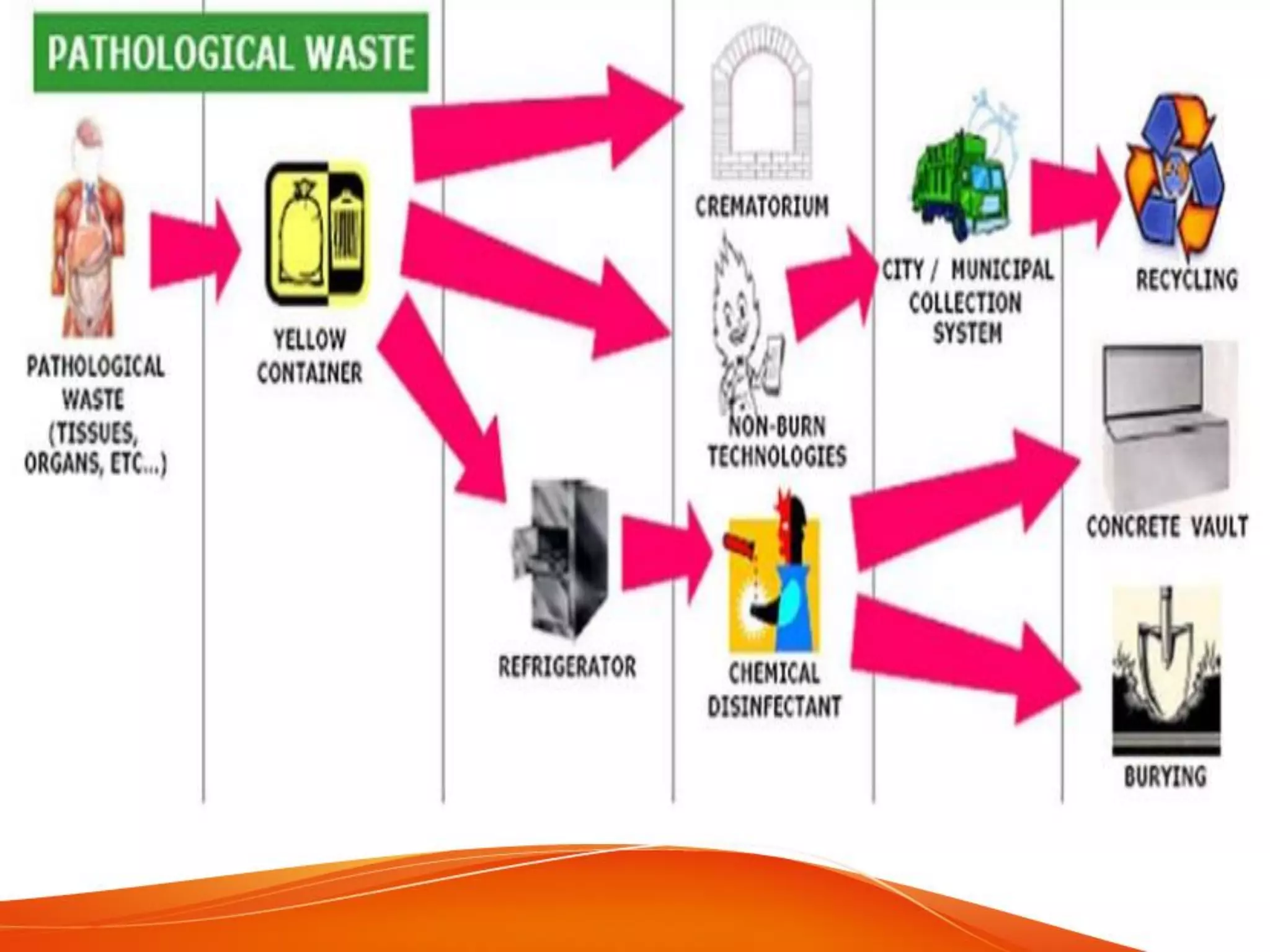
PATHOLOGICAL WASTE
Human tissues or fluids (e.g., body parts, blood
or other body fluids, fetuses)
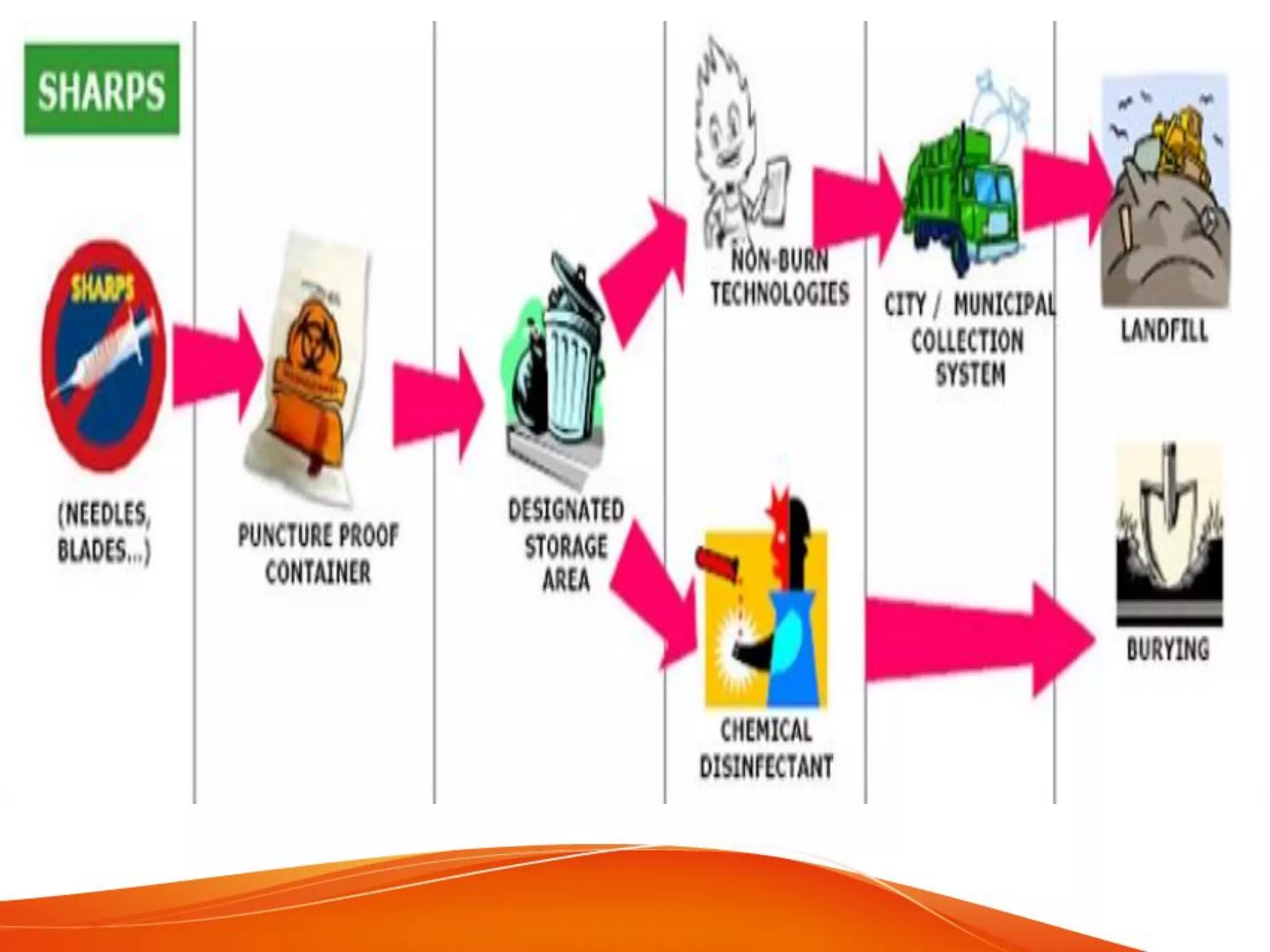
SHARPS
• Needles, syringes scalpels,
saws, blades, broken glass,
infusion sets, knives, nails,
& other items that can
cause a cut or punctured
wounds
• Considered as highly
hazardous HCW
COLLECTION / DISPOSAL
• Sharps should be collected at
source of use in puncture-proof
containers (metal or high-density
plastic) with fitted covers.
• Container made of dense
cardboard may be a substitute.
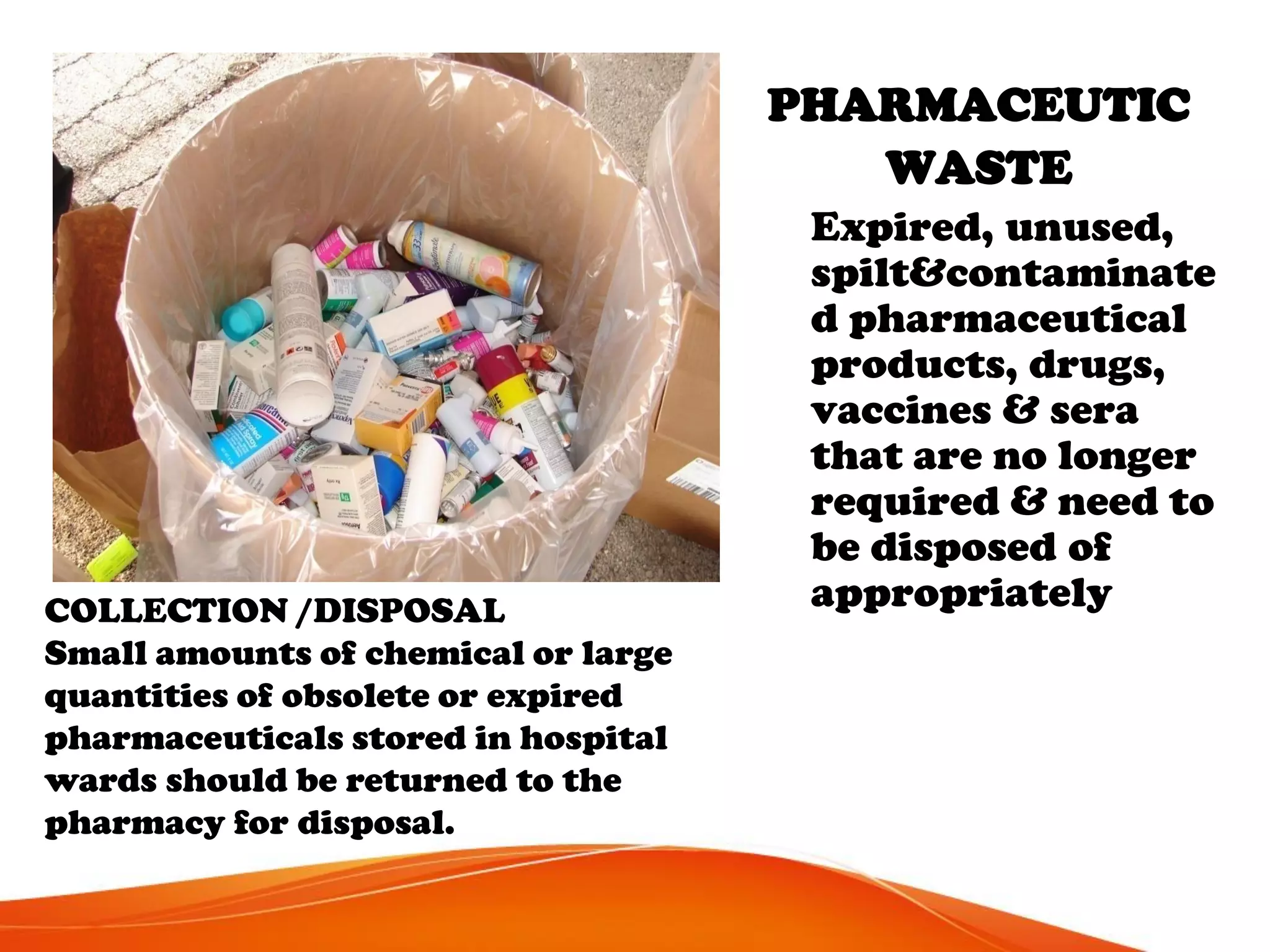
PHARMACEUTIC
WASTE
Expired, unused,
spilt&contaminate
d pharmaceutical
products, drugs,
vaccines & sera
that are no longer
required & need to
be disposed of
appropriatelyCOLLECTION /DISPOSAL
Small amounts of chemical or large
quantities of obsolete or expired
pharmaceuticals stored in hospital
wards should be returned to the
pharmacy for disposal.
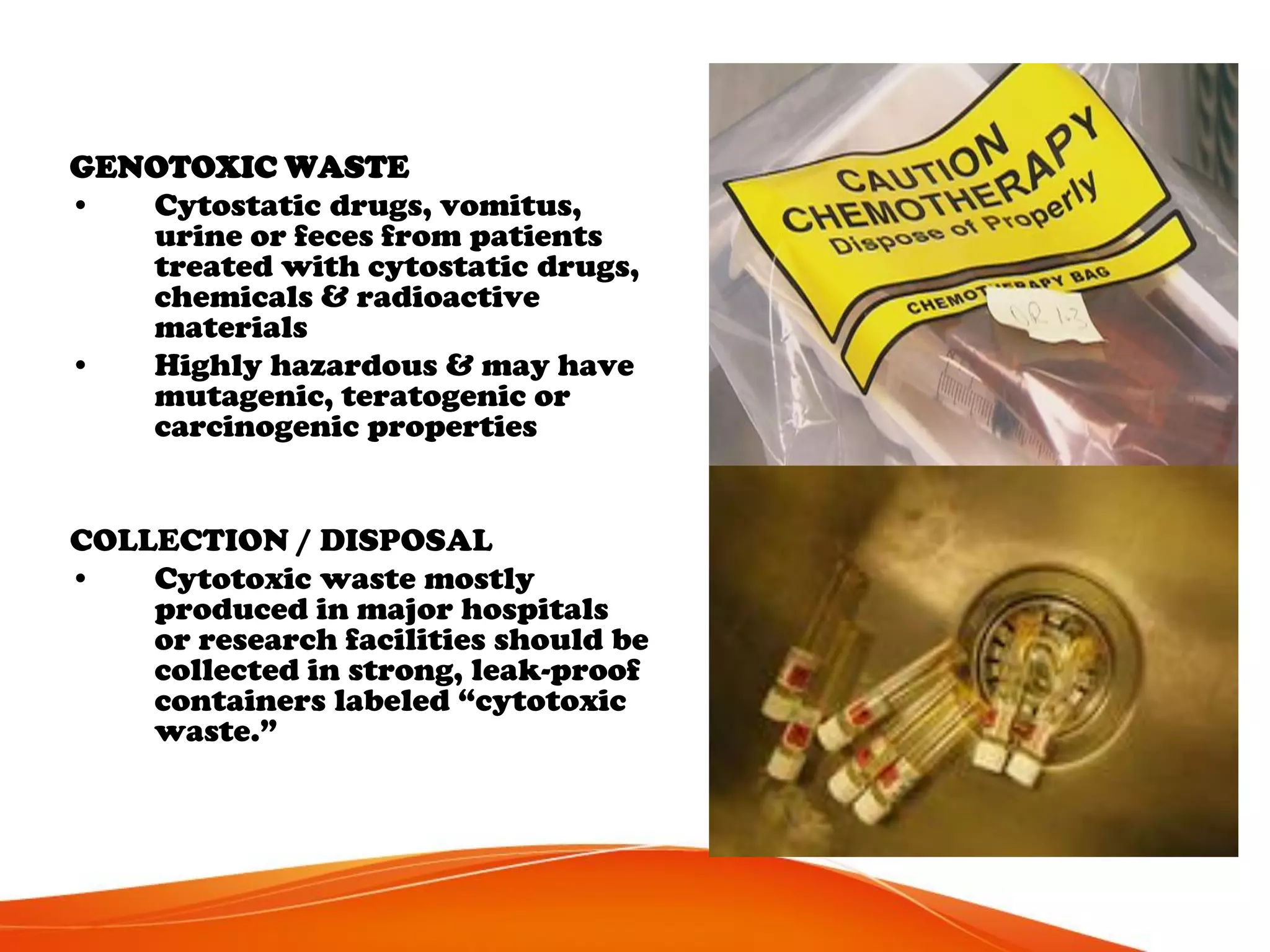
GENOTOXIC WASTE
• Cytostatic drugs, vomitus,
urine or feces from patients
treated with cytostatic drugs,
chemicals & radioactive
materials
• Highly hazardous & may have
mutagenic, teratogenic or
carcinogenic properties
COLLECTION / DISPOSAL
• Cytotoxic waste mostly
produced in major hospitals
or research facilities should be
collected in strong, leak-proof
containers labeled “cytotoxic
waste.”
WASTE WITH HIGH
CONTENT OF
HEAVY METAL
Batteries, broken thermometers,
blood pressure gauges
COLLECTION / DISPOSAL
• Waste with high content of heavy
metals (e.g., cadmium or mercury)
should be collected separately.
• Large quantities of chemical waste
should be packed in chemical-
resistant container and sent to
specialized treatment facilities.
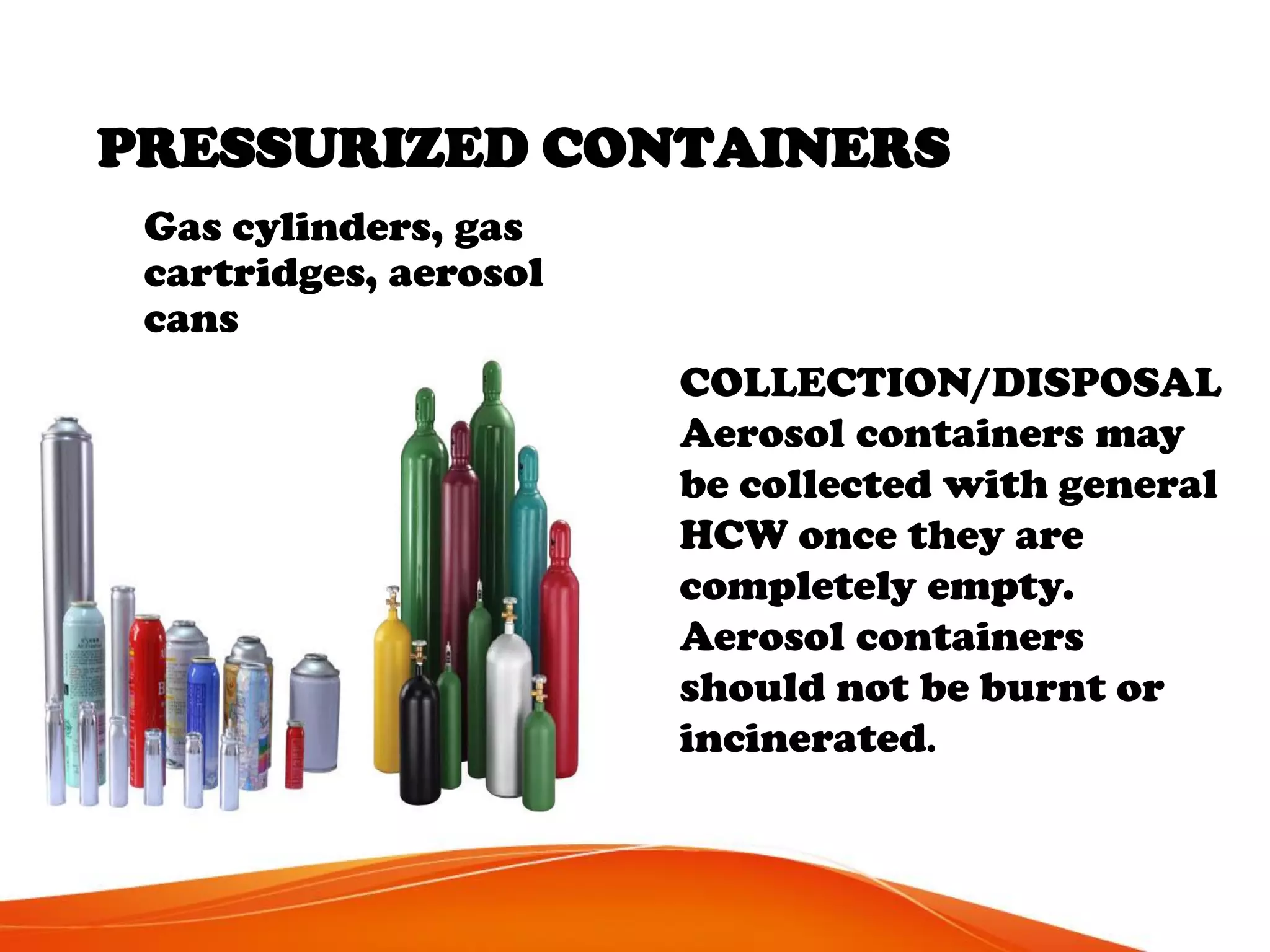
PRESSURIZED CONTAINERS
Gas cylinders, gas
cartridges, aerosol
cans
COLLECTION/DISPOSAL
Aerosol containers may
be collected with general
HCW once they are
completely empty.
Aerosol containers
should not be burnt or
incinerated.
•All government hospitals, clinics,
laboratories and research offices shall
incorporate satisfactory segregation,
treatment, collection and disposal
system.
•All infectious and hazardous hospital
wastes shall be treated before storage,
collection and disposal.
•All hospitals and other related
institutions shall inform their staff
and personnel about the proper waste
segregation (color-coding) and storage,
collection and disposal of hospital
waste.
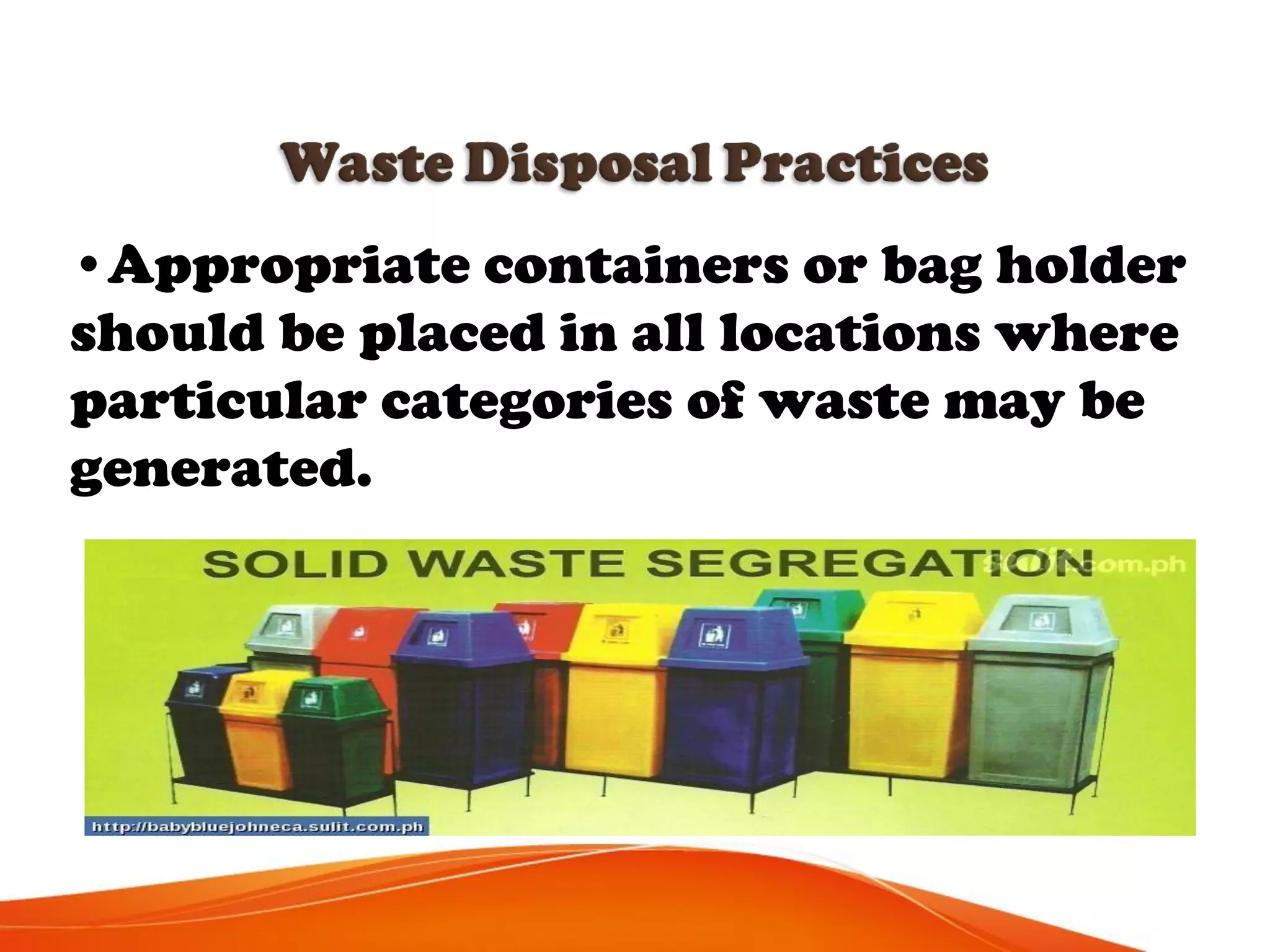
Color Coding Scheme Waste Categories
Black Non-infectious dry waste
Green Non-infectious wet waste
Yellow Infectious and pathological
waste
Yellow with Black band Chemical and heavy metal wastes
Orange Radioactive waste
Red Sharps and pressured containers
•Appropriate containers or bag holder
should be placed in all locations where
particular categories of waste may be
generated.
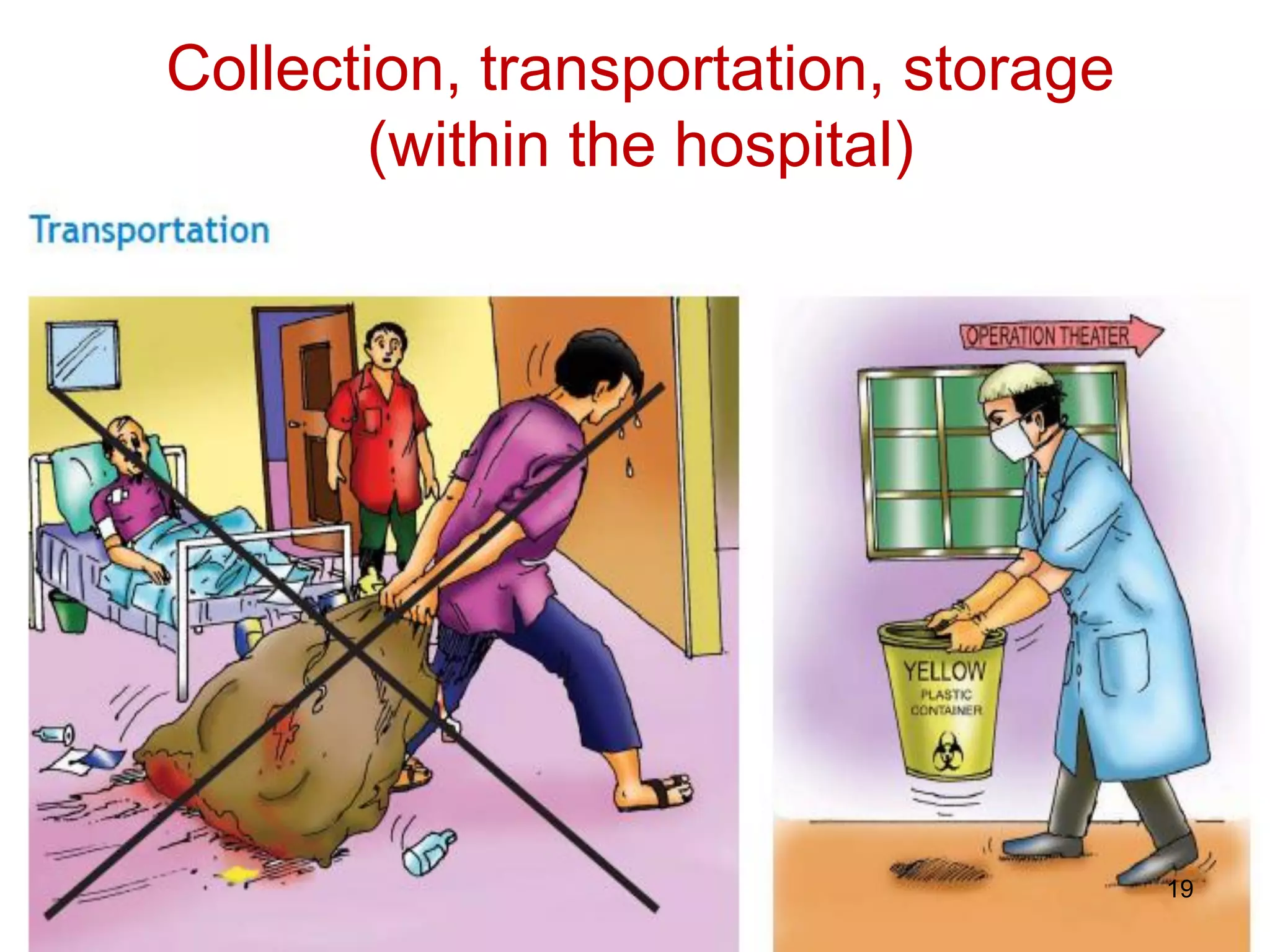
•Staff should never attempt to correct
errors of segregation by removing
items from a bag after disposal or by
placing one bag inside another bag of
different color.
•If general & hazardous wastes are
accidentally mixed, it should be
classified as hazardous HCW.
•Waste should be collected daily (or as
frequently as required) & transported
to the designated central storage site.
•No bags should be removed unless
they are labeled with their point of
production & contents.
•Bags or containers should be replaced
immediately with new ones of the
same type.
Collection, transportation, storage
(within the hospital)
19
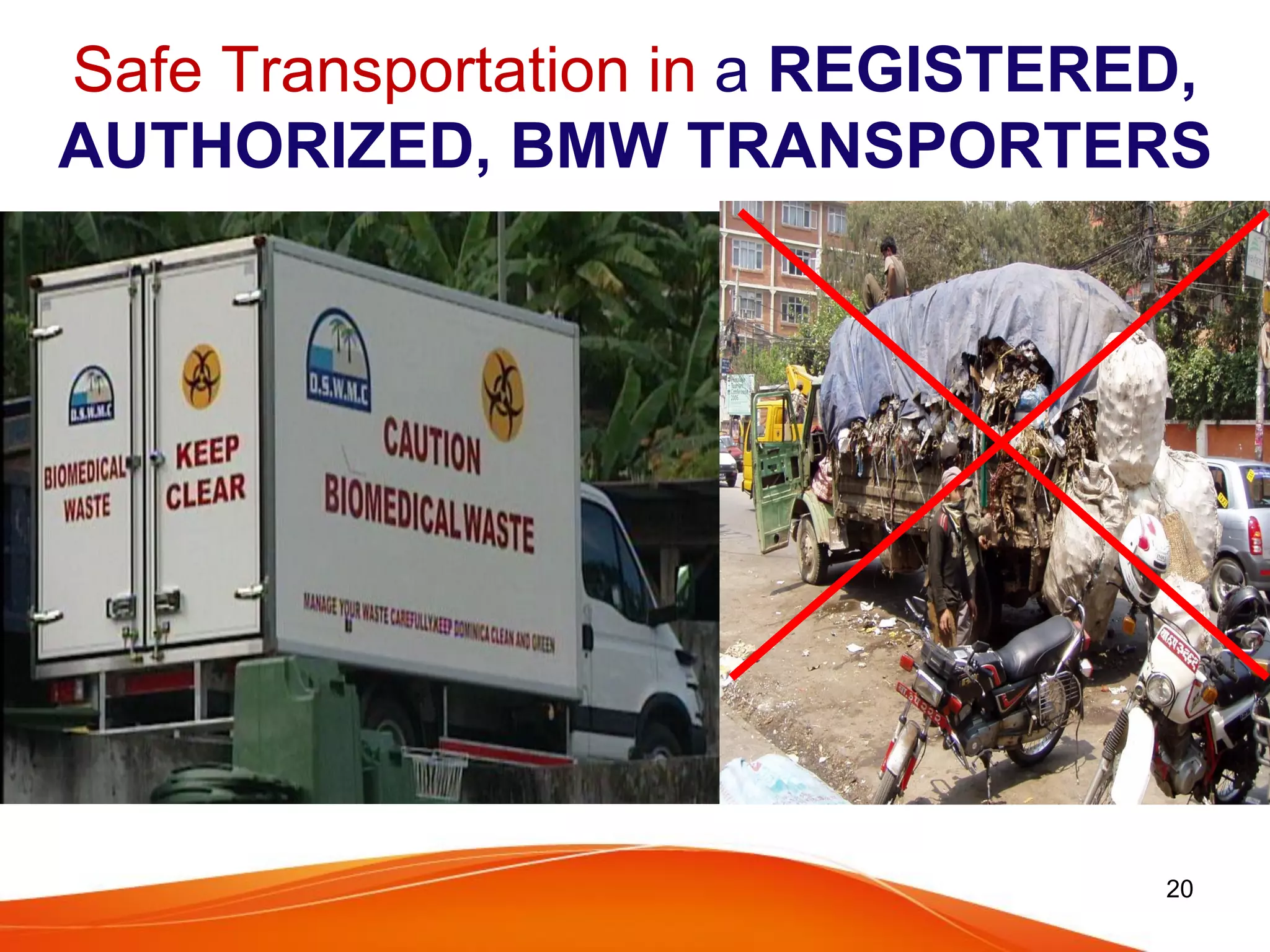
Safe Transportation in a REGISTERED,
AUTHORIZED, BMW TRANSPORTERS
20
PURPOSE:To change the biological &
chemical characteristic of the waste to
minimize its potential to cause harm
•Prohibits the incineration of medical
wastes
•Promotes the use of state of the art,
environmentally sound & safe non-
burn technologies for handling,
treatment, thermal destruction,
utilization & disposal of sorted
unrecycled biomedical & hazardous
waste.
A. Thermal process
B. Chemical disinfection
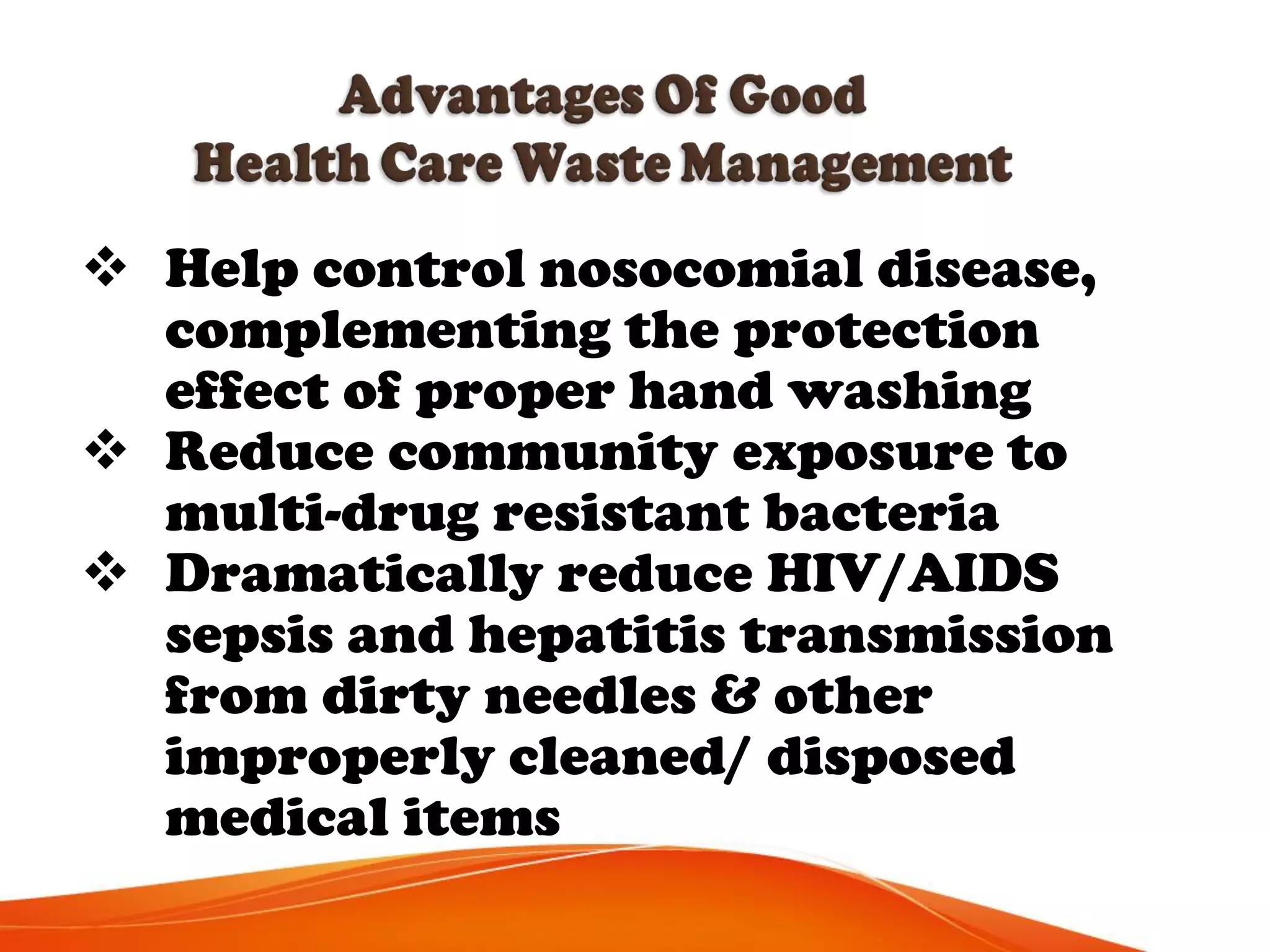
 Help control nosocomial disease,
complementing the protection
effect of proper hand washing
 Reduce community exposure to
multi-drug resistant bacteria
 Dramatically reduce HIV/AIDS
sepsis and hepatitis transmission
from dirty needles & other
improperly cleaned/ disposed
medical items
 Control zoonoses (disease passed to
humans through insects, birds, rats
& other animals)
 Cut cycles of infection
 Easily and cost-effectively address
health care worker safety issues,
including reducing the risk of
needlestick injuries
 Prevent illegal repackaging & resale
of contaminated needles
 Avoid negative long-term health
effects, e.g., cancer from the
environmental release of toxic
substances such as dioxin, mercury
& others
Healthcare Waste Management

Healthcare Waste Management

  • 1.
    HEALTH CARE WASTE MANAGEMENT OBJECTIVES: 1.To provide an overview of the different categories of health care waste 2. To inform healthcare workers of the proper waste segregation, collection, disposal, and transport of healthcare waste 3. To develop awareness of environmental issues relating to health care waste
  • 2.
    Includes all waste generatedby health care establishments, research facilities, & laboratories
  • 3.
     General waste Infectious waste  Pathological waste  Sharps  Pharmaceutical waste  Genotoxic waste  Waste with high content of heavy metal  Pressurized container  Radioactive waste
  • 4.
    GENERAL WASTE • Comparableto domestic waste • Does not pose special handling problems or hazards to human health or to the environment • Mostly from administrative & housekeeping functions of health care establishments, e.g., office paper, food waste
  • 5.
    INFECTIOUS WASTE • Contains pathogens (bacteria,viruses, parasites, or fungi) in sufficient amount • 10% to 15% of hospital waste COLLECTION/DISPOSAL • Should be placed in yellow leakproof container • Collected by
  • 6.
    PATHOLOGICAL WASTE Human tissuesor fluids (e.g., body parts, blood or other body fluids, fetuses)
  • 7.
    SHARPS • Needles, syringesscalpels, saws, blades, broken glass, infusion sets, knives, nails, & other items that can cause a cut or punctured wounds • Considered as highly hazardous HCW COLLECTION / DISPOSAL • Sharps should be collected at source of use in puncture-proof containers (metal or high-density plastic) with fitted covers. • Container made of dense cardboard may be a substitute.
  • 8.
    PHARMACEUTIC WASTE Expired, unused, spilt&contaminate d pharmaceutical products,drugs, vaccines & sera that are no longer required & need to be disposed of appropriatelyCOLLECTION /DISPOSAL Small amounts of chemical or large quantities of obsolete or expired pharmaceuticals stored in hospital wards should be returned to the pharmacy for disposal.
  • 9.
    GENOTOXIC WASTE • Cytostaticdrugs, vomitus, urine or feces from patients treated with cytostatic drugs, chemicals & radioactive materials • Highly hazardous & may have mutagenic, teratogenic or carcinogenic properties COLLECTION / DISPOSAL • Cytotoxic waste mostly produced in major hospitals or research facilities should be collected in strong, leak-proof containers labeled “cytotoxic waste.”
  • 10.
    WASTE WITH HIGH CONTENTOF HEAVY METAL Batteries, broken thermometers, blood pressure gauges COLLECTION / DISPOSAL • Waste with high content of heavy metals (e.g., cadmium or mercury) should be collected separately. • Large quantities of chemical waste should be packed in chemical- resistant container and sent to specialized treatment facilities.
  • 11.
    PRESSURIZED CONTAINERS Gas cylinders,gas cartridges, aerosol cans COLLECTION/DISPOSAL Aerosol containers may be collected with general HCW once they are completely empty. Aerosol containers should not be burnt or incinerated.
  • 13.
    •All government hospitals,clinics, laboratories and research offices shall incorporate satisfactory segregation, treatment, collection and disposal system. •All infectious and hazardous hospital wastes shall be treated before storage, collection and disposal.
  • 14.
    •All hospitals andother related institutions shall inform their staff and personnel about the proper waste segregation (color-coding) and storage, collection and disposal of hospital waste.
  • 15.
    Color Coding SchemeWaste Categories Black Non-infectious dry waste Green Non-infectious wet waste Yellow Infectious and pathological waste Yellow with Black band Chemical and heavy metal wastes Orange Radioactive waste Red Sharps and pressured containers
  • 16.
    •Appropriate containers orbag holder should be placed in all locations where particular categories of waste may be generated.
  • 17.
    •Staff should neverattempt to correct errors of segregation by removing items from a bag after disposal or by placing one bag inside another bag of different color. •If general & hazardous wastes are accidentally mixed, it should be classified as hazardous HCW.
  • 18.
    •Waste should becollected daily (or as frequently as required) & transported to the designated central storage site. •No bags should be removed unless they are labeled with their point of production & contents. •Bags or containers should be replaced immediately with new ones of the same type.
  • 19.
  • 20.
    Safe Transportation ina REGISTERED, AUTHORIZED, BMW TRANSPORTERS 20
  • 21.
    PURPOSE:To change thebiological & chemical characteristic of the waste to minimize its potential to cause harm
  • 22.
    •Prohibits the incinerationof medical wastes •Promotes the use of state of the art, environmentally sound & safe non- burn technologies for handling, treatment, thermal destruction, utilization & disposal of sorted unrecycled biomedical & hazardous waste.
  • 23.
    A. Thermal process B.Chemical disinfection
  • 29.
     Help controlnosocomial disease, complementing the protection effect of proper hand washing  Reduce community exposure to multi-drug resistant bacteria  Dramatically reduce HIV/AIDS sepsis and hepatitis transmission from dirty needles & other improperly cleaned/ disposed medical items
  • 30.
     Control zoonoses(disease passed to humans through insects, birds, rats & other animals)  Cut cycles of infection  Easily and cost-effectively address health care worker safety issues, including reducing the risk of needlestick injuries
  • 31.
     Prevent illegalrepackaging & resale of contaminated needles  Avoid negative long-term health effects, e.g., cancer from the environmental release of toxic substances such as dioxin, mercury & others