CONTENTS
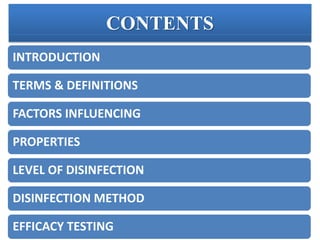
INTRODUCTION
TERMS & DEFINITIONS
FACTORS INFLUENCING
PROPERTIES
LEVEL OF DISINFECTION
DISINFECTION METHOD
EFFICACY TESTING
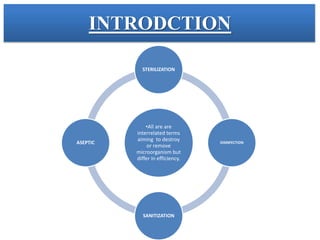
INTRODCTION
•All are are
interrelated terms
aiming to destroy
or remove
microorganism but
differ in efficiency.
STERILIZATION
DISINFECTION
SANITIZATION
ASEPTIC
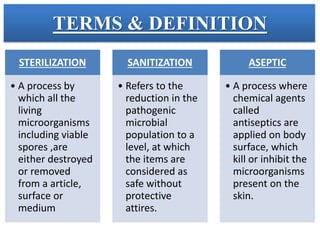
TERMS & DEFINITION
STERILIZATION
• A process by
which all the
living
microorganisms
including viable
spores ,are
either destroyed
or removed
from a article,
surface or
medium
SANITIZATION
• Refers to the
reduction in the
pathogenic
microbial
population to a
level, at which
the items are
considered as
safe without
protective
attires.
ASEPTIC
• A process where
chemical agents
called
antiseptics are
applied on body
surface, which
kill or inhibit the
microorganisms
present on the
skin.
DISINFECTION
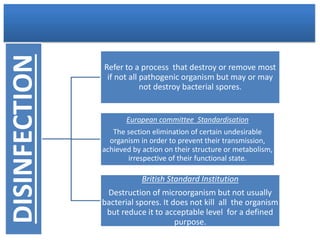
Refer to a process that destroy or remove most
if not all pathogenic organism but may or may
not destroy bacterial spores.
European committee Standardisation
The section elimination of certain undesirable
organism in order to prevent their transmission,
achieved by action on their structure or metabolism,
irrespective of their functional state.
British Standard Institution
Destruction of microorganism but not usually
bacterial spores. It does not kill all the organism
but reduce it to acceptable level for a defined
purpose.
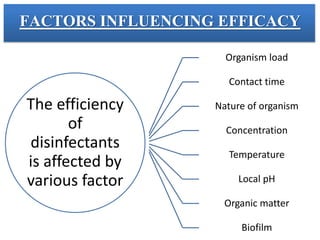
FACTORS INFLUENCING EFFICACY
The efficiency
of
disinfectants
is affected by
various factor
Organism load
Contact time
Nature of organism
Concentration
Temperature
Local pH
Organic matter
Biofilm
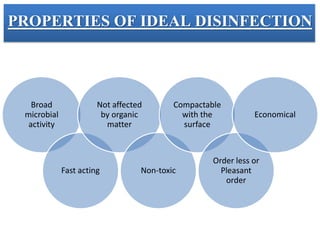
PROPERTIES OF IDEAL DISINFECTION
Broad
microbial
activity
Fast acting
Not affected
by organic
matter
Non-toxic
Compactable
with the
surface
Order less or
Pleasant
order
Economical
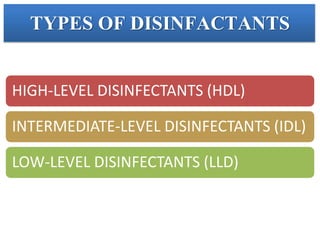
TYPES OF DISINFACTANTS
HIGH-LEVEL DISINFECTANTS (HDL)
INTERMEDIATE-LEVEL DISINFECTANTS (IDL)
LOW-LEVEL DISINFECTANTS (LLD)
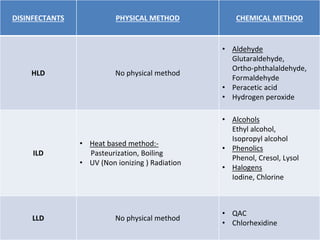
DISINFECTANTS PHYSICAL METHOD CHEMICAL METHOD
HLD No physical method
• Aldehyde
Glutaraldehyde,
Ortho-phthalaldehyde,
Formaldehyde
• Peracetic acid
• Hydrogen peroxide
ILD
• Heat based method:-
Pasteurization, Boiling
• UV (Non ionizing ) Radiation
• Alcohols
Ethyl alcohol,
Isopropyl alcohol
• Phenolics
Phenol, Cresol, Lysol
• Halogens
Iodine, Chlorine
LLD No physical method
• QAC
• Chlorhexidine
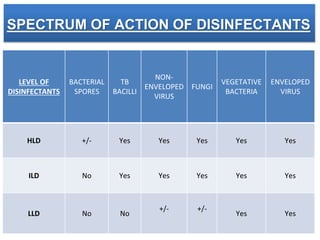
SPECTRUM OF ACTION OF DISINFECTANTS
LEVEL OF
DISINFECTANTS
BACTERIAL
SPORES
TB
BACILLI
NON-
ENVELOPED
VIRUS
FUNGI
VEGETATIVE
BACTERIA
ENVELOPED
VIRUS
HLD +/- Yes Yes Yes Yes Yes
ILD No Yes Yes Yes Yes Yes
LLD No No
+/- +/-
Yes Yes
HIGH LEVEL DISINFECTANTS
(HLD)
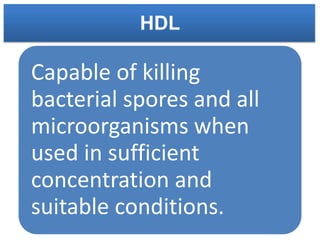
HDL
Capable of killing
bacterial spores and all
microorganisms when
used in sufficient
concentration and
suitable conditions.
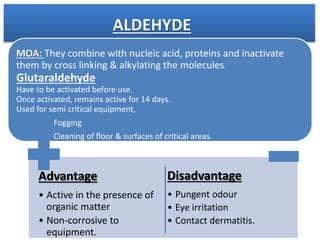
MOA: They combine with nucleic acid, proteins and inactivate
them by cross linking & alkylating the molecules.
Glutaraldehyde
Have to be activated before use.
Once activated, remains active for 14 days.
Used for semi critical equipment,
Fogging
Cleaning of floor & surfaces of critical areas.
Advantage
• Active in the presence of
organic matter
• Non-corrosive to
equipment.
Disadvantage
• Pungent odour
• Eye irritation
• Contact dermatitis.
ALDEHYDE
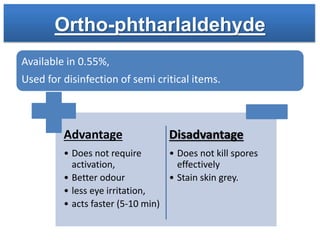
Ortho-phtharlaldehyde
Advantage
• Does not require
activation,
• Better odour
• less eye irritation,
• acts faster (5-10 min)
Disadvantage
• Does not kill spores
effectively
• Stain skin grey.
Available in 0.55%,
Used for disinfection of semi critical items.
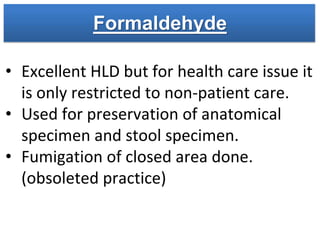
Formaldehyde
• Excellent HLD but for health care issue it
is only restricted to non-patient care.
• Used for preservation of anatomical
specimen and stool specimen.
• Fumigation of closed area done.
(obsoleted practice)
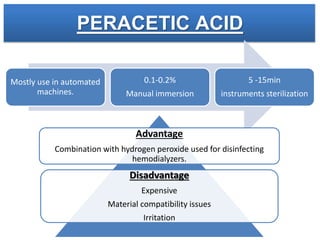
PERACETIC ACID
Mostly use in automated
machines.
0.1-0.2%
Manual immersion
5 -15min
instruments sterilization
Advantage
Combination with hydrogen peroxide used for disinfecting
hemodialyzers.
Disadvantage
Expensive
Material compatibility issues
Irritation
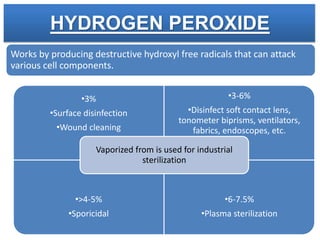
HYDROGEN PEROXIDE
Works by producing destructive hydroxyl free radicals that can attack
various cell components.
•3%
•Surface disinfection
•Wound cleaning
•3-6%
•Disinfect soft contact lens,
tonometer biprisms, ventilators,
fabrics, endoscopes, etc.
•>4-5%
•Sporicidal
•6-7.5%
•Plasma sterilization
Vaporized from is used for industrial
sterilization
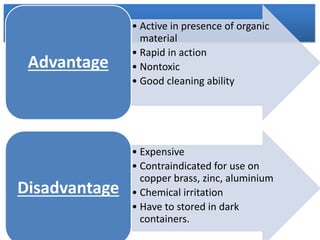
• Active in presence of organic
material
• Rapid in action
• Nontoxic
• Good cleaning ability
Advantage
• Expensive
• Contraindicated for use on
copper brass, zinc, aluminium
• Chemical irritation
• Have to stored in dark
containers.
Disadvantage
INTERMEDIATE LEVEL DISINFECTANTS
(ILD)
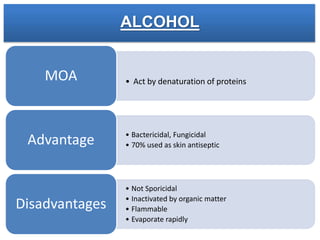
ALCOHOL
• Act by denaturation of proteins
MOA
• Bactericidal, Fungicidal
• 70% used as skin antiseptic
Advantage
• Not Sporicidal
• Inactivated by organic matter
• Flammable
• Evaporate rapidly
Disadvantages
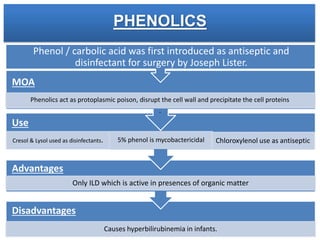
PHENOLICS
Disadvantages
Causes hyperbilirubinemia in infants.
Advantages
Only ILD which is active in presences of organic matter
Use
Cresol & Lysol used as disinfectants. 5% phenol is mycobactericidal Chloroxylenol use as antiseptic
MOA
Phenol / carbolic acid was first introduced as antiseptic and
disinfectant for surgery by Joseph Lister.
Phenolics act as protoplasmic poison, disrupt the cell wall and precipitate the cell proteins
.
HALOGENES
Halogens
Iodine
Chlorine
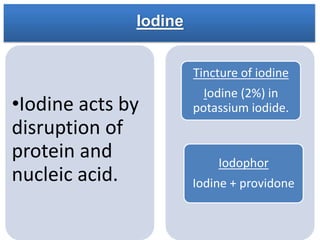
Iodine
•Iodine acts by
disruption of
protein and
nucleic acid.
Tincture of iodine
Iodine (2%) in
potassium iodide.
Iodophor
Iodine + providone
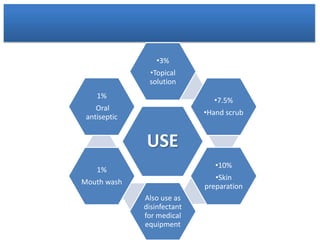
USE
•3%
•Topical
solution
•7.5%
•Hand scrub
•10%
•Skin
preparation
Also use as
disinfectant
for medical
equipment
1%
Mouth wash
1%
Oral
antiseptic
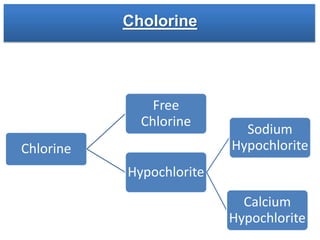
Cholorine
Chlorine
Hypochlorite
Sodium
Hypochlorite
Calcium
Hypochlorite
Free
Chlorine
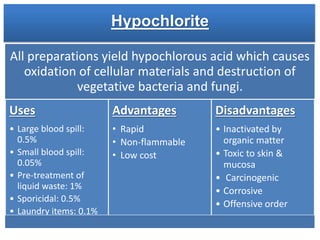
Hypochlorite
All preparations yield hypochlorous acid which causes
oxidation of cellular materials and destruction of
vegetative bacteria and fungi.
Uses
• Large blood spill:
0.5%
• Small blood spill:
0.05%
• Pre-treatment of
liquid waste: 1%
• Sporicidal: 0.5%
• Laundry items: 0.1%
Advantages
• Rapid
• Non-flammable
• Low cost
Disadvantages
• Inactivated by
organic matter
• Toxic to skin &
mucosa
• Carcinogenic
• Corrosive
• Offensive order
LOW LEVEL DISINFECTANTS
(LLD)
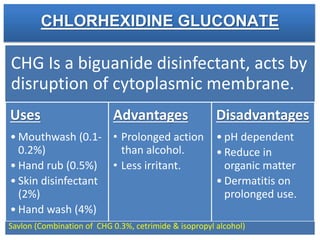
CHLORHEXIDINE GLUCONATE
CHG Is a biguanide disinfectant, acts by
disruption of cytoplasmic membrane.
Uses
• Mouthwash (0.1-
0.2%)
• Hand rub (0.5%)
• Skin disinfectant
(2%)
• Hand wash (4%)
Advantages
• Prolonged action
than alcohol.
• Less irritant.
Disadvantages
• pH dependent
• Reduce in
organic matter
• Dermatitis on
prolonged use.
Savlon (Combination of CHG 0.3%, cetrimide & isopropyl alcohol)
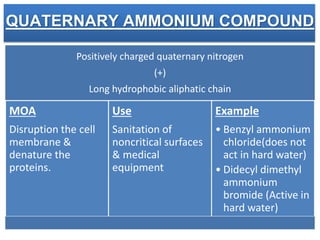
QUATERNARY AMMONIUM COMPOUND
Positively charged quaternary nitrogen
(+)
Long hydrophobic aliphatic chain
MOA
Disruption the cell
membrane &
denature the
proteins.
Use
Sanitation of
noncritical surfaces
& medical
equipment
Example
• Benzyl ammonium
chloride(does not
act in hard water)
• Didecyl dimethyl
ammonium
bromide (Active in
hard water)
DISINFECTION METHOD
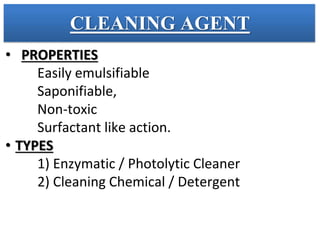
CLEANING AGENT
• PROPERTIES
Easily emulsifiable
Saponifiable,
Non-toxic
Surfactant like action.
• TYPES
1) Enzymatic / Photolytic Cleaner
2) Cleaning Chemical / Detergent
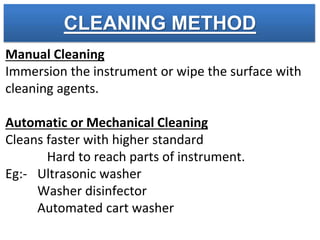
CLEANING METHOD
Manual Cleaning
Immersion the instrument or wipe the surface with
cleaning agents.
Automatic or Mechanical Cleaning
Cleans faster with higher standard
Hard to reach parts of instrument.
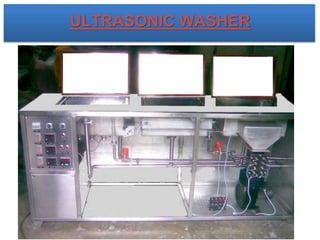
Eg:- Ultrasonic washer
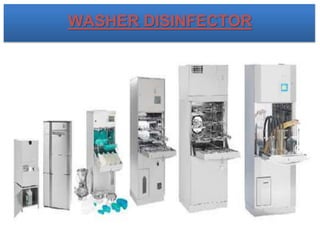
Washer disinfector
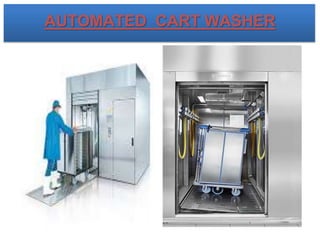
Automated cart washer
ULTRASONIC WASHER
WASHER DISINFECTOR
AUTOMATED CART WASHER
DISINFECTION OF ENVIRONMENT
ORDER
• Cleaning with a cleaning agent is performed first,
before applying disinfectant
• CDC recommends to use ILD to LLD for
environmental disinfection.
SEQUENCE
• Cleaner to dirtier area
• Higher to lower
• Inward to outwards
FREQUENCY OF CLEANING DEPENDS ON
• Probability of contamination
• Vulnerability of population to infection
• Frequency of hand contact
COMMON SITUATIONS
• Non-critical surfaces: 2-3 times a day
• Mattress: weekly or after discharge
• Doors, windows, walls, ceiling: once a month or
soiled
• High touch area: every 3-4 hours.
Method Contd….
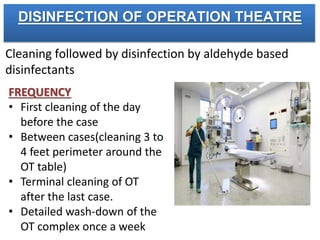
DISINFECTION OF OPERATION THEATRE
Cleaning followed by disinfection by aldehyde based
disinfectants
FREQUENCY
• First cleaning of the day
before the case
• Between cases(cleaning 3 to
4 feet perimeter around the
OT table)
• Terminal cleaning of OT
after the last case.
• Detailed wash-down of the
OT complex once a week
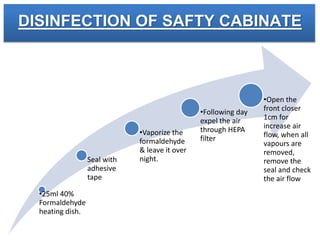
•25ml 40%
Formaldehyde
heating dish.
Seal with
adhesive
tape
•Vaporize the
formaldehyde
& leave it over
night.
•Following day
expel the air
through HEPA
filter
•Open the
front closer
1cm for
increase air
flow, when all
vapours are
removed,
remove the
seal and check
the air flow
DISINFECTION OF SAFTY CABINATE
DISINFECTION OF SKIN
•
SPAULDING’S CLASSIFICATION
OF MEDICAL DEVICES
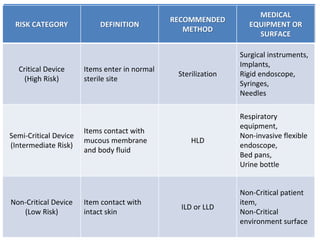
RISK CATEGORY DEFINITION
RECOMMENDED
METHOD
MEDICAL
EQUIPMENT OR
SURFACE
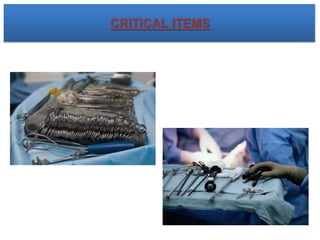
Critical Device
(High Risk)
Items enter in normal
sterile site
Sterilization
Surgical instruments,
Implants,
Rigid endoscope,
Syringes,
Needles
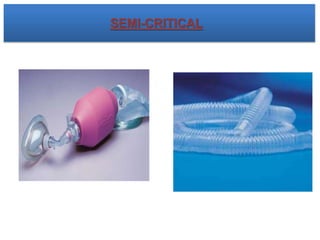
Semi-Critical Device
(Intermediate Risk)
Items contact with
mucous membrane
and body fluid
HLD
Respiratory
equipment,
Non-invasive flexible
endoscope,
Bed pans,
Urine bottle
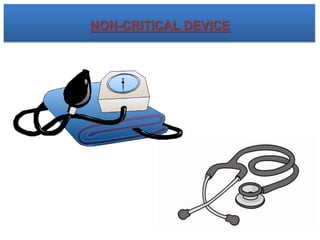
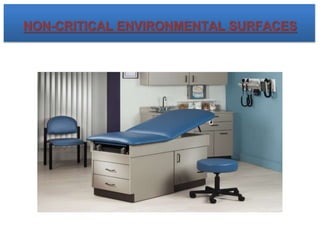
Non-Critical Device
(Low Risk)
Item contact with
intact skin
ILD or LLD
Non-Critical patient
item,
Non-Critical
environment surface
CRITICAL ITEMS
SEMI-CRITICAL
NON-CRITICAL DEVICE
NON-CRITICAL ENVIRONMENTAL SURFACES
EFFICACY TESTING
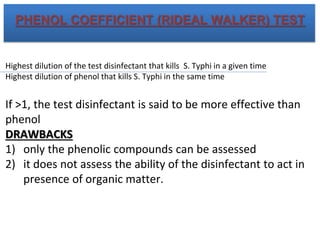
PHENOL COEFFICIENT (RIDEAL WALKER) TEST
Highest dilution of the test disinfectant that kills S. Typhi in a given time
Highest dilution of phenol that kills S. Typhi in the same time
If >1, the test disinfectant is said to be more effective than
phenol
DRAWBACKS
1) only the phenolic compounds can be assessed
2) it does not assess the ability of the disinfectant to act in
presence of organic matter.
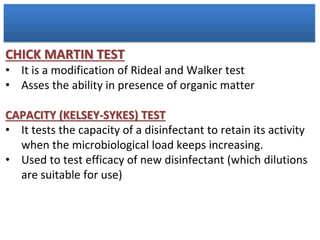
CHICK MARTIN TEST
• It is a modification of Rideal and Walker test
• Asses the ability in presence of organic matter
CAPACITY (KELSEY-SYKES) TEST
• It tests the capacity of a disinfectant to retain its activity
when the microbiological load keeps increasing.
• Used to test efficacy of new disinfectant (which dilutions
are suitable for use)
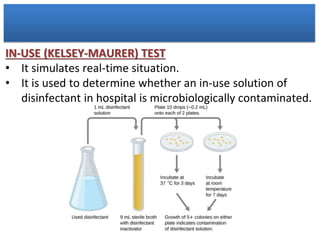
IN-USE (KELSEY-MAURER) TEST
• It simulates real-time situation.
• It is used to determine whether an in-use solution of
disinfectant in hospital is microbiologically contaminated.
Disinfection (dr.sumesh)

Disinfection (dr.sumesh)

  • 2.
    CONTENTS INTRODUCTION TERMS & DEFINITIONS FACTORSINFLUENCING PROPERTIES LEVEL OF DISINFECTION DISINFECTION METHOD EFFICACY TESTING
  • 3.
    INTRODCTION •All are are interrelatedterms aiming to destroy or remove microorganism but differ in efficiency. STERILIZATION DISINFECTION SANITIZATION ASEPTIC
  • 4.
    TERMS & DEFINITION STERILIZATION •A process by which all the living microorganisms including viable spores ,are either destroyed or removed from a article, surface or medium SANITIZATION • Refers to the reduction in the pathogenic microbial population to a level, at which the items are considered as safe without protective attires. ASEPTIC • A process where chemical agents called antiseptics are applied on body surface, which kill or inhibit the microorganisms present on the skin.
  • 5.
    DISINFECTION Refer to aprocess that destroy or remove most if not all pathogenic organism but may or may not destroy bacterial spores. European committee Standardisation The section elimination of certain undesirable organism in order to prevent their transmission, achieved by action on their structure or metabolism, irrespective of their functional state. British Standard Institution Destruction of microorganism but not usually bacterial spores. It does not kill all the organism but reduce it to acceptable level for a defined purpose.
  • 6.
    FACTORS INFLUENCING EFFICACY Theefficiency of disinfectants is affected by various factor Organism load Contact time Nature of organism Concentration Temperature Local pH Organic matter Biofilm
  • 7.
    PROPERTIES OF IDEALDISINFECTION Broad microbial activity Fast acting Not affected by organic matter Non-toxic Compactable with the surface Order less or Pleasant order Economical
  • 8.
    TYPES OF DISINFACTANTS HIGH-LEVELDISINFECTANTS (HDL) INTERMEDIATE-LEVEL DISINFECTANTS (IDL) LOW-LEVEL DISINFECTANTS (LLD)
  • 9.
    DISINFECTANTS PHYSICAL METHODCHEMICAL METHOD HLD No physical method • Aldehyde Glutaraldehyde, Ortho-phthalaldehyde, Formaldehyde • Peracetic acid • Hydrogen peroxide ILD • Heat based method:- Pasteurization, Boiling • UV (Non ionizing ) Radiation • Alcohols Ethyl alcohol, Isopropyl alcohol • Phenolics Phenol, Cresol, Lysol • Halogens Iodine, Chlorine LLD No physical method • QAC • Chlorhexidine
  • 10.
    SPECTRUM OF ACTIONOF DISINFECTANTS LEVEL OF DISINFECTANTS BACTERIAL SPORES TB BACILLI NON- ENVELOPED VIRUS FUNGI VEGETATIVE BACTERIA ENVELOPED VIRUS HLD +/- Yes Yes Yes Yes Yes ILD No Yes Yes Yes Yes Yes LLD No No +/- +/- Yes Yes
  • 11.
  • 12.
    HDL Capable of killing bacterialspores and all microorganisms when used in sufficient concentration and suitable conditions.
  • 13.
    MOA: They combinewith nucleic acid, proteins and inactivate them by cross linking & alkylating the molecules. Glutaraldehyde Have to be activated before use. Once activated, remains active for 14 days. Used for semi critical equipment, Fogging Cleaning of floor & surfaces of critical areas. Advantage • Active in the presence of organic matter • Non-corrosive to equipment. Disadvantage • Pungent odour • Eye irritation • Contact dermatitis. ALDEHYDE
  • 14.
    Ortho-phtharlaldehyde Advantage • Does notrequire activation, • Better odour • less eye irritation, • acts faster (5-10 min) Disadvantage • Does not kill spores effectively • Stain skin grey. Available in 0.55%, Used for disinfection of semi critical items.
  • 15.
    Formaldehyde • Excellent HLDbut for health care issue it is only restricted to non-patient care. • Used for preservation of anatomical specimen and stool specimen. • Fumigation of closed area done. (obsoleted practice)
  • 16.
    PERACETIC ACID Mostly usein automated machines. 0.1-0.2% Manual immersion 5 -15min instruments sterilization Advantage Combination with hydrogen peroxide used for disinfecting hemodialyzers. Disadvantage Expensive Material compatibility issues Irritation
  • 17.
    HYDROGEN PEROXIDE Works byproducing destructive hydroxyl free radicals that can attack various cell components. •3% •Surface disinfection •Wound cleaning •3-6% •Disinfect soft contact lens, tonometer biprisms, ventilators, fabrics, endoscopes, etc. •>4-5% •Sporicidal •6-7.5% •Plasma sterilization Vaporized from is used for industrial sterilization
  • 18.
    • Active inpresence of organic material • Rapid in action • Nontoxic • Good cleaning ability Advantage • Expensive • Contraindicated for use on copper brass, zinc, aluminium • Chemical irritation • Have to stored in dark containers. Disadvantage
  • 19.
  • 20.
    ALCOHOL • Act bydenaturation of proteins MOA • Bactericidal, Fungicidal • 70% used as skin antiseptic Advantage • Not Sporicidal • Inactivated by organic matter • Flammable • Evaporate rapidly Disadvantages
  • 21.
    PHENOLICS Disadvantages Causes hyperbilirubinemia ininfants. Advantages Only ILD which is active in presences of organic matter Use Cresol & Lysol used as disinfectants. 5% phenol is mycobactericidal Chloroxylenol use as antiseptic MOA Phenol / carbolic acid was first introduced as antiseptic and disinfectant for surgery by Joseph Lister. Phenolics act as protoplasmic poison, disrupt the cell wall and precipitate the cell proteins .
  • 22.
  • 23.
    Iodine •Iodine acts by disruptionof protein and nucleic acid. Tincture of iodine Iodine (2%) in potassium iodide. Iodophor Iodine + providone
  • 24.
    USE •3% •Topical solution •7.5% •Hand scrub •10% •Skin preparation Also useas disinfectant for medical equipment 1% Mouth wash 1% Oral antiseptic
  • 25.
  • 26.
    Hypochlorite All preparations yieldhypochlorous acid which causes oxidation of cellular materials and destruction of vegetative bacteria and fungi. Uses • Large blood spill: 0.5% • Small blood spill: 0.05% • Pre-treatment of liquid waste: 1% • Sporicidal: 0.5% • Laundry items: 0.1% Advantages • Rapid • Non-flammable • Low cost Disadvantages • Inactivated by organic matter • Toxic to skin & mucosa • Carcinogenic • Corrosive • Offensive order
  • 27.
  • 28.
    CHLORHEXIDINE GLUCONATE CHG Isa biguanide disinfectant, acts by disruption of cytoplasmic membrane. Uses • Mouthwash (0.1- 0.2%) • Hand rub (0.5%) • Skin disinfectant (2%) • Hand wash (4%) Advantages • Prolonged action than alcohol. • Less irritant. Disadvantages • pH dependent • Reduce in organic matter • Dermatitis on prolonged use. Savlon (Combination of CHG 0.3%, cetrimide & isopropyl alcohol)
  • 29.
    QUATERNARY AMMONIUM COMPOUND Positivelycharged quaternary nitrogen (+) Long hydrophobic aliphatic chain MOA Disruption the cell membrane & denature the proteins. Use Sanitation of noncritical surfaces & medical equipment Example • Benzyl ammonium chloride(does not act in hard water) • Didecyl dimethyl ammonium bromide (Active in hard water)
  • 30.
  • 31.
    CLEANING AGENT • PROPERTIES Easilyemulsifiable Saponifiable, Non-toxic Surfactant like action. • TYPES 1) Enzymatic / Photolytic Cleaner 2) Cleaning Chemical / Detergent
  • 32.
    CLEANING METHOD Manual Cleaning Immersionthe instrument or wipe the surface with cleaning agents. Automatic or Mechanical Cleaning Cleans faster with higher standard Hard to reach parts of instrument. Eg:- Ultrasonic washer Washer disinfector Automated cart washer
  • 33.
  • 34.
  • 35.
  • 36.
    DISINFECTION OF ENVIRONMENT ORDER •Cleaning with a cleaning agent is performed first, before applying disinfectant • CDC recommends to use ILD to LLD for environmental disinfection. SEQUENCE • Cleaner to dirtier area • Higher to lower • Inward to outwards
  • 37.
    FREQUENCY OF CLEANINGDEPENDS ON • Probability of contamination • Vulnerability of population to infection • Frequency of hand contact COMMON SITUATIONS • Non-critical surfaces: 2-3 times a day • Mattress: weekly or after discharge • Doors, windows, walls, ceiling: once a month or soiled • High touch area: every 3-4 hours.
  • 38.
  • 39.
    DISINFECTION OF OPERATIONTHEATRE Cleaning followed by disinfection by aldehyde based disinfectants FREQUENCY • First cleaning of the day before the case • Between cases(cleaning 3 to 4 feet perimeter around the OT table) • Terminal cleaning of OT after the last case. • Detailed wash-down of the OT complex once a week
  • 40.
    •25ml 40% Formaldehyde heating dish. Sealwith adhesive tape •Vaporize the formaldehyde & leave it over night. •Following day expel the air through HEPA filter •Open the front closer 1cm for increase air flow, when all vapours are removed, remove the seal and check the air flow DISINFECTION OF SAFTY CABINATE
  • 41.
  • 42.
  • 43.
    RISK CATEGORY DEFINITION RECOMMENDED METHOD MEDICAL EQUIPMENTOR SURFACE Critical Device (High Risk) Items enter in normal sterile site Sterilization Surgical instruments, Implants, Rigid endoscope, Syringes, Needles Semi-Critical Device (Intermediate Risk) Items contact with mucous membrane and body fluid HLD Respiratory equipment, Non-invasive flexible endoscope, Bed pans, Urine bottle Non-Critical Device (Low Risk) Item contact with intact skin ILD or LLD Non-Critical patient item, Non-Critical environment surface
  • 44.
  • 45.
  • 46.
  • 47.
  • 48.
  • 49.
    PHENOL COEFFICIENT (RIDEALWALKER) TEST Highest dilution of the test disinfectant that kills S. Typhi in a given time Highest dilution of phenol that kills S. Typhi in the same time If >1, the test disinfectant is said to be more effective than phenol DRAWBACKS 1) only the phenolic compounds can be assessed 2) it does not assess the ability of the disinfectant to act in presence of organic matter.
  • 50.
    CHICK MARTIN TEST •It is a modification of Rideal and Walker test • Asses the ability in presence of organic matter CAPACITY (KELSEY-SYKES) TEST • It tests the capacity of a disinfectant to retain its activity when the microbiological load keeps increasing. • Used to test efficacy of new disinfectant (which dilutions are suitable for use)
  • 51.
    IN-USE (KELSEY-MAURER) TEST •It simulates real-time situation. • It is used to determine whether an in-use solution of disinfectant in hospital is microbiologically contaminated.