HAND HYGIENE
RUVY TAN DE GUZMAN, RN MGM
SAN LAZARO HOSPITAL
OBJECTIVES
OUTLINE
HISTORY OF HANDWASHING
A French Pharmacist
demonstrated that solutions
containing chloride of lime or soda
could eradicate the foul odor
associated with human corpses
and be used as disinfectants and
antiseptics
1822
HISTORY OF HANDWASHING
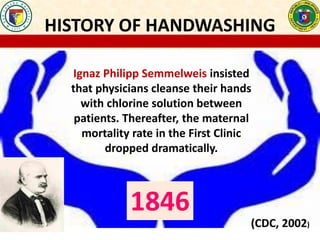
Ignaz Philipp Semmelweis insisted
that physicians cleanse their hands
with chlorine solution between
patients. Thereafter, the maternal
mortality rate in the First Clinic
dropped dramatically.
(CDC, 2002)
1846
HISTORY OF HANDWASHING
The U.S. Public Health Service
recommendations directed personnel to
wash their hands with soap and water for
1 to 2 minutes before and after patient
contact. Rinsing hands with an antiseptic agent
was believed to be less effective than hand
washing with plain soap and
was recommended only in emergencies or in
areas where sinks were not available.
1961
HISTORY OF HANDWASHING
Guidelines on hand washing practices in
hospitals were published by CDC. They recommended
hand washing with plain soap between patients and
washing with antimicrobial products
before and after performing invasive procedures.
Waterless antiseptic agents such as alcohol-based
solutions were recommended only in situations
where sinks were not available.
1975 & 1985
HISTORY OF HANDWASHING
Guidelines similar to those of the CDC were
published by the Association for
Professionals in Infection Control (APIC,
2010). The 1995 APIC guidelines included
discussion of alcohol-based hand rubs and
supported their use in more clinical settings
than had been recommended earlier.
1988 & 1995
HISTORY OF HANDWASHING
Healthcare Infection Control Practices Advisory
Committee (HICPAC) recommended that upon
leaving the rooms of patients with multi-drug
resistant pathogens such as methicillin-resistant
Staphylococcus aureus (MRSA), caregivers use
either antimicrobial soap or a waterless
antiseptic agent to cleanse their hands. These
guidelines also recommended hand washing and
hand antisepsis for routine patient care.
1995 & 1996
HISTORY OF HANDWASHING
Guideline for Hand Hygiene in Health-Care
Settings was published as the
recommendations of the Healthcare
Infection Control Practices Advisory
Committee and the
HICPAC/SHEA/APIC/IDSA Hand Hygiene
Task Force. In 2010, the 2002 Guideline
continued to be available on the CDC
website (CDC, 2002).
2002
HISTORY OF HANDWASHING
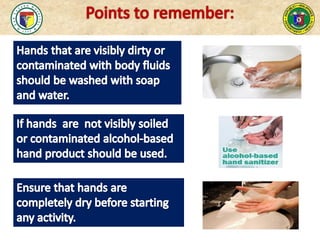
World Health Organization (WHO) reaffirmed
the recommendation to wash hands with soap and
water when visibly dirty, soiled with blood or other
body fluids, or exposed to potential spore-forming
pathogens, such as Clostridium difficile.
When hands are not visibly soiled, the WHO
recommended the use of alcohol-based hand rubs
as the preferred means for routine
hand antisepsis
2009 (WHO, 2009)
HISTORY OF HANDWASHING
Although the guidelines of all these healthcare
organizations have been adopted by the majority
of hospitals, adherence by healthcare providers to
recommended hand washing protocols remains
low. For this reason, various professional groups
have undertaken studies to identify factors that
improve adherence to hand hygiene protocols.
2011
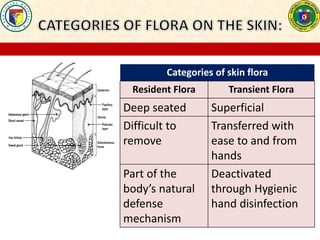
Categories of skin flora
Resident Flora Transient Flora
Deep seated Superficial
Difficult to
remove
Transferred with
ease to and from
hands
Part of the
body’s natural
defense
mechanism
Deactivated
through Hygienic
hand disinfection
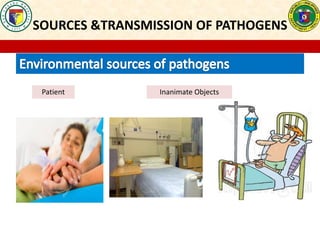
SOURCES &TRANSMISSION OF PATHOGENS
Inanimate ObjectsPatient
SOURCES &TRANSMISSION OF PATHOGENS
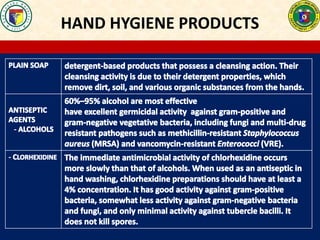
HAND HYGIENE PRODUCTS
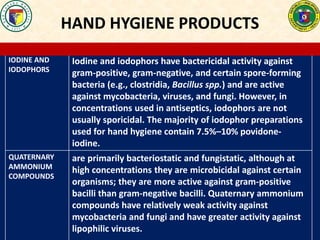
IODINE AND
IODOPHORS
Iodine and iodophors have bactericidal activity against
gram-positive, gram-negative, and certain spore-forming
bacteria (e.g., clostridia, Bacillus spp.) and are active
against mycobacteria, viruses, and fungi. However, in
concentrations used in antiseptics, iodophors are not
usually sporicidal. The majority of iodophor preparations
used for hand hygiene contain 7.5%–10% povidone-
iodine.
QUATERNARY
AMMONIUM
COMPOUNDS
are primarily bacteriostatic and fungistatic, although at
high concentrations they are microbicidal against certain
organisms; they are more active against gram-positive
bacilli than gram-negative bacilli. Quaternary ammonium
compounds have relatively weak activity against
mycobacteria and fungi and have greater activity against
lipophilic viruses.
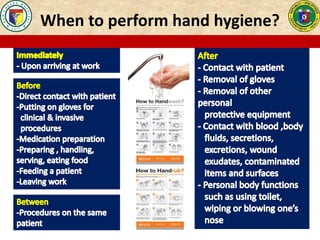
When to perform hand hygiene?
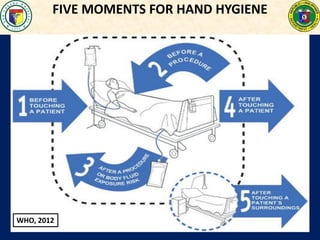
FIVE MOMENTS FOR HAND HYGIENE
WHO, 2012
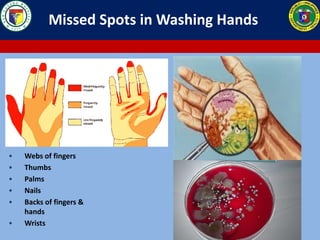
• Webs of fingers
• Thumbs
• Palms
• Nails
• Backs of fingers &
hands
• Wrists
Missed Spots in Washing Hands
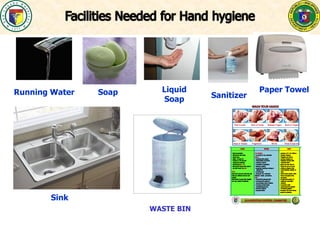
Running Water Soap
Towel
Paper TowelLiquid
Soap Sanitizer
WASTE BIN
Sink
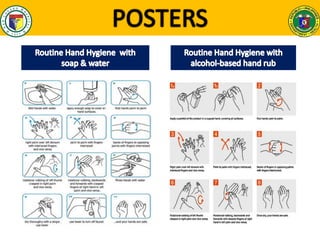
Palm to palm Back of hands Between fingers Back of fingers
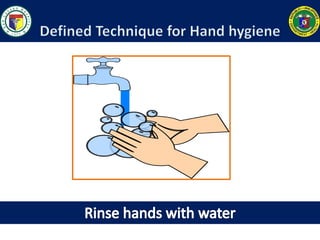
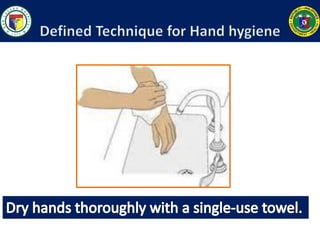
Base of thumbs Fingernails Wrists Rinse & wipe dry
1 2 3 4
5 6 7 8
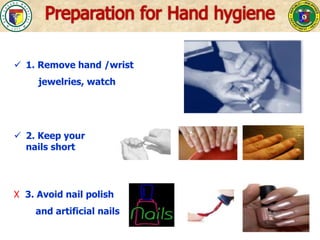
 1. Remove hand /wrist
jewelries, watch
 2. Keep your
nails short
X 3. Avoid nail polish
and artificial nails
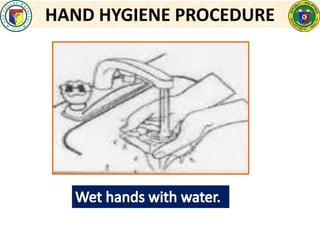
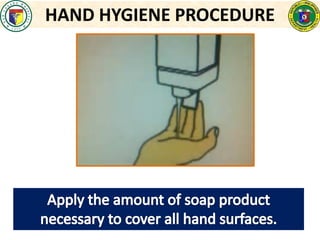
HAND HYGIENE PROCEDURE
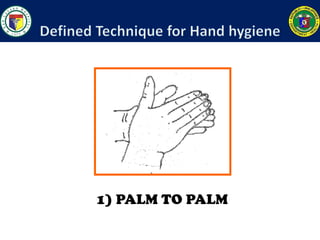
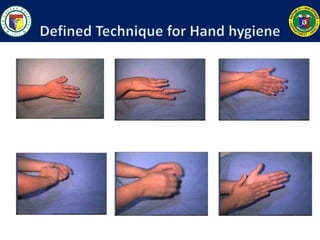
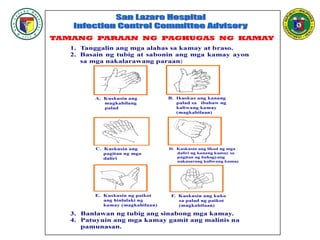
1) PALM TO PALM
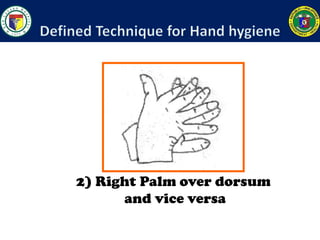
2) Right Palm over dorsum
and vice versa
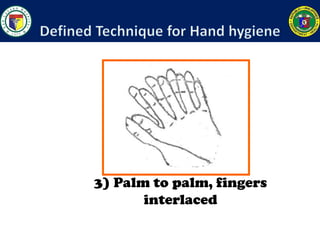
3) Palm to palm, fingers
interlaced
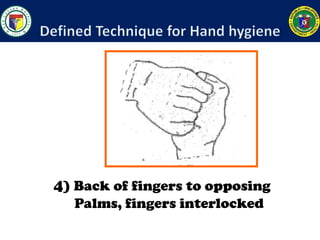
4) Back of fingers to opposing
Palms, fingers interlocked
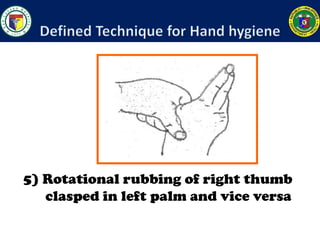
5) Rotational rubbing of right thumb
clasped in left palm and vice versa
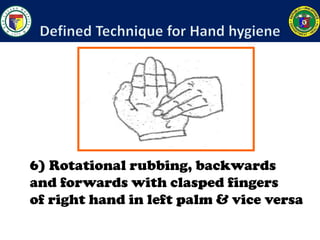
6) Rotational rubbing, backwards
and forwards with clasped fingers
of right hand in left palm & vice versa
SURGICAL HAND PREPARATION TECHNIQUE
WITH AN ALCOHOL-BASED HANDRUB
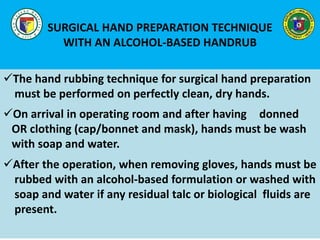
The hand rubbing technique for surgical hand preparation
must be performed on perfectly clean, dry hands.
On arrival in operating room and after having donned
OR clothing (cap/bonnet and mask), hands must be wash
with soap and water.
After the operation, when removing gloves, hands must be
rubbed with an alcohol-based formulation or washed with
soap and water if any residual talc or biological fluids are
present.
SURGICAL HAND PREPARATION TECHNIQUE
WITH AN ALCOHOL-BASED HANDRUB
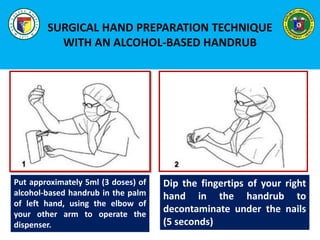
Put approximately 5ml (3 doses) of
alcohol-based handrub in the palm
of left hand, using the elbow of
your other arm to operate the
dispenser.
Dip the fingertips of your right
hand in the handrub to
decontaminate under the nails
(5 seconds)
SURGICAL HAND PREPARATION TECHNIQUE
WITH AN ALCOHOL-BASED HANDRUB
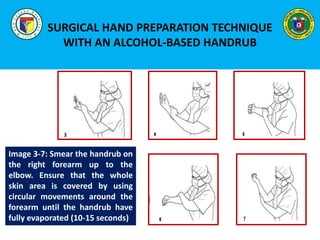
Image 3-7: Smear the handrub on
the right forearm up to the
elbow. Ensure that the whole
skin area is covered by using
circular movements around the
forearm until the handrub have
fully evaporated (10-15 seconds)
SURGICAL HAND PREPARATION TECHNIQUE
WITH AN ALCOHOL-BASED HANDRUB
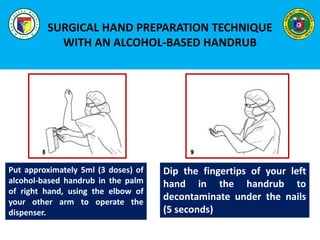
Put approximately 5ml (3 doses) of
alcohol-based handrub in the palm
of right hand, using the elbow of
your other arm to operate the
dispenser.
Dip the fingertips of your left
hand in the handrub to
decontaminate under the nails
(5 seconds)
SURGICAL HAND PREPARATION TECHNIQUE
WITH AN ALCOHOL-BASED HANDRUB
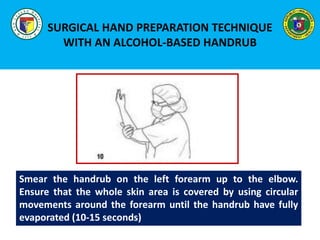
Smear the handrub on the left forearm up to the elbow.
Ensure that the whole skin area is covered by using circular
movements around the forearm until the handrub have fully
evaporated (10-15 seconds)
SURGICAL HAND PREPARATION TECHNIQUE
WITH AN ALCOHOL-BASED HANDRUB
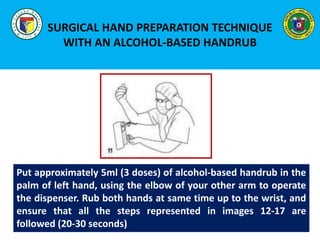
Put approximately 5ml (3 doses) of alcohol-based handrub in the
palm of left hand, using the elbow of your other arm to operate
the dispenser. Rub both hands at same time up to the wrist, and
ensure that all the steps represented in images 12-17 are
followed (20-30 seconds)
SURGICAL HAND PREPARATION TECHNIQUE
WITH AN ALCOHOL-BASED HANDRUB
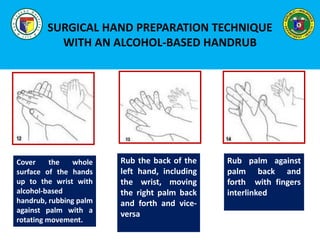
Cover the whole
surface of the hands
up to the wrist with
alcohol-based
handrub, rubbing palm
against palm with a
rotating movement.
Rub the back of the
left hand, including
the wrist, moving
the right palm back
and forth and vice-
versa
Rub palm against
palm back and
forth with fingers
interlinked
SURGICAL HAND PREPARATION TECHNIQUE
WITH AN ALCOHOL-BASED HANDRUB
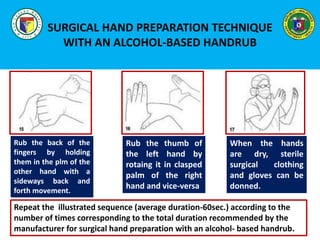
Rub the back of the
fingers by holding
them in the plm of the
other hand with a
sideways back and
forth movement.
Rub the thumb of
the left hand by
rotaing it in clasped
palm of the right
hand and vice-versa
When the hands
are dry, sterile
surgical clothing
and gloves can be
donned.
Repeat the illustrated sequence (average duration-60sec.) according to the
number of times corresponding to the total duration recommended by the
manufacturer for surgical hand preparation with an alcohol- based handrub.
SURGICAL HAND PREPARATION TECHNIQUE
WITH AN ALCOHOL-BASED HANDRUB
BARRIERS TO HAND HYGIENE
• Inaccessible hand hygiene supplies
• Skin irritation caused by hand hygiene agents
• Hand washing and hygiene products thought to be harmful to the
skin
• Priority of care (the patient’s need takes priority over hand
hygiene)
• Lack of knowledge of the guidelines
• Lack of feedback to encourage compliance
• Insufficient time for hand hygiene
• Forgetfulness
• High workload and understaffing
• Lack of scientific information about healthcare-related infection
rates
CULTURE OF CARE TO PRACTICE HAND HYGIENE
• Provide written guidelines for all healthcare
providers
• Introduce and demonstrate hand hygiene protocols
to all caregivers
• Encourage leaders to model and support antiseptic
hand hygiene practice
• Monitor and give feedback to all healthcare
providers, including physicians, nursing care
providers, food service personnel, laboratory
technicians, pharmacists, and therapists
REFERENCES
Hand Hygiene

Hand Hygiene

  • 1.
    HAND HYGIENE RUVY TANDE GUZMAN, RN MGM SAN LAZARO HOSPITAL
  • 2.
  • 3.
  • 4.
    HISTORY OF HANDWASHING AFrench Pharmacist demonstrated that solutions containing chloride of lime or soda could eradicate the foul odor associated with human corpses and be used as disinfectants and antiseptics 1822
  • 5.
    HISTORY OF HANDWASHING IgnazPhilipp Semmelweis insisted that physicians cleanse their hands with chlorine solution between patients. Thereafter, the maternal mortality rate in the First Clinic dropped dramatically. (CDC, 2002) 1846
  • 6.
    HISTORY OF HANDWASHING TheU.S. Public Health Service recommendations directed personnel to wash their hands with soap and water for 1 to 2 minutes before and after patient contact. Rinsing hands with an antiseptic agent was believed to be less effective than hand washing with plain soap and was recommended only in emergencies or in areas where sinks were not available. 1961
  • 7.
    HISTORY OF HANDWASHING Guidelineson hand washing practices in hospitals were published by CDC. They recommended hand washing with plain soap between patients and washing with antimicrobial products before and after performing invasive procedures. Waterless antiseptic agents such as alcohol-based solutions were recommended only in situations where sinks were not available. 1975 & 1985
  • 8.
    HISTORY OF HANDWASHING Guidelinessimilar to those of the CDC were published by the Association for Professionals in Infection Control (APIC, 2010). The 1995 APIC guidelines included discussion of alcohol-based hand rubs and supported their use in more clinical settings than had been recommended earlier. 1988 & 1995
  • 9.
    HISTORY OF HANDWASHING HealthcareInfection Control Practices Advisory Committee (HICPAC) recommended that upon leaving the rooms of patients with multi-drug resistant pathogens such as methicillin-resistant Staphylococcus aureus (MRSA), caregivers use either antimicrobial soap or a waterless antiseptic agent to cleanse their hands. These guidelines also recommended hand washing and hand antisepsis for routine patient care. 1995 & 1996
  • 10.
    HISTORY OF HANDWASHING Guidelinefor Hand Hygiene in Health-Care Settings was published as the recommendations of the Healthcare Infection Control Practices Advisory Committee and the HICPAC/SHEA/APIC/IDSA Hand Hygiene Task Force. In 2010, the 2002 Guideline continued to be available on the CDC website (CDC, 2002). 2002
  • 11.
    HISTORY OF HANDWASHING WorldHealth Organization (WHO) reaffirmed the recommendation to wash hands with soap and water when visibly dirty, soiled with blood or other body fluids, or exposed to potential spore-forming pathogens, such as Clostridium difficile. When hands are not visibly soiled, the WHO recommended the use of alcohol-based hand rubs as the preferred means for routine hand antisepsis 2009 (WHO, 2009)
  • 12.
    HISTORY OF HANDWASHING Althoughthe guidelines of all these healthcare organizations have been adopted by the majority of hospitals, adherence by healthcare providers to recommended hand washing protocols remains low. For this reason, various professional groups have undertaken studies to identify factors that improve adherence to hand hygiene protocols. 2011
  • 13.
    Categories of skinflora Resident Flora Transient Flora Deep seated Superficial Difficult to remove Transferred with ease to and from hands Part of the body’s natural defense mechanism Deactivated through Hygienic hand disinfection
  • 14.
  • 15.
    SOURCES &TRANSMISSION OFPATHOGENS Inanimate ObjectsPatient
  • 16.
  • 17.
  • 18.
    HAND HYGIENE PRODUCTS IODINEAND IODOPHORS Iodine and iodophors have bactericidal activity against gram-positive, gram-negative, and certain spore-forming bacteria (e.g., clostridia, Bacillus spp.) and are active against mycobacteria, viruses, and fungi. However, in concentrations used in antiseptics, iodophors are not usually sporicidal. The majority of iodophor preparations used for hand hygiene contain 7.5%–10% povidone- iodine. QUATERNARY AMMONIUM COMPOUNDS are primarily bacteriostatic and fungistatic, although at high concentrations they are microbicidal against certain organisms; they are more active against gram-positive bacilli than gram-negative bacilli. Quaternary ammonium compounds have relatively weak activity against mycobacteria and fungi and have greater activity against lipophilic viruses.
  • 19.
    When to performhand hygiene?
  • 20.
    FIVE MOMENTS FORHAND HYGIENE WHO, 2012
  • 21.
    • Webs offingers • Thumbs • Palms • Nails • Backs of fingers & hands • Wrists Missed Spots in Washing Hands
  • 22.
    Running Water Soap Towel PaperTowelLiquid Soap Sanitizer WASTE BIN Sink Palm to palm Back of hands Between fingers Back of fingers Base of thumbs Fingernails Wrists Rinse & wipe dry 1 2 3 4 5 6 7 8
  • 23.
     1. Removehand /wrist jewelries, watch  2. Keep your nails short X 3. Avoid nail polish and artificial nails
  • 24.
  • 25.
  • 26.
  • 27.
    2) Right Palmover dorsum and vice versa
  • 28.
    3) Palm topalm, fingers interlaced
  • 29.
    4) Back offingers to opposing Palms, fingers interlocked
  • 30.
    5) Rotational rubbingof right thumb clasped in left palm and vice versa
  • 31.
    6) Rotational rubbing,backwards and forwards with clasped fingers of right hand in left palm & vice versa
  • 37.
    SURGICAL HAND PREPARATIONTECHNIQUE WITH AN ALCOHOL-BASED HANDRUB The hand rubbing technique for surgical hand preparation must be performed on perfectly clean, dry hands. On arrival in operating room and after having donned OR clothing (cap/bonnet and mask), hands must be wash with soap and water. After the operation, when removing gloves, hands must be rubbed with an alcohol-based formulation or washed with soap and water if any residual talc or biological fluids are present.
  • 38.
    SURGICAL HAND PREPARATIONTECHNIQUE WITH AN ALCOHOL-BASED HANDRUB Put approximately 5ml (3 doses) of alcohol-based handrub in the palm of left hand, using the elbow of your other arm to operate the dispenser. Dip the fingertips of your right hand in the handrub to decontaminate under the nails (5 seconds)
  • 39.
    SURGICAL HAND PREPARATIONTECHNIQUE WITH AN ALCOHOL-BASED HANDRUB Image 3-7: Smear the handrub on the right forearm up to the elbow. Ensure that the whole skin area is covered by using circular movements around the forearm until the handrub have fully evaporated (10-15 seconds)
  • 40.
    SURGICAL HAND PREPARATIONTECHNIQUE WITH AN ALCOHOL-BASED HANDRUB Put approximately 5ml (3 doses) of alcohol-based handrub in the palm of right hand, using the elbow of your other arm to operate the dispenser. Dip the fingertips of your left hand in the handrub to decontaminate under the nails (5 seconds)
  • 41.
    SURGICAL HAND PREPARATIONTECHNIQUE WITH AN ALCOHOL-BASED HANDRUB Smear the handrub on the left forearm up to the elbow. Ensure that the whole skin area is covered by using circular movements around the forearm until the handrub have fully evaporated (10-15 seconds)
  • 42.
    SURGICAL HAND PREPARATIONTECHNIQUE WITH AN ALCOHOL-BASED HANDRUB Put approximately 5ml (3 doses) of alcohol-based handrub in the palm of left hand, using the elbow of your other arm to operate the dispenser. Rub both hands at same time up to the wrist, and ensure that all the steps represented in images 12-17 are followed (20-30 seconds)
  • 43.
    SURGICAL HAND PREPARATIONTECHNIQUE WITH AN ALCOHOL-BASED HANDRUB Cover the whole surface of the hands up to the wrist with alcohol-based handrub, rubbing palm against palm with a rotating movement. Rub the back of the left hand, including the wrist, moving the right palm back and forth and vice- versa Rub palm against palm back and forth with fingers interlinked
  • 44.
    SURGICAL HAND PREPARATIONTECHNIQUE WITH AN ALCOHOL-BASED HANDRUB Rub the back of the fingers by holding them in the plm of the other hand with a sideways back and forth movement. Rub the thumb of the left hand by rotaing it in clasped palm of the right hand and vice-versa When the hands are dry, sterile surgical clothing and gloves can be donned. Repeat the illustrated sequence (average duration-60sec.) according to the number of times corresponding to the total duration recommended by the manufacturer for surgical hand preparation with an alcohol- based handrub.
  • 45.
    SURGICAL HAND PREPARATIONTECHNIQUE WITH AN ALCOHOL-BASED HANDRUB
  • 46.
    BARRIERS TO HANDHYGIENE • Inaccessible hand hygiene supplies • Skin irritation caused by hand hygiene agents • Hand washing and hygiene products thought to be harmful to the skin • Priority of care (the patient’s need takes priority over hand hygiene) • Lack of knowledge of the guidelines • Lack of feedback to encourage compliance • Insufficient time for hand hygiene • Forgetfulness • High workload and understaffing • Lack of scientific information about healthcare-related infection rates
  • 47.
    CULTURE OF CARETO PRACTICE HAND HYGIENE • Provide written guidelines for all healthcare providers • Introduce and demonstrate hand hygiene protocols to all caregivers • Encourage leaders to model and support antiseptic hand hygiene practice • Monitor and give feedback to all healthcare providers, including physicians, nursing care providers, food service personnel, laboratory technicians, pharmacists, and therapists
  • 49.