Industrial Instrumentation
MCQ
ER. FARUK BIN POYEN
ASST. PROFESSOR, AEIE, UIT, BU
FARUK.POYEN@GMAIL.COM
Set I
1. Smoke density of the flue gas going out of the chimney is measured by a
a) Polarograph
b) Chromatograph
c) Thermal conductivity meter
d) Photo electric cell – correct
2. Flapper nozzle is used in a/an __________ controller.
a) Hydraulic
b) Pneumatic
c) None of these
d) Electronic
2
Set I
3. Which of the following relates the emf. generated in a single homogeneous wire to
the temperature difference ?
a) Thomson effect
b) Peltier effect
c) Seebeck effect
d) None of these
4. Load cells are used for the measurement of
a) Stress
b) Strain
c) Weight
d) Velocity
3
Set I
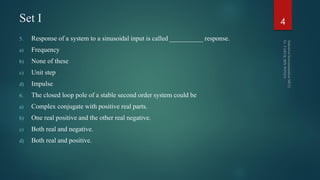
5. Response of a system to a sinusoidal input is called __________ response.
a) Frequency
b) None of these
c) Unit step
d) Impulse
6. The closed loop pole of a stable second order system could be
a) Complex conjugate with positive real parts.
b) One real positive and the other real negative.
c) Both real and negative.
d) Both real and positive.
4
Set I
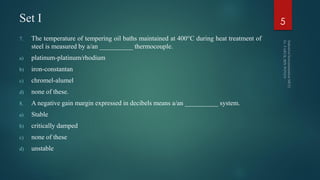
7. The temperature of tempering oil baths maintained at 400°C during heat treatment of
steel is measured by a/an __________ thermocouple.
a) platinum-platinum/rhodium
b) iron-constantan
c) chromel-alumel
d) none of these.
8. A negative gain margin expressed in decibels means a/an __________ system.
a) Stable
b) critically damped
c) none of these
d) unstable
5
Set I
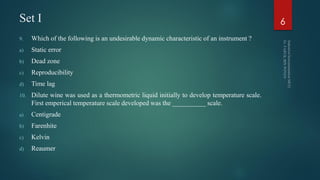
9. Which of the following is an undesirable dynamic characteristic of an instrument ?
a) Static error
b) Dead zone
c) Reproducibility
d) Time lag
10. Dilute wine was used as a thermometric liquid initially to develop temperature scale.
First emperical temperature scale developed was the __________ scale.
a) Centigrade
b) Farenhite
c) Kelvin
d) Reaumer
6
Set I
11. Typical specifications for design stipulates the gain margin and phase margin to be
respectively
a) < 1.7 and > 30°
b) > 1.7 and > 30°
c) > 1.7 and < 30°
d) < 1.7 and < 30°
12. Which of the following is not the triple point of water ?
a) 32 °F
b) 492 °R
c) 32 °R
d) 273 °K
7
Set I
13. Which of the following is a desirable characteristic of an instrument ?
a) High drift
b) High fidelity
c) High measuring lag
d) Poor reproducibility
14. Thermistor, which has high temperature co-efficient of resistivity, is used as the
sensing element in resistance thermometer. It is a/an
a) Liquid semi-conductor
b) Conductor
c) Solid semi-conductor
d) Insulator
8
Set I
15. Working principle of radiation pyrometer is based on the
a) Seebeck effect
b) Wien's law
c) Kirchoffs law
d) Stafan - Boltzman law
16. Which of the following is the dynamic characteristics of an instrument ?
a) Sensitivity
b) Reproducibility
c) Fidelity
d) Dead zone
9
Set I
17. The operation of a rotameter is based on
a) Variable flow area.
b) Rotation of a turbine.
c) Pressure at a stagnation point.
d) Pressure drop across a nozzle.
18. Which of the following temperature measuring instruments need not touch the object
whose temperature is being measured ?
a) Mercury in glass thermometer
b) Radiation/infrared pyrometer
c) Thermo electric pyrometer
d) Filled system thermometer
10
Set I
19. Pick out the first order system from among the following.
a) Mercury in glass thermometer kept in boiling water.
b) Damped vibrator.
c) Interacting system of two tanks in series.
d) Non-interacting system of two tanks in series.
20. The __________ of a vapour pressure thermometer is a functioning element.
a) Bourdon tube
b) Pointer
c) Bulb
d) None of these
11
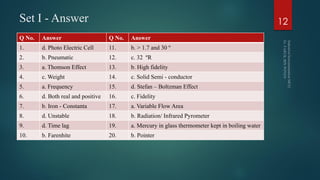
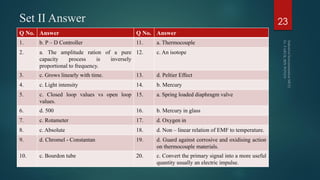
Set I - Answer
Q No. Answer Q No. Answer
1. d. Photo Electric Cell 11. b. > 1.7 and 30 º
2. b. Pneumatic 12. c. 32 ºR
3. a. Thomson Effect 13. b. High fidelity
4. c. Weight 14. c. Solid Semi - conductor
5. a. Frequency 15. d. Stefan – Boltzman Effect
6. d. Both real and positive 16. c. Fidelity
7. b. Iron - Constanta 17. a. Variable Flow Area
8. d. Unstable 18. b. Radiation/ Infrared Pyrometer
9. d. Time lag 19. a. Mercury in glass thermometer kept in boiling water
10. b. Farenhite 20. b. Pointer
12
Set II
1. Which of the following controllers has the least maximum deviation ?
a) P-I controller
b) P-D controller
c) P-controller
d) P-I-D controller
2. Select the correct statement from the following.
a) The amplitude ratio of a pure capacity process is inversely proportional to frequency.
b) The amplitude ratio of a pure time delay system increases with frequency.
c) The phase lag of a pure time delay system decreases with increasing frequency.
d) The frequency response of a pure capacity process is unbounded.
13
Set II
3. A system with a double pole at the origin is unstable since the corresponding term in the
time domain
a) Grows exponentially with time.
b) Decays linearly with time.
c) Grows linearly with time.
d) Is a constant.
4. A photo electric device in which the resistance of the metal is directly proportional to the
light striking on it, is known as photo-conductive cell. Photoelectric transducers are used
for the measurement of those parameters, which can be used to produce variation in
a) Voltage
b) Current
c) Light intensity
d) Flux density
14
Set II
5. Nichol’s chart deals with
a) Frequency response values of controllers.
b) A.R. vs. phase lag of second order.
c) Closed loop values vs. open loop values.
d) A.R. vs. phase lag of first order.
6. The maximum service temperature for fibre glass used as thermocouple wire
insulation material is __________ °C.
a) 1000
b) 750
c) 250
d) 500
15
Set II
7. Which of the following is not a differential pressure flow meter ?
a) Orifice meter
b) Flow nozzle
c) Rotameter
d) Venturi meter
8. An aneroid barometer measures the __________ pressure.
a) Atmospheric
b) Vacuum
c) Absolute
d) Gage
16
Set II
9. Which of the following thermocouples will give the highest output for the same value
of hot and cold junction temperature ?
a) All will give the same output.
b) Platinum-platinum + rhodium.
c) Iron-constantan.
d) Chromel - constantan.
10. The __________ of a vapour pressure thermometer is a secondary element.
a) Pointer
b) None of these
c) Bourdon tube
d) Bulb
17
Set II
11. Continuous shell temperature measurement in a liquid-liquid heat exchanger is done by
a
a) Thermocouple
b) Resistance thermometer
c) Vapour pressure thermometer
d) Mercury in glass thermometer
12. Compositional analysis of __________ is done using mass spectrometer.
a) Natural gas
b) A solid
c) An isotope
d) An alloy
18
Set II
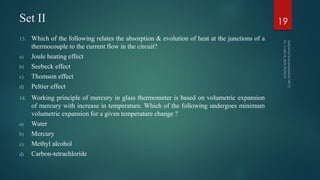
13. Which of the following relates the absorption & evolution of heat at the junctions of a
thermocouple to the current flow in the circuit?
a) Joule heating effect
b) Seebeck effect
c) Thomson effect
d) Peltier effect
14. Working principle of mercury in glass thermometer is based on volumetric expansion
of mercury with increase in temperature. Which of the following undergoes minimum
volumetric expansion for a given temperature change ?
a) Water
b) Mercury
c) Methyl alcohol
d) Carbon-tetrachloride
19
Set II
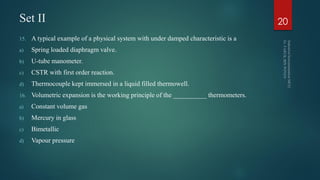
15. A typical example of a physical system with under damped characteristic is a
a) Spring loaded diaphragm valve.
b) U-tube manometer.
c) CSTR with first order reaction.
d) Thermocouple kept immersed in a liquid filled thermowell.
16. Volumetric expansion is the working principle of the __________ thermometers.
a) Constant volume gas
b) Mercury in glass
c) Bimetallic
d) Vapour pressure
20
Set II
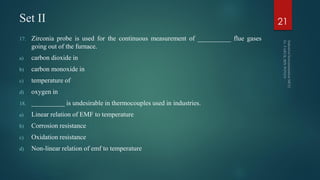
17. Zirconia probe is used for the continuous measurement of __________ flue gases
going out of the furnace.
a) carbon dioxide in
b) carbon monoxide in
c) temperature of
d) oxygen in
18. __________ is undesirable in thermocouples used in industries.
a) Linear relation of EMF to temperature
b) Corrosion resistance
c) Oxidation resistance
d) Non-linear relation of emf to temperature
21
Set II
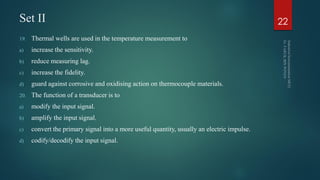
19. Thermal wells are used in the temperature measurement to
a) increase the sensitivity.
b) reduce measuring lag.
c) increase the fidelity.
d) guard against corrosive and oxidising action on thermocouple materials.
20. The function of a transducer is to
a) modify the input signal.
b) amplify the input signal.
c) convert the primary signal into a more useful quantity, usually an electric impulse.
d) codify/decodify the input signal.
22
Set II Answer
Q No. Answer Q No. Answer
1. b. P – D Controller 11. a. Thermocouple
2. a. The amplitude ration of a pure
capacity process is inversely
proportional to frequency.
12. c. An isotope
3. c. Grows linearly with time. 13. d. Peltier Effect
4. c. Light intensity 14. b. Mercury
5. c. Closed loop values vs open loop
values.
15. a. Spring loaded diaphragm valve
6. d. 500 16. b. Mercury in glass
7. c. Rotameter 17. d. Oxygen in
8. c. Absolute 18. d. Non – linear relation of EMF to temperature.
9. d. Chromel - Constantan 19. d. Guard against corrosive and oxidising action
on thermocouple materials.
10. c. Bourdon tube 20. c. Convert the primary signal into a more useful
quantity usually an electric impulse.
23
Set III
1. Reset rate is the another term used for __________ time.
a) Dead
b) Integral
c) Derivative
d) None of these
2. The amplitude ratio for the sinusoidal response of __________ is < 1.
a) Transportation lag
b) None of these
c) First order system
d) Second order system
24
Set III
3. Pressure of 0.0001 absolute psi can be measured by __________ gauge.
a) Pirani
b) Mcloid
c) None of these
d) Thermocouple
4. The response of two tanks of same size and resistance in series is
a) Critically damped
b) Over damped
c) Under damped
d) None of the above
25
Set III
5. A mercury barometer measures the __________ pressure.
a) Vacuum
b) Atmospheric
c) Gauge
d) Absolute
6. The amplitude ratio for the sinusoidal response of a __________ is 1.
a) None of these
b) First order system
c) Second order system
d) Transportation lag
26
Set III
7. Starting temperature of optical radiation pyrometer is __________ °C.
a) 400
b) 800
c) 1500
d) 1200
8. Alphatron measures pressure __________ microns.
a) < 1
b) < 3
c) None of these
d) >1
27
Set III
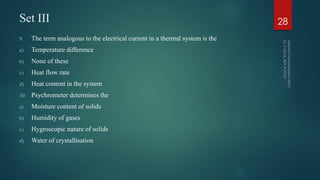
9. The term analogous to the electrical current in a thermal system is the
a) Temperature difference
b) None of these
c) Heat flow rate
d) Heat content in the system
10. Psychrometer determines the
a) Moisture content of solids
b) Humidity of gases
c) Hygroscopic nature of solids
d) Water of crystallisation
28
Set III
11. The temperature range for which copper resistance thermometer can be used is
__________ °C
a) 0 to 150
b) -200 to 150
c) 500 to 900
d) 350 to 750
12. Paramagnetism method is not used for the composition determination of __________
in gases.
a) Oxides of nitrogen
b) Oxygen
c) Carbon dioxide
d) Any of these
29
Set III
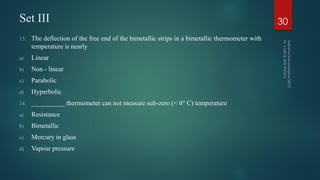
13. The deflection of the free end of the bimetallic strips in a bimetallic thermometer with
temperature is nearly
a) Linear
b) Non - linear
c) Parabolic
d) Hyperbolic
14. __________ thermometer can not measure sub-zero (< 0° C) temperature
a) Resistance
b) Bimetallic
c) Mercury in glass
d) Vapour pressure
30
Set III
15. Pirani gauge is used for the measurement of
a) High vacuum.
b) Very high pressure.
c) Liquid level under pressure.
d) Liquid level at atmospheric pressure
16. Continuous measurement of moisture in paper is done by
a) Sling psychrometer.
b) Weighing
c) Hair-hygrometer.
d) High resistance Wheatstone's bridge circuit.
31
Set III
17. Which of the following is a ‘contact’ pyrometer ?
a) Resistance pyrometer
b) Radiation pyrometer
c) Infra red pyrometer
d) Optical pyrometer
18. An amplitude ratio of 0.1 corresponds to __________ decibels.
a) - 20
b) - 10
c) 10
d) 20
32
Set III
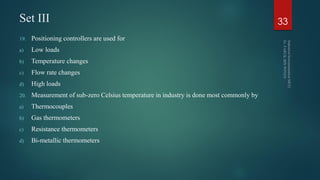
19. Positioning controllers are used for
a) Low loads
b) Temperature changes
c) Flow rate changes
d) High loads
20. Measurement of sub-zero Celsius temperature in industry is done most commonly by
a) Thermocouples
b) Gas thermometers
c) Resistance thermometers
d) Bi-metallic thermometers
33
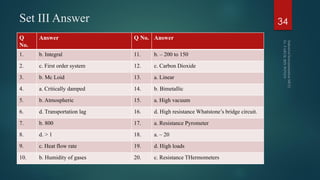
Set III Answer 34
Q
No.
Answer Q No. Answer
1. b. Integral 11. b. – 200 to 150
2. c. First order system 12. c. Carbon Dioxide
3. b. Mc Loid 13. a. Linear
4. a. Critically damped 14. b. Bimetallic
5. b. Atmospheric 15. a. High vacuum
6. d. Transportation lag 16. d. High resistance Whatstone’s bridge circuit.
7. b. 800 17. a. Resistance Pyrometer
8. d. > 1 18. a. – 20
9. c. Heat flow rate 19. d. High loads
10. b. Humidity of gases 20. c. Resistance THermometers
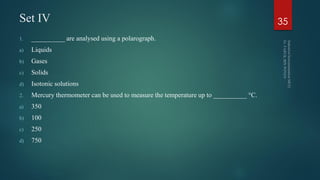
Set IV
1. __________ are analysed using a polarograph.
a) Liquids
b) Gases
c) Solids
d) Isotonic solutions
2. Mercury thermometer can be used to measure the temperature up to __________ °C.
a) 350
b) 100
c) 250
d) 750
35
Set IV
3. When a bare thermocouple is covered by a protective sheath, the response becomes
a) Faster and oscillatory.
b) Slower and non-oscillatory.
c) Slower and oscillatory.
d) Faster and non-oscillatory.
4. What is the normal percentage of rhodium in platinum + rhodium element used in the
thermocouple ?
a) 3
b) 13
c) 29
d) 0.1
36
Set IV
5. Routh test
a) Criterion provides information about the actual location of roots.

b) Criterion is not applicable to systems with polynomial characteristic equation.
c) Cannot be used to test the stability of a control system containing transportation lag.
d) Can not determine as to how many roots of the characteristics equation have positive
real roots.
6. pH meter has
a) 1 cell
b) 2 cell
c) 3 cell
d) No cell
37
Set IV
7. On-off controllers are normally used for
a) Temperature changes
b) Flow rate changes
c) Low loads
d) None of these
8. Which of the following is not a mechanical pressure sensing element ?
a) Bellows
b) Bourdon tube
c) Diaphragm
d) U-tube
38
Set IV
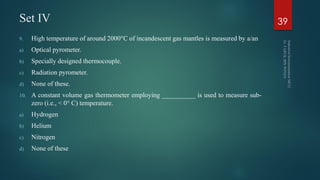
9. High temperature of around 2000°C of incandescent gas mantles is measured by a/an
a) Optical pyrometer.
b) Specially designed thermocouple.
c) Radiation pyrometer.
d) None of these.
10. A constant volume gas thermometer employing __________ is used to measure sub-
zero (i.e., < 0° C) temperature.
a) Hydrogen
b) Helium
c) Nitrogen
d) None of these
39
Set IV
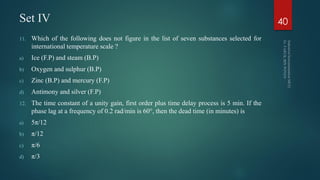
11. Which of the following does not figure in the list of seven substances selected for
international temperature scale ?
a) Ice (F.P) and steam (B.P)
b) Oxygen and sulphur (B.P)
c) Zinc (B.P) and mercury (F.P)
d) Antimony and silver (F.P)
12. The time constant of a unity gain, first order plus time delay process is 5 min. If the
phase lag at a frequency of 0.2 rad/min is 60°, then the dead time (in minutes) is
a) 5π/12
b) π/12
c) π/6
d) π/3
40
Set IV
13. Pressure of 0.01 psi (absolute) can be measured by __________ gauge.
a) Ionisation
b) Pirani
c) none of these
d) Mc Loid
14. Which of the following controllers has maximum offset ?
a) P-controller
b) P-I controller
c) P-I-D controller
d) P-D controller
41
Set IV
15. Magnetic flowmeters are generally not used for the velocity/flow measurement of
hydrocarbons due to their
a) High viscosity index.
b) Low electrical conductivity.
c) Low thermal conductivity.
d) Low flash point.
16. Helium gas constant volume thermometer is suitable for the measurement of a
temperature of __________ °C.
a) < 100
b) > 800
c) > 0
d) < 0
42
Set IV
17. Which of the following judges the accuracy of an instrument ?
a) None of these
b) Drift
c) Dead zone
d) Static error
18. Bode diagram are generated from output response of the system subjected to which of
the following input?
a) Ramp
b) Impulse
c) Sinusoidal
d) Step
43
Set IV
19. Liquid discharge from a tank or reservoir can not be measured by
a) Weirs
b) Orifice meters
c) Mouthpieces
d) Notches
20. Which of the following thermocouples is the most suitable for measuring a
temperature of about 1600°C in an oxidizing atmosphere ?
a) Iron-constantan
b) Platinum-platinum + rhodium
c) Chromel - alumel
d) Copper-constantan
44
Set IV Answer 45
Q
No.
Answer Q No. Answer
1. c. Solids 11. c. Zinc (B.P) and Mercury (F.P)
2. a. 350 12. a. 5π/12
3. b. Slower and non – oscillatory 13. d. Mc Loid
4. b. 13 14. a. P – controller
5. c. Can not be used to test the stability of a control
system containing transportation lag.
15. b. Low electrical conductivity
6. b. 2 cell 16. d. < 0
7. c. Low loads 17. d. Static Error
8. d. U - tube 18. c. Sinusoidal
9. c. Radiation pyrometer 19. b. Orifice meters
10. b. Helium 20. b. Platinum – Platinum + Rhodium
Reference:
 http://examtimequiz.com/multiple-choice-questions-process-control-instrumentation/
46

Industrial instrumentation MCQ

  • 1.
    Industrial Instrumentation MCQ ER. FARUKBIN POYEN ASST. PROFESSOR, AEIE, UIT, BU FARUK.POYEN@GMAIL.COM
  • 2.
    Set I 1. Smokedensity of the flue gas going out of the chimney is measured by a a) Polarograph b) Chromatograph c) Thermal conductivity meter d) Photo electric cell – correct 2. Flapper nozzle is used in a/an __________ controller. a) Hydraulic b) Pneumatic c) None of these d) Electronic 2
  • 3.
    Set I 3. Whichof the following relates the emf. generated in a single homogeneous wire to the temperature difference ? a) Thomson effect b) Peltier effect c) Seebeck effect d) None of these 4. Load cells are used for the measurement of a) Stress b) Strain c) Weight d) Velocity 3
  • 4.
    Set I 5. Responseof a system to a sinusoidal input is called __________ response. a) Frequency b) None of these c) Unit step d) Impulse 6. The closed loop pole of a stable second order system could be a) Complex conjugate with positive real parts. b) One real positive and the other real negative. c) Both real and negative. d) Both real and positive. 4
  • 5.
    Set I 7. Thetemperature of tempering oil baths maintained at 400°C during heat treatment of steel is measured by a/an __________ thermocouple. a) platinum-platinum/rhodium b) iron-constantan c) chromel-alumel d) none of these. 8. A negative gain margin expressed in decibels means a/an __________ system. a) Stable b) critically damped c) none of these d) unstable 5
  • 6.
    Set I 9. Whichof the following is an undesirable dynamic characteristic of an instrument ? a) Static error b) Dead zone c) Reproducibility d) Time lag 10. Dilute wine was used as a thermometric liquid initially to develop temperature scale. First emperical temperature scale developed was the __________ scale. a) Centigrade b) Farenhite c) Kelvin d) Reaumer 6
  • 7.
    Set I 11. Typicalspecifications for design stipulates the gain margin and phase margin to be respectively a) < 1.7 and > 30° b) > 1.7 and > 30° c) > 1.7 and < 30° d) < 1.7 and < 30° 12. Which of the following is not the triple point of water ? a) 32 °F b) 492 °R c) 32 °R d) 273 °K 7
  • 8.
    Set I 13. Whichof the following is a desirable characteristic of an instrument ? a) High drift b) High fidelity c) High measuring lag d) Poor reproducibility 14. Thermistor, which has high temperature co-efficient of resistivity, is used as the sensing element in resistance thermometer. It is a/an a) Liquid semi-conductor b) Conductor c) Solid semi-conductor d) Insulator 8
  • 9.
    Set I 15. Workingprinciple of radiation pyrometer is based on the a) Seebeck effect b) Wien's law c) Kirchoffs law d) Stafan - Boltzman law 16. Which of the following is the dynamic characteristics of an instrument ? a) Sensitivity b) Reproducibility c) Fidelity d) Dead zone 9
  • 10.
    Set I 17. Theoperation of a rotameter is based on a) Variable flow area. b) Rotation of a turbine. c) Pressure at a stagnation point. d) Pressure drop across a nozzle. 18. Which of the following temperature measuring instruments need not touch the object whose temperature is being measured ? a) Mercury in glass thermometer b) Radiation/infrared pyrometer c) Thermo electric pyrometer d) Filled system thermometer 10
  • 11.
    Set I 19. Pickout the first order system from among the following. a) Mercury in glass thermometer kept in boiling water. b) Damped vibrator. c) Interacting system of two tanks in series. d) Non-interacting system of two tanks in series. 20. The __________ of a vapour pressure thermometer is a functioning element. a) Bourdon tube b) Pointer c) Bulb d) None of these 11
  • 12.
    Set I -Answer Q No. Answer Q No. Answer 1. d. Photo Electric Cell 11. b. > 1.7 and 30 º 2. b. Pneumatic 12. c. 32 ºR 3. a. Thomson Effect 13. b. High fidelity 4. c. Weight 14. c. Solid Semi - conductor 5. a. Frequency 15. d. Stefan – Boltzman Effect 6. d. Both real and positive 16. c. Fidelity 7. b. Iron - Constanta 17. a. Variable Flow Area 8. d. Unstable 18. b. Radiation/ Infrared Pyrometer 9. d. Time lag 19. a. Mercury in glass thermometer kept in boiling water 10. b. Farenhite 20. b. Pointer 12
  • 13.
    Set II 1. Whichof the following controllers has the least maximum deviation ? a) P-I controller b) P-D controller c) P-controller d) P-I-D controller 2. Select the correct statement from the following. a) The amplitude ratio of a pure capacity process is inversely proportional to frequency. b) The amplitude ratio of a pure time delay system increases with frequency. c) The phase lag of a pure time delay system decreases with increasing frequency. d) The frequency response of a pure capacity process is unbounded. 13
  • 14.
    Set II 3. Asystem with a double pole at the origin is unstable since the corresponding term in the time domain a) Grows exponentially with time. b) Decays linearly with time. c) Grows linearly with time. d) Is a constant. 4. A photo electric device in which the resistance of the metal is directly proportional to the light striking on it, is known as photo-conductive cell. Photoelectric transducers are used for the measurement of those parameters, which can be used to produce variation in a) Voltage b) Current c) Light intensity d) Flux density 14
  • 15.
    Set II 5. Nichol’schart deals with a) Frequency response values of controllers. b) A.R. vs. phase lag of second order. c) Closed loop values vs. open loop values. d) A.R. vs. phase lag of first order. 6. The maximum service temperature for fibre glass used as thermocouple wire insulation material is __________ °C. a) 1000 b) 750 c) 250 d) 500 15
  • 16.
    Set II 7. Whichof the following is not a differential pressure flow meter ? a) Orifice meter b) Flow nozzle c) Rotameter d) Venturi meter 8. An aneroid barometer measures the __________ pressure. a) Atmospheric b) Vacuum c) Absolute d) Gage 16
  • 17.
    Set II 9. Whichof the following thermocouples will give the highest output for the same value of hot and cold junction temperature ? a) All will give the same output. b) Platinum-platinum + rhodium. c) Iron-constantan. d) Chromel - constantan. 10. The __________ of a vapour pressure thermometer is a secondary element. a) Pointer b) None of these c) Bourdon tube d) Bulb 17
  • 18.
    Set II 11. Continuousshell temperature measurement in a liquid-liquid heat exchanger is done by a a) Thermocouple b) Resistance thermometer c) Vapour pressure thermometer d) Mercury in glass thermometer 12. Compositional analysis of __________ is done using mass spectrometer. a) Natural gas b) A solid c) An isotope d) An alloy 18
  • 19.
    Set II 13. Whichof the following relates the absorption & evolution of heat at the junctions of a thermocouple to the current flow in the circuit? a) Joule heating effect b) Seebeck effect c) Thomson effect d) Peltier effect 14. Working principle of mercury in glass thermometer is based on volumetric expansion of mercury with increase in temperature. Which of the following undergoes minimum volumetric expansion for a given temperature change ? a) Water b) Mercury c) Methyl alcohol d) Carbon-tetrachloride 19
  • 20.
    Set II 15. Atypical example of a physical system with under damped characteristic is a a) Spring loaded diaphragm valve. b) U-tube manometer. c) CSTR with first order reaction. d) Thermocouple kept immersed in a liquid filled thermowell. 16. Volumetric expansion is the working principle of the __________ thermometers. a) Constant volume gas b) Mercury in glass c) Bimetallic d) Vapour pressure 20
  • 21.
    Set II 17. Zirconiaprobe is used for the continuous measurement of __________ flue gases going out of the furnace. a) carbon dioxide in b) carbon monoxide in c) temperature of d) oxygen in 18. __________ is undesirable in thermocouples used in industries. a) Linear relation of EMF to temperature b) Corrosion resistance c) Oxidation resistance d) Non-linear relation of emf to temperature 21
  • 22.
    Set II 19. Thermalwells are used in the temperature measurement to a) increase the sensitivity. b) reduce measuring lag. c) increase the fidelity. d) guard against corrosive and oxidising action on thermocouple materials. 20. The function of a transducer is to a) modify the input signal. b) amplify the input signal. c) convert the primary signal into a more useful quantity, usually an electric impulse. d) codify/decodify the input signal. 22
  • 23.
    Set II Answer QNo. Answer Q No. Answer 1. b. P – D Controller 11. a. Thermocouple 2. a. The amplitude ration of a pure capacity process is inversely proportional to frequency. 12. c. An isotope 3. c. Grows linearly with time. 13. d. Peltier Effect 4. c. Light intensity 14. b. Mercury 5. c. Closed loop values vs open loop values. 15. a. Spring loaded diaphragm valve 6. d. 500 16. b. Mercury in glass 7. c. Rotameter 17. d. Oxygen in 8. c. Absolute 18. d. Non – linear relation of EMF to temperature. 9. d. Chromel - Constantan 19. d. Guard against corrosive and oxidising action on thermocouple materials. 10. c. Bourdon tube 20. c. Convert the primary signal into a more useful quantity usually an electric impulse. 23
  • 24.
    Set III 1. Resetrate is the another term used for __________ time. a) Dead b) Integral c) Derivative d) None of these 2. The amplitude ratio for the sinusoidal response of __________ is < 1. a) Transportation lag b) None of these c) First order system d) Second order system 24
  • 25.
    Set III 3. Pressureof 0.0001 absolute psi can be measured by __________ gauge. a) Pirani b) Mcloid c) None of these d) Thermocouple 4. The response of two tanks of same size and resistance in series is a) Critically damped b) Over damped c) Under damped d) None of the above 25
  • 26.
    Set III 5. Amercury barometer measures the __________ pressure. a) Vacuum b) Atmospheric c) Gauge d) Absolute 6. The amplitude ratio for the sinusoidal response of a __________ is 1. a) None of these b) First order system c) Second order system d) Transportation lag 26
  • 27.
    Set III 7. Startingtemperature of optical radiation pyrometer is __________ °C. a) 400 b) 800 c) 1500 d) 1200 8. Alphatron measures pressure __________ microns. a) < 1 b) < 3 c) None of these d) >1 27
  • 28.
    Set III 9. Theterm analogous to the electrical current in a thermal system is the a) Temperature difference b) None of these c) Heat flow rate d) Heat content in the system 10. Psychrometer determines the a) Moisture content of solids b) Humidity of gases c) Hygroscopic nature of solids d) Water of crystallisation 28
  • 29.
    Set III 11. Thetemperature range for which copper resistance thermometer can be used is __________ °C a) 0 to 150 b) -200 to 150 c) 500 to 900 d) 350 to 750 12. Paramagnetism method is not used for the composition determination of __________ in gases. a) Oxides of nitrogen b) Oxygen c) Carbon dioxide d) Any of these 29
  • 30.
    Set III 13. Thedeflection of the free end of the bimetallic strips in a bimetallic thermometer with temperature is nearly a) Linear b) Non - linear c) Parabolic d) Hyperbolic 14. __________ thermometer can not measure sub-zero (< 0° C) temperature a) Resistance b) Bimetallic c) Mercury in glass d) Vapour pressure 30
  • 31.
    Set III 15. Piranigauge is used for the measurement of a) High vacuum. b) Very high pressure. c) Liquid level under pressure. d) Liquid level at atmospheric pressure 16. Continuous measurement of moisture in paper is done by a) Sling psychrometer. b) Weighing c) Hair-hygrometer. d) High resistance Wheatstone's bridge circuit. 31
  • 32.
    Set III 17. Whichof the following is a ‘contact’ pyrometer ? a) Resistance pyrometer b) Radiation pyrometer c) Infra red pyrometer d) Optical pyrometer 18. An amplitude ratio of 0.1 corresponds to __________ decibels. a) - 20 b) - 10 c) 10 d) 20 32
  • 33.
    Set III 19. Positioningcontrollers are used for a) Low loads b) Temperature changes c) Flow rate changes d) High loads 20. Measurement of sub-zero Celsius temperature in industry is done most commonly by a) Thermocouples b) Gas thermometers c) Resistance thermometers d) Bi-metallic thermometers 33
  • 34.
    Set III Answer34 Q No. Answer Q No. Answer 1. b. Integral 11. b. – 200 to 150 2. c. First order system 12. c. Carbon Dioxide 3. b. Mc Loid 13. a. Linear 4. a. Critically damped 14. b. Bimetallic 5. b. Atmospheric 15. a. High vacuum 6. d. Transportation lag 16. d. High resistance Whatstone’s bridge circuit. 7. b. 800 17. a. Resistance Pyrometer 8. d. > 1 18. a. – 20 9. c. Heat flow rate 19. d. High loads 10. b. Humidity of gases 20. c. Resistance THermometers
  • 35.
    Set IV 1. __________are analysed using a polarograph. a) Liquids b) Gases c) Solids d) Isotonic solutions 2. Mercury thermometer can be used to measure the temperature up to __________ °C. a) 350 b) 100 c) 250 d) 750 35
  • 36.
    Set IV 3. Whena bare thermocouple is covered by a protective sheath, the response becomes a) Faster and oscillatory. b) Slower and non-oscillatory. c) Slower and oscillatory. d) Faster and non-oscillatory. 4. What is the normal percentage of rhodium in platinum + rhodium element used in the thermocouple ? a) 3 b) 13 c) 29 d) 0.1 36
  • 37.
    Set IV 5. Routhtest a) Criterion provides information about the actual location of roots. b) Criterion is not applicable to systems with polynomial characteristic equation. c) Cannot be used to test the stability of a control system containing transportation lag. d) Can not determine as to how many roots of the characteristics equation have positive real roots. 6. pH meter has a) 1 cell b) 2 cell c) 3 cell d) No cell 37
  • 38.
    Set IV 7. On-offcontrollers are normally used for a) Temperature changes b) Flow rate changes c) Low loads d) None of these 8. Which of the following is not a mechanical pressure sensing element ? a) Bellows b) Bourdon tube c) Diaphragm d) U-tube 38
  • 39.
    Set IV 9. Hightemperature of around 2000°C of incandescent gas mantles is measured by a/an a) Optical pyrometer. b) Specially designed thermocouple. c) Radiation pyrometer. d) None of these. 10. A constant volume gas thermometer employing __________ is used to measure sub- zero (i.e., < 0° C) temperature. a) Hydrogen b) Helium c) Nitrogen d) None of these 39
  • 40.
    Set IV 11. Whichof the following does not figure in the list of seven substances selected for international temperature scale ? a) Ice (F.P) and steam (B.P) b) Oxygen and sulphur (B.P) c) Zinc (B.P) and mercury (F.P) d) Antimony and silver (F.P) 12. The time constant of a unity gain, first order plus time delay process is 5 min. If the phase lag at a frequency of 0.2 rad/min is 60°, then the dead time (in minutes) is a) 5π/12 b) π/12 c) π/6 d) π/3 40
  • 41.
    Set IV 13. Pressureof 0.01 psi (absolute) can be measured by __________ gauge. a) Ionisation b) Pirani c) none of these d) Mc Loid 14. Which of the following controllers has maximum offset ? a) P-controller b) P-I controller c) P-I-D controller d) P-D controller 41
  • 42.
    Set IV 15. Magneticflowmeters are generally not used for the velocity/flow measurement of hydrocarbons due to their a) High viscosity index. b) Low electrical conductivity. c) Low thermal conductivity. d) Low flash point. 16. Helium gas constant volume thermometer is suitable for the measurement of a temperature of __________ °C. a) < 100 b) > 800 c) > 0 d) < 0 42
  • 43.
    Set IV 17. Whichof the following judges the accuracy of an instrument ? a) None of these b) Drift c) Dead zone d) Static error 18. Bode diagram are generated from output response of the system subjected to which of the following input? a) Ramp b) Impulse c) Sinusoidal d) Step 43
  • 44.
    Set IV 19. Liquiddischarge from a tank or reservoir can not be measured by a) Weirs b) Orifice meters c) Mouthpieces d) Notches 20. Which of the following thermocouples is the most suitable for measuring a temperature of about 1600°C in an oxidizing atmosphere ? a) Iron-constantan b) Platinum-platinum + rhodium c) Chromel - alumel d) Copper-constantan 44
  • 45.
    Set IV Answer45 Q No. Answer Q No. Answer 1. c. Solids 11. c. Zinc (B.P) and Mercury (F.P) 2. a. 350 12. a. 5π/12 3. b. Slower and non – oscillatory 13. d. Mc Loid 4. b. 13 14. a. P – controller 5. c. Can not be used to test the stability of a control system containing transportation lag. 15. b. Low electrical conductivity 6. b. 2 cell 16. d. < 0 7. c. Low loads 17. d. Static Error 8. d. U - tube 18. c. Sinusoidal 9. c. Radiation pyrometer 19. b. Orifice meters 10. b. Helium 20. b. Platinum – Platinum + Rhodium
  • 46.