SHORT-CIRCUIT AND OPEN-CIRCUIT TEST ON
TRANSFORMER
PREPARED BY –
Harshit khandelwal
Roll number – 16ume017
Email – live.harshit@hotmail.com
Contact - +91-8387835209
CONTENTS
• Aim
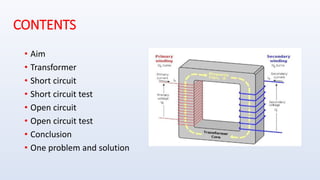
• Transformer
• Short circuit
• Short circuit test
• Open circuit
• Open circuit test
• Conclusion
• One problem and solution
AIM
1. To understand the basic working principle of a
transformer.
2. To obtain the equivalent circuit parameters from OC
and SC tests, and to estimate efficiency & regulation
at various loads.
TRANSFORMERS
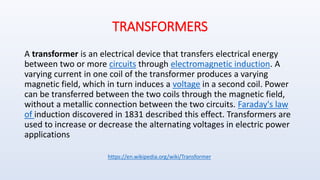
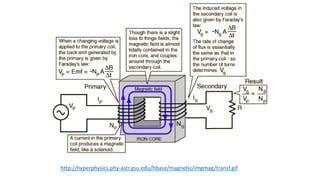
A transformer is an electrical device that transfers electrical energy
between two or more circuits through electromagnetic induction. A
varying current in one coil of the transformer produces a varying
magnetic field, which in turn induces a voltage in a second coil. Power
can be transferred between the two coils through the magnetic field,
without a metallic connection between the two circuits. Faraday's law
of induction discovered in 1831 described this effect. Transformers are
used to increase or decrease the alternating voltages in electric power
applications
https://en.wikipedia.org/wiki/Transformer
http://hyperphysics.phy-astr.gsu.edu/hbase/magnetic/imgmag/transf.gif
SHORT CIRCUIT
• A short circuit is an electrical circuit that allows a current to travel
along an unintended path, often where essentially no (or a very low)
electrical impedance is encountered.
• In circuit analysis a short circuit is a connection between two nodes
that forces them to be at the same voltage.
• In an ideal short circuit, this means there is no resistance and no
voltage drop across the short.
• In real circuits, the result is a connection with almost no resistance. In
such a case, the current that flows is limited by the rest of the circuit.
SHORT
CIRCUIT TEST
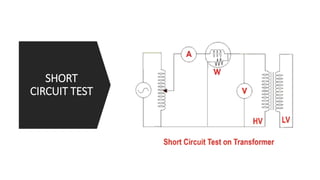
• The connection diagram for short circuit test on transformer is shown in the figure.
A voltmeter, wattmeter, and an ammeter are connected in HV side of the transformer
as shown. The voltage at rated frequency is applied to that HV side with the help of a
variac of variable ratio auto transformer.
• The LV side of the transformer is short circuited.
• Now applied voltage is slowly increased until the ammeter gives reading equal to the
rated current of the HV side.
• After that all three instruments reading (Voltmeter, Ammeter and Watt-meter readings)
are recorded.
• The ammeter reading gives the primary equivalent of full load current IL And voltmeter
reading is Vsc.
• the core losses in transformer can be taken as negligible here.
• The input power during test is indicated by watt-meter reading.
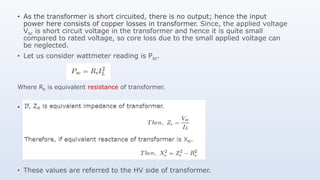
• As the transformer is short circuited, there is no output; hence the input
power here consists of copper losses in transformer. Since, the applied voltage
Vsc is short circuit voltage in the transformer and hence it is quite small
compared to rated voltage, so core loss due to the small applied voltage can
be neglected.
• Let us consider wattmeter reading is Psc.
Where Re is equivalent resistance of transformer.
• .
• These values are referred to the HV side of transformer.
OPEN CIRCUIT
• An electrical circuit is an "open circuit" if it lacks a complete path
between the terminals of its power source; in other words, if no true
"circuit" currently exists, because for instance a power switch is
turned off.
• The electrical opposite of a short circuit is an "open circuit", which is
an infinite resistance between two nodes.
• The open circuit test, or "no-load test", is one of the methods used in
electrical engineering to determine the no load impedance in the
excitation branch of a transformer.
OPEN
CIRCUIT TEST
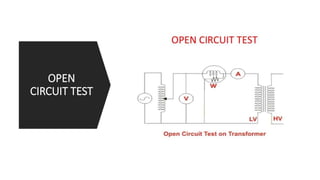
• The connection diagram for open circuit test on transformer is shown in the figure.
A voltmeter, wattmeter, and an ammeter are connected in LV side of the transformer as
shown. The voltage at rated frequency is applied to that LV side with the help of a
variac of variable ratio auto transformer.
• The HV side of the transformer is kept open.
• Now applied voltage is slowly increased until the voltmeter gives reading equal to the
rated voltage of the LV side.
• After that all three instruments reading (Voltmeter, Ammeter and Watt-meter readings)
are recorded.
• The ammeter reading gives the no load current Ie , the voltage drops due to this current
that can be taken as negligible and the voltmeter reading V1 equal to secondary induced
voltage of the transformer.
• The input power during test is indicated by watt-meter reading.
• copper loss due to the small no load current can be neglected.
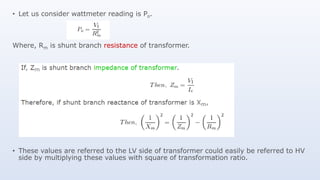
• Let us consider wattmeter reading is Po.
Where, Rm is shunt branch resistance of transformer.
• These values are referred to the LV side of transformer could easily be referred to HV
side by multiplying these values with square of transformation ratio.
CONCULATION
• The Short Circuit test on transformer is used to determine copper loss
in transformer at full load and parameters of approximate equivalent
circuit of transformer.
• The open circuit test on transformer is used to determine core losses
in transformer and parameters of shunt branch of the equivalent
circuit of transformer.
PROBLEM
The O.C and S.C test data are given below for a single phase, 5 kVA,
200V/400V, 50Hz transformer.
O.C test from LV side : 200V 1.25A 150W
S.C test from HV side : 20V 12.5A 175W
Draw the equivalent circuit of the transformer -
(i) Computation with O.C test data.
(ii) Computation with S.C test data.
Solution on 2 next slides.
SOLUTION
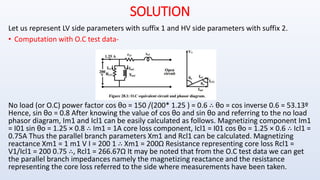
Let us represent LV side parameters with suffix 1 and HV side parameters with suffix 2.
• Computation with O.C test data-
No load (or O.C) power factor cos θo = 150 /(200* 1.25 ) = 0.6 ∴ θo = cos inverse 0.6 = 53.13º
Hence, sin θo = 0.8 After knowing the value of cos θo and sin θo and referring to the no load
phasor diagram, Im1 and Icl1 can be easily calculated as follows. Magnetizing component Im1
= I01 sin θo = 1.25 × 0.8 ∴ Im1 = 1A core loss component, Icl1 = I01 cos θo = 1.25 × 0.6 ∴ Icl1 =
0.75A Thus the parallel branch parameters Xm1 and Rcl1 can be calculated. Magnetizing
reactance Xm1 = 1 m1 V I = 200 1 ∴ Xm1 = 200Ω Resistance representing core loss Rcl1 =
V1/Icl1 = 200 0.75 ∴, Rcl1 = 266.67Ω It may be noted that from the O.C test data we can get
the parallel branch impedances namely the magnetizing reactance and the resistance
representing the core loss referred to the side where measurements have been taken.
• Computation with S.C test data
Calculation of series parameters is rather simple and as follows.
Power drawn Wsc = sq(Isc) re2 or, re2 = Wsc/ sq(Isc) = 2 175 12.5 ∴ re2 = 1.12Ω Now S.C
impedance zsc = Vsc/ Isc = 20/12.5 ∴ zsc = 1.6Ω= sq root[sq(re2) + sq(xe2)] Thus, xe2 =
1.14Ω .
Although calculation of parameters from the test results are over, it is very important to
note that parallel branch parameters have been obtained referred to LV side and series
branch parameters have been obtained referred to HV side.

Open circuit and Short circuit test on transformer

  • 1.
    SHORT-CIRCUIT AND OPEN-CIRCUITTEST ON TRANSFORMER PREPARED BY – Harshit khandelwal Roll number – 16ume017 Email – live.harshit@hotmail.com Contact - +91-8387835209
  • 2.
    CONTENTS • Aim • Transformer •Short circuit • Short circuit test • Open circuit • Open circuit test • Conclusion • One problem and solution
  • 3.
    AIM 1. To understandthe basic working principle of a transformer. 2. To obtain the equivalent circuit parameters from OC and SC tests, and to estimate efficiency & regulation at various loads.
  • 4.
    TRANSFORMERS A transformer isan electrical device that transfers electrical energy between two or more circuits through electromagnetic induction. A varying current in one coil of the transformer produces a varying magnetic field, which in turn induces a voltage in a second coil. Power can be transferred between the two coils through the magnetic field, without a metallic connection between the two circuits. Faraday's law of induction discovered in 1831 described this effect. Transformers are used to increase or decrease the alternating voltages in electric power applications https://en.wikipedia.org/wiki/Transformer
  • 5.
  • 6.
    SHORT CIRCUIT • Ashort circuit is an electrical circuit that allows a current to travel along an unintended path, often where essentially no (or a very low) electrical impedance is encountered. • In circuit analysis a short circuit is a connection between two nodes that forces them to be at the same voltage. • In an ideal short circuit, this means there is no resistance and no voltage drop across the short. • In real circuits, the result is a connection with almost no resistance. In such a case, the current that flows is limited by the rest of the circuit.
  • 7.
  • 8.
    • The connectiondiagram for short circuit test on transformer is shown in the figure. A voltmeter, wattmeter, and an ammeter are connected in HV side of the transformer as shown. The voltage at rated frequency is applied to that HV side with the help of a variac of variable ratio auto transformer. • The LV side of the transformer is short circuited. • Now applied voltage is slowly increased until the ammeter gives reading equal to the rated current of the HV side. • After that all three instruments reading (Voltmeter, Ammeter and Watt-meter readings) are recorded. • The ammeter reading gives the primary equivalent of full load current IL And voltmeter reading is Vsc. • the core losses in transformer can be taken as negligible here. • The input power during test is indicated by watt-meter reading.
  • 9.
    • As thetransformer is short circuited, there is no output; hence the input power here consists of copper losses in transformer. Since, the applied voltage Vsc is short circuit voltage in the transformer and hence it is quite small compared to rated voltage, so core loss due to the small applied voltage can be neglected. • Let us consider wattmeter reading is Psc. Where Re is equivalent resistance of transformer. • . • These values are referred to the HV side of transformer.
  • 10.
    OPEN CIRCUIT • Anelectrical circuit is an "open circuit" if it lacks a complete path between the terminals of its power source; in other words, if no true "circuit" currently exists, because for instance a power switch is turned off. • The electrical opposite of a short circuit is an "open circuit", which is an infinite resistance between two nodes. • The open circuit test, or "no-load test", is one of the methods used in electrical engineering to determine the no load impedance in the excitation branch of a transformer.
  • 11.
  • 12.
    • The connectiondiagram for open circuit test on transformer is shown in the figure. A voltmeter, wattmeter, and an ammeter are connected in LV side of the transformer as shown. The voltage at rated frequency is applied to that LV side with the help of a variac of variable ratio auto transformer. • The HV side of the transformer is kept open. • Now applied voltage is slowly increased until the voltmeter gives reading equal to the rated voltage of the LV side. • After that all three instruments reading (Voltmeter, Ammeter and Watt-meter readings) are recorded. • The ammeter reading gives the no load current Ie , the voltage drops due to this current that can be taken as negligible and the voltmeter reading V1 equal to secondary induced voltage of the transformer. • The input power during test is indicated by watt-meter reading. • copper loss due to the small no load current can be neglected.
  • 13.
    • Let usconsider wattmeter reading is Po. Where, Rm is shunt branch resistance of transformer. • These values are referred to the LV side of transformer could easily be referred to HV side by multiplying these values with square of transformation ratio.
  • 14.
    CONCULATION • The ShortCircuit test on transformer is used to determine copper loss in transformer at full load and parameters of approximate equivalent circuit of transformer. • The open circuit test on transformer is used to determine core losses in transformer and parameters of shunt branch of the equivalent circuit of transformer.
  • 15.
    PROBLEM The O.C andS.C test data are given below for a single phase, 5 kVA, 200V/400V, 50Hz transformer. O.C test from LV side : 200V 1.25A 150W S.C test from HV side : 20V 12.5A 175W Draw the equivalent circuit of the transformer - (i) Computation with O.C test data. (ii) Computation with S.C test data. Solution on 2 next slides.
  • 16.
    SOLUTION Let us representLV side parameters with suffix 1 and HV side parameters with suffix 2. • Computation with O.C test data- No load (or O.C) power factor cos θo = 150 /(200* 1.25 ) = 0.6 ∴ θo = cos inverse 0.6 = 53.13º Hence, sin θo = 0.8 After knowing the value of cos θo and sin θo and referring to the no load phasor diagram, Im1 and Icl1 can be easily calculated as follows. Magnetizing component Im1 = I01 sin θo = 1.25 × 0.8 ∴ Im1 = 1A core loss component, Icl1 = I01 cos θo = 1.25 × 0.6 ∴ Icl1 = 0.75A Thus the parallel branch parameters Xm1 and Rcl1 can be calculated. Magnetizing reactance Xm1 = 1 m1 V I = 200 1 ∴ Xm1 = 200Ω Resistance representing core loss Rcl1 = V1/Icl1 = 200 0.75 ∴, Rcl1 = 266.67Ω It may be noted that from the O.C test data we can get the parallel branch impedances namely the magnetizing reactance and the resistance representing the core loss referred to the side where measurements have been taken.
  • 17.
    • Computation withS.C test data Calculation of series parameters is rather simple and as follows. Power drawn Wsc = sq(Isc) re2 or, re2 = Wsc/ sq(Isc) = 2 175 12.5 ∴ re2 = 1.12Ω Now S.C impedance zsc = Vsc/ Isc = 20/12.5 ∴ zsc = 1.6Ω= sq root[sq(re2) + sq(xe2)] Thus, xe2 = 1.14Ω . Although calculation of parameters from the test results are over, it is very important to note that parallel branch parameters have been obtained referred to LV side and series branch parameters have been obtained referred to HV side.