Elemental analysis by
ICP
GUIDED BY:- DR. VAISHALI SHIRSAT
PRESENTED BY:- MANALI PARAB
F.Y.M.PHARM
PHARMACEUTICAL ANALYSIS DEPARTMENT
1
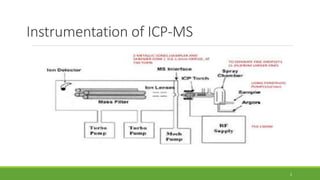
Instrumentation of ICP-MS
2
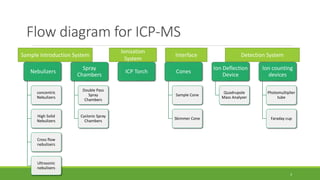
Flow diagram for ICP-MS
Nebulizers
concentric
Nebulizers
High Solid
Nebulizers
Cross flow
nebulisers
Ultrasonic
nebulisers
Spray
Chambers
Double Pass
Spray
Chambers
Cyclonic Spray
Chambers
ICP Torch Cones
Sample Cone
Skimmer Cone
Ion Deflection
Device
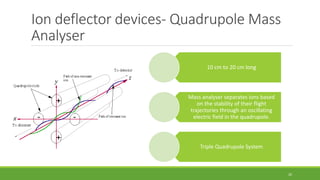
Quadrupole
Mass Analyzer
Ion counting
devices
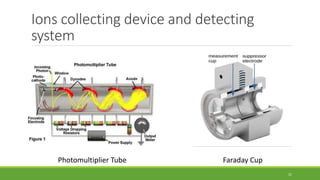
Photomultiplier
tube
Faraday cup
Sample Introduction System
Ionization
System
Detection SystemInterface
3
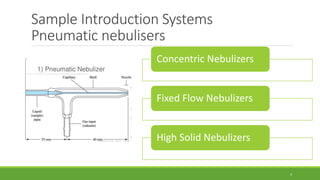
Sample Introduction Systems
Pneumatic nebulisers
Concentric Nebulizers
Fixed Flow Nebulizers
High Solid Nebulizers
4
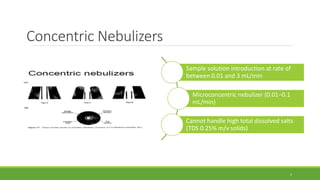
Concentric Nebulizers
Sample solution introduction at rate of
between 0.01 and 3 mL/min
Microconcentric nebulizer (0.01–0.1
mL/min)
Cannot handle high total dissolved salts
(TDS 0.25% m/v solids)
5
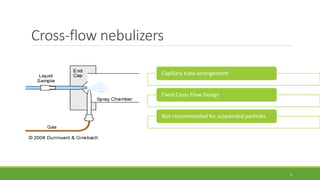
Cross-flow nebulizers
Capillary tube arrangement
Fixed Cross Flow Design
Not recommended for suspended particles
6
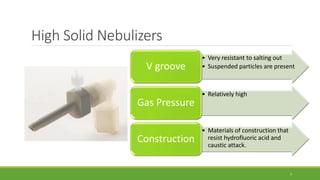
High Solid Nebulizers
• Very resistant to salting out
• Suspended particles are presentV groove
• Relatively high
Gas Pressure
• Materials of construction that
resist hydrofluoric acid and
caustic attack.
Construction
7
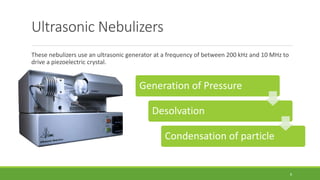
Ultrasonic Nebulizers
These nebulizers use an ultrasonic generator at a frequency of between 200 kHz and 10 MHz to
drive a piezoelectric crystal.
Generation of Pressure
Desolvation
Condensation of particle
8
Spray Chambers
The purpose of the spray chamber is to remove droplets produced by the nebulizer that are >8μm
in diameter
Faster wash out time depends on wettability of glass
Water-cooled spray chambers may be used for volatile organic solvents
They are externally cooled for thermal stability of the molecule
Important advantage: to reduce oxide species, reduce solvent loading
9
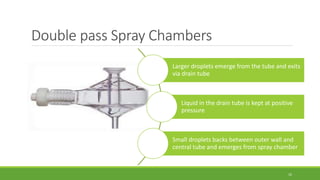
Double pass Spray Chambers
Larger droplets emerge from the tube and exits
via drain tube
Liquid in the drain tube is kept at positive
pressure
Small droplets backs between outer wall and
central tube and emerges from spray chamber
10
Cyclonic spray chambers
Operates by centrifugal force
Vortex produced by tangential flow of sample and argon
gas inside the chamber
Larger droplets impinge on the wall and fall out through
drain
Chilled spray chambers
11
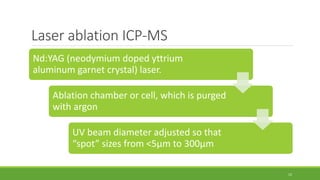
Laser ablation ICP-MS
Nd:YAG (neodymium doped yttrium
aluminum garnet crystal) laser.
Ablation chamber or cell, which is purged
with argon
UV beam diameter adjusted so that
“spot” sizes from <5μm to 300μm
12
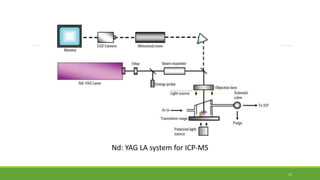
Nd: YAG LA system for ICP-MS
13
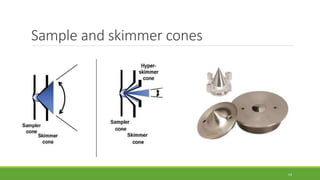
Sample and skimmer cones
14
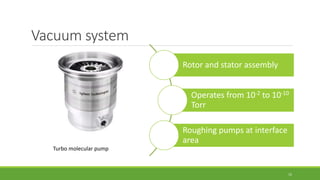
Vacuum system
Turbo molecular pump
Rotor and stator assembly
Operates from 10-2 to 10-10
Torr
Roughing pumps at interface
area
15
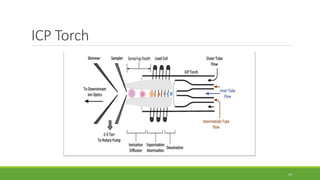
ICP Torch
16
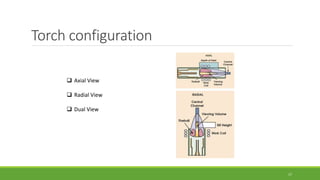
Torch configuration
 Axial View
 Radial View
 Dual View
17
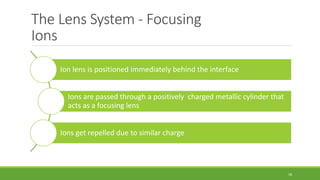
The Lens System - Focusing
Ions
Ion lens is positioned immediately behind the interface
Ions are passed through a positively charged metallic cylinder that
acts as a focusing lens
Ions get repelled due to similar charge
18
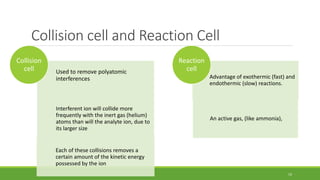
Collision cell and Reaction Cell
Used to remove polyatomic
interferences
Interferent ion will collide more
frequently with the inert gas (helium)
atoms than will the analyte ion, due to
its larger size
Each of these collisions removes a
certain amount of the kinetic energy
possessed by the ion
Collision
cell
Advantage of exothermic (fast) and
endothermic (slow) reactions.
An active gas, (like ammonia),
Reaction
cell
19
Ion deflector devices- Quadrupole Mass
Analyser
10 cm to 20 cm long
Mass analyser separates ions based
on the stability of their flight
trajectories through an oscillating
electric field in the quadrupole.
Triple Quadrupole System
20
Ions collecting device and detecting
system
Photomultiplier Tube Faraday Cup
21
Application
Simple metal analysis during metal based drug development
Impurity limit tests
Metals present in Active Pharmaceutical Ingredients
Quality Control Tests of natural products for toxic impurities testing
Monitoring metabolites of an administered drug
Detection of metal impurities from leachable packaging material
For elemental speciation
Pharmaceutical Waste Water monitoring
22
ICP-OES
23
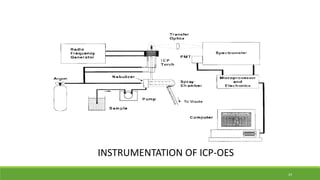
INSTRUMENTATION OF ICP-OES
24
Sample introduction system other than ICP-MS
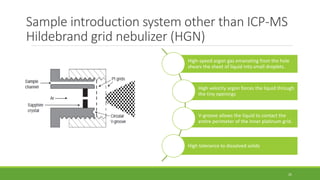
Hildebrand grid nebulizer (HGN)
High-speed argon gas emanating from the hole
shears the sheet of liquid into small droplets.
High velocity argon forces the liquid through
the tiny openings
V-groove allows the liquid to contact the
entire perimeter of the inner platinum grid.
High tolerance to dissolved solids
25
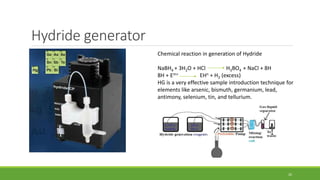
Hydride generator
Chemical reaction in generation of Hydride
NaBH4 + 3H2O + HCl H3BO4 + NaCl + 8H
8H + Em+ EHn + H2 (excess)
HG is a very effective sample introduction technique for
elements like arsenic, bismuth, germanium, lead,
antimony, selenium, tin, and tellurium.
26
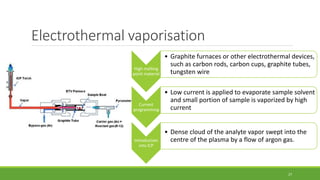
Electrothermal vaporisation
High melting
point material
• Graphite furnaces or other electrothermal devices,
such as carbon rods, carbon cups, graphite tubes,
tungsten wire
Current
programming
• Low current is applied to evaporate sample solvent
and small portion of sample is vaporized by high
current
Introduction
into ICP
• Dense cloud of the analyte vapor swept into the
centre of the plasma by a flow of argon gas.
27
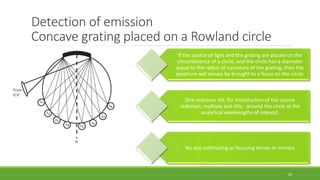
Detection of emission
Concave grating placed on a Rowland circle
If the source of light and the grating are placed on the
circumference of a circle, and the circle has a diameter
equal to the radius of curvature of the grating, then the
spectrum will always be brought to a focus on the circle.
One entrance slit: for introduction of the source
radiation, multiple exit slits : around the circle at the
analytical wavelengths of interest.
No any collimating or focusing lenses or mirrors
28
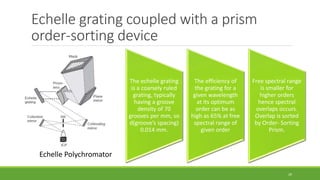
Echelle grating coupled with a prism
order-sorting device
Echelle Polychromator
The echelle grating
is a coarsely ruled
grating, typically
having a groove
density of 70
grooves per mm, so
d(groove’s spacing)
0.014 mm.
The efficiency of
the grating for a
given wavelength
at its optimum
order can be as
high as 65% at free
spectral range of
given order
Free spectral range
is smaller for
higher orders
hence spectral
overlaps occurs.
Overlap is sorted
by Order- Sorting
Prism.
29
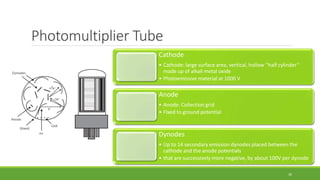
Photomultiplier Tube
Cathode
• Cathode: large surface area, vertical, hollow ‘‘half cylinder’’
made up of alkali metal oxide
• Photoemissive material at 1000 V
Anode
• Anode: Collection grid
• Fixed to ground potential
Dynodes
• Up to 14 secondary emission dynodes placed between the
cathode and the anode potentials
• that are successively more negative, by about 100V per dynode
30
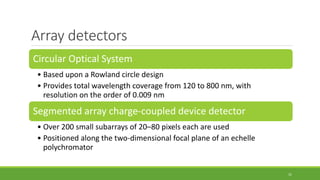
Array detectors
Circular Optical System
• Based upon a Rowland circle design
• Provides total wavelength coverage from 120 to 800 nm, with
resolution on the order of 0.009 nm
Segmented array charge-coupled device detector
• Over 200 small subarrays of 20–80 pixels each are used
• Positioned along the two-dimensional focal plane of an echelle
polychromator
31
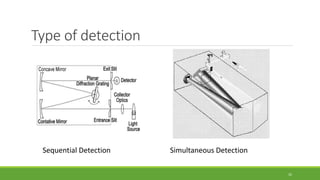
Type of detection
Sequential Detection Simultaneous Detection
32
Applications
Determination of metals in biological fluids (blood. urine)
Environmental Analysis: Trace metals and other elements in water, soil and plants
Pharmaceuticals: Traces of catalyst used
Industry: Trace metal analysis in raw material
Forensic science: Toxicological determination
33
Comparison between ICP-OES and ICP-
MS
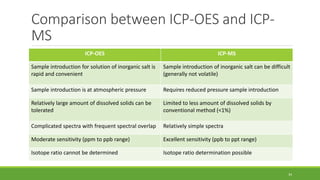
ICP-OES ICP-MS
Sample introduction for solution of inorganic salt is
rapid and convenient
Sample introduction of inorganic salt can be difficult
(generally not volatile)
Sample introduction is at atmospheric pressure Requires reduced pressure sample introduction
Relatively large amount of dissolved solids can be
tolerated
Limited to less amount of dissolved solids by
conventional method (<1%)
Complicated spectra with frequent spectral overlap Relatively simple spectra
Moderate sensitivity (ppm to ppb range) Excellent sensitivity (ppb to ppt range)
Isotope ratio cannot be determined Isotope ratio determination possible
34
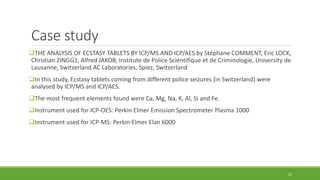
Case study
THE ANALYSIS OF ECSTASY TABLETS BY ICP/MS AND ICP/AES by Stéphane COMMENT, Eric LOCK,
Christian ZINGG1, Alfred JAKOB, Institute de Police Scientifique et de Criminologie, University de
Lausanne, Switzerland AC Laboratories, Spiez, Switzerland
In this study, Ecstasy tablets coming from different police seizures (in Switzerland) were
analysed by ICP/MS and ICP/AES.
The most frequent elements found were Ca, Mg, Na, K, Al, Si and Fe.
Instrument used for ICP-OES: Perkin Elmer Emission Spectrometer Plasma 1000
Instrument used for ICP-MS: Perkin Elmer Elan 6000
35
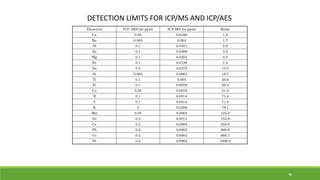
DETECTION LIMITS FOR ICP/MS AND ICP/AES
36
20 tablets coming from one batch (containing MDMA) and 20 other tablets coming from another
batch (containing MDEA) were used
The variation depends on the element analysed. The mean variation was found to be 20% for
ICP/AES and 25% for ICP/MS. Therefore, these relative standard deviations represents the
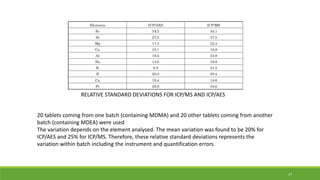
variation within batch including the instrument and quantification errors.
RELATIVE STANDARD DEVIATIONS FOR ICP/MS AND ICP/AES
37

Elemental Analysis by Inductively Coupled Plasma - MS and OES

  • 1.
    Elemental analysis by ICP GUIDEDBY:- DR. VAISHALI SHIRSAT PRESENTED BY:- MANALI PARAB F.Y.M.PHARM PHARMACEUTICAL ANALYSIS DEPARTMENT 1
  • 2.
  • 3.
    Flow diagram forICP-MS Nebulizers concentric Nebulizers High Solid Nebulizers Cross flow nebulisers Ultrasonic nebulisers Spray Chambers Double Pass Spray Chambers Cyclonic Spray Chambers ICP Torch Cones Sample Cone Skimmer Cone Ion Deflection Device Quadrupole Mass Analyzer Ion counting devices Photomultiplier tube Faraday cup Sample Introduction System Ionization System Detection SystemInterface 3
  • 4.
    Sample Introduction Systems Pneumaticnebulisers Concentric Nebulizers Fixed Flow Nebulizers High Solid Nebulizers 4
  • 5.
    Concentric Nebulizers Sample solutionintroduction at rate of between 0.01 and 3 mL/min Microconcentric nebulizer (0.01–0.1 mL/min) Cannot handle high total dissolved salts (TDS 0.25% m/v solids) 5
  • 6.
    Cross-flow nebulizers Capillary tubearrangement Fixed Cross Flow Design Not recommended for suspended particles 6
  • 7.
    High Solid Nebulizers •Very resistant to salting out • Suspended particles are presentV groove • Relatively high Gas Pressure • Materials of construction that resist hydrofluoric acid and caustic attack. Construction 7
  • 8.
    Ultrasonic Nebulizers These nebulizersuse an ultrasonic generator at a frequency of between 200 kHz and 10 MHz to drive a piezoelectric crystal. Generation of Pressure Desolvation Condensation of particle 8
  • 9.
    Spray Chambers The purposeof the spray chamber is to remove droplets produced by the nebulizer that are >8μm in diameter Faster wash out time depends on wettability of glass Water-cooled spray chambers may be used for volatile organic solvents They are externally cooled for thermal stability of the molecule Important advantage: to reduce oxide species, reduce solvent loading 9
  • 10.
    Double pass SprayChambers Larger droplets emerge from the tube and exits via drain tube Liquid in the drain tube is kept at positive pressure Small droplets backs between outer wall and central tube and emerges from spray chamber 10
  • 11.
    Cyclonic spray chambers Operatesby centrifugal force Vortex produced by tangential flow of sample and argon gas inside the chamber Larger droplets impinge on the wall and fall out through drain Chilled spray chambers 11
  • 12.
    Laser ablation ICP-MS Nd:YAG(neodymium doped yttrium aluminum garnet crystal) laser. Ablation chamber or cell, which is purged with argon UV beam diameter adjusted so that “spot” sizes from <5μm to 300μm 12
  • 13.
    Nd: YAG LAsystem for ICP-MS 13
  • 14.
  • 15.
    Vacuum system Turbo molecularpump Rotor and stator assembly Operates from 10-2 to 10-10 Torr Roughing pumps at interface area 15
  • 16.
  • 17.
    Torch configuration  AxialView  Radial View  Dual View 17
  • 18.
    The Lens System- Focusing Ions Ion lens is positioned immediately behind the interface Ions are passed through a positively charged metallic cylinder that acts as a focusing lens Ions get repelled due to similar charge 18
  • 19.
    Collision cell andReaction Cell Used to remove polyatomic interferences Interferent ion will collide more frequently with the inert gas (helium) atoms than will the analyte ion, due to its larger size Each of these collisions removes a certain amount of the kinetic energy possessed by the ion Collision cell Advantage of exothermic (fast) and endothermic (slow) reactions. An active gas, (like ammonia), Reaction cell 19
  • 20.
    Ion deflector devices-Quadrupole Mass Analyser 10 cm to 20 cm long Mass analyser separates ions based on the stability of their flight trajectories through an oscillating electric field in the quadrupole. Triple Quadrupole System 20
  • 21.
    Ions collecting deviceand detecting system Photomultiplier Tube Faraday Cup 21
  • 22.
    Application Simple metal analysisduring metal based drug development Impurity limit tests Metals present in Active Pharmaceutical Ingredients Quality Control Tests of natural products for toxic impurities testing Monitoring metabolites of an administered drug Detection of metal impurities from leachable packaging material For elemental speciation Pharmaceutical Waste Water monitoring 22
  • 23.
  • 24.
  • 25.
    Sample introduction systemother than ICP-MS Hildebrand grid nebulizer (HGN) High-speed argon gas emanating from the hole shears the sheet of liquid into small droplets. High velocity argon forces the liquid through the tiny openings V-groove allows the liquid to contact the entire perimeter of the inner platinum grid. High tolerance to dissolved solids 25
  • 26.
    Hydride generator Chemical reactionin generation of Hydride NaBH4 + 3H2O + HCl H3BO4 + NaCl + 8H 8H + Em+ EHn + H2 (excess) HG is a very effective sample introduction technique for elements like arsenic, bismuth, germanium, lead, antimony, selenium, tin, and tellurium. 26
  • 27.
    Electrothermal vaporisation High melting pointmaterial • Graphite furnaces or other electrothermal devices, such as carbon rods, carbon cups, graphite tubes, tungsten wire Current programming • Low current is applied to evaporate sample solvent and small portion of sample is vaporized by high current Introduction into ICP • Dense cloud of the analyte vapor swept into the centre of the plasma by a flow of argon gas. 27
  • 28.
    Detection of emission Concavegrating placed on a Rowland circle If the source of light and the grating are placed on the circumference of a circle, and the circle has a diameter equal to the radius of curvature of the grating, then the spectrum will always be brought to a focus on the circle. One entrance slit: for introduction of the source radiation, multiple exit slits : around the circle at the analytical wavelengths of interest. No any collimating or focusing lenses or mirrors 28
  • 29.
    Echelle grating coupledwith a prism order-sorting device Echelle Polychromator The echelle grating is a coarsely ruled grating, typically having a groove density of 70 grooves per mm, so d(groove’s spacing) 0.014 mm. The efficiency of the grating for a given wavelength at its optimum order can be as high as 65% at free spectral range of given order Free spectral range is smaller for higher orders hence spectral overlaps occurs. Overlap is sorted by Order- Sorting Prism. 29
  • 30.
    Photomultiplier Tube Cathode • Cathode:large surface area, vertical, hollow ‘‘half cylinder’’ made up of alkali metal oxide • Photoemissive material at 1000 V Anode • Anode: Collection grid • Fixed to ground potential Dynodes • Up to 14 secondary emission dynodes placed between the cathode and the anode potentials • that are successively more negative, by about 100V per dynode 30
  • 31.
    Array detectors Circular OpticalSystem • Based upon a Rowland circle design • Provides total wavelength coverage from 120 to 800 nm, with resolution on the order of 0.009 nm Segmented array charge-coupled device detector • Over 200 small subarrays of 20–80 pixels each are used • Positioned along the two-dimensional focal plane of an echelle polychromator 31
  • 32.
    Type of detection SequentialDetection Simultaneous Detection 32
  • 33.
    Applications Determination of metalsin biological fluids (blood. urine) Environmental Analysis: Trace metals and other elements in water, soil and plants Pharmaceuticals: Traces of catalyst used Industry: Trace metal analysis in raw material Forensic science: Toxicological determination 33
  • 34.
    Comparison between ICP-OESand ICP- MS ICP-OES ICP-MS Sample introduction for solution of inorganic salt is rapid and convenient Sample introduction of inorganic salt can be difficult (generally not volatile) Sample introduction is at atmospheric pressure Requires reduced pressure sample introduction Relatively large amount of dissolved solids can be tolerated Limited to less amount of dissolved solids by conventional method (<1%) Complicated spectra with frequent spectral overlap Relatively simple spectra Moderate sensitivity (ppm to ppb range) Excellent sensitivity (ppb to ppt range) Isotope ratio cannot be determined Isotope ratio determination possible 34
  • 35.
    Case study THE ANALYSISOF ECSTASY TABLETS BY ICP/MS AND ICP/AES by Stéphane COMMENT, Eric LOCK, Christian ZINGG1, Alfred JAKOB, Institute de Police Scientifique et de Criminologie, University de Lausanne, Switzerland AC Laboratories, Spiez, Switzerland In this study, Ecstasy tablets coming from different police seizures (in Switzerland) were analysed by ICP/MS and ICP/AES. The most frequent elements found were Ca, Mg, Na, K, Al, Si and Fe. Instrument used for ICP-OES: Perkin Elmer Emission Spectrometer Plasma 1000 Instrument used for ICP-MS: Perkin Elmer Elan 6000 35
  • 36.
    DETECTION LIMITS FORICP/MS AND ICP/AES 36
  • 37.
    20 tablets comingfrom one batch (containing MDMA) and 20 other tablets coming from another batch (containing MDEA) were used The variation depends on the element analysed. The mean variation was found to be 20% for ICP/AES and 25% for ICP/MS. Therefore, these relative standard deviations represents the variation within batch including the instrument and quantification errors. RELATIVE STANDARD DEVIATIONS FOR ICP/MS AND ICP/AES 37

Editor's Notes

  • #3 https://www.slideshare.net/AakratiGupta1/icpms
  • #10 First, stabilizing the spray chamber at any temperature reduces temperature related signal drift. Secondly, many analysts have found that spray chamber temperature along with other parameters, particularly nebulizer gas flow, can be optimized to minimize oxide formation in the plasma.
  • #15 Though the fundamental dimensions are all essentially the same (sample cone with shallow angle, skimmer cone with acute angle), each manufacturer has designed the cone’s critical dimensions to their own unique specifications (orifice diameter, hole depth, material composition, etc.).
  • #18 Radial view Plasma is operated in a vertical orientation, and the analytical zone is observed from the side of the plasma Axial View Plasma is rotated to a horizontal position and the ICP is observed from the end of the plasma. Better sensitivity than radial view Dual view To optimize the appropriate configuration for the type of sample without the expense of two separate
  • #23 Isotope fingerprinting: Isotope ratio mass spectrometry (IRMS) is used in product authentication to establish the origin of food and beverages. On the basis of stable isotope fingerprints from samples or in specific compounds, this approach may differentiate pharmaceutical products by manufacturer and production batch. Multielement Analysis: