ELEMENTAL ANALYSIS AND
TRACE METALS BY ICP-MS
K.LOHITHA
PA2016106 (Department of Pharmaceutical Analysis)
1/3/2017
1
INTRODUCTION
REGULATORY COMPLIANCE
ICP-MS
INSTRUMENTATION &WORKING
ASSETS & LIMITATIONS
APPLICATIONS & REFERENCES
1/3/2017
2
Elemental impurities are
 Elements found in environment
 Introduced in manufacturing of drug and excipients
 They have to be monitored for two reasons
 Enter the human body via food chain including medicines, ambient
air and drinking water leading to health problems
 Affect the stability of formulation and catalyze degradation of drug
substance
1/3/2017
3
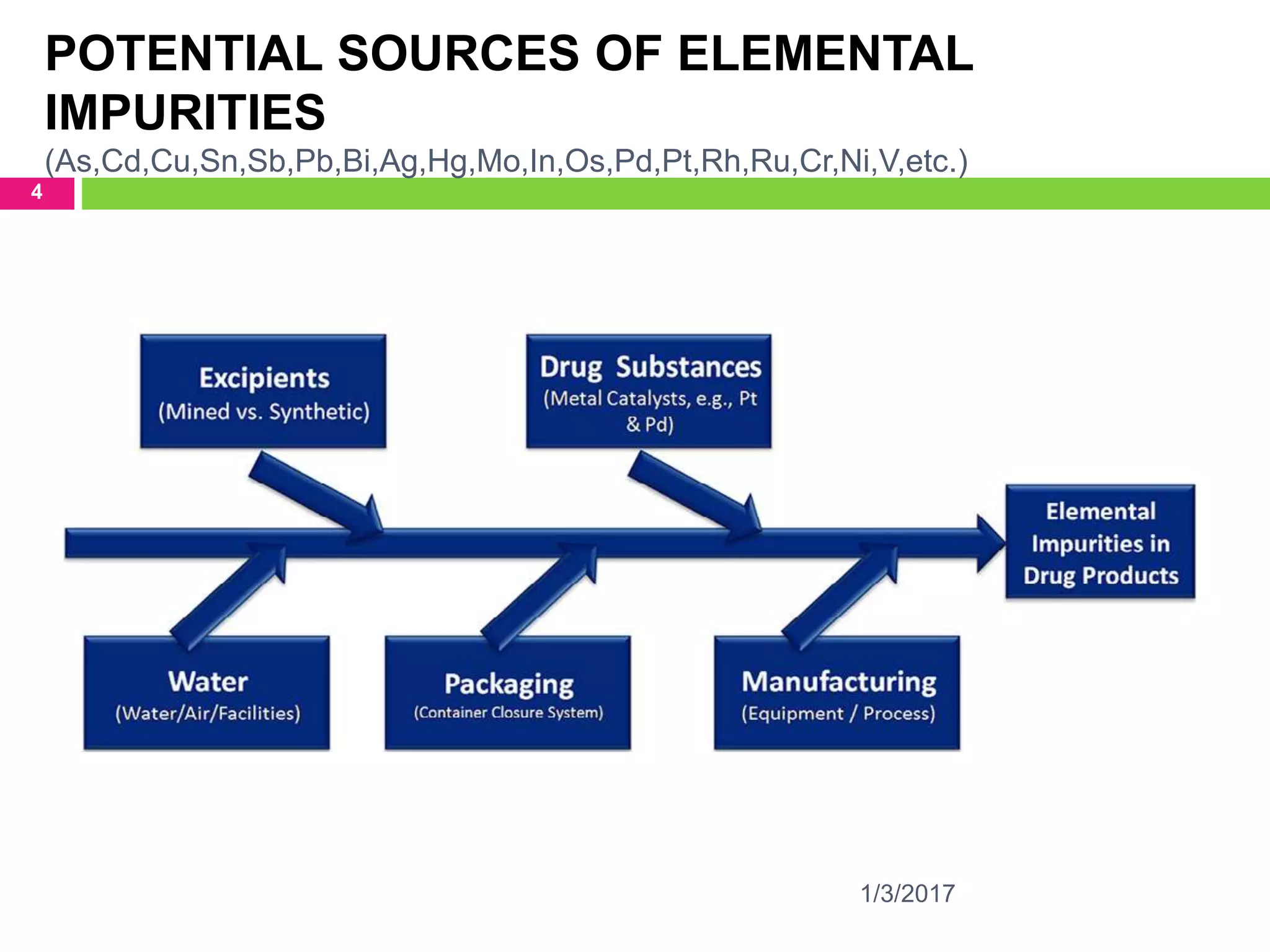
POTENTIAL SOURCES OF ELEMENTAL
IMPURITIES
(As,Cd,Cu,Sn,Sb,Pb,Bi,Ag,Hg,Mo,In,Os,Pd,Pt,Rh,Ru,Cr,Ni,V,etc.)
1/3/2017
4
REGULATORY COMPLIANCE
1/3/2017
5
ICH Q3D-Guideline for elemental impurity
Development of
design for control
Establishment of
permitted daily exposure
(PDE)
Evaluation of toxicity
data for potential source
Safety Toxicity
Acceptance
level
International Council for Harmonisation
CLASSIFICATIONOF ELEMENTAL IMPURITIES
1/3/2017
6
1/3/20177
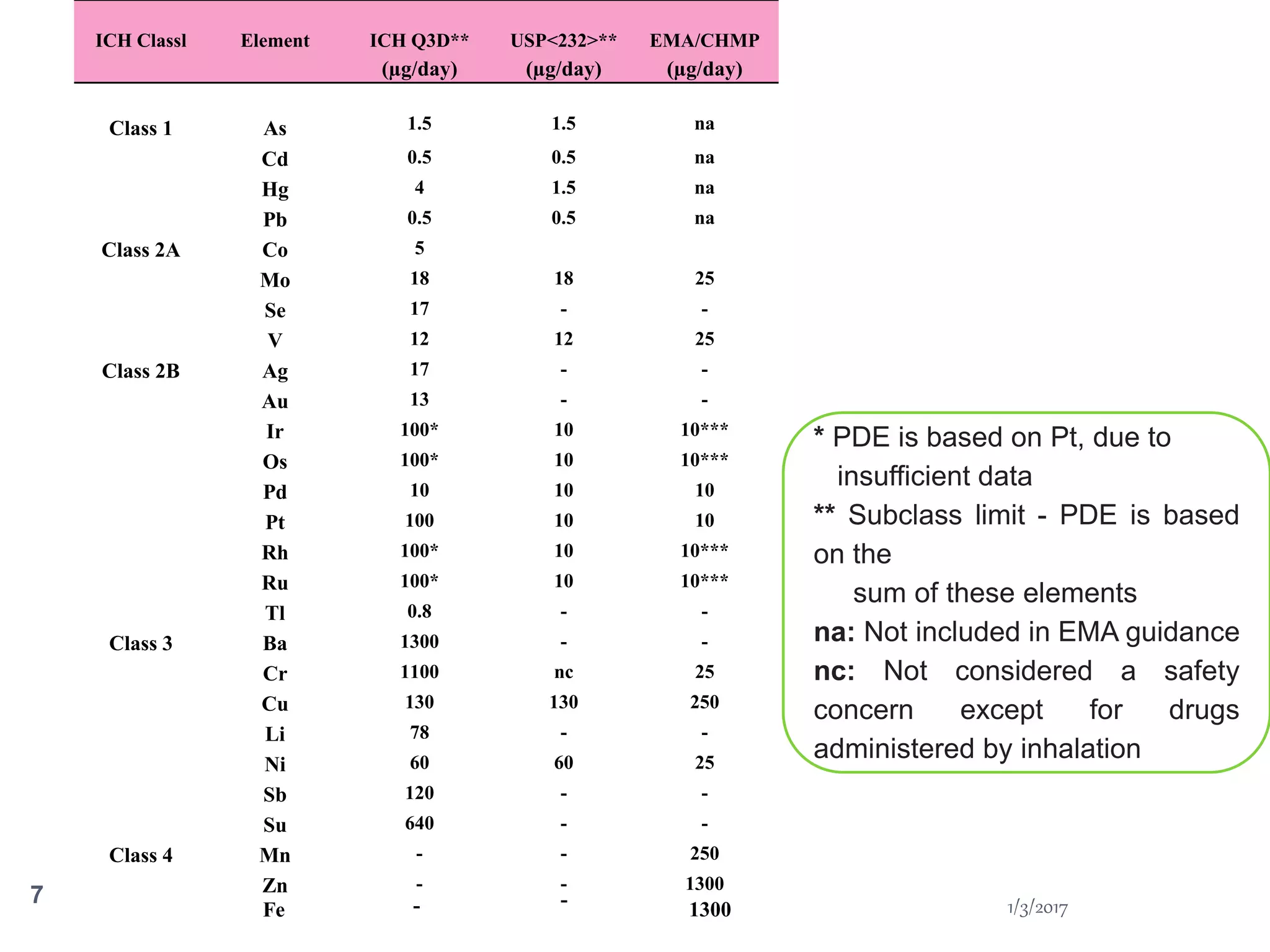
ICH Classl Element ICH Q3D**
(µg/day)
USP<232>**
(µg/day)
EMA/CHMP
(µg/day)
Class 1 As 1.5 1.5 na
Cd 0.5 0.5 na
Hg 4 1.5 na
Pb 0.5 0.5 na
Class 2A Co 5
Mo 18 18 25
Se 17 - -
V 12 12 25
Class 2B Ag 17 - -
Au 13 - -
Ir 100* 10 10***
Os 100* 10 10***
Pd 10 10 10
Pt 100 10 10
Rh 100* 10 10***
Ru 100* 10 10***
Tl 0.8 - -
Class 3 Ba 1300 - -
Cr 1100 nc 25
Cu 130 130 250
Li 78 - -
Ni 60 60 25
Sb 120 - -
Su 640 - -
Class 4 Mn - - 250
Zn - - 1300
* PDE is based on Pt, due to
insufficient data
** Subclass limit - PDE is based
on the
sum of these elements
na: Not included in EMA guidance
nc: Not considered a safety
concern except for drugs
administered by inhalation
Fe - - 1300
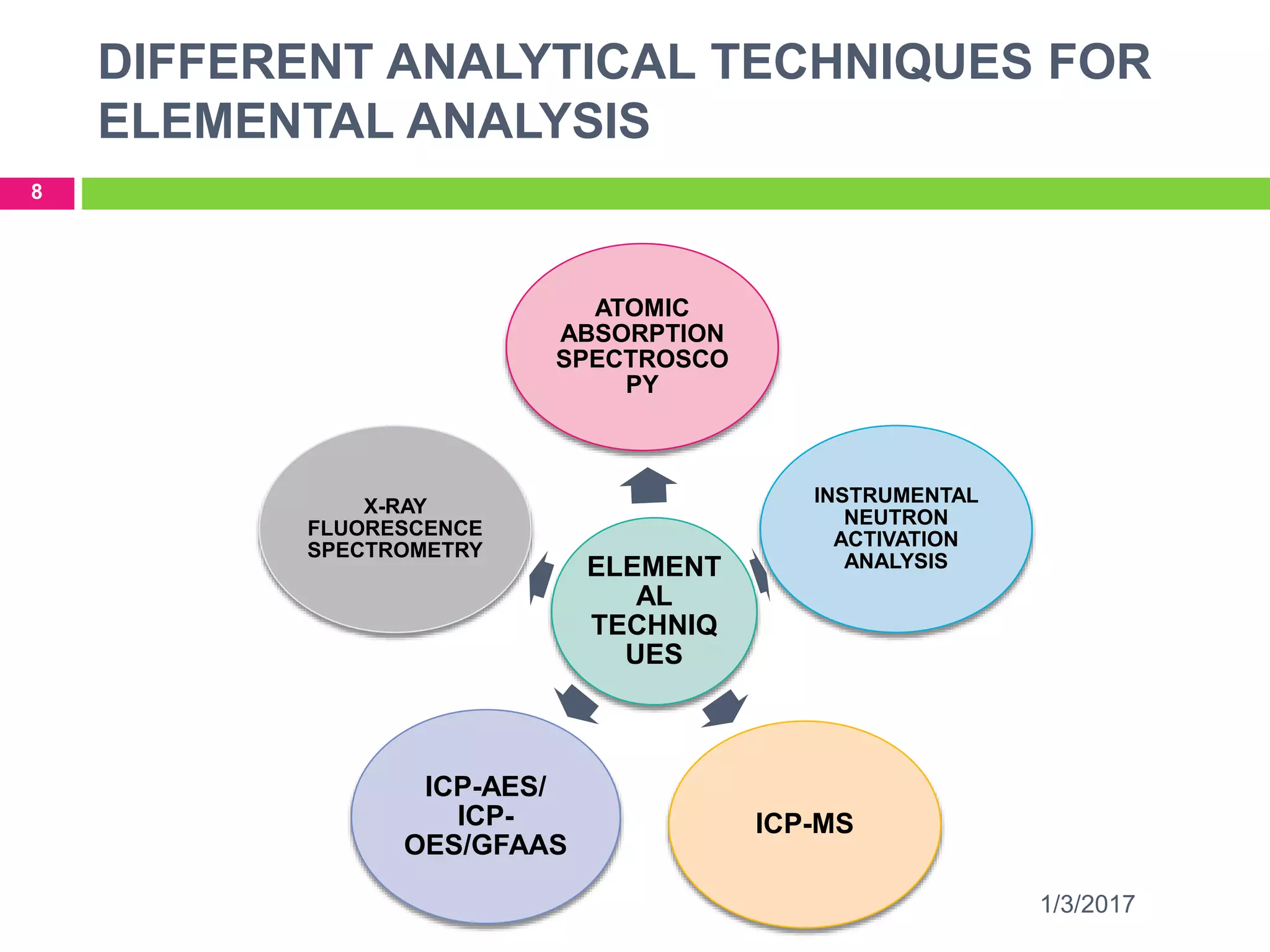
DIFFERENT ANALYTICAL TECHNIQUES FOR
ELEMENTAL ANALYSIS
1/3/2017
8
ELEMENT
AL
TECHNIQ
UES
ATOMIC
ABSORPTION
SPECTROSCO
PY
INSTRUMENTAL
NEUTRON
ACTIVATION
ANALYSIS
ICP-MS
ICP-AES/
ICP-
OES/GFAAS
X-RAY
FLUORESCENCE
SPECTROMETRY
WHAT IS ICP-MS ???
1/3/2017
9
 Inductively coupled plasma mass spectrometry (ICP-MS) is a type
of mass spectrometry which is capable of detecting metals and non-
metals at concentrations as low as one part in 1015 (ppq).
 This is achieved by ionizing the sample with ICP and then using a
MS to separate and quantify those ions.
PRINCIPLE
1/3/2017
10
 Liquid sample is introduced into an argon plasma as aerosol
droplets.
 The plasma dries the aerosol, dissociates the molecules, and then
removes an electron from the components, forming singly-charged
ions, which are directed into a mass filtering device known as mass
spectrometer.
 Once the ions enter MS (mostly quadrupole), they are separated by
their mass-to-charge ratio and gets detected.
ICP-MS INSTRUMENTATION AND
WORKING
1/3/2017
11
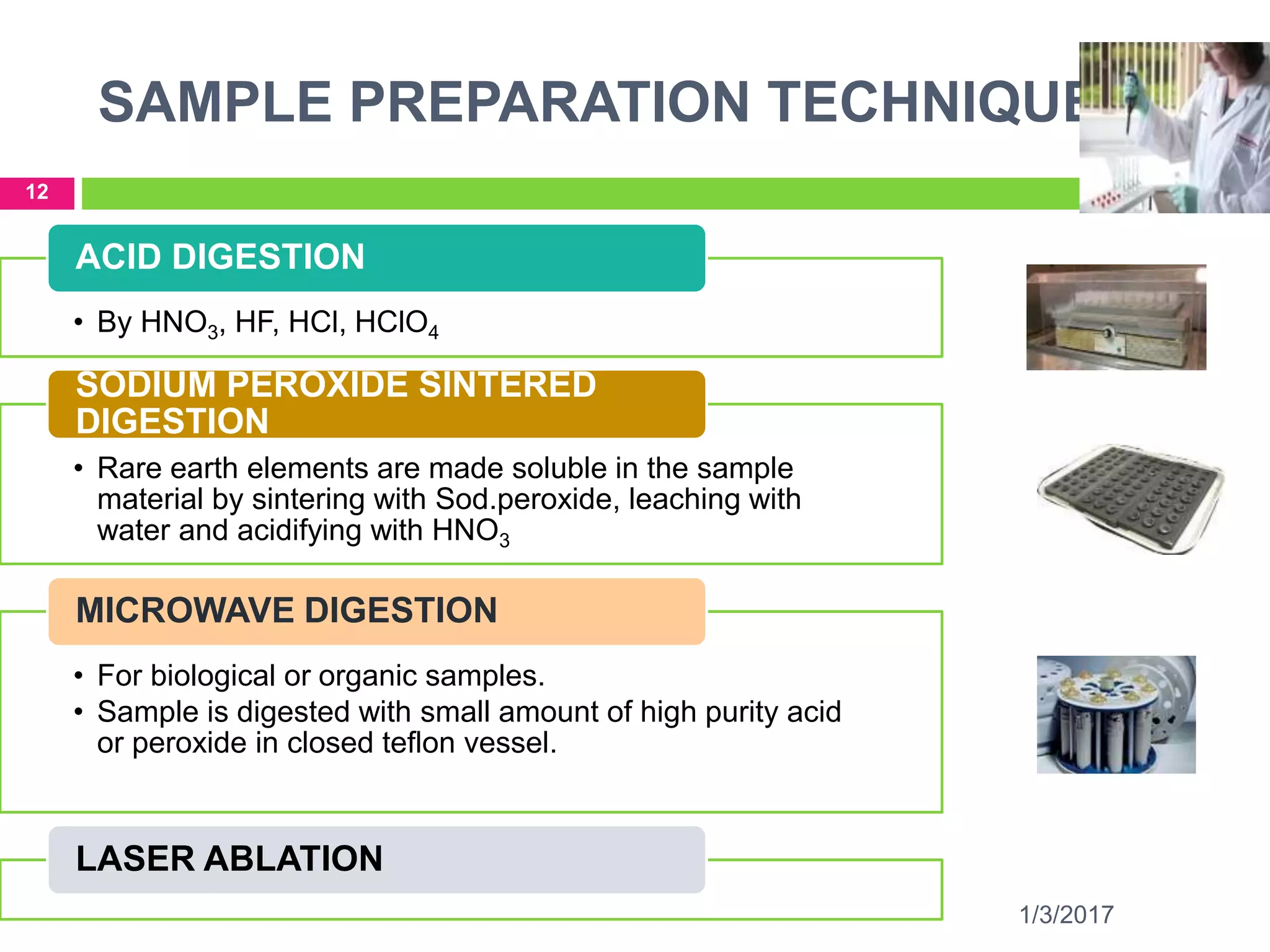
SAMPLE PREPARATION TECHNIQUES
1/3/2017
12
• By HNO3, HF, HCl, HClO4
ACID DIGESTION
• Rare earth elements are made soluble in the sample
material by sintering with Sod.peroxide, leaching with
water and acidifying with HNO3
SODIUM PEROXIDE SINTERED
DIGESTION
• For biological or organic samples.
• Sample is digested with small amount of high purity acid
or peroxide in closed teflon vessel.
MICROWAVE DIGESTION
LASER ABLATION
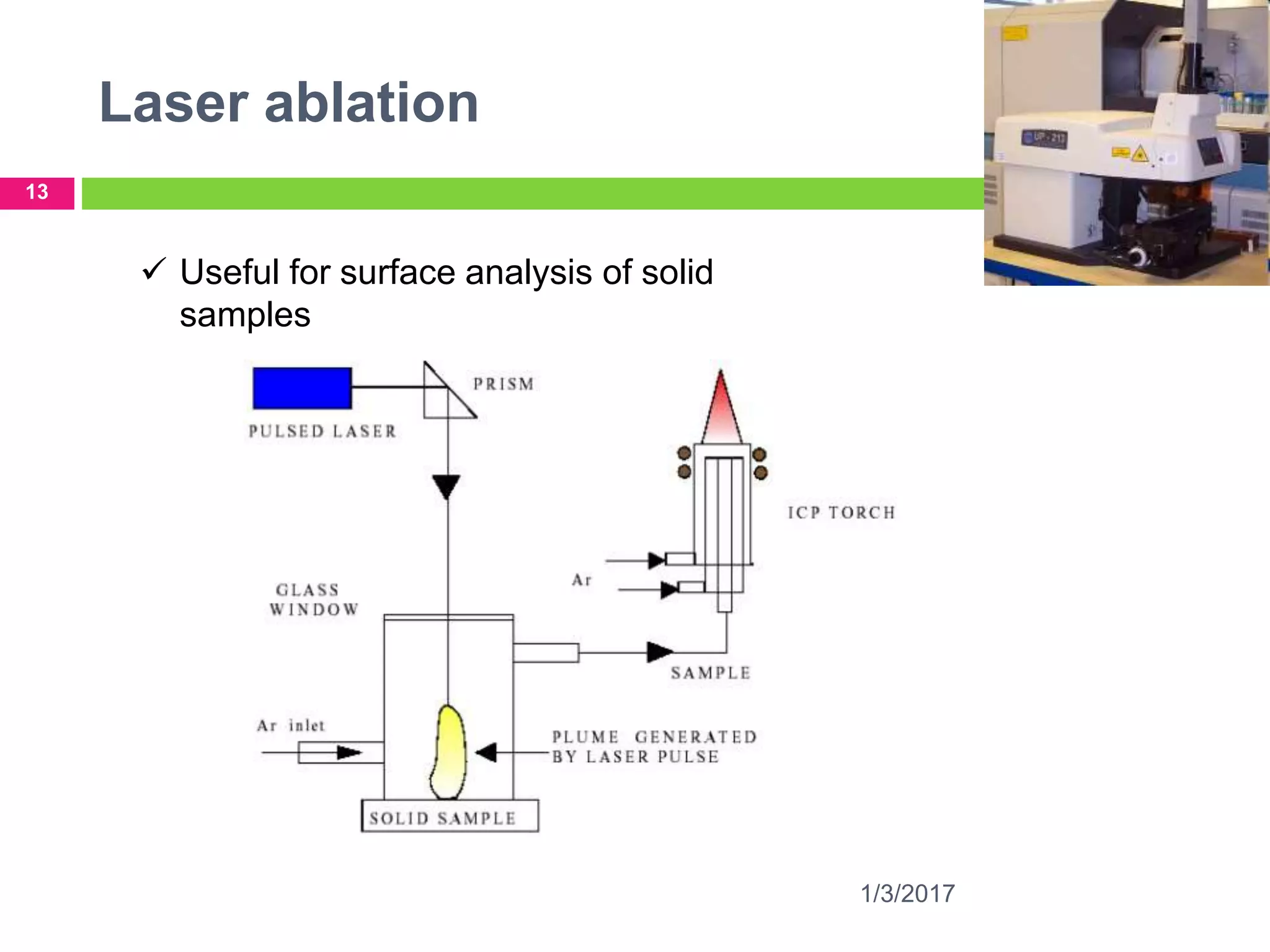
Laser ablation
1/3/2017
13
 Useful for surface analysis of solid
samples
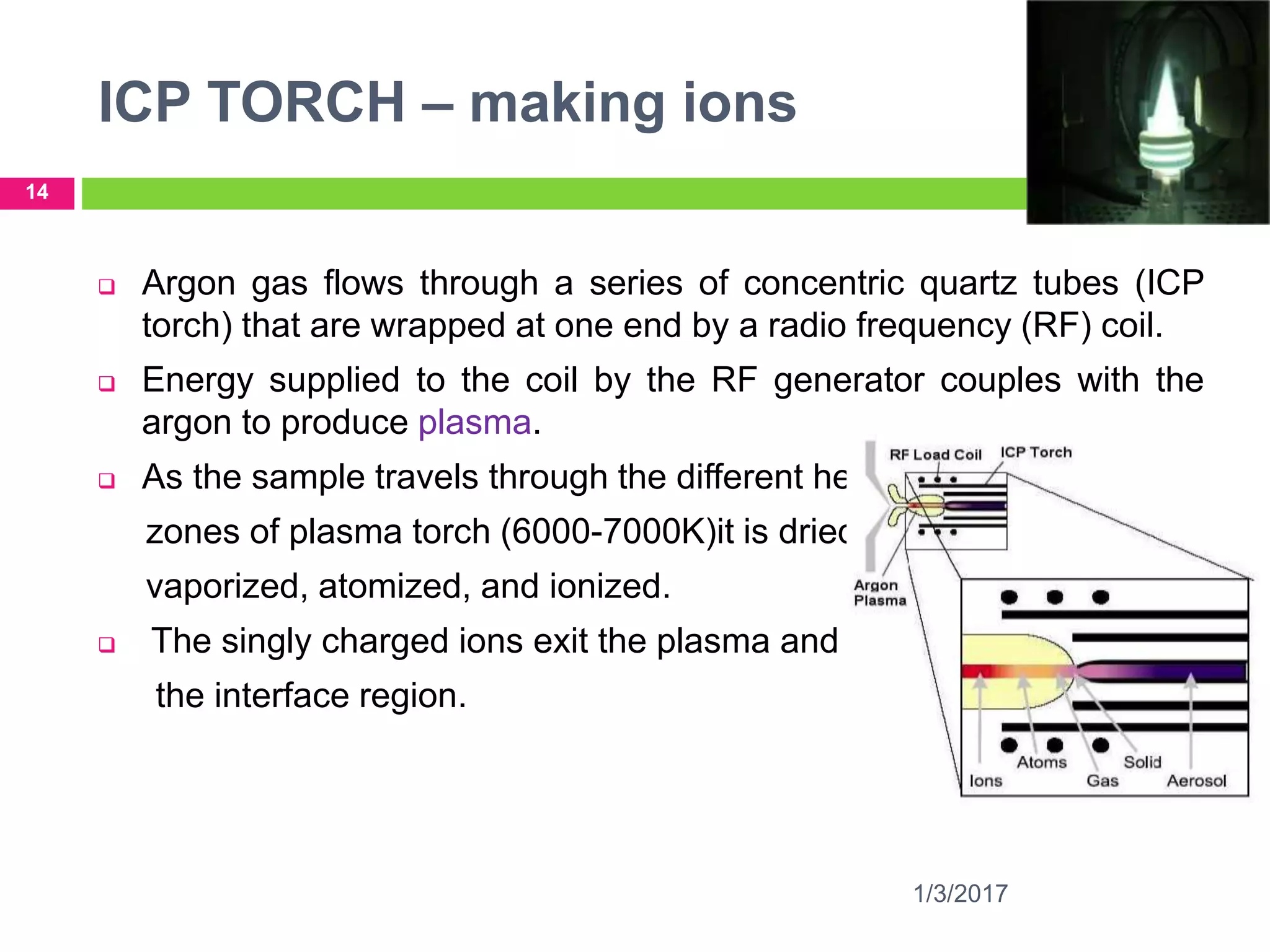
ICP TORCH – making ions
1/3/2017
14
 Argon gas flows through a series of concentric quartz tubes (ICP
torch) that are wrapped at one end by a radio frequency (RF) coil.
 Energy supplied to the coil by the RF generator couples with the
argon to produce plasma.
 As the sample travels through the different heating
zones of plasma torch (6000-7000K)it is dried,
vaporized, atomized, and ionized.
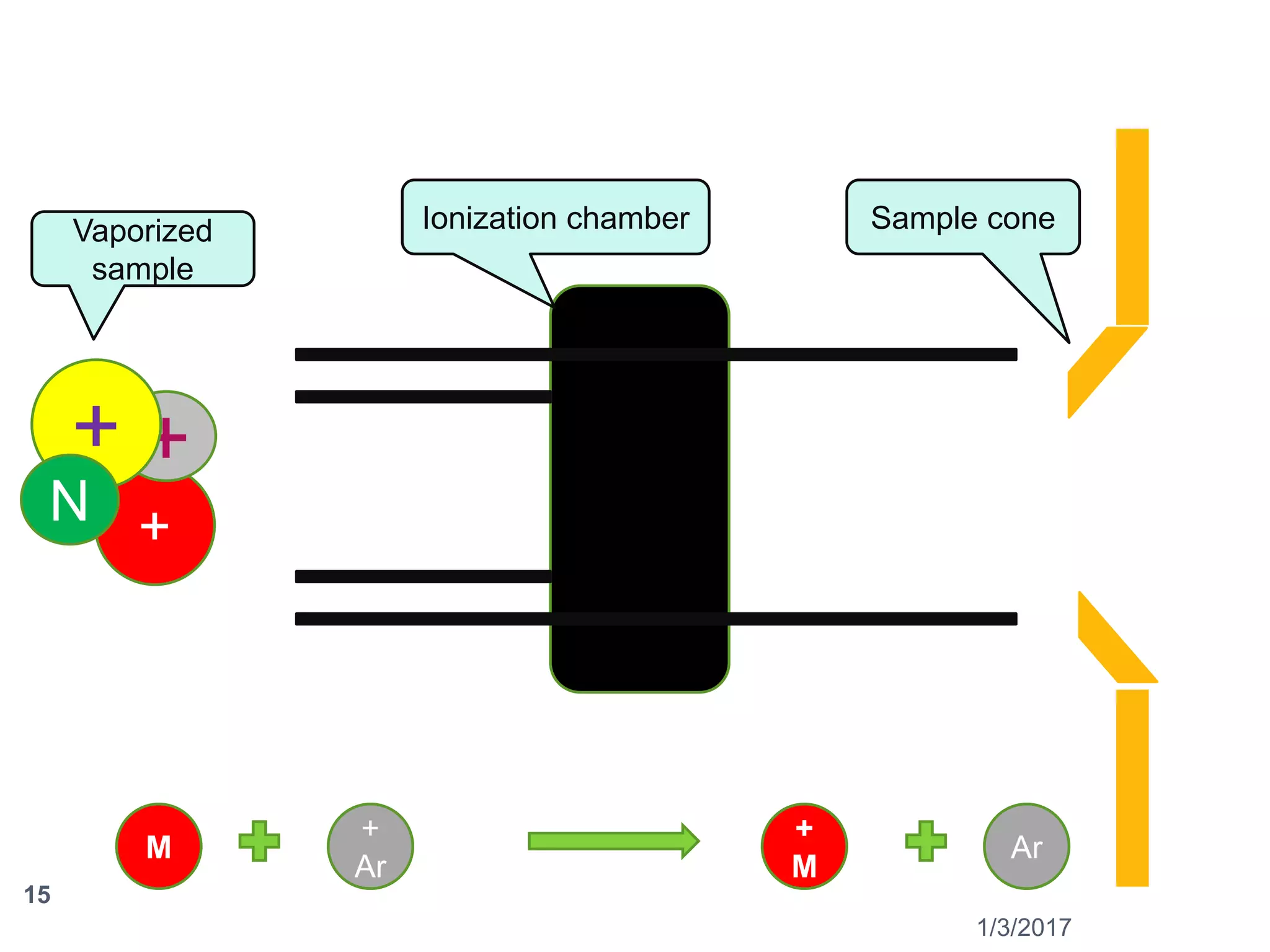
 The singly charged ions exit the plasma and enter
the interface region.
1/3/2017
15
+
++
N
Vaporized
sample
Ionization chamber Sample cone
M
+
Ar
+
M
Ar
THE INTERFACE – sampling ions
16
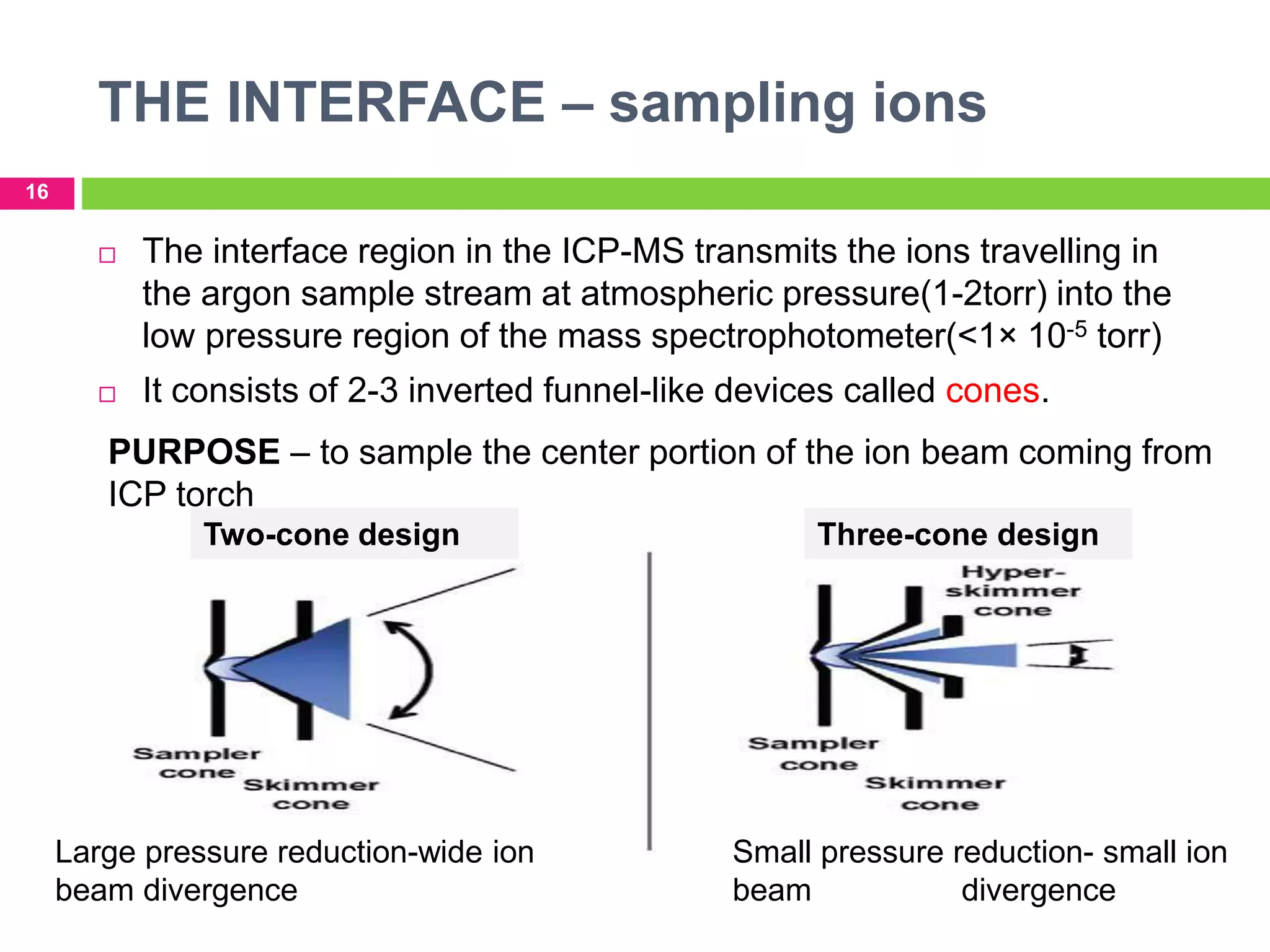
 The interface region in the ICP-MS transmits the ions travelling in
the argon sample stream at atmospheric pressure(1-2torr) into the
low pressure region of the mass spectrophotometer(<1× 10⁻⁵ torr)
 It consists of 2-3 inverted funnel-like devices called cones.
Two-cone design Three-cone design
Large pressure reduction-wide ion
beam divergence
Small pressure reduction- small ion
beam divergence
PURPOSE – to sample the center portion of the ion beam coming from
ICP torch
TWO-CONE DESIGN
1/3/2017
17
The ions from the ICP source are then focussed by the electrostatic lenses in the
system.
The ions coming from the system are positively charged, so the electrostatic lens
which also has a positive charge serves to collimate the ion beam and focus into
the entrance aperture or slit of MS.
MASS ANALYZER
1/3/2017
18
 Heart of MS
 Mass analyzers separate the ions according to their mass-to-charge
ratio.
 The most commonly used type of mass analyzer is Quadrupole
mass filter.
 It consists of 4 cylindrical rods, set parallel to eachother.
 Alternating AC and DC voltages are applied to opposite pairs of
rods.
 The result is that an electrostatic filter is established that only allows
ions of a single mass-to-charge ratio (m/z) pass through the rods to
the detector at a given instant in time.
 So, quadrupole mass filter is really a sequential filter, with the
settings being change for each specific m/z at a time.
QUADRUPOLE ANALYZER
1/3/2017
19
+
+ ++ m/z
RA
OTHER MASS ANALYZERS
1/3/2017
20
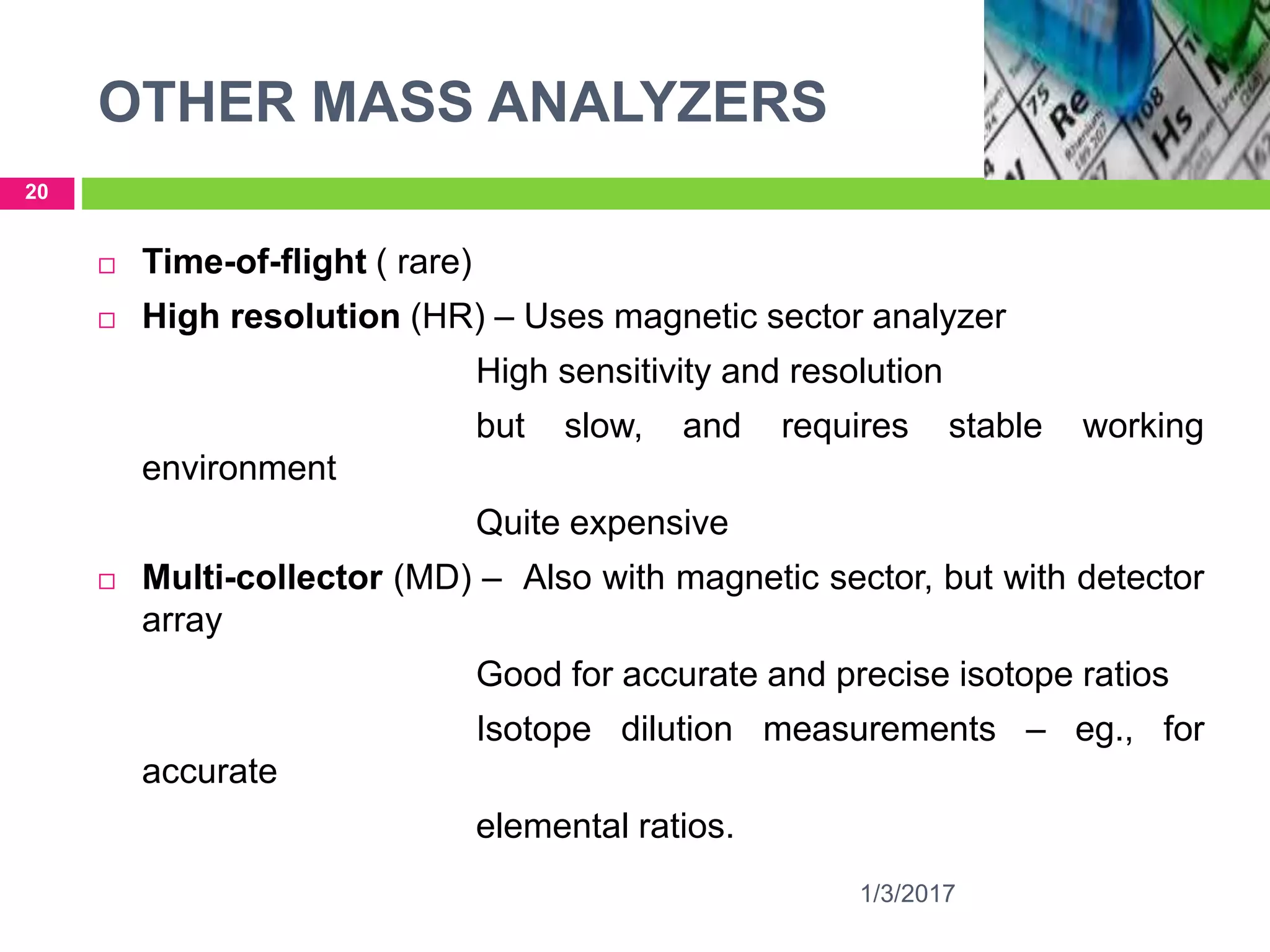
 Time-of-flight ( rare)
 High resolution (HR) – Uses magnetic sector analyzer
High sensitivity and resolution
but slow, and requires stable working
environment
Quite expensive
 Multi-collector (MD) – Also with magnetic sector, but with detector
array
Good for accurate and precise isotope ratios
Isotope dilution measurements – eg., for
accurate
elemental ratios.
INTERFERENCES
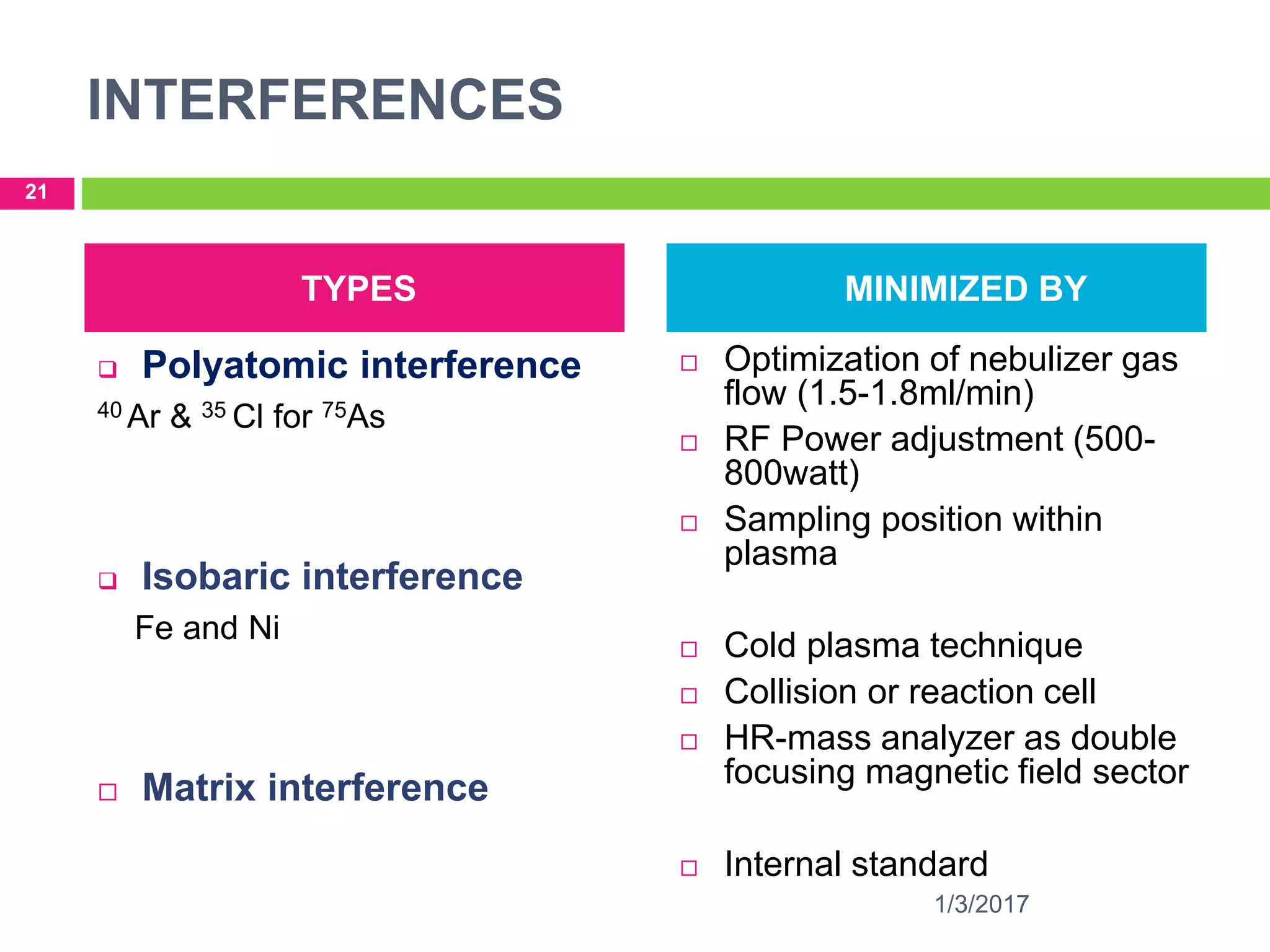
 Polyatomic interference
40 Ar & 35 Cl for 75As
 Isobaric interference
Fe and Ni
 Matrix interference
 Optimization of nebulizer gas
flow (1.5-1.8ml/min)
 RF Power adjustment (500-
800watt)
 Sampling position within
plasma
 Cold plasma technique
 Collision or reaction cell
 HR-mass analyzer as double
focusing magnetic field sector
 Internal standard
1/3/2017
21
TYPES MINIMIZED BY
DETECTOR
1/3/2017
22
 Fundamental purpose of the detector is to translate the number of
ions striking the detector into an electrical signal that can be
measured and related to the number of atoms of that element in the
sample via the use of calibration standards.
 Uses a high negative voltage to attract positively charged ions
 Most commonly used are discrete dynode detectors
Ion striking
active surface
of detector
Electrons
release
Striking next
surface of
detector
Amplification of
signal
ICP-MS AND HYPHENATION
1/3/2017
23
 ICP-MS can be coupled with various separation techniques :
Liquid chromatography HPLC-ICP-MS
Capillary electrophoresis CE-ICP-MS
Laser ablation LA-ICP-MS
 For surface analysis
 For materials that are difficult to
digest (eg., Alloys)
ADVANTAGES OF HYPHENATED TECHNIQUES :
 Better control over matrix
 Allows separation of different components : direct access
to speciation
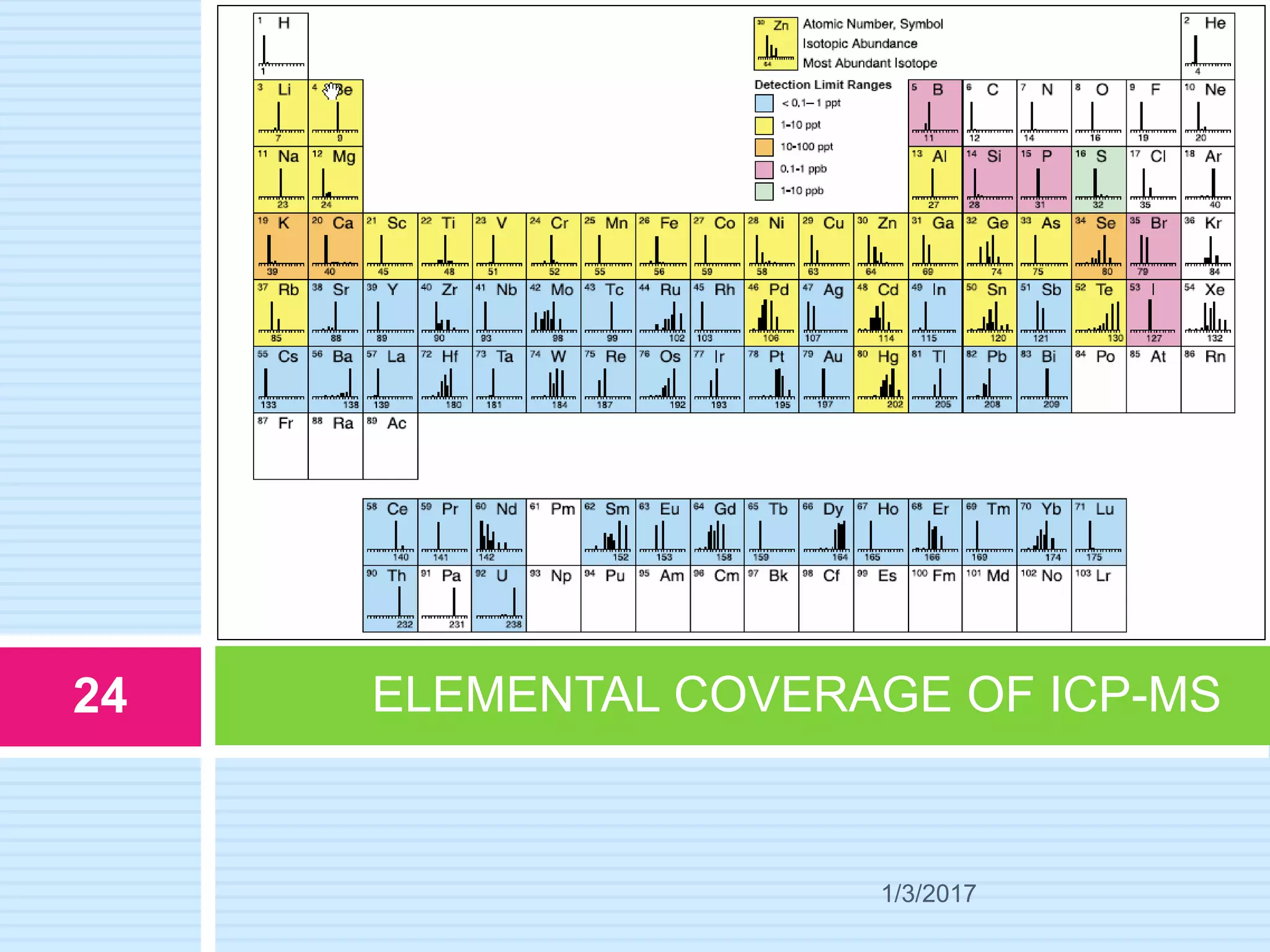
ELEMENTAL COVERAGE OF ICP-MS
1/3/2017
24
TECHNIQUE DECISION MATRIX
1/3/2017
25
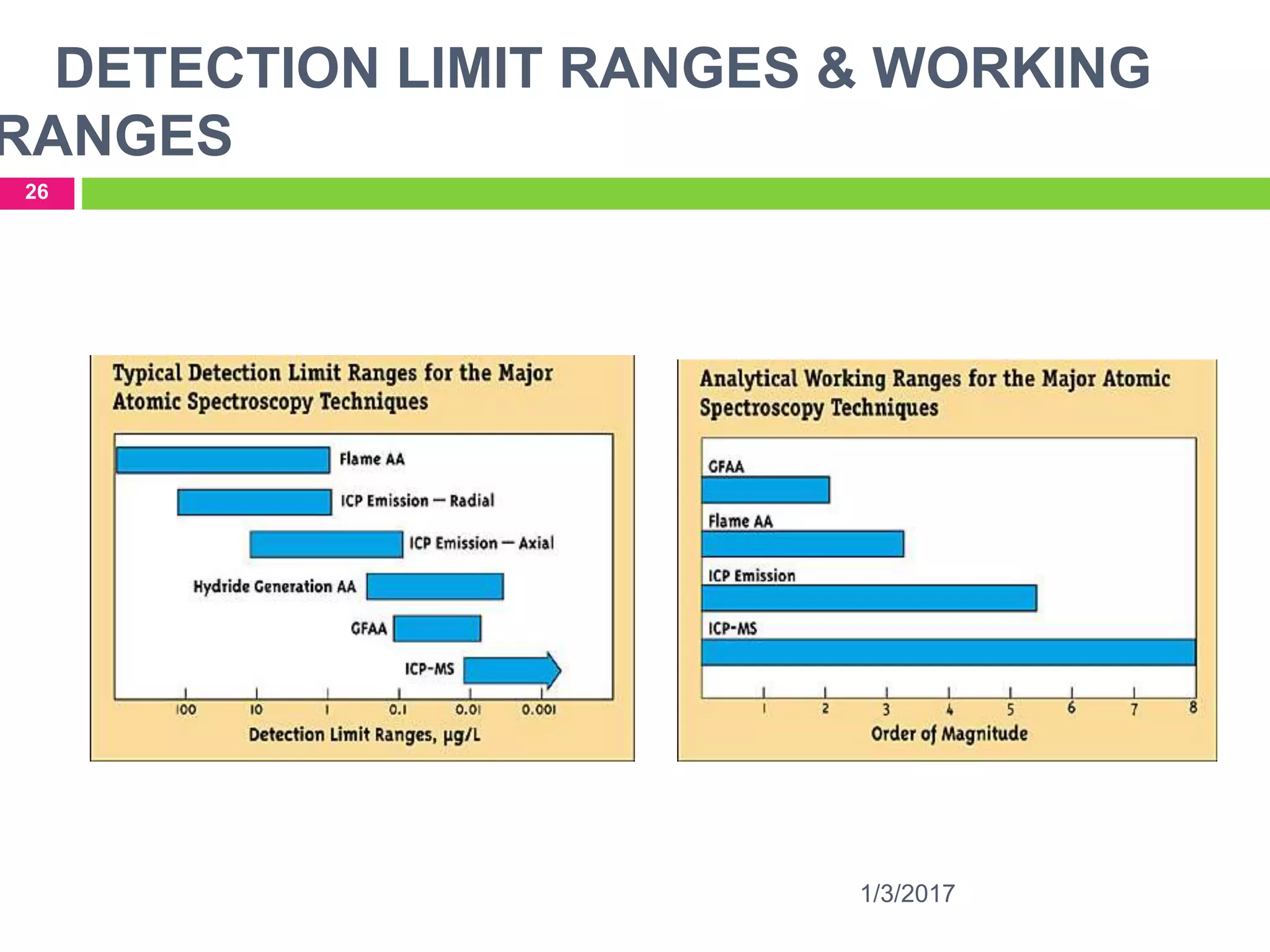
DETECTION LIMIT RANGES & WORKING
RANGES
1/3/2017
26
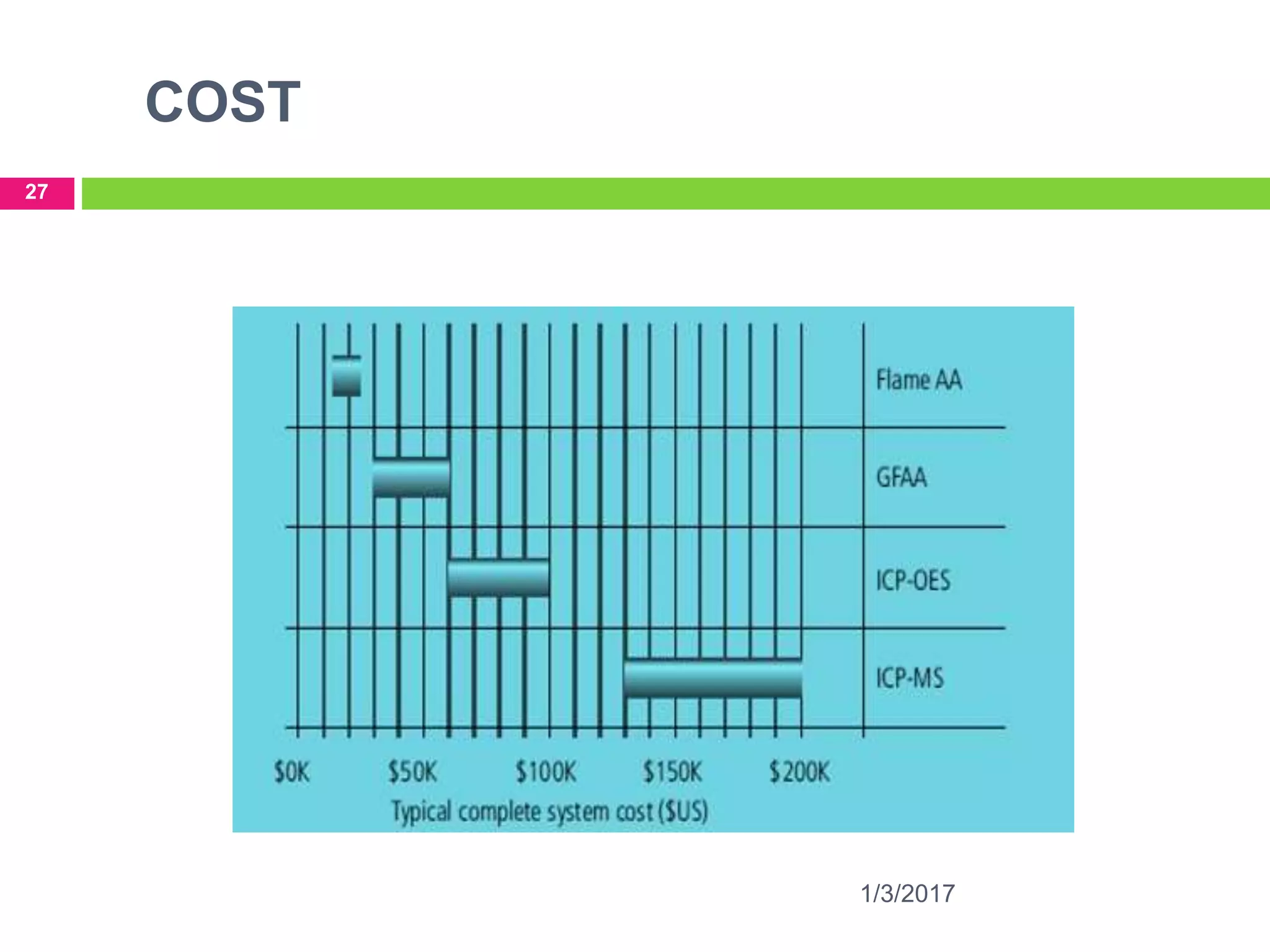
COST
1/3/2017
27
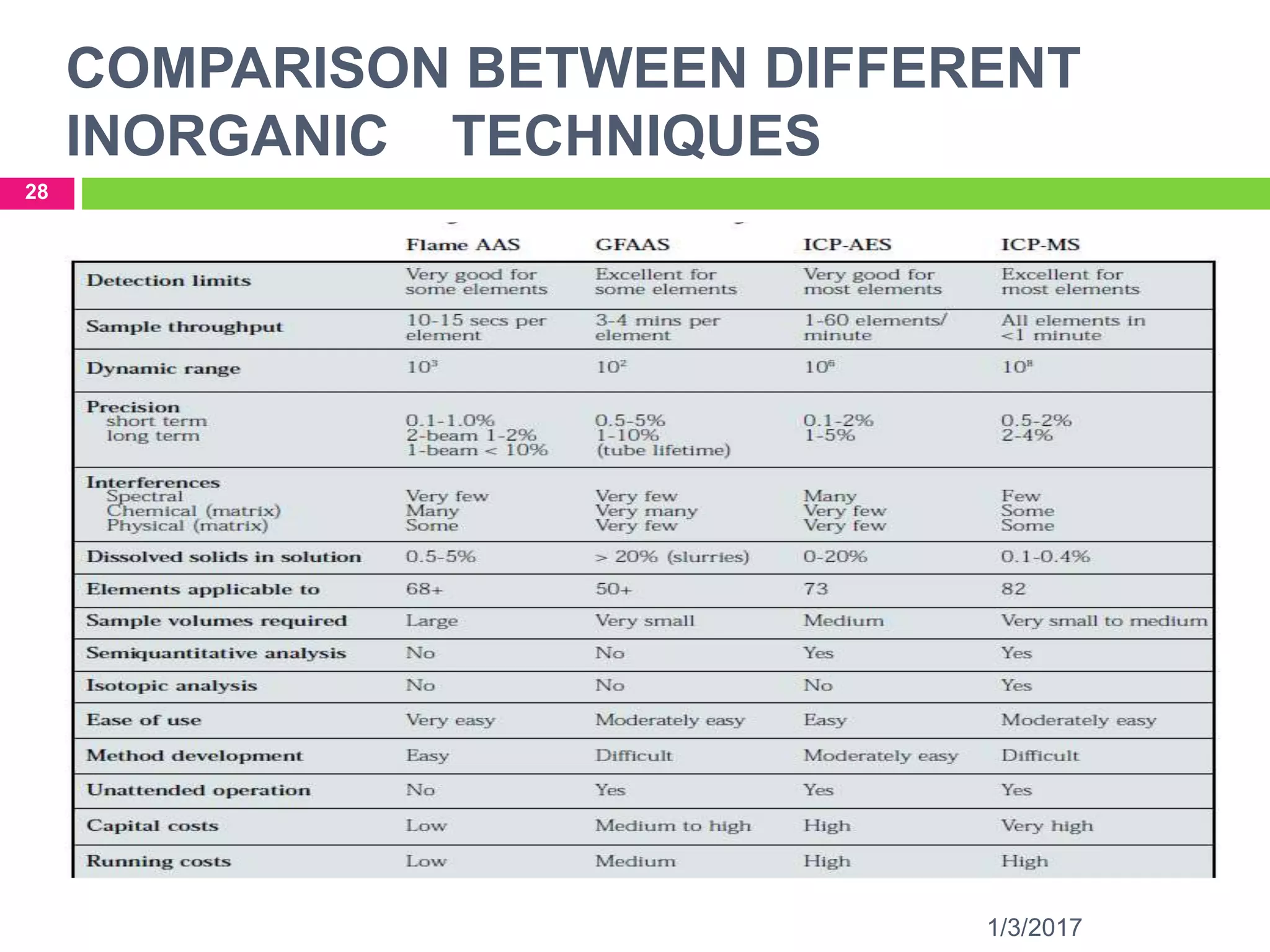
COMPARISON BETWEEN DIFFERENT
INORGANIC TECHNIQUES
1/3/2017
28
ADVANTAGES
1/3/2017
29
 Multi Element Analysis (consistent conditions for most/all
elements)
 Wide elemental coverage (almost all except H, noble gases and F)
 Low detection limits for most elements (ppt or sub ppt in most
cases)
 Wide dynamic range (10-9 – 0.5 ppt-500 ppm)
 Short acquisition times (full mass acquisition in less than 5 mins)
 Good matrix tolerance (will handle acids, solvents, matrix up to
0.5%)
LIMITATIONS
1/3/2017
30
 Difficult to determine negative species (Cl,Br)
 Dissolved solids/matrix effects –need to dilute samples more than
other techniques
 High capital cost
 Require skilled personnel
APPLICATIONS
1/3/2017
31
PHARMACEUTICAL
FOOD ANALYSIS
ENVIRONMENTAL
GEOLOGICAL
ARCHAELOGICAL
FORENSIC
CASE STUDY
1/3/2017
32
RESULT AND DISCUSSION
1/3/2017
33
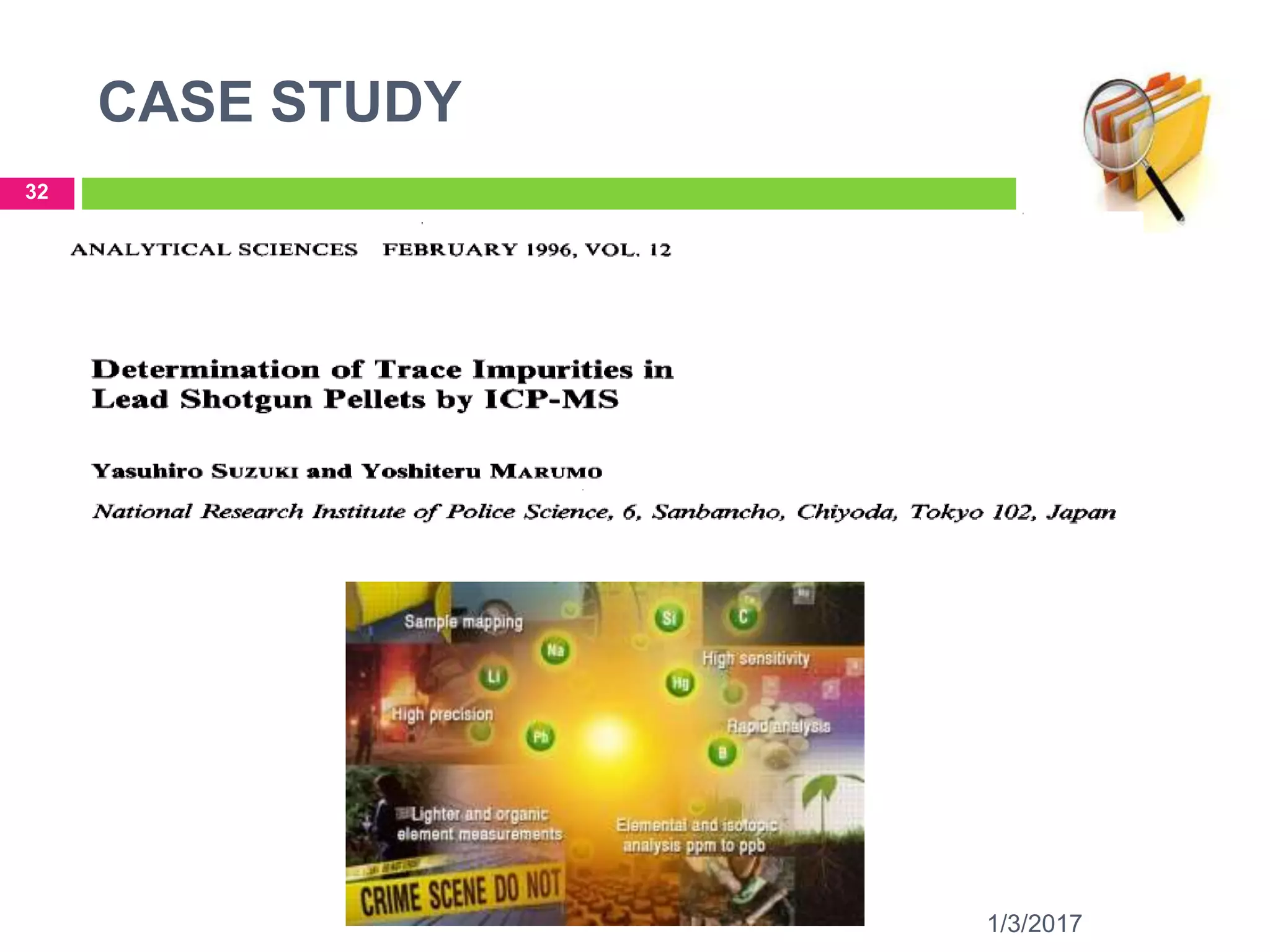
Comparison of analytical values is done for discrimination of pellets with
possession of a suspect in order to determine whether they are of common
origin or not.
1/3/2017
34
ICP-MS is an ideal choice for the laboratory that is
seeking the lowest possible detection limits and the
highest level of productivity.
Conclusion
1/3/2017
35
REFERENCES
1/3/2017
36
[1] V. Balaram ; Recent advances in the determination of elemental
impurities in pharmaceuticals – Status, challenges and moving
frontiers ; Trends in Analytical Chemistry.
[2] R.N. Rao, M.K. Talluri, An overview of recent applications of
inductively coupled plasma-mass spectrometry (ICP-MS) in
determination of inorganic impurities in drugs and pharmaceuticals,
J. Pharm. Biomed. Anal. 43 (2007) 1-13.
[3] ICH, Guideline for Elemental Impurities Q3D, in: International
Council for Harmonisation, IFPMA, Geneva, Switzerland, 2014.
[4] Skoog, D. A., Holler, F. J., & Crouch, S. R.(2007).Principles of
Instrumental Analysis.
[5] Available from:
http://www.perkinelmer.com/icpmsthirtminuteguide.pdf
1/3/201737
1/3/2017
T
H
N
K
Y
O
UA

Elemental analysis & Trace metals by ICP-MS

  • 1.
    ELEMENTAL ANALYSIS AND TRACEMETALS BY ICP-MS K.LOHITHA PA2016106 (Department of Pharmaceutical Analysis) 1/3/2017 1
  • 2.
    INTRODUCTION REGULATORY COMPLIANCE ICP-MS INSTRUMENTATION &WORKING ASSETS& LIMITATIONS APPLICATIONS & REFERENCES 1/3/2017 2
  • 3.
    Elemental impurities are Elements found in environment  Introduced in manufacturing of drug and excipients  They have to be monitored for two reasons  Enter the human body via food chain including medicines, ambient air and drinking water leading to health problems  Affect the stability of formulation and catalyze degradation of drug substance 1/3/2017 3
  • 4.
    POTENTIAL SOURCES OFELEMENTAL IMPURITIES (As,Cd,Cu,Sn,Sb,Pb,Bi,Ag,Hg,Mo,In,Os,Pd,Pt,Rh,Ru,Cr,Ni,V,etc.) 1/3/2017 4
  • 5.
    REGULATORY COMPLIANCE 1/3/2017 5 ICH Q3D-Guidelinefor elemental impurity Development of design for control Establishment of permitted daily exposure (PDE) Evaluation of toxicity data for potential source Safety Toxicity Acceptance level International Council for Harmonisation
  • 6.
  • 7.
    1/3/20177 ICH Classl ElementICH Q3D** (µg/day) USP<232>** (µg/day) EMA/CHMP (µg/day) Class 1 As 1.5 1.5 na Cd 0.5 0.5 na Hg 4 1.5 na Pb 0.5 0.5 na Class 2A Co 5 Mo 18 18 25 Se 17 - - V 12 12 25 Class 2B Ag 17 - - Au 13 - - Ir 100* 10 10*** Os 100* 10 10*** Pd 10 10 10 Pt 100 10 10 Rh 100* 10 10*** Ru 100* 10 10*** Tl 0.8 - - Class 3 Ba 1300 - - Cr 1100 nc 25 Cu 130 130 250 Li 78 - - Ni 60 60 25 Sb 120 - - Su 640 - - Class 4 Mn - - 250 Zn - - 1300 * PDE is based on Pt, due to insufficient data ** Subclass limit - PDE is based on the sum of these elements na: Not included in EMA guidance nc: Not considered a safety concern except for drugs administered by inhalation Fe - - 1300
  • 8.
    DIFFERENT ANALYTICAL TECHNIQUESFOR ELEMENTAL ANALYSIS 1/3/2017 8 ELEMENT AL TECHNIQ UES ATOMIC ABSORPTION SPECTROSCO PY INSTRUMENTAL NEUTRON ACTIVATION ANALYSIS ICP-MS ICP-AES/ ICP- OES/GFAAS X-RAY FLUORESCENCE SPECTROMETRY
  • 9.
    WHAT IS ICP-MS??? 1/3/2017 9  Inductively coupled plasma mass spectrometry (ICP-MS) is a type of mass spectrometry which is capable of detecting metals and non- metals at concentrations as low as one part in 1015 (ppq).  This is achieved by ionizing the sample with ICP and then using a MS to separate and quantify those ions.
  • 10.
    PRINCIPLE 1/3/2017 10  Liquid sampleis introduced into an argon plasma as aerosol droplets.  The plasma dries the aerosol, dissociates the molecules, and then removes an electron from the components, forming singly-charged ions, which are directed into a mass filtering device known as mass spectrometer.  Once the ions enter MS (mostly quadrupole), they are separated by their mass-to-charge ratio and gets detected.
  • 11.
  • 12.
    SAMPLE PREPARATION TECHNIQUES 1/3/2017 12 •By HNO3, HF, HCl, HClO4 ACID DIGESTION • Rare earth elements are made soluble in the sample material by sintering with Sod.peroxide, leaching with water and acidifying with HNO3 SODIUM PEROXIDE SINTERED DIGESTION • For biological or organic samples. • Sample is digested with small amount of high purity acid or peroxide in closed teflon vessel. MICROWAVE DIGESTION LASER ABLATION
  • 13.
    Laser ablation 1/3/2017 13  Usefulfor surface analysis of solid samples
  • 14.
    ICP TORCH –making ions 1/3/2017 14  Argon gas flows through a series of concentric quartz tubes (ICP torch) that are wrapped at one end by a radio frequency (RF) coil.  Energy supplied to the coil by the RF generator couples with the argon to produce plasma.  As the sample travels through the different heating zones of plasma torch (6000-7000K)it is dried, vaporized, atomized, and ionized.  The singly charged ions exit the plasma and enter the interface region.
  • 15.
  • 16.
    THE INTERFACE –sampling ions 16  The interface region in the ICP-MS transmits the ions travelling in the argon sample stream at atmospheric pressure(1-2torr) into the low pressure region of the mass spectrophotometer(<1× 10⁻⁵ torr)  It consists of 2-3 inverted funnel-like devices called cones. Two-cone design Three-cone design Large pressure reduction-wide ion beam divergence Small pressure reduction- small ion beam divergence PURPOSE – to sample the center portion of the ion beam coming from ICP torch
  • 17.
    TWO-CONE DESIGN 1/3/2017 17 The ionsfrom the ICP source are then focussed by the electrostatic lenses in the system. The ions coming from the system are positively charged, so the electrostatic lens which also has a positive charge serves to collimate the ion beam and focus into the entrance aperture or slit of MS.
  • 18.
    MASS ANALYZER 1/3/2017 18  Heartof MS  Mass analyzers separate the ions according to their mass-to-charge ratio.  The most commonly used type of mass analyzer is Quadrupole mass filter.  It consists of 4 cylindrical rods, set parallel to eachother.  Alternating AC and DC voltages are applied to opposite pairs of rods.  The result is that an electrostatic filter is established that only allows ions of a single mass-to-charge ratio (m/z) pass through the rods to the detector at a given instant in time.  So, quadrupole mass filter is really a sequential filter, with the settings being change for each specific m/z at a time.
  • 19.
  • 20.
    OTHER MASS ANALYZERS 1/3/2017 20 Time-of-flight ( rare)  High resolution (HR) – Uses magnetic sector analyzer High sensitivity and resolution but slow, and requires stable working environment Quite expensive  Multi-collector (MD) – Also with magnetic sector, but with detector array Good for accurate and precise isotope ratios Isotope dilution measurements – eg., for accurate elemental ratios.
  • 21.
    INTERFERENCES  Polyatomic interference 40Ar & 35 Cl for 75As  Isobaric interference Fe and Ni  Matrix interference  Optimization of nebulizer gas flow (1.5-1.8ml/min)  RF Power adjustment (500- 800watt)  Sampling position within plasma  Cold plasma technique  Collision or reaction cell  HR-mass analyzer as double focusing magnetic field sector  Internal standard 1/3/2017 21 TYPES MINIMIZED BY
  • 22.
    DETECTOR 1/3/2017 22  Fundamental purposeof the detector is to translate the number of ions striking the detector into an electrical signal that can be measured and related to the number of atoms of that element in the sample via the use of calibration standards.  Uses a high negative voltage to attract positively charged ions  Most commonly used are discrete dynode detectors Ion striking active surface of detector Electrons release Striking next surface of detector Amplification of signal
  • 23.
    ICP-MS AND HYPHENATION 1/3/2017 23 ICP-MS can be coupled with various separation techniques : Liquid chromatography HPLC-ICP-MS Capillary electrophoresis CE-ICP-MS Laser ablation LA-ICP-MS  For surface analysis  For materials that are difficult to digest (eg., Alloys) ADVANTAGES OF HYPHENATED TECHNIQUES :  Better control over matrix  Allows separation of different components : direct access to speciation
  • 24.
    ELEMENTAL COVERAGE OFICP-MS 1/3/2017 24
  • 25.
  • 26.
    DETECTION LIMIT RANGES& WORKING RANGES 1/3/2017 26
  • 27.
  • 28.
  • 29.
    ADVANTAGES 1/3/2017 29  Multi ElementAnalysis (consistent conditions for most/all elements)  Wide elemental coverage (almost all except H, noble gases and F)  Low detection limits for most elements (ppt or sub ppt in most cases)  Wide dynamic range (10-9 – 0.5 ppt-500 ppm)  Short acquisition times (full mass acquisition in less than 5 mins)  Good matrix tolerance (will handle acids, solvents, matrix up to 0.5%)
  • 30.
    LIMITATIONS 1/3/2017 30  Difficult todetermine negative species (Cl,Br)  Dissolved solids/matrix effects –need to dilute samples more than other techniques  High capital cost  Require skilled personnel
  • 31.
  • 32.
  • 33.
    RESULT AND DISCUSSION 1/3/2017 33 Comparisonof analytical values is done for discrimination of pellets with possession of a suspect in order to determine whether they are of common origin or not.
  • 34.
  • 35.
    ICP-MS is anideal choice for the laboratory that is seeking the lowest possible detection limits and the highest level of productivity. Conclusion 1/3/2017 35
  • 36.
    REFERENCES 1/3/2017 36 [1] V. Balaram; Recent advances in the determination of elemental impurities in pharmaceuticals – Status, challenges and moving frontiers ; Trends in Analytical Chemistry. [2] R.N. Rao, M.K. Talluri, An overview of recent applications of inductively coupled plasma-mass spectrometry (ICP-MS) in determination of inorganic impurities in drugs and pharmaceuticals, J. Pharm. Biomed. Anal. 43 (2007) 1-13. [3] ICH, Guideline for Elemental Impurities Q3D, in: International Council for Harmonisation, IFPMA, Geneva, Switzerland, 2014. [4] Skoog, D. A., Holler, F. J., & Crouch, S. R.(2007).Principles of Instrumental Analysis. [5] Available from: http://www.perkinelmer.com/icpmsthirtminuteguide.pdf
  • 37.
  • 38.