Introduction
From 2007 to 2008, the number of recalls for toys exceed-
ing the U.S. limits set for lead dropped 43%. This represents
however, more than 300,000 individual products posing
potential hazardous exposure for children. The Consumer
Product Safety Improvement Act of 2008 (CPSIA 2008)
defines a children’s product as a product primarily used by
a child under the age of 12 and defines new levels of lead
allowed in those products1
. Allowable lead in painted
surfaces will be reduced from 600 mg/kg to 90 mg/kg one
year from enactment of the legislation (enactment date:
August 14, 2008). Allowable total lead content (surface and substrate) is reduced from 600 mg/kg
to 100 mg/kg, incrementally over the course of three years. The American Academy of Pediatrics
suggests that a level close to the background level in soil of 40 mg/kg would be most protective
of children’s health2
.
Currently, EN-71, Part 3 and ASTM 963 specify evaluation of the toy by soaking in a mild hydrochloric
acid solution at body temperature and measuring the accessible metal extracted into the solution.
If a coating can be separated, a total analysis of the coating to comply with lead content
requirements can be done. CPSIA 2008 provides no exemption for electroplated substrates, so
that a total analysis on both coating and substrate must be done, though little other measurement
guidance is currently available. EN-71 may also be revised in the near future to add other hazard-
ous elements, such as aluminum, cobalt, copper, nickel, and others. The evolving need to measure
lead and other metals at increasingly lower levels makes information on analysis technologies
and performance valuable in making knowledgeable decisions.
Children's Products
A P P L I C A T I O N N O T E
Authors
Zoe Grosser, Ph.D.
Laura Thompson
Lee Davidowski, Ph.D.
PerkinElmer Inc.
Shelton, CT
Suzanne Moller
Innov-X Systems
Woburn, MA
Lead and Other Toxic
Metals in Toys Using
XRF Screening and
ICP-OES Quantitative
Analysis
2
A variety of techniques can be used to meet the regula-
tions, including atomic absorption (both flame FLAA
and graphite furnace GFAA), inductively coupled plasma
optical emission spectroscopy (ICP-OES) and inductively
coupled plasma mass spectrometry (ICP-MS). Hand-held
energy dispersive XRF, requiring minimal or no sample
preparation can provide a way to screen products on-site
as to determine whether further quantitative analysis is
required.
The techniques are compared for several parameters in
Table 1.
Since the techniques in Table 1 have different character-
istics, which would be the most suitable for the variety
of children’s products, including toys that may require
analysis? This question is addressed in this work using
ICP-OES and hand-held XRF to examine a variety of toy
materials. Ease of use and agreement between techniques
at the current level for lead were evaluated.
Experimental
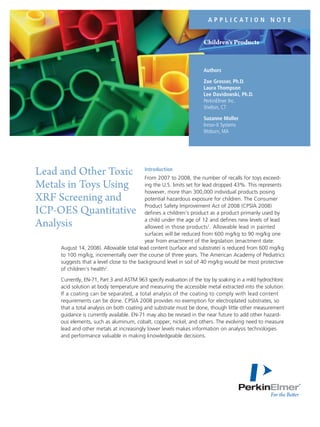
A variety of children’s toys were obtained randomly from
a church nursery room and other sources. One known
recalled item, Boy Scout totem badges of differing ages
were also obtained. Figure 1 shows the variety of toys,
including fabric, soft and hard toys and some with painted
surfaces.
Table 1. Comparison of Several Analysis Techniques for Lead Determination (mg/kg).
	 GFAA	 ICP-OES	 ICP-MS	 Hand-held XRF
Estimated detection limit for lead*	 0.025	 0.5	 0.025	 NA**
Sample prep required	 Yes	 Yes	 Yes	 No
Simultaneous multielement	 No	 Yes	 Yes	 Yes
* Includes a 500x dilution to account for sample preparation for GFAA, ICP-OES, and ICP-MS. Detection limits can be further improved if a smaller dilution is used.
**NA: screening tool, detection limits matrix driven.
Table 2. Microwave Digestion Program.
Power (W)	 Ramp (min)	 Hold (min)	 Fan
500	 5:00	 15:00	1
900	 10:00	15:00	1
0		 20:00	2
Table 3. ICP-OES Instrumental Conditions.
Instrument	 Optima 7300 DV ICP-OES
RF Power	 1450 W
Nebulizer Flow	 0.55 L/min
Auxiliary Flow	 0.2 L/min
Plasma Flow	 15.0 L/min
Sample Pump Flow	 1.2 mL/min
Plasma Viewing	 Axial
Processing Mode	 Area
Auto Integration	 5 sec min-20 sec max
Read Delay	 30 sec
Rinse	 30 sec
Replicates	 3
Background Correction	 one or two points
Spray Chamber	 Cyclonic
Nebulizer	 SeaSpray (Glass Expansion®
, Pocasset, MA)
Figure 1. Variety of toys measured.
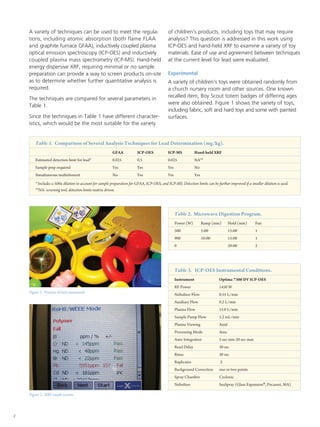
Figure 2. XRF result screen.
elements over a wide dynamic concentration range, from
ppm levels up to virtually 100% by weight. An example
of the result obtained on the screen is shown in Figure 2.
Results and Discussion
The analysis of the toys by hand-held XRF and ICP-OES
are shown in Table 4. The check mark in the XRF column
indicates the XRF analysis displayed a lead value higher
than the limit of 600 mg/kg in the screened toy indicating
further quantitative analysis is recommended. The value
determined by ICP-OES confirms that the value was
higher than the regulatory limit in the coating or for a
total analysis of the substrate material. In this case, the
value measured with XRF is not reported although the
value would give further refinement of the concentration
for the elements measured.
Detection limits for the ICP-OES are shown in Table 5 for
both the digested solution and the amount in the origi-
nal material. Since the amount taken for digestion may
vary and the dilution can be changed, a 500x dilution
was assumed for the calculation. This represents a typical
0.1 g of material diluted to a final volume of 50 mL.
Duplicate sample preparation and analysis of several
samples can indicate the reproducibility of the method,
provided the samples are homogeneous. Table 6 shows
the results for duplicate sample preparation and analysis
of three different types of samples. The fabric and the
uniformly-colored plastic show good agreement between
the duplicate analyses (less than 20% relative percent
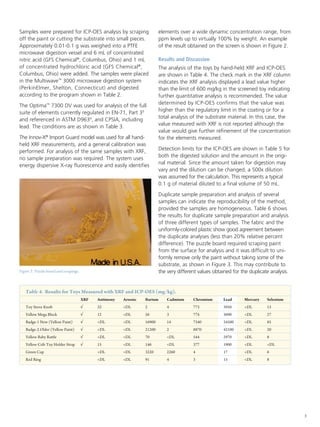
difference). The puzzle board required scraping paint
from the surface for analysis and it was difficult to uni-
formly remove only the paint without taking some of the
substrate, as shown in Figure 3. This may contribute to
the very different values obtained for the duplicate analysis.
Samples were prepared for ICP-OES analysis by scraping
off the paint or cutting the substrate into small pieces.
Approximately 0.01-0.1 g was weighed into a PTFE
microwave digestion vessel and 6 mL of concentrated
nitric acid (GFS Chemical®
, Columbus, Ohio) and 1 mL
of concentrated hydrochloric acid (GFS Chemical®
,
Columbus, Ohio) were added. The samples were placed
in the Multiwave™
3000 microwave digestion system
(PerkinElmer, Shelton, Connecticut) and digested
according to the program shown in Table 2.
The Optima™
7300 DV was used for analysis of the full
suite of elements currently regulated in EN-71, Part 33
and referenced in ASTM D9634
, and CPSIA, including
lead. The conditions are as shown in Table 3.
The Innov-X®
Import Guard model was used for all hand-
held XRF measurements, and a general calibration was
performed. For analysis of the same samples with XRF,
no sample preparation was required. The system uses
energy dispersive X-ray fluorescence and easily identifies
3
Figure 3. Puzzle board and scrapings.
Table 4. Results for Toys Measured with XRF and ICP-OES (mg/kg).
	 XRF	 Antimony	Arsenic	 Barium	 Cadmium	 Chromium	 Lead	 Mercury	Selenium
Toy Stove Knob	 √ 	 32	 <DL	 2	 4	 773	 3950	 <DL	 13
Yellow Mega Block	 √ 	 12	 <DL	 56	 3	 774	 3690	 <DL	 27
Badge-1 New (Yellow Paint)	 √ 	 <DL	 <DL	 16900	 14	 7340	 34500	 <DL	 85
Badge-2 Older (Yellow Paint)	 √ 	 <DL	 <DL	 21200	 2	 8870	 42100	 <DL	 20
Yellow Baby Rattle	 √ 	 <DL	 <DL	 70	 <DL	 544	 2970	 <DL	 8
Yellow Crib Toy Holder Strap	 √ 	 15	 <DL	 146	 <DL	 377	 1900	 <DL	 <DL
Green Cup		 <DL	 <DL	 3220	 2260	 4	 17	 <DL	 6
Red Ring		 <DL	 <DL	 91	 4	 3	 15	 <DL	 8
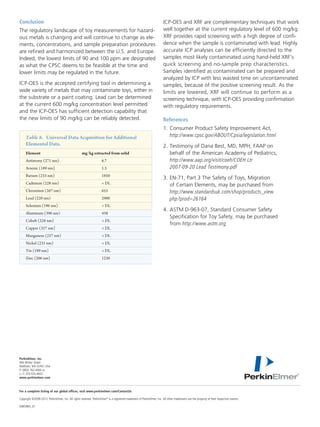
Table 8 shows an example for a hydrochloric acid extract
from a toy, extracted and measured using procedures
specified in EN-71, Part 3. Both the original set of ele-
ments reported and the elements determined later (in
blue) by reprocessing the data to examine the informa-
tion previously stored for those elements are listed. This
can be useful in assessing samples that may have been dis-
posed or in better understanding the scope of samples in
preparing for future analyses.
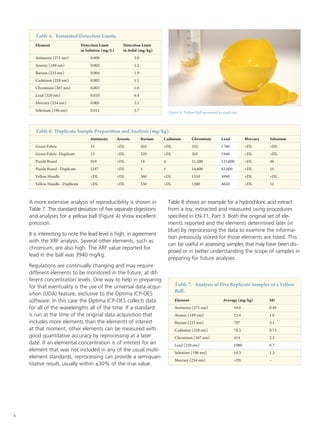
A more extensive analysis of reproducibility is shown in
Table 7. The standard deviation of five separate digestions
and analyses for a yellow ball (Figure 4) show excellent
precision.
It is interesting to note the lead level is high, in agreement
with the XRF analysis. Several other elements, such as
chromium, are also high. The XRF value reported for
lead in the ball was 3940 mg/kg.
Regulations are continually changing and may require
different elements to be monitored in the future, at dif-
ferent concentration levels. One way to help in preparing
for that eventuality is the use of the universal data acqui-
sition (UDA) feature, exclusive to the Optima ICP-OES
software. In this case the Optima ICP-OES collects data
for all of the wavelengths all of the time. If a standard
is run at the time of the original data acquisition that
includes more elements than the elements of interest
at that moment, other elements can be measured with
good quantitative accuracy by reprocessing at a later
date. If an elemental concentration is of interest for an
element that was not included in any of the usual multi-
element standards, reprocessing can provide a semiquan-
titative result, usually within ±30% of the true value.
4
Table 5. Estimated Detection Limits.
Element	 Detection Limit 	 Detection Limit
	 in Solution (mg/L)	 in Solid (mg/kg)
Antimony (271 nm)	 0.008	 3.8
Arsenic (189 nm)	 0.002	 1.2
Barium (233 nm)	 0.004	 1.9
Cadmium (228 nm)	 0.002	 1.1
Chromium (267 nm)	 0.003	 1.6
Lead (220 nm)	 0.010	 6.4
Mercury (254 nm)	 0.005	 2.2
Selenium (196 nm)	 0.011	 5.7
Table 6. Duplicate Sample Preparation and Analysis (mg/kg).
	 Antimony	Arsenic	 Barium	 Cadmium	 Chromium	 Lead	 Mercury	 Selenium
Green Fabric	 15	 <DL	 302	 <DL	 332	 1780	 <DL	 <DL
Green Fabric -Duplicate	 13	 <DL	 329	 <DL	 362	 1940	 <DL	 <DL
Puzzle Board	 919	 <DL	 14	 4	 21,200	 121,000	 <DL	 49
Puzzle Board - Duplicate	 2187	 <DL	 5	 5	 14,600	 82,600	 <DL	 15
Yellow Handle	 <DL	 <DL	 360	 <DL	 1310	 4990	 <DL	 <DL
Yellow Handle - Duplicate	 <DL	 <DL	 336	 <DL	 1200	 4620	 <DL	 12
Table 7. Analysis of Five Replicate Samples of a Yellow
Ball.
Element	 Average (mg/kg)	 SD
Antimony (271 nm)	 10.6	 0.49
Arsenic (189 nm)	 12.4	 1.8
Barium (233 nm)	 707	 3.1
Cadmium (228 nm)	 78.3	 0.73
Chromium (267 nm)	 414	 2.3
Lead (220 nm)	 1980	 9.7
Selenium (196 nm)	 16.3	 1.3
Mercury (254 nm)	 <DL	 –
Figure 4. Yellow ball measured in replicate.
For a complete listing of our global offices, visit www.perkinelmer.com/ContactUs
Copyright ©2009-2012, PerkinElmer, Inc. All rights reserved. PerkinElmer®
is a registered trademark of PerkinElmer, Inc. All other trademarks are the property of their respective owners.
008598A_01	
PerkinElmer, Inc.
940 Winter Street
Waltham, MA 02451 USA	
P: (800) 762-4000 or
(+1) 203-925-4602
www.perkinelmer.com
Conclusion
The regulatory landscape of toy measurements for hazard-
ous metals is changing and will continue to change as ele-
ments, concentrations, and sample preparation procedures
are refined and harmonized between the U.S. and Europe.
Indeed, the lowest limits of 90 and 100 ppm are designated
as what the CPSC deems to be feasible at the time and
lower limits may be regulated in the future.
ICP-OES is the accepted certifying tool in determining a
wide variety of metals that may contaminate toys, either in
the substrate or a paint coating. Lead can be determined
at the current 600 mg/kg concentration level permitted
and the ICP-OES has sufficient detection capability that
the new limits of 90 mg/kg can be reliably detected.
ICP-OES and XRF are complementary techniques that work
well together at the current regulatory level of 600 mg/kg.
XRF provides rapid screening with a high degree of confi-
dence when the sample is contaminated with lead. Highly
accurate ICP analyses can be efficiently directed to the
samples most likely contaminated using hand-held XRF’s
quick screening and no-sample prep characteristics.
Samples identified as contaminated can be prepared and
analyzed by ICP with less wasted time on uncontaminated
samples, because of the positive screening result. As the
limits are lowered, XRF will continue to perform as a
screening technique, with ICP-OES providing confirmation
with regulatory requirements.
References
1.	Consumer Product Safety Improvement Act,
http://www.cpsc.gov/ABOUT/Cpsia/legislation.html
2.	Testimony of Dana Best, MD, MPH, FAAP on
behalf of the American Academy of Pediatrics,
http://www.aap.org/visit/coeh/COEH Ltr
2007-09-20 Lead Testimony.pdf
3.	EN-71, Part 3 The Safety of Toys, Migration
of Certain Elements, may be purchased from
http://www.standardsuk.com/shop/products_view.
php?prod=26164
4.	ASTM D-963-07, Standard Consumer Safety
Specification for Toy Safety, may be purchased
from http://www.astm.org
Table 8. Universal Data Acquisition for Additional
Elemental Data.
Element	 mg/kg extracted from solid
Antimony (271 nm)	 6.7
Arsenic (189 nm)	 1.5
Barium (233 nm)	 1850
Cadmium (228 nm)	 < DL
Chromium (267 nm)	 655
Lead (220 nm)	 2900
Selenium (196 nm)	 < DL
Aluminum (396 nm)	 438
Cobalt (228 nm)	 < DL
Copper (327 nm)	 < DL
Manganese (257 nm)	 < DL
Nickel (231 nm)	 < DL
Tin (189 nm)	 < DL
Zinc (206 nm)	 1230

1 perkinelmerleadtestingoverview(5 pgs)

  • 1.
    Introduction From 2007 to2008, the number of recalls for toys exceed- ing the U.S. limits set for lead dropped 43%. This represents however, more than 300,000 individual products posing potential hazardous exposure for children. The Consumer Product Safety Improvement Act of 2008 (CPSIA 2008) defines a children’s product as a product primarily used by a child under the age of 12 and defines new levels of lead allowed in those products1 . Allowable lead in painted surfaces will be reduced from 600 mg/kg to 90 mg/kg one year from enactment of the legislation (enactment date: August 14, 2008). Allowable total lead content (surface and substrate) is reduced from 600 mg/kg to 100 mg/kg, incrementally over the course of three years. The American Academy of Pediatrics suggests that a level close to the background level in soil of 40 mg/kg would be most protective of children’s health2 . Currently, EN-71, Part 3 and ASTM 963 specify evaluation of the toy by soaking in a mild hydrochloric acid solution at body temperature and measuring the accessible metal extracted into the solution. If a coating can be separated, a total analysis of the coating to comply with lead content requirements can be done. CPSIA 2008 provides no exemption for electroplated substrates, so that a total analysis on both coating and substrate must be done, though little other measurement guidance is currently available. EN-71 may also be revised in the near future to add other hazard- ous elements, such as aluminum, cobalt, copper, nickel, and others. The evolving need to measure lead and other metals at increasingly lower levels makes information on analysis technologies and performance valuable in making knowledgeable decisions. Children's Products A P P L I C A T I O N N O T E Authors Zoe Grosser, Ph.D. Laura Thompson Lee Davidowski, Ph.D. PerkinElmer Inc. Shelton, CT Suzanne Moller Innov-X Systems Woburn, MA Lead and Other Toxic Metals in Toys Using XRF Screening and ICP-OES Quantitative Analysis
  • 2.
    2 A variety oftechniques can be used to meet the regula- tions, including atomic absorption (both flame FLAA and graphite furnace GFAA), inductively coupled plasma optical emission spectroscopy (ICP-OES) and inductively coupled plasma mass spectrometry (ICP-MS). Hand-held energy dispersive XRF, requiring minimal or no sample preparation can provide a way to screen products on-site as to determine whether further quantitative analysis is required. The techniques are compared for several parameters in Table 1. Since the techniques in Table 1 have different character- istics, which would be the most suitable for the variety of children’s products, including toys that may require analysis? This question is addressed in this work using ICP-OES and hand-held XRF to examine a variety of toy materials. Ease of use and agreement between techniques at the current level for lead were evaluated. Experimental A variety of children’s toys were obtained randomly from a church nursery room and other sources. One known recalled item, Boy Scout totem badges of differing ages were also obtained. Figure 1 shows the variety of toys, including fabric, soft and hard toys and some with painted surfaces. Table 1. Comparison of Several Analysis Techniques for Lead Determination (mg/kg). GFAA ICP-OES ICP-MS Hand-held XRF Estimated detection limit for lead* 0.025 0.5 0.025 NA** Sample prep required Yes Yes Yes No Simultaneous multielement No Yes Yes Yes * Includes a 500x dilution to account for sample preparation for GFAA, ICP-OES, and ICP-MS. Detection limits can be further improved if a smaller dilution is used. **NA: screening tool, detection limits matrix driven. Table 2. Microwave Digestion Program. Power (W) Ramp (min) Hold (min) Fan 500 5:00 15:00 1 900 10:00 15:00 1 0 20:00 2 Table 3. ICP-OES Instrumental Conditions. Instrument Optima 7300 DV ICP-OES RF Power 1450 W Nebulizer Flow 0.55 L/min Auxiliary Flow 0.2 L/min Plasma Flow 15.0 L/min Sample Pump Flow 1.2 mL/min Plasma Viewing Axial Processing Mode Area Auto Integration 5 sec min-20 sec max Read Delay 30 sec Rinse 30 sec Replicates 3 Background Correction one or two points Spray Chamber Cyclonic Nebulizer SeaSpray (Glass Expansion® , Pocasset, MA) Figure 1. Variety of toys measured. Figure 2. XRF result screen.
  • 3.
    elements over awide dynamic concentration range, from ppm levels up to virtually 100% by weight. An example of the result obtained on the screen is shown in Figure 2. Results and Discussion The analysis of the toys by hand-held XRF and ICP-OES are shown in Table 4. The check mark in the XRF column indicates the XRF analysis displayed a lead value higher than the limit of 600 mg/kg in the screened toy indicating further quantitative analysis is recommended. The value determined by ICP-OES confirms that the value was higher than the regulatory limit in the coating or for a total analysis of the substrate material. In this case, the value measured with XRF is not reported although the value would give further refinement of the concentration for the elements measured. Detection limits for the ICP-OES are shown in Table 5 for both the digested solution and the amount in the origi- nal material. Since the amount taken for digestion may vary and the dilution can be changed, a 500x dilution was assumed for the calculation. This represents a typical 0.1 g of material diluted to a final volume of 50 mL. Duplicate sample preparation and analysis of several samples can indicate the reproducibility of the method, provided the samples are homogeneous. Table 6 shows the results for duplicate sample preparation and analysis of three different types of samples. The fabric and the uniformly-colored plastic show good agreement between the duplicate analyses (less than 20% relative percent difference). The puzzle board required scraping paint from the surface for analysis and it was difficult to uni- formly remove only the paint without taking some of the substrate, as shown in Figure 3. This may contribute to the very different values obtained for the duplicate analysis. Samples were prepared for ICP-OES analysis by scraping off the paint or cutting the substrate into small pieces. Approximately 0.01-0.1 g was weighed into a PTFE microwave digestion vessel and 6 mL of concentrated nitric acid (GFS Chemical® , Columbus, Ohio) and 1 mL of concentrated hydrochloric acid (GFS Chemical® , Columbus, Ohio) were added. The samples were placed in the Multiwave™ 3000 microwave digestion system (PerkinElmer, Shelton, Connecticut) and digested according to the program shown in Table 2. The Optima™ 7300 DV was used for analysis of the full suite of elements currently regulated in EN-71, Part 33 and referenced in ASTM D9634 , and CPSIA, including lead. The conditions are as shown in Table 3. The Innov-X® Import Guard model was used for all hand- held XRF measurements, and a general calibration was performed. For analysis of the same samples with XRF, no sample preparation was required. The system uses energy dispersive X-ray fluorescence and easily identifies 3 Figure 3. Puzzle board and scrapings. Table 4. Results for Toys Measured with XRF and ICP-OES (mg/kg). XRF Antimony Arsenic Barium Cadmium Chromium Lead Mercury Selenium Toy Stove Knob √ 32 <DL 2 4 773 3950 <DL 13 Yellow Mega Block √ 12 <DL 56 3 774 3690 <DL 27 Badge-1 New (Yellow Paint) √ <DL <DL 16900 14 7340 34500 <DL 85 Badge-2 Older (Yellow Paint) √ <DL <DL 21200 2 8870 42100 <DL 20 Yellow Baby Rattle √ <DL <DL 70 <DL 544 2970 <DL 8 Yellow Crib Toy Holder Strap √ 15 <DL 146 <DL 377 1900 <DL <DL Green Cup <DL <DL 3220 2260 4 17 <DL 6 Red Ring <DL <DL 91 4 3 15 <DL 8
  • 4.
    Table 8 showsan example for a hydrochloric acid extract from a toy, extracted and measured using procedures specified in EN-71, Part 3. Both the original set of ele- ments reported and the elements determined later (in blue) by reprocessing the data to examine the informa- tion previously stored for those elements are listed. This can be useful in assessing samples that may have been dis- posed or in better understanding the scope of samples in preparing for future analyses. A more extensive analysis of reproducibility is shown in Table 7. The standard deviation of five separate digestions and analyses for a yellow ball (Figure 4) show excellent precision. It is interesting to note the lead level is high, in agreement with the XRF analysis. Several other elements, such as chromium, are also high. The XRF value reported for lead in the ball was 3940 mg/kg. Regulations are continually changing and may require different elements to be monitored in the future, at dif- ferent concentration levels. One way to help in preparing for that eventuality is the use of the universal data acqui- sition (UDA) feature, exclusive to the Optima ICP-OES software. In this case the Optima ICP-OES collects data for all of the wavelengths all of the time. If a standard is run at the time of the original data acquisition that includes more elements than the elements of interest at that moment, other elements can be measured with good quantitative accuracy by reprocessing at a later date. If an elemental concentration is of interest for an element that was not included in any of the usual multi- element standards, reprocessing can provide a semiquan- titative result, usually within ±30% of the true value. 4 Table 5. Estimated Detection Limits. Element Detection Limit Detection Limit in Solution (mg/L) in Solid (mg/kg) Antimony (271 nm) 0.008 3.8 Arsenic (189 nm) 0.002 1.2 Barium (233 nm) 0.004 1.9 Cadmium (228 nm) 0.002 1.1 Chromium (267 nm) 0.003 1.6 Lead (220 nm) 0.010 6.4 Mercury (254 nm) 0.005 2.2 Selenium (196 nm) 0.011 5.7 Table 6. Duplicate Sample Preparation and Analysis (mg/kg). Antimony Arsenic Barium Cadmium Chromium Lead Mercury Selenium Green Fabric 15 <DL 302 <DL 332 1780 <DL <DL Green Fabric -Duplicate 13 <DL 329 <DL 362 1940 <DL <DL Puzzle Board 919 <DL 14 4 21,200 121,000 <DL 49 Puzzle Board - Duplicate 2187 <DL 5 5 14,600 82,600 <DL 15 Yellow Handle <DL <DL 360 <DL 1310 4990 <DL <DL Yellow Handle - Duplicate <DL <DL 336 <DL 1200 4620 <DL 12 Table 7. Analysis of Five Replicate Samples of a Yellow Ball. Element Average (mg/kg) SD Antimony (271 nm) 10.6 0.49 Arsenic (189 nm) 12.4 1.8 Barium (233 nm) 707 3.1 Cadmium (228 nm) 78.3 0.73 Chromium (267 nm) 414 2.3 Lead (220 nm) 1980 9.7 Selenium (196 nm) 16.3 1.3 Mercury (254 nm) <DL – Figure 4. Yellow ball measured in replicate.
  • 5.
    For a completelisting of our global offices, visit www.perkinelmer.com/ContactUs Copyright ©2009-2012, PerkinElmer, Inc. All rights reserved. PerkinElmer® is a registered trademark of PerkinElmer, Inc. All other trademarks are the property of their respective owners. 008598A_01 PerkinElmer, Inc. 940 Winter Street Waltham, MA 02451 USA P: (800) 762-4000 or (+1) 203-925-4602 www.perkinelmer.com Conclusion The regulatory landscape of toy measurements for hazard- ous metals is changing and will continue to change as ele- ments, concentrations, and sample preparation procedures are refined and harmonized between the U.S. and Europe. Indeed, the lowest limits of 90 and 100 ppm are designated as what the CPSC deems to be feasible at the time and lower limits may be regulated in the future. ICP-OES is the accepted certifying tool in determining a wide variety of metals that may contaminate toys, either in the substrate or a paint coating. Lead can be determined at the current 600 mg/kg concentration level permitted and the ICP-OES has sufficient detection capability that the new limits of 90 mg/kg can be reliably detected. ICP-OES and XRF are complementary techniques that work well together at the current regulatory level of 600 mg/kg. XRF provides rapid screening with a high degree of confi- dence when the sample is contaminated with lead. Highly accurate ICP analyses can be efficiently directed to the samples most likely contaminated using hand-held XRF’s quick screening and no-sample prep characteristics. Samples identified as contaminated can be prepared and analyzed by ICP with less wasted time on uncontaminated samples, because of the positive screening result. As the limits are lowered, XRF will continue to perform as a screening technique, with ICP-OES providing confirmation with regulatory requirements. References 1. Consumer Product Safety Improvement Act, http://www.cpsc.gov/ABOUT/Cpsia/legislation.html 2. Testimony of Dana Best, MD, MPH, FAAP on behalf of the American Academy of Pediatrics, http://www.aap.org/visit/coeh/COEH Ltr 2007-09-20 Lead Testimony.pdf 3. EN-71, Part 3 The Safety of Toys, Migration of Certain Elements, may be purchased from http://www.standardsuk.com/shop/products_view. php?prod=26164 4. ASTM D-963-07, Standard Consumer Safety Specification for Toy Safety, may be purchased from http://www.astm.org Table 8. Universal Data Acquisition for Additional Elemental Data. Element mg/kg extracted from solid Antimony (271 nm) 6.7 Arsenic (189 nm) 1.5 Barium (233 nm) 1850 Cadmium (228 nm) < DL Chromium (267 nm) 655 Lead (220 nm) 2900 Selenium (196 nm) < DL Aluminum (396 nm) 438 Cobalt (228 nm) < DL Copper (327 nm) < DL Manganese (257 nm) < DL Nickel (231 nm) < DL Tin (189 nm) < DL Zinc (206 nm) 1230