Excitons and traps in  rare-earth materials probed by a  free-electron laser  Michael F Reid Jon Wells, Pubudu Senanayake  Alex Salkeld, Roger Reeves Giel Berden, FELIX Andries Meijerink, Utrecht Chang-Kui Duan, USTC, China NZIP, Wellington, October 18, 2011
Outline 4f N , 4f N-1 5d, and exciton states FELIX FEL Excited state absorption with UV + IR Yb 2+  in CaF 2 , SrF 2   Marsden Fund
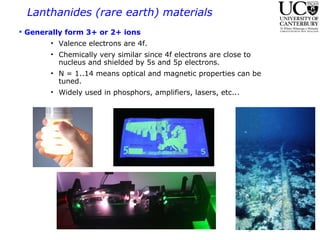
Lanthanides (rare earth) materials  Generally form 3+ or 2+ ions  Valence electrons are 4f. Chemically very similar since 4f electrons are close to nucleus and shielded by 5s and 5p electrons.  N = 1..14 means optical and magnetic properties can be tuned. Widely used in phosphors, amplifiers, lasers, etc...
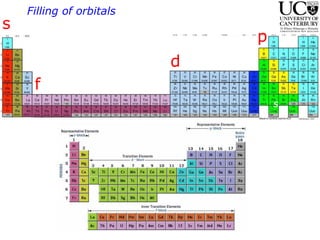
Filling of orbitals s s p d f
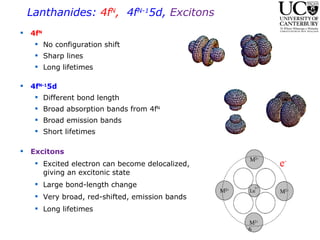
Lanthanides:  4f N ,  4f N-1 5d,  Excitons   4f N No configuration shift Sharp lines Long lifetimes 4f N-1 5d Different bond length Broad absorption bands from 4f N Broad emission bands Short lifetimes Excitons Excited electron can become delocalized, giving an excitonic state Large bond-length change Very broad, red-shifted, emission bands Long lifetimes e -
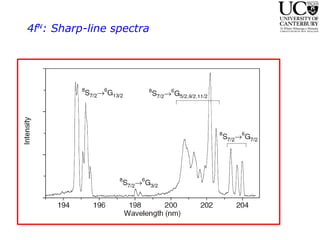
4f N :  Sharp-line spectra
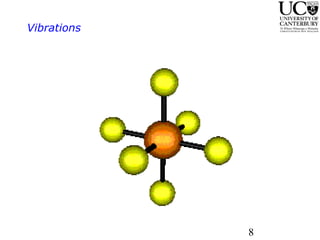
Vibrations
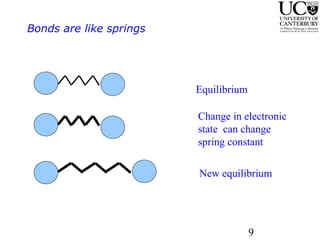
Bonds are like springs Equilibrium Change in electronic state  can change spring constant New equilibrium
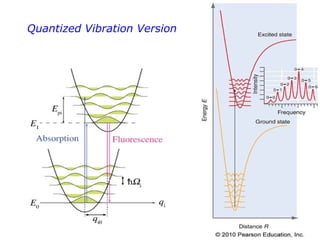
Quantized Vibration Version
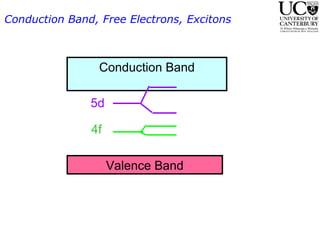
Conduction Band, Free Electrons, Excitons Conduction Band Valence Band 4f 5d
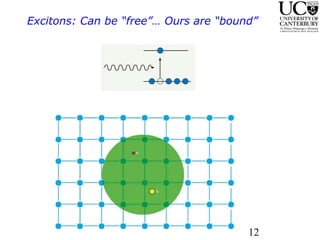
Excitons: Can be “free”… Ours are “bound”
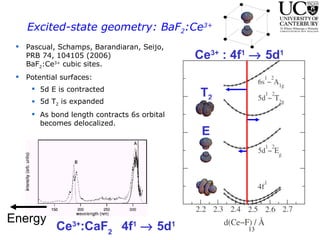
Excited-state geometry: BaF 2 :Ce 3+ Pascual, Schamps, Barandiaran, Seijo, PRB 74, 104105 (2006) BaF 2 :Ce 3+  cubic sites.  Potential surfaces:  5d E is contracted 5d T 2  is expanded As bond length contracts 6s orbital becomes delocalized. E T 2 Energy Ce 3+ :CaF 2  4f 1     5d 1 Ce 3+  : 4f 1     5d 1
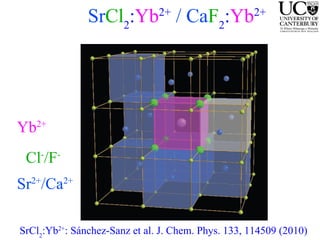
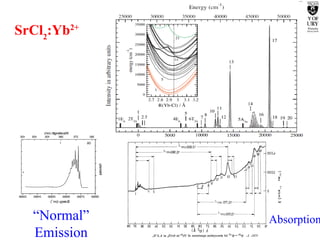
SrCl 2 :Yb 2+ : Sánchez-Sanz et al. J. Chem. Phys. 133, 114509 (2010) Yb 2+ Cl - /F - Sr 2+ /Ca 2+ Sr Cl 2 : Yb 2+  / Ca F 2 : Yb 2+
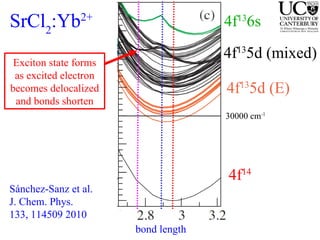
SrCl 2 :Yb 2+ 4f 14 4f 13 5d (mixed) 4f 13 6s Sánchez-Sanz et al.  J. Chem. Phys.  133, 114509 2010 bond length 4f 13 5d (E) 30000 cm -1 Exciton state forms as excited electron becomes delocalized and bonds shorten
SrCl 2 :Yb 2+ Absorption “ Normal”Emission
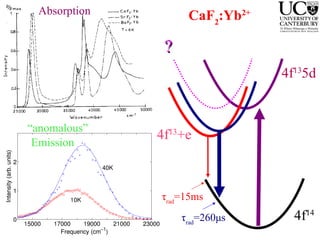
CaF 2 :Yb 2+ Absorption “ anomalous” Emission 4f 14 4f 13 5d 4f 13 +e ? τ rad =15ms τ rad =260μs
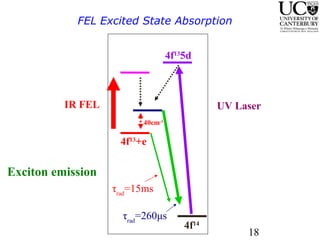
FEL Excited State Absorption UV Laser  Exciton emission IR FEL  4f 13 5d 4f 14 4f 13 +e 40cm -1 τ rad =15ms τ rad =260μs
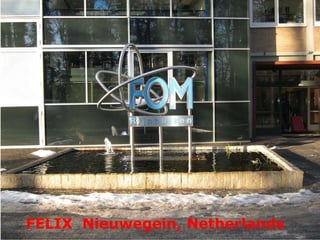
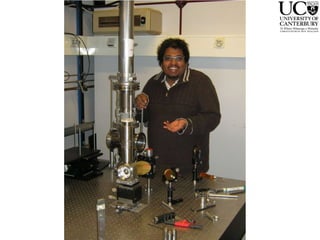
FELIX  Nieuwegein, Netherlands
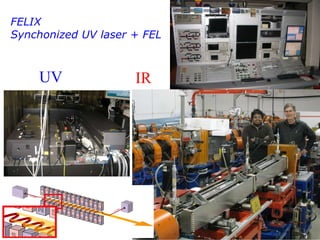
FELIX Synchonized UV laser + FEL UV IR
 
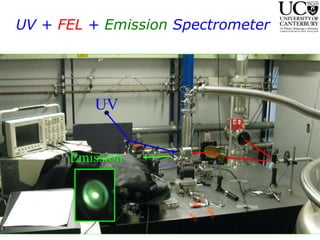
UV +  FEL  +  Emission  Spectrometer UV IR Emission
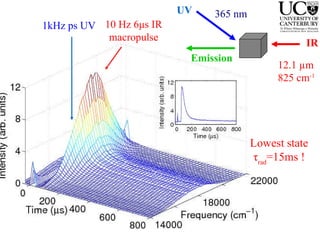
1kHz ps UV 10 Hz 6 μ s IR macropulse UV IR Emission 365 nm 12.1  µ m 825 cm -1 Lowest state τ rad =15ms !
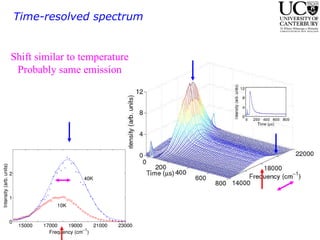
10K Time-resolved spectrum  Shift similar to temperature Probably same emission
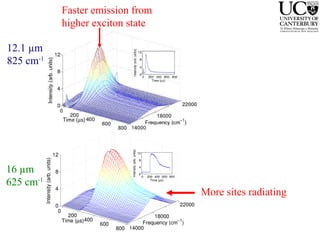
12.1  µ m 825 cm -1 16  µ m 625 cm -1 Faster emission from higher exciton state More sites radiating
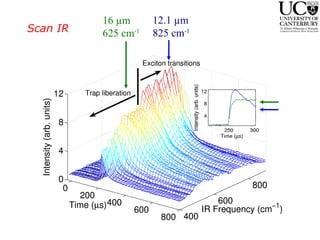
Scan IR  12.1  µ m 825 cm -1 16  µ m 625 cm -1
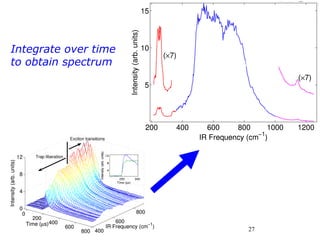
Integrate over time to obtain spectrum
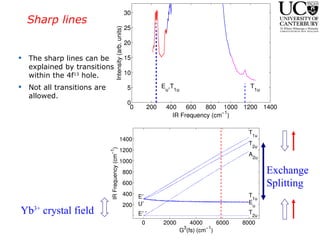
Sharp lines The sharp lines can be explained by transitions within the 4f 13  hole. Not all transitions are allowed. Yb 3+  crystal field Exchange Splitting
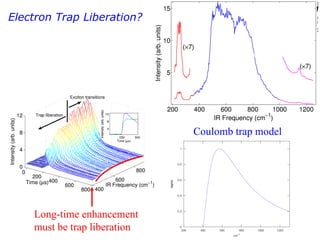
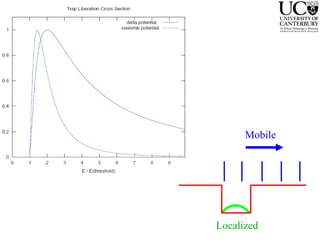
Electron Trap Liberation?  Long-time enhancement must be trap liberation  Coulomb trap model
Localized Mobile
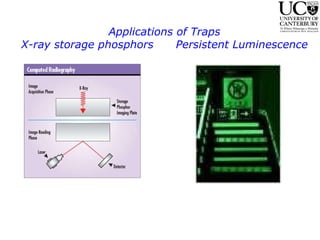
Applications of Traps X-ray storage phosphors  Persistent Luminescence
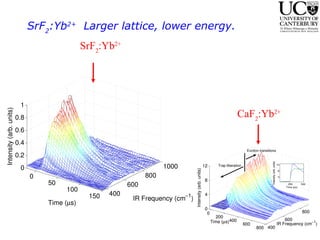
SrF 2 :Yb 2+   Larger lattice, lower energy.  SrF 2 :Yb 2+ CaF 2 :Yb 2+
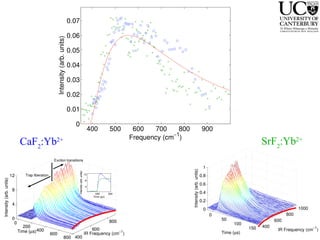
CaF 2 :Yb 2+ SrF 2 :Yb 2+
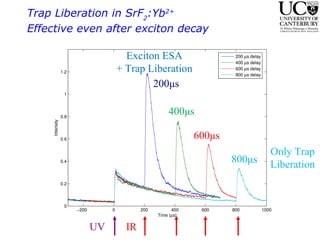
Trap Liberation in SrF 2 :Yb 2+ Effective even after exciton decay UV IR Exciton ESA + Trap Liberation Only Trap Liberation 200μs 400μs 600μs 800μs
Conclusion  FEL experiments give us a unique tool to investigate: Excitonic states Trap states More experiments and analysis FEL Synchrotron Local laser experiments Detailed modeling

15.30 o11 m reid

  • 1.
    Excitons and trapsin rare-earth materials probed by a free-electron laser Michael F Reid Jon Wells, Pubudu Senanayake Alex Salkeld, Roger Reeves Giel Berden, FELIX Andries Meijerink, Utrecht Chang-Kui Duan, USTC, China NZIP, Wellington, October 18, 2011
  • 2.
    Outline 4f N, 4f N-1 5d, and exciton states FELIX FEL Excited state absorption with UV + IR Yb 2+ in CaF 2 , SrF 2 Marsden Fund
  • 3.
    Lanthanides (rare earth)materials Generally form 3+ or 2+ ions Valence electrons are 4f. Chemically very similar since 4f electrons are close to nucleus and shielded by 5s and 5p electrons. N = 1..14 means optical and magnetic properties can be tuned. Widely used in phosphors, amplifiers, lasers, etc...
  • 5.
  • 6.
    Lanthanides: 4fN , 4f N-1 5d, Excitons 4f N No configuration shift Sharp lines Long lifetimes 4f N-1 5d Different bond length Broad absorption bands from 4f N Broad emission bands Short lifetimes Excitons Excited electron can become delocalized, giving an excitonic state Large bond-length change Very broad, red-shifted, emission bands Long lifetimes e -
  • 7.
    4f N : Sharp-line spectra
  • 8.
  • 9.
    Bonds are likesprings Equilibrium Change in electronic state can change spring constant New equilibrium
  • 10.
  • 11.
    Conduction Band, FreeElectrons, Excitons Conduction Band Valence Band 4f 5d
  • 12.
    Excitons: Can be“free”… Ours are “bound”
  • 13.
    Excited-state geometry: BaF2 :Ce 3+ Pascual, Schamps, Barandiaran, Seijo, PRB 74, 104105 (2006) BaF 2 :Ce 3+ cubic sites. Potential surfaces: 5d E is contracted 5d T 2 is expanded As bond length contracts 6s orbital becomes delocalized. E T 2 Energy Ce 3+ :CaF 2 4f 1  5d 1 Ce 3+ : 4f 1  5d 1
  • 14.
    SrCl 2 :Yb2+ : Sánchez-Sanz et al. J. Chem. Phys. 133, 114509 (2010) Yb 2+ Cl - /F - Sr 2+ /Ca 2+ Sr Cl 2 : Yb 2+ / Ca F 2 : Yb 2+
  • 15.
    SrCl 2 :Yb2+ 4f 14 4f 13 5d (mixed) 4f 13 6s Sánchez-Sanz et al. J. Chem. Phys. 133, 114509 2010 bond length 4f 13 5d (E) 30000 cm -1 Exciton state forms as excited electron becomes delocalized and bonds shorten
  • 16.
    SrCl 2 :Yb2+ Absorption “ Normal”Emission
  • 17.
    CaF 2 :Yb2+ Absorption “ anomalous” Emission 4f 14 4f 13 5d 4f 13 +e ? τ rad =15ms τ rad =260μs
  • 18.
    FEL Excited StateAbsorption UV Laser Exciton emission IR FEL 4f 13 5d 4f 14 4f 13 +e 40cm -1 τ rad =15ms τ rad =260μs
  • 19.
    FELIX Nieuwegein,Netherlands
  • 20.
    FELIX Synchonized UVlaser + FEL UV IR
  • 21.
  • 22.
    UV + FEL + Emission Spectrometer UV IR Emission
  • 23.
    1kHz ps UV10 Hz 6 μ s IR macropulse UV IR Emission 365 nm 12.1 µ m 825 cm -1 Lowest state τ rad =15ms !
  • 24.
    10K Time-resolved spectrum Shift similar to temperature Probably same emission
  • 25.
    12.1 µm 825 cm -1 16 µ m 625 cm -1 Faster emission from higher exciton state More sites radiating
  • 26.
    Scan IR 12.1 µ m 825 cm -1 16 µ m 625 cm -1
  • 27.
    Integrate over timeto obtain spectrum
  • 28.
    Sharp lines Thesharp lines can be explained by transitions within the 4f 13 hole. Not all transitions are allowed. Yb 3+ crystal field Exchange Splitting
  • 29.
    Electron Trap Liberation? Long-time enhancement must be trap liberation Coulomb trap model
  • 30.
  • 31.
    Applications of TrapsX-ray storage phosphors Persistent Luminescence
  • 32.
    SrF 2 :Yb2+ Larger lattice, lower energy. SrF 2 :Yb 2+ CaF 2 :Yb 2+
  • 33.
    CaF 2 :Yb2+ SrF 2 :Yb 2+
  • 34.
    Trap Liberation inSrF 2 :Yb 2+ Effective even after exciton decay UV IR Exciton ESA + Trap Liberation Only Trap Liberation 200μs 400μs 600μs 800μs
  • 35.
    Conclusion FELexperiments give us a unique tool to investigate: Excitonic states Trap states More experiments and analysis FEL Synchrotron Local laser experiments Detailed modeling

Editor's Notes

  • #14 E state has shorter bond length than ground state. T2 longer. Can tell from pressure experiments, etc.
  • #21 UV laser at left goes through wall. Felix is synchronized with the UV laser UV 1kHz, Felix 10Hz macropulses.
  • #28 With ratio we get spectrum. High-energy from january with caf2 windows. I cut it off at 10microns, where it starts to dip. Medium with PbS windows Low with polypropolene windows and different FEL. Medium energy range is probably saturated.
  • #29 Cubic, so MD allowed (or vibronic). The calculation is oscillator strength. The normalization of the excitation spectrum has not been worked out yet.