Indicators
CONTENTS
• Acid-base indicators - theory
• Titration curves - introduction
• Titration curve; strong acid - strong base
• Titration curve; strong acid - weak base
• Titration curve; weak acid - strong base
• Titration curve; weak acid - weak base
• Titration curve; acid - carbonate
• Titration curve; phosphoric acid
• Check list
Acid-base indicators
General

Many indicators are weak acids and partially dissociate in aqueous solution
HIn(aq)

H+(aq) + In¯(aq)

The un-ionised form (HIn) is a different colour to the anionic form (In¯).
Acid-base indicators
General

Many indicators are weak acids and partially dissociate in aqueous solution
HIn(aq)

H+(aq) + In¯(aq)

The un-ionised form (HIn) is a different colour to the anionic form (In¯).
Apply Le Chatelier’s Principle to predict any colour change
In acid

- increase of [H+]
- equilibrium moves to the left to give red undissociated form

In alkali - increase of [OH¯]
- OH¯ ions remove H+ ions to form water;

H+(aq) + OH¯(aq)

- equilibrium will move to the right to produce a blue colour

H2O(l)
Acid-base indicators
General

Many indicators are weak acids and partially dissociate in aqueous solution
HIn(aq)

H+(aq) + In¯(aq)

The un-ionised form (HIn) is a different colour to the anionic form (In¯).
Apply Le Chatelier’s Principle to predict any colour change
In acid

- increase of [H+]
- equilibrium moves to the left to give red undissociated form

In alkali - increase of [OH¯]
- OH¯ ions remove H+ ions to form water;

H+(aq) + OH¯(aq)

- equilibrium will move to the right to produce a blue colour

Summary

In acidic solution

HIn(aq)

H+(aq) + In¯(aq)
In alkaline solution

H2O(l)
Acid-base indicators
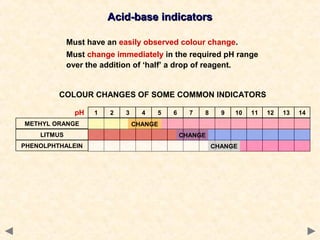
Must have an easily observed colour change.
Must change immediately in the required pH range
over the addition of ‘half’ a drop of reagent.

COLOUR CHANGES OF SOME COMMON INDICATORS
pH
METHYL ORANGE
LITMUS
PHENOLPHTHALEIN

1

2

3

4

5

6

7

8

9

10

CHANGE
CHANGE
CHANGE

11

12

13

14
Acid-base indicators
Must have an easily observed colour change.
Must change immediately in the required pH range
over the addition of ‘half’ a drop of reagent.

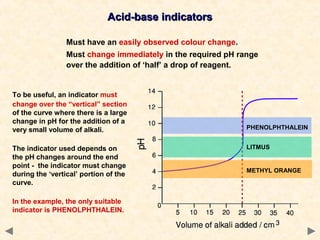
To be useful, an indicator must
change over the “vertical” section
of the curve where there is a large
change in pH for the addition of a
very small volume of alkali.
The indicator used depends on
the pH changes around the end
point - the indicator must change
during the ‘vertical’ portion of the
curve.
In the example, the only suitable
indicator is PHENOLPHTHALEIN.

PHENOLPHTHALEIN
LITMUS

METHYL ORANGE
pH curves
Types

There are four types of acid-base titration; each has a characteristic curve.

strong acid (HCl) v. strong base (NaOH)
weak acid (CH3COOH) v. strong alkali (NaOH)
strong acid (HCl) v. weak base (NH3)
weak acid (CH3COOH) v. weak base (NH3)

In the following examples, alkali (0.1M) is added to 25cm3 of acid (0.1M)
End points need not be “neutral‘ due to the phenomenon of salt hydrolysis
strong acid (HCl) v. strong base (NaOH)

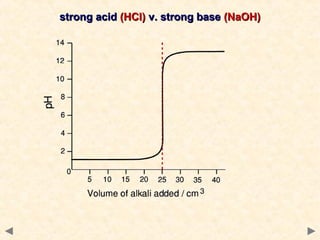
pH 1 at the start
due to 0.1M HCl
(strong
monoprotic acid)
strong acid (HCl) v. strong base (NaOH)

Very little pH change
during the initial 20cm3
pH 1 at the start
due to 0.1M HCl
(strong
monoprotic acid)
strong acid (HCl) v. strong base (NaOH)

Very sharp change in pH
over the addition of less
than half a drop of
NaOH

Very little pH change
during the initial 20cm3
pH 1 at the start
due to 0.1M HCl
(strong
monoprotic acid)
strong acid (HCl) v. strong base (NaOH)
Curve levels off at pH 13
due to excess 0.1M NaOH
(a strong alkali)

Very sharp change in pH
over the addition of less
than half a drop of
NaOH

Very little pH change
during the initial 20cm3
pH 1 at the start
due to 0.1M HCl
(strong
monoprotic acid)
strong acid (HCl) v. strong base (NaOH)

PHENOLPHTHALEIN

LITMUS

METHYL ORANGE

Any of the indicators listed will be suitable - they all change in the ‘vertical’ portion
strong acid (HCl) v. weak base (NH3)

Curve levels off at pH 10
due to excess 0.1M NH3
(a weak alkali)

Sharp change in pH over
the addition of less than
half a drop of NH3

pH 1 at the start
due to 0.1M HCl

Very little pH change
during the initial 20cm3
strong acid (HCl) v. weak base (NH3)

PHENOLPHTHALEIN

LITMUS

METHYL ORANGE

Only methyl orange is suitable - it is the only one to change in the ‘vertical’ portion
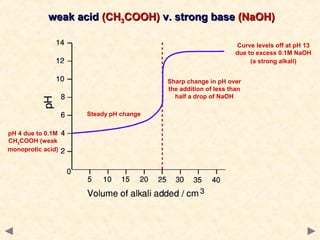
weak acid (CH3COOH) v. strong base (NaOH)
Curve levels off at pH 13
due to excess 0.1M NaOH
(a strong alkali)
Sharp change in pH over
the addition of less than
half a drop of NaOH
Steady pH change
pH 4 due to 0.1M
CH3COOH (weak
monoprotic acid)
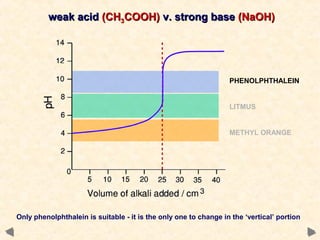
weak acid (CH3COOH) v. strong base (NaOH)

PHENOLPHTHALEIN

LITMUS

METHYL ORANGE

Only phenolphthalein is suitable - it is the only one to change in the ‘vertical’ portion
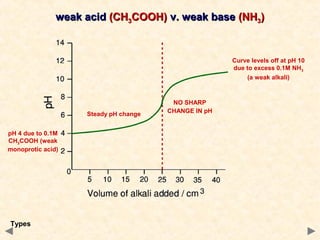
weak acid (CH3COOH) v. weak base (NH3)

Curve levels off at pH 10
due to excess 0.1M NH3
(a weak alkali)

Steady pH change
pH 4 due to 0.1M
CH3COOH (weak
monoprotic acid)

Types

NO SHARP
CHANGE IN pH
weak acid (CH3COOH) v. weak base (NH3)

PHENOLPHTHALEIN

LITMUS

METHYL ORANGE
NOTHING SUITABLE

There is no suitable indicator- none change in the ‘vertical’ portion.
The end point can be detected by plotting a curve using a pH meter.
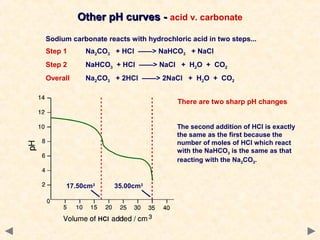
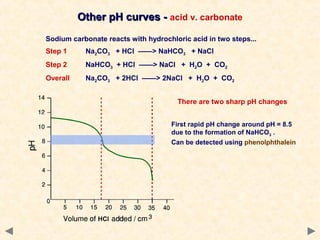
Other pH curves - acid v. carbonate
Sodium carbonate reacts with hydrochloric acid in two steps...
Step 1

Na2CO3 + HCl ——> NaHCO3 + NaCl

Step 2

NaHCO3 + HCl ——> NaCl + H2O + CO2

Overall

Na2CO3 + 2HCl ——> 2NaCl + H2O + CO2
Other pH curves - acid v. carbonate
Sodium carbonate reacts with hydrochloric acid in two steps...
Step 1

Na2CO3 + HCl ——> NaHCO3 + NaCl

Step 2

NaHCO3 + HCl ——> NaCl + H2O + CO2

Overall

Na2CO3 + 2HCl ——> 2NaCl + H2O + CO2
There are two sharp pH changes
The second addition of HCl is exactly
the same as the first because the
number of moles of HCl which react
with the NaHCO3 is the same as that
reacting with the Na2CO3.

17.50cm3

35.00cm3
Other pH curves - acid v. carbonate
Sodium carbonate reacts with hydrochloric acid in two steps...
Step 1

Na2CO3 + HCl ——> NaHCO3 + NaCl

Step 2

NaHCO3 + HCl ——> NaCl + H2O + CO2

Overall

Na2CO3 + 2HCl ——> 2NaCl + H2O + CO2
There are two sharp pH changes
First rapid pH change around pH = 8.5
due to the formation of NaHCO3 .
Can be detected using phenolphthalein
Other pH curves - acid v. carbonate
Sodium carbonate reacts with hydrochloric acid in two steps...
Step 1

Na2CO3 + HCl ——> NaHCO3 + NaCl

Step 2

NaHCO3 + HCl ——> NaCl + H2O + CO2

Overall

Na2CO3 + 2HCl ——> 2NaCl + H2O + CO2
There are two sharp pH changes
First rapid pH change around pH = 8.5
due to the formation of NaHCO3 .
Can be detected using phenolphthalein

Second rapid pH change around pH = 4
due to the formation of acidic CO2 .
Can be detected using methyl orange.
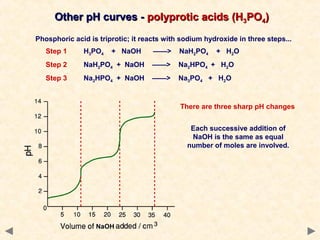
Other pH curves - polyprotic acids (H3PO4)
Phosphoric acid is triprotic; it reacts with sodium hydroxide in three steps...
Step 1

H3PO4

Step 2
Step 3

+ NaOH

——>

NaH2PO4

+ H2O

NaH2PO4 + NaOH

——>

Na2HPO4 + H2O

Na2HPO4 + NaOH

——>

Na3PO4 + H2O
Other pH curves - polyprotic acids (H3PO4)
Phosphoric acid is triprotic; it reacts with sodium hydroxide in three steps...
Step 1

H3PO4

Step 2
Step 3

+ NaOH

——>

NaH2PO4

+ H2O

NaH2PO4 + NaOH

——>

Na2HPO4 + H2O

Na2HPO4 + NaOH

——>

Na3PO4 + H2O

There are three sharp pH changes
Each successive addition of
NaOH is the same as equal
number of moles are involved.
Other pH curves - polyprotic acids (H3PO4)
Phosphoric acid is triprotic; it reacts with sodium hydroxide in three steps...
Step 1

H3PO4

Step 2
Step 3

+ NaOH

——>

NaH2PO4

+ H2O

NaH2PO4 + NaOH

——>

Na2HPO4 + H2O

Na2HPO4 + NaOH

——>

Na3PO4 + H2O

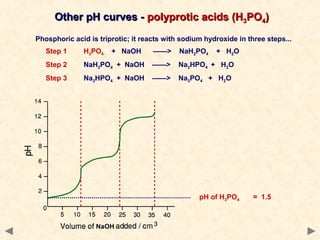
pH of H3PO4

= 1.5
Other pH curves - polyprotic acids (H3PO4)
Phosphoric acid is triprotic; it reacts with sodium hydroxide in three steps...
Step 1

H3PO4

Step 2
Step 3

+ NaOH

——>

NaH2PO4

+ H2O

NaH2PO4 + NaOH

——>

Na2HPO4 + H2O

Na2HPO4 + NaOH

——>

Na3PO4 + H2O

pH of NaH2PO4 = 4.4
pH of H3PO4

= 1.5
Other pH curves - polyprotic acids (H3PO4)
Phosphoric acid is triprotic; it reacts with sodium hydroxide in three steps...
Step 1

H3PO4

Step 2
Step 3

+ NaOH

——>

NaH2PO4

+ H2O

NaH2PO4 + NaOH

——>

Na2HPO4 + H2O

Na2HPO4 + NaOH

——>

Na3PO4 + H2O

pH of Na2HPO4 = 9.6

pH of NaH2PO4 = 4.4
pH of H3PO4

= 1.5
Other pH curves - polyprotic acids (H3PO4)
Phosphoric acid is triprotic; it reacts with sodium hydroxide in three steps...
Step 1

H3PO4

Step 2
Step 3

+ NaOH

——>

NaH2PO4

+ H2O

NaH2PO4 + NaOH

——>

Na2HPO4 + H2O

Na2HPO4 + NaOH

——>

Na3PO4 + H2O

pH of Na3PO4

= 12

pH of Na2HPO4 = 9.6

pH of NaH2PO4 = 4.4
pH of H3PO4

= 1.5
REVISION CHECK

What should you be able to do?
Recall the definition of a weak acid
Understand why indicators can be made from weak acids
Understand why indicators must change colour quickly over a small pH range
Recall and explain the shape of titration curves involving acids and bases
Explain why particular indicators are used for certain titrations
Explain the shape of the titration curve for phosphoric acid
Explain the shape of the titration curve for acid -sodium carbonate reactions

CAN YOU DO ALL OF THESE?

YES

NO
You need to go over the
relevant topic(s) again
Click on the button to
return to the menu
WELL DONE!
Try some past paper questions
INDICATORS
& pH CURVES
THE END

© 2004 JONATHAN HOPTON & KNOCKHARDY PUBLISHING

Indicators

  • 1.
    Indicators CONTENTS • Acid-base indicators- theory • Titration curves - introduction • Titration curve; strong acid - strong base • Titration curve; strong acid - weak base • Titration curve; weak acid - strong base • Titration curve; weak acid - weak base • Titration curve; acid - carbonate • Titration curve; phosphoric acid • Check list
  • 2.
    Acid-base indicators General Many indicatorsare weak acids and partially dissociate in aqueous solution HIn(aq) H+(aq) + In¯(aq) The un-ionised form (HIn) is a different colour to the anionic form (In¯).
  • 3.
    Acid-base indicators General Many indicatorsare weak acids and partially dissociate in aqueous solution HIn(aq) H+(aq) + In¯(aq) The un-ionised form (HIn) is a different colour to the anionic form (In¯). Apply Le Chatelier’s Principle to predict any colour change In acid - increase of [H+] - equilibrium moves to the left to give red undissociated form In alkali - increase of [OH¯] - OH¯ ions remove H+ ions to form water; H+(aq) + OH¯(aq) - equilibrium will move to the right to produce a blue colour H2O(l)
  • 4.
    Acid-base indicators General Many indicatorsare weak acids and partially dissociate in aqueous solution HIn(aq) H+(aq) + In¯(aq) The un-ionised form (HIn) is a different colour to the anionic form (In¯). Apply Le Chatelier’s Principle to predict any colour change In acid - increase of [H+] - equilibrium moves to the left to give red undissociated form In alkali - increase of [OH¯] - OH¯ ions remove H+ ions to form water; H+(aq) + OH¯(aq) - equilibrium will move to the right to produce a blue colour Summary In acidic solution HIn(aq) H+(aq) + In¯(aq) In alkaline solution H2O(l)
  • 5.
    Acid-base indicators Must havean easily observed colour change. Must change immediately in the required pH range over the addition of ‘half’ a drop of reagent. COLOUR CHANGES OF SOME COMMON INDICATORS pH METHYL ORANGE LITMUS PHENOLPHTHALEIN 1 2 3 4 5 6 7 8 9 10 CHANGE CHANGE CHANGE 11 12 13 14
  • 6.
    Acid-base indicators Must havean easily observed colour change. Must change immediately in the required pH range over the addition of ‘half’ a drop of reagent. To be useful, an indicator must change over the “vertical” section of the curve where there is a large change in pH for the addition of a very small volume of alkali. The indicator used depends on the pH changes around the end point - the indicator must change during the ‘vertical’ portion of the curve. In the example, the only suitable indicator is PHENOLPHTHALEIN. PHENOLPHTHALEIN LITMUS METHYL ORANGE
  • 7.
    pH curves Types There arefour types of acid-base titration; each has a characteristic curve. strong acid (HCl) v. strong base (NaOH) weak acid (CH3COOH) v. strong alkali (NaOH) strong acid (HCl) v. weak base (NH3) weak acid (CH3COOH) v. weak base (NH3) In the following examples, alkali (0.1M) is added to 25cm3 of acid (0.1M) End points need not be “neutral‘ due to the phenomenon of salt hydrolysis
  • 8.
    strong acid (HCl)v. strong base (NaOH)
  • 9.
    strong acid (HCl)v. strong base (NaOH) pH 1 at the start due to 0.1M HCl (strong monoprotic acid)
  • 10.
    strong acid (HCl)v. strong base (NaOH) Very little pH change during the initial 20cm3 pH 1 at the start due to 0.1M HCl (strong monoprotic acid)
  • 11.
    strong acid (HCl)v. strong base (NaOH) Very sharp change in pH over the addition of less than half a drop of NaOH Very little pH change during the initial 20cm3 pH 1 at the start due to 0.1M HCl (strong monoprotic acid)
  • 12.
    strong acid (HCl)v. strong base (NaOH) Curve levels off at pH 13 due to excess 0.1M NaOH (a strong alkali) Very sharp change in pH over the addition of less than half a drop of NaOH Very little pH change during the initial 20cm3 pH 1 at the start due to 0.1M HCl (strong monoprotic acid)
  • 13.
    strong acid (HCl)v. strong base (NaOH) PHENOLPHTHALEIN LITMUS METHYL ORANGE Any of the indicators listed will be suitable - they all change in the ‘vertical’ portion
  • 14.
    strong acid (HCl)v. weak base (NH3) Curve levels off at pH 10 due to excess 0.1M NH3 (a weak alkali) Sharp change in pH over the addition of less than half a drop of NH3 pH 1 at the start due to 0.1M HCl Very little pH change during the initial 20cm3
  • 15.
    strong acid (HCl)v. weak base (NH3) PHENOLPHTHALEIN LITMUS METHYL ORANGE Only methyl orange is suitable - it is the only one to change in the ‘vertical’ portion
  • 16.
    weak acid (CH3COOH)v. strong base (NaOH) Curve levels off at pH 13 due to excess 0.1M NaOH (a strong alkali) Sharp change in pH over the addition of less than half a drop of NaOH Steady pH change pH 4 due to 0.1M CH3COOH (weak monoprotic acid)
  • 17.
    weak acid (CH3COOH)v. strong base (NaOH) PHENOLPHTHALEIN LITMUS METHYL ORANGE Only phenolphthalein is suitable - it is the only one to change in the ‘vertical’ portion
  • 18.
    weak acid (CH3COOH)v. weak base (NH3) Curve levels off at pH 10 due to excess 0.1M NH3 (a weak alkali) Steady pH change pH 4 due to 0.1M CH3COOH (weak monoprotic acid) Types NO SHARP CHANGE IN pH
  • 19.
    weak acid (CH3COOH)v. weak base (NH3) PHENOLPHTHALEIN LITMUS METHYL ORANGE NOTHING SUITABLE There is no suitable indicator- none change in the ‘vertical’ portion. The end point can be detected by plotting a curve using a pH meter.
  • 20.
    Other pH curves- acid v. carbonate Sodium carbonate reacts with hydrochloric acid in two steps... Step 1 Na2CO3 + HCl ——> NaHCO3 + NaCl Step 2 NaHCO3 + HCl ——> NaCl + H2O + CO2 Overall Na2CO3 + 2HCl ——> 2NaCl + H2O + CO2
  • 21.
    Other pH curves- acid v. carbonate Sodium carbonate reacts with hydrochloric acid in two steps... Step 1 Na2CO3 + HCl ——> NaHCO3 + NaCl Step 2 NaHCO3 + HCl ——> NaCl + H2O + CO2 Overall Na2CO3 + 2HCl ——> 2NaCl + H2O + CO2 There are two sharp pH changes The second addition of HCl is exactly the same as the first because the number of moles of HCl which react with the NaHCO3 is the same as that reacting with the Na2CO3. 17.50cm3 35.00cm3
  • 22.
    Other pH curves- acid v. carbonate Sodium carbonate reacts with hydrochloric acid in two steps... Step 1 Na2CO3 + HCl ——> NaHCO3 + NaCl Step 2 NaHCO3 + HCl ——> NaCl + H2O + CO2 Overall Na2CO3 + 2HCl ——> 2NaCl + H2O + CO2 There are two sharp pH changes First rapid pH change around pH = 8.5 due to the formation of NaHCO3 . Can be detected using phenolphthalein
  • 23.
    Other pH curves- acid v. carbonate Sodium carbonate reacts with hydrochloric acid in two steps... Step 1 Na2CO3 + HCl ——> NaHCO3 + NaCl Step 2 NaHCO3 + HCl ——> NaCl + H2O + CO2 Overall Na2CO3 + 2HCl ——> 2NaCl + H2O + CO2 There are two sharp pH changes First rapid pH change around pH = 8.5 due to the formation of NaHCO3 . Can be detected using phenolphthalein Second rapid pH change around pH = 4 due to the formation of acidic CO2 . Can be detected using methyl orange.
  • 24.
    Other pH curves- polyprotic acids (H3PO4) Phosphoric acid is triprotic; it reacts with sodium hydroxide in three steps... Step 1 H3PO4 Step 2 Step 3 + NaOH ——> NaH2PO4 + H2O NaH2PO4 + NaOH ——> Na2HPO4 + H2O Na2HPO4 + NaOH ——> Na3PO4 + H2O
  • 25.
    Other pH curves- polyprotic acids (H3PO4) Phosphoric acid is triprotic; it reacts with sodium hydroxide in three steps... Step 1 H3PO4 Step 2 Step 3 + NaOH ——> NaH2PO4 + H2O NaH2PO4 + NaOH ——> Na2HPO4 + H2O Na2HPO4 + NaOH ——> Na3PO4 + H2O There are three sharp pH changes Each successive addition of NaOH is the same as equal number of moles are involved.
  • 26.
    Other pH curves- polyprotic acids (H3PO4) Phosphoric acid is triprotic; it reacts with sodium hydroxide in three steps... Step 1 H3PO4 Step 2 Step 3 + NaOH ——> NaH2PO4 + H2O NaH2PO4 + NaOH ——> Na2HPO4 + H2O Na2HPO4 + NaOH ——> Na3PO4 + H2O pH of H3PO4 = 1.5
  • 27.
    Other pH curves- polyprotic acids (H3PO4) Phosphoric acid is triprotic; it reacts with sodium hydroxide in three steps... Step 1 H3PO4 Step 2 Step 3 + NaOH ——> NaH2PO4 + H2O NaH2PO4 + NaOH ——> Na2HPO4 + H2O Na2HPO4 + NaOH ——> Na3PO4 + H2O pH of NaH2PO4 = 4.4 pH of H3PO4 = 1.5
  • 28.
    Other pH curves- polyprotic acids (H3PO4) Phosphoric acid is triprotic; it reacts with sodium hydroxide in three steps... Step 1 H3PO4 Step 2 Step 3 + NaOH ——> NaH2PO4 + H2O NaH2PO4 + NaOH ——> Na2HPO4 + H2O Na2HPO4 + NaOH ——> Na3PO4 + H2O pH of Na2HPO4 = 9.6 pH of NaH2PO4 = 4.4 pH of H3PO4 = 1.5
  • 29.
    Other pH curves- polyprotic acids (H3PO4) Phosphoric acid is triprotic; it reacts with sodium hydroxide in three steps... Step 1 H3PO4 Step 2 Step 3 + NaOH ——> NaH2PO4 + H2O NaH2PO4 + NaOH ——> Na2HPO4 + H2O Na2HPO4 + NaOH ——> Na3PO4 + H2O pH of Na3PO4 = 12 pH of Na2HPO4 = 9.6 pH of NaH2PO4 = 4.4 pH of H3PO4 = 1.5
  • 30.
    REVISION CHECK What shouldyou be able to do? Recall the definition of a weak acid Understand why indicators can be made from weak acids Understand why indicators must change colour quickly over a small pH range Recall and explain the shape of titration curves involving acids and bases Explain why particular indicators are used for certain titrations Explain the shape of the titration curve for phosphoric acid Explain the shape of the titration curve for acid -sodium carbonate reactions CAN YOU DO ALL OF THESE? YES NO
  • 31.
    You need togo over the relevant topic(s) again Click on the button to return to the menu
  • 32.
    WELL DONE! Try somepast paper questions
  • 33.
    INDICATORS & pH CURVES THEEND © 2004 JONATHAN HOPTON & KNOCKHARDY PUBLISHING