Starter
In pairs :1. Build; water, carbon dioxide, Ammonia
2. Draw these molecules in 3D, include bon
dangles and lone pairs.
Must : Describe Van der Waals,
Dipole, and Hydrogen Bonding.
Should : Relate intermolecular force
to physical property.
Could : Imagine 3D shapes of
molecules.
What are Intermolecular Forces ?
• Attractive forces between neighbouring
molecules.....
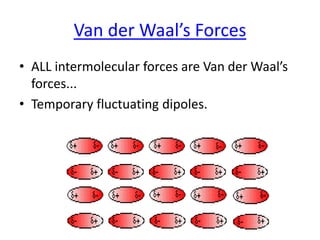
Van der Waal’s Forces
• ALL intermolecular forces are Van der Waal’s
forces...
• Temporary fluctuating dipoles.
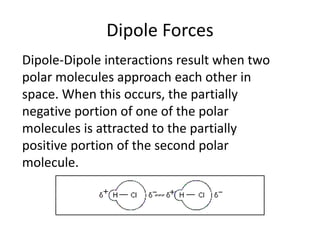
Dipole Forces
Dipole-Dipole interactions result when two
polar molecules approach each other in
space. When this occurs, the partially
negative portion of one of the polar
molecules is attracted to the partially
positive portion of the second polar
molecule.
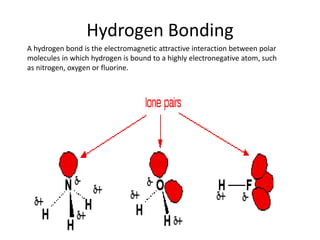
Hydrogen Bonding
A hydrogen bond is the electromagnetic attractive interaction between polar
molecules in which hydrogen is bound to a highly electronegative atom, such
as nitrogen, oxygen or fluorine.
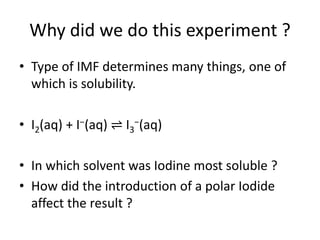
Why did we do this experiment ?
• Type of IMF determines many things, one of
which is solubility.
• I2(aq) + I−(aq) ⇌ I3−(aq)
• In which solvent was Iodine most soluble ?
• How did the introduction of a polar Iodide
affect the result ?
5 Question Quiz
• Which would have the higher boiling point ? –
Chlorine, or Hydrogen Chloride – Why ?
• Why is water a liquid ?
• Why won’t Sodium Chloride dissolve in
Decane ?
• What is another name for Van der Waals
forces ?
• What is Darth Vader’s dad called ?
Homework
• Use Mr Midgley site here.
• Chem factsheet on bonding issued yesterday.

Imf intro

  • 1.
    Starter In pairs :1.Build; water, carbon dioxide, Ammonia 2. Draw these molecules in 3D, include bon dangles and lone pairs.
  • 2.
    Must : DescribeVan der Waals, Dipole, and Hydrogen Bonding. Should : Relate intermolecular force to physical property. Could : Imagine 3D shapes of molecules.
  • 3.
    What are IntermolecularForces ? • Attractive forces between neighbouring molecules.....
  • 4.
    Van der Waal’sForces • ALL intermolecular forces are Van der Waal’s forces... • Temporary fluctuating dipoles.
  • 5.
    Dipole Forces Dipole-Dipole interactionsresult when two polar molecules approach each other in space. When this occurs, the partially negative portion of one of the polar molecules is attracted to the partially positive portion of the second polar molecule.
  • 6.
    Hydrogen Bonding A hydrogenbond is the electromagnetic attractive interaction between polar molecules in which hydrogen is bound to a highly electronegative atom, such as nitrogen, oxygen or fluorine.
  • 7.
    Why did wedo this experiment ? • Type of IMF determines many things, one of which is solubility. • I2(aq) + I−(aq) ⇌ I3−(aq) • In which solvent was Iodine most soluble ? • How did the introduction of a polar Iodide affect the result ?
  • 8.
    5 Question Quiz •Which would have the higher boiling point ? – Chlorine, or Hydrogen Chloride – Why ? • Why is water a liquid ? • Why won’t Sodium Chloride dissolve in Decane ? • What is another name for Van der Waals forces ? • What is Darth Vader’s dad called ?
  • 9.
    Homework • Use MrMidgley site here. • Chem factsheet on bonding issued yesterday.