 Compare

the ionic radii of Li+ and Be2+.
Include their electronic configurations.
 Why does Na have a higher melting point
than Cs ?
 Why don’t ionic compounds have bond
angles?
 S&C

: Why do the noble gases not have an
atomic radius ?
 Must

: Describe PT in terms of proton
number, periods, groups, and chemical
property.
 Should : Comment on similar chemical
property of isoelectronic species.
 Could : Explain trend in ionisation energies
using knowledge of enc and shells.
 Periodicity



is a plate spinning activity :-

Plate 1 is effective nuclear charge
Plate 2 is number of shells.

 Which

one wins ?

 Complete

booklet.

and highlight pages 2 and 3 in your
 Activity
 On

your blank Periodic Tables draw trend
lines for :




Melting point – Groups 1,2,7
Ionisation energy
Atomic Radius
Electronic configurations of the TMs
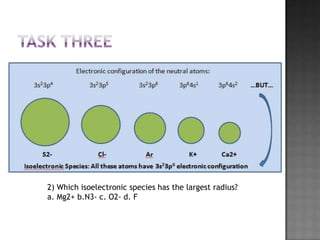
2) Which isoelectronic species has the largest radius?
a. Mg2+ b.N3- c. O2- d. F
 Pages

4,5,6
 Must

: Describe PT in terms of proton
number, periods, groups, and chemical
property.
 Should : Comment on similar chemical
property of isoelectronic species.
 Could : Explain trend in ionisation energies
using knowledge of enc and shells.

Periodicity

  • 1.
     Compare the ionicradii of Li+ and Be2+. Include their electronic configurations.  Why does Na have a higher melting point than Cs ?  Why don’t ionic compounds have bond angles?  S&C : Why do the noble gases not have an atomic radius ?
  • 2.
     Must : DescribePT in terms of proton number, periods, groups, and chemical property.  Should : Comment on similar chemical property of isoelectronic species.  Could : Explain trend in ionisation energies using knowledge of enc and shells.
  • 3.
     Periodicity   is aplate spinning activity :- Plate 1 is effective nuclear charge Plate 2 is number of shells.  Which one wins ?  Complete booklet. and highlight pages 2 and 3 in your
  • 4.
     Activity  On yourblank Periodic Tables draw trend lines for :    Melting point – Groups 1,2,7 Ionisation energy Atomic Radius Electronic configurations of the TMs
  • 5.
    2) Which isoelectronicspecies has the largest radius? a. Mg2+ b.N3- c. O2- d. F
  • 6.
  • 7.
     Must : DescribePT in terms of proton number, periods, groups, and chemical property.  Should : Comment on similar chemical property of isoelectronic species.  Could : Explain trend in ionisation energies using knowledge of enc and shells.