
IMPLEMENTING THE CURRICULUM
THE ROLE OF TECHNOLOGY IN DELIVERING THE CURRICULUM
Paz I. Lucido, Ph.D.
After the tasks of learning fundamental concepts about the curriculum –
its nature and development – you are now brought to the more practical phase of
curriculum implementation. Appropriately, the role of technology in curriculum
implementation shall now be treated.
The role of technology finds its place at the onset of curriculum
implementation, namely at the stage of instructional planning. In a teaching-
learning situation, there is the critical need to provide the learners information
that forms a coherent whole. Otherwise, learning may end up haphazard and in
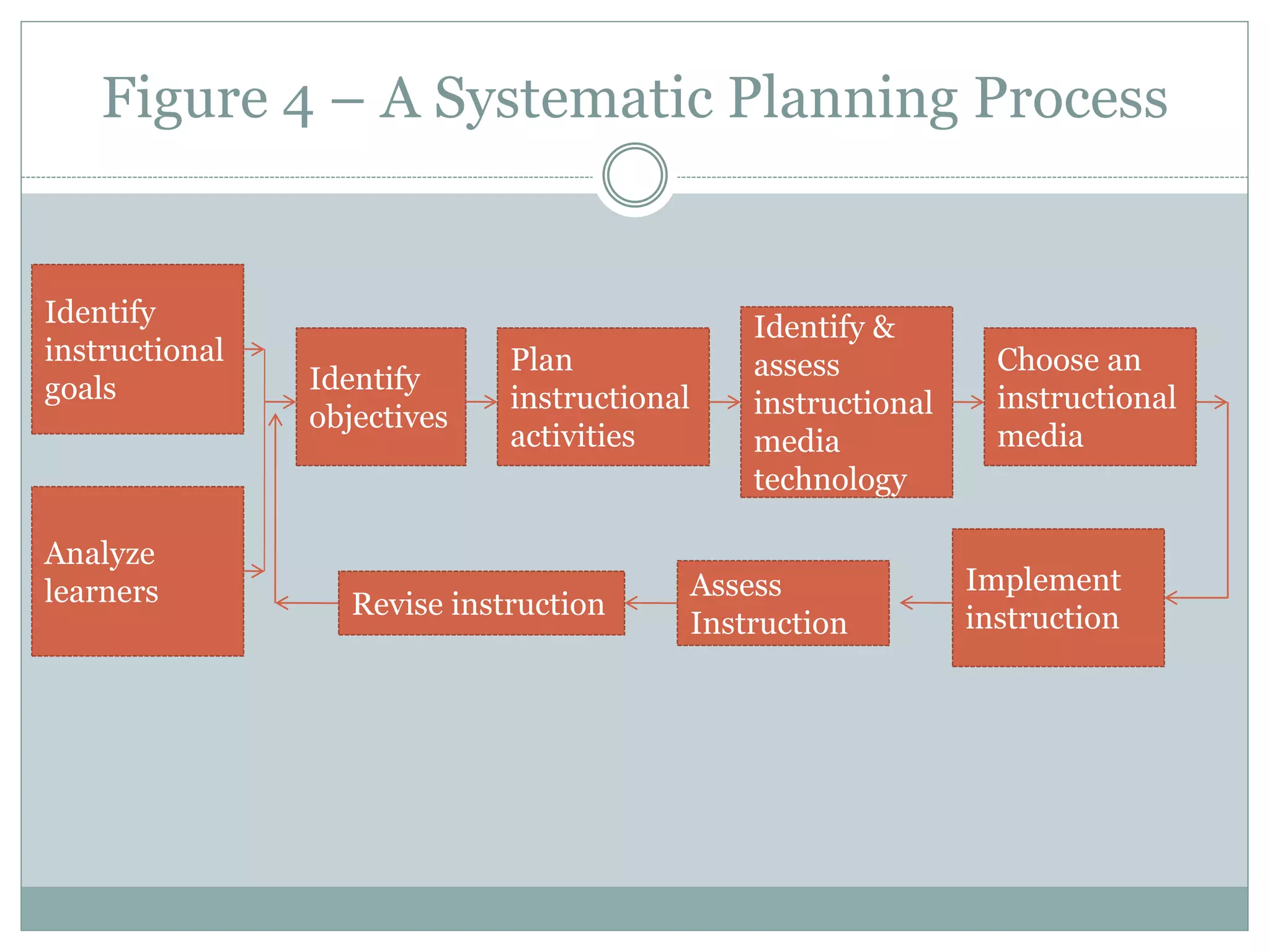
the end ineffective. A systematic approach to instructional planning is, therefore,
necessary. And in instructional planning, each lesson should have a clear idea of
general specific goals, instructional objectives, content, activities, media,
materials, assessment and evaluation on how objectives have been achieved.
In the choice of instructional media, technology comes into play.
Figure 4 – A Systematic Planning Process
Identify
instructional
goals
Analyze
learners
Identify
objectives
Plan
instructional
activities
Identify &
assess
instructional
media
technology
Choose an
instructional
media
Implement
instruction
Assess
Instruction
Revise instruction
 Instructional media may also be referred to as media
technology or learning technology, or simply technology.
Technology plays a crucial role in delivering instruction
to learners.
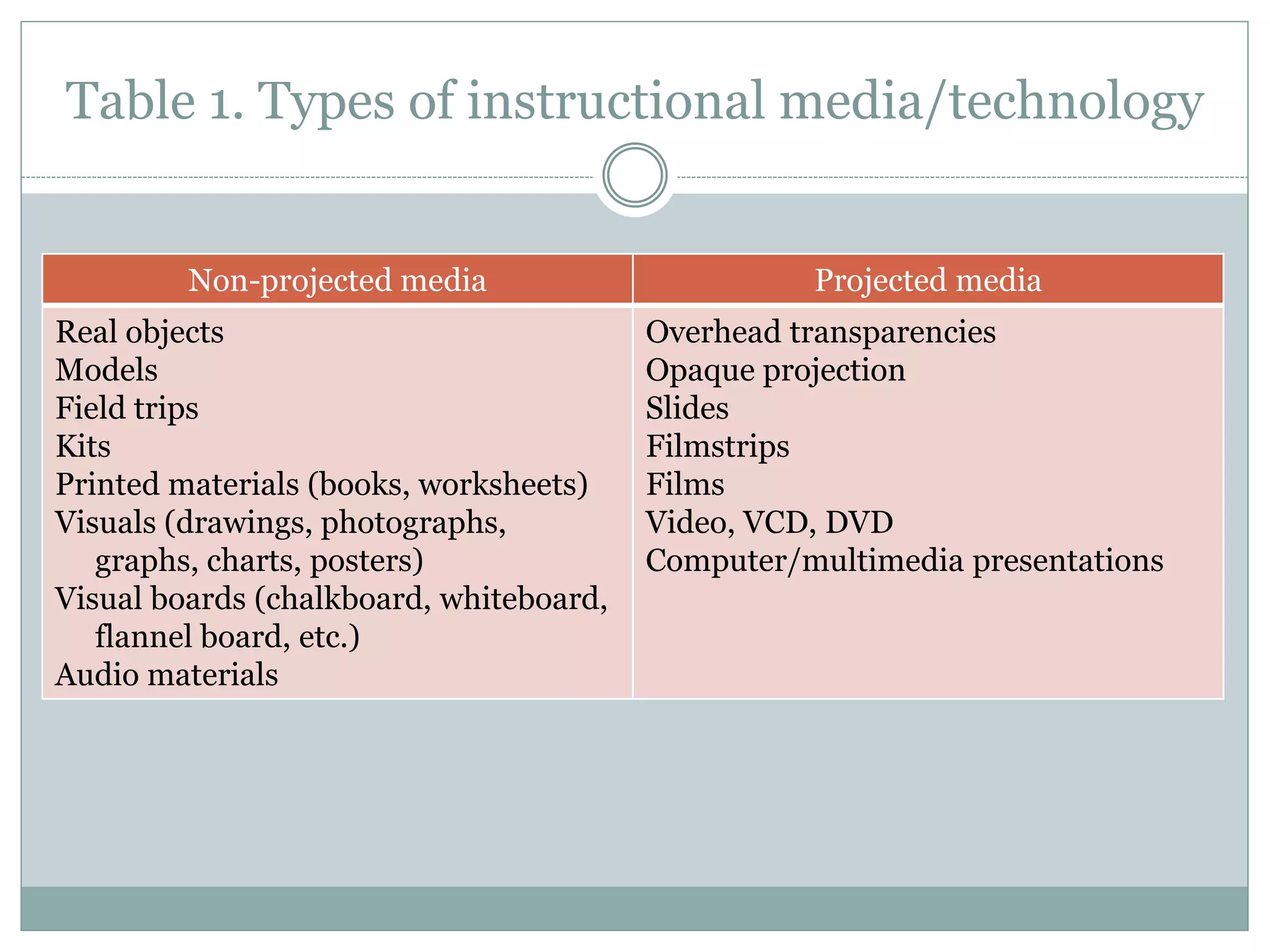
 Technology offers various tools of learning and these
range from non-projected and projected media from
which the teacher can choose, depending on what he sees
fit with the intended instructional setting. For example,
will a chalkboard presentation be sufficient in illustrating
a mathematical procedure; will a video clip be needed for
motivating learners?
 In the process, what ensues is objective-matching where
the teacher decides on what media or technology to use
to help achieve the set learning objectives.
Table 1. Types of instructional media/technology
Non-projected media Projected media
Real objects
Models
Field trips
Kits
Printed materials (books, worksheets)
Visuals (drawings, photographs,
graphs, charts, posters)
Visual boards (chalkboard, whiteboard,
flannel board, etc.)
Audio materials
Overhead transparencies
Opaque projection
Slides
Filmstrips
Films
Video, VCD, DVD
Computer/multimedia presentations
Implementing the Curriculum

Implementing the Curriculum

  • 1.
    IMPLEMENTING THE CURRICULUM THEROLE OF TECHNOLOGY IN DELIVERING THE CURRICULUM Paz I. Lucido, Ph.D. After the tasks of learning fundamental concepts about the curriculum – its nature and development – you are now brought to the more practical phase of curriculum implementation. Appropriately, the role of technology in curriculum implementation shall now be treated. The role of technology finds its place at the onset of curriculum implementation, namely at the stage of instructional planning. In a teaching- learning situation, there is the critical need to provide the learners information that forms a coherent whole. Otherwise, learning may end up haphazard and in the end ineffective. A systematic approach to instructional planning is, therefore, necessary. And in instructional planning, each lesson should have a clear idea of general specific goals, instructional objectives, content, activities, media, materials, assessment and evaluation on how objectives have been achieved. In the choice of instructional media, technology comes into play.
  • 2.
    Figure 4 –A Systematic Planning Process Identify instructional goals Analyze learners Identify objectives Plan instructional activities Identify & assess instructional media technology Choose an instructional media Implement instruction Assess Instruction Revise instruction
  • 3.
     Instructional mediamay also be referred to as media technology or learning technology, or simply technology. Technology plays a crucial role in delivering instruction to learners.  Technology offers various tools of learning and these range from non-projected and projected media from which the teacher can choose, depending on what he sees fit with the intended instructional setting. For example, will a chalkboard presentation be sufficient in illustrating a mathematical procedure; will a video clip be needed for motivating learners?  In the process, what ensues is objective-matching where the teacher decides on what media or technology to use to help achieve the set learning objectives.
  • 4.
    Table 1. Typesof instructional media/technology Non-projected media Projected media Real objects Models Field trips Kits Printed materials (books, worksheets) Visuals (drawings, photographs, graphs, charts, posters) Visual boards (chalkboard, whiteboard, flannel board, etc.) Audio materials Overhead transparencies Opaque projection Slides Filmstrips Films Video, VCD, DVD Computer/multimedia presentations