Learning – aprocess that builds on or modifies understanding, capacities, abilities,
attitudes, and propensities in the individual.
A process of having one’s behaviour modified , more or less permanently by what
happens in the world around him, by what he does.
Instruction – is a teaching provided through classroom activities and is often
associated with pre-service education programmes.
Technology – a branch of knowledge based on the development and implementation
of computers, software, and other technical tools and the assessment and evaluation of
students’ educational outcomes resulting from their use of technology tools.
4.
Educational Technology –emphasis on its hardware aspect – that is –
machines and the equipment themselves- while others stress its software side-
the programs, printouts or instructional materials that go with those machines.
Technology (Goodman, 1972) – complex human activities concerned with
using the findings of science to solve the problems of human society.
A social activity, involving people and ideas, methods and machines, dynamic
structures, communications, values and tools, but always people.
To achieve an efficient and rational divisions of labor, subject to human control,
between people and the support systems they evolve to amplify human
creativity not to replace it.
5.
Seattler (1978) citestwo differing viewpoints in educators:
1. Physical Science View – defines educational technology in terms of hardware
or devices; slide projector, television, radio, film, camera, computer and the like.
- Materials (audio-visual) or software and machines (projectors, computers and others)
are assigned non-verbal roles while some of the traditional media (lectures, books) are
assigned verbal roles.
- Non-verbal Media – are assumed to be more concrete and effective and that
perennial villain in the teaching-learning process is “verbalism”
6.
– 2. BehavioralScience View – concerned with the
application of scientific knowledge which provides a conceptual
basis and methodology for the design, development and
evaluation of instructional systems.
– Emphasizes the application or use the scientific knowledge rather
than the mere availability of the hardware.
7.
Common Elements ofEducational
Technology:
1. Filed area of study or the practice of using methods and
technologies.
2. Systematized methods and resources.
3. Facilitation of the learning process as the ultimate goal.
8.
Four Phases ofEducational
Technology:
1. Identification of Objectives
Logical approach to any type of activity
Goals, purpose or objectives to be accomplished serve as guide
to the type and nature of learning activities as well as the
methodologies to be used.
There is a need to ensure that the objectives chosen are
relevant to the individuals’ needs in a rapidly changing society.
9.
2. Design ofLearning Experiences
1. Sequence and strategies
2. Modes and media
Simultaneous with the selection of teaching strategies for a
particular subject matter is the design of the media and
materials to be used with these strategies.
The teacher selects and prepares media that are appropriate for
the learning experiences and methods keeping in mind the
requirements and limitations of budget, personnel, facilities,
equipment and schedules.
10.
3. Evaluation ofhow effective learning
experiences are in achieving the objectives
Accurate and evaluation of how effective the learning experiences have been
depends on the construction and use of evaluative devices that fit the stated
objectives.
Evaluative methods:
Observation devices, checklists, rating scales, anecdotal records and the
behaviour journal
Self-report instruments: inventories, questionnaires and ranking devices
Test items: essay and objective types
11.
4. Improvement ofthe learning experiences in
achieving the objectives
Presupposes partial or complete non-attainment of objectives designed to be
accomplished with a set of learning experiences.
There is a need to modify the whole system to only certain elements of it.
Some learning experiences may need to be revised themselves through the
sequencing or strategies used or through the media or materials employed.
Determine if the objectives are compatible with the need, goals or interests of
the learner.
Instructional Technology
– Brickson(1969) – aspects of educational technology that are concerned primarily with
instruction as contrasted to design and operation institutions
– An area within educational technology which stresses the teaching-learning
process or instruction.
– Tickton (1970) – has two ways of defining instructional technology:
– A media born of the communication revolution; can be used for instructional
purposes
– Systematic way of designing, carrying out and evaluating the total process of
learning and teaching in terms of specific objectives, based on research in human
learning and communication.
-employs human and non-human resources so combined to make instruction
more effective
14.
Instructional Technology
– Themeans of communication available for educational purposes
other that the live teacher or other human resources in a face-to-
face situation. Consists primarily of instructional materials
advertently developed to promote learning and includes
hardwares such as television and teaching machines and softwares
such as programmed texts and films.
15.
Educational Media
– Putsspecial emphasis on the material medium or means of
communication other than the human teacher.
16.
Media
– represents anintervening or mediating substance
through which impressions are conveyed to the senses
– Chalkboard-and chalk-combination – an educational
medium between the teacher and students, or between
the sender of information and its receiver
17.
Audio-visual Media
– Emphasison the use of two sense modalities: hearing
(audio) and seeing (visual), either singly or in
combination.
18.
Audio-media-radio and recordings
–Still and moving pictures sound as visual aid and
television, films, slide tape presentations and all others
which use both modalities
– Emphasize the use of above materials as a means of
communication
19.
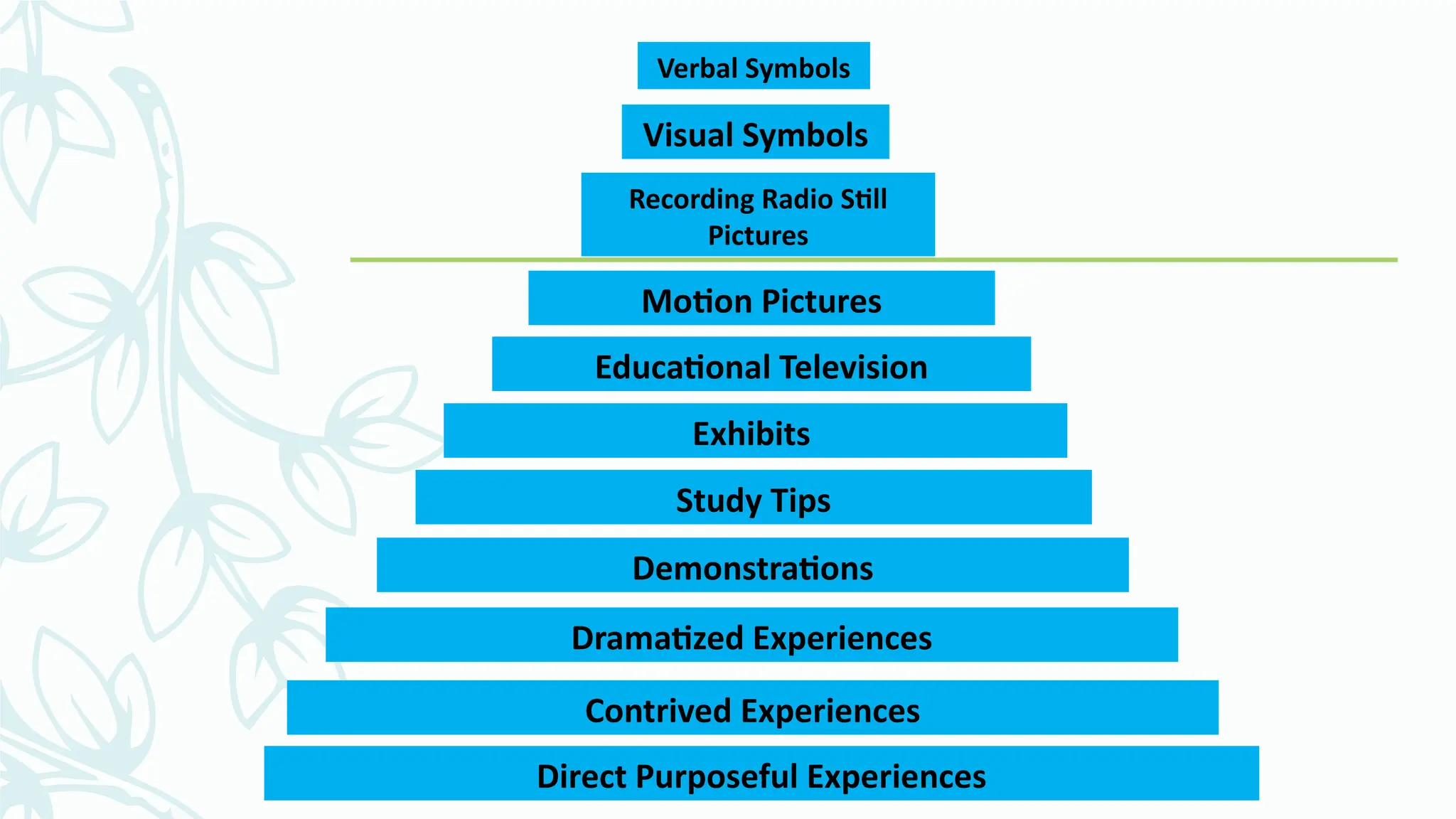
Verbal Symbols
Visual Symbols
RecordingRadio Still
Pictures
Motion Pictures
Educational Television
Exhibits
Study Tips
Demonstrations
Dramatized Experiences
Contrived Experiences
Direct Purposeful Experiences
Factors affecting educational
technology:
1.Trend toward a science of education
2. Shift from what to teach and how to teach
3. Improved performance and productivity
4. Focus on the learner
24.
The Teacher’s Role
–Teacher may act as facilitator, catalyst, director or manager of the
teaching-learning process
– Require a vast understanding of subject matter, learning process
and nature of the learner
– Provide for individual differences guided by educational
accountability, the teacher needs to undertake systematic
planning, control and evaluation to ensure effective instruction
25.
Principles and guidelinesfor teachers and
administrators, potential of educational technology
– Be open to innovation
– Use media effectively
– Cultivate a commitment to continuous assessment
– Promote the humanizing aspects of educational
technology
26.
Student’s Role
– Witheducational technology comes shift in the responsibility of learning from that of the
teacher to the student
– A greater part of educational activity may be done by the student himself especially in
cases where individualized instruction is practiced
– The student assumes the task of teaching himself and even evaluating his own progress
– He takes personal responsibility for his own learning
– Self-feedback provides him with the motivation or reinforcement to do better
– Learning proceeds at one’s own rate, the students therefore tend to perform different
activities at the same time