Prepared by: Ma. Divina Kristi
A. Discar
Module 5 Curriculum Evaluation
WHAT, WHY, & HOW
TO EVALUATE A
CURRICULUM
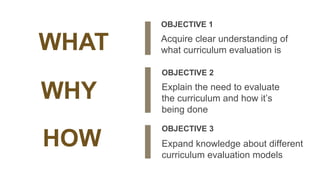
Acquire clear understanding of
what curriculum evaluation is
OBJECTIVE 1
Explain the need to evaluate
the curriculum and how it’s
being done
OBJECTIVE 2
Expand knowledge about different
curriculum evaluation models
OBJECTIVE 3
WHAT
WHY
HOW
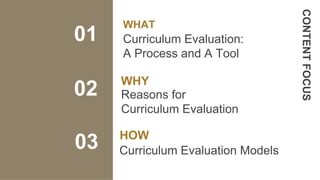
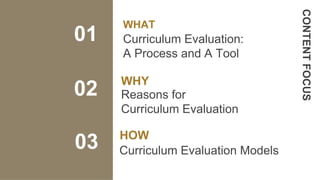
CONTENT
FOCUS
03
WHAT
Curriculum Evaluation:
A Process and A Tool
01
02 Reasons for
Curriculum Evaluation
Curriculum Evaluation Models
WHY
HOW
It looks into educational
reforms or innovations
that happen in the
teacher’s classrooms,
the school, district,
division, or the whole
educational system.
CURRICULUM
EVALUATION
Written
Planned
Implemented
CURRICULUM
EVALUATION
1. Do planned courses,
programs, activities as written
and implemented produce
desired outcomes?
It is an attempt to
answer two big
questions:
2. How can these school curricula
be improved?
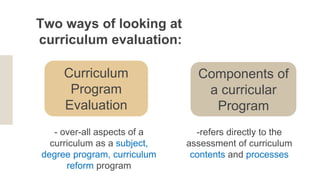
Two ways of looking at
curriculum evaluation:
Curriculum
Program
Evaluation
Components of
a curricular
Program
Two ways of looking at
curriculum evaluation:
Components of
a curricular
Program
-refers directly to the
assessment of curriculum
contents and processes
Curriculum
Program
Evaluation
- over-all aspects of a
curriculum as a subject,
degree program, curriculum
reform program
CONTENT
FOCUS
03
WHAT
Curriculum Evaluation:
A Process and A Tool
01
02 Reasons for
Curriculum Evaluation
Curriculum Evaluation Models
WHY
HOW
WHAT
Curriculum
Evaluation: A
Process and a Tool
01
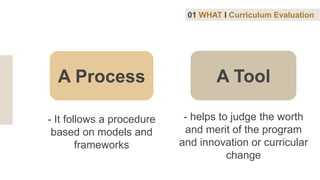
A Process A Tool
- It follows a procedure
based on models and
frameworks
- helps to judge the worth
and merit of the program
and innovation or curricular
change
01 WHAT I Curriculum Evaluation
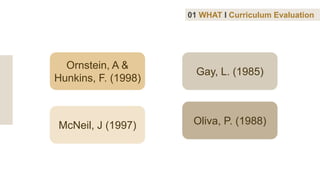
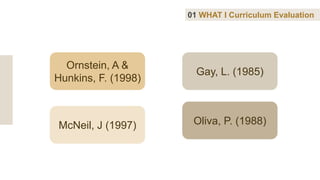
Ornstein, A &
Hunkins, F. (1998)
McNeil, J (1997)
Gay, L. (1985)
Oliva, P. (1988)
01 WHAT I Curriculum Evaluation
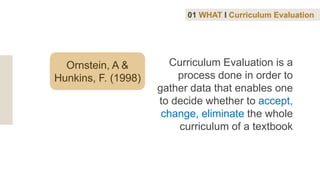
Ornstein, A &
Hunkins, F. (1998)
Curriculum Evaluation is a
process done in order to
gather data that enables one
to decide whether to accept,
change, eliminate the whole
curriculum of a textbook
01 WHAT I Curriculum Evaluation
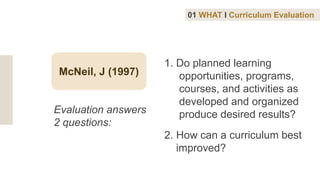
McNeil, J (1997)
1. Do planned learning
opportunities, programs,
courses, and activities as
developed and organized
produce desired results?
2. How can a curriculum best
improved?
Evaluation answers
2 questions:
01 WHAT I Curriculum Evaluation
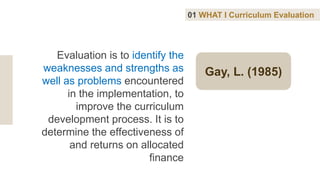
Gay, L. (1985)
Evaluation is to identify the
weaknesses and strengths as
well as problems encountered
in the implementation, to
improve the curriculum
development process. It is to
determine the effectiveness of
and returns on allocated
finance
01 WHAT I Curriculum Evaluation
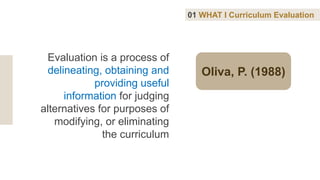
Oliva, P. (1988)
Evaluation is a process of
delineating, obtaining and
providing useful
information for judging
alternatives for purposes of
modifying, or eliminating
the curriculum
01 WHAT I Curriculum Evaluation
Ornstein, A &
Hunkins, F. (1998)
McNeil, J (1997)
Gay, L. (1985)
Oliva, P. (1988)
01 WHAT I Curriculum Evaluation
WHY
Reasons for
Curriculum Evaluation
02
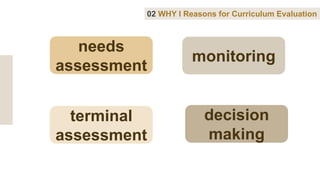
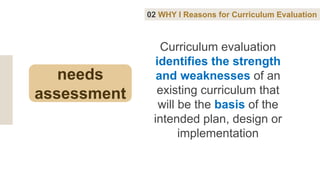
needs
assessment
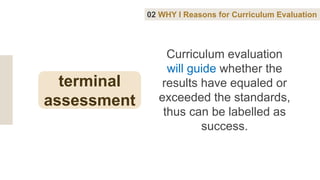
terminal
assessment
monitoring
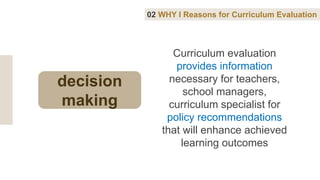
decision
making
02 WHY I Reasons for Curriculum Evaluation
Curriculum evaluation
identifies the strength
and weaknesses of an
existing curriculum that
will be the basis of the
intended plan, design or
implementation
02 WHY I Reasons for Curriculum Evaluation
needs
assessment
When evaluation is done
in the middle of the
curriculum development,
it will tell if the designed
or implemented
curriculum can produce
or is producing the
desired results
02 WHY I Reasons for Curriculum Evaluation
monitoring
Curriculum evaluation
will guide whether the
results have equaled or
exceeded the standards,
thus can be labelled as
success.
02 WHY I Reasons for Curriculum Evaluation
terminal
assessment
Curriculum evaluation
provides information
necessary for teachers,
school managers,
curriculum specialist for
policy recommendations
that will enhance achieved
learning outcomes
02 WHY I Reasons for Curriculum Evaluation
decision
making
HOW
CURRICULUM
EVALUATION MODELS
03
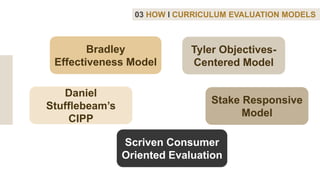
Bradley
Effectiveness Model
Daniel
Stufflebeam’s
CIPP
Tyler Objectives-
Centered Model
Stake Responsive
Model
03 HOW I CURRICULUM EVALUATION MODELS
Scriven Consumer
Oriented Evaluation
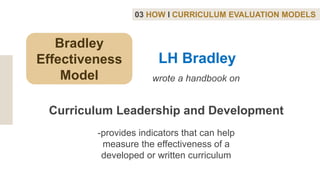
Bradley
Effectiveness
Model
03 HOW I CURRICULUM EVALUATION MODELS
wrote a handbook on
Curriculum Leadership and Development
LH Bradley
-provides indicators that can help
measure the effectiveness of a
developed or written curriculum
Bradley
Effectiveness Model
03 HOW I CURRICULUM EVALUATION MODELS
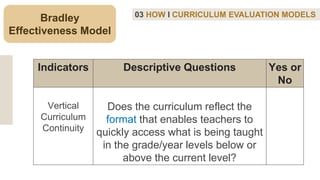
Indicators Descriptive Questions Yes or
No
Vertical
Curriculum
Continuity
Does the curriculum reflect the
format that enables teachers to
quickly access what is being taught
in the grade/year levels below or
above the current level?
Bradley
Effectiveness Model
03 HOW I CURRICULUM EVALUATION MODELS
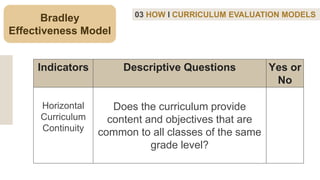
Indicators Descriptive Questions Yes or
No
Horizontal
Curriculum
Continuity
Does the curriculum provide
content and objectives that are
common to all classes of the same
grade level?
Bradley
Effectiveness Model
03 HOW I CURRICULUM EVALUATION MODELS
Indicators Descriptive Questions Yes or
No
Instruction
based on
Curriculum
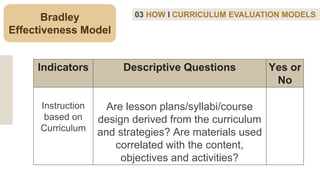
Are lesson plans/syllabi/course
design derived from the curriculum
and strategies? Are materials used
correlated with the content,
objectives and activities?
Bradley
Effectiveness Model
03 HOW I CURRICULUM EVALUATION MODELS
Indicators Descriptive Questions Yes or
No
Broad
Involvement
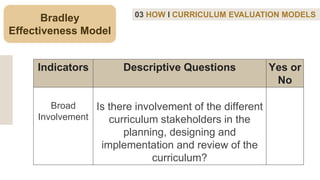
Is there involvement of the different
curriculum stakeholders in the
planning, designing and
implementation and review of the
curriculum?
Bradley
Effectiveness Model
03 HOW I CURRICULUM EVALUATION MODELS
Indicators Descriptive Questions Yes or
No
Long Range
Planning
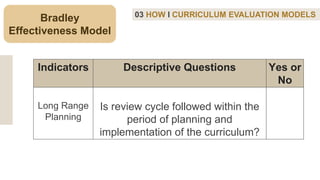
Is review cycle followed within the
period of planning and
implementation of the curriculum?
Bradley
Effectiveness Model
03 HOW I CURRICULUM EVALUATION MODELS
Indicators Descriptive Questions Yes or
No
Positive
Human
Relations
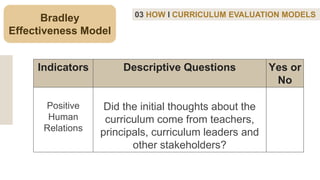
Did the initial thoughts about the
curriculum come from teachers,
principals, curriculum leaders and
other stakeholders?
Bradley
Effectiveness Model
03 HOW I CURRICULUM EVALUATION MODELS
Indicators Descriptive Questions Yes or
No
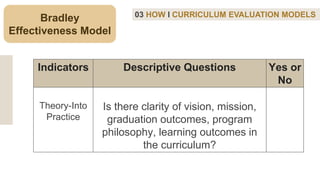
Theory-Into
Practice
Is there clarity of vision, mission,
graduation outcomes, program
philosophy, learning outcomes in
the curriculum?
Bradley
Effectiveness Model
03 HOW I CURRICULUM EVALUATION MODELS
Indicators Descriptive Questions Yes or
No
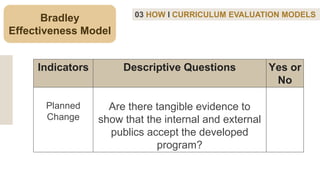
Planned
Change
Are there tangible evidence to
show that the internal and external
publics accept the developed
program?
Bradley
Effectiveness
Model
03 HOW I CURRICULUM EVALUATION MODELS
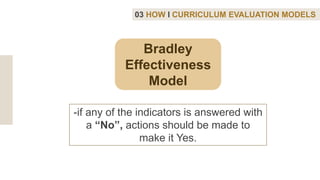
-if any of the indicators is answered with
a “No”, actions should be made to
make it Yes.
03 HOW I CURRICULUM EVALUATION MODELS
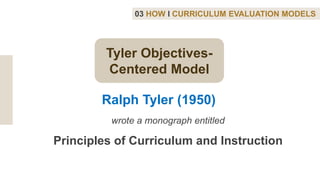
wrote a monograph entitled
Principles of Curriculum and Instruction
Ralph Tyler (1950)
Tyler Objectives-
Centered Model
03 HOW I CURRICULUM EVALUATION MODELS
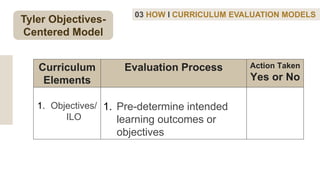
Curriculum
Elements
Evaluation Process Action Taken
Yes or No
1. Objectives/
ILO
1. Pre-determine intended
learning outcomes or
objectives
Tyler Objectives-
Centered Model
03 HOW I CURRICULUM EVALUATION MODELS
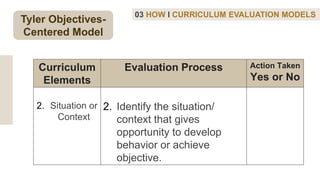
Curriculum
Elements
Evaluation Process Action Taken
Yes or No
2. Situation or
Context
2. Identify the situation/
context that gives
opportunity to develop
behavior or achieve
objective.
Tyler Objectives-
Centered Model
03 HOW I CURRICULUM EVALUATION MODELS
Curriculum
Elements
Evaluation Process Action Taken
Yes or No
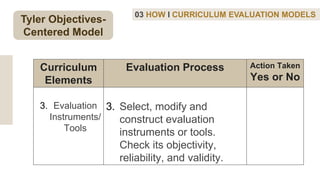
3. Evaluation
Instruments/
Tools
3. Select, modify and
construct evaluation
instruments or tools.
Check its objectivity,
reliability, and validity.
Tyler Objectives-
Centered Model
03 HOW I CURRICULUM EVALUATION MODELS
Curriculum
Elements
Evaluation Process Action Taken
Yes or No
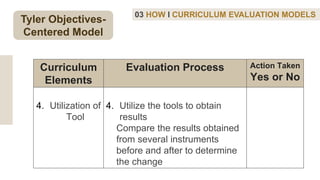
4. Utilization of
Tool
4. Utilize the tools to obtain
results
Compare the results obtained
from several instruments
before and after to determine
the change
Tyler Objectives-
Centered Model
03 HOW I CURRICULUM EVALUATION MODELS
Curriculum
Elements
Evaluation Process Action Taken
Yes or No
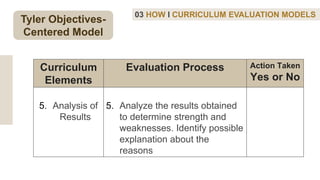
5. Analysis of
Results
5. Analyze the results obtained
to determine strength and
weaknesses. Identify possible
explanation about the
reasons
Tyler Objectives-
Centered Model
03 HOW I CURRICULUM EVALUATION MODELS
Curriculum
Elements
Evaluation Process Action Taken
Yes or No
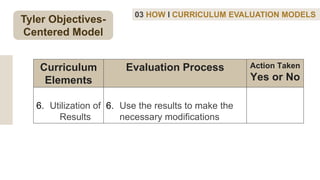
6. Utilization of
Results
6. Use the results to make the
necessary modifications
Tyler Objectives-
Centered Model
03 HOW I CURRICULUM EVALUATION MODELS
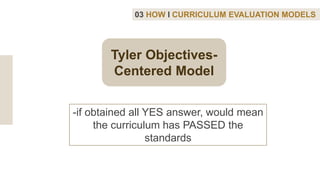
-if obtained all YES answer, would mean
the curriculum has PASSED the
standards
Tyler Objectives-
Centered Model
03 HOW I CURRICULUM EVALUATION MODELS
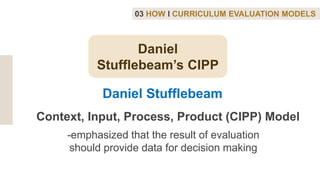
Context, Input, Process, Product (CIPP) Model
Daniel Stufflebeam
Daniel
Stufflebeam’s CIPP
-emphasized that the result of evaluation
should provide data for decision making
03 HOW I CURRICULUM EVALUATION MODELS
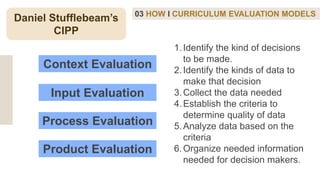
Daniel Stufflebeam’s
CIPP
Context Evaluation
Process Evaluation
Input Evaluation
Product Evaluation
1.Identify the kind of decisions
to be made.
2.Identify the kinds of data to
make that decision
3.Collect the data needed
4.Establish the criteria to
determine quality of data
5.Analyze data based on the
criteria
6.Organize needed information
needed for decision makers.
03 HOW I CURRICULUM EVALUATION MODELS
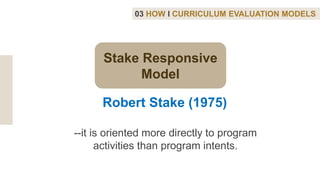
Robert Stake (1975)
--it is oriented more directly to program
activities than program intents.
Stake Responsive
Model
03 HOW I CURRICULUM EVALUATION MODELS
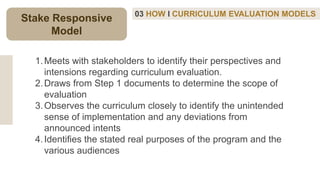
1.Meets with stakeholders to identify their perspectives and
intensions regarding curriculum evaluation.
2.Draws from Step 1 documents to determine the scope of
evaluation
3.Observes the curriculum closely to identify the unintended
sense of implementation and any deviations from
announced intents
4.Identifies the stated real purposes of the program and the
various audiences
Stake Responsive
Model
03 HOW I CURRICULUM EVALUATION MODELS
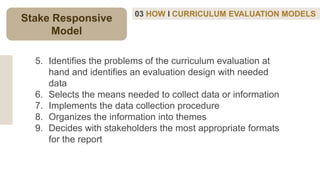
5. Identifies the problems of the curriculum evaluation at
hand and identifies an evaluation design with needed
data
6. Selects the means needed to collect data or information
7. Implements the data collection procedure
8. Organizes the information into themes
9. Decides with stakeholders the most appropriate formats
for the report
Stake Responsive
Model
03 HOW I CURRICULUM EVALUATION MODELS
Michael Scriven (1967)
Scriven Consumer
Oriented Evaluation
03 HOW I CURRICULUM EVALUATION MODELS
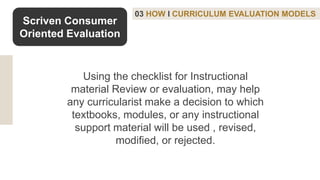
Using the checklist for Instructional
material Review or evaluation, may help
any curricularist make a decision to which
textbooks, modules, or any instructional
support material will be used , revised,
modified, or rejected.
Scriven Consumer
Oriented Evaluation
A Simple Way of Curriculum
Evaluation Process
1. Does the curriculum emphasize learning outcomes?
2. Does the implemented curriculum require less
demands?
3. Can this curriculum be applied to any particular level?
4. Can the curriculum aspects be assessed as (a)
written (b) taught (c) supported (d) tested (e) learned
5. Does the curriculum include formative assessment?
A Simple Way of Curriculum
Evaluation Process
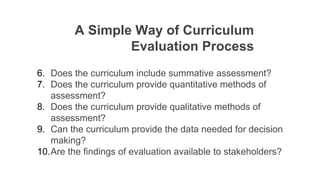
6. Does the curriculum include summative assessment?
7. Does the curriculum provide quantitative methods of
assessment?
8. Does the curriculum provide qualitative methods of
assessment?
9. Can the curriculum provide the data needed for decision
making?
10.Are the findings of evaluation available to stakeholders?
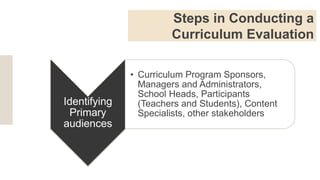
Steps in Conducting a
Curriculum Evaluation
Identifying
Primary
audiences
• Curriculum Program Sponsors,
Managers and Administrators,
School Heads, Participants
(Teachers and Students), Content
Specialists, other stakeholders
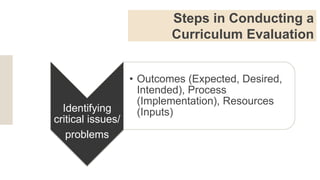
Steps in Conducting a
Curriculum Evaluation
Identifying
critical issues/
problems
• Outcomes (Expected, Desired,
Intended), Process
(Implementation), Resources
(Inputs)
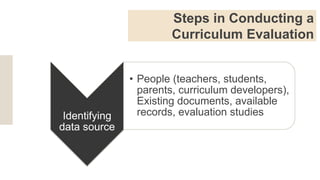
Steps in Conducting a
Curriculum Evaluation
Identifying
data source
• People (teachers, students,
parents, curriculum developers),
Existing documents, available
records, evaluation studies
Steps in Conducting a
Curriculum Evaluation
Identifying
techniques for
collecting data
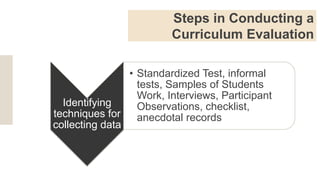
• Standardized Test, informal
tests, Samples of Students
Work, Interviews, Participant
Observations, checklist,
anecdotal records
Steps in Conducting a
Curriculum Evaluation
Identifying
established
standards and
criteria
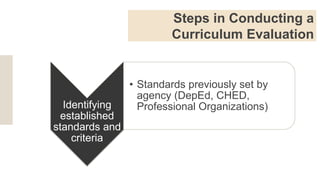
• Standards previously set by
agency (DepEd, CHED,
Professional Organizations)
Steps in Conducting a
Curriculum Evaluation
Identifying
Techniques in
Data Analysis
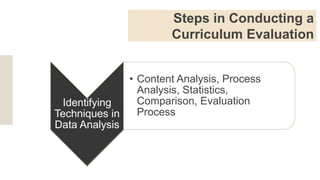
• Content Analysis, Process
Analysis, Statistics,
Comparison, Evaluation
Process
Steps in Conducting a
Curriculum Evaluation
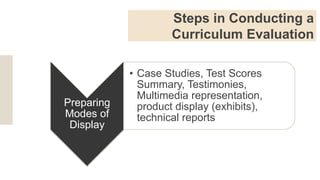
Preparing
Evaluation
Report
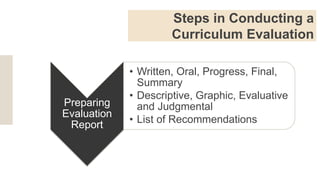
• Written, Oral, Progress, Final,
Summary
• Descriptive, Graphic, Evaluative
and Judgmental
• List of Recommendations
Steps in Conducting a
Curriculum Evaluation
Preparing
Modes of
Display
• Case Studies, Test Scores
Summary, Testimonies,
Multimedia representation,
product display (exhibits),
technical reports
Prepared by: Ma. Divina Kristi
A. Discar
WHAT, WHY, & HOW TO
EVALUATE A CURRICULUM
THANK
YOU!

Module 5 What, Why, and How to Evaluate a Curriculum.pptx

  • 1.
    Prepared by: Ma.Divina Kristi A. Discar Module 5 Curriculum Evaluation WHAT, WHY, & HOW TO EVALUATE A CURRICULUM
  • 2.
    Acquire clear understandingof what curriculum evaluation is OBJECTIVE 1 Explain the need to evaluate the curriculum and how it’s being done OBJECTIVE 2 Expand knowledge about different curriculum evaluation models OBJECTIVE 3 WHAT WHY HOW
  • 3.
    CONTENT FOCUS 03 WHAT Curriculum Evaluation: A Processand A Tool 01 02 Reasons for Curriculum Evaluation Curriculum Evaluation Models WHY HOW
  • 4.
    It looks intoeducational reforms or innovations that happen in the teacher’s classrooms, the school, district, division, or the whole educational system. CURRICULUM EVALUATION
  • 5.
  • 6.
    1. Do plannedcourses, programs, activities as written and implemented produce desired outcomes? It is an attempt to answer two big questions: 2. How can these school curricula be improved?
  • 7.
    Two ways oflooking at curriculum evaluation: Curriculum Program Evaluation Components of a curricular Program
  • 8.
    Two ways oflooking at curriculum evaluation: Components of a curricular Program -refers directly to the assessment of curriculum contents and processes Curriculum Program Evaluation - over-all aspects of a curriculum as a subject, degree program, curriculum reform program
  • 9.
    CONTENT FOCUS 03 WHAT Curriculum Evaluation: A Processand A Tool 01 02 Reasons for Curriculum Evaluation Curriculum Evaluation Models WHY HOW
  • 10.
  • 11.
    A Process ATool - It follows a procedure based on models and frameworks - helps to judge the worth and merit of the program and innovation or curricular change 01 WHAT I Curriculum Evaluation
  • 12.
    Ornstein, A & Hunkins,F. (1998) McNeil, J (1997) Gay, L. (1985) Oliva, P. (1988) 01 WHAT I Curriculum Evaluation
  • 13.
    Ornstein, A & Hunkins,F. (1998) Curriculum Evaluation is a process done in order to gather data that enables one to decide whether to accept, change, eliminate the whole curriculum of a textbook 01 WHAT I Curriculum Evaluation
  • 14.
    McNeil, J (1997) 1.Do planned learning opportunities, programs, courses, and activities as developed and organized produce desired results? 2. How can a curriculum best improved? Evaluation answers 2 questions: 01 WHAT I Curriculum Evaluation
  • 15.
    Gay, L. (1985) Evaluationis to identify the weaknesses and strengths as well as problems encountered in the implementation, to improve the curriculum development process. It is to determine the effectiveness of and returns on allocated finance 01 WHAT I Curriculum Evaluation
  • 16.
    Oliva, P. (1988) Evaluationis a process of delineating, obtaining and providing useful information for judging alternatives for purposes of modifying, or eliminating the curriculum 01 WHAT I Curriculum Evaluation
  • 17.
    Ornstein, A & Hunkins,F. (1998) McNeil, J (1997) Gay, L. (1985) Oliva, P. (1988) 01 WHAT I Curriculum Evaluation
  • 18.
  • 19.
  • 20.
    Curriculum evaluation identifies thestrength and weaknesses of an existing curriculum that will be the basis of the intended plan, design or implementation 02 WHY I Reasons for Curriculum Evaluation needs assessment
  • 21.
    When evaluation isdone in the middle of the curriculum development, it will tell if the designed or implemented curriculum can produce or is producing the desired results 02 WHY I Reasons for Curriculum Evaluation monitoring
  • 22.
    Curriculum evaluation will guidewhether the results have equaled or exceeded the standards, thus can be labelled as success. 02 WHY I Reasons for Curriculum Evaluation terminal assessment
  • 23.
    Curriculum evaluation provides information necessaryfor teachers, school managers, curriculum specialist for policy recommendations that will enhance achieved learning outcomes 02 WHY I Reasons for Curriculum Evaluation decision making
  • 24.
  • 25.
    Bradley Effectiveness Model Daniel Stufflebeam’s CIPP Tyler Objectives- CenteredModel Stake Responsive Model 03 HOW I CURRICULUM EVALUATION MODELS Scriven Consumer Oriented Evaluation
  • 26.
    Bradley Effectiveness Model 03 HOW ICURRICULUM EVALUATION MODELS wrote a handbook on Curriculum Leadership and Development LH Bradley -provides indicators that can help measure the effectiveness of a developed or written curriculum
  • 27.
    Bradley Effectiveness Model 03 HOWI CURRICULUM EVALUATION MODELS Indicators Descriptive Questions Yes or No Vertical Curriculum Continuity Does the curriculum reflect the format that enables teachers to quickly access what is being taught in the grade/year levels below or above the current level?
  • 28.
    Bradley Effectiveness Model 03 HOWI CURRICULUM EVALUATION MODELS Indicators Descriptive Questions Yes or No Horizontal Curriculum Continuity Does the curriculum provide content and objectives that are common to all classes of the same grade level?
  • 29.
    Bradley Effectiveness Model 03 HOWI CURRICULUM EVALUATION MODELS Indicators Descriptive Questions Yes or No Instruction based on Curriculum Are lesson plans/syllabi/course design derived from the curriculum and strategies? Are materials used correlated with the content, objectives and activities?
  • 30.
    Bradley Effectiveness Model 03 HOWI CURRICULUM EVALUATION MODELS Indicators Descriptive Questions Yes or No Broad Involvement Is there involvement of the different curriculum stakeholders in the planning, designing and implementation and review of the curriculum?
  • 31.
    Bradley Effectiveness Model 03 HOWI CURRICULUM EVALUATION MODELS Indicators Descriptive Questions Yes or No Long Range Planning Is review cycle followed within the period of planning and implementation of the curriculum?
  • 32.
    Bradley Effectiveness Model 03 HOWI CURRICULUM EVALUATION MODELS Indicators Descriptive Questions Yes or No Positive Human Relations Did the initial thoughts about the curriculum come from teachers, principals, curriculum leaders and other stakeholders?
  • 33.
    Bradley Effectiveness Model 03 HOWI CURRICULUM EVALUATION MODELS Indicators Descriptive Questions Yes or No Theory-Into Practice Is there clarity of vision, mission, graduation outcomes, program philosophy, learning outcomes in the curriculum?
  • 34.
    Bradley Effectiveness Model 03 HOWI CURRICULUM EVALUATION MODELS Indicators Descriptive Questions Yes or No Planned Change Are there tangible evidence to show that the internal and external publics accept the developed program?
  • 35.
    Bradley Effectiveness Model 03 HOW ICURRICULUM EVALUATION MODELS -if any of the indicators is answered with a “No”, actions should be made to make it Yes.
  • 36.
    03 HOW ICURRICULUM EVALUATION MODELS wrote a monograph entitled Principles of Curriculum and Instruction Ralph Tyler (1950) Tyler Objectives- Centered Model
  • 37.
    03 HOW ICURRICULUM EVALUATION MODELS Curriculum Elements Evaluation Process Action Taken Yes or No 1. Objectives/ ILO 1. Pre-determine intended learning outcomes or objectives Tyler Objectives- Centered Model
  • 38.
    03 HOW ICURRICULUM EVALUATION MODELS Curriculum Elements Evaluation Process Action Taken Yes or No 2. Situation or Context 2. Identify the situation/ context that gives opportunity to develop behavior or achieve objective. Tyler Objectives- Centered Model
  • 39.
    03 HOW ICURRICULUM EVALUATION MODELS Curriculum Elements Evaluation Process Action Taken Yes or No 3. Evaluation Instruments/ Tools 3. Select, modify and construct evaluation instruments or tools. Check its objectivity, reliability, and validity. Tyler Objectives- Centered Model
  • 40.
    03 HOW ICURRICULUM EVALUATION MODELS Curriculum Elements Evaluation Process Action Taken Yes or No 4. Utilization of Tool 4. Utilize the tools to obtain results Compare the results obtained from several instruments before and after to determine the change Tyler Objectives- Centered Model
  • 41.
    03 HOW ICURRICULUM EVALUATION MODELS Curriculum Elements Evaluation Process Action Taken Yes or No 5. Analysis of Results 5. Analyze the results obtained to determine strength and weaknesses. Identify possible explanation about the reasons Tyler Objectives- Centered Model
  • 42.
    03 HOW ICURRICULUM EVALUATION MODELS Curriculum Elements Evaluation Process Action Taken Yes or No 6. Utilization of Results 6. Use the results to make the necessary modifications Tyler Objectives- Centered Model
  • 43.
    03 HOW ICURRICULUM EVALUATION MODELS -if obtained all YES answer, would mean the curriculum has PASSED the standards Tyler Objectives- Centered Model
  • 44.
    03 HOW ICURRICULUM EVALUATION MODELS Context, Input, Process, Product (CIPP) Model Daniel Stufflebeam Daniel Stufflebeam’s CIPP -emphasized that the result of evaluation should provide data for decision making
  • 45.
    03 HOW ICURRICULUM EVALUATION MODELS Daniel Stufflebeam’s CIPP Context Evaluation Process Evaluation Input Evaluation Product Evaluation 1.Identify the kind of decisions to be made. 2.Identify the kinds of data to make that decision 3.Collect the data needed 4.Establish the criteria to determine quality of data 5.Analyze data based on the criteria 6.Organize needed information needed for decision makers.
  • 46.
    03 HOW ICURRICULUM EVALUATION MODELS Robert Stake (1975) --it is oriented more directly to program activities than program intents. Stake Responsive Model
  • 47.
    03 HOW ICURRICULUM EVALUATION MODELS 1.Meets with stakeholders to identify their perspectives and intensions regarding curriculum evaluation. 2.Draws from Step 1 documents to determine the scope of evaluation 3.Observes the curriculum closely to identify the unintended sense of implementation and any deviations from announced intents 4.Identifies the stated real purposes of the program and the various audiences Stake Responsive Model
  • 48.
    03 HOW ICURRICULUM EVALUATION MODELS 5. Identifies the problems of the curriculum evaluation at hand and identifies an evaluation design with needed data 6. Selects the means needed to collect data or information 7. Implements the data collection procedure 8. Organizes the information into themes 9. Decides with stakeholders the most appropriate formats for the report Stake Responsive Model
  • 49.
    03 HOW ICURRICULUM EVALUATION MODELS Michael Scriven (1967) Scriven Consumer Oriented Evaluation
  • 50.
    03 HOW ICURRICULUM EVALUATION MODELS Using the checklist for Instructional material Review or evaluation, may help any curricularist make a decision to which textbooks, modules, or any instructional support material will be used , revised, modified, or rejected. Scriven Consumer Oriented Evaluation
  • 51.
    A Simple Wayof Curriculum Evaluation Process 1. Does the curriculum emphasize learning outcomes? 2. Does the implemented curriculum require less demands? 3. Can this curriculum be applied to any particular level? 4. Can the curriculum aspects be assessed as (a) written (b) taught (c) supported (d) tested (e) learned 5. Does the curriculum include formative assessment?
  • 52.
    A Simple Wayof Curriculum Evaluation Process 6. Does the curriculum include summative assessment? 7. Does the curriculum provide quantitative methods of assessment? 8. Does the curriculum provide qualitative methods of assessment? 9. Can the curriculum provide the data needed for decision making? 10.Are the findings of evaluation available to stakeholders?
  • 53.
    Steps in Conductinga Curriculum Evaluation Identifying Primary audiences • Curriculum Program Sponsors, Managers and Administrators, School Heads, Participants (Teachers and Students), Content Specialists, other stakeholders
  • 54.
    Steps in Conductinga Curriculum Evaluation Identifying critical issues/ problems • Outcomes (Expected, Desired, Intended), Process (Implementation), Resources (Inputs)
  • 55.
    Steps in Conductinga Curriculum Evaluation Identifying data source • People (teachers, students, parents, curriculum developers), Existing documents, available records, evaluation studies
  • 56.
    Steps in Conductinga Curriculum Evaluation Identifying techniques for collecting data • Standardized Test, informal tests, Samples of Students Work, Interviews, Participant Observations, checklist, anecdotal records
  • 57.
    Steps in Conductinga Curriculum Evaluation Identifying established standards and criteria • Standards previously set by agency (DepEd, CHED, Professional Organizations)
  • 58.
    Steps in Conductinga Curriculum Evaluation Identifying Techniques in Data Analysis • Content Analysis, Process Analysis, Statistics, Comparison, Evaluation Process
  • 59.
    Steps in Conductinga Curriculum Evaluation Preparing Evaluation Report • Written, Oral, Progress, Final, Summary • Descriptive, Graphic, Evaluative and Judgmental • List of Recommendations
  • 60.
    Steps in Conductinga Curriculum Evaluation Preparing Modes of Display • Case Studies, Test Scores Summary, Testimonies, Multimedia representation, product display (exhibits), technical reports
  • 61.
    Prepared by: Ma.Divina Kristi A. Discar WHAT, WHY, & HOW TO EVALUATE A CURRICULUM THANK YOU!

Editor's Notes

  • #9 Examples Curriculum Development as a Subject Bachelor of Education as a degree K to 12 as a Curriculum reform Outcomes-Based Education (OBE) as a process Examples Achieved Learning Outcomes Teaching Learning Process Instructional Materials Assessment of Learning Outcomes