ESSU – GUIUAN
GRADUATE SCHOOL
Philo-Social Foundations of
Education
What is Philosophy?
the science that seeks to organize and systemize all
fields of knowledge as a means of understanding and
interpreting the totality of reality.
The systematic and logical explanation of the nature,
existence, purpose and relationships of things,
including human beings in the universe
Main Branches of Philosophy
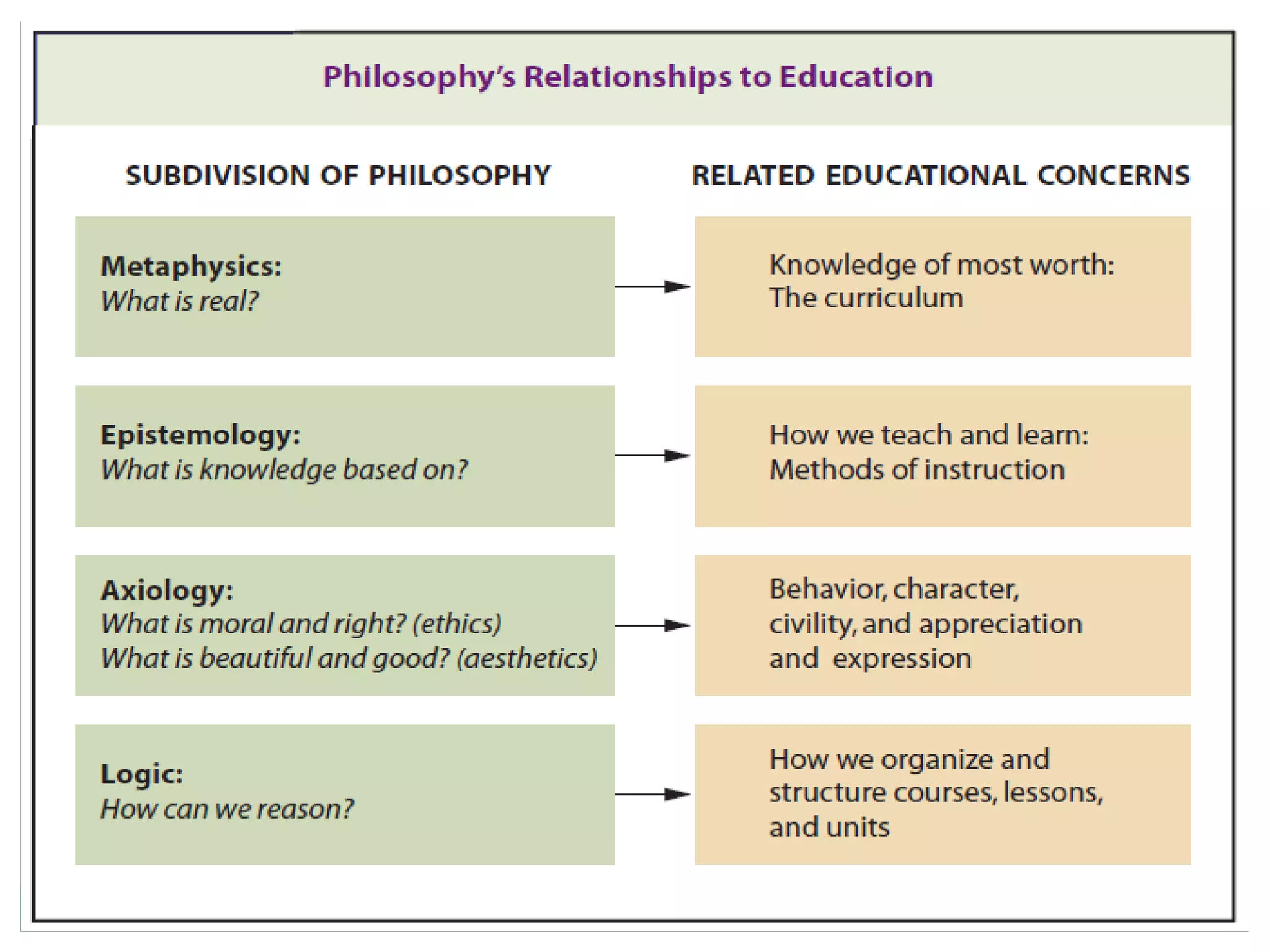
 1. Metaphysics – deals with the first principles, the
origin an essence of things, the causes and end of
things.
2. Epistemology – deals with knowledge and with
ways of knowing.
Main Branches of Philosophy
3. Axiology – deals with purposes and values.
4. Logic – deals with the correct way of thinking.
FUNCTIONS of the PHILOSOPHIES OF EDUCATION
1. Provide guidelines in the formulation of the
educational policies and programs and in the
construction of curricula.
2. Provide direction toward which all educational
effort should be exerted.
FUNCTIONS of the PHILOSOPHIES OF EDUCATION
3. Provide theories and hypothesis which may be
tested for their effectiveness and efficiency.
4. Provide norms or standards for evaluation
purposes.
IMPORTANCE OF PHILOSOPHY OF EDUCATION TO
THE TEACHER
1. Provides the teacher with basis for making his
decision concerning his work.
2. Help the teacher develop a wide range of interest,
attitudes, and values concomitant to his professional
life as teacher.
IMPORTANCE OF PHILOSOPHY OF EDUCATION TO
THE TEACHER
3. Makes a teacher more aware of his own life and
work, and makes him more dynamic, discriminating,
critical and mentally alert.
4. Philosophy of education saves time, money and
effort.
NEED OF PHILOSOPHY OF EDUCATION IN
MODERN TIMES
Every behaviour or action has its own principles.
The principles underlying all educational behaviour
are derived from philosophy of education.
It is only through a philosophy of education that one
determines the curriculum, the textbooks, the
methods of teaching, methods and standards of
evaluation, the methods of maintaining discipline,
etc.
Philo-Social Foundations of Education

Philo-Social Foundations of Education

  • 1.
    ESSU – GUIUAN GRADUATESCHOOL Philo-Social Foundations of Education
  • 2.
    What is Philosophy? thescience that seeks to organize and systemize all fields of knowledge as a means of understanding and interpreting the totality of reality. The systematic and logical explanation of the nature, existence, purpose and relationships of things, including human beings in the universe
  • 3.
    Main Branches ofPhilosophy  1. Metaphysics – deals with the first principles, the origin an essence of things, the causes and end of things. 2. Epistemology – deals with knowledge and with ways of knowing.
  • 4.
    Main Branches ofPhilosophy 3. Axiology – deals with purposes and values. 4. Logic – deals with the correct way of thinking.
  • 5.
    FUNCTIONS of thePHILOSOPHIES OF EDUCATION 1. Provide guidelines in the formulation of the educational policies and programs and in the construction of curricula. 2. Provide direction toward which all educational effort should be exerted.
  • 6.
    FUNCTIONS of thePHILOSOPHIES OF EDUCATION 3. Provide theories and hypothesis which may be tested for their effectiveness and efficiency. 4. Provide norms or standards for evaluation purposes.
  • 7.
    IMPORTANCE OF PHILOSOPHYOF EDUCATION TO THE TEACHER 1. Provides the teacher with basis for making his decision concerning his work. 2. Help the teacher develop a wide range of interest, attitudes, and values concomitant to his professional life as teacher.
  • 8.
    IMPORTANCE OF PHILOSOPHYOF EDUCATION TO THE TEACHER 3. Makes a teacher more aware of his own life and work, and makes him more dynamic, discriminating, critical and mentally alert. 4. Philosophy of education saves time, money and effort.
  • 9.
    NEED OF PHILOSOPHYOF EDUCATION IN MODERN TIMES Every behaviour or action has its own principles. The principles underlying all educational behaviour are derived from philosophy of education. It is only through a philosophy of education that one determines the curriculum, the textbooks, the methods of teaching, methods and standards of evaluation, the methods of maintaining discipline, etc.