TECHNOLOGYTHEEDUCATIONAL  PROCESS
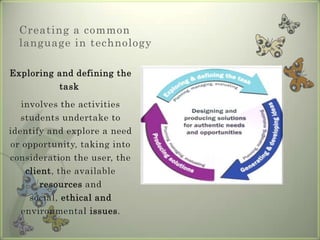
Creating a common language in technologyExploring and defining the task involves the activities students undertake to identify and explore a need or opportunity, taking into consideration the user, the client, the available resources and social, ethical and environmental issues.
Generating and developing ideas involves students exploring options, considering existing solutions, generating alternatives, representing and refining those ideas and deciding upon options.Students identify, explore and select resources such as techniques, materials and equipment that will best achieve the solution for their decisions and actions
Producing solutions involves students finalizing design decisions completing final design representations such as production drawings or storyboards sequencing the step-by-step actions for production managing safety risks practicing and refining techniques and completing the production of the solutionStudents reflect on the success of the solution, the process and the learning.
Planning, managing and evaluatingOngoing evaluation, related to the criteria of success, informs the students’ decision making at each phasethe evaluation at the conclusion of the project involves reflection and learning about the process used and the success of the solution.It is an essential component of each of the above phases. Management decisions made by students involve planning and reviewing milestones and implementing and monitoring time, actions and financial plans.
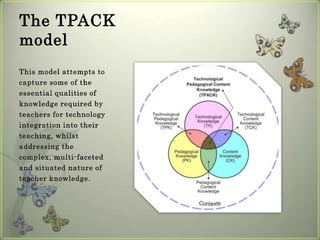
The TPACK model This model attempts to capture some of the essential qualities of knowledge required by teachers for technology integration into their teaching, whilst addressing the complex, multi-faceted and situated nature of teacher knowledge.
Other elements related to different types of knowledge included in the                   TPACK model :Content Knowledge
Pedagogical Knowledge
Technological KnowledgeTeaching with technology
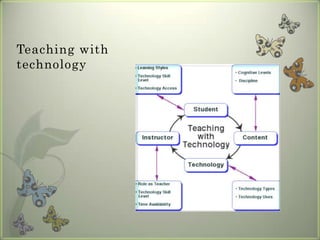
An examination of each component raises a set of issues that we need to consider in order to make technology integration as successful as possible.The studentsThe instructorCourse contentTechnology tools
We need to think carefully about our students, their exposure and access to technology as well as their preferred learning styles. Finally, we can turn to the technology itself and analyze it according to its functions. This approach to teaching and learning with technology assumes that the four component parts are integrated and that changes in one part will require adjustments to the other three in order to achieve the same goals.
Learning, Teaching, and TechnologyExample 1	A four-year-old girl sits at a computer with her mother, exploring Just Grandma and Me, an electronic storybook. When she clicks on a word, the computer says it aloud. The child repeats the word. After clicking through the text one word at a time, she says the whole sentence aloud, turns to her mother, and exclaims,"I can read!"Example 2 At the Harvard Literacy Lab, students with reading and writing difficulties willingly compose autobiographies, stories, and poems for personal home pages posted on the Lab's Web site. When e-mail responses to their writing arrive from other parts of the country and from as far away as Japan and Australia, they proudly mark the location of the sender on a map of the world.
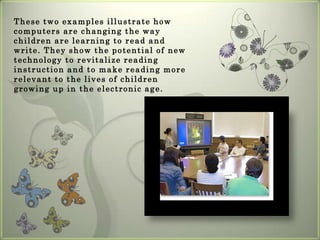
These two examples illustrate how computers are changing the way children are learning to read and write. They show the potential of new technology to revitalize reading instruction and to make reading more relevant to the lives of children growing up in the electronic age.
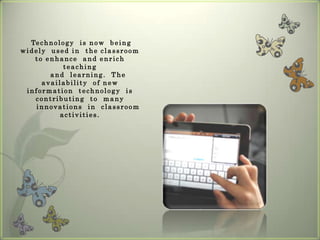
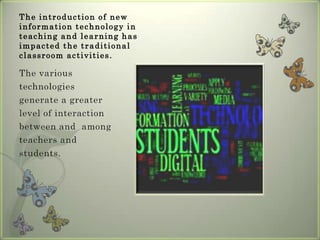
 Technology  is now  being widely  used in  the classroom to enhance  and enrich teaching      and  learning.  The  availability  of new  information  technology  is  contributing  to  many      innovations  in  classroom activities.
Strategies and  techniquesStrategies/techniques  now used to support  technology  in teaching  and  learning  enable  teachers  to  work collaboratively  with  students while  the students  themselves  become  more  immersed  in  their  own  learning.
New information  technologies  are increasingly  being adapted and integrated into the  educational  process.  The growing  use  of these  technologies  in  teaching  and learning  activities  has  given  rise to numerous  questions.Are the  new technologies changing  the  traditional  approach  to classroom activities?
How much are  the technologies  changing  the strategies/techniques  used in  the delivery  of instruction?
 Are the technologies  changing  the  quality  of interpersonal  relations  in our  classroom? Technology  of one  kind or the  other has always  been  used  in  the educationalenvironment.Devices utilized in  the  teaching  and  learning  process :The printed pageChalk and  chalkboardOverhead projectorsFilmstrips35mm films
The emergence  of newer forms  of technologyComputers,Computer  discs  interactive (CD-i)Videodiscs DVDDesktop  videoconferencing,InternetThese forms have  created  a  renewed  interest  for  their use  in  supporting  teaching  and learning  activities.These  technologies  are  also  capable  of promoting  educational activities  (synchronous  or asynchronous)  which  are  not  confined  to specific  time and/or  place.
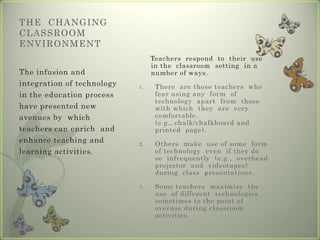
Education and  training activities  are increasingly  employing the use  of a variety  of technologies  to  support  pedagogy  and  learning. Word-processors
 Spreadsheets
Databases  Are being utilized  as tools in supporting teaching and  learning.
THE  CHANGING  CLASSROOM  ENVIRONMENTTeachers  respond  to  their  use in the  classroom  setting  in a number of ways.There  are those teachers  who fear using any  form  of technology  apart  from  those with which  they  are  very  comfortable.                                 (e.g., chalk/chalkboard and printed  page).Others  make  use of some  form  of technology  even  if they do  so  infrequently  (e.g.,  overhead  projector  and  videotapes)  during  class  presentations.Some teachers  maximize  the use  of different  technologies  sometimes to the point of overuse during classroom activities.The infusion and integration of technology in the education process have presented new avenues by  which teachers can enrich  and enhance teaching and  learning activities.
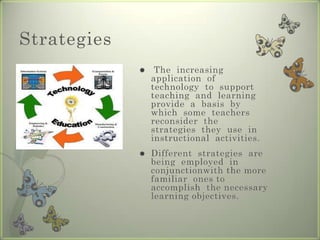
Strategies The  increasing  application  of  technology  to  support  teaching  and  learning provide  a  basis  by  which  some  teachers  reconsider  the  strategies  they  use  in instructional  activities.  Different  strategies  are  being  employed  in  conjunctionwith the more familiar  ones to accomplish  the necessary  learning objectives.
Students and their roleMany students  are more familiar  with some of the  technologies  employed in the  educational  environment. They also show a high  level of resourcefulness in  determining  different ways by  which the technologies  available might be  used to support  teaching and  learning activities.Working together in  this new learning  environment,  teachers and  students become  teams of 'knowledge  explorers' who  translate textbook knowledge into new  exciting   presentations, using the different  technologies  learning for many  students become  more exciting  as  they are actively  involved in the process.
The  infusion  and integration  of technologyD'Ignazio (1990a)  indicated, The  infusion  and integration  of technology  in  classrooms will increase  the  use  of  strategies  such  as  thematic  teaching, guided  inquiry  apprenticeship,  group  problem  solving,  and  critical  thinking.

Technology and education

  • 1.
  • 2.
    Creating a commonlanguage in technologyExploring and defining the task involves the activities students undertake to identify and explore a need or opportunity, taking into consideration the user, the client, the available resources and social, ethical and environmental issues.
  • 3.
    Generating and developingideas involves students exploring options, considering existing solutions, generating alternatives, representing and refining those ideas and deciding upon options.Students identify, explore and select resources such as techniques, materials and equipment that will best achieve the solution for their decisions and actions
  • 4.
    Producing solutions involves studentsfinalizing design decisions completing final design representations such as production drawings or storyboards sequencing the step-by-step actions for production managing safety risks practicing and refining techniques and completing the production of the solutionStudents reflect on the success of the solution, the process and the learning.
  • 5.
    Planning, managing andevaluatingOngoing evaluation, related to the criteria of success, informs the students’ decision making at each phasethe evaluation at the conclusion of the project involves reflection and learning about the process used and the success of the solution.It is an essential component of each of the above phases. Management decisions made by students involve planning and reviewing milestones and implementing and monitoring time, actions and financial plans.
  • 6.
    The TPACK modelThis model attempts to capture some of the essential qualities of knowledge required by teachers for technology integration into their teaching, whilst addressing the complex, multi-faceted and situated nature of teacher knowledge.
  • 7.
    Other elements relatedto different types of knowledge included in the TPACK model :Content Knowledge
  • 8.
  • 9.
  • 10.
    An examination ofeach component raises a set of issues that we need to consider in order to make technology integration as successful as possible.The studentsThe instructorCourse contentTechnology tools
  • 11.
    We need tothink carefully about our students, their exposure and access to technology as well as their preferred learning styles. Finally, we can turn to the technology itself and analyze it according to its functions. This approach to teaching and learning with technology assumes that the four component parts are integrated and that changes in one part will require adjustments to the other three in order to achieve the same goals.
  • 12.
    Learning, Teaching, andTechnologyExample 1 A four-year-old girl sits at a computer with her mother, exploring Just Grandma and Me, an electronic storybook. When she clicks on a word, the computer says it aloud. The child repeats the word. After clicking through the text one word at a time, she says the whole sentence aloud, turns to her mother, and exclaims,"I can read!"Example 2 At the Harvard Literacy Lab, students with reading and writing difficulties willingly compose autobiographies, stories, and poems for personal home pages posted on the Lab's Web site. When e-mail responses to their writing arrive from other parts of the country and from as far away as Japan and Australia, they proudly mark the location of the sender on a map of the world.
  • 13.
    These two examplesillustrate how computers are changing the way children are learning to read and write. They show the potential of new technology to revitalize reading instruction and to make reading more relevant to the lives of children growing up in the electronic age.
  • 14.
    Technology is now being widely used in the classroom to enhance and enrich teaching and learning. The availability of new information technology is contributing to many innovations in classroom activities.
  • 15.
    Strategies and techniquesStrategies/techniques now used to support technology in teaching and learning enable teachers to work collaboratively with students while the students themselves become more immersed in their own learning.
  • 16.
    New information technologies are increasingly being adapted and integrated into the educational process. The growing use of these technologies in teaching and learning activities has given rise to numerous questions.Are the new technologies changing the traditional approach to classroom activities?
  • 17.
    How much are the technologies changing the strategies/techniques used in the delivery of instruction?
  • 18.
    Are thetechnologies changing the quality of interpersonal relations in our classroom? Technology of one kind or the other has always been used in the educationalenvironment.Devices utilized in the teaching and learning process :The printed pageChalk and chalkboardOverhead projectorsFilmstrips35mm films
  • 19.
    The emergence of newer forms of technologyComputers,Computer discs interactive (CD-i)Videodiscs DVDDesktop videoconferencing,InternetThese forms have created a renewed interest for their use in supporting teaching and learning activities.These technologies are also capable of promoting educational activities (synchronous or asynchronous) which are not confined to specific time and/or place.
  • 20.
    Education and training activities are increasingly employing the use of a variety of technologies to support pedagogy and learning. Word-processors
  • 21.
  • 22.
    Databases Arebeing utilized as tools in supporting teaching and learning.
  • 23.
    THE CHANGING CLASSROOM ENVIRONMENTTeachers respond to their use in the classroom setting in a number of ways.There are those teachers who fear using any form of technology apart from those with which they are very comfortable. (e.g., chalk/chalkboard and printed page).Others make use of some form of technology even if they do so infrequently (e.g., overhead projector and videotapes) during class presentations.Some teachers maximize the use of different technologies sometimes to the point of overuse during classroom activities.The infusion and integration of technology in the education process have presented new avenues by which teachers can enrich and enhance teaching and learning activities.
  • 24.
    Strategies The increasing application of technology to support teaching and learning provide a basis by which some teachers reconsider the strategies they use in instructional activities. Different strategies are being employed in conjunctionwith the more familiar ones to accomplish the necessary learning objectives.
  • 25.
    Students and theirroleMany students are more familiar with some of the technologies employed in the educational environment. They also show a high level of resourcefulness in determining different ways by which the technologies available might be used to support teaching and learning activities.Working together in this new learning environment, teachers and students become teams of 'knowledge explorers' who translate textbook knowledge into new exciting presentations, using the different technologies learning for many students become more exciting as they are actively involved in the process.
  • 26.
    The infusion and integration of technologyD'Ignazio (1990a) indicated, The infusion and integration of technology in classrooms will increase the use of strategies such as thematic teaching, guided inquiry apprenticeship, group problem solving, and critical thinking.