COLD CHAIN
INTRODUCTION
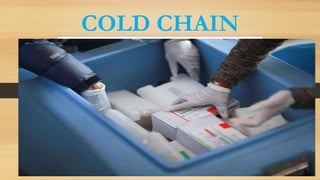
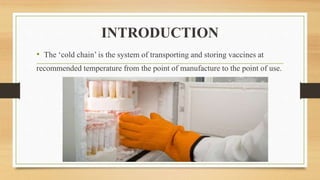
• The ‘cold chain’ is the system of transporting and storing vaccines at
recommended temperature from the point of manufacture to the point of use.
DEFINITION
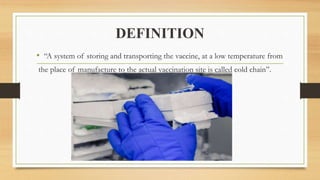
• “A system of storing and transporting the vaccine, at a low temperature from
the place of manufacture to the actual vaccination site is called cold chain”.
IMPORTANCE OF COLD CHAIN
• 1. Obtaining the vaccines from the manufacturers
• 2. Storing and transporting the vaccines
• 3. Maintaining the supply of vaccines
• 4. Having information about essential equipments, supply of electricity etc
• 5. Keeping the vaccine at low temperature 6. Protecting the vaccine from
sunlight exposure
• 7. Maintaining the potency of vaccines.
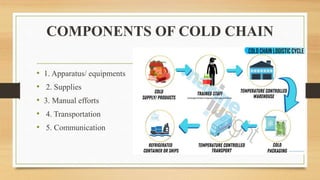
COMPONENTS OF COLD CHAIN
• 1. Apparatus/ equipments
• 2. Supplies
• 3. Manual efforts
• 4. Transportation
• 5. Communication
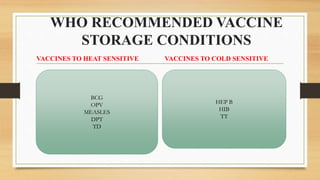
WHO RECOMMENDED VACCINE
STORAGE CONDITIONS
VACCINES TO HEAT SENSITIVE
•
VACCINES TO COLD SENSITIVE
HEP B
HIB
TT
BCG
OPV
MEASLES
DPT
TD
THE COLD CHAIN SYSTEM-
ELEMENTS
• Personnel
• Who use and maintain the equipment and provide the health service.
• Equipment
• For safe storage and transportation of vaccines. 3. Procedures: to manage the
programme and control
• Procedures
• To manage the programme and control distribution and use of vaccines.
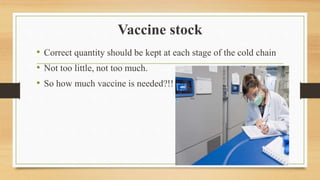
Vaccine stock
• Correct quantity should be kept at each stage of the cold chain
• Not too little, not too much.
• So how much vaccine is needed?!!
ESTIMATION OF THE QUANTITY OF
VACCINE NEEDED
• Number of vaccine deliveries planned during the next 12 months (fewer
deliveries,, larger and costive cold chain).
•Amount of reserve vaccine stock to be kept in the main store (for
outbreaks, delay in arrival of vaccine delivery).
•Balance of vaccine stock remaining in the main store (stock remaining
should be added to the amount needed, balanced to avoid overcrowding &
expiry of vaccines).
Vaccine stock records
• All vaccine storage units must keep Complete & updated stock record.
• 1. Information to be recorded: 1. Name of vaccine, batch number, expiry
date & vial size.
• 2. Quantity received and source of supply.
• 3. Quantity issued & to whom sent.
• 4. For BCG, measles & mumps: quantities of diluent received & issued.
• 5. Balance in stock after each transaction.
• 6. Date of transaction.
• 7. Physical stock check at the end of each page.
COLD CHAIN DURING
IMMUNIZATION SESSIONS
• Vaccines are most vulnerable at this level / Precautions should
be taken
1.At the beginning of the working day.
2. During immunization session
3. At the end of the working day.
4. During outreach immunization session.
AT THE BEGINNING OF THE
WORKING DAY
• Check refrigerator temperature.
• Estimate number of vials needed
• Prepare vaccine carrier loaded with icepacks, do not work directly from
the refrigerator.
• Replace used icepacks by new filled ones for the next day.
DURING IMMUNIZATION SESSION
• Open vials only after calling the first child.
• Put remaining vaccine back into carrier as quickly as possible.
• Vaccines should be kept out of direct sunlight.
AT THE END OF THE WORKING DAY
• Opened vials returned to refrigerator for the next session Except for
measles and BCG.
• Unopened vials returned to be used first during the next session.
• Record quantity used during the day.
• Record refrigerator temperature on the record sheet.
DURING OUTREACH IMMUNIZATION
SESSIONS
• Same instructions, plus,,,
• Sufficient stock, sufficient icepacks.
• Extra cold box (if no electric supply for a refrigerator).
BREAKDOWNS AND EMERGENCY
• Any interruption of the cold chain is an emergency.
• Technical faults in refrigerator:
• If refrigerator stops, transfer vaccines to a cold box
• Check plugs, thermostat, appliances,..
• Call for help.
• Plan for cold chain emergencies:
• Always prepare your plan.
• Define at least two people who know what to do and when.
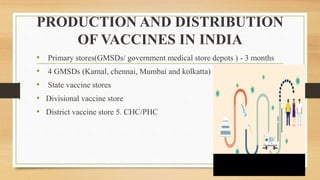
PRODUCTION AND DISTRIBUTION
OF VACCINES IN INDIA
• Primary stores(GMSDs/ government medical store depots ) - 3 months
• 4 GMSDs (Karnal, chennai, Mumbai and kolkatta)
• State vaccine stores
• Divisional vaccine store
• District vaccine store 5. CHC/PHC
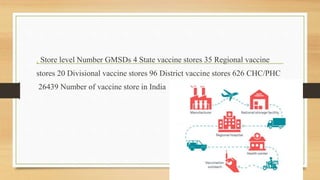
. Store level Number GMSDs 4 State vaccine stores 35 Regional vaccine
stores 20 Divisional vaccine stores 96 District vaccine stores 626 CHC/PHC
26439 Number of vaccine store in India
WHY IS THE COLD CHAIN
IMPORTANT
• 1. Vaccines are:
• Biological products
• lose potency with time
• Process irreversible and accelerated if proper storage conditions are not
adhered to
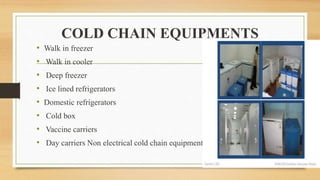
COLD CHAIN EQUIPMENTS
• Walk in freezer
• Walk in cooler
• Deep freezer
• Ice lined refrigerators
• Domestic refrigerators
• Cold box
• Vaccine carriers
• Day carriers Non electrical cold chain equipments
Walk in freezer
• State level
• Bulk storage of OPV
• Prepare frozen ice packs
• Maintain temperature : - 20 deg C
• Storage capacity: 15 – 20 Lakh doses
• Stand by generator
• Alarm
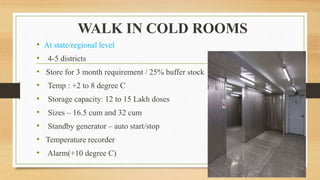
WALK IN COLD ROOMS
• At state/regional level
• 4-5 districts
• Store for 3 month requirement / 25% buffer stock
• Temp : +2 to 8 degree C
• Storage capacity: 12 to 15 Lakh doses
• Sizes – 16.5 cum and 32 cum
• Standby generator – auto start/stop
• Temperature recorder
• Alarm(+10 degree C)
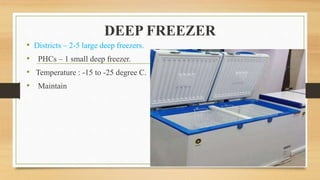
DEEP FREEZER
• Districts – 2-5 large deep freezers.
• PHCs – 1 small deep freezer.
• Temperature : -15 to -25 degree C.
• Maintain
ICE LINED REFRIGERATOR(ILR)
• Both at district and PHC levels
• Temp :- +2oc to +8oc
• 2 sections –A and B.
• A- bottom – OPV and Measles.
• B- upper – BCG, DPT, DT and TT.
DO’S FOR USE OF ILR/FREEZER
• Keep the equipment in a cool room
• Away from direct sunlight
• At least 10 cms away from the wall.
• Keep the equipment properly levelled.
• Fix the plug permanently to the socket.
• Use voltage stabilizer.
• Keep the vaccines neatly stacked with space for circulation of air.
• Keep the equipment locked and open it only when necessary.
• Defrost periodically.
• Check the temperature twice a day
• Maintain a record Supervised and signed - supervisor/Medical Officer
regularly.
• Outside the equipment - notice of the contingency plan
• Should know whom to contact
• Should arrange for alternate place for storing vaccines.
DON’TS FOR USE OF ILR/FREEZER
• Do not keep other drugs and vaccines not used in UIP.
• Do not open the top un-necessarily (Paste this message on the top of the
ILR).
• Do not keep food or drinking water in the DFs/ILR.
• Do not keep – More than one month’s requirement at PHC
headquarters
• More than 3 months requirement at district level.
• Do not keep vaccines, which have expired.
• Do not disturb thermostat setting frequently.
COLD BOX
• Collect and transport large quantities of vaccines.
• These are of different sizes 5, 8, 20 and 22 litres.
• Store vaccines for transfer up to five days
• The hold over time is- More than 90 hours for 5 Litre
• Six days for 20 Litre cold box
• Remember - ? If not opened at all
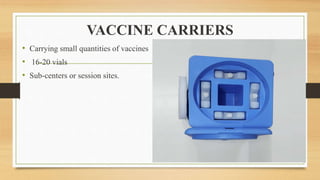
VACCINE CARRIERS
• Carrying small quantities of vaccines
• 16-20 vials
• Sub-centers or session sites.
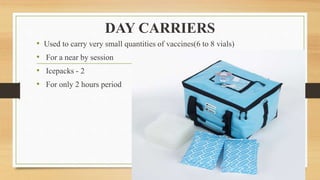
DAY CARRIERS
• Used to carry very small quantities of vaccines(6 to 8 vials)
• For a near by session
• Icepacks - 2
• For only 2 hours period
VACCINE STORAGE POINTS TO BE
REMEMBER
• No food or medical specimens
• Do not place fridge in direct sunlight or near heat source
• Do not store vaccines for more than 1 month at PHC.
• Do not store vaccines in fridge doors or in solid plastic trays/containers
within the fridge
DONT'S
• Safeguard electricity supply
• Not more than 50% full
• Place vaccines in clearly labelled plastic mesh baskets
• Group vaccines by type (Paediatric,Adult, Adolescent)
• Defrost/calibrate fridge regularly
SHAKE TEST
• The Shake Test can help give an idea wheather absorbed vaccines
(dpt,dt,td,tthep-b) have been subjected to freezing temperatures likely to have
damaged them
• steps of shake test
1. Take asuspected freeze damaged vial
2. Take another vial of same vaccine from the same batch and the same
manufracturerer label
3. Deliberately control the room temperature
4. Shake both vials vigorously
5. Place the both of them on a flat surface against source of light
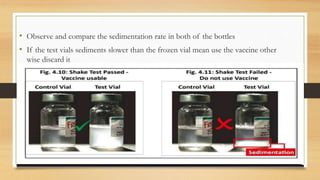
• Observe and compare the sedimentation rate in both of the bottles
• If the test vials sediments slower than the frozen vial mean use the vaccine other
wise discard it
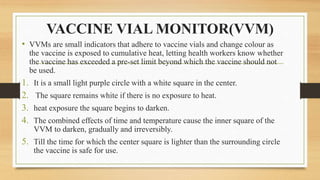
VACCINE VIAL MONITOR(VVM)
• VVMs are small indicators that adhere to vaccine vials and change colour as
the vaccine is exposed to cumulative heat, letting health workers know whether
the vaccine has exceeded a pre-set limit beyond which the vaccine should not
be used.
1. It is a small light purple circle with a white square in the center.
2. The square remains white if there is no exposure to heat.
3. heat exposure the square begins to darken.
4. The combined effects of time and temperature cause the inner square of the
VVM to darken, gradually and irreversibly.
5. Till the time for which the center square is lighter than the surrounding circle
the vaccine is safe for use.
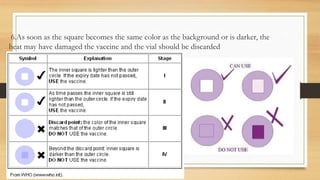
6.As soon as the square becomes the same color as the background or is darker, the
heat may have damaged the vaccine and the vial should be discarded
COLD CHAIN MONITORING
EQUIPMENT
• Dial type Thermometer
• Bar type Thermometer
• Vaccine cold chain monitor
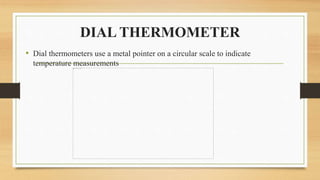
DIAL THERMOMETER
• Dial thermometers use a metal pointer on a circular scale to indicate
temperature measurements
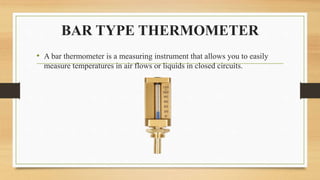
BAR TYPE THERMOMETER
• A bar thermometer is a measuring instrument that allows you to easily
measure temperatures in air flows or liquids in closed circuits.
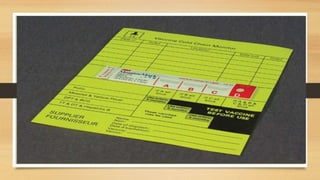
VACCINE COLD CHAIN MONITOR
• The cold-chain monitor is used to show exposure to temperatures above the safe
range during transportation and storage. It has an indicator that responds to two
different temperatures:
• the first part —marked ABC—responds to temperatures above +10oC
• the second part—marked D—responds to temperatures above +34oC
COLD CHAIN.pptx
COLD CHAIN.pptx

COLD CHAIN.pptx

  • 1.
  • 2.
    INTRODUCTION • The ‘coldchain’ is the system of transporting and storing vaccines at recommended temperature from the point of manufacture to the point of use.
  • 3.
    DEFINITION • “A systemof storing and transporting the vaccine, at a low temperature from the place of manufacture to the actual vaccination site is called cold chain”.
  • 4.
    IMPORTANCE OF COLDCHAIN • 1. Obtaining the vaccines from the manufacturers • 2. Storing and transporting the vaccines • 3. Maintaining the supply of vaccines • 4. Having information about essential equipments, supply of electricity etc • 5. Keeping the vaccine at low temperature 6. Protecting the vaccine from sunlight exposure • 7. Maintaining the potency of vaccines.
  • 5.
    COMPONENTS OF COLDCHAIN • 1. Apparatus/ equipments • 2. Supplies • 3. Manual efforts • 4. Transportation • 5. Communication
  • 6.
    WHO RECOMMENDED VACCINE STORAGECONDITIONS VACCINES TO HEAT SENSITIVE • VACCINES TO COLD SENSITIVE HEP B HIB TT BCG OPV MEASLES DPT TD
  • 7.
    THE COLD CHAINSYSTEM- ELEMENTS • Personnel • Who use and maintain the equipment and provide the health service. • Equipment • For safe storage and transportation of vaccines. 3. Procedures: to manage the programme and control • Procedures • To manage the programme and control distribution and use of vaccines.
  • 8.
    Vaccine stock • Correctquantity should be kept at each stage of the cold chain • Not too little, not too much. • So how much vaccine is needed?!!
  • 9.
    ESTIMATION OF THEQUANTITY OF VACCINE NEEDED • Number of vaccine deliveries planned during the next 12 months (fewer deliveries,, larger and costive cold chain). •Amount of reserve vaccine stock to be kept in the main store (for outbreaks, delay in arrival of vaccine delivery). •Balance of vaccine stock remaining in the main store (stock remaining should be added to the amount needed, balanced to avoid overcrowding & expiry of vaccines).
  • 10.
    Vaccine stock records •All vaccine storage units must keep Complete & updated stock record. • 1. Information to be recorded: 1. Name of vaccine, batch number, expiry date & vial size. • 2. Quantity received and source of supply. • 3. Quantity issued & to whom sent. • 4. For BCG, measles & mumps: quantities of diluent received & issued. • 5. Balance in stock after each transaction. • 6. Date of transaction. • 7. Physical stock check at the end of each page.
  • 11.
    COLD CHAIN DURING IMMUNIZATIONSESSIONS • Vaccines are most vulnerable at this level / Precautions should be taken 1.At the beginning of the working day. 2. During immunization session 3. At the end of the working day. 4. During outreach immunization session.
  • 12.
    AT THE BEGINNINGOF THE WORKING DAY • Check refrigerator temperature. • Estimate number of vials needed • Prepare vaccine carrier loaded with icepacks, do not work directly from the refrigerator. • Replace used icepacks by new filled ones for the next day.
  • 13.
    DURING IMMUNIZATION SESSION •Open vials only after calling the first child. • Put remaining vaccine back into carrier as quickly as possible. • Vaccines should be kept out of direct sunlight.
  • 14.
    AT THE ENDOF THE WORKING DAY • Opened vials returned to refrigerator for the next session Except for measles and BCG. • Unopened vials returned to be used first during the next session. • Record quantity used during the day. • Record refrigerator temperature on the record sheet.
  • 15.
    DURING OUTREACH IMMUNIZATION SESSIONS •Same instructions, plus,,, • Sufficient stock, sufficient icepacks. • Extra cold box (if no electric supply for a refrigerator).
  • 16.
    BREAKDOWNS AND EMERGENCY •Any interruption of the cold chain is an emergency. • Technical faults in refrigerator: • If refrigerator stops, transfer vaccines to a cold box • Check plugs, thermostat, appliances,.. • Call for help. • Plan for cold chain emergencies: • Always prepare your plan. • Define at least two people who know what to do and when.
  • 17.
    PRODUCTION AND DISTRIBUTION OFVACCINES IN INDIA • Primary stores(GMSDs/ government medical store depots ) - 3 months • 4 GMSDs (Karnal, chennai, Mumbai and kolkatta) • State vaccine stores • Divisional vaccine store • District vaccine store 5. CHC/PHC
  • 18.
    . Store levelNumber GMSDs 4 State vaccine stores 35 Regional vaccine stores 20 Divisional vaccine stores 96 District vaccine stores 626 CHC/PHC 26439 Number of vaccine store in India
  • 19.
    WHY IS THECOLD CHAIN IMPORTANT • 1. Vaccines are: • Biological products • lose potency with time • Process irreversible and accelerated if proper storage conditions are not adhered to
  • 20.
    COLD CHAIN EQUIPMENTS •Walk in freezer • Walk in cooler • Deep freezer • Ice lined refrigerators • Domestic refrigerators • Cold box • Vaccine carriers • Day carriers Non electrical cold chain equipments
  • 21.
    Walk in freezer •State level • Bulk storage of OPV • Prepare frozen ice packs • Maintain temperature : - 20 deg C • Storage capacity: 15 – 20 Lakh doses • Stand by generator • Alarm
  • 22.
    WALK IN COLDROOMS • At state/regional level • 4-5 districts • Store for 3 month requirement / 25% buffer stock • Temp : +2 to 8 degree C • Storage capacity: 12 to 15 Lakh doses • Sizes – 16.5 cum and 32 cum • Standby generator – auto start/stop • Temperature recorder • Alarm(+10 degree C)
  • 23.
    DEEP FREEZER • Districts– 2-5 large deep freezers. • PHCs – 1 small deep freezer. • Temperature : -15 to -25 degree C. • Maintain
  • 24.
    ICE LINED REFRIGERATOR(ILR) •Both at district and PHC levels • Temp :- +2oc to +8oc • 2 sections –A and B. • A- bottom – OPV and Measles. • B- upper – BCG, DPT, DT and TT.
  • 25.
    DO’S FOR USEOF ILR/FREEZER • Keep the equipment in a cool room • Away from direct sunlight • At least 10 cms away from the wall. • Keep the equipment properly levelled. • Fix the plug permanently to the socket. • Use voltage stabilizer. • Keep the vaccines neatly stacked with space for circulation of air. • Keep the equipment locked and open it only when necessary.
  • 26.
    • Defrost periodically. •Check the temperature twice a day • Maintain a record Supervised and signed - supervisor/Medical Officer regularly. • Outside the equipment - notice of the contingency plan • Should know whom to contact • Should arrange for alternate place for storing vaccines.
  • 27.
    DON’TS FOR USEOF ILR/FREEZER • Do not keep other drugs and vaccines not used in UIP. • Do not open the top un-necessarily (Paste this message on the top of the ILR). • Do not keep food or drinking water in the DFs/ILR. • Do not keep – More than one month’s requirement at PHC headquarters • More than 3 months requirement at district level. • Do not keep vaccines, which have expired. • Do not disturb thermostat setting frequently.
  • 28.
    COLD BOX • Collectand transport large quantities of vaccines. • These are of different sizes 5, 8, 20 and 22 litres. • Store vaccines for transfer up to five days • The hold over time is- More than 90 hours for 5 Litre • Six days for 20 Litre cold box • Remember - ? If not opened at all
  • 29.
    VACCINE CARRIERS • Carryingsmall quantities of vaccines • 16-20 vials • Sub-centers or session sites.
  • 30.
    DAY CARRIERS • Usedto carry very small quantities of vaccines(6 to 8 vials) • For a near by session • Icepacks - 2 • For only 2 hours period
  • 31.
    VACCINE STORAGE POINTSTO BE REMEMBER • No food or medical specimens • Do not place fridge in direct sunlight or near heat source • Do not store vaccines for more than 1 month at PHC. • Do not store vaccines in fridge doors or in solid plastic trays/containers within the fridge
  • 32.
    DONT'S • Safeguard electricitysupply • Not more than 50% full • Place vaccines in clearly labelled plastic mesh baskets • Group vaccines by type (Paediatric,Adult, Adolescent) • Defrost/calibrate fridge regularly
  • 33.
    SHAKE TEST • TheShake Test can help give an idea wheather absorbed vaccines (dpt,dt,td,tthep-b) have been subjected to freezing temperatures likely to have damaged them • steps of shake test 1. Take asuspected freeze damaged vial 2. Take another vial of same vaccine from the same batch and the same manufracturerer label 3. Deliberately control the room temperature 4. Shake both vials vigorously 5. Place the both of them on a flat surface against source of light
  • 34.
    • Observe andcompare the sedimentation rate in both of the bottles • If the test vials sediments slower than the frozen vial mean use the vaccine other wise discard it
  • 35.
    VACCINE VIAL MONITOR(VVM) •VVMs are small indicators that adhere to vaccine vials and change colour as the vaccine is exposed to cumulative heat, letting health workers know whether the vaccine has exceeded a pre-set limit beyond which the vaccine should not be used. 1. It is a small light purple circle with a white square in the center. 2. The square remains white if there is no exposure to heat. 3. heat exposure the square begins to darken. 4. The combined effects of time and temperature cause the inner square of the VVM to darken, gradually and irreversibly. 5. Till the time for which the center square is lighter than the surrounding circle the vaccine is safe for use.
  • 36.
    6.As soon asthe square becomes the same color as the background or is darker, the heat may have damaged the vaccine and the vial should be discarded
  • 37.
    COLD CHAIN MONITORING EQUIPMENT •Dial type Thermometer • Bar type Thermometer • Vaccine cold chain monitor
  • 38.
    DIAL THERMOMETER • Dialthermometers use a metal pointer on a circular scale to indicate temperature measurements
  • 39.
    BAR TYPE THERMOMETER •A bar thermometer is a measuring instrument that allows you to easily measure temperatures in air flows or liquids in closed circuits.
  • 40.
    VACCINE COLD CHAINMONITOR • The cold-chain monitor is used to show exposure to temperatures above the safe range during transportation and storage. It has an indicator that responds to two different temperatures: • the first part —marked ABC—responds to temperatures above +10oC • the second part—marked D—responds to temperatures above +34oC