WHY IMMUNIZATION ?
 Key strategy to child survival
 Protecting infants from diseases.
 Lowers morbidity and mortality rates in
children.
 Can lead to lower birth rates.
 Indicator of a strong primary health care
system.
IMMUNIZATION: COMMON TERMS
 Immunization:
Process of inducing immunity by stimulating
immune system through antigens.
 Immunity :
Resistance of a host to a specific agent,
characterized by measurable and protective
surface or humoral antibody and by cell mediated
immune responses.
 Vaccine:
A preparation of a weakened or killed pathogen,
such as a bacterium or virus, or of a portion of the
pathogen's structure that upon administration
stimulates antibody production or cellular
immunity against the pathogen but is incapable of
causing severe infection.
 Vaccination:
Administration of antigenic material (the vaccine)
to produce immunity to a disease.
FULL IMMUNIZATION:
 Beneficiary child (12-23 months) - 3 doses of
 DPT and OPV each, 1 dose of BCG & measles
each.
 Mother - two doses or 1 booster dose of tetanus
toxoid during her last pregnancy.
Partial Immunization:
 Child- missed any vaccine or one or more doses
 Mother- received just one dose of primary tetanus
toxoid during last pregnancy.
Non immunization:
 Child and/or mother- not received a single dose
of vaccine.
 Ring immunization:
Vaccination of people in close contact with an isolated
infected patient.
 Mop-up rounds:
When the final pockets of polio virus transmission have
been identified through standard surveillance, door-to-
door immunization in high-risk districts.
 Catch up rounds:
Additional effort besides routine immunization to cover
left outs
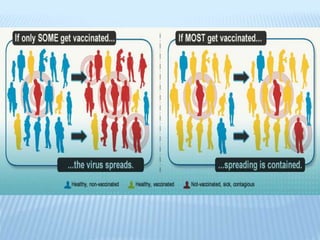
HERD IMMUNITY?
 Resistance to spread of infectious disease in a
group because of few susceptible members,
making transmission unlikely.
 The immunologic status of a population,
determined by the ratio of resistant to
susceptible members and their distribution.
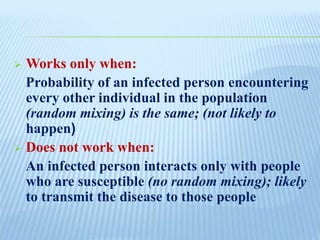
 Works only when:
Probability of an infected person encountering
every other individual in the population
(random mixing) is the same; (not likely to
happen)
 Does not work when:
An infected person interacts only with people
who are susceptible (no random mixing); likely
to transmit the disease to those people
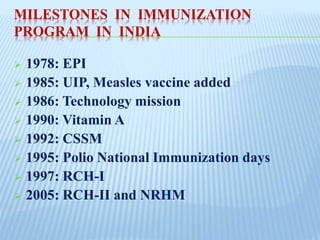
MILESTONES IN IMMUNIZATION
PROGRAM IN INDIA
 1978: EPI
 1985: UIP, Measles vaccine added
 1986: Technology mission
 1990: Vitamin A
 1992: CSSM
 1995: Polio National Immunization days
 1997: RCH-I
 2005: RCH-II and NRHM
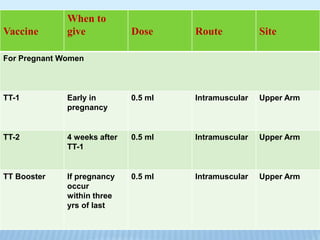
Vaccine
When to
give Dose Route Site
For Pregnant Women
TT-1 Early in
pregnancy
0.5 ml Intramuscular Upper Arm
TT-2 4 weeks after
TT-1
0.5 ml Intramuscular Upper Arm
TT Booster If pregnancy
occur
within three
yrs of last
0.5 ml Intramuscular Upper Arm
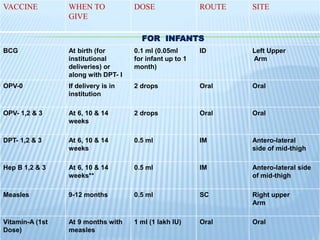
VACCINE WHEN TO
GIVE
DOSE ROUTE SITE
FOR INFANTS
BCG At birth (for
institutional
deliveries) or
along with DPT- I
0.1 ml (0.05ml
for infant up to 1
month)
ID Left Upper
Arm
OPV-0 If delivery is in
institution
2 drops Oral Oral
OPV- 1,2 & 3 At 6, 10 & 14
weeks
2 drops Oral Oral
DPT- 1,2 & 3 At 6, 10 & 14
weeks
0.5 ml IM Antero-lateral
side of mid-thigh
Hep B 1,2 & 3 At 6, 10 & 14
weeks**
0.5 ml IM Antero-lateral side
of mid-thigh
Measles 9-12 months 0.5 ml SC Right upper
Arm
Vitamin-A (1st
Dose)
At 9 months with
measles
1 ml (1 lakh IU) Oral Oral
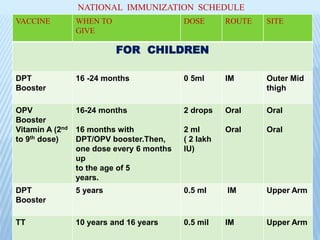
VACCINE WHEN TO
GIVE
DOSE ROUTE SITE
FOR CHILDREN
DPT
Booster
16 -24 months 0 5ml IM Outer Mid
thigh
OPV
Booster
Vitamin A (2nd
to 9th dose)
16-24 months
16 months with
DPT/OPV booster.Then,
one dose every 6 months
up
to the age of 5
years.
2 drops
2 ml
( 2 lakh
IU)
Oral
Oral
Oral
Oral
DPT
Booster
5 years 0.5 ml IM Upper Arm
TT 10 years and 16 years 0.5 mil IM Upper Arm
NATIONAL IMMUNIZATION SCHEDULE
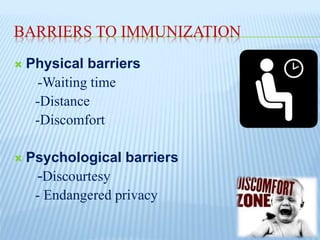
BARRIERS TO IMMUNIZATION
 Physical barriers
-Waiting time
-Distance
-Discomfort
 Psychological barriers
-Discourtesy
- Endangered privacy
REASONS FOR LOW IMMUNIZATION
COVERAGE
 Failure to provide immunization
 Dropouts
 Un-reached populations:-
- Unawareness
- socio-economic barriers
- geographic access
 Resistant populations
 Missed Opportunities
 Improper logistics management
WHAT SHOULD NOT HOLD ROUTINE
IMMUNIZATION
 Minor illnesses such as upper respiratory
infections or diarrhea, mild fever (< 38.5°c)
 Allergy, asthma
 Prematurity, underweight newborn child
 Malnutrition
 Child being breastfed
 Family history of convulsions
 Treatment with antibiotics
 Dermatosis, eczema or localized skin infection
 Chronic diseases of the heart, lung, kidney
and liver.
 Stable neurological conditions, such as
cerebral palsy and Down's syndrome
 History of jaundice after birth
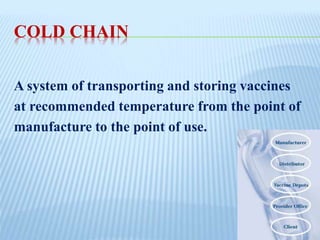
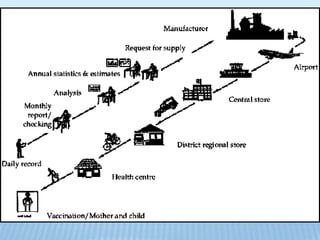
COLD CHAIN
A system of transporting and storing vaccines
at recommended temperature from the point of
manufacture to the point of use.
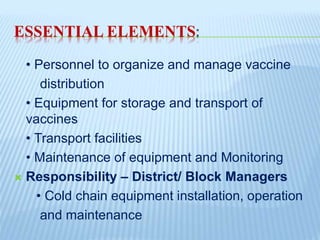
ESSENTIAL ELEMENTS:
• Personnel to organize and manage vaccine
distribution
• Equipment for storage and transport of
vaccines
• Transport facilities
• Maintenance of equipment and Monitoring
 Responsibility – District/ Block Managers
• Cold chain equipment installation, operation
and maintenance
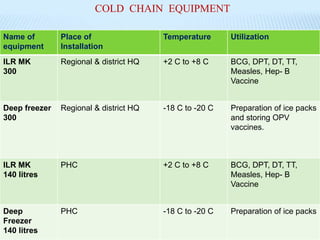
Name of
equipment
Place of
Installation
Temperature Utilization
ILR MK
300
Regional & district HQ +2 C to +8 C BCG, DPT, DT, TT,
Measles, Hep- B
Vaccine
Deep freezer
300
Regional & district HQ -18 C to -20 C Preparation of ice packs
and storing OPV
vaccines.
ILR MK
140 litres
PHC +2 C to +8 C BCG, DPT, DT, TT,
Measles, Hep- B
Vaccine
Deep
Freezer
140 litres
PHC -18 C to -20 C Preparation of ice packs
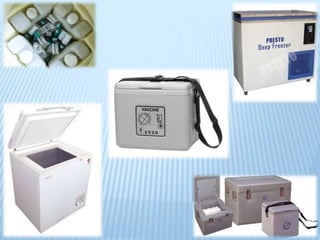
COLD CHAIN EQUIPMENT
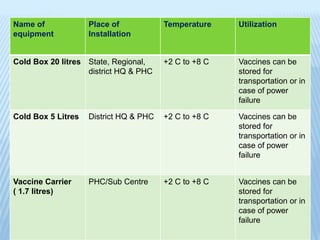
Name of
equipment
Place of
Installation
Temperature Utilization
Cold Box 20 litres State, Regional,
district HQ & PHC
+2 C to +8 C Vaccines can be
stored for
transportation or in
case of power
failure
Cold Box 5 Litres District HQ & PHC +2 C to +8 C Vaccines can be
stored for
transportation or in
case of power
failure
Vaccine Carrier
( 1.7 litres)
PHC/Sub Centre +2 C to +8 C Vaccines can be
stored for
transportation or in
case of power
failure
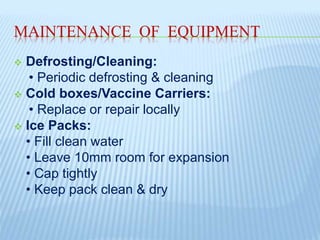
MAINTENANCE OF EQUIPMENT
 Defrosting/Cleaning:
• Periodic defrosting & cleaning
 Cold boxes/Vaccine Carriers:
• Replace or repair locally
 Ice Packs:
• Fill clean water
• Leave 10mm room for expansion
• Cap tightly
• Keep pack clean & dry
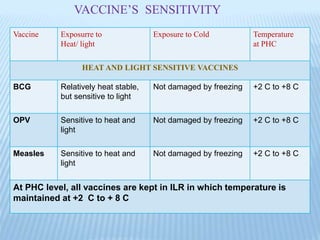
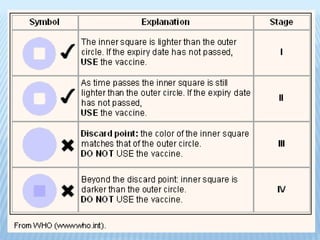
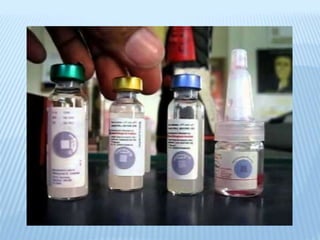
Vaccine Exposurre to
Heat/ light
Exposure to Cold Temperature
at PHC
HEAT AND LIGHT SENSITIVE VACCINES
BCG Relatively heat stable,
but sensitive to light
Not damaged by freezing +2 C to +8 C
OPV Sensitive to heat and
light
Not damaged by freezing +2 C to +8 C
Measles Sensitive to heat and
light
Not damaged by freezing +2 C to +8 C
At PHC level, all vaccines are kept in ILR in which temperature is
maintained at +2 C to + 8 C
VACCINE’S SENSITIVITY
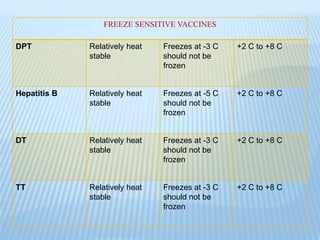
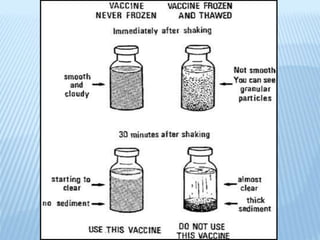
FREEZE SENSITIVE VACCINES
DPT Relatively heat
stable
Freezes at -3 C
should not be
frozen
+2 C to +8 C
Hepatitis B Relatively heat
stable
Freezes at -5 C
should not be
frozen
+2 C to +8 C
DT Relatively heat
stable
Freezes at -3 C
should not be
frozen
+2 C to +8 C
TT Relatively heat
stable
Freezes at -3 C
should not be
frozen
+2 C to +8 C
AEFI - RARE, MORE SEVERE
REACTIONS
 Seizures,
 Thrombocytopenia,
 Hypotonic-hypo responsive episodes,
 Persistent inconsolable screaming –in most
cases they are self-limiting and lead to no long-
term problems
 Anaphylaxis, while potentially fatal, is
treatable without any long-term effects
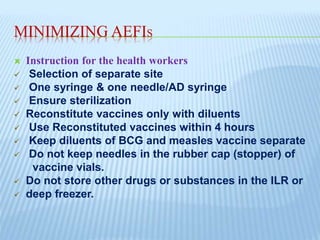
MINIMIZING AEFIS
 Instruction for the health workers
 Selection of separate site
 One syringe & one needle/AD syringe
 Ensure sterilization
 Reconstitute vaccines only with diluents
 Use Reconstituted vaccines within 4 hours
 Keep diluents of BCG and measles vaccine separate
 Do not keep needles in the rubber cap (stopper) of
vaccine vials.
 Do not store other drugs or substances in the ILR or
 deep freezer.
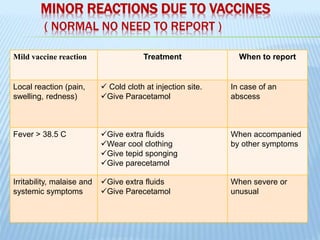
MINOR REACTIONS DUE TO VACCINES
( NORMAL NO NEED TO REPORT )
Mild vaccine reaction Treatment When to report
Local reaction (pain,
swelling, redness)
 Cold cloth at injection site.
Give Paracetamol
In case of an
abscess
Fever > 38.5 C Give extra fluids
Wear cool clothing
Give tepid sponging
Give parecetamol
When accompanied
by other symptoms
Irritability, malaise and
systemic symptoms
Give extra fluids
Give Parecetamol
When severe or
unusual
THANK YOU !!!
LIVSON THOMAS
M.Sc. (N) 1st Year
CMC & Hospital, Ludhiana

Immunization 130520002709-phpapp01

  • 2.
    WHY IMMUNIZATION ? Key strategy to child survival  Protecting infants from diseases.  Lowers morbidity and mortality rates in children.  Can lead to lower birth rates.  Indicator of a strong primary health care system.
  • 3.
    IMMUNIZATION: COMMON TERMS Immunization: Process of inducing immunity by stimulating immune system through antigens.  Immunity : Resistance of a host to a specific agent, characterized by measurable and protective surface or humoral antibody and by cell mediated immune responses.
  • 4.
     Vaccine: A preparationof a weakened or killed pathogen, such as a bacterium or virus, or of a portion of the pathogen's structure that upon administration stimulates antibody production or cellular immunity against the pathogen but is incapable of causing severe infection.  Vaccination: Administration of antigenic material (the vaccine) to produce immunity to a disease.
  • 5.
    FULL IMMUNIZATION:  Beneficiarychild (12-23 months) - 3 doses of  DPT and OPV each, 1 dose of BCG & measles each.  Mother - two doses or 1 booster dose of tetanus toxoid during her last pregnancy.
  • 6.
    Partial Immunization:  Child-missed any vaccine or one or more doses  Mother- received just one dose of primary tetanus toxoid during last pregnancy. Non immunization:  Child and/or mother- not received a single dose of vaccine.
  • 7.
     Ring immunization: Vaccinationof people in close contact with an isolated infected patient.  Mop-up rounds: When the final pockets of polio virus transmission have been identified through standard surveillance, door-to- door immunization in high-risk districts.  Catch up rounds: Additional effort besides routine immunization to cover left outs
  • 8.
    HERD IMMUNITY?  Resistanceto spread of infectious disease in a group because of few susceptible members, making transmission unlikely.  The immunologic status of a population, determined by the ratio of resistant to susceptible members and their distribution.
  • 10.
     Works onlywhen: Probability of an infected person encountering every other individual in the population (random mixing) is the same; (not likely to happen)  Does not work when: An infected person interacts only with people who are susceptible (no random mixing); likely to transmit the disease to those people
  • 11.
    MILESTONES IN IMMUNIZATION PROGRAMIN INDIA  1978: EPI  1985: UIP, Measles vaccine added  1986: Technology mission  1990: Vitamin A  1992: CSSM  1995: Polio National Immunization days  1997: RCH-I  2005: RCH-II and NRHM
  • 12.
    Vaccine When to give DoseRoute Site For Pregnant Women TT-1 Early in pregnancy 0.5 ml Intramuscular Upper Arm TT-2 4 weeks after TT-1 0.5 ml Intramuscular Upper Arm TT Booster If pregnancy occur within three yrs of last 0.5 ml Intramuscular Upper Arm
  • 13.
    VACCINE WHEN TO GIVE DOSEROUTE SITE FOR INFANTS BCG At birth (for institutional deliveries) or along with DPT- I 0.1 ml (0.05ml for infant up to 1 month) ID Left Upper Arm OPV-0 If delivery is in institution 2 drops Oral Oral OPV- 1,2 & 3 At 6, 10 & 14 weeks 2 drops Oral Oral DPT- 1,2 & 3 At 6, 10 & 14 weeks 0.5 ml IM Antero-lateral side of mid-thigh Hep B 1,2 & 3 At 6, 10 & 14 weeks** 0.5 ml IM Antero-lateral side of mid-thigh Measles 9-12 months 0.5 ml SC Right upper Arm Vitamin-A (1st Dose) At 9 months with measles 1 ml (1 lakh IU) Oral Oral
  • 14.
    VACCINE WHEN TO GIVE DOSEROUTE SITE FOR CHILDREN DPT Booster 16 -24 months 0 5ml IM Outer Mid thigh OPV Booster Vitamin A (2nd to 9th dose) 16-24 months 16 months with DPT/OPV booster.Then, one dose every 6 months up to the age of 5 years. 2 drops 2 ml ( 2 lakh IU) Oral Oral Oral Oral DPT Booster 5 years 0.5 ml IM Upper Arm TT 10 years and 16 years 0.5 mil IM Upper Arm NATIONAL IMMUNIZATION SCHEDULE
  • 15.
    BARRIERS TO IMMUNIZATION Physical barriers -Waiting time -Distance -Discomfort  Psychological barriers -Discourtesy - Endangered privacy
  • 16.
    REASONS FOR LOWIMMUNIZATION COVERAGE  Failure to provide immunization  Dropouts  Un-reached populations:- - Unawareness - socio-economic barriers - geographic access  Resistant populations  Missed Opportunities  Improper logistics management
  • 17.
    WHAT SHOULD NOTHOLD ROUTINE IMMUNIZATION  Minor illnesses such as upper respiratory infections or diarrhea, mild fever (< 38.5°c)  Allergy, asthma  Prematurity, underweight newborn child  Malnutrition  Child being breastfed  Family history of convulsions
  • 18.
     Treatment withantibiotics  Dermatosis, eczema or localized skin infection  Chronic diseases of the heart, lung, kidney and liver.  Stable neurological conditions, such as cerebral palsy and Down's syndrome  History of jaundice after birth
  • 19.
    COLD CHAIN A systemof transporting and storing vaccines at recommended temperature from the point of manufacture to the point of use.
  • 21.
    ESSENTIAL ELEMENTS: • Personnelto organize and manage vaccine distribution • Equipment for storage and transport of vaccines • Transport facilities • Maintenance of equipment and Monitoring  Responsibility – District/ Block Managers • Cold chain equipment installation, operation and maintenance
  • 22.
    Name of equipment Place of Installation TemperatureUtilization ILR MK 300 Regional & district HQ +2 C to +8 C BCG, DPT, DT, TT, Measles, Hep- B Vaccine Deep freezer 300 Regional & district HQ -18 C to -20 C Preparation of ice packs and storing OPV vaccines. ILR MK 140 litres PHC +2 C to +8 C BCG, DPT, DT, TT, Measles, Hep- B Vaccine Deep Freezer 140 litres PHC -18 C to -20 C Preparation of ice packs COLD CHAIN EQUIPMENT
  • 23.
    Name of equipment Place of Installation TemperatureUtilization Cold Box 20 litres State, Regional, district HQ & PHC +2 C to +8 C Vaccines can be stored for transportation or in case of power failure Cold Box 5 Litres District HQ & PHC +2 C to +8 C Vaccines can be stored for transportation or in case of power failure Vaccine Carrier ( 1.7 litres) PHC/Sub Centre +2 C to +8 C Vaccines can be stored for transportation or in case of power failure
  • 24.
    MAINTENANCE OF EQUIPMENT Defrosting/Cleaning: • Periodic defrosting & cleaning  Cold boxes/Vaccine Carriers: • Replace or repair locally  Ice Packs: • Fill clean water • Leave 10mm room for expansion • Cap tightly • Keep pack clean & dry
  • 26.
    Vaccine Exposurre to Heat/light Exposure to Cold Temperature at PHC HEAT AND LIGHT SENSITIVE VACCINES BCG Relatively heat stable, but sensitive to light Not damaged by freezing +2 C to +8 C OPV Sensitive to heat and light Not damaged by freezing +2 C to +8 C Measles Sensitive to heat and light Not damaged by freezing +2 C to +8 C At PHC level, all vaccines are kept in ILR in which temperature is maintained at +2 C to + 8 C VACCINE’S SENSITIVITY
  • 27.
    FREEZE SENSITIVE VACCINES DPTRelatively heat stable Freezes at -3 C should not be frozen +2 C to +8 C Hepatitis B Relatively heat stable Freezes at -5 C should not be frozen +2 C to +8 C DT Relatively heat stable Freezes at -3 C should not be frozen +2 C to +8 C TT Relatively heat stable Freezes at -3 C should not be frozen +2 C to +8 C
  • 32.
    AEFI - RARE,MORE SEVERE REACTIONS  Seizures,  Thrombocytopenia,  Hypotonic-hypo responsive episodes,  Persistent inconsolable screaming –in most cases they are self-limiting and lead to no long- term problems  Anaphylaxis, while potentially fatal, is treatable without any long-term effects
  • 33.
    MINIMIZING AEFIS  Instructionfor the health workers  Selection of separate site  One syringe & one needle/AD syringe  Ensure sterilization  Reconstitute vaccines only with diluents  Use Reconstituted vaccines within 4 hours  Keep diluents of BCG and measles vaccine separate  Do not keep needles in the rubber cap (stopper) of vaccine vials.  Do not store other drugs or substances in the ILR or  deep freezer.
  • 34.
    MINOR REACTIONS DUETO VACCINES ( NORMAL NO NEED TO REPORT ) Mild vaccine reaction Treatment When to report Local reaction (pain, swelling, redness)  Cold cloth at injection site. Give Paracetamol In case of an abscess Fever > 38.5 C Give extra fluids Wear cool clothing Give tepid sponging Give parecetamol When accompanied by other symptoms Irritability, malaise and systemic symptoms Give extra fluids Give Parecetamol When severe or unusual
  • 35.
    THANK YOU !!! LIVSONTHOMAS M.Sc. (N) 1st Year CMC & Hospital, Ludhiana