INTRODUCTION TO 
IMMUNIZATION 
2013-14 
2013-14 
VIKAS SONI 
Management Scholar, 
Pharmaceutical Management, 
NIPER, Mohali, Punjab, India. 
GMAIL: Vikas.niper2014@gmail.com 
LINKEDIN: http://in.linkedin.com/in/vikassoni11/ 
FACEBOOK: https://www.facebook.com/Vickysoni11
INTRODUCTION TO IMMUNIZATION 
1. INTRODUCTION 
2. HISTORY 
3. IMMUNIZATION AND BOOSTER SHOTS 
4. BENEFITS OF IMMUNIZATION 
5. SIDE EFFECTS OF IMMUNIZATION 
6. CLASSIFICATION OF IMMUNIZATION 
7. ACTIVE IMMUNIZATION 
8. PASSIVE IMMUNIZATION 
9. ANTIBODY ANTIGEN IMMUNE TESTING: 
 Precipitation Tests. 
 Agglutination Tests. 
 Neutralization Tests. 
 The Complement Fixation Test. 
 Labeled Antibody Test. 
10. RECENT DEVELOPMENTS 
11. REFERENCES 
2 | P a g e
INTRODUCTION TO IMMUNIZATION 
INTRODUCTION: 
Immunization is the process by which an individual's immune system becomes fortified 
against an agent (known as the immunogen). When this system is exposed to molecules 
that are foreign to the body, called non-self, it will orchestrate an immune response, and it 
will also develop the ability to quickly respond to a subsequent encounter because of 
immunological memory. This is a function of the adaptive immune system. Therefore, by 
exposing an animal to an immunogen in a controlled way, its body can learn to protect 
itself, this is called active immunization. Immunization is done through various 
techniques, most commonly vaccination. Vaccines against microorganisms that cause 
diseases can prepare the body's immune system, thus helping to fight or prevent an 
infection. Before the introduction of vaccines, the only way people became immune to an 
infectious disease was by actually getting the disease and surviving it. Smallpox (variola) 
was prevented in this way by inoculation, which produced a milder effect than the natural 
disease. Immunizations are definitely less risky and an easier way to become immune to a 
particular disease than risking a milder form of the disease itself. They are important for 
both adults and children in that they can protect us from the many diseases out there. 
Through the use of immunizations, some infections and diseases have almost completely 
been eradicated throughout the World. 
HISTORY: 
Since the time of the ancient Greeks, it has been recognized that people who have 
recovered from plague, smallpox, yellow fever, and various other infectious diseases rarely 
contract the diseases again. The first scientific attempts at artificial immunizations were 
made in the late eighteenth century by Edward Jenner (1749–1823): a country doctor 
from Berkley, Gloucestershire, England. Jenner investigated the basis for the widespread 
belief of the English peasants that anyone who had vaccinia (cowpox) never contracted 
smallpox. Smallpox was often fatal—10 to 40% of the victims died—and those who 
recovered had disfiguring pockmarks. Yet most English milkmaids, who were readily 
infected with cowpox, had clear skin because cowpox was a relatively mild infection that 
left no scars. It was on May 14, 1796, that Jenner extracted the contents of a pustule from 
the arm of a cowpox-infected milkmaid, Sarah Nelmes, and injected it into the arm of 
eight year old James Phipps. As Jenner expected, immunization with the cowpox virus 
caused only mild symptoms in the boy. When he subsequently inoculated the boy with 
smallpox virus, the boy showed no symptoms of the disease. Jenner then inoculated large 
numbers of his patients with cowpox pus, as did other physicians in England and on the 
European continent. By 1800 the practice known as vaccination had begun in America, 
and by 1805 Napoleon Bonaparte had ordered all French soldiers to be vaccinated. 
Further work on immunization was carried out by Louis Pasteur (1822–1895). Pasteur 
3 | P a g e
INTRODUCTION TO IMMUNIZATION 
discovered that if cultures of chicken cholera bacteria were allowed to age for two or three 
months the bacteria produced only a mild attack of cholera when inoculated into 
chickens. Somehow the old cultures had become less pathogenic (attenuated) for the 
chickens. He then found that fresh cultures of the bacteria failed to produce cholera in 
chickens that had been previously inoculated with old, attenuated cultures. To honor 
Jenner’s work with cowpox, Pasteur gave the name vaccine to any preparation of a 
weakened pathogen that was used (as was Jenner’s “vaccine virus”) to immunize against 
infectious disease. 
IMMUNIZATION AND BOOSTER SHOTS: 
The childhood immunization schedule outlines the following immunizations and booster 
shots and these include: 
● Diphtheria, tetanus, and pertussis (also known as whooping cough) 
● Measles, mumps, and rubella 
● Chickenpox 
● Polio 
● Hepatitis B 
● Hepatitis A 
● Rotavirus 
● Bacterial meningitis 
● Human papilloma virus (HPV) 
● Haemophilus influenzae type b disease 
● Pneumococcal disease 
● Flu (influenza) 
BENEFITS OF IMMUNIZATION: 
Immunizations have a number of benefits and these include: 
 Protects against certain diseases. 
4 | P a g e
INTRODUCTION TO IMMUNIZATION 
 Helps the immune system build resistance against disease. 
 Minimizes the spread of disease to others and prevents epidemics. 
 Cost effective way of getting treated for diseases. 
 Often required for entrance into daycare facilities, school, college, employment or 
travel to another country. 
 In pregnancy periods, it is necessary that the vaccinations are up to date to protect 
the baby. 
 Fewer side effects. 
SIDE EFFECTS OF IMMUNIZATION: 
There can be side effects from immunizations as it entails injecting a virus into body. If 
serious side effects such as, 
 Severe allergic reactions. 
 Difficulty breathing. 
 Fever over 104.5F. 
 Common reactions that may occur include: 
 Mild pain. 
 Swelling, soreness or redness on the area where the injection was given. 
 Muscle ache or joint pain after a measles-mumps-rubella shot. 
 Mild rash after chickenpox or measles-mumps-rubella shots for about 7 to 14 days. 
 Slight fever. 
 Fussiness (often seen in babies). 
 Loss of appetite. 
 It is important to consult with health practitioner immediately. 
CLASSIFICATION OF IMMUNIZATION: 
Two Artificial Methods of Immunity, 
1. Active immunization: 
Administration of antigens so patient actively mounts a protective immune response 
2. Passive immunization: 
Individual acquires immunity through the transfer of antibodies formed by immune 
individual or animal. 
5 | P a g e
INTRODUCTION TO IMMUNIZATION 
ACTIVE IMMUNIZATION: 
 DEFINITION: 
It is the protection of susceptible humans and domestic animals from communicable diseases by 
the administration of vaccines (vaccination). A vaccine [Latin vacca, cow] is a preparation from 
an infectious agent that is administered to humans and other animals to induce protective 
immunity. It may consist of a preparation of killed microorganisms; living, weakened (attenuated) 
microorganisms; inactivated bacterial toxins (toxoids); purified macromolecules; recombinant 
vectors (e.g., modified polio vaccine); or DNA vaccines that are administered to an animal to 
induce immunity artificially. 
 HISTORY: 
The modern era of vaccines and vaccination began in 1798 with Edward Jenner’s use of cowpox as 
a vaccine against smallpox and in 1881 with Louis Pasteur’s anthrax vaccine. Vaccines for other 
diseases did not emerge until the latter part of the nineteenth century, when largely through a 
process of trial and error, methods for inactivating and attenuating microorganisms were 
developed and vaccines were produced. Vaccines were eventually developed against most of the 
epidemic diseases that had plagued Western Europe and North America (diphtheria, measles, 
mumps, whooping cough, German measles, polio). Indeed, toward the end of the twentieth 
century it began to seem that the combination of vaccines and antibiotics would temper the 
problem of microbial infections. Such optimism was cut short by the emergence of new or 
previously unrecognized diseases and antibiotic resistance to old ones. Nevertheless, vaccination 
is still one of the most cost-effective weapons for microbial disease prevention. 
1. VACCINE TYPES: 
1. Combination vaccines: 
 Administration of antigens from several pathogens. 
2. Vaccines using recombinant gene technology: 
 Attempts to make vaccines more effective, cheaper, safer. 
 Variety of techniques used to improve vaccines. 
2. Vaccine manufacture: 
 Mass-produce many vaccines by growing microbes in culture vessels. 
 Viruses are cultured inside chicken eggs. 
 Individuals with egg allergies must avoid some vaccines. 
6 | P a g e
INTRODUCTION TO IMMUNIZATION 
3. Vaccine safety: 
 Problems associated with immunization 
 Mild toxicity most common. 
 Risk of anaphylactic shock. 
 Residual virulence from attenuated viruses. 
 Allegations that certain vaccines cause autism, diabetes, and asthma. 
 Research has not substantiated these allegations. 
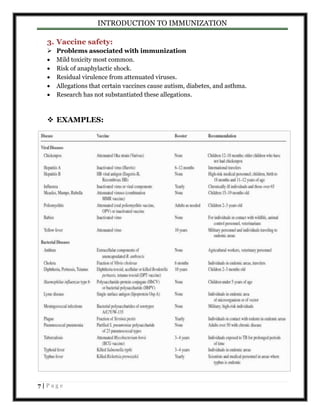
 EXAMPLES: 
7 | P a g e
INTRODUCTION TO IMMUNIZATION 
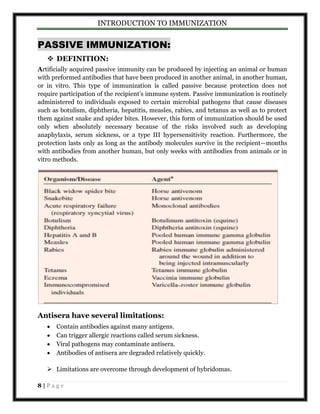
PASSIVE IMMUNIZATION: 
 DEFINITION: 
Artificially acquired passive immunity can be produced by injecting an animal or human 
with preformed antibodies that have been produced in another animal, in another human, 
or in vitro. This type of immunization is called passive because protection does not 
require participation of the recipient’s immune system. Passive immunization is routinely 
administered to individuals exposed to certain microbial pathogens that cause diseases 
such as botulism, diphtheria, hepatitis, measles, rabies, and tetanus as well as to protect 
them against snake and spider bites. However, this form of immunization should be used 
only when absolutely necessary because of the risks involved such as developing 
anaphylaxis, serum sickness, or a type III hypersensitivity reaction. Furthermore, the 
protection lasts only as long as the antibody molecules survive in the recipient—months 
with antibodies from another human, but only weeks with antibodies from animals or in 
vitro methods. 
Antisera have several limitations: 
 Contain antibodies against many antigens. 
 Can trigger allergic reactions called serum sickness. 
 Viral pathogens may contaminate antisera. 
 Antibodies of antisera are degraded relatively quickly. 
 Limitations are overcome through development of hybridomas. 
8 | P a g e
INTRODUCTION TO IMMUNIZATION 
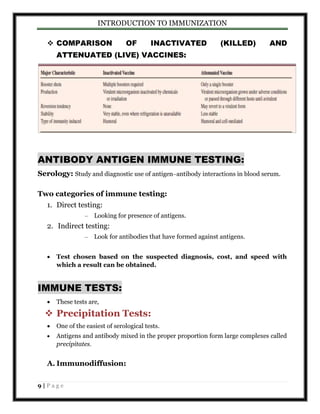
 COMPARISON OF INACTIVATED (KILLED) AND 
ATTENUATED (LIVE) VACCINES: 
ANTIBODY ANTIGEN IMMUNE TESTING: 
Serology: Study and diagnostic use of antigenantibody interactions in blood serum. 
Two categories of immune testing: 
1. Direct testing: 
9 | P a g e 
– Looking for presence of antigens. 
2. Indirect testing: 
– Look for antibodies that have formed against antigens. 
 Test chosen based on the suspected diagnosis, cost, and speed with 
which a result can be obtained. 
IMMUNE TESTS: 
 These tests are, 
 Precipitation Tests: 
 One of the easiest of serological tests. 
 Antigens and antibody mixed in the proper proportion form large complexes called 
precipitates. 
A. Immunodiffusion:
INTRODUCTION TO IMMUNIZATION 
 Determines optimal antibody and antigen concentrations. 
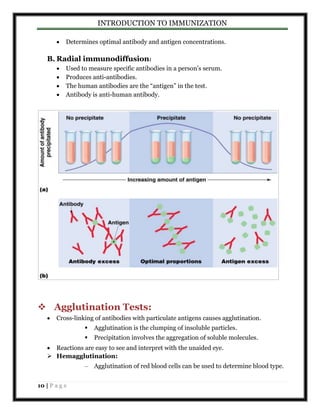
B. Radial immunodiffusion: 
 Used to measure specific antibodies in a person’s serum. 
 Produces anti-antibodies. 
 The human antibodies are the “antigen” in the test. 
 Antibody is anti-human antibody. 
 Agglutination Tests: 
 Cross-linking of antibodies with particulate antigens causes agglutination. 
10 | P a g e 
 Agglutination is the clumping of insoluble particles. 
 Precipitation involves the aggregation of soluble molecules. 
 Reactions are easy to see and interpret with the unaided eye. 
 Hemagglutination: 
– Agglutination of red blood cells can be used to determine blood type.
INTRODUCTION TO IMMUNIZATION 
 Neutralization Tests: 
A. Viral neutralization: 
 Cytopathic effect. 
 Viruses will kill appropriate cell cultures. 
 Virus is first mixed with antibodies against it. 
 Ability of virus to kill culture cells is neutralized. 
 Absence of cytopathic effect indicates presence of antibodies. 
 Identify whether individual has been exposed to a particular virus or viral strain. 
B. Viral hemagglutination inhibition test: 
 Useful for viruses that aren’t cytopathic 
 Based on viral hemagglutination. 
 Ability of viral surface proteins to clump red blood cells. 
 Individual’s serum will stop viral hemagglutination if the serum contains 
antibodies against the specific virus. 
 Used to detect antibodies against influenza, measles and mumps. 
 The Complement Fixation Test: 
 Based on generation of membrane attack complexes during complement 
activation. 
 Detect presence of specific antibodies in an individual’s serum. 
 Can detect antibody amounts too small to detect by agglutination. 
 Labeled Antibody Test: 
 Uses antibody molecules linked to some “label” that enables them to be easily 
detected. 
 Used to detect either antigens or antibodies. 
A. Fluorescent antibody tests: 
 Use fluorescent dyes as labels. 
 Fluorescein is one dye used in these tests. 
 Fluorescein-labeled antibodies used in two types of tests: 
11 | P a g e
INTRODUCTION TO IMMUNIZATION 
12 | P a g e 
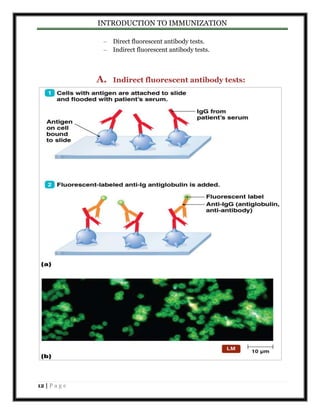
– Direct fluorescent antibody tests. 
– Indirect fluorescent antibody tests. 
A. Indirect fluorescent antibody tests:
INTRODUCTION TO IMMUNIZATION 
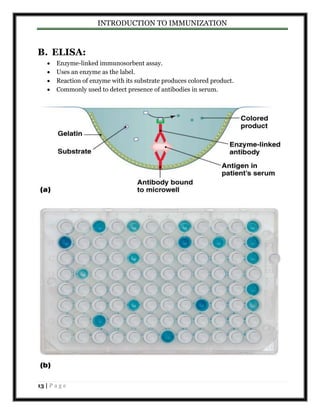
B. ELISA: 
 Enzyme-linked immunosorbent assay. 
 Uses an enzyme as the label. 
 Reaction of enzyme with its substrate produces colored product. 
 Commonly used to detect presence of antibodies in serum. 
13 | P a g e
INTRODUCTION TO IMMUNIZATION 
 Antibody sandwich ELISA: 
 Modification of the ELISA technique. 
 Commonly used to detect antigen. 
 Antigen being tested for is “sandwiched” between two antibody molecules. 
 Advantages of the ELISA: 
 Can detect either antibody or antigen. 
 Can quantify amounts of antigen or antibody. 
 Easy to perform and can test many samples quickly. 
 Plates coated with antigen and gelatin can be stored for later testing. 
C. Western blot test: 
 Technique to detect antibodies against multiple antigens. 
 Advantages over other tests. 
 Can detect more types of antibodies. 
 Less subject to misinterpretation. 
RECENT DEVELOPMENTS: 
 Immunofiltration: 
 Rapid ELISA that uses antibodies bound to membrane filters rather than 
polystyrene plates. 
 Membrane filters have large surface area. 
 Assay quicker to complete. 
 Immunochromatography: 
 Very rapid and easy-to-read ELISAs. 
 Antigen solution flows through a porous strip and encounters labeled antibody. 
 Visible line produced when antigen-antibody immune complexes encounter 
antibody against them. 
 Used for pregnancy testing and rapid identification of infectious agents. 
14 | P a g e
INTRODUCTION TO IMMUNIZATION 
REFERENCES: 
 Prescott L.M.; “Microbiology”, 5th edition, 2002, Mcgraw hill 
publication, New York, 764-778. 
 Jain N.K.; “Pharmaceutical microbiology”, 2nd edition, 2005, Vallabh 
prakashan, pithampura, New Delhi, 168-184. 
 www.mhhe.com 
 www.ijrpc.com 
 www.ijpbs.net 
15 | P a g e

INTRODUCTION TO IMMUNIZATION

  • 1.
    INTRODUCTION TO IMMUNIZATION 2013-14 2013-14 VIKAS SONI Management Scholar, Pharmaceutical Management, NIPER, Mohali, Punjab, India. GMAIL: Vikas.niper2014@gmail.com LINKEDIN: http://in.linkedin.com/in/vikassoni11/ FACEBOOK: https://www.facebook.com/Vickysoni11
  • 2.
    INTRODUCTION TO IMMUNIZATION 1. INTRODUCTION 2. HISTORY 3. IMMUNIZATION AND BOOSTER SHOTS 4. BENEFITS OF IMMUNIZATION 5. SIDE EFFECTS OF IMMUNIZATION 6. CLASSIFICATION OF IMMUNIZATION 7. ACTIVE IMMUNIZATION 8. PASSIVE IMMUNIZATION 9. ANTIBODY ANTIGEN IMMUNE TESTING:  Precipitation Tests.  Agglutination Tests.  Neutralization Tests.  The Complement Fixation Test.  Labeled Antibody Test. 10. RECENT DEVELOPMENTS 11. REFERENCES 2 | P a g e
  • 3.
    INTRODUCTION TO IMMUNIZATION INTRODUCTION: Immunization is the process by which an individual's immune system becomes fortified against an agent (known as the immunogen). When this system is exposed to molecules that are foreign to the body, called non-self, it will orchestrate an immune response, and it will also develop the ability to quickly respond to a subsequent encounter because of immunological memory. This is a function of the adaptive immune system. Therefore, by exposing an animal to an immunogen in a controlled way, its body can learn to protect itself, this is called active immunization. Immunization is done through various techniques, most commonly vaccination. Vaccines against microorganisms that cause diseases can prepare the body's immune system, thus helping to fight or prevent an infection. Before the introduction of vaccines, the only way people became immune to an infectious disease was by actually getting the disease and surviving it. Smallpox (variola) was prevented in this way by inoculation, which produced a milder effect than the natural disease. Immunizations are definitely less risky and an easier way to become immune to a particular disease than risking a milder form of the disease itself. They are important for both adults and children in that they can protect us from the many diseases out there. Through the use of immunizations, some infections and diseases have almost completely been eradicated throughout the World. HISTORY: Since the time of the ancient Greeks, it has been recognized that people who have recovered from plague, smallpox, yellow fever, and various other infectious diseases rarely contract the diseases again. The first scientific attempts at artificial immunizations were made in the late eighteenth century by Edward Jenner (1749–1823): a country doctor from Berkley, Gloucestershire, England. Jenner investigated the basis for the widespread belief of the English peasants that anyone who had vaccinia (cowpox) never contracted smallpox. Smallpox was often fatal—10 to 40% of the victims died—and those who recovered had disfiguring pockmarks. Yet most English milkmaids, who were readily infected with cowpox, had clear skin because cowpox was a relatively mild infection that left no scars. It was on May 14, 1796, that Jenner extracted the contents of a pustule from the arm of a cowpox-infected milkmaid, Sarah Nelmes, and injected it into the arm of eight year old James Phipps. As Jenner expected, immunization with the cowpox virus caused only mild symptoms in the boy. When he subsequently inoculated the boy with smallpox virus, the boy showed no symptoms of the disease. Jenner then inoculated large numbers of his patients with cowpox pus, as did other physicians in England and on the European continent. By 1800 the practice known as vaccination had begun in America, and by 1805 Napoleon Bonaparte had ordered all French soldiers to be vaccinated. Further work on immunization was carried out by Louis Pasteur (1822–1895). Pasteur 3 | P a g e
  • 4.
    INTRODUCTION TO IMMUNIZATION discovered that if cultures of chicken cholera bacteria were allowed to age for two or three months the bacteria produced only a mild attack of cholera when inoculated into chickens. Somehow the old cultures had become less pathogenic (attenuated) for the chickens. He then found that fresh cultures of the bacteria failed to produce cholera in chickens that had been previously inoculated with old, attenuated cultures. To honor Jenner’s work with cowpox, Pasteur gave the name vaccine to any preparation of a weakened pathogen that was used (as was Jenner’s “vaccine virus”) to immunize against infectious disease. IMMUNIZATION AND BOOSTER SHOTS: The childhood immunization schedule outlines the following immunizations and booster shots and these include: ● Diphtheria, tetanus, and pertussis (also known as whooping cough) ● Measles, mumps, and rubella ● Chickenpox ● Polio ● Hepatitis B ● Hepatitis A ● Rotavirus ● Bacterial meningitis ● Human papilloma virus (HPV) ● Haemophilus influenzae type b disease ● Pneumococcal disease ● Flu (influenza) BENEFITS OF IMMUNIZATION: Immunizations have a number of benefits and these include:  Protects against certain diseases. 4 | P a g e
  • 5.
    INTRODUCTION TO IMMUNIZATION  Helps the immune system build resistance against disease.  Minimizes the spread of disease to others and prevents epidemics.  Cost effective way of getting treated for diseases.  Often required for entrance into daycare facilities, school, college, employment or travel to another country.  In pregnancy periods, it is necessary that the vaccinations are up to date to protect the baby.  Fewer side effects. SIDE EFFECTS OF IMMUNIZATION: There can be side effects from immunizations as it entails injecting a virus into body. If serious side effects such as,  Severe allergic reactions.  Difficulty breathing.  Fever over 104.5F.  Common reactions that may occur include:  Mild pain.  Swelling, soreness or redness on the area where the injection was given.  Muscle ache or joint pain after a measles-mumps-rubella shot.  Mild rash after chickenpox or measles-mumps-rubella shots for about 7 to 14 days.  Slight fever.  Fussiness (often seen in babies).  Loss of appetite.  It is important to consult with health practitioner immediately. CLASSIFICATION OF IMMUNIZATION: Two Artificial Methods of Immunity, 1. Active immunization: Administration of antigens so patient actively mounts a protective immune response 2. Passive immunization: Individual acquires immunity through the transfer of antibodies formed by immune individual or animal. 5 | P a g e
  • 6.
    INTRODUCTION TO IMMUNIZATION ACTIVE IMMUNIZATION:  DEFINITION: It is the protection of susceptible humans and domestic animals from communicable diseases by the administration of vaccines (vaccination). A vaccine [Latin vacca, cow] is a preparation from an infectious agent that is administered to humans and other animals to induce protective immunity. It may consist of a preparation of killed microorganisms; living, weakened (attenuated) microorganisms; inactivated bacterial toxins (toxoids); purified macromolecules; recombinant vectors (e.g., modified polio vaccine); or DNA vaccines that are administered to an animal to induce immunity artificially.  HISTORY: The modern era of vaccines and vaccination began in 1798 with Edward Jenner’s use of cowpox as a vaccine against smallpox and in 1881 with Louis Pasteur’s anthrax vaccine. Vaccines for other diseases did not emerge until the latter part of the nineteenth century, when largely through a process of trial and error, methods for inactivating and attenuating microorganisms were developed and vaccines were produced. Vaccines were eventually developed against most of the epidemic diseases that had plagued Western Europe and North America (diphtheria, measles, mumps, whooping cough, German measles, polio). Indeed, toward the end of the twentieth century it began to seem that the combination of vaccines and antibiotics would temper the problem of microbial infections. Such optimism was cut short by the emergence of new or previously unrecognized diseases and antibiotic resistance to old ones. Nevertheless, vaccination is still one of the most cost-effective weapons for microbial disease prevention. 1. VACCINE TYPES: 1. Combination vaccines:  Administration of antigens from several pathogens. 2. Vaccines using recombinant gene technology:  Attempts to make vaccines more effective, cheaper, safer.  Variety of techniques used to improve vaccines. 2. Vaccine manufacture:  Mass-produce many vaccines by growing microbes in culture vessels.  Viruses are cultured inside chicken eggs.  Individuals with egg allergies must avoid some vaccines. 6 | P a g e
  • 7.
    INTRODUCTION TO IMMUNIZATION 3. Vaccine safety:  Problems associated with immunization  Mild toxicity most common.  Risk of anaphylactic shock.  Residual virulence from attenuated viruses.  Allegations that certain vaccines cause autism, diabetes, and asthma.  Research has not substantiated these allegations.  EXAMPLES: 7 | P a g e
  • 8.
    INTRODUCTION TO IMMUNIZATION PASSIVE IMMUNIZATION:  DEFINITION: Artificially acquired passive immunity can be produced by injecting an animal or human with preformed antibodies that have been produced in another animal, in another human, or in vitro. This type of immunization is called passive because protection does not require participation of the recipient’s immune system. Passive immunization is routinely administered to individuals exposed to certain microbial pathogens that cause diseases such as botulism, diphtheria, hepatitis, measles, rabies, and tetanus as well as to protect them against snake and spider bites. However, this form of immunization should be used only when absolutely necessary because of the risks involved such as developing anaphylaxis, serum sickness, or a type III hypersensitivity reaction. Furthermore, the protection lasts only as long as the antibody molecules survive in the recipient—months with antibodies from another human, but only weeks with antibodies from animals or in vitro methods. Antisera have several limitations:  Contain antibodies against many antigens.  Can trigger allergic reactions called serum sickness.  Viral pathogens may contaminate antisera.  Antibodies of antisera are degraded relatively quickly.  Limitations are overcome through development of hybridomas. 8 | P a g e
  • 9.
    INTRODUCTION TO IMMUNIZATION  COMPARISON OF INACTIVATED (KILLED) AND ATTENUATED (LIVE) VACCINES: ANTIBODY ANTIGEN IMMUNE TESTING: Serology: Study and diagnostic use of antigenantibody interactions in blood serum. Two categories of immune testing: 1. Direct testing: 9 | P a g e – Looking for presence of antigens. 2. Indirect testing: – Look for antibodies that have formed against antigens.  Test chosen based on the suspected diagnosis, cost, and speed with which a result can be obtained. IMMUNE TESTS:  These tests are,  Precipitation Tests:  One of the easiest of serological tests.  Antigens and antibody mixed in the proper proportion form large complexes called precipitates. A. Immunodiffusion:
  • 10.
    INTRODUCTION TO IMMUNIZATION  Determines optimal antibody and antigen concentrations. B. Radial immunodiffusion:  Used to measure specific antibodies in a person’s serum.  Produces anti-antibodies.  The human antibodies are the “antigen” in the test.  Antibody is anti-human antibody.  Agglutination Tests:  Cross-linking of antibodies with particulate antigens causes agglutination. 10 | P a g e  Agglutination is the clumping of insoluble particles.  Precipitation involves the aggregation of soluble molecules.  Reactions are easy to see and interpret with the unaided eye.  Hemagglutination: – Agglutination of red blood cells can be used to determine blood type.
  • 11.
    INTRODUCTION TO IMMUNIZATION  Neutralization Tests: A. Viral neutralization:  Cytopathic effect.  Viruses will kill appropriate cell cultures.  Virus is first mixed with antibodies against it.  Ability of virus to kill culture cells is neutralized.  Absence of cytopathic effect indicates presence of antibodies.  Identify whether individual has been exposed to a particular virus or viral strain. B. Viral hemagglutination inhibition test:  Useful for viruses that aren’t cytopathic  Based on viral hemagglutination.  Ability of viral surface proteins to clump red blood cells.  Individual’s serum will stop viral hemagglutination if the serum contains antibodies against the specific virus.  Used to detect antibodies against influenza, measles and mumps.  The Complement Fixation Test:  Based on generation of membrane attack complexes during complement activation.  Detect presence of specific antibodies in an individual’s serum.  Can detect antibody amounts too small to detect by agglutination.  Labeled Antibody Test:  Uses antibody molecules linked to some “label” that enables them to be easily detected.  Used to detect either antigens or antibodies. A. Fluorescent antibody tests:  Use fluorescent dyes as labels.  Fluorescein is one dye used in these tests.  Fluorescein-labeled antibodies used in two types of tests: 11 | P a g e
  • 12.
    INTRODUCTION TO IMMUNIZATION 12 | P a g e – Direct fluorescent antibody tests. – Indirect fluorescent antibody tests. A. Indirect fluorescent antibody tests:
  • 13.
    INTRODUCTION TO IMMUNIZATION B. ELISA:  Enzyme-linked immunosorbent assay.  Uses an enzyme as the label.  Reaction of enzyme with its substrate produces colored product.  Commonly used to detect presence of antibodies in serum. 13 | P a g e
  • 14.
    INTRODUCTION TO IMMUNIZATION  Antibody sandwich ELISA:  Modification of the ELISA technique.  Commonly used to detect antigen.  Antigen being tested for is “sandwiched” between two antibody molecules.  Advantages of the ELISA:  Can detect either antibody or antigen.  Can quantify amounts of antigen or antibody.  Easy to perform and can test many samples quickly.  Plates coated with antigen and gelatin can be stored for later testing. C. Western blot test:  Technique to detect antibodies against multiple antigens.  Advantages over other tests.  Can detect more types of antibodies.  Less subject to misinterpretation. RECENT DEVELOPMENTS:  Immunofiltration:  Rapid ELISA that uses antibodies bound to membrane filters rather than polystyrene plates.  Membrane filters have large surface area.  Assay quicker to complete.  Immunochromatography:  Very rapid and easy-to-read ELISAs.  Antigen solution flows through a porous strip and encounters labeled antibody.  Visible line produced when antigen-antibody immune complexes encounter antibody against them.  Used for pregnancy testing and rapid identification of infectious agents. 14 | P a g e
  • 15.
    INTRODUCTION TO IMMUNIZATION REFERENCES:  Prescott L.M.; “Microbiology”, 5th edition, 2002, Mcgraw hill publication, New York, 764-778.  Jain N.K.; “Pharmaceutical microbiology”, 2nd edition, 2005, Vallabh prakashan, pithampura, New Delhi, 168-184.  www.mhhe.com  www.ijrpc.com  www.ijpbs.net 15 | P a g e