
 BY:;
 Anju sapkota
BPH 3rd year ,UCMS
NATIONAL
IMMUNIZATION
PROGRAMME
 The National Immunization Programme (NIP) is
a priority 1 (P1) programme of the Government
of Nepal
 Launched as the Expanded Programme on
Immunization in 2034 BS (1977/78)
 the National Immunization Programme has met
several milestones, including Millennium
Development Goal 4 (MDG 4) on reducing
under-5 mortality.
 The Immunization Act endorsed (BS 2072) says
that every child has the right to access quality
vaccines.
 Nepal has been polio free since 2010.
 The elimination status of maternal and neonatal
polio has been sustained since 2005.
 The reduced burden of Japanese encephalitis
was successfully maintained during the
reporting period.
 Progress has been maintained towards measles
elimination and the control of rubella and
congenital rubella syndrome (CRS) by 2019.
 Immunization services are delivered through
static immunization clinics in health facilities,
outreach sessions and mobile clinics in
communities (VDCs and municipalities)
throughout the country.
 Outreach sessions are periodically reviewed to
increase the access of immunization services
 More than 16,000 immunization sessions per
month or 192,000 per year are conducted
nationwide. Private health facilities, hospitals,
NGO/INGO and medical colleges run static
immunization clinics to increase the access of
immunization services and is based on needs
and included in district micro plans.
GOAL, AND OBJECTIVES
 Goal :-- To reduce child mortality, morbidity
and disability associated with vaccine
preventable diseases.
OBJECTIVES
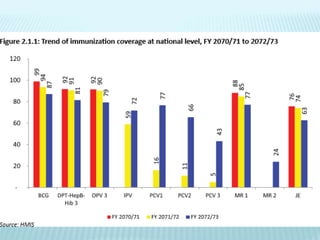
 1. Achieve and maintain at least 90%
vaccination coverage for all antigens at
national and district level by 2016
 2. Ensure access to vaccines of assured
quality and with appropriate waste
management
 3. Achieve and maintain polio free status
 4. Maintain maternal and neonatal tetanus
elimination status
 5. Initiate measles elimination
 6. Accelerate control of vaccine-preventable
diseases by introducing new and underused
vaccines
 7. Strengthen and expand VPD surveillance
 8. Continue to expand immunization beyond
infancy
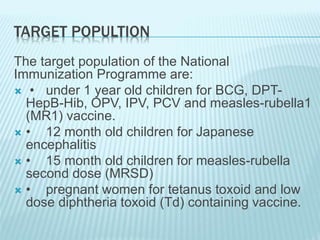
TARGET POPULTION
The target population of the National
Immunization Programme are:
 • under 1 year old children for BCG, DPT-
HepB-Hib, OPV, IPV, PCV and measles-rubella1
(MR1) vaccine.
 • 12 month old children for Japanese
encephalitis
 • 15 month old children for measles-rubella
second dose (MRSD)
 • pregnant women for tetanus toxoid and low
dose diphtheria toxoid (Td) containing vaccine.
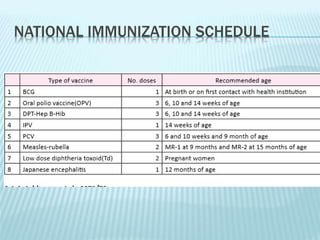
NATIONAL IMMUNIZATION SCHEDULE
Thank
you

National immunization programme

  • 1.
     BY:;  Anjusapkota BPH 3rd year ,UCMS NATIONAL IMMUNIZATION PROGRAMME
  • 2.
     The NationalImmunization Programme (NIP) is a priority 1 (P1) programme of the Government of Nepal  Launched as the Expanded Programme on Immunization in 2034 BS (1977/78)  the National Immunization Programme has met several milestones, including Millennium Development Goal 4 (MDG 4) on reducing under-5 mortality.  The Immunization Act endorsed (BS 2072) says that every child has the right to access quality vaccines.
  • 3.
     Nepal hasbeen polio free since 2010.  The elimination status of maternal and neonatal polio has been sustained since 2005.  The reduced burden of Japanese encephalitis was successfully maintained during the reporting period.  Progress has been maintained towards measles elimination and the control of rubella and congenital rubella syndrome (CRS) by 2019.
  • 4.
     Immunization servicesare delivered through static immunization clinics in health facilities, outreach sessions and mobile clinics in communities (VDCs and municipalities) throughout the country.  Outreach sessions are periodically reviewed to increase the access of immunization services  More than 16,000 immunization sessions per month or 192,000 per year are conducted nationwide. Private health facilities, hospitals, NGO/INGO and medical colleges run static immunization clinics to increase the access of immunization services and is based on needs and included in district micro plans.
  • 5.
    GOAL, AND OBJECTIVES Goal :-- To reduce child mortality, morbidity and disability associated with vaccine preventable diseases.
  • 6.
    OBJECTIVES  1. Achieveand maintain at least 90% vaccination coverage for all antigens at national and district level by 2016  2. Ensure access to vaccines of assured quality and with appropriate waste management  3. Achieve and maintain polio free status  4. Maintain maternal and neonatal tetanus elimination status
  • 7.
     5. Initiatemeasles elimination  6. Accelerate control of vaccine-preventable diseases by introducing new and underused vaccines  7. Strengthen and expand VPD surveillance  8. Continue to expand immunization beyond infancy
  • 8.
    TARGET POPULTION The targetpopulation of the National Immunization Programme are:  • under 1 year old children for BCG, DPT- HepB-Hib, OPV, IPV, PCV and measles-rubella1 (MR1) vaccine.  • 12 month old children for Japanese encephalitis  • 15 month old children for measles-rubella second dose (MRSD)  • pregnant women for tetanus toxoid and low dose diphtheria toxoid (Td) containing vaccine.
  • 9.
  • 11.