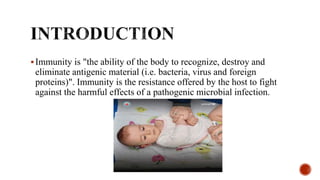
Immunity is "the ability of the body to recognize, destroy and
eliminate antigenic material (i.e. bacteria, virus and foreign
proteins)". Immunity is the resistance offered by the host to fight
against the harmful effects of a pathogenic microbial infection.
1. Innate
Non-specific
Specific
2. Acquired
Active (Natural, Artificial)
Passive (Natural, Artificial)
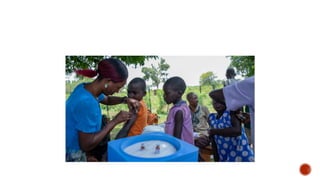
Immunization is a process of protecting a child or an individual
from diseases through introduction of live or killed or attenuated
organism into the individual.
It is one of the most cost-effective health intervention.
Immunization against vaccine-preventable diseases is essential to
reduce the child's mortality and morbidity It is the best and cheap
method to protect masses.
 It gives resistance to an infectious disease by producing or
augmenting the immunity.
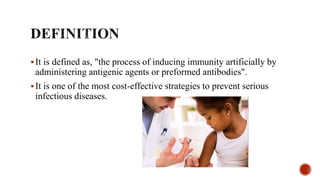
It is defined as, "the process of inducing immunity artificially by
administering antigenic agents or preformed antibodies".
It is one of the most cost-effective strategies to prevent serious
infectious diseases.
To provide protection before the child is exposed to infection or
likely to be encountered in childhood by use of patent specific
antigens that are available.
To control the infection in the community in addition to providing
individual protection.
To reduce the mortality and morbidity due to six killer disease
among children.
To archive self sufficiency in the production of vaccines.
IMMUNIZING AGENTS
 Immunizing agents are the substances which produces immunity
when introduced into the body.
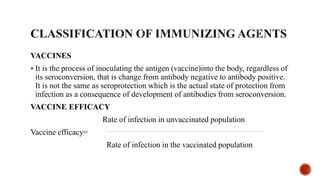
VACCINES
 It is the process of inoculating the antigen (vaccine)into the body, regardless of
its seroconversion, that is change from antibody negative to antibody positive.
It is not the same as seroprotection which is the actual state of protection from
infection as a consequence of development of antibodies from seroconversion.
VACCINE EFFICACY
Rate of infection in unvaccinated population
Vaccine efficacy=
Rate of infection in the vaccinated population
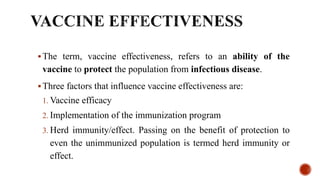
The term, vaccine effectiveness, refers to an ability of the
vaccine to protect the population from infectious disease.
Three factors that influence vaccine effectiveness are:
1. Vaccine efficacy
2. Implementation of the immunization program
3. Herd immunity/effect. Passing on the benefit of protection to
even the unimmunized population is termed herd immunity or
effect.
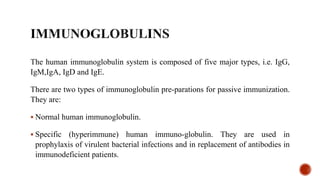
The human immunoglobulin system is composed of five major types, i.e. IgG,
IgM,IgA, IgD and IgE.
There are two types of immunoglobulin pre-parations for passive immunization.
They are:
 Normal human immunoglobulin.
 Specific (hyperimmune) human immuno-globulin. They are used in
prophylaxis of virulent bacterial infections and in replacement of antibodies in
immunodeficient patients.
 Antisera are specific immunoglobins prepared from the serum of immunized
animals, e.g. horse serum. They afford passive immunity for example, anti-
diphtheria serum, antirabies-serum and anti-gas gangrene serum.
Administration of antisera
 may give rise to serum sickness and anaphylactic shock because of animal
protein to which the recipient may have abnormal sensitivity. Test dose should
be given to exclude sensitivity reaction.
1. The expanded programme on Immunization in India initiated in 1978 with the
objective of protecting eligible population.
2. In May 1974, the WHO officially launched a global immunization
programme, known as Expanded Programme on Immunization (EPI) to
protect all children of the world against six vaccine-preventable diseases,
namely-diphtheria, whooping cough, tetanus, polio, tuberculosis and measles
by the year 2000.
 The programme is now called Universal Child Immunization, 1990 that is the
name given to a declaration sponsored by UNICEF as part of the united
nations, 40tn anniversary in October 1985.
 The cold chain is a system of storage and transport of vaccine at low temperature from
the place of manufacture to the actual vaccination site.
 The main objective of old chain is to maintain the potency of the vaccine by providing
adequate cooling facilities.
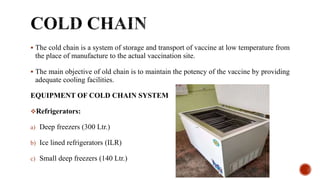
EQUIPMENT OF COLD CHAIN SYSTEM
Refrigerators:
a) Deep freezers (300 Ltr.)
b) Ice lined refrigerators (ILR)
c) Small deep freezers (140 Ltr.)
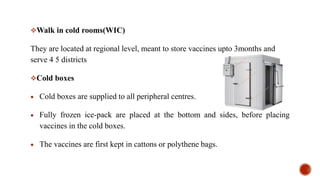
Walk in cold rooms(WIC)
They are located at regional level, meant to store vaccines upto 3months and
serve 4 5 districts
Cold boxes
 Cold boxes are supplied to all peripheral centres.
 Fully frozen ice-pack are placed at the bottom and sides, before placing
vaccines in the cold boxes.
 The vaccines are first kept in cattons or polythene bags.
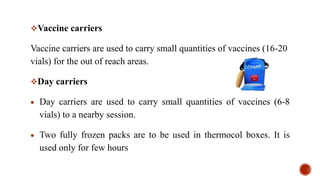
Vaccine carriers
Vaccine carriers are used to carry small quantities of vaccines (16-20
vials) for the out of reach areas.
Day carriers
 Day carriers are used to carry small quantities of vaccines (6-8
vials) to a nearby session.
 Two fully frozen packs are to be used in thermocol boxes. It is
used only for few hours
Ice packs/cold packs
 These are flat bottles of plastic, which are filled with water but no
salt should be added to it.
 The water should be filled up to the level marked on the side.
 These packs are used in the vaccine carriers after freezing their
water.
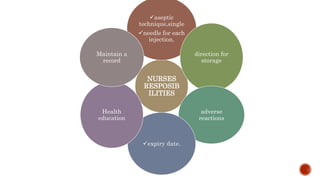
NURSES
RESPOSIB
ILITIES
aseptic
technique,single
needle for each
injection.
direction for
storage
adverse
reactions
expiry date.
Health
education
Maintain a
record
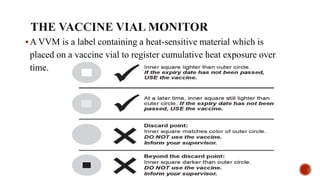
A VVM is a label containing a heat-sensitive material which is
placed on a vaccine vial to register cumulative heat exposure over
time.
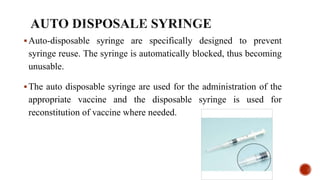
Auto-disposable syringe are specifically designed to prevent
syringe reuse. The syringe is automatically blocked, thus becoming
unusable.
The auto disposable syringe are used for the administration of the
appropriate vaccine and the disposable syringe is used for
reconstitution of vaccine where needed.
1. Acute illness with fever
2. When child is on immunosuppressive drug or on radiation.
3. When child is suffering from lymphoma malignancy or leukemia
 Reactions inherent to inoculations are pain, swelling, redness,
tenderness, small nodule, and abscess as the site of injection, fever,
malaise, and headache.
 Reactions due to faulty technique related to faulty production of vaccine,
too much vaccine given in one dose, improper site or route, incorrect
diluents, wrong amount
 Reaction due to hypersensitivity gives rise to occasionally anaphylactic
shock and serum sickness. There is bronchospasm, dyspnea, pallor,
hypotension and collapse.
 Neurological involvement following anti-rabies vaccine,
encephalopathy may be fetal. It is foreign serum, keep adrenaline.
 reduced dose of BCG given to babies affords lasting protection.
 The risk of tuberculosis infection in many developing countries is
still high and most infection occur after puberty. Vaccination at the
age of 6 years may protect children up to 20 years of age.
 Vaccination at school is feasible and due to growing school
attendance, will cover all the children in community.
The process of increasing the resistance of a person to a
particular infection or artificial means is called
immunization. Immunization procedures are designed to
stimulate the normal response of the tissues in such a way
that the person will develop an artificial active immunity
without the risk or inconvenience of having the disease.
A STUDY OF KNOWLEDGE, ATTITUDE AND PRACTICES
ON IMMUNIZATION OF CHILDREN IN URBAN SLUMS OF
BIJAPUR CITY, KARNATAKA, INDIA
 The immunization coverage is not uniform in India. In Karnataka, except for
Uttar Kannada District (very high immunization coverage of 95%) and 14
districts that have shown a better immunization coverage (>85% coverage), the
remaining 15 districts (including Bijapur District) have poor coverage. The
United Nations Children’s Fund (UNICEF) 2002 report on Bijapur district
shows that only a little over one fourth of the children were fully immunized
(25.8%). The state’s fully vaccinated figure was more than two and a half times
higher than that of the district. In this prevailing scenario, it becomes the need
of the hour to find factors which influence routine immunization in Bijapur
district, which will help the planners in implementing the immunization
programme in a better way, to achieve >85% coverage.
BOOK REFERENCE:
1) RimpleSharma,’’Essential Of Paediatric
Nursing,’’2ndedition,Jaypee publication Pg No:502-504.
2) Parul Data ‘’Pediatric Nursing’’ 2ndedition(2009),Jaypee Brothers
medical Publication Pg No:483-485.
3) Ghai, ‘’Essential Pediatrics’’7thEdition(2009),Cbs Publisher Pg
No:371-374 .
NET REFERENCE:
1. https://main.mohfw.gov.in/sites/default/files/24545352106148966
3873.pdf
2. http://www.nrhmhp.gov.in/content/immunisation
3. https://www.who.int/health-topics/vaccines-and-immunization
immunization%20semi.pptx

immunization%20semi.pptx

  • 4.
    Immunity is "theability of the body to recognize, destroy and eliminate antigenic material (i.e. bacteria, virus and foreign proteins)". Immunity is the resistance offered by the host to fight against the harmful effects of a pathogenic microbial infection.
  • 5.
    1. Innate Non-specific Specific 2. Acquired Active(Natural, Artificial) Passive (Natural, Artificial)
  • 6.
    Immunization is aprocess of protecting a child or an individual from diseases through introduction of live or killed or attenuated organism into the individual. It is one of the most cost-effective health intervention. Immunization against vaccine-preventable diseases is essential to reduce the child's mortality and morbidity It is the best and cheap method to protect masses.  It gives resistance to an infectious disease by producing or augmenting the immunity.
  • 7.
    It is definedas, "the process of inducing immunity artificially by administering antigenic agents or preformed antibodies". It is one of the most cost-effective strategies to prevent serious infectious diseases.
  • 8.
    To provide protectionbefore the child is exposed to infection or likely to be encountered in childhood by use of patent specific antigens that are available. To control the infection in the community in addition to providing individual protection.
  • 9.
    To reduce themortality and morbidity due to six killer disease among children. To archive self sufficiency in the production of vaccines. IMMUNIZING AGENTS  Immunizing agents are the substances which produces immunity when introduced into the body.
  • 10.
    VACCINES  It isthe process of inoculating the antigen (vaccine)into the body, regardless of its seroconversion, that is change from antibody negative to antibody positive. It is not the same as seroprotection which is the actual state of protection from infection as a consequence of development of antibodies from seroconversion. VACCINE EFFICACY Rate of infection in unvaccinated population Vaccine efficacy= Rate of infection in the vaccinated population
  • 11.
    The term, vaccineeffectiveness, refers to an ability of the vaccine to protect the population from infectious disease. Three factors that influence vaccine effectiveness are: 1. Vaccine efficacy 2. Implementation of the immunization program 3. Herd immunity/effect. Passing on the benefit of protection to even the unimmunized population is termed herd immunity or effect.
  • 13.
    The human immunoglobulinsystem is composed of five major types, i.e. IgG, IgM,IgA, IgD and IgE. There are two types of immunoglobulin pre-parations for passive immunization. They are:  Normal human immunoglobulin.  Specific (hyperimmune) human immuno-globulin. They are used in prophylaxis of virulent bacterial infections and in replacement of antibodies in immunodeficient patients.
  • 14.
     Antisera arespecific immunoglobins prepared from the serum of immunized animals, e.g. horse serum. They afford passive immunity for example, anti- diphtheria serum, antirabies-serum and anti-gas gangrene serum. Administration of antisera  may give rise to serum sickness and anaphylactic shock because of animal protein to which the recipient may have abnormal sensitivity. Test dose should be given to exclude sensitivity reaction.
  • 15.
    1. The expandedprogramme on Immunization in India initiated in 1978 with the objective of protecting eligible population. 2. In May 1974, the WHO officially launched a global immunization programme, known as Expanded Programme on Immunization (EPI) to protect all children of the world against six vaccine-preventable diseases, namely-diphtheria, whooping cough, tetanus, polio, tuberculosis and measles by the year 2000.  The programme is now called Universal Child Immunization, 1990 that is the name given to a declaration sponsored by UNICEF as part of the united nations, 40tn anniversary in October 1985.
  • 17.
     The coldchain is a system of storage and transport of vaccine at low temperature from the place of manufacture to the actual vaccination site.  The main objective of old chain is to maintain the potency of the vaccine by providing adequate cooling facilities. EQUIPMENT OF COLD CHAIN SYSTEM Refrigerators: a) Deep freezers (300 Ltr.) b) Ice lined refrigerators (ILR) c) Small deep freezers (140 Ltr.)
  • 18.
    Walk in coldrooms(WIC) They are located at regional level, meant to store vaccines upto 3months and serve 4 5 districts Cold boxes  Cold boxes are supplied to all peripheral centres.  Fully frozen ice-pack are placed at the bottom and sides, before placing vaccines in the cold boxes.  The vaccines are first kept in cattons or polythene bags.
  • 19.
    Vaccine carriers Vaccine carriersare used to carry small quantities of vaccines (16-20 vials) for the out of reach areas. Day carriers  Day carriers are used to carry small quantities of vaccines (6-8 vials) to a nearby session.  Two fully frozen packs are to be used in thermocol boxes. It is used only for few hours
  • 20.
    Ice packs/cold packs These are flat bottles of plastic, which are filled with water but no salt should be added to it.  The water should be filled up to the level marked on the side.  These packs are used in the vaccine carriers after freezing their water.
  • 21.
    NURSES RESPOSIB ILITIES aseptic technique,single needle for each injection. directionfor storage adverse reactions expiry date. Health education Maintain a record
  • 22.
    A VVM isa label containing a heat-sensitive material which is placed on a vaccine vial to register cumulative heat exposure over time.
  • 23.
    Auto-disposable syringe arespecifically designed to prevent syringe reuse. The syringe is automatically blocked, thus becoming unusable. The auto disposable syringe are used for the administration of the appropriate vaccine and the disposable syringe is used for reconstitution of vaccine where needed.
  • 24.
    1. Acute illnesswith fever 2. When child is on immunosuppressive drug or on radiation. 3. When child is suffering from lymphoma malignancy or leukemia
  • 25.
     Reactions inherentto inoculations are pain, swelling, redness, tenderness, small nodule, and abscess as the site of injection, fever, malaise, and headache.  Reactions due to faulty technique related to faulty production of vaccine, too much vaccine given in one dose, improper site or route, incorrect diluents, wrong amount  Reaction due to hypersensitivity gives rise to occasionally anaphylactic shock and serum sickness. There is bronchospasm, dyspnea, pallor, hypotension and collapse.  Neurological involvement following anti-rabies vaccine, encephalopathy may be fetal. It is foreign serum, keep adrenaline.
  • 26.
     reduced doseof BCG given to babies affords lasting protection.  The risk of tuberculosis infection in many developing countries is still high and most infection occur after puberty. Vaccination at the age of 6 years may protect children up to 20 years of age.  Vaccination at school is feasible and due to growing school attendance, will cover all the children in community.
  • 27.
    The process ofincreasing the resistance of a person to a particular infection or artificial means is called immunization. Immunization procedures are designed to stimulate the normal response of the tissues in such a way that the person will develop an artificial active immunity without the risk or inconvenience of having the disease.
  • 30.
    A STUDY OFKNOWLEDGE, ATTITUDE AND PRACTICES ON IMMUNIZATION OF CHILDREN IN URBAN SLUMS OF BIJAPUR CITY, KARNATAKA, INDIA  The immunization coverage is not uniform in India. In Karnataka, except for Uttar Kannada District (very high immunization coverage of 95%) and 14 districts that have shown a better immunization coverage (>85% coverage), the remaining 15 districts (including Bijapur District) have poor coverage. The United Nations Children’s Fund (UNICEF) 2002 report on Bijapur district shows that only a little over one fourth of the children were fully immunized (25.8%). The state’s fully vaccinated figure was more than two and a half times higher than that of the district. In this prevailing scenario, it becomes the need of the hour to find factors which influence routine immunization in Bijapur district, which will help the planners in implementing the immunization programme in a better way, to achieve >85% coverage.
  • 31.
    BOOK REFERENCE: 1) RimpleSharma,’’EssentialOf Paediatric Nursing,’’2ndedition,Jaypee publication Pg No:502-504. 2) Parul Data ‘’Pediatric Nursing’’ 2ndedition(2009),Jaypee Brothers medical Publication Pg No:483-485. 3) Ghai, ‘’Essential Pediatrics’’7thEdition(2009),Cbs Publisher Pg No:371-374 .
  • 32.
    NET REFERENCE: 1. https://main.mohfw.gov.in/sites/default/files/24545352106148966 3873.pdf 2.http://www.nrhmhp.gov.in/content/immunisation 3. https://www.who.int/health-topics/vaccines-and-immunization