WIENER  FILTER
INTRODUCTION	
•  The Wiener filter was proposed by Norbert Wiener in
   1940.
•  It was published in 1949
•  Its purpose is to reduce the amount of a noise in a
   signal.
•  This is done by comparing the received signal with a
   estimation of a desired noiseless signal.
•  Wiener filter is not an adaptive filter as it assumes
   input to be stationery.
DESCRIPTION	
•  It takes a statistical approach to solve its goal
•  Goal of the filter is to remove the noise from a signal
•  Before implementation of the filter it is assumed that
   the user knows the spectral properties of the original
   signal and noise.
•  Spectral properties like the power functions for both
   the original signal and noise.
•  And the resultant signal required is as close to the
   original signal
DESCRIPTION	
•  Signal and noise are both linear stochastic
   processes with known spectral properties.
•  The aim of the process is to have minimum mean-
   square error
•  That is, the difference between the original signal
   and the new signal should be as less as possible.
Important  Equations	
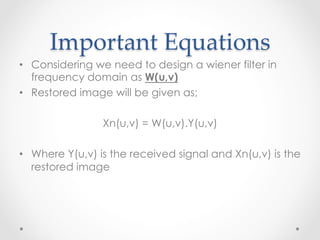
•  Considering we need to design a wiener filter in
   frequency domain as W(u,v)
•  Restored image will be given as;

                Xn(u,v) = W(u,v).Y(u,v)

•  Where Y(u,v) is the received signal and Xn(u,v) is the
   restored image
Considering images and noise as random variables, the
                                       ˆ
      Important  Equations	
                is to find an estimate f of the uncorrupted image f su
                mean square error between them is minimized.
•  We choose The error measure is given by
             W(k,l) to minimize:

                       e 2 = E { (f − f )2 }
                                      ˆ

                           Obtained from [1]
               where E {i} is the expected value of the argument.
•  Where the equation represents the mean square
   error.
               By assuming that
•  The wiener filter can be represented by the
   equation:        1. the noise and the image are uncorrelated;
                    2. one or the other has zero mean;
                    3. the intensity levels in the estimate are a linear fu
                       the levels in the degraded image.
Important  Equations	


       •    Obtained from [1]
Important  Equations	
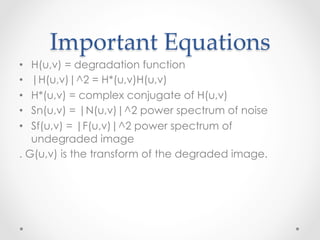
•  H(u,v) = degradation function
•  |H(u,v)|^2 = H*(u,v)H(u,v)
•  H*(u,v) = complex conjugate of H(u,v)
•  Sn(u,v) = |N(u,v)|^2 power spectrum of noise
•  Sf(u,v) = |F(u,v)|^2 power spectrum of
   undegraded image
. G(u,v) is the transform of the degraded image.
The Wiener filter does not have the same problem as the invers
         filter with zeros in the degradation function, unless the entire
         denominator is zero for the same value(s) of u and v .

       Important  Equations	
         If the noise is zero, then the Wiener filter reduces to the invers
         filter.
•  The signal to noise ration can be approximated
   using One of the most important measures is the signal-to-noise ratio
         the following equation:
         approximated using frequency domain quantities such as
                            M −1 N −1

                             ∑∑          F (u, v ) 2
                            u =0 v =0
                   SNR =    M −1 N −1
                                                                  (5.8-3)
                            ∑∑           N (u, v ) 2
                            u =0 v =0

                             Obtained from [1]

•  Low noise gives high SNR and High noise gives Low
   SNR. The value is a good metric used in
   characterizing the performance of restoration
   algorithm
The mean square error given in statistical form in (5.8-1) can be
        Important  Equations	
           approximated also in terms a summation involving the original
           and restored images:Image Processing (Fall Term, 2011-12) Page 291
•  The MSE in statistical form can be calculated as:
         ACS-7205-001 Digital

                                M −1 N −1
                             1
           The mean square error given in statistical form in (5.8-1) can be
                                                       2
                      MSE =
           and restored images:∑ ∑  f (x, y) − fˆ(x, y)
           approximated also in terms a summation involving the original

                            MN x =0 y =0 M −1 N −1
                                                                               (5.8-4)
                             1                  f (x , y ) − f (x , y )  2
                      MSE =        ∑ ∑
                            MN x = 0 y = 0 
                             Obtained from [1]
                                                              ˆ
                                                                         
                                                                                   (5.8-4)

•  If restored signal isthe restored image asbe signal and the difference
            If one considers considered to signal and can define a
           If one considers the restored image to be signal and the difference
   difference between the thespatial domain noise, we
           between this image and restored to be degraded as
                                         original and
           signal-to-noise ratio inthe original to be noise, we can define a
            between this we can the
   the noise, then
                         image and obtain SNR in spatial domain
                                                          as

            signal-to-noise ratio in the∑ ∑ domain as
                                        spatial fˆ(x, y)
                                    M −1 N −1
                                                               2

                                        x =0 y =0
                      SNR =      M −1 N −1
                                                                          2         (5.8-5)
                                  ∑ M −1 N −1 x, y ) − f (x, y ) 
                                        ∑ f(              ˆ
                                  x =0 y =0


                            ˆ          ∑ ∑ f (x, y)
                                    Obtained from ˆ
                                                  [1]   2
           The closer f and f are, the larger this ratio will be.
                                       x =0 y =0
                      SNR =                                          2
           If we are dealing with white noise, the spectrum N (u, v ) is a
                                M −1 N −1
∑ ∑  f (x, y) − f (x, y) 
                           x =0 y =0


       Important  Equations	
      The closer f and fˆ are, the larger this ratio will be.

                                                     N (u, v) 2 is a
•  But it isare dealing withhard noise, the spectrum power
      If we sometimes white to estimate the
   spectrumwhich simplifies things considerably.image or the
      constant, of either the un-degraded However,
   noise., v ) 2
       F (u      is usually unknown.
•  In that case we assume a constant K, that is then
   added to allis used frequently when these quantities are not
      An approach terms of H|(u,v)|^2
•  The new equation in that case becomes:
      known or cannot be estimated:

                              1           H (u, v) 2 
                  ˆ
                  F (u, v) =                          G(u, v)
                              H (u, v) H (u, v) + K 
                                                 2                (5.8-6)
                                                     
                                   Obtained from [1]
      where K is a specified constant that is added to all terms of
       H (u, v) 2 .
Working  Example  1	
  ACS-7205-001 Digital Image Processing (Fall Term, 2011-12)
 7205-001 Digital Image Processing (Fall Term, 2011-12)
                                                                          Page 293
                                                                     Page 293

ample 5.13:apply Further comparisons of Wienerof images 293
     •  We 5.13: the filter to the following set filtering
   Example Further comparisons of Wiener filtering
205-001 Digital Image Processing (Fall Term, 2011-12)   Page
ACS-7205-001 Digital Image Processing (Fall Term, 2011-12)                  Page 2

mple 5.13: Further comparisons of Wiener filtering
 Example 5.13: Further comparisons of Wiener filtering


                   1 obtained from [1]      2 Obtained from [1]

     •  We reduce the noise variance (noise power):


                    3 obtained from[1]         4 obtained from [1]
Working  Example  1	
•  We decrease the noise variance even further:


           5 obtained from [1]    6 obtained from [1]

•  As we can see A wiener filter does a very good job
   at deblurring of an image and reducing the noise.
Example  2	
•  The problem is to estimate the power spectrum of
   noise and even more difficult is to estimate the
   power spectrum of the image.
•  We know that most of the images have similar
   power spectrum.
•  We take two images and calculate their individual
   power spectrum
•  The images derived are obtained from [2]
Example  2	


   Obtained from [2]
Example  2	
•  We calculate the power spectrum of each image:


                     Obtained from [2]
Example  2	
•  If we restore the cameraman image using its own
   power spectrum, the image will look like this:


                      Obtained from [2]
Example  2	
•  But we use the power spectrum obtained from the
   house image, the restored image will look like this:


                       Obtained from [2]
Example  2	
•  Now if we consider a large set of images and
   calculate the power spectrum for them and find a
   mean, that could then be used as the power
   spectrum input for the wiener filter, we are likely to
   get better results.
•  Hence, it is important to have a large data set, to
   calculate power spectrum for.
•  In the previous scenario a user can derive the noise
   power spectrum from previous knowledge or can
   calculate it by observing the variance within an
   image’s smoother part.
How  to  use  Wiener  filter?	
•  Implementation of wiener filter are available both in
   Matlab and Python.
•  These implementations can be used to perform
   analysis on images.
Conclusion	
•  Wiener filter is an excellent filter when it comes to
   noise reduction or deblluring of images.
•  A user can test the performance of a wiener filter
   for different parameters to get the desired results.
•  It is also used in steganography processes.
•  It considers both the degradation function and
   noise as part of analysis of an image.
References	
•  [1] R. Gonzalez and W. RE, Digital Image
   Processing, Third Edit. Pearson Prentice Hall, 2008,
   pp. 352–357.
•  [2] S. Eddins, “Matlab Central Steve on Image
   Processing.” [Online]. Available: http://
   blogs.mathworks.com/steve/2007/11/02/image-
   deblurring-wiener-filter/. [Accessed: 25-Aug-2012].

Wiener Filter

  • 1.
  • 2.
    INTRODUCTION •  The Wienerfilter was proposed by Norbert Wiener in 1940. •  It was published in 1949 •  Its purpose is to reduce the amount of a noise in a signal. •  This is done by comparing the received signal with a estimation of a desired noiseless signal. •  Wiener filter is not an adaptive filter as it assumes input to be stationery.
  • 3.
    DESCRIPTION •  It takesa statistical approach to solve its goal •  Goal of the filter is to remove the noise from a signal •  Before implementation of the filter it is assumed that the user knows the spectral properties of the original signal and noise. •  Spectral properties like the power functions for both the original signal and noise. •  And the resultant signal required is as close to the original signal
  • 4.
    DESCRIPTION •  Signal andnoise are both linear stochastic processes with known spectral properties. •  The aim of the process is to have minimum mean- square error •  That is, the difference between the original signal and the new signal should be as less as possible.
  • 5.
    Important  Equations •  Consideringwe need to design a wiener filter in frequency domain as W(u,v) •  Restored image will be given as; Xn(u,v) = W(u,v).Y(u,v) •  Where Y(u,v) is the received signal and Xn(u,v) is the restored image
  • 6.
    Considering images andnoise as random variables, the ˆ Important  Equations is to find an estimate f of the uncorrupted image f su mean square error between them is minimized. •  We choose The error measure is given by W(k,l) to minimize: e 2 = E { (f − f )2 } ˆ Obtained from [1] where E {i} is the expected value of the argument. •  Where the equation represents the mean square error. By assuming that •  The wiener filter can be represented by the equation: 1. the noise and the image are uncorrelated; 2. one or the other has zero mean; 3. the intensity levels in the estimate are a linear fu the levels in the degraded image.
  • 7.
    Important  Equations •  Obtained from [1]
  • 8.
    Important  Equations •  H(u,v)= degradation function •  |H(u,v)|^2 = H*(u,v)H(u,v) •  H*(u,v) = complex conjugate of H(u,v) •  Sn(u,v) = |N(u,v)|^2 power spectrum of noise •  Sf(u,v) = |F(u,v)|^2 power spectrum of undegraded image . G(u,v) is the transform of the degraded image.
  • 9.
    The Wiener filterdoes not have the same problem as the invers filter with zeros in the degradation function, unless the entire denominator is zero for the same value(s) of u and v . Important  Equations If the noise is zero, then the Wiener filter reduces to the invers filter. •  The signal to noise ration can be approximated using One of the most important measures is the signal-to-noise ratio the following equation: approximated using frequency domain quantities such as M −1 N −1 ∑∑ F (u, v ) 2 u =0 v =0 SNR = M −1 N −1 (5.8-3) ∑∑ N (u, v ) 2 u =0 v =0 Obtained from [1] •  Low noise gives high SNR and High noise gives Low SNR. The value is a good metric used in characterizing the performance of restoration algorithm
  • 10.
    The mean squareerror given in statistical form in (5.8-1) can be Important  Equations approximated also in terms a summation involving the original and restored images:Image Processing (Fall Term, 2011-12) Page 291 •  The MSE in statistical form can be calculated as: ACS-7205-001 Digital M −1 N −1 1 The mean square error given in statistical form in (5.8-1) can be 2 MSE = and restored images:∑ ∑  f (x, y) − fˆ(x, y) approximated also in terms a summation involving the original MN x =0 y =0 M −1 N −1 (5.8-4) 1  f (x , y ) − f (x , y )  2 MSE = ∑ ∑ MN x = 0 y = 0  Obtained from [1] ˆ   (5.8-4) •  If restored signal isthe restored image asbe signal and the difference If one considers considered to signal and can define a If one considers the restored image to be signal and the difference difference between the thespatial domain noise, we between this image and restored to be degraded as original and signal-to-noise ratio inthe original to be noise, we can define a between this we can the the noise, then image and obtain SNR in spatial domain as signal-to-noise ratio in the∑ ∑ domain as spatial fˆ(x, y) M −1 N −1 2 x =0 y =0 SNR = M −1 N −1 2 (5.8-5) ∑ M −1 N −1 x, y ) − f (x, y )  ∑ f( ˆ x =0 y =0 ˆ ∑ ∑ f (x, y) Obtained from ˆ [1] 2 The closer f and f are, the larger this ratio will be. x =0 y =0 SNR = 2 If we are dealing with white noise, the spectrum N (u, v ) is a M −1 N −1
  • 11.
    ∑ ∑ f (x, y) − f (x, y)  x =0 y =0 Important  Equations The closer f and fˆ are, the larger this ratio will be. N (u, v) 2 is a •  But it isare dealing withhard noise, the spectrum power If we sometimes white to estimate the spectrumwhich simplifies things considerably.image or the constant, of either the un-degraded However, noise., v ) 2 F (u is usually unknown. •  In that case we assume a constant K, that is then added to allis used frequently when these quantities are not An approach terms of H|(u,v)|^2 •  The new equation in that case becomes: known or cannot be estimated:  1 H (u, v) 2  ˆ F (u, v) =   G(u, v)  H (u, v) H (u, v) + K  2 (5.8-6)   Obtained from [1] where K is a specified constant that is added to all terms of H (u, v) 2 .
  • 12.
    Working  Example  1 ACS-7205-001 Digital Image Processing (Fall Term, 2011-12) 7205-001 Digital Image Processing (Fall Term, 2011-12) Page 293 Page 293 ample 5.13:apply Further comparisons of Wienerof images 293 •  We 5.13: the filter to the following set filtering Example Further comparisons of Wiener filtering 205-001 Digital Image Processing (Fall Term, 2011-12) Page ACS-7205-001 Digital Image Processing (Fall Term, 2011-12) Page 2 mple 5.13: Further comparisons of Wiener filtering Example 5.13: Further comparisons of Wiener filtering 1 obtained from [1] 2 Obtained from [1] •  We reduce the noise variance (noise power): 3 obtained from[1] 4 obtained from [1]
  • 13.
    Working  Example  1 • We decrease the noise variance even further: 5 obtained from [1] 6 obtained from [1] •  As we can see A wiener filter does a very good job at deblurring of an image and reducing the noise.
  • 14.
    Example  2 •  Theproblem is to estimate the power spectrum of noise and even more difficult is to estimate the power spectrum of the image. •  We know that most of the images have similar power spectrum. •  We take two images and calculate their individual power spectrum •  The images derived are obtained from [2]
  • 15.
    Example  2 Obtained from [2]
  • 16.
    Example  2 •  Wecalculate the power spectrum of each image: Obtained from [2]
  • 17.
    Example  2 •  Ifwe restore the cameraman image using its own power spectrum, the image will look like this: Obtained from [2]
  • 18.
    Example  2 •  Butwe use the power spectrum obtained from the house image, the restored image will look like this: Obtained from [2]
  • 19.
    Example  2 •  Nowif we consider a large set of images and calculate the power spectrum for them and find a mean, that could then be used as the power spectrum input for the wiener filter, we are likely to get better results. •  Hence, it is important to have a large data set, to calculate power spectrum for. •  In the previous scenario a user can derive the noise power spectrum from previous knowledge or can calculate it by observing the variance within an image’s smoother part.
  • 20.
    How  to  use Wiener  filter? •  Implementation of wiener filter are available both in Matlab and Python. •  These implementations can be used to perform analysis on images.
  • 21.
    Conclusion •  Wiener filteris an excellent filter when it comes to noise reduction or deblluring of images. •  A user can test the performance of a wiener filter for different parameters to get the desired results. •  It is also used in steganography processes. •  It considers both the degradation function and noise as part of analysis of an image.
  • 22.
    References •  [1] R.Gonzalez and W. RE, Digital Image Processing, Third Edit. Pearson Prentice Hall, 2008, pp. 352–357. •  [2] S. Eddins, “Matlab Central Steve on Image Processing.” [Online]. Available: http:// blogs.mathworks.com/steve/2007/11/02/image- deblurring-wiener-filter/. [Accessed: 25-Aug-2012].