

Digital Image Processing
Algebraic Approach to Image
Restoration
&
Inverse Filtering
Submitted by,
M. Kavitha,
II – M.Sc(CS&IT),
Nadar Saraswathi College of
Arts & Science, Theni.
Algebraic Approach to Restoration
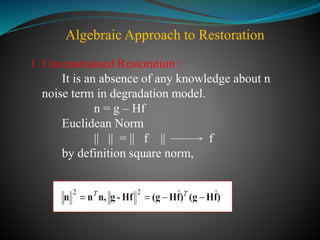
1. Unconstrained Restoration :
It is an absence of any knowledge about n
noise term in degradation model.
n = g – Hf
Euclidean Norm
|| || = || f || f
by definition square norm,
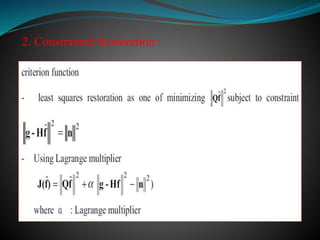
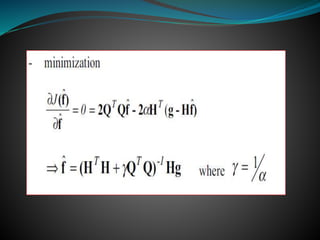
2. Constrained Restoration :
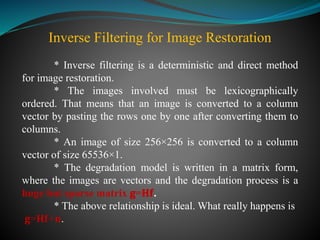
Inverse Filtering for Image Restoration
* Inverse filtering is a deterministic and direct method
for image restoration.
* The images involved must be lexicographically
ordered. That means that an image is converted to a column
vector by pasting the rows one by one after converting them to
columns.
* An image of size 256×256 is converted to a column
vector of size 65536×1.
* The degradation model is written in a matrix form,
where the images are vectors and the degradation process is a
huge but sparse matrix 𝐠=𝐇𝐟.
* The above relationship is ideal. What really happens is
𝐠=𝐇𝐟+𝐧.
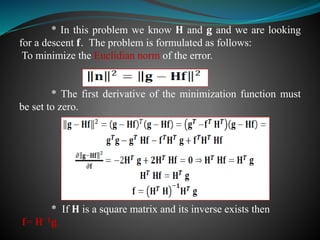
* In this problem we know 𝐇 and 𝐠 and we are looking
for a descent 𝐟. The problem is formulated as follows:
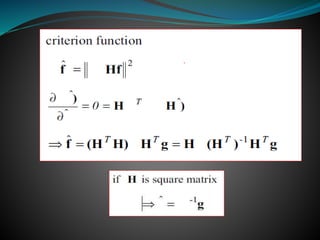
To minimize the Euclidian norm of the error.
* The first derivative of the minimization function must
be set to zero.
* If 𝐇 is a square matrix and its inverse exists then
𝐟= 𝐇−𝟏 𝐠
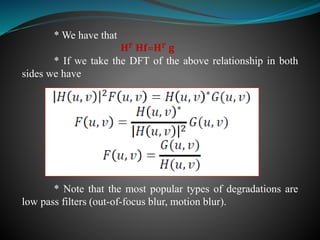
* We have that
𝐇 𝑻 𝐇𝐟=𝐇 𝑻 𝐠
* If we take the DFT of the above relationship in both
sides we have
* Note that the most popular types of degradations are
low pass filters (out-of-focus blur, motion blur).
Inverse Filtering for noise - free scenarios :
* We have that 𝐹𝑢,
𝑣= 𝐺(𝑢,𝑣)/𝐻(𝑢,𝑣)
* Problem: It is very likely that 𝐻(𝑢,𝑣) is 0 or very small
at certain frequency pairs.
* For example,
𝐻(𝑢,𝑣) could be a 𝑠𝑖𝑛𝑐 function.
* In general, since 𝐻(𝑢,𝑣) is a low pass filter, it is very
likely that its values drop off rapidly as the distance of (𝑢,𝑣) from
the origin (0,0) increases.
Pseudo – Inverse Filtering :
* Instead of the conventional inverse filter, we
implement one of the following :
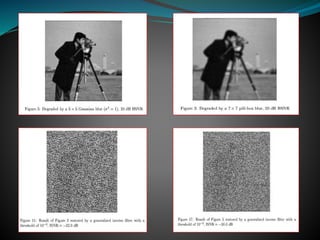
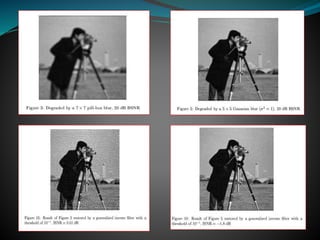
* The parameter 𝜖 (called threshold in the figures in
the next slides) is a small number chosen by the user.
* This filter is called pseudo-inverse or generalized
inverse filter.
Pseudo – Inverse Filtering with different Thresholds :
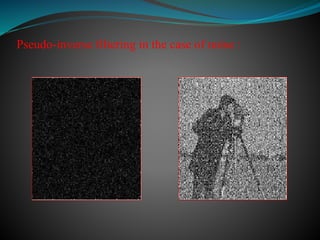
Pseudo-inverse filtering in the case of noise :
Thank You

Digital image processing

  • 1.
    Digital Image Processing AlgebraicApproach to Image Restoration & Inverse Filtering Submitted by, M. Kavitha, II – M.Sc(CS&IT), Nadar Saraswathi College of Arts & Science, Theni.
  • 2.
    Algebraic Approach toRestoration 1. Unconstrained Restoration : It is an absence of any knowledge about n noise term in degradation model. n = g – Hf Euclidean Norm || || = || f || f by definition square norm,
  • 4.
  • 6.
    Inverse Filtering forImage Restoration * Inverse filtering is a deterministic and direct method for image restoration. * The images involved must be lexicographically ordered. That means that an image is converted to a column vector by pasting the rows one by one after converting them to columns. * An image of size 256×256 is converted to a column vector of size 65536×1. * The degradation model is written in a matrix form, where the images are vectors and the degradation process is a huge but sparse matrix 𝐠=𝐇𝐟. * The above relationship is ideal. What really happens is 𝐠=𝐇𝐟+𝐧.
  • 7.
    * In thisproblem we know 𝐇 and 𝐠 and we are looking for a descent 𝐟. The problem is formulated as follows: To minimize the Euclidian norm of the error. * The first derivative of the minimization function must be set to zero. * If 𝐇 is a square matrix and its inverse exists then 𝐟= 𝐇−𝟏 𝐠
  • 8.
    * We havethat 𝐇 𝑻 𝐇𝐟=𝐇 𝑻 𝐠 * If we take the DFT of the above relationship in both sides we have * Note that the most popular types of degradations are low pass filters (out-of-focus blur, motion blur).
  • 9.
    Inverse Filtering fornoise - free scenarios : * We have that 𝐹𝑢, 𝑣= 𝐺(𝑢,𝑣)/𝐻(𝑢,𝑣) * Problem: It is very likely that 𝐻(𝑢,𝑣) is 0 or very small at certain frequency pairs. * For example, 𝐻(𝑢,𝑣) could be a 𝑠𝑖𝑛𝑐 function. * In general, since 𝐻(𝑢,𝑣) is a low pass filter, it is very likely that its values drop off rapidly as the distance of (𝑢,𝑣) from the origin (0,0) increases.
  • 10.
    Pseudo – InverseFiltering : * Instead of the conventional inverse filter, we implement one of the following : * The parameter 𝜖 (called threshold in the figures in the next slides) is a small number chosen by the user. * This filter is called pseudo-inverse or generalized inverse filter.
  • 11.
    Pseudo – InverseFiltering with different Thresholds :
  • 12.
    Pseudo-inverse filtering inthe case of noise :
  • 15.