A PRESENTATION ON IMAGE
ENHANCEMENT TECHNIQUES
PRESENTED BY
JUHI MISHRA
Assistant Professor
Electrical and Electronics Engineering
Dr. C. V. Raman University Juhi mishra 1
DR. C. V. RAMAN INSTITUTE OF SCIENCE & TECHNOLOGY
INTRODUCTION
DIGITAL IMAGE PROCESSING
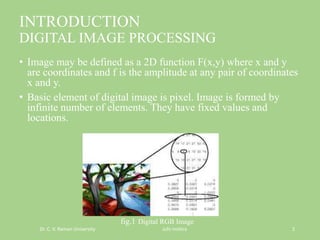
• Image may be defined as a 2D function F(x,y) where x and y
are coordinates and f is the amplitude at any pair of coordinates
x and y.
• Basic element of digital image is pixel. Image is formed by
infinite number of elements. They have fixed values and
locations.
fig.1 Digital RGB Image
Dr. C. V. Raman University Juhi mishra 2
Dr. C. V. Raman University Juhi mishra 3
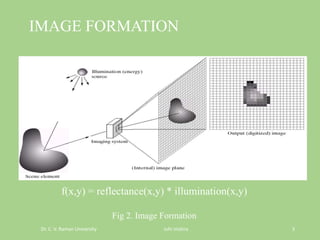
IMAGE FORMATION
f(x,y) = reflectance(x,y) * illumination(x,y)
Fig 2. Image Formation
WHY DIGITAL IMAGE PROCESSING?
• Improvement of pictorial information for human
perception
• For efficient storage
• For better transmission of image with low bandwidth
• Feature Extraction
• Pattern Classification
• Image processing for Manufacturing Systems, Medical
Community etc
Dr. C. V. Raman University Juhi mishra 4
IMAGE ENHANCEMENT
• Process of manipulating an image so that result is
more suitable than the original image.
• Type of enhancement depends on the features of
image which we have to enhance.
• Main goal is reduction of noise which can give better
visualization of image.
Dr. C. V. Raman University Juhi mishra 5
NOISE
• Noise is random variation in image intensity
• Image shows different intensity values instead of true values.
• Noise makes an image unpleasant to see and makes it bad for
further analysis
• Reasons of image noise:
-Due to pixel corruption during acquisition, transmission or
compression process.
-Motion blur
-Poor lightning
-Abnormal atmospheric conditions
Dr. C. V. Raman University Juhi mishra 6
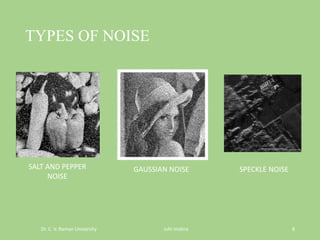
TYPES OF NOISE
There may be three basic types of noise-
1.Impulse noise
-salt and pepper noise
-random noise
2. Additive noise
-Gaussian noise
3. Multiplicative noise-
- Speckle noise
Dr. C. V. Raman University Juhi mishra 7
TYPES OF NOISE
Dr. C. V. Raman University Juhi mishra 8
SALT AND PEPPER
NOISE
GAUSSIAN NOISE SPECKLE NOISE
IMAGE FILTRATION
• Filtering is a technique for modifying or enhancing an image.
Filter can emphasize or remove other features of image.
• Filtering is a neighbourhood operation.
• Image filters provide a denoised image and it is a special
technique of image denoising
• Types of image denoising techniques
- Spatial domain filtering
- Transform domain filtering
• Types of spatial domain filters
- Linear filters
- Non-linear filters
Dr. C. V. Raman University Juhi mishra 9
REGULAR MEDIAN FILTER
Dr. C. V. Raman University Juhi mishra 10
225 225 225 226 226 226 226 226
225 225 226 226 226 226 226 226
225 226 226 226 226 226 226 226
226 226 225 225 226 226 226 226
225 225 225 225 226 226 226 226
225 225 225 226 226 226 226 226
225 225 225 226 226 226 226 226
226 226 226 226 226 226 226 226
225 225 225 226 226 226 226 226
225 225 255 226 226 226 225 226
226 226 225 226 226 226 226 255
255 226 225 0 226 226 226 226
225 255 225 225 226 226 226 255
255 225 224 226 226 0 225 226
226 225 225 226 255 226 226 228
226 226 225 226 226 226 226 226
Sorted: [0, 225, 225, 225, 225, 226, 226, 226, 226]
The median filter is normally used to reduce noise in an
image, somewhat like the mean filter. However, it often does
a better job than the mean filter of preserving useful detail in
the image.
ADAPTIVE MEDIAN FILTER
• Adaptive median filtering has been applied widely as an
advanced method compared with standard median filtering. The
Adaptive Median Filter performs spatial processing to
determine which pixels in an image have been affected by
impulse noise.
• Steps-
-find out local minimum, local maximum and median values.
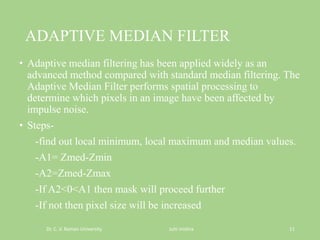
-A1= Zmed-Zmin
-A2=Zmed-Zmax
-If A2<0<A1 then mask will proceed further
-If not then pixel size will be increased
Dr. C. V. Raman University Juhi mishra 11
GAUSSIAN FILTERS
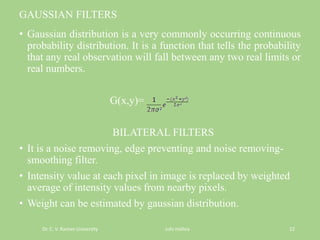
• Gaussian distribution is a very commonly occurring continuous
probability distribution. It is a function that tells the probability
that any real observation will fall between any two real limits or
real numbers.
G(x,y)=
BILATERAL FILTERS
• It is a noise removing, edge preventing and noise removing-
smoothing filter.
• Intensity value at each pixel in image is replaced by weighted
average of intensity values from nearby pixels.
• Weight can be estimated by gaussian distribution.
Dr. C. V. Raman University Juhi mishra 12
PARAMETERS
• To evaluate filter performance following parameters can
be used:
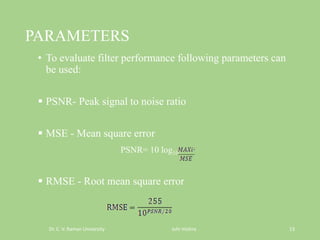
 PSNR- Peak signal to noise ratio
 MSE - Mean square error
PSNR= 10 log10
 RMSE - Root mean square error
Dr. C. V. Raman University Juhi mishra 13
WAVELET ANALYSIS
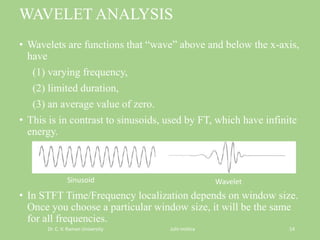
• Wavelets are functions that “wave” above and below the x-axis,
have
(1) varying frequency,
(2) limited duration,
(3) an average value of zero.
• This is in contrast to sinusoids, used by FT, which have infinite
energy.
• In STFT Time/Frequency localization depends on window size.
Once you choose a particular window size, it will be the same
for all frequencies.
Dr. C. V. Raman University Juhi mishra 14
Sinusoid Wavelet
CONTINUE….
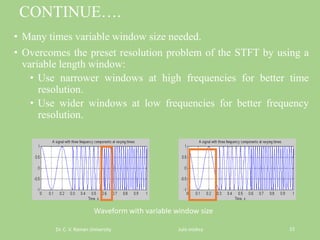
• Many times variable window size needed.
• Overcomes the preset resolution problem of the STFT by using a
variable length window:
• Use narrower windows at high frequencies for better time
resolution.
• Use wider windows at low frequencies for better frequency
resolution.
Dr. C. V. Raman University Juhi mishra 15
Waveform with variable window size
TYPES OF WAVELET TRANSFORM
• Types of wavelet transform:
- Continuous wavelet transform
-> finds out correlation function
-> this correlation gives wavelet coefficient.
- Discrete wavelet transform
-> works on discrete data
-> Uses low pass and high pass filters
-> upsampling and downsampling
Dr. C. V. Raman University Juhi mishra 16
DISCRETE WAVELET TRANSFORM
• It has advantage over CWT as it generate less number of data for
analysis.
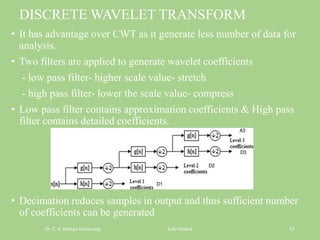
• Two filters are applied to generate wavelet coefficients
- low pass filter- higher scale value- stretch
- high pass filter- lower the scale value- compress
• Low pass filter contains approximation coefficients & High pass
filter contains detailed coefficients.
• Decimation reduces samples in output and thus sufficient number
of coefficients can be generated
Dr. C. V. Raman University Juhi mishra 17
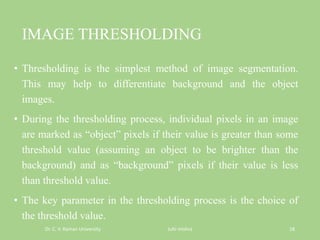
IMAGE THRESHOLDING
• Thresholding is the simplest method of image segmentation.
This may help to differentiate background and the object
images.
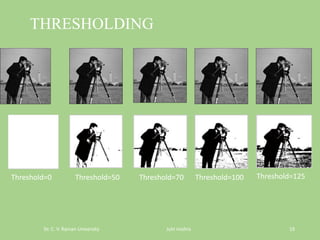
• During the thresholding process, individual pixels in an image
are marked as “object” pixels if their value is greater than some
threshold value (assuming an object to be brighter than the
background) and as “background” pixels if their value is less
than threshold value.
• The key parameter in the thresholding process is the choice of
the threshold value.
Dr. C. V. Raman University Juhi mishra 18
Dr. C. V. Raman University Juhi mishra 19
THRESHOLDING
Threshold=0 Threshold=50 Threshold=70 Threshold=100 Threshold=125
REFERENCES
• An overview of DIP fundamentals: http://www.imageprocessingplace.com/root_files_V3/tutorials.htm
by I.T. Young, J.J. Gerbrands, and L.J. van Vliet
• CVIPtools at SIUE http://www.ee.siue.edu/CVIPtools/examples.php
• www.google.com
• en.wikipedia.org
Dr. C. V. Raman University Juhi mishra 20

Image enhancement

  • 1.
    A PRESENTATION ONIMAGE ENHANCEMENT TECHNIQUES PRESENTED BY JUHI MISHRA Assistant Professor Electrical and Electronics Engineering Dr. C. V. Raman University Juhi mishra 1 DR. C. V. RAMAN INSTITUTE OF SCIENCE & TECHNOLOGY
  • 2.
    INTRODUCTION DIGITAL IMAGE PROCESSING •Image may be defined as a 2D function F(x,y) where x and y are coordinates and f is the amplitude at any pair of coordinates x and y. • Basic element of digital image is pixel. Image is formed by infinite number of elements. They have fixed values and locations. fig.1 Digital RGB Image Dr. C. V. Raman University Juhi mishra 2
  • 3.
    Dr. C. V.Raman University Juhi mishra 3 IMAGE FORMATION f(x,y) = reflectance(x,y) * illumination(x,y) Fig 2. Image Formation
  • 4.
    WHY DIGITAL IMAGEPROCESSING? • Improvement of pictorial information for human perception • For efficient storage • For better transmission of image with low bandwidth • Feature Extraction • Pattern Classification • Image processing for Manufacturing Systems, Medical Community etc Dr. C. V. Raman University Juhi mishra 4
  • 5.
    IMAGE ENHANCEMENT • Processof manipulating an image so that result is more suitable than the original image. • Type of enhancement depends on the features of image which we have to enhance. • Main goal is reduction of noise which can give better visualization of image. Dr. C. V. Raman University Juhi mishra 5
  • 6.
    NOISE • Noise israndom variation in image intensity • Image shows different intensity values instead of true values. • Noise makes an image unpleasant to see and makes it bad for further analysis • Reasons of image noise: -Due to pixel corruption during acquisition, transmission or compression process. -Motion blur -Poor lightning -Abnormal atmospheric conditions Dr. C. V. Raman University Juhi mishra 6
  • 7.
    TYPES OF NOISE Theremay be three basic types of noise- 1.Impulse noise -salt and pepper noise -random noise 2. Additive noise -Gaussian noise 3. Multiplicative noise- - Speckle noise Dr. C. V. Raman University Juhi mishra 7
  • 8.
    TYPES OF NOISE Dr.C. V. Raman University Juhi mishra 8 SALT AND PEPPER NOISE GAUSSIAN NOISE SPECKLE NOISE
  • 9.
    IMAGE FILTRATION • Filteringis a technique for modifying or enhancing an image. Filter can emphasize or remove other features of image. • Filtering is a neighbourhood operation. • Image filters provide a denoised image and it is a special technique of image denoising • Types of image denoising techniques - Spatial domain filtering - Transform domain filtering • Types of spatial domain filters - Linear filters - Non-linear filters Dr. C. V. Raman University Juhi mishra 9
  • 10.
    REGULAR MEDIAN FILTER Dr.C. V. Raman University Juhi mishra 10 225 225 225 226 226 226 226 226 225 225 226 226 226 226 226 226 225 226 226 226 226 226 226 226 226 226 225 225 226 226 226 226 225 225 225 225 226 226 226 226 225 225 225 226 226 226 226 226 225 225 225 226 226 226 226 226 226 226 226 226 226 226 226 226 225 225 225 226 226 226 226 226 225 225 255 226 226 226 225 226 226 226 225 226 226 226 226 255 255 226 225 0 226 226 226 226 225 255 225 225 226 226 226 255 255 225 224 226 226 0 225 226 226 225 225 226 255 226 226 228 226 226 225 226 226 226 226 226 Sorted: [0, 225, 225, 225, 225, 226, 226, 226, 226] The median filter is normally used to reduce noise in an image, somewhat like the mean filter. However, it often does a better job than the mean filter of preserving useful detail in the image.
  • 11.
    ADAPTIVE MEDIAN FILTER •Adaptive median filtering has been applied widely as an advanced method compared with standard median filtering. The Adaptive Median Filter performs spatial processing to determine which pixels in an image have been affected by impulse noise. • Steps- -find out local minimum, local maximum and median values. -A1= Zmed-Zmin -A2=Zmed-Zmax -If A2<0<A1 then mask will proceed further -If not then pixel size will be increased Dr. C. V. Raman University Juhi mishra 11
  • 12.
    GAUSSIAN FILTERS • Gaussiandistribution is a very commonly occurring continuous probability distribution. It is a function that tells the probability that any real observation will fall between any two real limits or real numbers. G(x,y)= BILATERAL FILTERS • It is a noise removing, edge preventing and noise removing- smoothing filter. • Intensity value at each pixel in image is replaced by weighted average of intensity values from nearby pixels. • Weight can be estimated by gaussian distribution. Dr. C. V. Raman University Juhi mishra 12
  • 13.
    PARAMETERS • To evaluatefilter performance following parameters can be used:  PSNR- Peak signal to noise ratio  MSE - Mean square error PSNR= 10 log10  RMSE - Root mean square error Dr. C. V. Raman University Juhi mishra 13
  • 14.
    WAVELET ANALYSIS • Waveletsare functions that “wave” above and below the x-axis, have (1) varying frequency, (2) limited duration, (3) an average value of zero. • This is in contrast to sinusoids, used by FT, which have infinite energy. • In STFT Time/Frequency localization depends on window size. Once you choose a particular window size, it will be the same for all frequencies. Dr. C. V. Raman University Juhi mishra 14 Sinusoid Wavelet
  • 15.
    CONTINUE…. • Many timesvariable window size needed. • Overcomes the preset resolution problem of the STFT by using a variable length window: • Use narrower windows at high frequencies for better time resolution. • Use wider windows at low frequencies for better frequency resolution. Dr. C. V. Raman University Juhi mishra 15 Waveform with variable window size
  • 16.
    TYPES OF WAVELETTRANSFORM • Types of wavelet transform: - Continuous wavelet transform -> finds out correlation function -> this correlation gives wavelet coefficient. - Discrete wavelet transform -> works on discrete data -> Uses low pass and high pass filters -> upsampling and downsampling Dr. C. V. Raman University Juhi mishra 16
  • 17.
    DISCRETE WAVELET TRANSFORM •It has advantage over CWT as it generate less number of data for analysis. • Two filters are applied to generate wavelet coefficients - low pass filter- higher scale value- stretch - high pass filter- lower the scale value- compress • Low pass filter contains approximation coefficients & High pass filter contains detailed coefficients. • Decimation reduces samples in output and thus sufficient number of coefficients can be generated Dr. C. V. Raman University Juhi mishra 17
  • 18.
    IMAGE THRESHOLDING • Thresholdingis the simplest method of image segmentation. This may help to differentiate background and the object images. • During the thresholding process, individual pixels in an image are marked as “object” pixels if their value is greater than some threshold value (assuming an object to be brighter than the background) and as “background” pixels if their value is less than threshold value. • The key parameter in the thresholding process is the choice of the threshold value. Dr. C. V. Raman University Juhi mishra 18
  • 19.
    Dr. C. V.Raman University Juhi mishra 19 THRESHOLDING Threshold=0 Threshold=50 Threshold=70 Threshold=100 Threshold=125
  • 20.
    REFERENCES • An overviewof DIP fundamentals: http://www.imageprocessingplace.com/root_files_V3/tutorials.htm by I.T. Young, J.J. Gerbrands, and L.J. van Vliet • CVIPtools at SIUE http://www.ee.siue.edu/CVIPtools/examples.php • www.google.com • en.wikipedia.org Dr. C. V. Raman University Juhi mishra 20