ADAPTIVE UNSHARP MASKING
       Digital Image Processing
Contents
• What is Unsharp Masking..?


• Concept of Operation


• Drawbacks


• Adaption Algorithm


• Advantages of Unsharp Masking
Unsharp Masking
• Unsharp masking (USM) is an image manipulation
 technique.

• An unsharp mask cannot create additional detail, but it can
 greatly enhance the appearance of detail by increasing
 small-scale acutance (the edge contrast of an image).

• Normally an "unsharp mask" is used to sharpen an image
 which can help us to emphasize texture and detail of the
 image.
Concept of Operation
• Normally in Unsharp Masking, a highpass filtered, scaled
 version of an image is added to the image itself.

• This will improve the visual appearance of an image
 significantly by emphasizing its high frequency contents to
 enhance the edge and detail information in it.

• Generally an unsharp mask is a filter that amplifies high-
 frequency components.
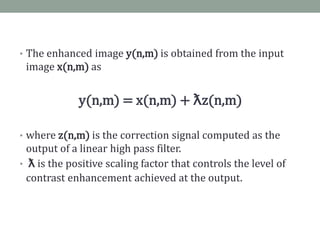
• The enhanced image y(n,m) is obtained from the input
 image x(n,m) as


             y(n,m) = x(n,m) + ƛz(n,m)

• where z(n,m) is the correction signal computed as the
  output of a linear high pass filter.
• ƛ is the positive scaling factor that controls the level of
  contrast enhancement achieved at the output.
hx                      hy
 0     -1   0            0    0     0
 0      2   0            -1   2     -1
 0     -1   0            0    0     0


Zx=conv(x,hx)           Zy=conv(x,hy)


     z(n,m) = [zx(n,m), zy(n,m)]T

  y(n,m) = x(n,m) + ƛz(n,m)
Zx                 Zy


Original Image(x)   Output Image(y)
Drawbacks
• Even though this method is simple and works well in many
 applications, it suffers from two main drawbacks.

  i) The presence of the linear high pass filter makes the system
  extremely sensitive to noise. This results in perceivable and
  undesirable distortions in the images.

  ii) It enhances high-contrast areas much more than areas that
  do not exhibit high image dynamics. Consequently, some
  unpleasant overshoot artifacts may appear in the output
  image.
Adaptive Unsharp Masking
• In this approach, we introduce a variation of the basic
 Unsharp Masking scheme that contains an adaptive filter in
 the correction path.

• The objective of the adaptive filter is to emphasize the
 medium-contrast details in the input image more than large-
 contrast details such as abrupt edges so as to avoid overshoot
 effects in the output image.

• The adaptive filter does not perform a sharpening operation
 in smooth areas, and therefore the overall system is more
 robust to the presence of noise in the input images than
 traditional approaches.
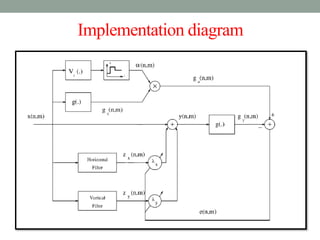
Implementation diagram
Here we go with the approach as below :

             y(n,m) = x(n,m) + ƛz(n,m)

where ƛ is the positive scaling factor that controls the level of
contrast enhancement achieved at the output.


               ƛ (n,m) = [ƛx(n,m), ƛy(n,m)]T


 y(n,m) =x(n,m) + ƛx(n,m)zx(n,m)+ ƛy(n,m)zy(n, m)
Objective of this approach
• In the previous equation, ƛx(n,m) and ƛy (n,m) are the
 scaling factors for the two components of the correction
 signal at the (n,m)th pixel.

• Our objective is to recursively update these parameters
 using an adaptation algorithm so as to produce an output
 image whose local dynamics are increased in the detail
 areas and left unchanged in the uniform areas.

• i,.e., little or no enhancement is applied in smooth areas of
 the image, maximum enhancement is applied in medium
 contrast areas, and large contrast areas are only moderately
 enhanced.
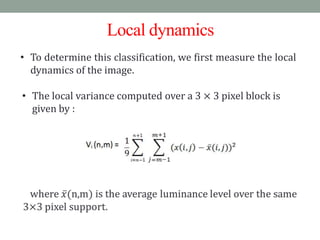
Local dynamics
• To determine this classification, we first measure the local
  dynamics of the image.

• The local variance computed over a 3 × 3 pixel block is
  given by :
•


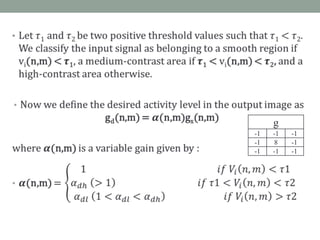
         g
    -1   -1   -1
    -1    8   -1
    -1   -1   -1
•
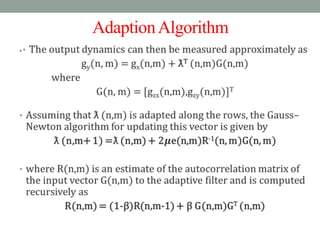
Adaption Algorithm
•
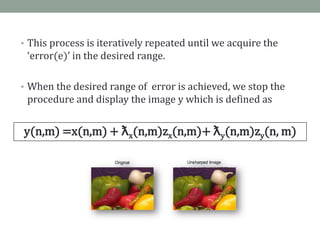
• This process is iteratively repeated until we acquire the
 ‘error(e)’ in the desired range.

• When the desired range of error is achieved, we stop the
 procedure and display the image y which is defined as


y(n,m) =x(n,m) + ƛx(n,m)zx(n,m)+ ƛy(n,m)zy(n, m)

                     Original         Unsharped Image
Advantages of Unsharp Masking
• Enhanced apparent sharpness through “edge effects”.


• An important advantage of unsharp masking is that it
 increases the sharpness of the prints.

• Reduction of contrast on negatives of excessive contrast.


• Improved print shadow detail.


• Well known benefits in the printing and graphics arts
 industries.
References:
• http://www.ieee.org

• Andrea Polesel, Giovanni Ramponi, and V. John Mathews

 “Image Enhancement via Adaptive Unsharp Masking”, IEEE
 TRANSACTIONS ON IMAGE PROCESSING

• Google Images

• MATLAB images
THANK YOU

Adaptive unsharp masking

  • 1.
    ADAPTIVE UNSHARP MASKING Digital Image Processing
  • 2.
    Contents • What isUnsharp Masking..? • Concept of Operation • Drawbacks • Adaption Algorithm • Advantages of Unsharp Masking
  • 3.
    Unsharp Masking • Unsharpmasking (USM) is an image manipulation technique. • An unsharp mask cannot create additional detail, but it can greatly enhance the appearance of detail by increasing small-scale acutance (the edge contrast of an image). • Normally an "unsharp mask" is used to sharpen an image which can help us to emphasize texture and detail of the image.
  • 4.
    Concept of Operation •Normally in Unsharp Masking, a highpass filtered, scaled version of an image is added to the image itself. • This will improve the visual appearance of an image significantly by emphasizing its high frequency contents to enhance the edge and detail information in it. • Generally an unsharp mask is a filter that amplifies high- frequency components.
  • 5.
    • The enhancedimage y(n,m) is obtained from the input image x(n,m) as y(n,m) = x(n,m) + ƛz(n,m) • where z(n,m) is the correction signal computed as the output of a linear high pass filter. • ƛ is the positive scaling factor that controls the level of contrast enhancement achieved at the output.
  • 6.
    hx hy 0 -1 0 0 0 0 0 2 0 -1 2 -1 0 -1 0 0 0 0 Zx=conv(x,hx) Zy=conv(x,hy) z(n,m) = [zx(n,m), zy(n,m)]T y(n,m) = x(n,m) + ƛz(n,m)
  • 7.
    Zx Zy Original Image(x) Output Image(y)
  • 8.
    Drawbacks • Even thoughthis method is simple and works well in many applications, it suffers from two main drawbacks. i) The presence of the linear high pass filter makes the system extremely sensitive to noise. This results in perceivable and undesirable distortions in the images. ii) It enhances high-contrast areas much more than areas that do not exhibit high image dynamics. Consequently, some unpleasant overshoot artifacts may appear in the output image.
  • 9.
    Adaptive Unsharp Masking •In this approach, we introduce a variation of the basic Unsharp Masking scheme that contains an adaptive filter in the correction path. • The objective of the adaptive filter is to emphasize the medium-contrast details in the input image more than large- contrast details such as abrupt edges so as to avoid overshoot effects in the output image. • The adaptive filter does not perform a sharpening operation in smooth areas, and therefore the overall system is more robust to the presence of noise in the input images than traditional approaches.
  • 10.
  • 11.
    Here we gowith the approach as below : y(n,m) = x(n,m) + ƛz(n,m) where ƛ is the positive scaling factor that controls the level of contrast enhancement achieved at the output. ƛ (n,m) = [ƛx(n,m), ƛy(n,m)]T y(n,m) =x(n,m) + ƛx(n,m)zx(n,m)+ ƛy(n,m)zy(n, m)
  • 12.
    Objective of thisapproach • In the previous equation, ƛx(n,m) and ƛy (n,m) are the scaling factors for the two components of the correction signal at the (n,m)th pixel. • Our objective is to recursively update these parameters using an adaptation algorithm so as to produce an output image whose local dynamics are increased in the detail areas and left unchanged in the uniform areas. • i,.e., little or no enhancement is applied in smooth areas of the image, maximum enhancement is applied in medium contrast areas, and large contrast areas are only moderately enhanced.
  • 13.
    Local dynamics • Todetermine this classification, we first measure the local dynamics of the image. • The local variance computed over a 3 × 3 pixel block is given by :
  • 14.
    g -1 -1 -1 -1 8 -1 -1 -1 -1
  • 15.
  • 16.
  • 17.
    • This processis iteratively repeated until we acquire the ‘error(e)’ in the desired range. • When the desired range of error is achieved, we stop the procedure and display the image y which is defined as y(n,m) =x(n,m) + ƛx(n,m)zx(n,m)+ ƛy(n,m)zy(n, m) Original Unsharped Image
  • 18.
    Advantages of UnsharpMasking • Enhanced apparent sharpness through “edge effects”. • An important advantage of unsharp masking is that it increases the sharpness of the prints. • Reduction of contrast on negatives of excessive contrast. • Improved print shadow detail. • Well known benefits in the printing and graphics arts industries.
  • 19.
    References: • http://www.ieee.org • AndreaPolesel, Giovanni Ramponi, and V. John Mathews “Image Enhancement via Adaptive Unsharp Masking”, IEEE TRANSACTIONS ON IMAGE PROCESSING • Google Images • MATLAB images
  • 20.