Morphological Image
    Processing


                  Nandu Raj
              Vinayak Narayanan
‘Morphology’ - a branch of Biology which deals with
the form and structure of plants and animals.
       Here, it is used as a tool for extracting image
components useful in describing image shape.

                    Programme chart

•   Dilation and Erosion
•   Opening and Closing
•   Hit or Miss transformation
•   Morph. algorithms
Dilation
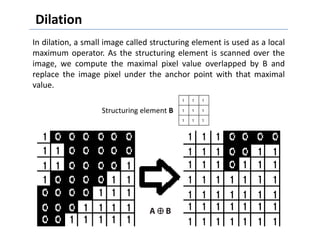
In dilation, a small image called structuring element is used as a local
maximum operator. As the structuring element is scanned over the
image, we compute the maximal pixel value overlapped by B and
replace the image pixel under the anchor point with that maximal
value.

                   Structuring element B
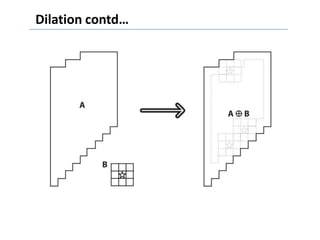
Dilation contd…
Dilation contd...
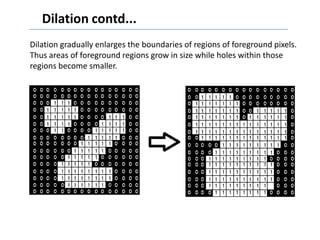
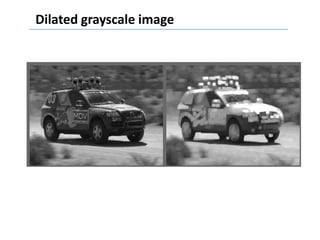
Dilation gradually enlarges the boundaries of regions of foreground pixels.
Thus areas of foreground regions grow in size while holes within those
regions become smaller.
Dilated grayscale image
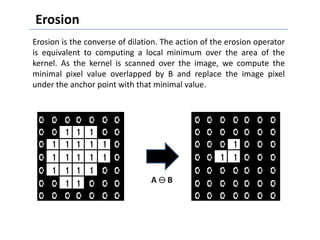
Erosion
Erosion is the converse of dilation. The action of the erosion operator
is equivalent to computing a local minimum over the area of the
kernel. As the kernel is scanned over the image, we compute the
minimal pixel value overlapped by B and replace the image pixel
under the anchor point with that minimal value.
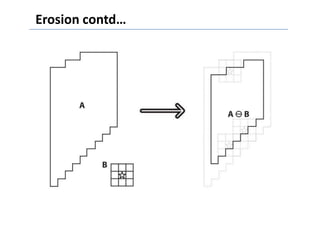
Erosion contd…
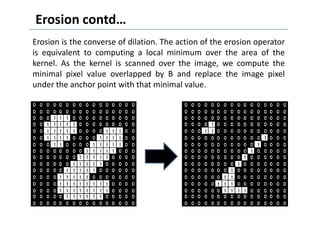
Erosion contd…
Erosion is the converse of dilation. The action of the erosion operator
is equivalent to computing a local minimum over the area of the
kernel. As the kernel is scanned over the image, we compute the
minimal pixel value overlapped by B and replace the image pixel
under the anchor point with that minimal value.
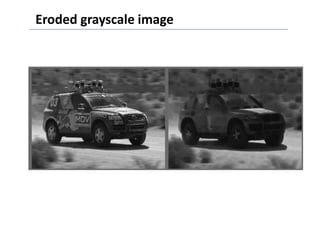
Eroded grayscale image
Opening

Opening generally smoothens the contour of an object, breaks narrow
isthmuses, and eliminates thin protrusions.

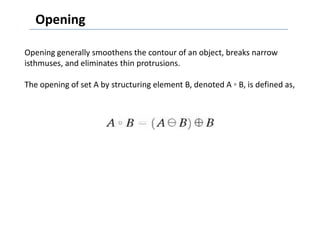
The opening of set A by structuring element B, denoted A ◦ B, is defined as,
Opening – geometrical interpretation

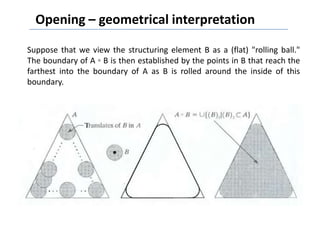
Suppose that we view the structuring element B as a (flat) "rolling ball."
The boundary of A ◦ B is then established by the points in B that reach the
farthest into the boundary of A as B is rolled around the inside of this
boundary.
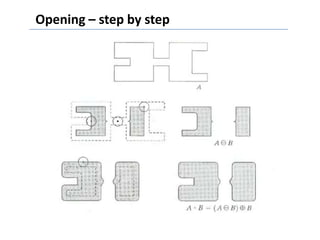
Opening – step by step
Closing

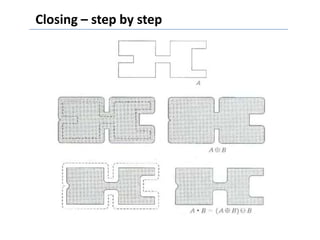
Closing also tends to smooth sections of contours but, as opposed to
opening, it generally fuses narrow breaks and long thin gulfs, eliminates small
holes, and fills gaps in the contour.


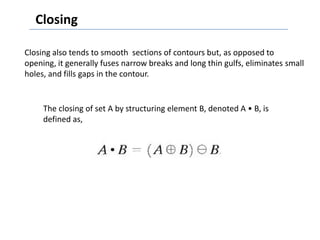
     The closing of set A by structuring element B, denoted A • B, is
     defined as,
Closing – geometrical interpretation
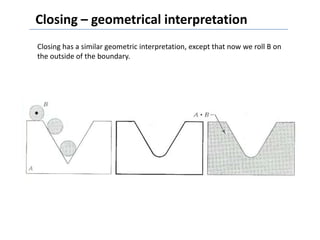
Closing has a similar geometric interpretation, except that now we roll B on
the outside of the boundary.
Closing – step by step
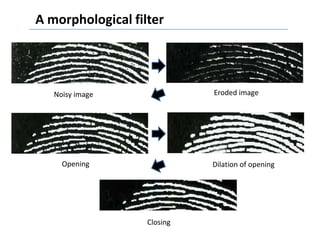
A morphological filter
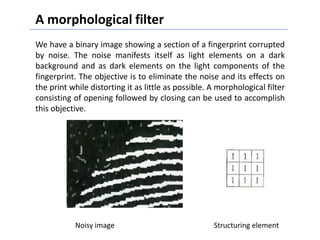
We have a binary image showing a section of a fingerprint corrupted
by noise. The noise manifests itself as light elements on a dark
background and as dark elements on the light components of the
fingerprint. The objective is to eliminate the noise and its effects on
the print while distorting it as little as possible. A morphological filter
consisting of opening followed by closing can be used to accomplish
this objective.


           Noisy image                               Structuring element
A morphological filter


   Noisy image               Eroded image


     Opening                 Dilation of opening


                   Closing
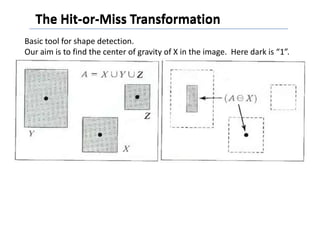
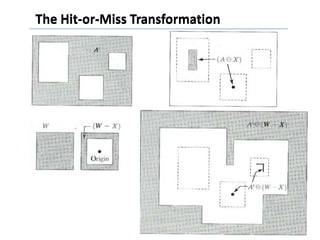
The Hit-or-Miss Transformation
Basic tool for shape detection.
Our aim is to find the center of gravity of X in the image. Here dark is “1”.
The Hit-or-Miss Transformation
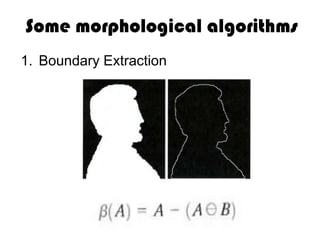
Some morphological algorithms
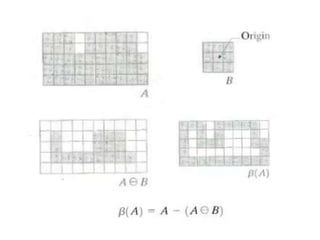
1. Boundary Extraction
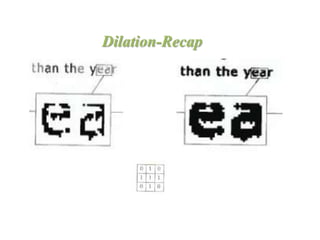
Dilation-Recap
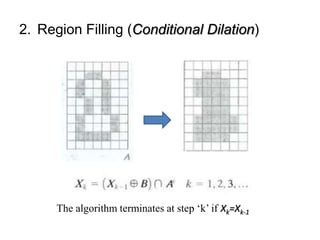
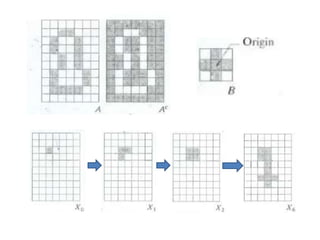
2. Region Filling (Conditional Dilation)


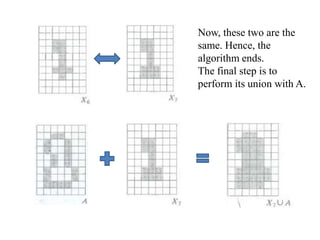
      The algorithm terminates at step ‘k’ if Xk=Xk-1
Now, these two are the
same. Hence, the
algorithm ends.
The final step is to
perform its union with A.
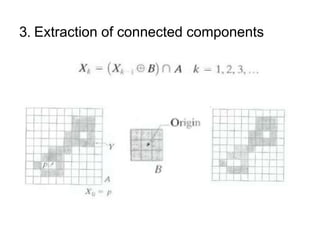
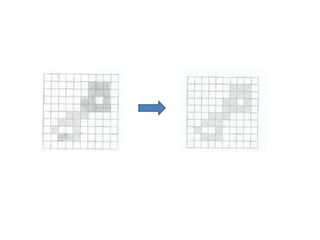
3. Extraction of connected components
Thank You

Morphological image processing

  • 1.
    Morphological Image Processing Nandu Raj Vinayak Narayanan
  • 2.
    ‘Morphology’ - abranch of Biology which deals with the form and structure of plants and animals. Here, it is used as a tool for extracting image components useful in describing image shape. Programme chart • Dilation and Erosion • Opening and Closing • Hit or Miss transformation • Morph. algorithms
  • 3.
    Dilation In dilation, asmall image called structuring element is used as a local maximum operator. As the structuring element is scanned over the image, we compute the maximal pixel value overlapped by B and replace the image pixel under the anchor point with that maximal value. Structuring element B
  • 4.
  • 5.
    Dilation contd... Dilation graduallyenlarges the boundaries of regions of foreground pixels. Thus areas of foreground regions grow in size while holes within those regions become smaller.
  • 6.
  • 7.
    Erosion Erosion is theconverse of dilation. The action of the erosion operator is equivalent to computing a local minimum over the area of the kernel. As the kernel is scanned over the image, we compute the minimal pixel value overlapped by B and replace the image pixel under the anchor point with that minimal value.
  • 8.
  • 9.
    Erosion contd… Erosion isthe converse of dilation. The action of the erosion operator is equivalent to computing a local minimum over the area of the kernel. As the kernel is scanned over the image, we compute the minimal pixel value overlapped by B and replace the image pixel under the anchor point with that minimal value.
  • 10.
  • 11.
    Opening Opening generally smoothensthe contour of an object, breaks narrow isthmuses, and eliminates thin protrusions. The opening of set A by structuring element B, denoted A ◦ B, is defined as,
  • 12.
    Opening – geometricalinterpretation Suppose that we view the structuring element B as a (flat) "rolling ball." The boundary of A ◦ B is then established by the points in B that reach the farthest into the boundary of A as B is rolled around the inside of this boundary.
  • 13.
  • 14.
    Closing Closing also tendsto smooth sections of contours but, as opposed to opening, it generally fuses narrow breaks and long thin gulfs, eliminates small holes, and fills gaps in the contour. The closing of set A by structuring element B, denoted A • B, is defined as,
  • 15.
    Closing – geometricalinterpretation Closing has a similar geometric interpretation, except that now we roll B on the outside of the boundary.
  • 16.
  • 17.
    A morphological filter Wehave a binary image showing a section of a fingerprint corrupted by noise. The noise manifests itself as light elements on a dark background and as dark elements on the light components of the fingerprint. The objective is to eliminate the noise and its effects on the print while distorting it as little as possible. A morphological filter consisting of opening followed by closing can be used to accomplish this objective. Noisy image Structuring element
  • 18.
    A morphological filter Noisy image Eroded image Opening Dilation of opening Closing
  • 19.
    The Hit-or-Miss Transformation Basictool for shape detection. Our aim is to find the center of gravity of X in the image. Here dark is “1”.
  • 20.
  • 21.
  • 23.
  • 24.
    2. Region Filling(Conditional Dilation) The algorithm terminates at step ‘k’ if Xk=Xk-1
  • 26.
    Now, these twoare the same. Hence, the algorithm ends. The final step is to perform its union with A.
  • 27.
    3. Extraction ofconnected components
  • 29.