International Journal of Engineering and Technical Research (IJETR)
ISSN: 2321-0869, Volume-1, Issue-10, December 2013
1 www.erpublication.org

Abstract— Educational building projects are considered as
one of the most important construction projects in Egypt. It is
well known that most construction projects in Egypt exposed to
time and cost overrun or both. This phenomenon may affect the
progress of educational building projects in Egypt. The aim of
this research is to find out the main causes of time and cost
overruns in educational buildings in Egypt, ranking these causes
according to their relative importance and level of severity and
investigate the expected effects of these factors on both cost and
time overruns of a selected sample of the educational building
projects in Egypt. Finally a multiple regression model was
developed for both time and cost overruns using SPSS version
16.
Index Terms— Educational building projects in Egypt, the
main causes of time and cost overruns, ranking, statistical
model.
I. INTRODUCTION
Time and cost overruns in education building projects in
Egypt are critical issues that badly affect project delivery.
This may lose the goal of building larger number of
educational projects to reduce the concentration of the people
in the class that can improve the overall education system in
Egypt. Time and cost overrun generally result from different
factors that occur at various phases of the project life cycle.
These factors include increase in project scope, design error,
mistakes in soil investigation, difficulty in getting work
permit from government, bureaucracy in bidding/tendering
method. Through this research statistical regression models
for time and cost overruns were developed using SPSS
version 16. To achieve this goal, first a review of the past
literature is presented. A questionnaire survey was conducted
to identify the most important time and cost overrun factors.
Finally the paper provided two regression models that can be
used to assess the expected time and cost overruns in
educational building projects in Egypt. The development of
the two models was discussed and the validity of them was
also investigated.
Manuscript received November 21, 2013.
Walid kholif M.Sc. Student, Building and Construction Dept., Faculty of
Engineering, Arab Academy for Science and Technology and Maritime
Transport Cairo, Egypt.
Hossam Hosny Professor, Construction Engineering Dept., Faculty of
Engineering, Zagazig University Zagazig, Egypt
Abdelmonem Sanad Professor, Building and Construction Dept., Faculty
of Engineering, Arab Academy for Science and Technology and Maritime
Transport, Cairo, Egypt.
II- Literature Review
Based on several previous researches, it is readily known that
time and cost overruns are inherent characteristics for the
construction industry in most countries. The most important
time and cost overrun factors according to contractors were
preparation and approval of shop drawings, delays and cost
overrun in contractors‘ progress, payment by owners and
design changes by owner, (Assaf, et al. 1995). Poor site
management and supervision, unforeseen ground conditions,
low speed of decision making involving all project teams,
Client initiated variations and necessary variations of works
indicated by Chan and Kumaraswamy (1997) as the main
causes of time and cost overruns in Hong Kong. Mansfield et
al. (1994) investigated the important factors responsible for
delays and cost overruns in highway construction projects in
Nigeria such as poor contract management, material
shortages, inaccurate estimating and overall price
fluctuations. Trigunarsyah (2004) pointed to the fact that
contractor involvement in pre-construction phases could
reduce time and cost problems during site operation. Refer to
Aibinu and Odeyinka (2006) delay is a situation when the
contractor and the project owner jointly or severally
contribute to the non-completion of the project within the
agreed contract period. Delays in construction projects are
frequently expensive since there is usually a construction
loan involved which charges interest, Management staff
dedicated to the project whose costs are time dependent and
ongoing inflation in wage and material prices. Creedy (2004)
is of the view that identification of the existence and
influence of cost overrun risk factors in a project can lead to a
better control on project cost overrun and also can help in
proposing solutions to avoid future overruns. Jahren and
Ashe (1990) found that a cost overrun rate of 1 to 11% is
more likely to occur on larger projects compared to overruns
on smaller projects but mentioned that managers on large
projects typically make special efforts to keep cost-overrun
rates low. Jahren and Ashe (1990) also determined that the
risk of high cost overrun rates is greater when the winning bid
amount is less than the engineer‘s estimate and further
identified some cost-overrun factors such as the contract
document quality, nature of interpersonal relations on the
project and contractor policies. In other studies the reasons
for cost overruns have been found to include rising costs of
labor and materials, inadequate analysis, poor costing
methods, poor control and scheduling, and inadequate
information, Akpan and Igwe (2001). Chang (2002) also
categorized the reasons for cost and time increases in
engineering design projects as those within the owner‘s
control for which the owner is responsible, those within the
consultant‘s control for which the consultant is responsible
Analysis of Time and Cost overruns in
Educational Building projects in Egypt
Walid kholif, Hossam Hosny and Abdelmonem Sanad
Analysis of Time and Cost overruns in Educational Building projects in Egypt
2 www.erpublication.org
and those beyond the control of the owner or the consultant,
such as increased work scope, changes in legislation or
changes in standards and archeological discoveries. Recently
Gkritza and Labi( 2008) determined that larger projects and
longer duration projects were more likely to incur cost
overruns and provided mathematical relationships between
project size and overrun likelihood. Flyvbjerg et al. (2003)
admitted that cost escalation is a pervasive phenomenon in
transport infrastructure projects irrespective of project type,
geographical location and historical period. Flyvbjerg et al.
(2004) found that cost escalation is strongly influenced by the
implementation phase length and project type, and suggested
that decision makers and planners should be duly concerned
about long implementation phases. Other studies from Hong
Kong include the work of Lo et al. (2006) who examined the
distribution of construction delays. Six of the most significant
causes of construction delay were found, These are:
unforeseen ground conditions, Poor site management and
supervision, client variations, inexperienced contractor, slow
coordination and seeking of approval from concerned
authorities and inadequate contractor resources. This
indicated that these construction delay problems still exist
and that further action for improvement is required. Kaliba et
al. (2009) concluded from their study that the major causes of
delay in road construction projects in Zambia were delayed
payments, financial deficiencies on the part of the client or
contractor, contract modification, economic problems,
Material procurement, changes in design drawings, staffing
problems, equipment unavailability, poor supervision,
construction mistakes, poor coordination on site, changes in
specifications, labor disputes and strikes. Agaba (2009)
attributes delays in construction projects to poor designs and
specifications, and problems associated with management
and supervision. M.E. Abdel-Razek et al. (2008) found that
delayed payments, coordination difficulty, and poor
communication were important causes of delay in Egypt.
Le-Hoai et al. (2008) ranked the three top causes of cost
overruns in Vietnam as material cost increase due to
inflation, inaccurate quantity take off and labor cost increase
due to environment restriction. Kaliba, et al. (2009)
concluded that cost escalation of construction projects in
Zambia are caused by factors such as inclement weather,
scope changes, environment protection and mitigation costs,
schedule delay, strikes, technical challenges and inflation.
Sambasivan and Soon (2007) established poor planning,
poor site management, inadequate supervisory skills of the
contractor, delayed payments, material shortage, labor
supply, equipment availability and failure, poor
communication and rework were the most important causes
of delays in the Malaysian construction industry.
III- Objective
The objectives of this research paper are:
1- To find out the main causes of time and cost overruns in
educational buildings in Egypt.
2- To rank these causes according to their relative
importance and level of severity.
3- To investigate the expected effects of these factors on
the cost and time overruns of a selected sample of the
educational building projects in Egypt.
4- To develop a statistical regression model that can be
used to assess the expected time and cost overruns in
the future educational buildings projects in Egypt.
IV- Methodology
The study will be conducted through the following
sequential steps:
1- A literature review will be carried out to cover the previous
studies regarding the construction project cost and time
overruns. Based on this review, the different causes that
are expected to affect the cost and time overruns will be
clearly identified.
2- Based on the previously identified factors, a questionnaire
survey targeted at contractors and consultant will be
conducted to identify the most important causes of time
and cost overruns in the educational buildings projects in
Egypt.
3- The identified causes will be also categorized according to
their relative importance. Such relative importance mainly
includes frequency index, severity index and important
index.
4- To address the study objectives, data will be collected for a
selected sample of educational projects that were executed
through the time period from 2007 to 2011 by the
Egyptian authority of educational building.
5- Finally the collected data and the questionnaire survey will
be deeply investigated to:
(a) Identify the main causes influencing the cost and time
overruns in the educational building projects,
Ranking these factors according to their relative
importance and identifying the most important factors.
(b) Investigate the simultaneous relationship between
these factors and the cost and time overrun by
developing two regression models using SPSS version
16 program.
II. UNITS
Use either SI (MKS) or CGS as primary units. (SI units are
strongly encouraged.) English units may be used as secondary
units (in parentheses). This applies to papers in data
storage. For example, write ―15 Gb/cm2
(100 Gb/in2
).‖ An
exception is when English units are used as identifiers in
trade, such as ―3½ in disk drive.‖ Avoid combining SI and
CGS units, such as current in amperes and magnetic field in
oersteds. This often leads to confusion because equations do
not balance dimensionally. If you must use mixed units,
clearly state the units for each quantity in an equation.
The SI unit for magnetic field strength H is A/m. However,
if you wish to use units of T, either refer to magnetic flux
density B or magnetic field strength symbolized as µ0H. Use
the center dot to separate compound units, e.g., ―A·m2
.‖
V- Questionnaire Survey
A. Identify the main factors affecting time and
cost overrun
A direct interview survey was used through a carefully
prepared detailed questionnaire to identify the most important
time and cost overruns factors. Questionnaire was sent to the
selected respondent from contractors and consultants. The
questionnaire also offers some level of confidentiality and
International Journal of Engineering and Technical Research (IJETR)
ISSN: 2321-0869, Volume-1, Issue-10, December 2013
3 www.erpublication.org
allows respondents to give true opinions on issues asked.
Because the mother tongue of most people working in
construction in Egypt is Arabic it was necessary to provide an
Arabic questionnaire format. Data were gathered indirect
interview because of the difficulty in gathering questionnaires
by post. A total of 80 questionnaires were sent to construction
professionals involved in educational building project in
Egypt. The chosen projects locate in 12 different cities, Cairo,
Alexandria, Giza, Qalubia, Daqahlia, Behera, Gharbia,
Asyood, Sohag, Eloqsor, Elminia and Qna. Uncompleted
questionnaires were eliminated. Fifty two full responses were
obtained showing a response rate of 65%. The response rate
from contractors and consultants is 78.85%, 21.15%,
respectively. Regarding number of years involved in
construction, 3.85% of respondents have less than or equal to
5 years, 25% of them have between 5 and 10 years. 13.55% of
them have years of experiences between 10 and 15 years and
finally 57.6% of them have 15 years of experiences or more.
The percentage of respondents whose experiences are 15
years or more is the highest this gives a great confidence
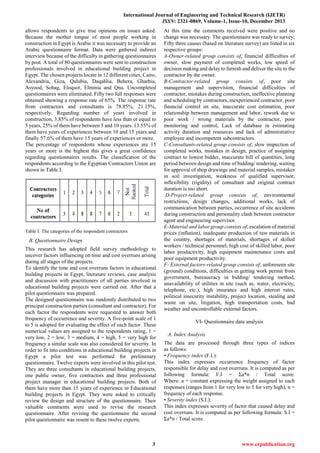
regarding questionnaires results. The classification of the
respondents according to the Egyptian Contractors Union are
shown in Table I.
Table I: The categories of the respondent contractors
B. Questionnaire Design
This research has adopted field survey methodology to
uncover factors influencing on time and cost overruns arising
during all stages of the projects.
To identify the time and cost overruns factors in educational
building projects in Egypt, literature reviews, case analysis
and discussion with practitioners of all parties involved in
educational building projects were carried out. After that a
pilot questionnaire was prepared.
The designed questionnaire was randomly distributed to two
principal construction parties (consultant and contractor). For
each factor the respondents were requested to answer both
frequency of occurrence and severity. A five-point scale of 1
to 5 is adopted for evaluating the effect of each factor. These
numerical values are assigned to the respondents rating, 1 =
very low, 2 = low, 3 = medium, 4 = high, 5 = very high for
frequency a similar scale was also considered for severity. In
order to fit into conditions in educational building projects in
Egypt a pilot test was performed for preliminary
questionnaire. Twelve experts were involved in this pilot test.
They are three consultants in educational building projects,
one public owner, five contractors and three professional
project manager in educational building projects. Both of
them have more than 15 years of experience in Educational
building projects in Egypt. They were asked to critically
review the design and structure of the questionnaire. Their
valuable comments were used to revise the research
questionnaire. After revising the questionnaire the second
pilot questionnaire was resent to these twelve experts.
At this time the comments received were positive and no
change was necessary. The questionnaire was ready to survey;
Fifty three causes (based on literature survey) are listed in six
respective groups:
A-Owner-related group consists of, financial difficulties of
owner, slow payment of completed works, low speed of
decision making and delay to furnish and deliver the site to the
contractor by the owner.
B-Contractor-related group consists of, poor site
management and supervision, financial difficulties of
contractor, mistakes during construction, ineffective planning
and scheduling by contractors, inexperienced contractor, poor
financial control on site, inaccurate cost estimation, poor
relationship between management and labor, rework due to
poor work / wrong materials by the contractor, poor
monitoring and control, Lack of database in estimating
activity duration and resources and lack of administrative
employee and incompetent subcontractors.
C-Consultants-related group consists of, slow inspection of
completed works, mistakes in design, practice of assigning
contract to lowest bidder, inaccurate bill of quantities, long
period between design and time of bidding/ tendering, waiting
for approval of shop drawings and material samples, mistakes
in soil investigation, weakness of qualified supervisor,
inflexibility (rigidity) of consultant and original contract
duration is too short.
D-Project-related group consists of, environmental
restrictions, design changes, additional works, lack of
communication between parties, occurrence of site accidents
during construction and personality clash between contractor
agent and engineering supervisor.
E-Material and labor group consists of, escalation of material
prices (inflation), inadequate production of raw materials in
the country, shortages of materials, shortages of skilled
workers / technical personnel, high cost of skilled labor, poor
labor productivity, high equipment maintenance costs and
poor equipment productivity.
F- External factors-related group consists of, unforeseen site
(ground) conditions, difficulties in getting work permit from
government, bureaucracy in bidding/ tendering method,
unavailability of utilities in site (such as, water, electricity,
telephone, etc.), high insurance and high interest rates,
political insecurity instability, project location, stealing and
waste on site, litigation, high transportation costs, bad
weather and uncontrollable external factors.
VI- Questionnaire data analysis
A. Index Analysis
The data are processed through three types of indices
as follows:
• Frequency index (F.I.):
This index expresses occurrence frequency of factor
responsible for delay and cost overruns. It is computed as per
following formula: F.I = Σa*n / Total score.
Where: a = constant expressing the weight assigned to each
responses (ranges from 1 for very low to 5 for very high), n =
frequency of each response.
• Severity index (S.I.):
This index expresses severity of factor that caused delay and
cost overruns. It is computed as per following formula: S.I =
Σa*n / Total score.
Analysis of Time and Cost overruns in Educational Building projects in Egypt
4 www.erpublication.org
Where: a = constant expressing the weight assigned to each
responses (ranges from 1 for very low to 5 for very high), n =
frequency of each response.
• Importance index (Imp. I.):
This index expresses the overview of factor based on both
their frequency and severity. It is computed as per following
formula: Imp. I. = F.I. × S.I.
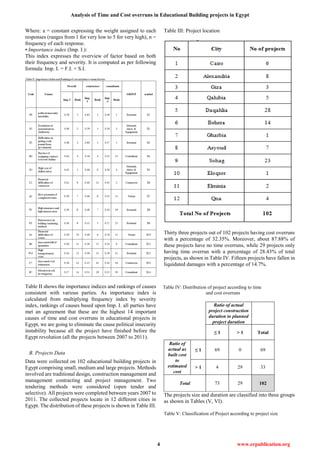
Table II shows the importance indices and rankings of causes
consistent with various parties. As importance index is
calculated from multiplying frequency index by severity
index, rankings of causes based upon Imp. I. all parties have
met an agreement that these are the highest 14 important
causes of time and cost overruns in educational projects in
Egypt, we are going to eliminate the cause political insecurity
instability because all the project have finished before the
Egypt revolution (all the projects between 2007 to 2011).
B. Projects Data
Data were collected on 102 educational building projects in
Egypt comprising small, medium and large projects. Methods
involved are traditional design, construction management and
management contracting and project management. Two
tendering methods were considered (open tender and
selective). All projects were completed between years 2007 to
2011. The collected projects locate in 12 different cities in
Egypt. The distribution of these projects is shown in Table III.
Table III: Project location
Thirty three projects out of 102 projects having cost overruns
with a percentage of 32.35%. Moreover, about 87.88% of
these projects have no time overruns, while 29 projects only
having time overrun with a percentage of 28.43% of total
projects, as shown in Table IV. Fifteen projects have fallen in
liquidated damages with a percentage of 14.7%.
Table IV: Distribution of project according to time
and cost overruns
Ratio of actual
project construction
duration to planned
project duration
≤ 1 > 1 Total
Ratio of
actual as
built cost
to
estimated
cost
≤ 1 69 0 69
> 1 4 29 33
Total 73 29 102
The projects size and duration are classified into three groups
as shown in Tables (V, VI).
Table V: Classification of Project according to project size
International Journal of Engineering and Technical Research (IJETR)
ISSN: 2321-0869, Volume-1, Issue-10, December 2013
5 www.erpublication.org
Projects size
No of
projects
Cost
overrun
% of
projects
% of
Average
value of
cost
overrun
Less than 1
million
17 3 17.65 14.13
Between 1 to 5
million
69 19 27.54 7.51
More than 5
million
16 11 68.75 5.91
Total 102 33 32.35
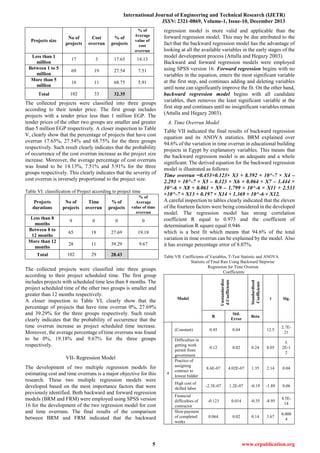
The collected projects were classified into three groups
according to their tender price. The first group includes
projects with a tender price less than 1 million EGP. The
tender prices of the other two groups are smaller and greater
than 5 million EGP respectively. A closer inspection to Table
V, clearly show that the percentage of projects that have cost
overrun 17.65%, 27.54% and 68.75% for the three groups
respectively. Such result clearly indicates that the probability
of occurrence of the cost overrun increase as the project size
increase. Moreover, the average percentage of cost overruns
was found to be 14.13%, 7.51% and 5.91% for the three
groups respectively. This clearly indicates that the severity of
cost overrun is inversely proportional to the project size.
Table VI: classification of Project according to project time
Projects
durations
No of
projects
Time
overrun
% of
projects
% of
Average
value of time
overrun
Less than 8
months
9 0 0 0
Between 8 to
12 months
65 18 27.69 19.18
More than 12
months
28 11 39.29 9.67
Total 102 29 28.43
The collected projects were classified into three groups
according to their project scheduled time. The first group
includes projects with scheduled time less than 8 months. The
project scheduled time of the other two groups is smaller and
greater than 12 months respectively.
A closer inspection to Table VI, clearly show that the
percentage of projects that have time overrun 0%, 27.69%
and 39.29% for the three groups respectively. Such result
clearly indicates that the probability of occurrence that the
time overrun increase as project scheduled time increase.
Moreover, the average percentage of time overruns was found
to be 0%, 19.18% and 9.67% for the three groups
respectively.
VII- Regression Model
The development of two multiple regression models for
estimating cost and time overruns is a major objective for this
research. These two multiple regression models were
developed based on the most importance factors that were
previously identified. Both backward and forward regression
models (BRM and FRM) were employed using SPSS version
16 for the development of the two regression model for cost
and time overruns. The final results of the comparison
between BRM and FRM indicated that the backward
regression model is more valid and applicable than the
forward regression model. This may be due attributed to the
fact that the backward regression model has the advantage of
looking at all the available variables in the early stages of the
model development process (Attalla and Hegazy 2003).
Backward and forward regression models were employed
using SPSS version 16. Forward regression begins with no
variables in the equation, enters the most significant variable
at the first step, and continues adding and deleting variables
until none can significantly improve the fit. On the other hand,
backward regression model begins with all candidate
variables, then removes the least significant variable at the
first step and continues until no insignificant variables remain
(Attalla and Hegazy 2003).
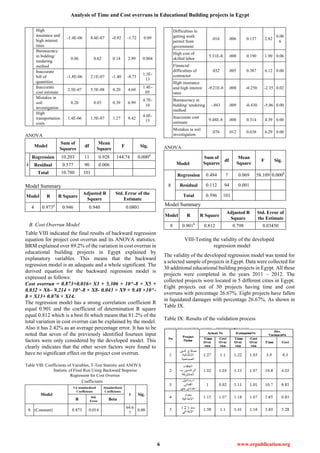
A. Time Overrun Model
Table VII indicated the final results of backward regression
equation and its ANOVA statistics. BRM explained over
94.6% of the variation in time overrun in educational building
projects in Egypt by explanatory variables. This means that
the backward regression model is an adequate and a whole
significant. The derived equation for the backward regression
model is illustrated as follows:
Time overrun =0.453+0.123× X3 + 8.592 × 10^-7 × X4 –
2.293 × 10^-7 × X5 – 0.123 × X6 + 0.064 × X7 – 1.444 ×
10^-6 × X8 + 0.061 × X9 – 1.799 × 10^-6 × X11 + 2.533
×10^-7 × X13 + 0.197 × X14 + 1.369 × 10^-6 × X12.
A careful inspection to tables clearly indicated that the eleven
of the fourteen factors were being considered in the developed
model. The regression model has strong correlation
coefficient R equal to 0.973 and the coefficient of
determination R square equal 0.946
which is a best fit which means that 94.6% of the total
variation in time overrun can be explained by the model. Also
it has average percentage error of 8.07%.
Table VII: Coefficients of Variables, T-Test Statistic and ANOVA
Statistic of Final Run Using Backward Stepwise
Regression for Time Overrun
Coefficients
Model
Unstandardize
dCoefficients
Standardized
Coefficients
t Sig.
B
Std.
Error
Beta
4
(Constant) 0.45 0.04 12.5
2.7E-
21
Difficulties in
getting work
permit from
government
0.12 0.02 0.24 8.05
3.
2E-1
2
Practice of
assigning
contract to
lowest bidder
8.6E-07 4.02E-07 1.35 2.14 0.04
High cost of
skilled labor
-2.3E-07 1.2E-07 -0.19 -1.88 0.06
Financial
difficulties of
contractor
-0.123 0.014 -0.35 -8.95
4.5E-
14
Slow payment
of completed
works
0.064 0.02 0.14 3.67
0.000
4
Analysis of Time and Cost overruns in Educational Building projects in Egypt
6 www.erpublication.org
High
insurance and
high interest
rates
-1.4E-06 8.4E-07 -0.92 -1.72 0.09
Bureaucracy
in bidding/
tendering
method
0.06 0.02 0.14 2.99 0.004
Inaccurate
bill of
quantities
-1.8E-06 2.1E-07 -1.40 -8.73
1.3E-
13
Inaccurate
cost estimate
2.5E-07 5.5E-08 0.20 4.60
1.4E-
05
Mistakes in
soil
investigation
0.20 0.03 0.39 6.99
4.7E-
10
High
transportation
costs
1.4E-06 1.5E-07 1.27 9.42
4.6E-
15
ANOVA
Model
Sum of
Squares
df
Mean
Square
F Sig.
4
Regression 10.203 11 0.928 144.74 0.000d
Residual 0.577 90 0.006
Total 10.780 101
Model Summary
Model R R Square
Adjusted R
Square
Std. Error of the
Estimate
4 0.973d
0.946 0.940 0.0801
B. Cost Overrun Model
Table VIII indicated the final results of backward regression
equation for project cost overrun and its ANOVA statistics.
BRM explained over 89.2% of the variation in cost overrun in
educational building projects in Egypt explained by
explanatory variables. This means that the backward
regression model is an adequate and a whole significant. The
derived equation for the backward regression model is
expressed as follows:
Cost overrun = 0.873+0.016× X3 + 5.306 × 10^-8 × X5 +
0.032 × X6– 9.214 × 10^-8 × X8- 0.043 × X9 + 9.48 ×10^-
8 × X13+ 0.076 × X14.
The regression model has a strong correlation coefficient R
equal 0.901 and the coefficient of determination R square
equal 0.812 which is a best fit which means that 81.2% of the
total variation in cost overrun can be explained by the model.
Also it has 2.42% as an average percentage error. It has to be
noted that seven of the previously identified fourteen input
factors were only considered by the developed model. This
clearly indicates that the other seven factors were found to
have no significant effect on the project cost overrun.
Table VIII: Coefficients of Variables, T-Test Statistic and ANOVA
Statistic of Final Run Using Backward Stepwise
Regression for Cost Overrun
Coefficients
Model
Un standardized
Coefficients
Standardized
Coefficients
t Sig.
B
Std.
Error Beta
8 (Constant) 0.873 0.014
64.6
7
0.00
Difficulties in
getting work
permit from
government
.016 .006 0.137 2.82
0.00
6
High cost of
skilled labor
5.31E-8 .000 0.190 1.90 0.06
Financial
difficulties of
contractor
.032 .005 0.387 6.12 0.00
High insurance
and high interest
rates
-9.21E-8 .000 -0.250 -2.35 0.02
Bureaucracy in
bidding/ tendering
method
-.043 .009 -0.430 -5.06 0.00
Inaccurate cost
estimate
9.48E-8 .000 0.314 4.39 0.00
Mistakes in soil
investigation
.076 .012 0.638 6.29 0.00
ANOVA
Model
Sum of
Squares
df
Mean
Square
F Sig.
8
Regression 0.484 7 0.069 58.109 0.000h
Residual 0.112 94 0.001
Total 0.596 101
Model Summary
Model R R Square
Adjusted R
Square
Std. Error of
the Estimate
8 0.901h
0.812 0.798 0.03450
VIII-Testing the validity of the developed
regression model
The validity of the developed regression model was tested for
a selected sample of projects in Egypt. Data were collected for
30 additional educational building projects in Egypt. All these
projects were completed in the years 2011 – 2012. The
collected projects were located in 5 different cities in Egypt.
Eight projects out of 30 projects having time and cost
overruns with percentage 26.67%. Eight projects have fallen
in liquidated damages with percentage 26.67%. As shown in
Table IX.
Table IX: Results of the validation process
International Journal of Engineering and Technical Research (IJETR)
ISSN: 2321-0869, Volume-1, Issue-10, December 2013
7 www.erpublication.org
A –Time overruns validation
The collected data was examined by calculating the actual
time overrun for the 30 educational building projects as
shown in Table 9. Then the estimated time overrun was
calculated using the developed time overrun regression
model. The percentage error of the time overrun was
calculated according to the following equation:
According to Table 9 the average percentage error of the time
overrun estimate was found to be 5.12%.
B –Cost overruns validation
The collected data was examined by calculating the actual
cost overrun for the 30 educational building projects as shown
in Table 9. Then we are going to calculate the estimated cost
overrun by substituting the data for 30 projects in the
estimated cost overrun regression model and then we are
going to calculate the percentage of error of the cost overrun
according to the equation:
By substituting in the above equation the average percentage
error is very low, equal to 3.33%.
which means that the validity of the cost overrun regression
model is excellent.
However, the results of the validation process clearly show
that the developed regression models have an average
percentage error of 5.12% and 3.33% for the time and cost
overrun respectively. Such results provide a good indication
regarding the ability of the developed model to assess the
expected percentage of time and cost overrun for any future
educational projects.
IX- Conclusion
The analysis of time and cost overruns of a selected sample of
102 educational projects show some interesting findings:
- Thirty three of the selected projects about 32.35%
have exposed to cost overrun. On the other side, time
overrun was only noticed on 29 projects about
28.43%.
- The average percentage of the actual cost overrun was
found to be inversely proportional to the project size.
- Testing the validity of the developed cost and time
overruns regression models clearly show that the
developed model can accurately assess in expected
cost and time overruns of any future projects at level
of confidence 96.67% and 94.88% respectively.
REFERENCES
[1] Agaba, E. (2009) Poor Planning Delaying Government Projects
(Business News Pullout), the New VisVol. 24, pp 6.
[2] Aibinu, A.A. and Odeyinka, A. (2006). ―Construction delays and their
causative factors in Nigeria.‖ J.Constr. Eng. Management, ASCE,
132(7), 667-677.
[3] Akpan, E. O. P., and Igwe, O. (2001). ―Methodology for
determiningprice variation in project execution.‖ J. Constr. Eng.
Manage., 127(5), 367–373.
[4] Assaf, S, AL-Khalil M. and Al Hazmi M. (1995). Causes of delay in
large building construction projects. Journal of Management in
Engineering, 11(2), 45-50.
[5] Attalla, M., and Hegazy, T. (2003). ―Predicting cost deviation in
reconstruction projects: Artificial neural networks versus
regression.‖ J. Constr. Eng. Manage., 129(4), 405–411.
Analysis of Time and Cost overruns in Educational Building projects in Egypt
8 www.erpublication.org
[6] Chan, D. W. M., and Kumaraswamy, M. M. (1997). ―A comparative
study of causes of time overruns in Hong Kong construction
projects.‖ Int. J. Proj. Manage.,15(1), 55–63.
[7] Chang, A. S. (2002). ―Reasons for cost and schedule increase for
engineering design projects.‖ J. Manage.Eng., 18(1), 29–36.
[8] Chang, A. S. (2002). ―Reasons for cost and schedule increase for
engineering design projects.‖ J. Manage. Eng., 18(1), 29–36.
[9] Creedy G.D. (2004), Risk factors leading to cost overrun in highway
construction projects, Clients Driving Innovation International
Conference, Australia.
[10] Flyvbjerg, B., Holm, M. K. S., and Buhl, S. L. (2003).―How common
and how large are cost overruns in transport infrastructure projects?
Transport Rev. 23(1), 71–88.
[11] Flyvbjerg, B., Holm, M. K. S., and Buhl, S. L. (2004).―What causes
cost overrun in transport infrastructure projects?‖ Transport Rev.,
24(1), 3–18.
[12] Gkritza, K., and Labi, S. (2008). ―Estimating cost discrepancies in
highway contracts, A multistep econometric approach.‖ J. Constr.
Eng. Manage. 134(12), 953–962.
[13] Jahren, C., and Ashe, A. (1990). ―Predictors of cost- overrun rates.‖ J.
Constr. Eng. Manage., 116(3), 548–551.
[14] Kaliba, C., Muya, M., Mumba, K., (2009), ‗Cost escalation and
schedule delays in road construction projects in Zambia‘,
International Journal of Project Management 27 (2009) 522-531.
[15] Kholif, W, (Incomplete), Analysis of time and cost overruns in
educational building projects in Egypt. M.Sc. thesis, college of
engineering and technology, Arab Academy for Science and
Technology and Maritime Transport, Cairo, Egypt.
[16] Le-Hoai, L., Lee, Y.D. & Lee, J.Y. (2008), Delay and Cost Overrun in
Vietnam Large construction Projects: A comparison with other
selected Countries, KSCE Journal of Civil Engineering, 12(6),
367-377.
[17] Lo, T. Y., Fung, I. W. H., and Tung, K. C. F. (2006). ―Construction
delays in Hong Kong civil engineering projects.‖ J. Constr. Eng.
Manage, 132(6), 636–649.
[18] Mansfield, N. R., Ugwu, O. O. and Doran, T. (1994). ―Causes of delay
and cost overruns in Nigerian construction projects.‖ Int. J. Proj.
Manage., 12(4), 254–260.
[19] M. E. Abd El-Razek, H. A. Bassioni and A. M. Mobarak (2008).Causes
of delay in building construction projects in Egypt, Journal of
Construction Engineering and Management, Vol. 134, No. 11.
[20] Sambasivan, M. and Soon, Y.W. (2007). ―Causes and effects of delays
in Malaysian construction industry.‖ Int. J. Project Management, Vol.
25, pp. 517-526.
[21] Trigunarsyah, B. (2004). Constructability Practices Among
Construction Contractors in Indonesia, Journal of Construction
Engineering and Management,130(5), 656-665.
Walid kholif M.Sc. Student, Building and Construction Dept., Faculty of
Engineering, Arab Academy for Science and Technology and Maritime
Transport Cairo, Egypt.
Hossam Hosny Professor, Construction Engineering Dept., Faculty of
Engineering, Zagazig University Zagazig, Egypt
Abdelmonem Sanad Professor, Building and Construction Dept., Faculty
of Engineering, Arab Academy for Science and Technology and Maritime
Transport, Cairo, Egypt.

Ijetr012001

  • 1.
    International Journal ofEngineering and Technical Research (IJETR) ISSN: 2321-0869, Volume-1, Issue-10, December 2013 1 www.erpublication.org  Abstract— Educational building projects are considered as one of the most important construction projects in Egypt. It is well known that most construction projects in Egypt exposed to time and cost overrun or both. This phenomenon may affect the progress of educational building projects in Egypt. The aim of this research is to find out the main causes of time and cost overruns in educational buildings in Egypt, ranking these causes according to their relative importance and level of severity and investigate the expected effects of these factors on both cost and time overruns of a selected sample of the educational building projects in Egypt. Finally a multiple regression model was developed for both time and cost overruns using SPSS version 16. Index Terms— Educational building projects in Egypt, the main causes of time and cost overruns, ranking, statistical model. I. INTRODUCTION Time and cost overruns in education building projects in Egypt are critical issues that badly affect project delivery. This may lose the goal of building larger number of educational projects to reduce the concentration of the people in the class that can improve the overall education system in Egypt. Time and cost overrun generally result from different factors that occur at various phases of the project life cycle. These factors include increase in project scope, design error, mistakes in soil investigation, difficulty in getting work permit from government, bureaucracy in bidding/tendering method. Through this research statistical regression models for time and cost overruns were developed using SPSS version 16. To achieve this goal, first a review of the past literature is presented. A questionnaire survey was conducted to identify the most important time and cost overrun factors. Finally the paper provided two regression models that can be used to assess the expected time and cost overruns in educational building projects in Egypt. The development of the two models was discussed and the validity of them was also investigated. Manuscript received November 21, 2013. Walid kholif M.Sc. Student, Building and Construction Dept., Faculty of Engineering, Arab Academy for Science and Technology and Maritime Transport Cairo, Egypt. Hossam Hosny Professor, Construction Engineering Dept., Faculty of Engineering, Zagazig University Zagazig, Egypt Abdelmonem Sanad Professor, Building and Construction Dept., Faculty of Engineering, Arab Academy for Science and Technology and Maritime Transport, Cairo, Egypt. II- Literature Review Based on several previous researches, it is readily known that time and cost overruns are inherent characteristics for the construction industry in most countries. The most important time and cost overrun factors according to contractors were preparation and approval of shop drawings, delays and cost overrun in contractors‘ progress, payment by owners and design changes by owner, (Assaf, et al. 1995). Poor site management and supervision, unforeseen ground conditions, low speed of decision making involving all project teams, Client initiated variations and necessary variations of works indicated by Chan and Kumaraswamy (1997) as the main causes of time and cost overruns in Hong Kong. Mansfield et al. (1994) investigated the important factors responsible for delays and cost overruns in highway construction projects in Nigeria such as poor contract management, material shortages, inaccurate estimating and overall price fluctuations. Trigunarsyah (2004) pointed to the fact that contractor involvement in pre-construction phases could reduce time and cost problems during site operation. Refer to Aibinu and Odeyinka (2006) delay is a situation when the contractor and the project owner jointly or severally contribute to the non-completion of the project within the agreed contract period. Delays in construction projects are frequently expensive since there is usually a construction loan involved which charges interest, Management staff dedicated to the project whose costs are time dependent and ongoing inflation in wage and material prices. Creedy (2004) is of the view that identification of the existence and influence of cost overrun risk factors in a project can lead to a better control on project cost overrun and also can help in proposing solutions to avoid future overruns. Jahren and Ashe (1990) found that a cost overrun rate of 1 to 11% is more likely to occur on larger projects compared to overruns on smaller projects but mentioned that managers on large projects typically make special efforts to keep cost-overrun rates low. Jahren and Ashe (1990) also determined that the risk of high cost overrun rates is greater when the winning bid amount is less than the engineer‘s estimate and further identified some cost-overrun factors such as the contract document quality, nature of interpersonal relations on the project and contractor policies. In other studies the reasons for cost overruns have been found to include rising costs of labor and materials, inadequate analysis, poor costing methods, poor control and scheduling, and inadequate information, Akpan and Igwe (2001). Chang (2002) also categorized the reasons for cost and time increases in engineering design projects as those within the owner‘s control for which the owner is responsible, those within the consultant‘s control for which the consultant is responsible Analysis of Time and Cost overruns in Educational Building projects in Egypt Walid kholif, Hossam Hosny and Abdelmonem Sanad
  • 2.
    Analysis of Timeand Cost overruns in Educational Building projects in Egypt 2 www.erpublication.org and those beyond the control of the owner or the consultant, such as increased work scope, changes in legislation or changes in standards and archeological discoveries. Recently Gkritza and Labi( 2008) determined that larger projects and longer duration projects were more likely to incur cost overruns and provided mathematical relationships between project size and overrun likelihood. Flyvbjerg et al. (2003) admitted that cost escalation is a pervasive phenomenon in transport infrastructure projects irrespective of project type, geographical location and historical period. Flyvbjerg et al. (2004) found that cost escalation is strongly influenced by the implementation phase length and project type, and suggested that decision makers and planners should be duly concerned about long implementation phases. Other studies from Hong Kong include the work of Lo et al. (2006) who examined the distribution of construction delays. Six of the most significant causes of construction delay were found, These are: unforeseen ground conditions, Poor site management and supervision, client variations, inexperienced contractor, slow coordination and seeking of approval from concerned authorities and inadequate contractor resources. This indicated that these construction delay problems still exist and that further action for improvement is required. Kaliba et al. (2009) concluded from their study that the major causes of delay in road construction projects in Zambia were delayed payments, financial deficiencies on the part of the client or contractor, contract modification, economic problems, Material procurement, changes in design drawings, staffing problems, equipment unavailability, poor supervision, construction mistakes, poor coordination on site, changes in specifications, labor disputes and strikes. Agaba (2009) attributes delays in construction projects to poor designs and specifications, and problems associated with management and supervision. M.E. Abdel-Razek et al. (2008) found that delayed payments, coordination difficulty, and poor communication were important causes of delay in Egypt. Le-Hoai et al. (2008) ranked the three top causes of cost overruns in Vietnam as material cost increase due to inflation, inaccurate quantity take off and labor cost increase due to environment restriction. Kaliba, et al. (2009) concluded that cost escalation of construction projects in Zambia are caused by factors such as inclement weather, scope changes, environment protection and mitigation costs, schedule delay, strikes, technical challenges and inflation. Sambasivan and Soon (2007) established poor planning, poor site management, inadequate supervisory skills of the contractor, delayed payments, material shortage, labor supply, equipment availability and failure, poor communication and rework were the most important causes of delays in the Malaysian construction industry. III- Objective The objectives of this research paper are: 1- To find out the main causes of time and cost overruns in educational buildings in Egypt. 2- To rank these causes according to their relative importance and level of severity. 3- To investigate the expected effects of these factors on the cost and time overruns of a selected sample of the educational building projects in Egypt. 4- To develop a statistical regression model that can be used to assess the expected time and cost overruns in the future educational buildings projects in Egypt. IV- Methodology The study will be conducted through the following sequential steps: 1- A literature review will be carried out to cover the previous studies regarding the construction project cost and time overruns. Based on this review, the different causes that are expected to affect the cost and time overruns will be clearly identified. 2- Based on the previously identified factors, a questionnaire survey targeted at contractors and consultant will be conducted to identify the most important causes of time and cost overruns in the educational buildings projects in Egypt. 3- The identified causes will be also categorized according to their relative importance. Such relative importance mainly includes frequency index, severity index and important index. 4- To address the study objectives, data will be collected for a selected sample of educational projects that were executed through the time period from 2007 to 2011 by the Egyptian authority of educational building. 5- Finally the collected data and the questionnaire survey will be deeply investigated to: (a) Identify the main causes influencing the cost and time overruns in the educational building projects, Ranking these factors according to their relative importance and identifying the most important factors. (b) Investigate the simultaneous relationship between these factors and the cost and time overrun by developing two regression models using SPSS version 16 program. II. UNITS Use either SI (MKS) or CGS as primary units. (SI units are strongly encouraged.) English units may be used as secondary units (in parentheses). This applies to papers in data storage. For example, write ―15 Gb/cm2 (100 Gb/in2 ).‖ An exception is when English units are used as identifiers in trade, such as ―3½ in disk drive.‖ Avoid combining SI and CGS units, such as current in amperes and magnetic field in oersteds. This often leads to confusion because equations do not balance dimensionally. If you must use mixed units, clearly state the units for each quantity in an equation. The SI unit for magnetic field strength H is A/m. However, if you wish to use units of T, either refer to magnetic flux density B or magnetic field strength symbolized as µ0H. Use the center dot to separate compound units, e.g., ―A·m2 .‖ V- Questionnaire Survey A. Identify the main factors affecting time and cost overrun A direct interview survey was used through a carefully prepared detailed questionnaire to identify the most important time and cost overruns factors. Questionnaire was sent to the selected respondent from contractors and consultants. The questionnaire also offers some level of confidentiality and
  • 3.
    International Journal ofEngineering and Technical Research (IJETR) ISSN: 2321-0869, Volume-1, Issue-10, December 2013 3 www.erpublication.org allows respondents to give true opinions on issues asked. Because the mother tongue of most people working in construction in Egypt is Arabic it was necessary to provide an Arabic questionnaire format. Data were gathered indirect interview because of the difficulty in gathering questionnaires by post. A total of 80 questionnaires were sent to construction professionals involved in educational building project in Egypt. The chosen projects locate in 12 different cities, Cairo, Alexandria, Giza, Qalubia, Daqahlia, Behera, Gharbia, Asyood, Sohag, Eloqsor, Elminia and Qna. Uncompleted questionnaires were eliminated. Fifty two full responses were obtained showing a response rate of 65%. The response rate from contractors and consultants is 78.85%, 21.15%, respectively. Regarding number of years involved in construction, 3.85% of respondents have less than or equal to 5 years, 25% of them have between 5 and 10 years. 13.55% of them have years of experiences between 10 and 15 years and finally 57.6% of them have 15 years of experiences or more. The percentage of respondents whose experiences are 15 years or more is the highest this gives a great confidence regarding questionnaires results. The classification of the respondents according to the Egyptian Contractors Union are shown in Table I. Table I: The categories of the respondent contractors B. Questionnaire Design This research has adopted field survey methodology to uncover factors influencing on time and cost overruns arising during all stages of the projects. To identify the time and cost overruns factors in educational building projects in Egypt, literature reviews, case analysis and discussion with practitioners of all parties involved in educational building projects were carried out. After that a pilot questionnaire was prepared. The designed questionnaire was randomly distributed to two principal construction parties (consultant and contractor). For each factor the respondents were requested to answer both frequency of occurrence and severity. A five-point scale of 1 to 5 is adopted for evaluating the effect of each factor. These numerical values are assigned to the respondents rating, 1 = very low, 2 = low, 3 = medium, 4 = high, 5 = very high for frequency a similar scale was also considered for severity. In order to fit into conditions in educational building projects in Egypt a pilot test was performed for preliminary questionnaire. Twelve experts were involved in this pilot test. They are three consultants in educational building projects, one public owner, five contractors and three professional project manager in educational building projects. Both of them have more than 15 years of experience in Educational building projects in Egypt. They were asked to critically review the design and structure of the questionnaire. Their valuable comments were used to revise the research questionnaire. After revising the questionnaire the second pilot questionnaire was resent to these twelve experts. At this time the comments received were positive and no change was necessary. The questionnaire was ready to survey; Fifty three causes (based on literature survey) are listed in six respective groups: A-Owner-related group consists of, financial difficulties of owner, slow payment of completed works, low speed of decision making and delay to furnish and deliver the site to the contractor by the owner. B-Contractor-related group consists of, poor site management and supervision, financial difficulties of contractor, mistakes during construction, ineffective planning and scheduling by contractors, inexperienced contractor, poor financial control on site, inaccurate cost estimation, poor relationship between management and labor, rework due to poor work / wrong materials by the contractor, poor monitoring and control, Lack of database in estimating activity duration and resources and lack of administrative employee and incompetent subcontractors. C-Consultants-related group consists of, slow inspection of completed works, mistakes in design, practice of assigning contract to lowest bidder, inaccurate bill of quantities, long period between design and time of bidding/ tendering, waiting for approval of shop drawings and material samples, mistakes in soil investigation, weakness of qualified supervisor, inflexibility (rigidity) of consultant and original contract duration is too short. D-Project-related group consists of, environmental restrictions, design changes, additional works, lack of communication between parties, occurrence of site accidents during construction and personality clash between contractor agent and engineering supervisor. E-Material and labor group consists of, escalation of material prices (inflation), inadequate production of raw materials in the country, shortages of materials, shortages of skilled workers / technical personnel, high cost of skilled labor, poor labor productivity, high equipment maintenance costs and poor equipment productivity. F- External factors-related group consists of, unforeseen site (ground) conditions, difficulties in getting work permit from government, bureaucracy in bidding/ tendering method, unavailability of utilities in site (such as, water, electricity, telephone, etc.), high insurance and high interest rates, political insecurity instability, project location, stealing and waste on site, litigation, high transportation costs, bad weather and uncontrollable external factors. VI- Questionnaire data analysis A. Index Analysis The data are processed through three types of indices as follows: • Frequency index (F.I.): This index expresses occurrence frequency of factor responsible for delay and cost overruns. It is computed as per following formula: F.I = Σa*n / Total score. Where: a = constant expressing the weight assigned to each responses (ranges from 1 for very low to 5 for very high), n = frequency of each response. • Severity index (S.I.): This index expresses severity of factor that caused delay and cost overruns. It is computed as per following formula: S.I = Σa*n / Total score.
  • 4.
    Analysis of Timeand Cost overruns in Educational Building projects in Egypt 4 www.erpublication.org Where: a = constant expressing the weight assigned to each responses (ranges from 1 for very low to 5 for very high), n = frequency of each response. • Importance index (Imp. I.): This index expresses the overview of factor based on both their frequency and severity. It is computed as per following formula: Imp. I. = F.I. × S.I. Table II shows the importance indices and rankings of causes consistent with various parties. As importance index is calculated from multiplying frequency index by severity index, rankings of causes based upon Imp. I. all parties have met an agreement that these are the highest 14 important causes of time and cost overruns in educational projects in Egypt, we are going to eliminate the cause political insecurity instability because all the project have finished before the Egypt revolution (all the projects between 2007 to 2011). B. Projects Data Data were collected on 102 educational building projects in Egypt comprising small, medium and large projects. Methods involved are traditional design, construction management and management contracting and project management. Two tendering methods were considered (open tender and selective). All projects were completed between years 2007 to 2011. The collected projects locate in 12 different cities in Egypt. The distribution of these projects is shown in Table III. Table III: Project location Thirty three projects out of 102 projects having cost overruns with a percentage of 32.35%. Moreover, about 87.88% of these projects have no time overruns, while 29 projects only having time overrun with a percentage of 28.43% of total projects, as shown in Table IV. Fifteen projects have fallen in liquidated damages with a percentage of 14.7%. Table IV: Distribution of project according to time and cost overruns Ratio of actual project construction duration to planned project duration ≤ 1 > 1 Total Ratio of actual as built cost to estimated cost ≤ 1 69 0 69 > 1 4 29 33 Total 73 29 102 The projects size and duration are classified into three groups as shown in Tables (V, VI). Table V: Classification of Project according to project size
  • 5.
    International Journal ofEngineering and Technical Research (IJETR) ISSN: 2321-0869, Volume-1, Issue-10, December 2013 5 www.erpublication.org Projects size No of projects Cost overrun % of projects % of Average value of cost overrun Less than 1 million 17 3 17.65 14.13 Between 1 to 5 million 69 19 27.54 7.51 More than 5 million 16 11 68.75 5.91 Total 102 33 32.35 The collected projects were classified into three groups according to their tender price. The first group includes projects with a tender price less than 1 million EGP. The tender prices of the other two groups are smaller and greater than 5 million EGP respectively. A closer inspection to Table V, clearly show that the percentage of projects that have cost overrun 17.65%, 27.54% and 68.75% for the three groups respectively. Such result clearly indicates that the probability of occurrence of the cost overrun increase as the project size increase. Moreover, the average percentage of cost overruns was found to be 14.13%, 7.51% and 5.91% for the three groups respectively. This clearly indicates that the severity of cost overrun is inversely proportional to the project size. Table VI: classification of Project according to project time Projects durations No of projects Time overrun % of projects % of Average value of time overrun Less than 8 months 9 0 0 0 Between 8 to 12 months 65 18 27.69 19.18 More than 12 months 28 11 39.29 9.67 Total 102 29 28.43 The collected projects were classified into three groups according to their project scheduled time. The first group includes projects with scheduled time less than 8 months. The project scheduled time of the other two groups is smaller and greater than 12 months respectively. A closer inspection to Table VI, clearly show that the percentage of projects that have time overrun 0%, 27.69% and 39.29% for the three groups respectively. Such result clearly indicates that the probability of occurrence that the time overrun increase as project scheduled time increase. Moreover, the average percentage of time overruns was found to be 0%, 19.18% and 9.67% for the three groups respectively. VII- Regression Model The development of two multiple regression models for estimating cost and time overruns is a major objective for this research. These two multiple regression models were developed based on the most importance factors that were previously identified. Both backward and forward regression models (BRM and FRM) were employed using SPSS version 16 for the development of the two regression model for cost and time overruns. The final results of the comparison between BRM and FRM indicated that the backward regression model is more valid and applicable than the forward regression model. This may be due attributed to the fact that the backward regression model has the advantage of looking at all the available variables in the early stages of the model development process (Attalla and Hegazy 2003). Backward and forward regression models were employed using SPSS version 16. Forward regression begins with no variables in the equation, enters the most significant variable at the first step, and continues adding and deleting variables until none can significantly improve the fit. On the other hand, backward regression model begins with all candidate variables, then removes the least significant variable at the first step and continues until no insignificant variables remain (Attalla and Hegazy 2003). A. Time Overrun Model Table VII indicated the final results of backward regression equation and its ANOVA statistics. BRM explained over 94.6% of the variation in time overrun in educational building projects in Egypt by explanatory variables. This means that the backward regression model is an adequate and a whole significant. The derived equation for the backward regression model is illustrated as follows: Time overrun =0.453+0.123× X3 + 8.592 × 10^-7 × X4 – 2.293 × 10^-7 × X5 – 0.123 × X6 + 0.064 × X7 – 1.444 × 10^-6 × X8 + 0.061 × X9 – 1.799 × 10^-6 × X11 + 2.533 ×10^-7 × X13 + 0.197 × X14 + 1.369 × 10^-6 × X12. A careful inspection to tables clearly indicated that the eleven of the fourteen factors were being considered in the developed model. The regression model has strong correlation coefficient R equal to 0.973 and the coefficient of determination R square equal 0.946 which is a best fit which means that 94.6% of the total variation in time overrun can be explained by the model. Also it has average percentage error of 8.07%. Table VII: Coefficients of Variables, T-Test Statistic and ANOVA Statistic of Final Run Using Backward Stepwise Regression for Time Overrun Coefficients Model Unstandardize dCoefficients Standardized Coefficients t Sig. B Std. Error Beta 4 (Constant) 0.45 0.04 12.5 2.7E- 21 Difficulties in getting work permit from government 0.12 0.02 0.24 8.05 3. 2E-1 2 Practice of assigning contract to lowest bidder 8.6E-07 4.02E-07 1.35 2.14 0.04 High cost of skilled labor -2.3E-07 1.2E-07 -0.19 -1.88 0.06 Financial difficulties of contractor -0.123 0.014 -0.35 -8.95 4.5E- 14 Slow payment of completed works 0.064 0.02 0.14 3.67 0.000 4
  • 6.
    Analysis of Timeand Cost overruns in Educational Building projects in Egypt 6 www.erpublication.org High insurance and high interest rates -1.4E-06 8.4E-07 -0.92 -1.72 0.09 Bureaucracy in bidding/ tendering method 0.06 0.02 0.14 2.99 0.004 Inaccurate bill of quantities -1.8E-06 2.1E-07 -1.40 -8.73 1.3E- 13 Inaccurate cost estimate 2.5E-07 5.5E-08 0.20 4.60 1.4E- 05 Mistakes in soil investigation 0.20 0.03 0.39 6.99 4.7E- 10 High transportation costs 1.4E-06 1.5E-07 1.27 9.42 4.6E- 15 ANOVA Model Sum of Squares df Mean Square F Sig. 4 Regression 10.203 11 0.928 144.74 0.000d Residual 0.577 90 0.006 Total 10.780 101 Model Summary Model R R Square Adjusted R Square Std. Error of the Estimate 4 0.973d 0.946 0.940 0.0801 B. Cost Overrun Model Table VIII indicated the final results of backward regression equation for project cost overrun and its ANOVA statistics. BRM explained over 89.2% of the variation in cost overrun in educational building projects in Egypt explained by explanatory variables. This means that the backward regression model is an adequate and a whole significant. The derived equation for the backward regression model is expressed as follows: Cost overrun = 0.873+0.016× X3 + 5.306 × 10^-8 × X5 + 0.032 × X6– 9.214 × 10^-8 × X8- 0.043 × X9 + 9.48 ×10^- 8 × X13+ 0.076 × X14. The regression model has a strong correlation coefficient R equal 0.901 and the coefficient of determination R square equal 0.812 which is a best fit which means that 81.2% of the total variation in cost overrun can be explained by the model. Also it has 2.42% as an average percentage error. It has to be noted that seven of the previously identified fourteen input factors were only considered by the developed model. This clearly indicates that the other seven factors were found to have no significant effect on the project cost overrun. Table VIII: Coefficients of Variables, T-Test Statistic and ANOVA Statistic of Final Run Using Backward Stepwise Regression for Cost Overrun Coefficients Model Un standardized Coefficients Standardized Coefficients t Sig. B Std. Error Beta 8 (Constant) 0.873 0.014 64.6 7 0.00 Difficulties in getting work permit from government .016 .006 0.137 2.82 0.00 6 High cost of skilled labor 5.31E-8 .000 0.190 1.90 0.06 Financial difficulties of contractor .032 .005 0.387 6.12 0.00 High insurance and high interest rates -9.21E-8 .000 -0.250 -2.35 0.02 Bureaucracy in bidding/ tendering method -.043 .009 -0.430 -5.06 0.00 Inaccurate cost estimate 9.48E-8 .000 0.314 4.39 0.00 Mistakes in soil investigation .076 .012 0.638 6.29 0.00 ANOVA Model Sum of Squares df Mean Square F Sig. 8 Regression 0.484 7 0.069 58.109 0.000h Residual 0.112 94 0.001 Total 0.596 101 Model Summary Model R R Square Adjusted R Square Std. Error of the Estimate 8 0.901h 0.812 0.798 0.03450 VIII-Testing the validity of the developed regression model The validity of the developed regression model was tested for a selected sample of projects in Egypt. Data were collected for 30 additional educational building projects in Egypt. All these projects were completed in the years 2011 – 2012. The collected projects were located in 5 different cities in Egypt. Eight projects out of 30 projects having time and cost overruns with percentage 26.67%. Eight projects have fallen in liquidated damages with percentage 26.67%. As shown in Table IX. Table IX: Results of the validation process
  • 7.
    International Journal ofEngineering and Technical Research (IJETR) ISSN: 2321-0869, Volume-1, Issue-10, December 2013 7 www.erpublication.org A –Time overruns validation The collected data was examined by calculating the actual time overrun for the 30 educational building projects as shown in Table 9. Then the estimated time overrun was calculated using the developed time overrun regression model. The percentage error of the time overrun was calculated according to the following equation: According to Table 9 the average percentage error of the time overrun estimate was found to be 5.12%. B –Cost overruns validation The collected data was examined by calculating the actual cost overrun for the 30 educational building projects as shown in Table 9. Then we are going to calculate the estimated cost overrun by substituting the data for 30 projects in the estimated cost overrun regression model and then we are going to calculate the percentage of error of the cost overrun according to the equation: By substituting in the above equation the average percentage error is very low, equal to 3.33%. which means that the validity of the cost overrun regression model is excellent. However, the results of the validation process clearly show that the developed regression models have an average percentage error of 5.12% and 3.33% for the time and cost overrun respectively. Such results provide a good indication regarding the ability of the developed model to assess the expected percentage of time and cost overrun for any future educational projects. IX- Conclusion The analysis of time and cost overruns of a selected sample of 102 educational projects show some interesting findings: - Thirty three of the selected projects about 32.35% have exposed to cost overrun. On the other side, time overrun was only noticed on 29 projects about 28.43%. - The average percentage of the actual cost overrun was found to be inversely proportional to the project size. - Testing the validity of the developed cost and time overruns regression models clearly show that the developed model can accurately assess in expected cost and time overruns of any future projects at level of confidence 96.67% and 94.88% respectively. REFERENCES [1] Agaba, E. (2009) Poor Planning Delaying Government Projects (Business News Pullout), the New VisVol. 24, pp 6. [2] Aibinu, A.A. and Odeyinka, A. (2006). ―Construction delays and their causative factors in Nigeria.‖ J.Constr. Eng. Management, ASCE, 132(7), 667-677. [3] Akpan, E. O. P., and Igwe, O. (2001). ―Methodology for determiningprice variation in project execution.‖ J. Constr. Eng. Manage., 127(5), 367–373. [4] Assaf, S, AL-Khalil M. and Al Hazmi M. (1995). Causes of delay in large building construction projects. Journal of Management in Engineering, 11(2), 45-50. [5] Attalla, M., and Hegazy, T. (2003). ―Predicting cost deviation in reconstruction projects: Artificial neural networks versus regression.‖ J. Constr. Eng. Manage., 129(4), 405–411.
  • 8.
    Analysis of Timeand Cost overruns in Educational Building projects in Egypt 8 www.erpublication.org [6] Chan, D. W. M., and Kumaraswamy, M. M. (1997). ―A comparative study of causes of time overruns in Hong Kong construction projects.‖ Int. J. Proj. Manage.,15(1), 55–63. [7] Chang, A. S. (2002). ―Reasons for cost and schedule increase for engineering design projects.‖ J. Manage.Eng., 18(1), 29–36. [8] Chang, A. S. (2002). ―Reasons for cost and schedule increase for engineering design projects.‖ J. Manage. Eng., 18(1), 29–36. [9] Creedy G.D. (2004), Risk factors leading to cost overrun in highway construction projects, Clients Driving Innovation International Conference, Australia. [10] Flyvbjerg, B., Holm, M. K. S., and Buhl, S. L. (2003).―How common and how large are cost overruns in transport infrastructure projects? Transport Rev. 23(1), 71–88. [11] Flyvbjerg, B., Holm, M. K. S., and Buhl, S. L. (2004).―What causes cost overrun in transport infrastructure projects?‖ Transport Rev., 24(1), 3–18. [12] Gkritza, K., and Labi, S. (2008). ―Estimating cost discrepancies in highway contracts, A multistep econometric approach.‖ J. Constr. Eng. Manage. 134(12), 953–962. [13] Jahren, C., and Ashe, A. (1990). ―Predictors of cost- overrun rates.‖ J. Constr. Eng. Manage., 116(3), 548–551. [14] Kaliba, C., Muya, M., Mumba, K., (2009), ‗Cost escalation and schedule delays in road construction projects in Zambia‘, International Journal of Project Management 27 (2009) 522-531. [15] Kholif, W, (Incomplete), Analysis of time and cost overruns in educational building projects in Egypt. M.Sc. thesis, college of engineering and technology, Arab Academy for Science and Technology and Maritime Transport, Cairo, Egypt. [16] Le-Hoai, L., Lee, Y.D. & Lee, J.Y. (2008), Delay and Cost Overrun in Vietnam Large construction Projects: A comparison with other selected Countries, KSCE Journal of Civil Engineering, 12(6), 367-377. [17] Lo, T. Y., Fung, I. W. H., and Tung, K. C. F. (2006). ―Construction delays in Hong Kong civil engineering projects.‖ J. Constr. Eng. Manage, 132(6), 636–649. [18] Mansfield, N. R., Ugwu, O. O. and Doran, T. (1994). ―Causes of delay and cost overruns in Nigerian construction projects.‖ Int. J. Proj. Manage., 12(4), 254–260. [19] M. E. Abd El-Razek, H. A. Bassioni and A. M. Mobarak (2008).Causes of delay in building construction projects in Egypt, Journal of Construction Engineering and Management, Vol. 134, No. 11. [20] Sambasivan, M. and Soon, Y.W. (2007). ―Causes and effects of delays in Malaysian construction industry.‖ Int. J. Project Management, Vol. 25, pp. 517-526. [21] Trigunarsyah, B. (2004). Constructability Practices Among Construction Contractors in Indonesia, Journal of Construction Engineering and Management,130(5), 656-665. Walid kholif M.Sc. Student, Building and Construction Dept., Faculty of Engineering, Arab Academy for Science and Technology and Maritime Transport Cairo, Egypt. Hossam Hosny Professor, Construction Engineering Dept., Faculty of Engineering, Zagazig University Zagazig, Egypt Abdelmonem Sanad Professor, Building and Construction Dept., Faculty of Engineering, Arab Academy for Science and Technology and Maritime Transport, Cairo, Egypt.