International Journal of Engineering and Technical Research (IJETR)
ISSN: 2321-0869, Volume-1, Issue-1, March 2013
1 www.erpublication.org

Abstract— In this paper a new ultra wideband (UWB)
antenna is proposed with band notch characteristics to avoid
interference with WLAN//HIPERLAN in 5.15 GHz – 5.85 GHz
band. In proposed antenna a wide impedance bandwidth is
achieved (3.15 GHz – 15.7 GHz) to fulfill requirements of UWB
for future applications? The proposed antenna is investigated
with partial ground plane. It has a simple geometry and by
cutting three slots band rejection characteristic of proposed
antenna are achieved. The measured S11 is well below 10 dB &
measured radiation patterns are near omnidirectional.
Index Terms— band notch, UWB, impedance, WLAN
I. INTRODUCTION
Ultra Wideband is a carrier less short range
communications technologywhich transmits the information
in the form of very short pulses. This former military
technology has gained a lot of popularity among researchers
and the wireless industry after the FCC [1] permitted the
marketing and operation of UWB. UWB has promised to
offer high data rates at short distances with low power,
primarily due to wide resolution bandwidth. The FCC in the
USA has allocated a frequency band 3.1 GHz to 10.6 GHz for
UWB transmission and released a mask which indicates the
power levels to keep the narrow band incumbents spectrum
free from interference. Compact and cheap ultra wideband
antennas are needed for numerous UWB applications like
wireless communications, indoor positioning and medical
imaging. Several single-feed planar microstrip antennas
such as Elliptically-shaped antenna with slots [2], curved
rectangle with slot antenna [3], Variable slot type antennas
[4], Cicular shape with variable slot [5], rectangle with steps
& slot [6]. In all these structures a partial ground has been
proposed, providing attractive solutions that can be readily
incorporated under an UWB system. Similarly in [7] a band
notched UWB antenna proposed by changing partial ground
geometry rather than main patch as in cases of [2-6]. But
tuning of back patch is difficult task.
In this paper, a new UWB antenna is proposed with a very
simple structure by cutting three slots
& corner notched rectangle patch with partial ground of
rectangle shape & compact size of . Here
notches & slots are made in such a way that current
Manuscript received March 15, 2013
Deepak Vyas, Assistant professor Department of Electronics &
Communication Engineering. He has done M.Tech. form RTU, Kota.
Vyas04deepak@gmail.com
Suman Sankhla, lecturer Department of Electronics & Communication
Engineering. She has research area in antenna designing & optical
fiber.smnsankhla@gmail.com
Sunil Sharma, M.Tech (Pursuing) from Arya college of Engineering & I.T,
Jaipur.
distribution is not effected & antenna is perfectly matched for
an impedance bandwidth of 3.15 GHz – 15.7 GHz.
II. ANTENNA STRUCTURE
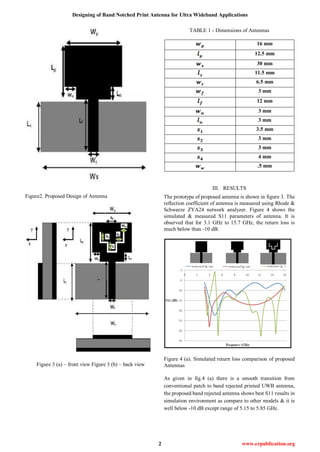
Proposed antenna is designed in three phases. In first phase a
rectangle patch with partial ground is designed as shown in
figure 1.In next phase a single step is created at lower edges
of patch of figure 1 to match antenna for UWB bandwidth as
given in figure 2 & in last phase a slotline of inverted hat type
is etched at centre of modified patch antenna of figure 2 and
design is given in figure 3 to make it a band rejected UWB
antenna. Dimensions of antennas are listed in table 1.
The antenna is fabricated on FR4 (roger) substrate
having thickness 1.65 mm & relative dielectric constant of
4.65. The area covered by antenna geometry is
.The antenna is simulated by Zeland’s
IE3D, MoM based simulator tool.
Figure1. Structure of Antenna
Designing of Band Notched Print Antenna for Ultra
Wideband Applications
Deepak Vyas, Suman Sankhla, Sunil Sharma
Designing of Band Notched Print Antenna for Ultra Wideband Applications
2 www.erpublication.org
Figure2. Proposed Design of Antenna
Figure 3 (a) – front view Figure 3 (b) – back view
TABLE 1 - Dimensions of Antennas
16 mm
12.5 mm
30 mm
11.5 mm
6.5 mm
3 mm
12 mm
3 mm
3 mm
3.5 mm
3 mm
3 mm
4 mm
.5 mm
III. RESULTS
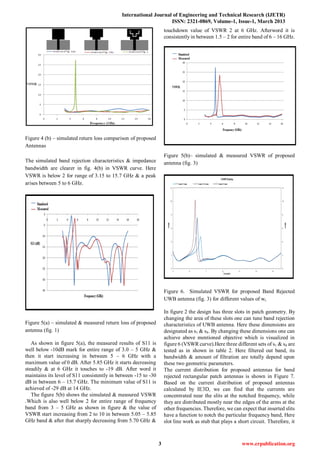
The prototype of proposed antenna is shown in figure 3. The
reflection coefficient of antenna is measured using Rhode &
Schwarze ZYA24 network analyzer. Figure 4 shows the
simulated & measured S11 parameters of antenna. It is
observed that for 3.1 GHz to 15.7 GHz, the return loss is
much below than -10 dB.
Figure 4 (a). Simulated return loss comparison of proposed
Antennas
As given in fig.4 (a) there is a smooth transition from
conventional patch to band rejected printed UWB antenna,
the proposed band rejected antenna shows best S11 results in
simulation environment as compare to other models & it is
well below -10 dB except range of 5.15 to 5.85 GHz.
International Journal of Engineering and Technical Research (IJETR)
ISSN: 2321-0869, Volume-1, Issue-1, March 2013
3 www.erpublication.org
Figure 4 (b) – simulated return loss comparison of proposed
Antennas
The simulated band rejection characteristics & impedance
bandwidth are clearer in fig. 4(b) in VSWR curve. Here
VSWR is below 2 for range of 3.15 to 15.7 GHz & a peak
arises between 5 to 6 GHz.
Figure 5(a) – simulated & measured return loss of proposed
antenna (fig. 1)
As shown in figure 5(a), the measured results of S11 is
well below -10dB mark for entire range of 3.0 – 5 GHz &
then it start increasing in between 5 – 6 GHz with a
maximum value of 0 dB. After 5.85 GHz it starts decreasing
steadily & at 6 GHz it touches to -19 dB. After word it
maintains its level of S11 consistently in between -15 to -30
dB in between 6 – 15.7 GHz. The minimum value of S11 is
achieved of -29 dB at 14 GHz.
The figure 5(b) shows the simulated & measured VSWR
.Which is also well below 2 for entire range of frequency
band from 3 – 5 GHz as shown in figure & the value of
VSWR start increasing from 2 to 10 in between 5.05 – 5.85
GHz band & after that sharply decreasing from 5.70 GHz &
touchdown value of VSWR 2 at 6 GHz. Afterword it is
consistently in between 1.5 – 2 for entire band of 6 – 16 GHz.
Figure 5(b)– simulated & measured VSWR of proposed
antenna (fig. 3)
Figure 6. Simulated VSWR for proposed Band Rejected
UWB antenna (fig. 3) for different values of wt.
In figure 2 the design has three slots in patch geometry. By
changing the area of these slots one can tune band rejection
characteristics of UWB antenna. Here these dimensions are
designated as s1 & s4. By changing these dimensions one can
achieve above mentioned objective which is visualized in
figure 6 (VSWR curve).Here three different sets of s1 & s4 are
tested as in shown in table 2. Here filtered out band, its
bandwidth & amount of filtration are totally depend upon
these two geometric parameters.
The current distribution for proposed antennas for band
rejected rectangular patch antennas is shown in Figure 7.
Based on the current distribution of proposed antennas
calculated by IE3D, we can find that the currents are
concentrated near the slits at the notched frequency, while
they are distributed mostly near the edges of the arms at the
other frequencies. Therefore, we can expect that inserted slits
have a function to notch the particular frequency band, Here
slot line work as stub that plays a short circuit. Therefore, it
Designing of Band Notched Print Antenna for Ultra Wideband Applications
4 www.erpublication.org
prevents the antenna from impedance matching at the
notched frequency.
Table 2. Comparison of ww for proposed Band Rejected UWB
antenna
ws (mm) Band (GHz)
Peak value of
VSWR
1.5 4.2 – 5.00 27.7
1 4. 5 – 5.3 16.2
.5 5.05 – 6.00 8.5
Figure 7 Current distribution of band rejected UWB antenna
F = 4GHz.
F = 6 GHz.
F = 8 GHz.
F = 12G Hz.
F = 14 GHz.
F = 15.7G Hz.
Figure 8 Simulated & Measured azimuthal & elevation angle
of proposed band rejected UWB antenna (fig.2)
All the antennas exhibit omnidirectional pattern for H-plane
at 4 GHz, 6 GHz, 8 GHz, 12 GHz, 14 GHz and 15.7 GHz for
each type of antenna where it is a characteristic of monopole
antenna. All antennas exhibit perfect 8 shape lobe pattern for
E-plane at lower frequencies as we increase frequency the
lobe start tilting from 0o
towards positive side as shown in
figure 8.
In figure 9 simulated & measured gain of proposed band
rejected antenna (fig. 2) has been shown, the gain of antenna
is very low & reduced at notch frequencies drastically.
International Journal of Engineering and Technical Research (IJETR)
ISSN: 2321-0869, Volume-1, Issue-1, March 2013
5 www.erpublication.org
Figure 9 Simulated & Measured gain of proposed band
rejected UWB antenna (fig.2)
IV. CONCLUSION
. A novel compact band notched ultra wideband rectangle
printed antenna has been designed. The impedance
bandwidth is much higher than required UWB band which
can be used by future application of UWB systems. Moreover
by visualizing radiation pattern, the proposed antenna can be
effectively used for UWB applications.
REFERENCES
[1] Yi-Cheng Lin and Kuan-Jung Hung, “Compact Ultra wideband
Rectangular Aperture Antenna and Band-Notched Designs”, IEEE
Transactions Antennas and Propagation Vol. 54, No. 11, November 2006
[2] Tao Yuan, Cheng Wei Qiu, Le Wei Li,1Mook Seng Leong and Qun
Zhang, “Elliptically Shaped Ultra Wide Band Patch Antenna with Band –
Notch Features”, Microwave & Optical Technology Letters Vol. 50, No.
3, March 2008
[3] Wen-jun Lui, Chong-hu Cheng, and Hong-bo Zhu, “Improved Frequency
Notched Ultra wideband Slot Antenna Using Square Ring Resonator”.
IEEE Transactions Antennas and Propagation Vol. 55, No. 9, September
2007
[4] Qing Qi Pei, Cheng-Wei Qiu, Tao Yuan, and Said Zouhdi, “Hybrid
Shaped Ultra Wide Band Antenna”, Microwave and Optical Technology
Letters, Vol. 49, No. 10, October 2007
[5] X.C.Yin, C.L.Ruan, S.G.Mo, C.Y.Ding, and J.H.Chu, “A Compact Ultra
Wide Band Microstrip Antenna with multiple Notches”, PIER 84,
321–332, 2008
[6] S.H. Choi, J.K. Park, S.K. Kim and J.Y. Park, “A new ultra-wideband
antenna for UWB applications”, Microwave Opt. Technol. Lett., Vol. 40,
No. 5, pp. 399-401, Mar. 2004
[7] Jia Yi Sze and Jen Yi Shiu, “Design of Band-Notched Ultra wideband
Square aperture Antenna With a Hat-Shaped Back-Patch”, IEEE
Transactions Antennas and Propagation Vol. 56, No.10, October 2008

Ijetr011101

  • 1.
    International Journal ofEngineering and Technical Research (IJETR) ISSN: 2321-0869, Volume-1, Issue-1, March 2013 1 www.erpublication.org  Abstract— In this paper a new ultra wideband (UWB) antenna is proposed with band notch characteristics to avoid interference with WLAN//HIPERLAN in 5.15 GHz – 5.85 GHz band. In proposed antenna a wide impedance bandwidth is achieved (3.15 GHz – 15.7 GHz) to fulfill requirements of UWB for future applications? The proposed antenna is investigated with partial ground plane. It has a simple geometry and by cutting three slots band rejection characteristic of proposed antenna are achieved. The measured S11 is well below 10 dB & measured radiation patterns are near omnidirectional. Index Terms— band notch, UWB, impedance, WLAN I. INTRODUCTION Ultra Wideband is a carrier less short range communications technologywhich transmits the information in the form of very short pulses. This former military technology has gained a lot of popularity among researchers and the wireless industry after the FCC [1] permitted the marketing and operation of UWB. UWB has promised to offer high data rates at short distances with low power, primarily due to wide resolution bandwidth. The FCC in the USA has allocated a frequency band 3.1 GHz to 10.6 GHz for UWB transmission and released a mask which indicates the power levels to keep the narrow band incumbents spectrum free from interference. Compact and cheap ultra wideband antennas are needed for numerous UWB applications like wireless communications, indoor positioning and medical imaging. Several single-feed planar microstrip antennas such as Elliptically-shaped antenna with slots [2], curved rectangle with slot antenna [3], Variable slot type antennas [4], Cicular shape with variable slot [5], rectangle with steps & slot [6]. In all these structures a partial ground has been proposed, providing attractive solutions that can be readily incorporated under an UWB system. Similarly in [7] a band notched UWB antenna proposed by changing partial ground geometry rather than main patch as in cases of [2-6]. But tuning of back patch is difficult task. In this paper, a new UWB antenna is proposed with a very simple structure by cutting three slots & corner notched rectangle patch with partial ground of rectangle shape & compact size of . Here notches & slots are made in such a way that current Manuscript received March 15, 2013 Deepak Vyas, Assistant professor Department of Electronics & Communication Engineering. He has done M.Tech. form RTU, Kota. Vyas04deepak@gmail.com Suman Sankhla, lecturer Department of Electronics & Communication Engineering. She has research area in antenna designing & optical fiber.smnsankhla@gmail.com Sunil Sharma, M.Tech (Pursuing) from Arya college of Engineering & I.T, Jaipur. distribution is not effected & antenna is perfectly matched for an impedance bandwidth of 3.15 GHz – 15.7 GHz. II. ANTENNA STRUCTURE Proposed antenna is designed in three phases. In first phase a rectangle patch with partial ground is designed as shown in figure 1.In next phase a single step is created at lower edges of patch of figure 1 to match antenna for UWB bandwidth as given in figure 2 & in last phase a slotline of inverted hat type is etched at centre of modified patch antenna of figure 2 and design is given in figure 3 to make it a band rejected UWB antenna. Dimensions of antennas are listed in table 1. The antenna is fabricated on FR4 (roger) substrate having thickness 1.65 mm & relative dielectric constant of 4.65. The area covered by antenna geometry is .The antenna is simulated by Zeland’s IE3D, MoM based simulator tool. Figure1. Structure of Antenna Designing of Band Notched Print Antenna for Ultra Wideband Applications Deepak Vyas, Suman Sankhla, Sunil Sharma
  • 2.
    Designing of BandNotched Print Antenna for Ultra Wideband Applications 2 www.erpublication.org Figure2. Proposed Design of Antenna Figure 3 (a) – front view Figure 3 (b) – back view TABLE 1 - Dimensions of Antennas 16 mm 12.5 mm 30 mm 11.5 mm 6.5 mm 3 mm 12 mm 3 mm 3 mm 3.5 mm 3 mm 3 mm 4 mm .5 mm III. RESULTS The prototype of proposed antenna is shown in figure 3. The reflection coefficient of antenna is measured using Rhode & Schwarze ZYA24 network analyzer. Figure 4 shows the simulated & measured S11 parameters of antenna. It is observed that for 3.1 GHz to 15.7 GHz, the return loss is much below than -10 dB. Figure 4 (a). Simulated return loss comparison of proposed Antennas As given in fig.4 (a) there is a smooth transition from conventional patch to band rejected printed UWB antenna, the proposed band rejected antenna shows best S11 results in simulation environment as compare to other models & it is well below -10 dB except range of 5.15 to 5.85 GHz.
  • 3.
    International Journal ofEngineering and Technical Research (IJETR) ISSN: 2321-0869, Volume-1, Issue-1, March 2013 3 www.erpublication.org Figure 4 (b) – simulated return loss comparison of proposed Antennas The simulated band rejection characteristics & impedance bandwidth are clearer in fig. 4(b) in VSWR curve. Here VSWR is below 2 for range of 3.15 to 15.7 GHz & a peak arises between 5 to 6 GHz. Figure 5(a) – simulated & measured return loss of proposed antenna (fig. 1) As shown in figure 5(a), the measured results of S11 is well below -10dB mark for entire range of 3.0 – 5 GHz & then it start increasing in between 5 – 6 GHz with a maximum value of 0 dB. After 5.85 GHz it starts decreasing steadily & at 6 GHz it touches to -19 dB. After word it maintains its level of S11 consistently in between -15 to -30 dB in between 6 – 15.7 GHz. The minimum value of S11 is achieved of -29 dB at 14 GHz. The figure 5(b) shows the simulated & measured VSWR .Which is also well below 2 for entire range of frequency band from 3 – 5 GHz as shown in figure & the value of VSWR start increasing from 2 to 10 in between 5.05 – 5.85 GHz band & after that sharply decreasing from 5.70 GHz & touchdown value of VSWR 2 at 6 GHz. Afterword it is consistently in between 1.5 – 2 for entire band of 6 – 16 GHz. Figure 5(b)– simulated & measured VSWR of proposed antenna (fig. 3) Figure 6. Simulated VSWR for proposed Band Rejected UWB antenna (fig. 3) for different values of wt. In figure 2 the design has three slots in patch geometry. By changing the area of these slots one can tune band rejection characteristics of UWB antenna. Here these dimensions are designated as s1 & s4. By changing these dimensions one can achieve above mentioned objective which is visualized in figure 6 (VSWR curve).Here three different sets of s1 & s4 are tested as in shown in table 2. Here filtered out band, its bandwidth & amount of filtration are totally depend upon these two geometric parameters. The current distribution for proposed antennas for band rejected rectangular patch antennas is shown in Figure 7. Based on the current distribution of proposed antennas calculated by IE3D, we can find that the currents are concentrated near the slits at the notched frequency, while they are distributed mostly near the edges of the arms at the other frequencies. Therefore, we can expect that inserted slits have a function to notch the particular frequency band, Here slot line work as stub that plays a short circuit. Therefore, it
  • 4.
    Designing of BandNotched Print Antenna for Ultra Wideband Applications 4 www.erpublication.org prevents the antenna from impedance matching at the notched frequency. Table 2. Comparison of ww for proposed Band Rejected UWB antenna ws (mm) Band (GHz) Peak value of VSWR 1.5 4.2 – 5.00 27.7 1 4. 5 – 5.3 16.2 .5 5.05 – 6.00 8.5 Figure 7 Current distribution of band rejected UWB antenna F = 4GHz. F = 6 GHz. F = 8 GHz. F = 12G Hz. F = 14 GHz. F = 15.7G Hz. Figure 8 Simulated & Measured azimuthal & elevation angle of proposed band rejected UWB antenna (fig.2) All the antennas exhibit omnidirectional pattern for H-plane at 4 GHz, 6 GHz, 8 GHz, 12 GHz, 14 GHz and 15.7 GHz for each type of antenna where it is a characteristic of monopole antenna. All antennas exhibit perfect 8 shape lobe pattern for E-plane at lower frequencies as we increase frequency the lobe start tilting from 0o towards positive side as shown in figure 8. In figure 9 simulated & measured gain of proposed band rejected antenna (fig. 2) has been shown, the gain of antenna is very low & reduced at notch frequencies drastically.
  • 5.
    International Journal ofEngineering and Technical Research (IJETR) ISSN: 2321-0869, Volume-1, Issue-1, March 2013 5 www.erpublication.org Figure 9 Simulated & Measured gain of proposed band rejected UWB antenna (fig.2) IV. CONCLUSION . A novel compact band notched ultra wideband rectangle printed antenna has been designed. The impedance bandwidth is much higher than required UWB band which can be used by future application of UWB systems. Moreover by visualizing radiation pattern, the proposed antenna can be effectively used for UWB applications. REFERENCES [1] Yi-Cheng Lin and Kuan-Jung Hung, “Compact Ultra wideband Rectangular Aperture Antenna and Band-Notched Designs”, IEEE Transactions Antennas and Propagation Vol. 54, No. 11, November 2006 [2] Tao Yuan, Cheng Wei Qiu, Le Wei Li,1Mook Seng Leong and Qun Zhang, “Elliptically Shaped Ultra Wide Band Patch Antenna with Band – Notch Features”, Microwave & Optical Technology Letters Vol. 50, No. 3, March 2008 [3] Wen-jun Lui, Chong-hu Cheng, and Hong-bo Zhu, “Improved Frequency Notched Ultra wideband Slot Antenna Using Square Ring Resonator”. IEEE Transactions Antennas and Propagation Vol. 55, No. 9, September 2007 [4] Qing Qi Pei, Cheng-Wei Qiu, Tao Yuan, and Said Zouhdi, “Hybrid Shaped Ultra Wide Band Antenna”, Microwave and Optical Technology Letters, Vol. 49, No. 10, October 2007 [5] X.C.Yin, C.L.Ruan, S.G.Mo, C.Y.Ding, and J.H.Chu, “A Compact Ultra Wide Band Microstrip Antenna with multiple Notches”, PIER 84, 321–332, 2008 [6] S.H. Choi, J.K. Park, S.K. Kim and J.Y. Park, “A new ultra-wideband antenna for UWB applications”, Microwave Opt. Technol. Lett., Vol. 40, No. 5, pp. 399-401, Mar. 2004 [7] Jia Yi Sze and Jen Yi Shiu, “Design of Band-Notched Ultra wideband Square aperture Antenna With a Hat-Shaped Back-Patch”, IEEE Transactions Antennas and Propagation Vol. 56, No.10, October 2008