A Thesis Proposal 
on 
Multi-Criteria Bid Evaluation System For The Department 
of Urban Development and Building Construction Projects 
in Nepal 
Presented By: Bidur Khadka 
Roll No: Fall 011-1004 
Program: Construction Management 
Date: 2013/12/18
Background 
 DUDBC is one of the oldest department carrying out public 
works such as public buildings and urban development 
infrastructure. 
Public procurement accounts for about 8 to 9 percentage 
of Gross Domestic Product in Nepal and therefore plays 
important role in national development (National Planning 
Commission, 2012/2013). 
Nepalese Construction Industry uses around 35 percentage 
of government budget (FCAN, 2010).
Background (Continued) 
 Public construction procurement, the process by which 
contractors are chosen for public construction projects, has 
traditionally been based on selecting the lowest bidder. 
contractors desperately quote low prices by reducing their 
quality of work, and hope to be compensated by submitting 
'claims'. They might also cause time and cost overruns of the 
projects. 
Many researchers state that 'reliance on bid prices alone as a 
discriminating factor between bidders is, however, somewhat 
risky .
Statement of the Problem 
 Extensive delays in the planned schedule, cost overruns and 
failure to meet desired level of quality are very common 
problems faced by most construction projects in Nepal 
(Agrawal, 2005). 
In competitive bidding process in Nepal, the contract is 
generally awarded to the lowest bidder (FCAN, 2010). It is 
often problematic in the long run. 
Failure of project implementation is quite often attributed 
to the inappropriate selection method of contractors. 
(Skitmore et al, 1997).
Statement of the Problem (Continued….) 
 There has been a steady increase in the variety of 
methods used for the procurement of construction work. 
However, there has been no proportionate improvement in 
the success rate of construction projects (Huang, 2010). 
 It is important to adopt an approach that will include 
necessary qualification-criteria for the selection of 
appropriate contractors in executing the public construction 
projects.
Research Questions 
What are the existing methods of contractor selection that 
are recently being applied? 
What are the qualification criteria that are being 
considered so far for the selection of contractors? 
 To what extent do these criteria apply to the public 
procurement system in DUDBC? Is there any necessity for 
the improvement in the current multi-criteria bid evaluation 
method adopted by DUDBC?
Research Questions (Continued….) 
 Is modification in the existing public procurement act and 
rule necessary to incorporate qualification criteria in the bid 
document for the selection of contractors? 
What sort of multi-criteria contractor selection model is 
suitable for DUDBC?
Research Objectives 
To review a range of prevailing methods of contractor 
selection and contract awarding systems. 
To identify from the literature the variables which have 
been determined to be used for the selection of contractors. 
 To identify the suitable contractor selection criteria in 
DUDBC based on the perceptions of engineers, consultants 
and contractors.
Research Objectives (Continued….) 
To recommend the factors to be considered in the selection 
of contractors and propose a suitable multi-criteria bid 
evaluation system for the selection of contractors in 
DUDBC.
Significance of the Study 
the volume of economic transactions conducted by public 
competitive bidding through multi-criteria selection method of 
contractor gives importance to its study as a part of basic 
research in management science. 
 It is therefore necessary to examine different qualification 
criteria adopted by DUDBC in selecting contractors in Nepal 
in order to find out the most suitable criteria that DUDBC 
should focus on when awarding construction contracts.
Significance of the Study (Contd……..) 
The results of this study will provide some insight and 
information on whether present qualification criteria used by 
DUDBC for the selection of contractors are sufficient and 
appropriate 
 The results recommends an appropriate multi-criteria 
contractor selection model. 
 It will provide the guideline to lawmakers and policymakers 
of Government of Nepal to adopt suitable multi-criteria 
contractor selection method or review and amend provisions of 
existing competitive bidding system of Public Procurement Act 
(2007).
Scope & Limitation of the Study 
Scope of the study: It will mainly focus on the 
development bid price and non-price selection criteria to be 
used in bid evaluation and contract award for the construction 
projects under study. 
 Limitation of the Study : Given the constraints of time and 
resources, the spatial coverage of the research is limited to a 
part of DUDBC.
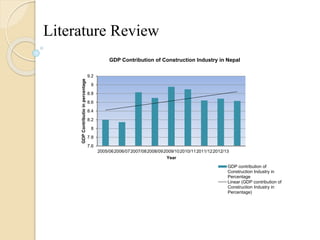
Literature Review 
9.2 
9 
8.8 
8.6 
8.4 
8.2 
8 
7.8 
7.6 
GDP Contribution of Construction Industry in Nepal 
2005/062006/072007/082008/092009/102010/112011/122012/13 
GDP Contributio in percentage 
Year 
GDP contribution of 
Construction Industry in 
Percentage 
Linear (GDP contribution of 
Construction Industry in 
Percentage)
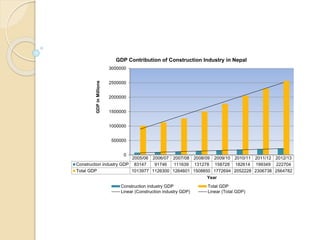
GDP Contribution of Construction Industry in Nepal 
2005/06 2006/07 2007/08 2008/09 2009/10 2010/11 2011/12 2012/13 
3000000 
2500000 
2000000 
1500000 
1000000 
500000 
0 
GDP in Millions 
Construction industry GDP 83147 91746 111639 131278 158728 182614 199349 222704 
Total GDP 1013977 1126300 1264601 1508850 1772694 2052228 2306738 2564782 
Year 
Construction industry GDP Total GDP 
Linear (Construction industry GDP) Linear (Total GDP)
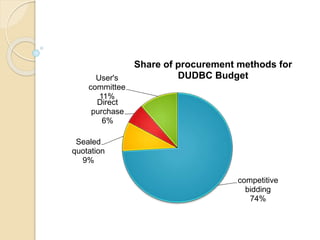
competitive 
bidding 
74% 
User's 
committee 
11% 
Direct 
purchase 
Sealed 
quotation 
9% 
6% 
Share of procurement methods for 
DUDBC Budget
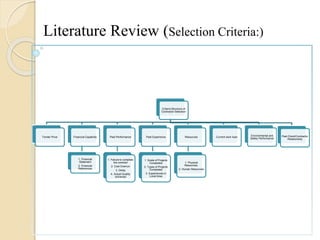
Literature Review (Selection Criteria:) 
Criteria Structure of 
Contractor Selection 
Tender Price Financial Capability 
1. Financial 
Statement 
2. Financial 
References 
Past Performance 
1. Failure to complete 
the contract 
2. Cost Overrun 
3. Delay 
4. Actual Quality 
Achieved 
Past Experience 
1. Scale of Projects 
Completed 
2. Types of Projects 
Completed 
3. Experiences in 
Local Area 
Resources 
1. Physical 
Resources. 
2. Human Resources 
Current work load 
Environmental and 
Safety Performance 
Past Client/Contractor 
Relationship
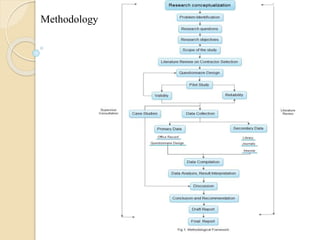
Methodology
Methodology (Contd……..) 
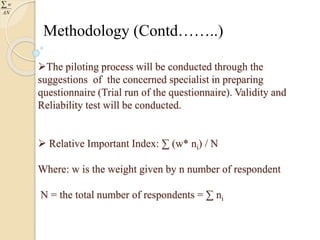
The piloting process will be conducted through the 
suggestions of the concerned specialist in preparing 
questionnaire (Trial run of the questionnaire). Validity and 
Reliability test will be conducted. 
 Relative Important Index: Σ (w* ni) / N 
Where: w is the weight given by n number of respondent 
N = the total number of respondents = Σ ni 
w 
 
AN
Methodology (Contd……..) 
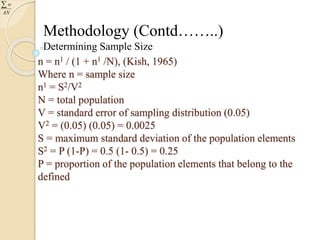
Determining Sample Size 
n = n1 / (1 + n1 /N), (Kish, 1965) 
Where n = sample size 
n1 = S2/V2 
N = total population 
V = standard error of sampling distribution (0.05) 
V2 = (0.05) (0.05) = 0.0025 
S = maximum standard deviation of the population elements 
S2 = P (1-P) = 0.5 (1- 0.5) = 0.25 
P = proportion of the population elements that belong to the 
defined 
w 
 
AN
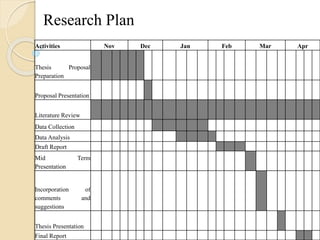
Research Plan 
Activities Nov Dec Jan Feb Mar Apr 
Thesis Proposal 
Preparation 
Proposal Presentation 
Literature Review 
Data Collection 
Data Analysis 
Draft Report 
Mid Term 
Presentation 
Incorporation of 
comments and 
suggestions 
Thesis Presentation 
Final Report
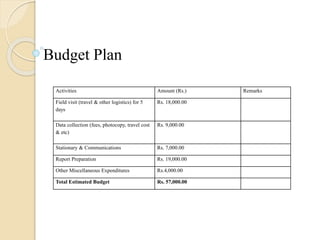
Budget Plan 
Activities Amount (Rs.) Remarks 
Field visit (travel & other logistics) for 5 
days 
Rs. 18,000.00 
Data collection (fees, photocopy, travel cost 
& etc) 
Rs. 9,000.00 
Stationary & Communications Rs. 7,000.00 
Report Preparation Rs. 19,000.00 
Other Miscellaneous Expenditures Rs.4,000.00 
Total Estimated Budget Rs. 57,000.00
Thank You

Thesis proposal

  • 1.
    A Thesis Proposal on Multi-Criteria Bid Evaluation System For The Department of Urban Development and Building Construction Projects in Nepal Presented By: Bidur Khadka Roll No: Fall 011-1004 Program: Construction Management Date: 2013/12/18
  • 2.
    Background  DUDBCis one of the oldest department carrying out public works such as public buildings and urban development infrastructure. Public procurement accounts for about 8 to 9 percentage of Gross Domestic Product in Nepal and therefore plays important role in national development (National Planning Commission, 2012/2013). Nepalese Construction Industry uses around 35 percentage of government budget (FCAN, 2010).
  • 3.
    Background (Continued) Public construction procurement, the process by which contractors are chosen for public construction projects, has traditionally been based on selecting the lowest bidder. contractors desperately quote low prices by reducing their quality of work, and hope to be compensated by submitting 'claims'. They might also cause time and cost overruns of the projects. Many researchers state that 'reliance on bid prices alone as a discriminating factor between bidders is, however, somewhat risky .
  • 4.
    Statement of theProblem  Extensive delays in the planned schedule, cost overruns and failure to meet desired level of quality are very common problems faced by most construction projects in Nepal (Agrawal, 2005). In competitive bidding process in Nepal, the contract is generally awarded to the lowest bidder (FCAN, 2010). It is often problematic in the long run. Failure of project implementation is quite often attributed to the inappropriate selection method of contractors. (Skitmore et al, 1997).
  • 5.
    Statement of theProblem (Continued….)  There has been a steady increase in the variety of methods used for the procurement of construction work. However, there has been no proportionate improvement in the success rate of construction projects (Huang, 2010).  It is important to adopt an approach that will include necessary qualification-criteria for the selection of appropriate contractors in executing the public construction projects.
  • 6.
    Research Questions Whatare the existing methods of contractor selection that are recently being applied? What are the qualification criteria that are being considered so far for the selection of contractors?  To what extent do these criteria apply to the public procurement system in DUDBC? Is there any necessity for the improvement in the current multi-criteria bid evaluation method adopted by DUDBC?
  • 7.
    Research Questions (Continued….)  Is modification in the existing public procurement act and rule necessary to incorporate qualification criteria in the bid document for the selection of contractors? What sort of multi-criteria contractor selection model is suitable for DUDBC?
  • 8.
    Research Objectives Toreview a range of prevailing methods of contractor selection and contract awarding systems. To identify from the literature the variables which have been determined to be used for the selection of contractors.  To identify the suitable contractor selection criteria in DUDBC based on the perceptions of engineers, consultants and contractors.
  • 9.
    Research Objectives (Continued….) To recommend the factors to be considered in the selection of contractors and propose a suitable multi-criteria bid evaluation system for the selection of contractors in DUDBC.
  • 10.
    Significance of theStudy the volume of economic transactions conducted by public competitive bidding through multi-criteria selection method of contractor gives importance to its study as a part of basic research in management science.  It is therefore necessary to examine different qualification criteria adopted by DUDBC in selecting contractors in Nepal in order to find out the most suitable criteria that DUDBC should focus on when awarding construction contracts.
  • 11.
    Significance of theStudy (Contd……..) The results of this study will provide some insight and information on whether present qualification criteria used by DUDBC for the selection of contractors are sufficient and appropriate  The results recommends an appropriate multi-criteria contractor selection model.  It will provide the guideline to lawmakers and policymakers of Government of Nepal to adopt suitable multi-criteria contractor selection method or review and amend provisions of existing competitive bidding system of Public Procurement Act (2007).
  • 12.
    Scope & Limitationof the Study Scope of the study: It will mainly focus on the development bid price and non-price selection criteria to be used in bid evaluation and contract award for the construction projects under study.  Limitation of the Study : Given the constraints of time and resources, the spatial coverage of the research is limited to a part of DUDBC.
  • 13.
    Literature Review 9.2 9 8.8 8.6 8.4 8.2 8 7.8 7.6 GDP Contribution of Construction Industry in Nepal 2005/062006/072007/082008/092009/102010/112011/122012/13 GDP Contributio in percentage Year GDP contribution of Construction Industry in Percentage Linear (GDP contribution of Construction Industry in Percentage)
  • 14.
    GDP Contribution ofConstruction Industry in Nepal 2005/06 2006/07 2007/08 2008/09 2009/10 2010/11 2011/12 2012/13 3000000 2500000 2000000 1500000 1000000 500000 0 GDP in Millions Construction industry GDP 83147 91746 111639 131278 158728 182614 199349 222704 Total GDP 1013977 1126300 1264601 1508850 1772694 2052228 2306738 2564782 Year Construction industry GDP Total GDP Linear (Construction industry GDP) Linear (Total GDP)
  • 15.
    competitive bidding 74% User's committee 11% Direct purchase Sealed quotation 9% 6% Share of procurement methods for DUDBC Budget
  • 16.
    Literature Review (SelectionCriteria:) Criteria Structure of Contractor Selection Tender Price Financial Capability 1. Financial Statement 2. Financial References Past Performance 1. Failure to complete the contract 2. Cost Overrun 3. Delay 4. Actual Quality Achieved Past Experience 1. Scale of Projects Completed 2. Types of Projects Completed 3. Experiences in Local Area Resources 1. Physical Resources. 2. Human Resources Current work load Environmental and Safety Performance Past Client/Contractor Relationship
  • 17.
  • 18.
    Methodology (Contd……..) Thepiloting process will be conducted through the suggestions of the concerned specialist in preparing questionnaire (Trial run of the questionnaire). Validity and Reliability test will be conducted.  Relative Important Index: Σ (w* ni) / N Where: w is the weight given by n number of respondent N = the total number of respondents = Σ ni w  AN
  • 19.
    Methodology (Contd……..) DeterminingSample Size n = n1 / (1 + n1 /N), (Kish, 1965) Where n = sample size n1 = S2/V2 N = total population V = standard error of sampling distribution (0.05) V2 = (0.05) (0.05) = 0.0025 S = maximum standard deviation of the population elements S2 = P (1-P) = 0.5 (1- 0.5) = 0.25 P = proportion of the population elements that belong to the defined w  AN
  • 20.
    Research Plan ActivitiesNov Dec Jan Feb Mar Apr Thesis Proposal Preparation Proposal Presentation Literature Review Data Collection Data Analysis Draft Report Mid Term Presentation Incorporation of comments and suggestions Thesis Presentation Final Report
  • 21.
    Budget Plan ActivitiesAmount (Rs.) Remarks Field visit (travel & other logistics) for 5 days Rs. 18,000.00 Data collection (fees, photocopy, travel cost & etc) Rs. 9,000.00 Stationary & Communications Rs. 7,000.00 Report Preparation Rs. 19,000.00 Other Miscellaneous Expenditures Rs.4,000.00 Total Estimated Budget Rs. 57,000.00
  • 22.