Link-state routing
Protocol
Aung Thu Rha Hein
Chinnawat Noosrikong
Outline
•   Overview
•   Features of Link-State routing protocols
•   link-state routing algorithm
•   Dijkstra’s algorithm
•   OSPF
•   IS-IS
• Advantages and Disadvantages of LS routing protocols
Overview
• One of two main classes of interior gateway routing protocols
  • OSPF, IS-IS
• Performed by every switching node in the network

Basic Concept
• every node creates a map of the connectivity to the network
  • This graph shows which nodes are connected to which other
    nodes
  • Each node calculates the next best logical path to the destination
  • Collection of best paths form the routing table of the node
Features of Link-state routing
protocols
Link-state advertisement (LSA) or Link-state Packet(LSP)
• a small packet of routing information that is sent between
  routers
Topological database or Link-state Database
• a collection of information gathered from LSAs
SPF algorithm
• a calculation performed on the database that results in the
  SPF tree
Routing table
• a list of the known paths and interfaces
link-state routing algorithm
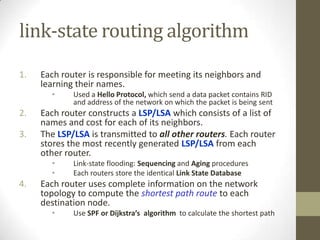
1.   Each router is responsible for meeting its neighbors and
     learning their names.
       •     Used a Hello Protocol, which send a data packet contains RID
             and address of the network on which the packet is being sent
2.   Each router constructs a LSP/LSA which consists of a list of
     names and cost for each of its neighbors.
3.   The LSP/LSA is transmitted to all other routers. Each router
     stores the most recently generated LSP/LSA from each
     other router.
       •     Link-state flooding: Sequencing and Aging procedures
       •     Each routers store the identical Link State Database
4.   Each router uses complete information on the network
     topology to compute the shortest path route to each
     destination node.
       •     Use SPF or Dijkstra’s algorithm to calculate the shortest path
Dijkstra’s algorithm
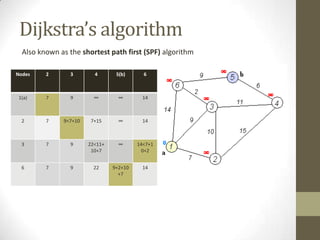
  Also known as the shortest path first (SPF) algorithm

Nodes    2      3        4       5(b)      6


1(a)     7      9        ∞        ∞       14


  2      7    9<7+10   7+15       ∞       14


  3      7      9      22<11+     ∞      14<7+1
                        10+7              0+2


  6      7      9       22      9+2+10    14
                                  +7
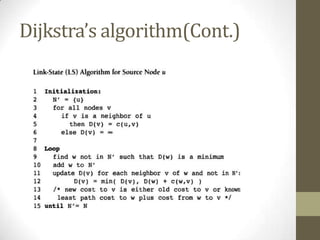
Dijkstra’s algorithm(Cont.)
Open Shortest Path First (OSPF)
• A routing protocol developed for Internet Protocol
  networks by the Interior Gateway Protocol (IGP)
• Based on the Dijkstra’s Algorithm
• Serving large, heterogeneous internetworks


• OSPF Version 1 (1988)
• OSPF Version 2 (1998) Supported IPv4
• OSPF Version 3 (2008) Supported IPv6
Open Shortest Path First
(OSPF)


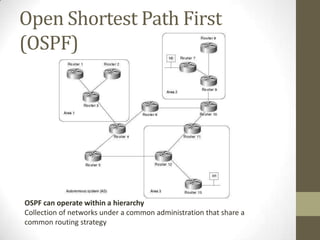
OSPF can operate within a hierarchy
Collection of networks under a common administration that share a
common routing strategy
Additional OSPF Features
• Equal-cost
• Multipath routing
• Routing based on upper-layer type-of-service (TOS) requests
IS-IS
• Intermediate System-to-Intermediate System (IS-IS)
• That floods the network with link-state information to build a
  complete, consistent picture of network topology
  • Each IS-IS router independently builds a database of the
    network's topology
• IS-IS uses Dijkstra's algorithm for computing the best path
  through the network
• IS-IS Metrics
• A single required default metric with a maximum path value of
  1024
• Three optional metrics (costs):
  • Delay
  • Expense
  • Error
Integrated IS-IS
•   Integrated IS-IS is a version of the OSI IS-IS
•   To support more network layer protocols than just CLNP
•   Dual IS-IS
•   Implementations send only one set of routing updates
•   Supporting multiple network layer protocols in a router
Advantages and Disadvantages of LS
routing protocols
Advantages
• Smaller routing tables
      • Only a single optimal route for each network ID is stored in
        the routing table.
• Low network overhead
      • do not exchange any routing information when the
        internetwork has converged.
• Ability to scale.
      • scale well to large and very large internetworks.
• Lower convergence time.
      • have a much lower convergence time and the internetwork is
        converged without routing loops.
Advantages and Disadvantages of LS
routing protocols(cont.)
Disadvantages
• Complex
      • much more complex and difficult to understand than DV
        routing protocols.
• More difficult to configure.
      • implementation requires additional planning and
        configuration.
• Resource intensive.
      • For very large internetworks, the LS database and the
        calculation of routing table entries can be memory and
        processor intensive.

Link state routing protocol

  • 1.
    Link-state routing Protocol Aung ThuRha Hein Chinnawat Noosrikong
  • 2.
    Outline • Overview • Features of Link-State routing protocols • link-state routing algorithm • Dijkstra’s algorithm • OSPF • IS-IS • Advantages and Disadvantages of LS routing protocols
  • 3.
    Overview • One oftwo main classes of interior gateway routing protocols • OSPF, IS-IS • Performed by every switching node in the network Basic Concept • every node creates a map of the connectivity to the network • This graph shows which nodes are connected to which other nodes • Each node calculates the next best logical path to the destination • Collection of best paths form the routing table of the node
  • 4.
    Features of Link-staterouting protocols Link-state advertisement (LSA) or Link-state Packet(LSP) • a small packet of routing information that is sent between routers Topological database or Link-state Database • a collection of information gathered from LSAs SPF algorithm • a calculation performed on the database that results in the SPF tree Routing table • a list of the known paths and interfaces
  • 5.
    link-state routing algorithm 1. Each router is responsible for meeting its neighbors and learning their names. • Used a Hello Protocol, which send a data packet contains RID and address of the network on which the packet is being sent 2. Each router constructs a LSP/LSA which consists of a list of names and cost for each of its neighbors. 3. The LSP/LSA is transmitted to all other routers. Each router stores the most recently generated LSP/LSA from each other router. • Link-state flooding: Sequencing and Aging procedures • Each routers store the identical Link State Database 4. Each router uses complete information on the network topology to compute the shortest path route to each destination node. • Use SPF or Dijkstra’s algorithm to calculate the shortest path
  • 6.
    Dijkstra’s algorithm Also known as the shortest path first (SPF) algorithm Nodes 2 3 4 5(b) 6 1(a) 7 9 ∞ ∞ 14 2 7 9<7+10 7+15 ∞ 14 3 7 9 22<11+ ∞ 14<7+1 10+7 0+2 6 7 9 22 9+2+10 14 +7
  • 7.
  • 8.
    Open Shortest PathFirst (OSPF) • A routing protocol developed for Internet Protocol networks by the Interior Gateway Protocol (IGP) • Based on the Dijkstra’s Algorithm • Serving large, heterogeneous internetworks • OSPF Version 1 (1988) • OSPF Version 2 (1998) Supported IPv4 • OSPF Version 3 (2008) Supported IPv6
  • 9.
    Open Shortest PathFirst (OSPF) OSPF can operate within a hierarchy Collection of networks under a common administration that share a common routing strategy
  • 10.
    Additional OSPF Features •Equal-cost • Multipath routing • Routing based on upper-layer type-of-service (TOS) requests
  • 11.
    IS-IS • Intermediate System-to-IntermediateSystem (IS-IS) • That floods the network with link-state information to build a complete, consistent picture of network topology • Each IS-IS router independently builds a database of the network's topology • IS-IS uses Dijkstra's algorithm for computing the best path through the network • IS-IS Metrics • A single required default metric with a maximum path value of 1024 • Three optional metrics (costs): • Delay • Expense • Error
  • 12.
    Integrated IS-IS • Integrated IS-IS is a version of the OSI IS-IS • To support more network layer protocols than just CLNP • Dual IS-IS • Implementations send only one set of routing updates • Supporting multiple network layer protocols in a router
  • 13.
    Advantages and Disadvantagesof LS routing protocols Advantages • Smaller routing tables • Only a single optimal route for each network ID is stored in the routing table. • Low network overhead • do not exchange any routing information when the internetwork has converged. • Ability to scale. • scale well to large and very large internetworks. • Lower convergence time. • have a much lower convergence time and the internetwork is converged without routing loops.
  • 14.
    Advantages and Disadvantagesof LS routing protocols(cont.) Disadvantages • Complex • much more complex and difficult to understand than DV routing protocols. • More difficult to configure. • implementation requires additional planning and configuration. • Resource intensive. • For very large internetworks, the LS database and the calculation of routing table entries can be memory and processor intensive.