PHYSICAL LAYER
By: Najam Sajid
Mob: +923351970482
Introduction
• How to connect two or more devices?
• OSI Model
--> Open Systems Interconnect
 Set of protocols
• Introduced in first time in 1770s by ISO
(International Standards Organization)
• Composed of 7 Layers
Wednesday, November 16,
2016
Physical Layer 2
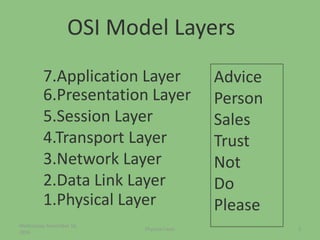
7.Application Layer
6.Presentation Layer
5.Session Layer
4.Transport Layer
3.Network Layer
2.Data Link Layer
1.Physical Layer
Advice
Person
Sales
Trust
Not
Do
Please
OSI Model Layers
Wednesday, November 16,
2016
3Physical Layer
PHYSICAL LAYER
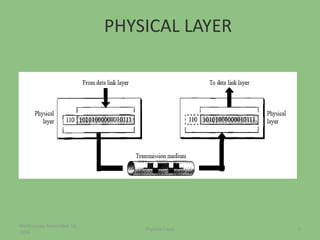
• It deals with the mechanical and electrical
specifications (Devices)
• Physical characteristics of interfaces and
medium.
• To move data in the form of electromagnetic
signals across a transmission medium
• The physical layer data consists of a stream of
bits (sequence of Os or 1s)
• Bits are encoded into signals
Wednesday, November 16,
2016
4Physical Layer
PHYSICAL LAYER
Wednesday, November 16,
2016
5Physical Layer
Signals
A signal is an electric current
or electromagnetic field used to convey data
from one place to another.
A Transmitter encodes a message into a
signal, which is carried to a receiver by the
communications channel.
Signals can be interpreted as either Analog or
Digital
Wednesday, November 16,
2016
6Physical Layer
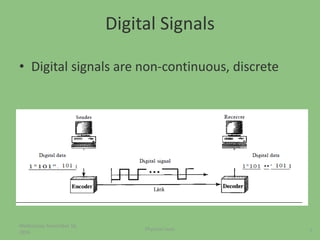
Digital Signals
• Digital signals are non-continuous, discrete
7
Wednesday, November 16,
2016
Physical Layer
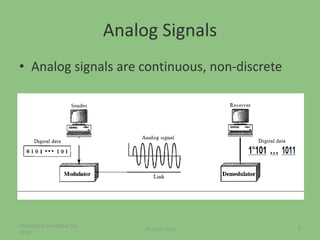
Analog Signals
• Analog signals are continuous, non-discrete
Wednesday, November 16,
2016
8Physical Layer
Devices
Some of the common devices are:
Hub
Switch
Repeater
Bridge
Modem
PC, Mobile phone, Telephone or Cables etc are
also devices use for data communication.
Wednesday, November 16,
2016
9Physical Layer
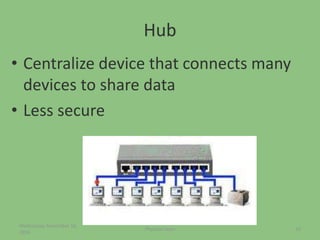
Hub
• Centralize device that connects many
devices to share data
• Less secure
Wednesday, November 16,
2016
10Physical Layer
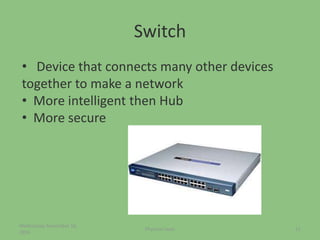
Switch
• Device that connects many other devices
together to make a network
• More intelligent then Hub
• More secure
Wednesday, November 16,
2016
11Physical Layer
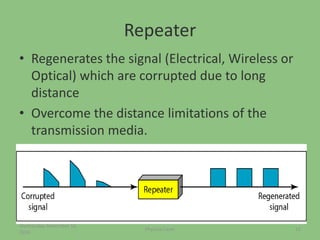
Repeater
• Regenerates the signal (Electrical, Wireless or
Optical) which are corrupted due to long
distance
• Overcome the distance limitations of the
transmission media.
Wednesday, November 16,
2016
12Physical Layer
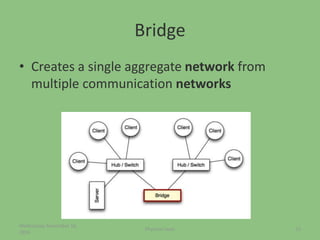
Bridge
• Creates a single aggregate network from
multiple communication networks
Wednesday, November 16,
2016
13Physical Layer
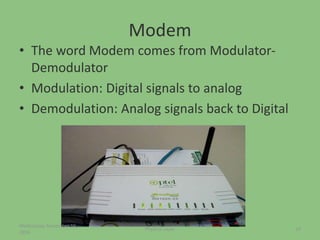
Modem
• The word Modem comes from Modulator-
Demodulator
• Modulation: Digital signals to analog
• Demodulation: Analog signals back to Digital
Wednesday, November 16,
2016
14Physical Layer
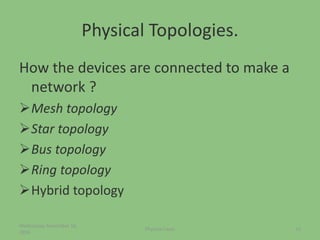
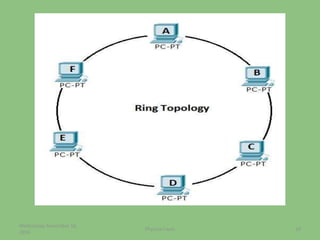
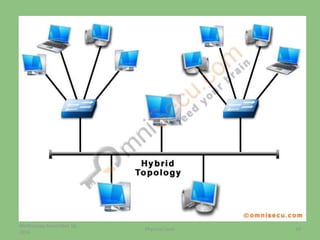
Physical Topologies.
How the devices are connected to make a
network ?
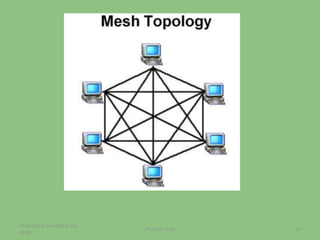
Mesh topology
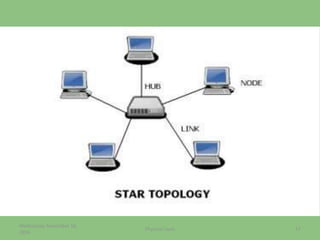
Star topology
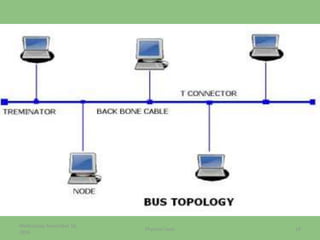
Bus topology
Ring topology
Hybrid topology
Wednesday, November 16,
2016
15Physical Layer
Wednesday, November 16,
2016
16Physical Layer
Wednesday, November 16,
2016
17Physical Layer
Wednesday, November 16,
2016
18Physical Layer
Wednesday, November 16,
2016
19Physical Layer
Wednesday, November 16,
2016
20Physical Layer
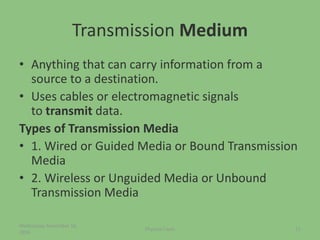
Transmission Medium
• Anything that can carry information from a
source to a destination.
• Uses cables or electromagnetic signals
to transmit data.
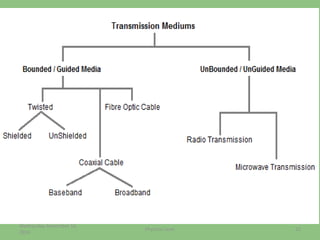
Types of Transmission Media
• 1. Wired or Guided Media or Bound Transmission
Media
• 2. Wireless or Unguided Media or Unbound
Transmission Media
Wednesday, November 16,
2016
21Physical Layer
Wednesday, November 16,
2016
22Physical Layer
THANKS
Wednesday, November 16,
2016
23Physical Layer

Physical layer ppt

  • 1.
    PHYSICAL LAYER By: NajamSajid Mob: +923351970482
  • 2.
    Introduction • How toconnect two or more devices? • OSI Model --> Open Systems Interconnect  Set of protocols • Introduced in first time in 1770s by ISO (International Standards Organization) • Composed of 7 Layers Wednesday, November 16, 2016 Physical Layer 2
  • 3.
    7.Application Layer 6.Presentation Layer 5.SessionLayer 4.Transport Layer 3.Network Layer 2.Data Link Layer 1.Physical Layer Advice Person Sales Trust Not Do Please OSI Model Layers Wednesday, November 16, 2016 3Physical Layer
  • 4.
    PHYSICAL LAYER • Itdeals with the mechanical and electrical specifications (Devices) • Physical characteristics of interfaces and medium. • To move data in the form of electromagnetic signals across a transmission medium • The physical layer data consists of a stream of bits (sequence of Os or 1s) • Bits are encoded into signals Wednesday, November 16, 2016 4Physical Layer
  • 5.
    PHYSICAL LAYER Wednesday, November16, 2016 5Physical Layer
  • 6.
    Signals A signal isan electric current or electromagnetic field used to convey data from one place to another. A Transmitter encodes a message into a signal, which is carried to a receiver by the communications channel. Signals can be interpreted as either Analog or Digital Wednesday, November 16, 2016 6Physical Layer
  • 7.
    Digital Signals • Digitalsignals are non-continuous, discrete 7 Wednesday, November 16, 2016 Physical Layer
  • 8.
    Analog Signals • Analogsignals are continuous, non-discrete Wednesday, November 16, 2016 8Physical Layer
  • 9.
    Devices Some of thecommon devices are: Hub Switch Repeater Bridge Modem PC, Mobile phone, Telephone or Cables etc are also devices use for data communication. Wednesday, November 16, 2016 9Physical Layer
  • 10.
    Hub • Centralize devicethat connects many devices to share data • Less secure Wednesday, November 16, 2016 10Physical Layer
  • 11.
    Switch • Device thatconnects many other devices together to make a network • More intelligent then Hub • More secure Wednesday, November 16, 2016 11Physical Layer
  • 12.
    Repeater • Regenerates thesignal (Electrical, Wireless or Optical) which are corrupted due to long distance • Overcome the distance limitations of the transmission media. Wednesday, November 16, 2016 12Physical Layer
  • 13.
    Bridge • Creates asingle aggregate network from multiple communication networks Wednesday, November 16, 2016 13Physical Layer
  • 14.
    Modem • The wordModem comes from Modulator- Demodulator • Modulation: Digital signals to analog • Demodulation: Analog signals back to Digital Wednesday, November 16, 2016 14Physical Layer
  • 15.
    Physical Topologies. How thedevices are connected to make a network ? Mesh topology Star topology Bus topology Ring topology Hybrid topology Wednesday, November 16, 2016 15Physical Layer
  • 16.
  • 17.
  • 18.
  • 19.
  • 20.
  • 21.
    Transmission Medium • Anythingthat can carry information from a source to a destination. • Uses cables or electromagnetic signals to transmit data. Types of Transmission Media • 1. Wired or Guided Media or Bound Transmission Media • 2. Wireless or Unguided Media or Unbound Transmission Media Wednesday, November 16, 2016 21Physical Layer
  • 22.
  • 23.