Stability Studies
Presentation By
PARTH CHAUHAN
• The Purpose of Stability testing is to
provide evidence on how the quality of a
drug substance / product varies with the
influence of variety of environmental
factors such as temperature, humidity &
light
Stability Studies
Stability Studies – an overview
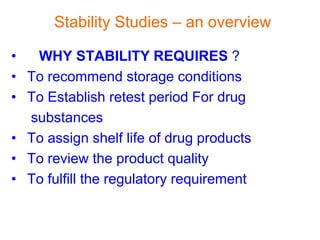
• WHY STABILITY REQUIRES ?
• To recommend storage conditions
• To Establish retest period For drug
substances
• To assign shelf life of drug products
• To review the product quality
• To fulfill the regulatory requirement
Stability Studies – an overview
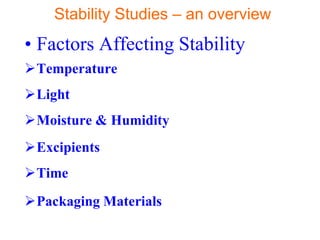
• Factors Affecting Stability
Temperature
Light
Moisture & Humidity
Excipients
Time
Packaging Materials
Stability Studies
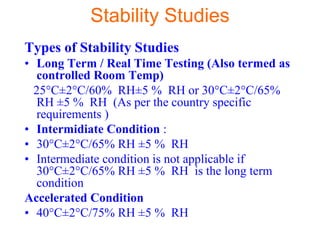
Types of Stability Studies
• Long Term / Real Time Testing (Also termed as
controlled Room Temp)
25°C±2°C/60% RH±5 % RH or 30°C±2°C/65%
RH ±5 % RH (As per the country specific
requirements )
• Intermidiate Condition :
• 30°C±2°C/65% RH ±5 % RH
• Intermediate condition is not applicable if
30°C±2°C/65% RH ±5 % RH is the long term
condition
Accelerated Condition
• 40°C±2°C/75% RH ±5 % RH
Stability Studies
• Guidelines for Stability Testing:
• ICH guidelines on Stability testing of new drug
• substances and drug products
• USFDA guidelines on Stability testing
• CPMP guidelines on stability
• WHO guidelines on stability testing of
pharmaceutical products
• IDMA
Stability Studies
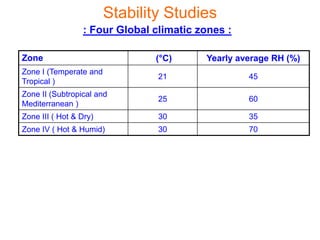
: Four Global climatic zones :
Zone (°C) Yearly average RH (%)
Zone I (Temperate and
Tropical )
21 45
Zone II (Subtropical and
Mediterranean )
25 60
Zone III ( Hot & Dry) 30 35
Zone IV ( Hot & Humid) 30 70
Stability Studies
Distribution of nations into different climatic zones:
Zone -I
(Temprate and
Tropical
Zone - II
(Subtropical and
Mediterranean )
Zone-III
( Hot & Dry)
Zone- IV
IVa and IVb
( Hot & Humid)
United Kingdom United States Iran Brazil
N. Europe Japan Iraq Ghana
Canada S.Europe Sudan Indonesia
Russia India Phillipines
Stability Studies
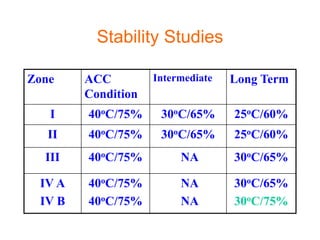
Zone ACC
Condition
Intermediate Long Term
I 40oC/75% 30oC/65% 25oC/60%
II 40oC/75% 30oC/65% 25oC/60%
III 40oC/75% NA 30oC/65%
IV A
IV B
40oC/75%
40oC/75%
NA
NA
30oC/65%
30oC/75%
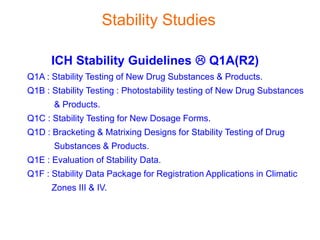
ICH Stability Guidelines  Q1A(R2)
Q1A : Stability Testing of New Drug Substances & Products.
Q1B : Stability Testing : Photostability testing of New Drug Substances
& Products.
Q1C : Stability Testing for New Dosage Forms.
Q1D : Bracketing & Matrixing Designs for Stability Testing of Drug
Substances & Products.
Q1E : Evaluation of Stability Data.
Q1F : Stability Data Package for Registration Applications in Climatic
Zones III & IV.
Stability Studies
Stability Studies
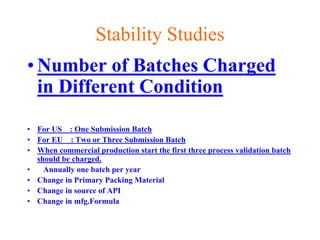
• Number of Batches Charged
in Different Condition
• For US : One Submission Batch
• For EU : Two or Three Submission Batch
• When commercial production start the first three process validation batch
should be charged.
• Annually one batch per year
• Change in Primary Packing Material
• Change in source of API
• Change in mfg.Formula
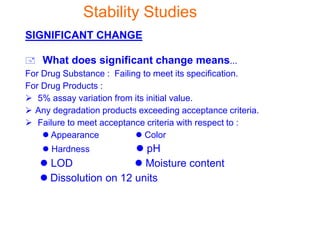
SIGNIFICANT CHANGE
 What does significant change means...
For Drug Substance : Failing to meet its specification.
For Drug Products :
 5% assay variation from its initial value.
 Any degradation products exceeding acceptance criteria.
 Failure to meet acceptance criteria with respect to :
 Appearance  Color
 Hardness  pH
 LOD  Moisture content
 Dissolution on 12 units
Stability Studies
Stability Studies
• Example of significant change
• Release Limit : 95% to 105%
• Shelf life limit : 90% to110%
• Release Assay (Initial)=98%
• After 24 month assay=91%
• Loss in Potency=7%(within shelf life limit)
• This change is SIGNIFICANT change
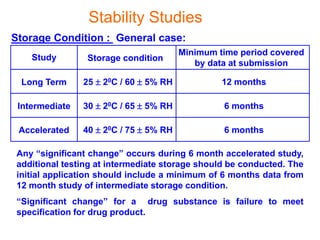
Storage Condition : General case:
Study Storage condition
Minimum time period covered
by data at submission
Long Term
Intermediate
Accelerated
25  20C / 60  5% RH
30  20C / 65  5% RH
40  20C / 75  5% RH
12 months
6 months
6 months
Any “significant change” occurs during 6 month accelerated study,
additional testing at intermediate storage should be conducted. The
initial application should include a minimum of 6 months data from
12 month study of intermediate storage condition.
“Significant change” for a drug substance is failure to meet
specification for drug product.
Stability Studies
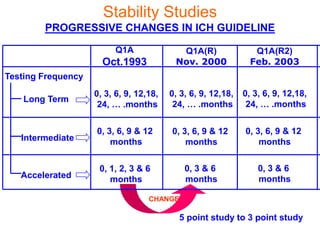
Q1A
Oct.1993
Q1A(R)
Nov. 2000
Q1A(R2)
Feb. 2003
0, 3, 6, 9, 12,18,
24, … .months
0, 3, 6, 9, 12,18,
24, … .months
0, 3, 6, 9, 12,18,
24, … .months
Testing Frequency
Long Term
0, 3, 6, 9 & 12
months
0, 3, 6, 9 & 12
months
0, 3, 6, 9 & 12
monthsIntermediate
0, 1, 2, 3 & 6
months
0, 3 & 6
months
0, 3 & 6
monthsAccelerated
Stability Studies
PROGRESSIVE CHANGES IN ICH GUIDELINE
CHANGE
5 point study to 3 point study
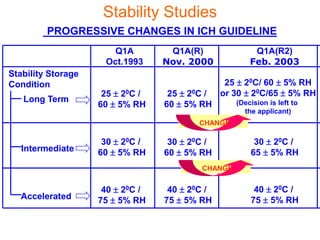
Q1A
Oct.1993
Q1A(R)
Nov. 2000
Q1A(R2)
Feb. 2003
25  20C /
60  5% RH
25  20C /
60  5% RH
25  20C/ 60  5% RH
or 30  20C/65  5% RH
(Decision is left to
the applicant)
Stability Storage
Condition
Long Term
30  20C /
60  5% RH
30  20C /
60  5% RH
30  20C /
65  5% RHIntermediate
40  20C /
75  5% RH
40  20C /
75  5% RH
40  20C /
75  5% RHAccelerated
Stability Studies
PROGRESSIVE CHANGES IN ICH GUIDELINE
CHANGE
CHANGE
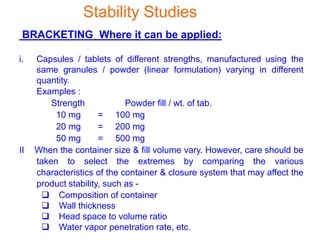
BRACKETING Where it can be applied:
i. Capsules / tablets of different strengths, manufactured using the
same granules / powder (linear formulation) varying in different
quantity.
Examples :
Strength Powder fill / wt. of tab.
10 mg = 100 mg
20 mg = 200 mg
50 mg = 500 mg
II When the container size & fill volume vary. However, care should be
taken to select the extremes by comparing the various
characteristics of the container & closure system that may affect the
product stability, such as -
 Composition of container
 Wall thickness
 Head space to volume ratio
 Water vapor penetration rate, etc.
Stability Studies
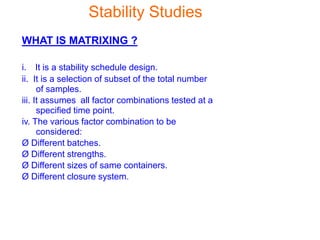
WHAT IS MATRIXING ?
i. It is a stability schedule design.
ii. It is a selection of subset of the total number
of samples.
iii. It assumes all factor combinations tested at a
specified time point.
iv. The various factor combination to be
considered:
Ø Different batches.
Ø Different strengths.
Ø Different sizes of same containers.
Ø Different closure system.
Stability Studies
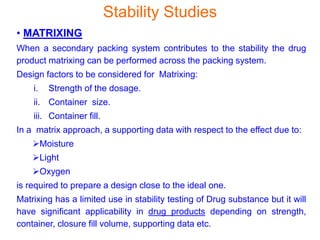
• MATRIXING
When a secondary packing system contributes to the stability the drug
product matrixing can be performed across the packing system.
Design factors to be considered for Matrixing:
i. Strength of the dosage.
ii. Container size.
iii. Container fill.
In a matrix approach, a supporting data with respect to the effect due to:
Moisture
Light
Oxygen
is required to prepare a design close to the ideal one.
Matrixing has a limited use in stability testing of Drug substance but it will
have significant applicability in drug products depending on strength,
container, closure fill volume, supporting data etc.
Stability Studies
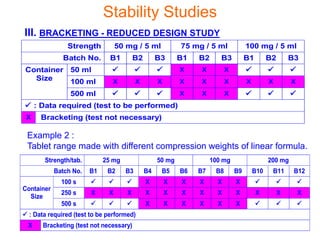
III. BRACKETING - REDUCED DESIGN STUDY
Stability Studies
Strength/tab. 25 mg 50 mg 100 mg 200 mg
Batch No. B1 B2 B3 B4 B5 B6 B7 B8 B9 B10 B11 B12
100 s    X X X X X X   
250 s X X X X X X X X X X X X
Container
Size
500 s    X X X X X X   
 : Data required (test to be performed)
X Bracketing (test not necessary)
Strength 50 mg / 5 ml 75 mg / 5 ml 100 mg / 5 ml
Batch No. B1 B2 B3 B1 B2 B3 B1 B2 B3
50 ml    X X X   
100 ml X X X X X X X X X
Container
Size
500 ml    X X X   
 : Data required (test to be performed)
X Bracketing (test not necessary)
Example 2 :
Tablet range made with different compression weights of linear formula.
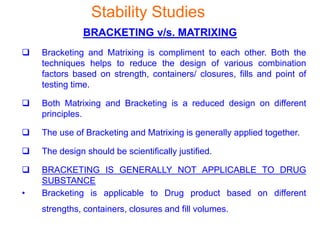
BRACKETING v/s. MATRIXING
 Bracketing and Matrixing is compliment to each other. Both the
techniques helps to reduce the design of various combination
factors based on strength, containers/ closures, fills and point of
testing time.
 Both Matrixing and Bracketing is a reduced design on different
principles.
 The use of Bracketing and Matrixing is generally applied together.
 The design should be scientifically justified.
 BRACKETING IS GENERALLY NOT APPLICABLE TO DRUG
SUBSTANCE
• Bracketing is applicable to Drug product based on different
strengths, containers, closures and fill volumes.
Stability Studies
CONCLUSION
 Bracketing & Matrixing is a stability
schedule & a reduced design. The
number of test to be performed on a
different size, pack & strength should
be logically justified to reduce the
analytical load. Bracketing and
Matrixing is more applicable for drug
product.
Stability Studies
Stability Studies
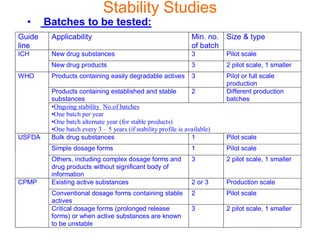
• Batches to be tested:
Guide
line
Applicability Min. no.
of batch
Size & type
New drug substances 3 Pilot scaleICH
New drug products 3 2 pilot scale, 1 smaller
Products containing easily degradable actives 3 Pilot or full scale
production
Products containing established and stable
substances
2 Different production
batches
WHO
•Ongoing stability No.of batches
•One batch per year
•One batch alternate year (for stable products)
•One batch every 3 – 5 years (if stability profile is available)
Bulk drug substances 1 Pilot scale
Simple dosage forms 1 Pilot scale
USFDA
Others, including complex dosage forms and
drug products without significant body of
information
3 2 pilot scale, 1 smaller
Existing active substances 2 or 3 Production scale
Conventional dosage forms containing stable
actives
2 Pilot scale
CPMP
Critical dosage forms (prolonged release
forms) or when active substances are known
to be unstable
3 2 pilot scale, 1 smaller
COMMITMENT
 Initial long-term data on primary batches may not cover the proposed
shelf life granted at the time of approval.
 Commitment is made to continue the post approval studies in order to
firmly establish the shelf life.
 If the submission includes data from studies on less than 3 production
batches, a commitment is made to continue the long term studies
during the proposed shelf life and place additional production batches
to make a total of at least 3 on long-term studies through the proposed
shelf life.
 If the submission does not include stability data on production
batches, a commitment should be made to place the first 3 production
batches on long term studies during the proposed shelf life and
accelerated studies for 6 months.
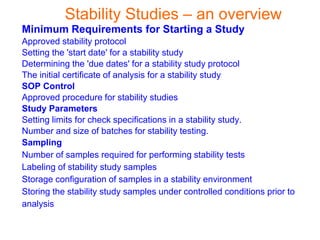
Stability Studies – an overview
Minimum Requirements for Starting a Study
Approved stability protocol
Setting the 'start date' for a stability study
Determining the 'due dates' for a stability study protocol
The initial certificate of analysis for a stability study
SOP Control
Approved procedure for stability studies
Study Parameters
Setting limits for check specifications in a stability study.
Number and size of batches for stability testing.
Sampling
Number of samples required for performing stability tests
Labeling of stability study samples
Storage configuration of samples in a stability environment
Storing the stability study samples under controlled conditions prior to
analysis
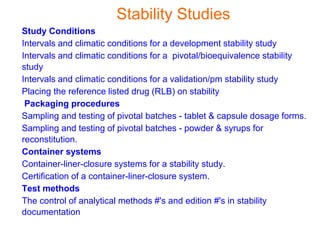
Stability Studies
Study Conditions
Intervals and climatic conditions for a development stability study
Intervals and climatic conditions for a pivotal/bioequivalence stability
study
Intervals and climatic conditions for a validation/pm stability study
Placing the reference listed drug (RLB) on stability
Packaging procedures
Sampling and testing of pivotal batches - tablet & capsule dosage forms.
Sampling and testing of pivotal batches - powder & syrups for
reconstitution.
Container systems
Container-liner-closure systems for a stability study.
Certification of a container-liner-closure system.
Test methods
The control of analytical methods #'s and edition #'s in stability
documentation
Stability Studies
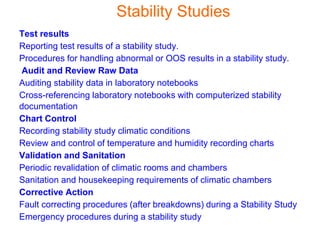
Test results
Reporting test results of a stability study.
Procedures for handling abnormal or OOS results in a stability study.
Audit and Review Raw Data
Auditing stability data in laboratory notebooks
Cross-referencing laboratory notebooks with computerized stability
documentation
Chart Control
Recording stability study climatic conditions
Review and control of temperature and humidity recording charts
Validation and Sanitation
Periodic revalidation of climatic rooms and chambers
Sanitation and housekeeping requirements of climatic chambers
Corrective Action
Fault correcting procedures (after breakdowns) during a Stability Study
Emergency procedures during a stability study
Stability Studies
Stopping a Study
Conditions for stopping a stability study.
Self Inspection
Self inspection procedures in a stability department.
Job Description and Training
Job description of stability department personnel
Using stability SOPs and compliance program as stability training tools.
The Do's and Don'ts of a stability study - a department training tool.
Stability department compliance staff training
Reviewing Documentation
Review and auditing stability study documentation.
The layout and format of a regulatory stability report (a filed report)
Documentation requirements for a stability study - contents
of a stability dossier
Closing a Study
Accepting and signing-off a completed stability study.
Stability protocol - contents:
 Name of the product
 Batch size, type of batch and number of batches
 Source of API
 Type, size, source of containers and closures
 Storage condition
 Sampling schedule
 Container storage orientation
 Test parameters
 Test methods
 Acceptance criteria
Stability Studies
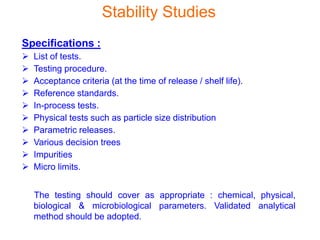
Specifications :
 List of tests.
 Testing procedure.
 Acceptance criteria (at the time of release / shelf life).
 Reference standards.
 In-process tests.
 Physical tests such as particle size distribution
 Parametric releases.
 Various decision trees
 Impurities
 Micro limits.
The testing should cover as appropriate : chemical, physical,
biological & microbiological parameters. Validated analytical
method should be adopted.
Stability Studies
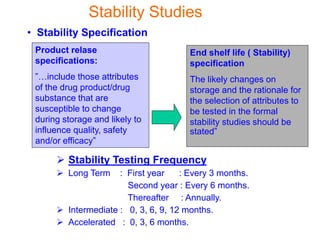
• Stability Specification
Product relase
specifications:
”…include those attributes
of the drug product/drug
substance that are
susceptible to change
during storage and likely to
influence quality, safety
and/or efficacy”
End shelf life ( Stability)
specification
The likely changes on
storage and the rationale for
the selection of attributes to
be tested in the formal
stability studies should be
stated”
Stability Studies
 Stability Testing Frequency
 Long Term : First year : Every 3 months.
Second year : Every 6 months.
Thereafter : Annually.
 Intermediate : 0, 3, 6, 9, 12 months.
 Accelerated : 0, 3, 6 months.
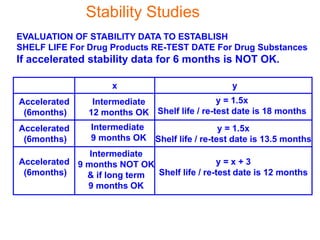
EVALUATION OF STABILITY DATA TO ESTABLISH
SHELF LIFE - For Drug Products
RE-TEST DATE - For Drug Substances
If accelerated stability data for 6 months is OK.
Accelerated
(6months)
Long Term
(9 months OK)
y = 2x
Shelf life / re-test date is 18 months
x y
Accelerated
(6months)
Long Term
(12 months OK)
y = 2x
Shelf life / re-test date is 24 months
Accelerated
(6months)
Long Term
(18 months OK)
y = x + 12
Shelf life / re-test date is 30 months
Accelerated
(6months)
Long Term
(24 months OK)
y = x + 12
Shelf life / re-test date is 36 months
Accelerated
(6months)
Long Term
(36 months OK)
y = x
No extrapolation beyond 36 months
Stability Studies
Accelerated
(6months)
Intermediate
12 months OK
y = 1.5x
Shelf life / re-test date is 18 months
x y
Accelerated
(6months)
Intermediate
9 months OK
y = 1.5x
Shelf life / re-test date is 13.5 months
Accelerated
(6months)
Intermediate
9 months NOT OK
& if long term
9 months OK
y = x + 3
Shelf life / re-test date is 12 months
EVALUATION OF STABILITY DATA TO ESTABLISH
SHELF LIFE For Drug Products RE-TEST DATE For Drug Substances
If accelerated stability data for 6 months is NOT OK.
Stability Studies
STABILITY EVALUATION DATA
 Consider assay, degradation products & other appropriate attributes
for evaluation of stability study data.
 Use formal statistical analysis for data showing substantial
variability & degradation.
 Do not apply this statistical analysis for stability data showing little
degradation / variability.
 The nature of degradation relationship determines whether it should
be converted for linear regression analysis.
Stability Studies
Stability Studies

Stability study

  • 1.
  • 2.
    • The Purposeof Stability testing is to provide evidence on how the quality of a drug substance / product varies with the influence of variety of environmental factors such as temperature, humidity & light Stability Studies
  • 3.
    Stability Studies –an overview • WHY STABILITY REQUIRES ? • To recommend storage conditions • To Establish retest period For drug substances • To assign shelf life of drug products • To review the product quality • To fulfill the regulatory requirement
  • 4.
    Stability Studies –an overview • Factors Affecting Stability Temperature Light Moisture & Humidity Excipients Time Packaging Materials
  • 5.
    Stability Studies Types ofStability Studies • Long Term / Real Time Testing (Also termed as controlled Room Temp) 25°C±2°C/60% RH±5 % RH or 30°C±2°C/65% RH ±5 % RH (As per the country specific requirements ) • Intermidiate Condition : • 30°C±2°C/65% RH ±5 % RH • Intermediate condition is not applicable if 30°C±2°C/65% RH ±5 % RH is the long term condition Accelerated Condition • 40°C±2°C/75% RH ±5 % RH
  • 6.
    Stability Studies • Guidelinesfor Stability Testing: • ICH guidelines on Stability testing of new drug • substances and drug products • USFDA guidelines on Stability testing • CPMP guidelines on stability • WHO guidelines on stability testing of pharmaceutical products • IDMA
  • 7.
    Stability Studies : FourGlobal climatic zones : Zone (°C) Yearly average RH (%) Zone I (Temperate and Tropical ) 21 45 Zone II (Subtropical and Mediterranean ) 25 60 Zone III ( Hot & Dry) 30 35 Zone IV ( Hot & Humid) 30 70
  • 8.
    Stability Studies Distribution ofnations into different climatic zones: Zone -I (Temprate and Tropical Zone - II (Subtropical and Mediterranean ) Zone-III ( Hot & Dry) Zone- IV IVa and IVb ( Hot & Humid) United Kingdom United States Iran Brazil N. Europe Japan Iraq Ghana Canada S.Europe Sudan Indonesia Russia India Phillipines
  • 9.
    Stability Studies Zone ACC Condition IntermediateLong Term I 40oC/75% 30oC/65% 25oC/60% II 40oC/75% 30oC/65% 25oC/60% III 40oC/75% NA 30oC/65% IV A IV B 40oC/75% 40oC/75% NA NA 30oC/65% 30oC/75%
  • 10.
    ICH Stability Guidelines Q1A(R2) Q1A : Stability Testing of New Drug Substances & Products. Q1B : Stability Testing : Photostability testing of New Drug Substances & Products. Q1C : Stability Testing for New Dosage Forms. Q1D : Bracketing & Matrixing Designs for Stability Testing of Drug Substances & Products. Q1E : Evaluation of Stability Data. Q1F : Stability Data Package for Registration Applications in Climatic Zones III & IV. Stability Studies
  • 11.
    Stability Studies • Numberof Batches Charged in Different Condition • For US : One Submission Batch • For EU : Two or Three Submission Batch • When commercial production start the first three process validation batch should be charged. • Annually one batch per year • Change in Primary Packing Material • Change in source of API • Change in mfg.Formula
  • 12.
    SIGNIFICANT CHANGE  Whatdoes significant change means... For Drug Substance : Failing to meet its specification. For Drug Products :  5% assay variation from its initial value.  Any degradation products exceeding acceptance criteria.  Failure to meet acceptance criteria with respect to :  Appearance  Color  Hardness  pH  LOD  Moisture content  Dissolution on 12 units Stability Studies
  • 13.
    Stability Studies • Exampleof significant change • Release Limit : 95% to 105% • Shelf life limit : 90% to110% • Release Assay (Initial)=98% • After 24 month assay=91% • Loss in Potency=7%(within shelf life limit) • This change is SIGNIFICANT change
  • 14.
    Storage Condition :General case: Study Storage condition Minimum time period covered by data at submission Long Term Intermediate Accelerated 25  20C / 60  5% RH 30  20C / 65  5% RH 40  20C / 75  5% RH 12 months 6 months 6 months Any “significant change” occurs during 6 month accelerated study, additional testing at intermediate storage should be conducted. The initial application should include a minimum of 6 months data from 12 month study of intermediate storage condition. “Significant change” for a drug substance is failure to meet specification for drug product. Stability Studies
  • 15.
    Q1A Oct.1993 Q1A(R) Nov. 2000 Q1A(R2) Feb. 2003 0,3, 6, 9, 12,18, 24, … .months 0, 3, 6, 9, 12,18, 24, … .months 0, 3, 6, 9, 12,18, 24, … .months Testing Frequency Long Term 0, 3, 6, 9 & 12 months 0, 3, 6, 9 & 12 months 0, 3, 6, 9 & 12 monthsIntermediate 0, 1, 2, 3 & 6 months 0, 3 & 6 months 0, 3 & 6 monthsAccelerated Stability Studies PROGRESSIVE CHANGES IN ICH GUIDELINE CHANGE 5 point study to 3 point study
  • 16.
    Q1A Oct.1993 Q1A(R) Nov. 2000 Q1A(R2) Feb. 2003 25 20C / 60  5% RH 25  20C / 60  5% RH 25  20C/ 60  5% RH or 30  20C/65  5% RH (Decision is left to the applicant) Stability Storage Condition Long Term 30  20C / 60  5% RH 30  20C / 60  5% RH 30  20C / 65  5% RHIntermediate 40  20C / 75  5% RH 40  20C / 75  5% RH 40  20C / 75  5% RHAccelerated Stability Studies PROGRESSIVE CHANGES IN ICH GUIDELINE CHANGE CHANGE
  • 17.
    BRACKETING Where itcan be applied: i. Capsules / tablets of different strengths, manufactured using the same granules / powder (linear formulation) varying in different quantity. Examples : Strength Powder fill / wt. of tab. 10 mg = 100 mg 20 mg = 200 mg 50 mg = 500 mg II When the container size & fill volume vary. However, care should be taken to select the extremes by comparing the various characteristics of the container & closure system that may affect the product stability, such as -  Composition of container  Wall thickness  Head space to volume ratio  Water vapor penetration rate, etc. Stability Studies
  • 18.
    WHAT IS MATRIXING? i. It is a stability schedule design. ii. It is a selection of subset of the total number of samples. iii. It assumes all factor combinations tested at a specified time point. iv. The various factor combination to be considered: Ø Different batches. Ø Different strengths. Ø Different sizes of same containers. Ø Different closure system. Stability Studies
  • 19.
    • MATRIXING When asecondary packing system contributes to the stability the drug product matrixing can be performed across the packing system. Design factors to be considered for Matrixing: i. Strength of the dosage. ii. Container size. iii. Container fill. In a matrix approach, a supporting data with respect to the effect due to: Moisture Light Oxygen is required to prepare a design close to the ideal one. Matrixing has a limited use in stability testing of Drug substance but it will have significant applicability in drug products depending on strength, container, closure fill volume, supporting data etc. Stability Studies
  • 20.
    III. BRACKETING -REDUCED DESIGN STUDY Stability Studies Strength/tab. 25 mg 50 mg 100 mg 200 mg Batch No. B1 B2 B3 B4 B5 B6 B7 B8 B9 B10 B11 B12 100 s    X X X X X X    250 s X X X X X X X X X X X X Container Size 500 s    X X X X X X     : Data required (test to be performed) X Bracketing (test not necessary) Strength 50 mg / 5 ml 75 mg / 5 ml 100 mg / 5 ml Batch No. B1 B2 B3 B1 B2 B3 B1 B2 B3 50 ml    X X X    100 ml X X X X X X X X X Container Size 500 ml    X X X     : Data required (test to be performed) X Bracketing (test not necessary) Example 2 : Tablet range made with different compression weights of linear formula.
  • 21.
    BRACKETING v/s. MATRIXING Bracketing and Matrixing is compliment to each other. Both the techniques helps to reduce the design of various combination factors based on strength, containers/ closures, fills and point of testing time.  Both Matrixing and Bracketing is a reduced design on different principles.  The use of Bracketing and Matrixing is generally applied together.  The design should be scientifically justified.  BRACKETING IS GENERALLY NOT APPLICABLE TO DRUG SUBSTANCE • Bracketing is applicable to Drug product based on different strengths, containers, closures and fill volumes. Stability Studies
  • 22.
    CONCLUSION  Bracketing &Matrixing is a stability schedule & a reduced design. The number of test to be performed on a different size, pack & strength should be logically justified to reduce the analytical load. Bracketing and Matrixing is more applicable for drug product. Stability Studies
  • 23.
    Stability Studies • Batchesto be tested: Guide line Applicability Min. no. of batch Size & type New drug substances 3 Pilot scaleICH New drug products 3 2 pilot scale, 1 smaller Products containing easily degradable actives 3 Pilot or full scale production Products containing established and stable substances 2 Different production batches WHO •Ongoing stability No.of batches •One batch per year •One batch alternate year (for stable products) •One batch every 3 – 5 years (if stability profile is available) Bulk drug substances 1 Pilot scale Simple dosage forms 1 Pilot scale USFDA Others, including complex dosage forms and drug products without significant body of information 3 2 pilot scale, 1 smaller Existing active substances 2 or 3 Production scale Conventional dosage forms containing stable actives 2 Pilot scale CPMP Critical dosage forms (prolonged release forms) or when active substances are known to be unstable 3 2 pilot scale, 1 smaller
  • 24.
    COMMITMENT  Initial long-termdata on primary batches may not cover the proposed shelf life granted at the time of approval.  Commitment is made to continue the post approval studies in order to firmly establish the shelf life.  If the submission includes data from studies on less than 3 production batches, a commitment is made to continue the long term studies during the proposed shelf life and place additional production batches to make a total of at least 3 on long-term studies through the proposed shelf life.  If the submission does not include stability data on production batches, a commitment should be made to place the first 3 production batches on long term studies during the proposed shelf life and accelerated studies for 6 months. Stability Studies – an overview
  • 25.
    Stability Studies –an overview Minimum Requirements for Starting a Study Approved stability protocol Setting the 'start date' for a stability study Determining the 'due dates' for a stability study protocol The initial certificate of analysis for a stability study SOP Control Approved procedure for stability studies Study Parameters Setting limits for check specifications in a stability study. Number and size of batches for stability testing. Sampling Number of samples required for performing stability tests Labeling of stability study samples Storage configuration of samples in a stability environment Storing the stability study samples under controlled conditions prior to analysis
  • 26.
    Stability Studies Study Conditions Intervalsand climatic conditions for a development stability study Intervals and climatic conditions for a pivotal/bioequivalence stability study Intervals and climatic conditions for a validation/pm stability study Placing the reference listed drug (RLB) on stability Packaging procedures Sampling and testing of pivotal batches - tablet & capsule dosage forms. Sampling and testing of pivotal batches - powder & syrups for reconstitution. Container systems Container-liner-closure systems for a stability study. Certification of a container-liner-closure system. Test methods The control of analytical methods #'s and edition #'s in stability documentation
  • 27.
    Stability Studies Test results Reportingtest results of a stability study. Procedures for handling abnormal or OOS results in a stability study. Audit and Review Raw Data Auditing stability data in laboratory notebooks Cross-referencing laboratory notebooks with computerized stability documentation Chart Control Recording stability study climatic conditions Review and control of temperature and humidity recording charts Validation and Sanitation Periodic revalidation of climatic rooms and chambers Sanitation and housekeeping requirements of climatic chambers Corrective Action Fault correcting procedures (after breakdowns) during a Stability Study Emergency procedures during a stability study
  • 28.
    Stability Studies Stopping aStudy Conditions for stopping a stability study. Self Inspection Self inspection procedures in a stability department. Job Description and Training Job description of stability department personnel Using stability SOPs and compliance program as stability training tools. The Do's and Don'ts of a stability study - a department training tool. Stability department compliance staff training Reviewing Documentation Review and auditing stability study documentation. The layout and format of a regulatory stability report (a filed report) Documentation requirements for a stability study - contents of a stability dossier Closing a Study Accepting and signing-off a completed stability study.
  • 29.
    Stability protocol -contents:  Name of the product  Batch size, type of batch and number of batches  Source of API  Type, size, source of containers and closures  Storage condition  Sampling schedule  Container storage orientation  Test parameters  Test methods  Acceptance criteria Stability Studies
  • 30.
    Specifications :  Listof tests.  Testing procedure.  Acceptance criteria (at the time of release / shelf life).  Reference standards.  In-process tests.  Physical tests such as particle size distribution  Parametric releases.  Various decision trees  Impurities  Micro limits. The testing should cover as appropriate : chemical, physical, biological & microbiological parameters. Validated analytical method should be adopted. Stability Studies
  • 31.
    • Stability Specification Productrelase specifications: ”…include those attributes of the drug product/drug substance that are susceptible to change during storage and likely to influence quality, safety and/or efficacy” End shelf life ( Stability) specification The likely changes on storage and the rationale for the selection of attributes to be tested in the formal stability studies should be stated” Stability Studies  Stability Testing Frequency  Long Term : First year : Every 3 months. Second year : Every 6 months. Thereafter : Annually.  Intermediate : 0, 3, 6, 9, 12 months.  Accelerated : 0, 3, 6 months.
  • 32.
    EVALUATION OF STABILITYDATA TO ESTABLISH SHELF LIFE - For Drug Products RE-TEST DATE - For Drug Substances If accelerated stability data for 6 months is OK. Accelerated (6months) Long Term (9 months OK) y = 2x Shelf life / re-test date is 18 months x y Accelerated (6months) Long Term (12 months OK) y = 2x Shelf life / re-test date is 24 months Accelerated (6months) Long Term (18 months OK) y = x + 12 Shelf life / re-test date is 30 months Accelerated (6months) Long Term (24 months OK) y = x + 12 Shelf life / re-test date is 36 months Accelerated (6months) Long Term (36 months OK) y = x No extrapolation beyond 36 months Stability Studies
  • 33.
    Accelerated (6months) Intermediate 12 months OK y= 1.5x Shelf life / re-test date is 18 months x y Accelerated (6months) Intermediate 9 months OK y = 1.5x Shelf life / re-test date is 13.5 months Accelerated (6months) Intermediate 9 months NOT OK & if long term 9 months OK y = x + 3 Shelf life / re-test date is 12 months EVALUATION OF STABILITY DATA TO ESTABLISH SHELF LIFE For Drug Products RE-TEST DATE For Drug Substances If accelerated stability data for 6 months is NOT OK. Stability Studies
  • 34.
    STABILITY EVALUATION DATA Consider assay, degradation products & other appropriate attributes for evaluation of stability study data.  Use formal statistical analysis for data showing substantial variability & degradation.  Do not apply this statistical analysis for stability data showing little degradation / variability.  The nature of degradation relationship determines whether it should be converted for linear regression analysis. Stability Studies
  • 35.