1
CONTROL INCLUDING
PHARMACEUTICAL ASPECTS,
PHYSICAL STABILITY AND PACKING
1
A.RAMYA PRIYA
13031S0312,
M.PHARMACY,
PHARMACEUTICS,
CPS,IST,JNTUH.
22
3
CONTENTS
• INTRODUCTION
• ADVANTAGES
• DISADVANTAGES
• QUALITY CONTROL OF CAPSULES
Physical tests
Chemical tests
• PACKAGING OF CAPSULES
• PHARMACEUTICAL ASPECTS 3
4
DEFINITION
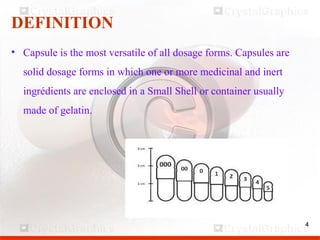
• Capsule is the most versatile of all dosage forms. Capsules are
solid dosage forms in which one or more medicinal and inert
ingrédients are enclosed in a Small Shell or container usually
made of gelatin.
4
5
ADVANTAGES OF CAPSULES
• Capsules mask the taste and odour of unpleasant drugs and can be easily
administered.
• They are slippery when moist and hence easy to swallow with a draught of
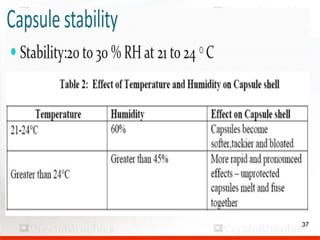
water.
• As compared to tablets less adjuncts are required.
• The shells are physiologically inert and easily and quickly digested in the
gastrointestinal tract.
• They are economical .
• They are easy to handle and carry.
• The shells can be opacified (with titanium dioxide) or coloured, to give
protection from light.
5
6
DISADVANTAGES OF CAPSULES
The drugs which are hygroscopic absorb water from the
capsule shell making it brittle and hence are not suitable for
filling into capsules.
The concentrated solutions which require previous dilution
are unsuitable for capsules because if administered as such
lead to irritation of stomach.
6
7
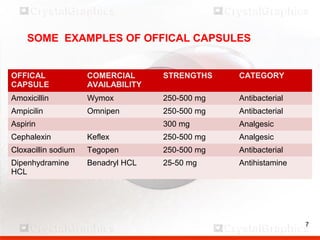
OFFICAL
CAPSULE
COMERCIAL
AVAILABILITY
STRENGTHS CATEGORY
Amoxicillin Wymox 250-500 mg Antibacterial
Ampicilin Omnipen 250-500 mg Antibacterial
Aspirin 300 mg Analgesic
Cephalexin Keflex 250-500 mg Analgesic
Cloxacillin sodium Tegopen 250-500 mg Antibacterial
Dipenhydramine
HCL
Benadryl HCL 25-50 mg Antihistamine
7
SOME EXAMPLES OF OFFICAL CAPSULES
8
QUALITY CONTROL OF CAPSULES
9
QUALITY CONTROL OF CAPSULES
Whether capsules are produced on a small scale or large scale all
of them are required to pass through certain tests i.e., quality
control tests to test the quality of the finished product.
9
10
Quality control tests are divided into
PHYSICAL TEST
• Disintegration test
• Weight variation
CHEMICAL TEST
• Dissolution test
• Assay
• Content uniformity
• Stability testing
• Moisture permeation test
10
11
PHYSICAL TESTS OF CAPSULES
11
12
Finally physical control processing and packing may be
accomplished by the following in line continuous operations
1.A capsule diameter sorter allows to pass to the next unit of any
capsule with in + or _ 0.020 inch of theoretical diameter .
2.A capsule colour -
the capsules are fed to it automatic from the diameter sorter
by a pneumatic conveyer .In this unit, any capsule whose colour
does not conform to the reference colour standard for that
particular product is discarded others passes the test.
12
1313
DISINTERATION TEST-
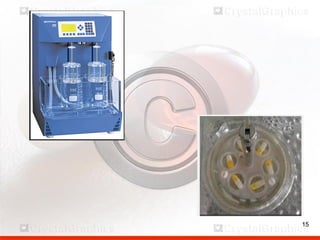
• The disintegration test determines the whether capsules
disintegrated with a prescribed time when placed in a liquid
medium under the prescribed integral conditions .
METHOD-
• According to B.P and which applies to both hard and soft capsules
1.introduce one capsule in each tube and suspend the apparatus in
a beaker containing 60ml water at 370
C,
– if hard capsules float on surface of water, the disc may be
added.
2.Operate the apparatus for 30 min, remove the assembly from
the liquid.
14
3.the capsule pass the test if
• No residue remains on the screen of the apparatus or,
• If the residue remains, it consists of fragments shells ,
• If a soft mass with no palpable core ,
• If the disc is used any residue is remaining on its lower surface
should only consists of fragments of shells.
14
1515
16
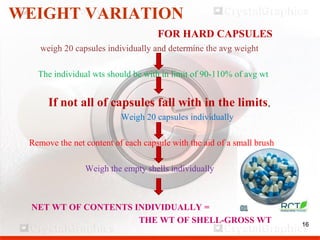
WEIGHT VARIATION
FOR HARD CAPSULES
weigh 20 capsules individually and determine the avg weight
The individual wts should be with in limit of 90-110% of avg wt
If not all of capsules fall with in the limits,
Weigh 20 capsules individually
Remove the net content of each capsule with the aid of a small brush
Weigh the empty shells individually
NET WT OF CONTENTS INDIVIDUALLY =
THE WT OF SHELL-GROSS WT 16
17
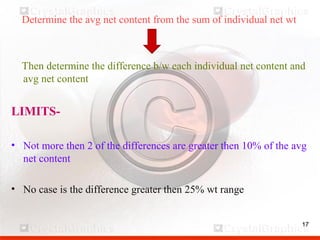
Determine the avg net content from the sum of individual net wt
Then determine the difference b/w each individual net content and
avg net content
LIMITS-
• Not more then 2 of the differences are greater then 10% of the avg
net content
• No case is the difference greater then 25% wt range
17
18
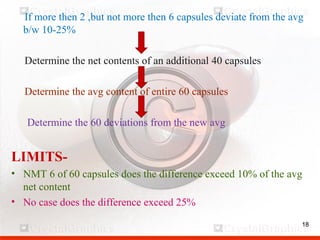
If more then 2 ,but not more then 6 capsules deviate from the avg
b/w 10-25%
Determine the net contents of an additional 40 capsules
Determine the avg content of entire 60 capsules
Determine the 60 deviations from the new avg
LIMITS-
• NMT 6 of 60 capsules does the difference exceed 10% of the avg
net content
• No case does the difference exceed 25%
18
19
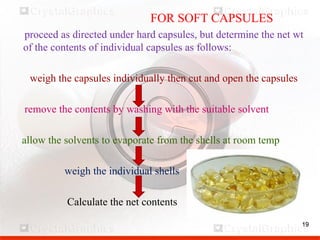
FOR SOFT CAPSULES
proceed as directed under hard capsules, but determine the net wt
of the contents of individual capsules as follows:
weigh the capsules individually then cut and open the capsules
remove the contents by washing with the suitable solvent
allow the solvents to evaporate from the shells at room temp
weigh the individual shells
Calculate the net contents
19
20
CHEMICAL TESTS OF CAPSULES
20
21
DISSOLUTION TEST-
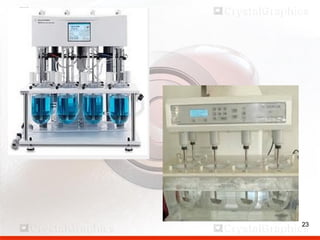
• The dissolution test is carried out using the dissolution apparatus
official in both the U.S.P and I.P .
• The capsule is placed in a basket , and the basket is immersed in
the dissolution medium and caused to rotate at a specified speed .
• The dissolution medium is held in a covered 1000ml glass vessel
and maintained at 370
c +-0.5 0c
by means of a constant temperature
suitable water bath .
• The stirrer speed and type of dissolution medium are specified in
the individual monograph .
21
22
RESULT -
• Six capsules are tested and are accepted if each of them is not less
than monograph specified i.e., p +5%
• If it fails then additional six capsules are tested the result is
accepted if the avg. of 12 capsules is greater than or equal to p and
none of them is less than p-15%.
• If the capsule still fails the test the additional 12 capsules are
tested and are accepted if the avg. of 24 is greater than to p, if not
more than two less than p-15% and none of them is less than p-
25%
22
2323
24
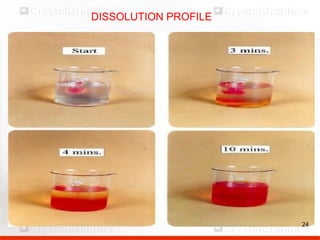
DISSOLUTION PROFILE
24
2525
26
FACTORS AFFECTING DRUG DISSOLUTION
FROM HARD GELATIN CAPSULES
Overall Dissolution Rate is a Function of:
• Dissolution Rate of the Shell
• Rate of Penetration of Dissolution Medium
• Rate of Deaggregationof Powder Mass
• Nature of Primary Drug Particles
27
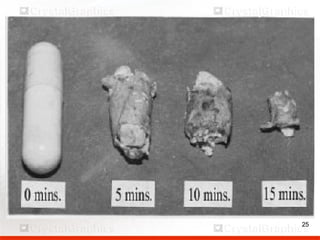
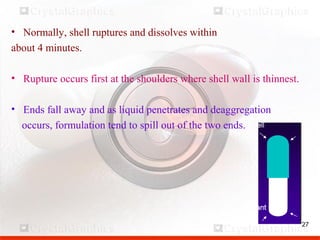
• Normally, shell ruptures and dissolves within
about 4 minutes.
• Rupture occurs first at the shoulders where shell wall is thinnest.
• Ends fall away and as liquid penetrates and deaggregation
occurs, formulation tend to spill out of the two ends.
28
CONTENT UNIFORMITY
10 capsules are taken and subjected to assay
9 of 10 capsules should be in the range of +_
15% (85-115%)
And 10th
capsule are beyond +_ 15% range then 20 capsules are
assayed
All capsules with in range of +_25% (75-125%)
28
29
MOISTURE PERMEATION TEST
The degree and rate of moisture penetration is determined by
packaging the dosage unit together with a colour revealing
desiccant pellet
Expose the packed unit to known relative humidity over a
specified time
Observe the desiccant pellet for colour change
Any change in colour indicates absorption of moisture
By measuring pre test weight and protest weight of pellet,
amount can be calculated. 29
30
BLOOM STRENGHT OF GELATIN
RAW MATERIALS-
The gelatin of the capsule shells should be assayed for varies
physical properties like bloom strength ,viscosity etc..
PROCEDURE-
gelatin is weighed into water to typically create a 6.67% soln
in
standard bloom bottles
The mix is then stirred and keep it for 3 hours at room temp
Bottles are placed in a 650
c bath for 20 minutes
30
3131
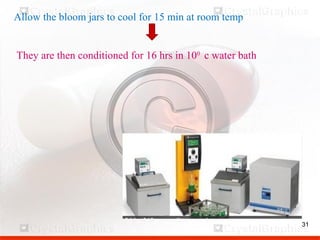
Allow the bloom jars to cool for 15 min at room temp
They are then conditioned for 16 hrs in 100
c water bath
32
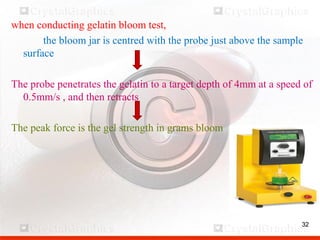
when conducting gelatin bloom test,
the bloom jar is centred with the probe just above the sample
surface
The probe penetrates the gelatin to a target depth of 4mm at a speed of
0.5mm/s , and then retracts
The peak force is the gel strength in grams bloom
32
33
CAPSULES PHYSICAL STABILITY
• Unprotected soft gelatin capsules rapidly reach equilibrium with
the atmospheric conditions under which they are stored.
• This inherent characteristic warrants a brief discussion of the
effects of temp and humidity on the products.
• General statements relative to the effects of temp and humidity on
soft gelatin capsules must be confined to a control capsule that
contains mineral oil with a gelatin shell having a dry glycerin to
dry gelatin ratio of 0.5-1 and water to dry gelatin ratio of 1-1 and
that is dried to equilibrium with 20-30% RH and 21-24o
c.
33
34
• The physical stability of soft gelatin capsules is associated
primarily with the pick up or loss of water by the capsule shell .
• If these are prevented by proper packaging ,the above
controlled capsule should have satisfactory physical stability at S
temp ranging from just above freezing to as high as 600
c.
• As the humidity increases the moisture content pickup of
capsules increases .
ex- at 30%RH at room temp shows that gelatin retain
about12%(48 mg) of water and glycerin 7%(14 mg)of water.
at 60%RH the moisture content should be 17.4%.
• High humidity (>60%RH at 21-240
c )produce more lasting
effects on the capsule shell.
34
35
Since as moisture is absorbed ,the capsules become softer ,tackier ,
and bloated.
• The capsule manufacturer routinely conducts accelerated stability
tests on new product as an integral part of the production
development program.
• The successful results are obtained by conducing at test conditions
like
1.80%RH at room temp in an open container
2.400
c in open container
3. 400
c in closed container (glass bottle with tight screw cap)
35
36
chemists conducting the physical stability test in their own lab
should keep two important points in mind
1.prior to testing ,the capsule should be equilibrated to known atm
conditions, preferably 20-30%RH at 21-240
c.
2.evaluation of the results of the previously described heat test
should be made only after the capsules have returned to
equilibrium to room temp
36
3737
38
PACKAGING OF CAPSULES
38
39
PACKAGING AND STORAGE OF CAPSULES
Capsules should be packed in a well-closed glass or plastic
containers and stored in a cool place.
• These type of containers have advantage over cardboard boxes
that they are more convenient to handle and transport and protect
the capsules from moisture and dust.
• To prevent the capsules from rattling a tuft of cotton is placed
over and under the capsules in the vials.
• In vials containing very hygroscopic capsules a packet-containing
desiccant like silica gel or anhydrous calcium chloride
39
40
may be placed to prevent the absorption of excessive moisture
by the capsules.
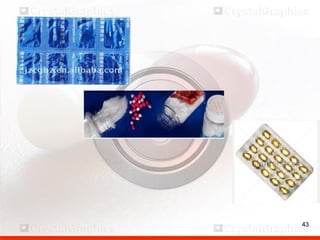
• Now a days capsules are strip packaged which provide sanitary
handling of medicines, ease in counting and identification .
40
4141
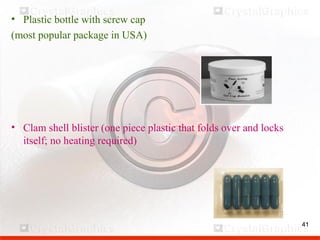
• Plastic bottle with screw cap
(most popular package in USA)
• Clam shell blister (one piece plastic that folds over and locks
itself; no heating required)
42
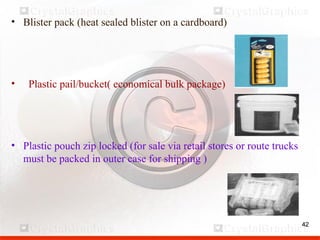
• Blister pack (heat sealed blister on a cardboard)
• Plastic pail/bucket( economical bulk package)
• Plastic pouch zip locked (for sale via retail stores or route trucks
must be packed in outer case for shipping )
42
4343
44
PHARMACEUTICAL ASPECTS
44
45
PHARMACEUTICAL ASPECTS –
Essentially capsules are solid dosage form containing liquid
medication and therefore offer certain advantages
1.They permit liquid medications to become easily portable.
2.These capsules easily pass the appropriate compendial tests and
surpass other solid dosage form ,because liquid formulations can
be more accurately and precisely compounded, blended,
homogenized and measured or dispensed then can dry solid
formulations
45
46
3.Dissolution and disintegration-
The majority of drugs were more rapidly and completely
available for dissolution from the soft gelatin capsule then from the
commercial tablets and capsules in accordance to dissolution and
disintegration time.
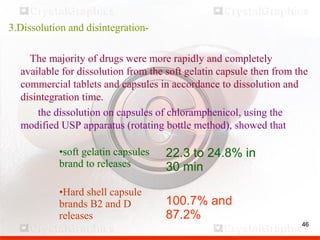
the dissolution on capsules of chloramphenicol, using the
modified USP apparatus (rotating bottle method), showed that
46
•soft gelatin capsules
brand to releases
•Hard shell capsule
brands B2 and D
releases
22.3 to 24.8% in
30 min
100.7% and
87.2%
47
4. The physiologic availability of drugs is often improved by
liquid drug substance i.e., it contains the drug in liquid form or in
suspension.
Nelson ,in his review, points out that the availability of a drug
for absorption of solid dosage forms decreases as below:
SOLUTION>SUSPENSION>POWDER FILLED
CAPSULE>COMPRESSED TABLET >COATED TABLET
absorption profile
Ex-1.bioavailability study of digoxin soft gelatin capsules and
tablets were reported by Astorri, and that in heart patients using
digoxin ,absorption of digoxin from
48
the capsulated solution was 36% higher than the tablet, while in
healthy volunteers it was 20% higher then tablets.
Ex-2. The bioavailability of theophylline from soft gelatin
capsule in comparison to a commercially available liquid
aminophylline preparation and to a non-alcoholic Aminophylline
were studied and found that two dosage forms were bioequivalent
as measured by the area under the plasma level time curves.
This shows that capsule providing a convenient portable dosage
form for a liquid medication.
49
• 5.The pharmaceutical chemist should certainly consider the
bioavailability potential of soft gelatin formulations. The
biopharmaceutical characteristics of such formulations can be
altered easily than solid dosage forms .
Through the selection and use of liquids and combinations of
liquids that range from water immiscible through emulsifiable to
completely water miscible and by altering the type and quantity of
thickening or suspending agents .
• 6.Orally administered drugs, particularly if used chronically ,can
be irritating to the stomach .The dosage form of such drugs can
affect gastric tolerance.
50
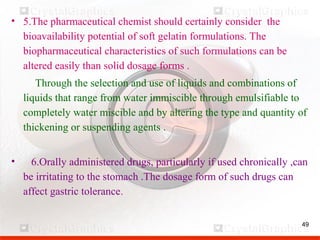
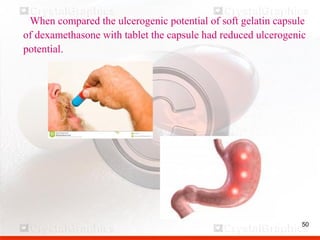
When compared the ulcerogenic potential of soft gelatin capsule
of dexamethasone with tablet the capsule had reduced ulcerogenic
potential.
51
• REFERENCE –
Leon Lachman , Herbert A. Lieberman ,
The theory and practice of industrial pharmacy,
CBS publishers &distributors ,special Indian edition 2009.
WWW.GOOGLE.COM
Indian pharmacopeia 2007 edition.
51
5252
5353

QUALITY CONTROL OF CAPSULES

  • 1.
    1 CONTROL INCLUDING PHARMACEUTICAL ASPECTS, PHYSICALSTABILITY AND PACKING 1 A.RAMYA PRIYA 13031S0312, M.PHARMACY, PHARMACEUTICS, CPS,IST,JNTUH.
  • 2.
  • 3.
    3 CONTENTS • INTRODUCTION • ADVANTAGES •DISADVANTAGES • QUALITY CONTROL OF CAPSULES Physical tests Chemical tests • PACKAGING OF CAPSULES • PHARMACEUTICAL ASPECTS 3
  • 4.
    4 DEFINITION • Capsule isthe most versatile of all dosage forms. Capsules are solid dosage forms in which one or more medicinal and inert ingrédients are enclosed in a Small Shell or container usually made of gelatin. 4
  • 5.
    5 ADVANTAGES OF CAPSULES •Capsules mask the taste and odour of unpleasant drugs and can be easily administered. • They are slippery when moist and hence easy to swallow with a draught of water. • As compared to tablets less adjuncts are required. • The shells are physiologically inert and easily and quickly digested in the gastrointestinal tract. • They are economical . • They are easy to handle and carry. • The shells can be opacified (with titanium dioxide) or coloured, to give protection from light. 5
  • 6.
    6 DISADVANTAGES OF CAPSULES Thedrugs which are hygroscopic absorb water from the capsule shell making it brittle and hence are not suitable for filling into capsules. The concentrated solutions which require previous dilution are unsuitable for capsules because if administered as such lead to irritation of stomach. 6
  • 7.
    7 OFFICAL CAPSULE COMERCIAL AVAILABILITY STRENGTHS CATEGORY Amoxicillin Wymox250-500 mg Antibacterial Ampicilin Omnipen 250-500 mg Antibacterial Aspirin 300 mg Analgesic Cephalexin Keflex 250-500 mg Analgesic Cloxacillin sodium Tegopen 250-500 mg Antibacterial Dipenhydramine HCL Benadryl HCL 25-50 mg Antihistamine 7 SOME EXAMPLES OF OFFICAL CAPSULES
  • 8.
  • 9.
    9 QUALITY CONTROL OFCAPSULES Whether capsules are produced on a small scale or large scale all of them are required to pass through certain tests i.e., quality control tests to test the quality of the finished product. 9
  • 10.
    10 Quality control testsare divided into PHYSICAL TEST • Disintegration test • Weight variation CHEMICAL TEST • Dissolution test • Assay • Content uniformity • Stability testing • Moisture permeation test 10
  • 11.
  • 12.
    12 Finally physical controlprocessing and packing may be accomplished by the following in line continuous operations 1.A capsule diameter sorter allows to pass to the next unit of any capsule with in + or _ 0.020 inch of theoretical diameter . 2.A capsule colour - the capsules are fed to it automatic from the diameter sorter by a pneumatic conveyer .In this unit, any capsule whose colour does not conform to the reference colour standard for that particular product is discarded others passes the test. 12
  • 13.
    1313 DISINTERATION TEST- • Thedisintegration test determines the whether capsules disintegrated with a prescribed time when placed in a liquid medium under the prescribed integral conditions . METHOD- • According to B.P and which applies to both hard and soft capsules 1.introduce one capsule in each tube and suspend the apparatus in a beaker containing 60ml water at 370 C, – if hard capsules float on surface of water, the disc may be added. 2.Operate the apparatus for 30 min, remove the assembly from the liquid.
  • 14.
    14 3.the capsule passthe test if • No residue remains on the screen of the apparatus or, • If the residue remains, it consists of fragments shells , • If a soft mass with no palpable core , • If the disc is used any residue is remaining on its lower surface should only consists of fragments of shells. 14
  • 15.
  • 16.
    16 WEIGHT VARIATION FOR HARDCAPSULES weigh 20 capsules individually and determine the avg weight The individual wts should be with in limit of 90-110% of avg wt If not all of capsules fall with in the limits, Weigh 20 capsules individually Remove the net content of each capsule with the aid of a small brush Weigh the empty shells individually NET WT OF CONTENTS INDIVIDUALLY = THE WT OF SHELL-GROSS WT 16
  • 17.
    17 Determine the avgnet content from the sum of individual net wt Then determine the difference b/w each individual net content and avg net content LIMITS- • Not more then 2 of the differences are greater then 10% of the avg net content • No case is the difference greater then 25% wt range 17
  • 18.
    18 If more then2 ,but not more then 6 capsules deviate from the avg b/w 10-25% Determine the net contents of an additional 40 capsules Determine the avg content of entire 60 capsules Determine the 60 deviations from the new avg LIMITS- • NMT 6 of 60 capsules does the difference exceed 10% of the avg net content • No case does the difference exceed 25% 18
  • 19.
    19 FOR SOFT CAPSULES proceedas directed under hard capsules, but determine the net wt of the contents of individual capsules as follows: weigh the capsules individually then cut and open the capsules remove the contents by washing with the suitable solvent allow the solvents to evaporate from the shells at room temp weigh the individual shells Calculate the net contents 19
  • 20.
  • 21.
    21 DISSOLUTION TEST- • Thedissolution test is carried out using the dissolution apparatus official in both the U.S.P and I.P . • The capsule is placed in a basket , and the basket is immersed in the dissolution medium and caused to rotate at a specified speed . • The dissolution medium is held in a covered 1000ml glass vessel and maintained at 370 c +-0.5 0c by means of a constant temperature suitable water bath . • The stirrer speed and type of dissolution medium are specified in the individual monograph . 21
  • 22.
    22 RESULT - • Sixcapsules are tested and are accepted if each of them is not less than monograph specified i.e., p +5% • If it fails then additional six capsules are tested the result is accepted if the avg. of 12 capsules is greater than or equal to p and none of them is less than p-15%. • If the capsule still fails the test the additional 12 capsules are tested and are accepted if the avg. of 24 is greater than to p, if not more than two less than p-15% and none of them is less than p- 25% 22
  • 23.
  • 24.
  • 25.
  • 26.
    26 FACTORS AFFECTING DRUGDISSOLUTION FROM HARD GELATIN CAPSULES Overall Dissolution Rate is a Function of: • Dissolution Rate of the Shell • Rate of Penetration of Dissolution Medium • Rate of Deaggregationof Powder Mass • Nature of Primary Drug Particles
  • 27.
    27 • Normally, shellruptures and dissolves within about 4 minutes. • Rupture occurs first at the shoulders where shell wall is thinnest. • Ends fall away and as liquid penetrates and deaggregation occurs, formulation tend to spill out of the two ends.
  • 28.
    28 CONTENT UNIFORMITY 10 capsulesare taken and subjected to assay 9 of 10 capsules should be in the range of +_ 15% (85-115%) And 10th capsule are beyond +_ 15% range then 20 capsules are assayed All capsules with in range of +_25% (75-125%) 28
  • 29.
    29 MOISTURE PERMEATION TEST Thedegree and rate of moisture penetration is determined by packaging the dosage unit together with a colour revealing desiccant pellet Expose the packed unit to known relative humidity over a specified time Observe the desiccant pellet for colour change Any change in colour indicates absorption of moisture By measuring pre test weight and protest weight of pellet, amount can be calculated. 29
  • 30.
    30 BLOOM STRENGHT OFGELATIN RAW MATERIALS- The gelatin of the capsule shells should be assayed for varies physical properties like bloom strength ,viscosity etc.. PROCEDURE- gelatin is weighed into water to typically create a 6.67% soln in standard bloom bottles The mix is then stirred and keep it for 3 hours at room temp Bottles are placed in a 650 c bath for 20 minutes 30
  • 31.
    3131 Allow the bloomjars to cool for 15 min at room temp They are then conditioned for 16 hrs in 100 c water bath
  • 32.
    32 when conducting gelatinbloom test, the bloom jar is centred with the probe just above the sample surface The probe penetrates the gelatin to a target depth of 4mm at a speed of 0.5mm/s , and then retracts The peak force is the gel strength in grams bloom 32
  • 33.
    33 CAPSULES PHYSICAL STABILITY •Unprotected soft gelatin capsules rapidly reach equilibrium with the atmospheric conditions under which they are stored. • This inherent characteristic warrants a brief discussion of the effects of temp and humidity on the products. • General statements relative to the effects of temp and humidity on soft gelatin capsules must be confined to a control capsule that contains mineral oil with a gelatin shell having a dry glycerin to dry gelatin ratio of 0.5-1 and water to dry gelatin ratio of 1-1 and that is dried to equilibrium with 20-30% RH and 21-24o c. 33
  • 34.
    34 • The physicalstability of soft gelatin capsules is associated primarily with the pick up or loss of water by the capsule shell . • If these are prevented by proper packaging ,the above controlled capsule should have satisfactory physical stability at S temp ranging from just above freezing to as high as 600 c. • As the humidity increases the moisture content pickup of capsules increases . ex- at 30%RH at room temp shows that gelatin retain about12%(48 mg) of water and glycerin 7%(14 mg)of water. at 60%RH the moisture content should be 17.4%. • High humidity (>60%RH at 21-240 c )produce more lasting effects on the capsule shell. 34
  • 35.
    35 Since as moistureis absorbed ,the capsules become softer ,tackier , and bloated. • The capsule manufacturer routinely conducts accelerated stability tests on new product as an integral part of the production development program. • The successful results are obtained by conducing at test conditions like 1.80%RH at room temp in an open container 2.400 c in open container 3. 400 c in closed container (glass bottle with tight screw cap) 35
  • 36.
    36 chemists conducting thephysical stability test in their own lab should keep two important points in mind 1.prior to testing ,the capsule should be equilibrated to known atm conditions, preferably 20-30%RH at 21-240 c. 2.evaluation of the results of the previously described heat test should be made only after the capsules have returned to equilibrium to room temp 36
  • 37.
  • 38.
  • 39.
    39 PACKAGING AND STORAGEOF CAPSULES Capsules should be packed in a well-closed glass or plastic containers and stored in a cool place. • These type of containers have advantage over cardboard boxes that they are more convenient to handle and transport and protect the capsules from moisture and dust. • To prevent the capsules from rattling a tuft of cotton is placed over and under the capsules in the vials. • In vials containing very hygroscopic capsules a packet-containing desiccant like silica gel or anhydrous calcium chloride 39
  • 40.
    40 may be placedto prevent the absorption of excessive moisture by the capsules. • Now a days capsules are strip packaged which provide sanitary handling of medicines, ease in counting and identification . 40
  • 41.
    4141 • Plastic bottlewith screw cap (most popular package in USA) • Clam shell blister (one piece plastic that folds over and locks itself; no heating required)
  • 42.
    42 • Blister pack(heat sealed blister on a cardboard) • Plastic pail/bucket( economical bulk package) • Plastic pouch zip locked (for sale via retail stores or route trucks must be packed in outer case for shipping ) 42
  • 43.
  • 44.
  • 45.
    45 PHARMACEUTICAL ASPECTS – Essentiallycapsules are solid dosage form containing liquid medication and therefore offer certain advantages 1.They permit liquid medications to become easily portable. 2.These capsules easily pass the appropriate compendial tests and surpass other solid dosage form ,because liquid formulations can be more accurately and precisely compounded, blended, homogenized and measured or dispensed then can dry solid formulations 45
  • 46.
    46 3.Dissolution and disintegration- Themajority of drugs were more rapidly and completely available for dissolution from the soft gelatin capsule then from the commercial tablets and capsules in accordance to dissolution and disintegration time. the dissolution on capsules of chloramphenicol, using the modified USP apparatus (rotating bottle method), showed that 46 •soft gelatin capsules brand to releases •Hard shell capsule brands B2 and D releases 22.3 to 24.8% in 30 min 100.7% and 87.2%
  • 47.
    47 4. The physiologicavailability of drugs is often improved by liquid drug substance i.e., it contains the drug in liquid form or in suspension. Nelson ,in his review, points out that the availability of a drug for absorption of solid dosage forms decreases as below: SOLUTION>SUSPENSION>POWDER FILLED CAPSULE>COMPRESSED TABLET >COATED TABLET absorption profile Ex-1.bioavailability study of digoxin soft gelatin capsules and tablets were reported by Astorri, and that in heart patients using digoxin ,absorption of digoxin from
  • 48.
    48 the capsulated solutionwas 36% higher than the tablet, while in healthy volunteers it was 20% higher then tablets. Ex-2. The bioavailability of theophylline from soft gelatin capsule in comparison to a commercially available liquid aminophylline preparation and to a non-alcoholic Aminophylline were studied and found that two dosage forms were bioequivalent as measured by the area under the plasma level time curves. This shows that capsule providing a convenient portable dosage form for a liquid medication.
  • 49.
    49 • 5.The pharmaceuticalchemist should certainly consider the bioavailability potential of soft gelatin formulations. The biopharmaceutical characteristics of such formulations can be altered easily than solid dosage forms . Through the selection and use of liquids and combinations of liquids that range from water immiscible through emulsifiable to completely water miscible and by altering the type and quantity of thickening or suspending agents . • 6.Orally administered drugs, particularly if used chronically ,can be irritating to the stomach .The dosage form of such drugs can affect gastric tolerance.
  • 50.
    50 When compared theulcerogenic potential of soft gelatin capsule of dexamethasone with tablet the capsule had reduced ulcerogenic potential.
  • 51.
    51 • REFERENCE – LeonLachman , Herbert A. Lieberman , The theory and practice of industrial pharmacy, CBS publishers &distributors ,special Indian edition 2009. WWW.GOOGLE.COM Indian pharmacopeia 2007 edition. 51
  • 52.
  • 53.