STABILITY OF
FORMULATED
PRODUCTS
TABLE OF CONTENTS.
Introduction.
Definition of stability.
The five types of stability.
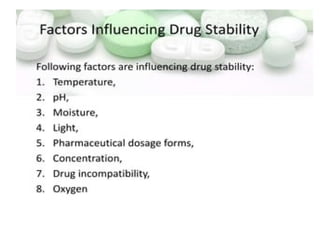
Factors affecting product stability.
Stability studies in manufacturing.
Observing products for evidence of
instability.
Responsibility of the pharmacist.
Reference.
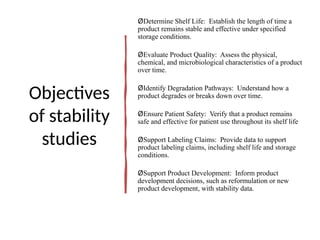
Objectives
of stability
studies
ØDetermine Shelf Life: Establish the length of time a
product remains stable and effective under specified
storage conditions.
ØEvaluate Product Quality: Assess the physical,
chemical, and microbiological characteristics of a product
over time.
ØIdentify Degradation Pathways: Understand how a
product degrades or breaks down over time.
ØEnsure Patient Safety: Verify that a product remains
safe and effective for patient use throughout its shelf life
ØSupport Labeling Claims: Provide data to support
product labeling claims, including shelf life and storage
conditions.
ØSupport Product Development: Inform product
development decisions, such as reformulation or new
product development, with stability data.
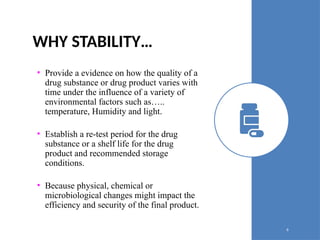
WHY STABILITY…
• Provide a evidence on how the quality of a
drug substance or drug product varies with
time under the influence of a variety of
environmental factors such as…..
temperature, Humidity and light.
• Establish a re-test period for the drug
substance or a shelf life for the drug
product and recommended storage
conditions.
• Because physical, chemical or
microbiological changes might impact the
efficiency and security of the final product.
6
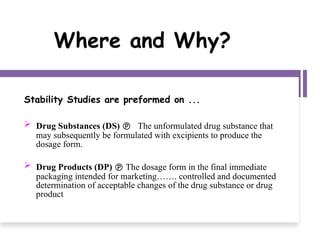
Where and Why?
Stability Studies are preformed on ...
 Drug Substances (DS)  The unformulated drug substance that
may subsequently be formulated with excipients to produce the
dosage form.
 Drug Products (DP)  The dosage form in the final immediate
packaging intended for marketing……. controlled and documented
determination of acceptable changes of the drug substance or drug
product
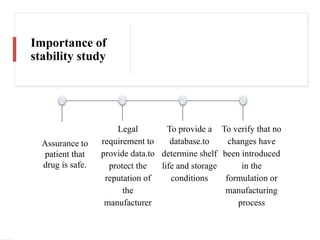
Importance of
stability study
Assurance to
patient that
drug is safe.
Legal
requirement to
provide data.to
protect the
reputation of
the
manufacturer
To provide a
database.to
determine shelf
life and storage
conditions
To verify that no
changes have
been introduced
in the
formulation or
manufacturing
process
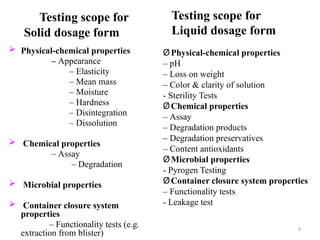
Testing scope for
Solid dosage form
 Physical-chemical properties
– Appearance
– Elasticity
– Mean mass
– Moisture
– Hardness
– Disintegration
– Dissolution
 Chemical properties
– Assay
– Degradation
 Microbial properties
 Container closure system
properties
– Functionality tests (e.g.
extraction from blister)
9
ØPhysical-chemical properties​
– pH​
– Loss on weight​
– Color & clarity of solution​
- Sterility Tests​
ØChemical properties​
– Assay​
– Degradation products​
– Degradation preservatives​
– Content antioxidants​
ØMicrobial properties ​
- Pyrogen Testing ​
ØContainer closure system properties​
– Functionality tests​
- Leakage test
Testing scope for
Liquid dosage form
Stages of Stability Studies
• Stability study is performed at various stages
of the drug development process.
• There are 6 different stages:
Stage 1: Early stage, i.e., stress and accelerated
testing with drug substances.
Stage 2: Stability on pre-formulation batches.
Stage 3: stress test done on scale-up batches
Stage 4 : Accelerated and long-term testing for
registration purposes.
Stage 5 : Enduring stability testing.
Stage 6: follow up studies.
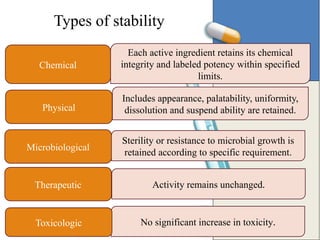
Types of stability
Chemical
Each active ingredient retains its chemical
integrity and labeled potency within specified
limits.
Physical
Microbiological
Therapeutic
Includes appearance, palatability, uniformity,
dissolution and suspend ability are retained.
Sterility or resistance to microbial growth is
retained according to specific requirement.
Activity remains unchanged.
No significant increase in toxicity.
Toxicologic
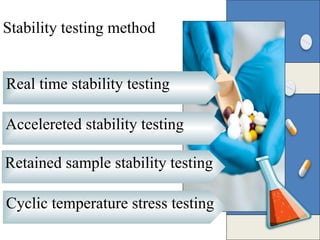
Real time stability testing
Accelereted stability testing
Retained sample stability testing
Cyclic temperature stress testing
Stability testing method
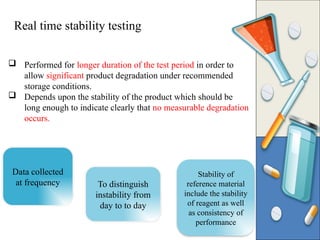
 Performed for longer duration of the test period in order to
allow significant product degradation under recommended
storage conditions.
 Depends upon the stability of the product which should be
long enough to indicate clearly that no measurable degradation
occurs.
Data collected
at frequency
Stability of
reference material
include the stability
of reagent as well
as consistency of
performance
To distinguish
instability from
day to to day
Real time stability testing
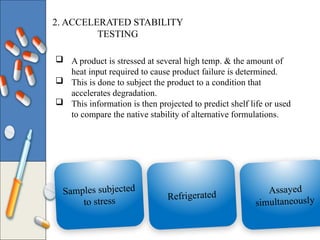
 A product is stressed at several high temp. & the amount of
heat input required to cause product failure is determined.
 This is done to subject the product to a condition that
accelerates degradation.
 This information is then projected to predict shelf life or used
to compare the native stability of alternative formulations.
Samples subjected
to stress Refrigerated Assayed
simultaneously
2. ACCELERATED STABILITY
TESTING
 Usual practice for every marketed product for which
stability data are reuired.
 Only one batch a year are selected.
 If the number of batches marketed exceeds 50,
stability samples from two batches are recommended
to be taken.
 Stability testing by evaluation of market samples is a
modified method which involves taking samples
already in the market place and evaluating stability
attributes.
3. RETAINED SAMPLE STABILITY
TESTING
 Is not a routine testing method for marketed products.
 In this method, cyclic temp. stress tests are designed on knowledge of
the product so as to mimic likely conditions in market place storage.
 The period of cycle mostly considered is 24 hours.
 The min, and max. temp. for the cyclic stress testing is recommended to
be selected on a product by-product basis and considering factors like
recommended storage temp. for the product and specific chemical and
physical degradation properties of the products.
 The test should normally have 20 cycles.
4. CYCLIC TEMPERATURE STRESS
TESTING
ICH
ICH stands for International Conference on
Harmonization of Technical Requirements for
Registration of Pharmaceuticals for Human use
Objectives of ICH
• Harmonization of registration applications within the
three regions of the EU, Japan and the United States.
• ICH is a joint initiative involving both regulators and
industry as equal partners in the scientific and
technical discussions of the testing procedures which
are required to ensure and assess the safety, quality
and efficacy of medicines.
● Tripartite guideline on stability testing of new drug
substances and products (Q1A) in 1993, has become
standard for stability evaluation in Japan, US, Europe.
ICH
CODE
GUIDELINE TITLE
Q1A Stability testing of New Drug Substances and
Products (Second Revision)
Q1B Stability testing Photo stability testing of New Drug
Substances and Products
Q1C Stability testing of New Dosage Form
Q1D Bracketing and Matrixing Designs for stability
testing of Drug Substances and Products
Q1E Evaluation of stability data
Q1F Stability data package for Registration Applications
in Climatic Zones III and IV
Q5C Stability testing of Biotechnological/Biological
Products
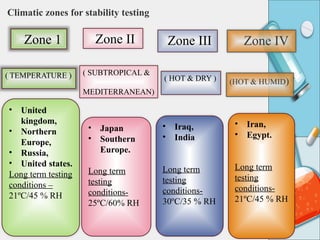
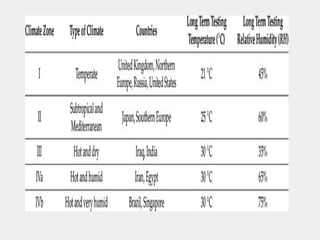
Zone 1 Zone II Zone III Zone IV
( TEMPERATURE ) ( SUBTROPICAL &
MEDITERRANEAN)
( HOT & DRY ) (HOT & HUMID)
• United
kingdom,
• Northern
Europe,
• Russia,
• United states.
Long term testing
conditions –
21ºC/45 % RH
• Japan
• Southern
Europe.
Long term
testing
conditions-
25ºC/60% RH
• Iraq,
• India
Long term
testing
conditions-
30ºC/35 % RH
• Iran,
• Egypt.
Long term
testing
conditions-
21ºC/45 % RH
Climatic zones for stability testing
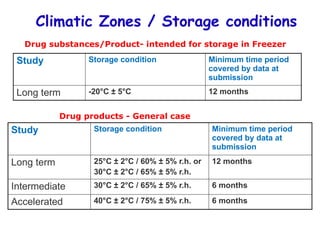
Drug substances/Product- intended for storage in Freezer
Study Storage condition Minimum time period
covered by data at
submission
Long term -20°C ± 5°C 12 months
Drug products - General case
Study Storage condition Minimum time period
covered by data at
submission
Long term 25°C ± 2°C / 60% ± 5% r.h. or
30°C ± 2°C / 65% ± 5% r.h.
12 months
Intermediate 30°C ± 2°C / 65% ± 5% r.h. 6 months
Accelerated 40°C ± 2°C / 75% ± 5% r.h. 6 months
Climatic Zones / Storage conditions
Stability chamber room
STABILITY STUDIES
IN MANUFACTURING
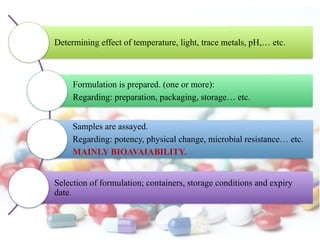
Determining effect of temperature, light, trace metals, pH,… etc.
Formulation is prepared. (one or more):
Regarding: preparation, packaging, storage… etc.
Samples are assayed.
Regarding: potency, physical change, microbial resistance… etc.
MAINLY BIOAVAIABILITY.
Selection of formulation; containers, storage conditions and expiry
date.
STABILITY STUDIES FOR PHARMACEUTICAL PRODUCTS
TABLET
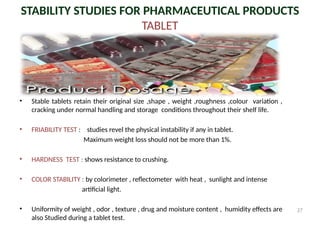
• Stable tablets retain their original size ,shape , weight ,roughness ,colour variation ,
cracking under normal handling and storage conditions throughout their shelf life.

• FRIABILITY TEST : studies revel the physical instability if any in tablet.
Maximum weight loss should not be more than 1%.
• HARDNESS TEST : shows resistance to crushing.
• COLOR STABILITY : by colorimeter , reflectometer with heat , sunlight and intense
artificial light.
• Uniformity of weight , odor , texture , drug and moisture content , humidity effects are
also Studied during a tablet test.
27
Tests Metho
d
SOP#
Specification
(Low/High)
Time (Months)
appearance 0 3 6 9 etc.
Color
Degradation
Assay
Dissolution
Clarity
Stability Raw Data format
AFTER REGISTRATION…
Once the pharmaceutical product has been
registered, additional stability studies are
required whenever variations that may affect
the stability of the active pharmaceutical
substance or pharmaceutical product are made,
such as major variations like the following:
a. Change in the manufacturing process.
b. Change in the composition of the
pharmaceutical product.
c. Change of the immediate packaging.
RESPONSIBILITY
OF PHARMACISTS
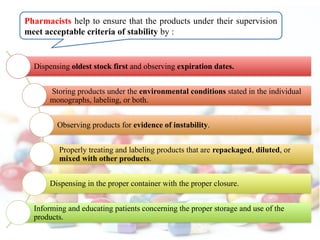
Pharmacists help to ensure that the products under their supervision
meet acceptable criteria of stability by :
Dispensing oldest stock first and observing expiration dates.
Storing products under the environmental conditions stated in the individual
monographs, labeling, or both.
Observing products for evidence of instability.
Properly treating and labeling products that are repackaged, diluted, or
mixed with other products.
Dispensing in the proper container with the proper closure.
Informing and educating patients concerning the proper storage and use of the
products.
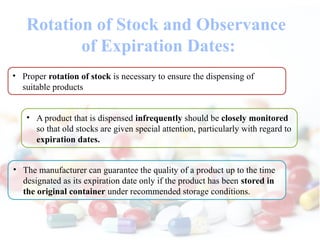
Rotation of Stock and Observance
of Expiration Dates:
• Proper rotation of stock is necessary to ensure the dispensing of
suitable products
• A product that is dispensed infrequently should be closely monitored
so that old stocks are given special attention, particularly with regard to
expiration dates.
• The manufacturer can guarantee the quality of a product up to the time
designated as its expiration date only if the product has been stored in
the original container under recommended storage conditions.
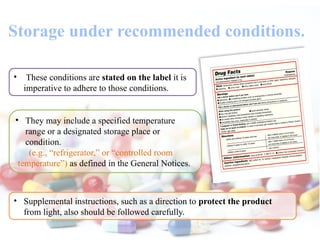
Storage under recommended conditions.
• These conditions are stated on the label it is
imperative to adhere to those conditions.
• They may include a specified temperature
range or a designated storage place or
condition.
(e.g., “refrigerator,” or “controlled room
temperature”) as defined in the General Notices.
• Supplemental instructions, such as a direction to protect the product
from light, also should be followed carefully.
• In the absence of specific instructions, the product should be
stored at controlled room temperature.
• Where a product is required to be protected from light and
is in a clear or translucent container enclosed in an
opaque outer covering, such outer covering is not to be
removed and discarded until the contents have been used.
• The product should be stored away from locations where
excessive or variable heat, cold, or light prevails, such as
those near heating pipes or fluorescent lighting.
CONCLUSION.
Stability testing is an essential part of the process
of ensuring that the patient receives a product
that meets established standards of safety,
efficacy and quality.
REFERENCE.
USP – United States
Pharmacopeia, 2008.
{1191} Stability
consideration in
dispensing practice/
General information, page
2414.
Thank you.

industry stability testing technique health

  • 2.
  • 3.
    TABLE OF CONTENTS. Introduction. Definitionof stability. The five types of stability. Factors affecting product stability. Stability studies in manufacturing. Observing products for evidence of instability. Responsibility of the pharmacist. Reference.
  • 5.
    Objectives of stability studies ØDetermine ShelfLife: Establish the length of time a product remains stable and effective under specified storage conditions. ØEvaluate Product Quality: Assess the physical, chemical, and microbiological characteristics of a product over time. ØIdentify Degradation Pathways: Understand how a product degrades or breaks down over time. ØEnsure Patient Safety: Verify that a product remains safe and effective for patient use throughout its shelf life ØSupport Labeling Claims: Provide data to support product labeling claims, including shelf life and storage conditions. ØSupport Product Development: Inform product development decisions, such as reformulation or new product development, with stability data.
  • 6.
    WHY STABILITY… • Providea evidence on how the quality of a drug substance or drug product varies with time under the influence of a variety of environmental factors such as….. temperature, Humidity and light. • Establish a re-test period for the drug substance or a shelf life for the drug product and recommended storage conditions. • Because physical, chemical or microbiological changes might impact the efficiency and security of the final product. 6
  • 7.
    Where and Why? StabilityStudies are preformed on ...  Drug Substances (DS)  The unformulated drug substance that may subsequently be formulated with excipients to produce the dosage form.  Drug Products (DP)  The dosage form in the final immediate packaging intended for marketing……. controlled and documented determination of acceptable changes of the drug substance or drug product
  • 8.
    Importance of stability study Assuranceto patient that drug is safe. Legal requirement to provide data.to protect the reputation of the manufacturer To provide a database.to determine shelf life and storage conditions To verify that no changes have been introduced in the formulation or manufacturing process
  • 9.
    Testing scope for Soliddosage form  Physical-chemical properties – Appearance – Elasticity – Mean mass – Moisture – Hardness – Disintegration – Dissolution  Chemical properties – Assay – Degradation  Microbial properties  Container closure system properties – Functionality tests (e.g. extraction from blister) 9 ØPhysical-chemical properties​ – pH​ – Loss on weight​ – Color & clarity of solution​ - Sterility Tests​ ØChemical properties​ – Assay​ – Degradation products​ – Degradation preservatives​ – Content antioxidants​ ØMicrobial properties ​ - Pyrogen Testing ​ ØContainer closure system properties​ – Functionality tests​ - Leakage test Testing scope for Liquid dosage form
  • 11.
    Stages of StabilityStudies • Stability study is performed at various stages of the drug development process. • There are 6 different stages: Stage 1: Early stage, i.e., stress and accelerated testing with drug substances. Stage 2: Stability on pre-formulation batches. Stage 3: stress test done on scale-up batches Stage 4 : Accelerated and long-term testing for registration purposes. Stage 5 : Enduring stability testing. Stage 6: follow up studies.
  • 12.
    Types of stability Chemical Eachactive ingredient retains its chemical integrity and labeled potency within specified limits. Physical Microbiological Therapeutic Includes appearance, palatability, uniformity, dissolution and suspend ability are retained. Sterility or resistance to microbial growth is retained according to specific requirement. Activity remains unchanged. No significant increase in toxicity. Toxicologic
  • 14.
    Real time stabilitytesting Accelereted stability testing Retained sample stability testing Cyclic temperature stress testing Stability testing method
  • 15.
     Performed forlonger duration of the test period in order to allow significant product degradation under recommended storage conditions.  Depends upon the stability of the product which should be long enough to indicate clearly that no measurable degradation occurs. Data collected at frequency Stability of reference material include the stability of reagent as well as consistency of performance To distinguish instability from day to to day Real time stability testing
  • 16.
     A productis stressed at several high temp. & the amount of heat input required to cause product failure is determined.  This is done to subject the product to a condition that accelerates degradation.  This information is then projected to predict shelf life or used to compare the native stability of alternative formulations. Samples subjected to stress Refrigerated Assayed simultaneously 2. ACCELERATED STABILITY TESTING
  • 17.
     Usual practicefor every marketed product for which stability data are reuired.  Only one batch a year are selected.  If the number of batches marketed exceeds 50, stability samples from two batches are recommended to be taken.  Stability testing by evaluation of market samples is a modified method which involves taking samples already in the market place and evaluating stability attributes. 3. RETAINED SAMPLE STABILITY TESTING
  • 18.
     Is nota routine testing method for marketed products.  In this method, cyclic temp. stress tests are designed on knowledge of the product so as to mimic likely conditions in market place storage.  The period of cycle mostly considered is 24 hours.  The min, and max. temp. for the cyclic stress testing is recommended to be selected on a product by-product basis and considering factors like recommended storage temp. for the product and specific chemical and physical degradation properties of the products.  The test should normally have 20 cycles. 4. CYCLIC TEMPERATURE STRESS TESTING
  • 19.
    ICH ICH stands forInternational Conference on Harmonization of Technical Requirements for Registration of Pharmaceuticals for Human use Objectives of ICH • Harmonization of registration applications within the three regions of the EU, Japan and the United States. • ICH is a joint initiative involving both regulators and industry as equal partners in the scientific and technical discussions of the testing procedures which are required to ensure and assess the safety, quality and efficacy of medicines. ● Tripartite guideline on stability testing of new drug substances and products (Q1A) in 1993, has become standard for stability evaluation in Japan, US, Europe.
  • 20.
    ICH CODE GUIDELINE TITLE Q1A Stabilitytesting of New Drug Substances and Products (Second Revision) Q1B Stability testing Photo stability testing of New Drug Substances and Products Q1C Stability testing of New Dosage Form Q1D Bracketing and Matrixing Designs for stability testing of Drug Substances and Products Q1E Evaluation of stability data Q1F Stability data package for Registration Applications in Climatic Zones III and IV Q5C Stability testing of Biotechnological/Biological Products
  • 21.
    Zone 1 ZoneII Zone III Zone IV ( TEMPERATURE ) ( SUBTROPICAL & MEDITERRANEAN) ( HOT & DRY ) (HOT & HUMID) • United kingdom, • Northern Europe, • Russia, • United states. Long term testing conditions – 21ºC/45 % RH • Japan • Southern Europe. Long term testing conditions- 25ºC/60% RH • Iraq, • India Long term testing conditions- 30ºC/35 % RH • Iran, • Egypt. Long term testing conditions- 21ºC/45 % RH Climatic zones for stability testing
  • 23.
    Drug substances/Product- intendedfor storage in Freezer Study Storage condition Minimum time period covered by data at submission Long term -20°C ± 5°C 12 months Drug products - General case Study Storage condition Minimum time period covered by data at submission Long term 25°C ± 2°C / 60% ± 5% r.h. or 30°C ± 2°C / 65% ± 5% r.h. 12 months Intermediate 30°C ± 2°C / 65% ± 5% r.h. 6 months Accelerated 40°C ± 2°C / 75% ± 5% r.h. 6 months Climatic Zones / Storage conditions
  • 24.
  • 25.
  • 26.
    Determining effect oftemperature, light, trace metals, pH,… etc. Formulation is prepared. (one or more): Regarding: preparation, packaging, storage… etc. Samples are assayed. Regarding: potency, physical change, microbial resistance… etc. MAINLY BIOAVAIABILITY. Selection of formulation; containers, storage conditions and expiry date.
  • 27.
    STABILITY STUDIES FORPHARMACEUTICAL PRODUCTS TABLET • Stable tablets retain their original size ,shape , weight ,roughness ,colour variation , cracking under normal handling and storage conditions throughout their shelf life. • FRIABILITY TEST : studies revel the physical instability if any in tablet. Maximum weight loss should not be more than 1%. • HARDNESS TEST : shows resistance to crushing. • COLOR STABILITY : by colorimeter , reflectometer with heat , sunlight and intense artificial light. • Uniformity of weight , odor , texture , drug and moisture content , humidity effects are also Studied during a tablet test. 27
  • 28.
    Tests Metho d SOP# Specification (Low/High) Time (Months) appearance0 3 6 9 etc. Color Degradation Assay Dissolution Clarity Stability Raw Data format
  • 29.
    AFTER REGISTRATION… Once thepharmaceutical product has been registered, additional stability studies are required whenever variations that may affect the stability of the active pharmaceutical substance or pharmaceutical product are made, such as major variations like the following: a. Change in the manufacturing process. b. Change in the composition of the pharmaceutical product. c. Change of the immediate packaging.
  • 30.
  • 31.
    Pharmacists help toensure that the products under their supervision meet acceptable criteria of stability by : Dispensing oldest stock first and observing expiration dates. Storing products under the environmental conditions stated in the individual monographs, labeling, or both. Observing products for evidence of instability. Properly treating and labeling products that are repackaged, diluted, or mixed with other products. Dispensing in the proper container with the proper closure. Informing and educating patients concerning the proper storage and use of the products.
  • 32.
    Rotation of Stockand Observance of Expiration Dates: • Proper rotation of stock is necessary to ensure the dispensing of suitable products • A product that is dispensed infrequently should be closely monitored so that old stocks are given special attention, particularly with regard to expiration dates. • The manufacturer can guarantee the quality of a product up to the time designated as its expiration date only if the product has been stored in the original container under recommended storage conditions.
  • 33.
    Storage under recommendedconditions. • These conditions are stated on the label it is imperative to adhere to those conditions. • They may include a specified temperature range or a designated storage place or condition. (e.g., “refrigerator,” or “controlled room temperature”) as defined in the General Notices. • Supplemental instructions, such as a direction to protect the product from light, also should be followed carefully.
  • 34.
    • In theabsence of specific instructions, the product should be stored at controlled room temperature. • Where a product is required to be protected from light and is in a clear or translucent container enclosed in an opaque outer covering, such outer covering is not to be removed and discarded until the contents have been used. • The product should be stored away from locations where excessive or variable heat, cold, or light prevails, such as those near heating pipes or fluorescent lighting.
  • 35.
    CONCLUSION. Stability testing isan essential part of the process of ensuring that the patient receives a product that meets established standards of safety, efficacy and quality.
  • 36.
    REFERENCE. USP – UnitedStates Pharmacopeia, 2008. {1191} Stability consideration in dispensing practice/ General information, page 2414.
  • 37.