Drug stability
Under the guidance of RAMESH
BABU.J
M.Pharm,Sr.assiatant professor

By
WILWIN
CONTENTS

1) Definition
2) Adverse effects of drug instability
3) Factors affecting drug stability
4) Types of drug degradation
5) Types of stability studies

6) Methods of accelerated stability testing in
dosage forms
7) Temperature and humidity control
Drug stabilty:It is the capacity of a drug product to remain with in
specifications established to ensure its identity ,strength ,quality
and purity.
Adverse effects of instability of drugs
 Loss of active drug (e.g. aspirin hydrolysis, oxidation of
adrenaline).
 Loss of vehicle (e.g. evaporation of water from o/w creams,
evaporation of alcohol from alcoholic mixtures).
 Loss of content uniformity (e.g. creaming of emulsions, impaction
of suspensions).
 Loss of elegance (e.g. fading of tablets and coloured solutions).
 Reduction in bioavailability (e.g. ageing of tablets resulting in a
change in dissolution profile).
 Production of potential toxic materials (e.g. breakdown products
from drug degradation).
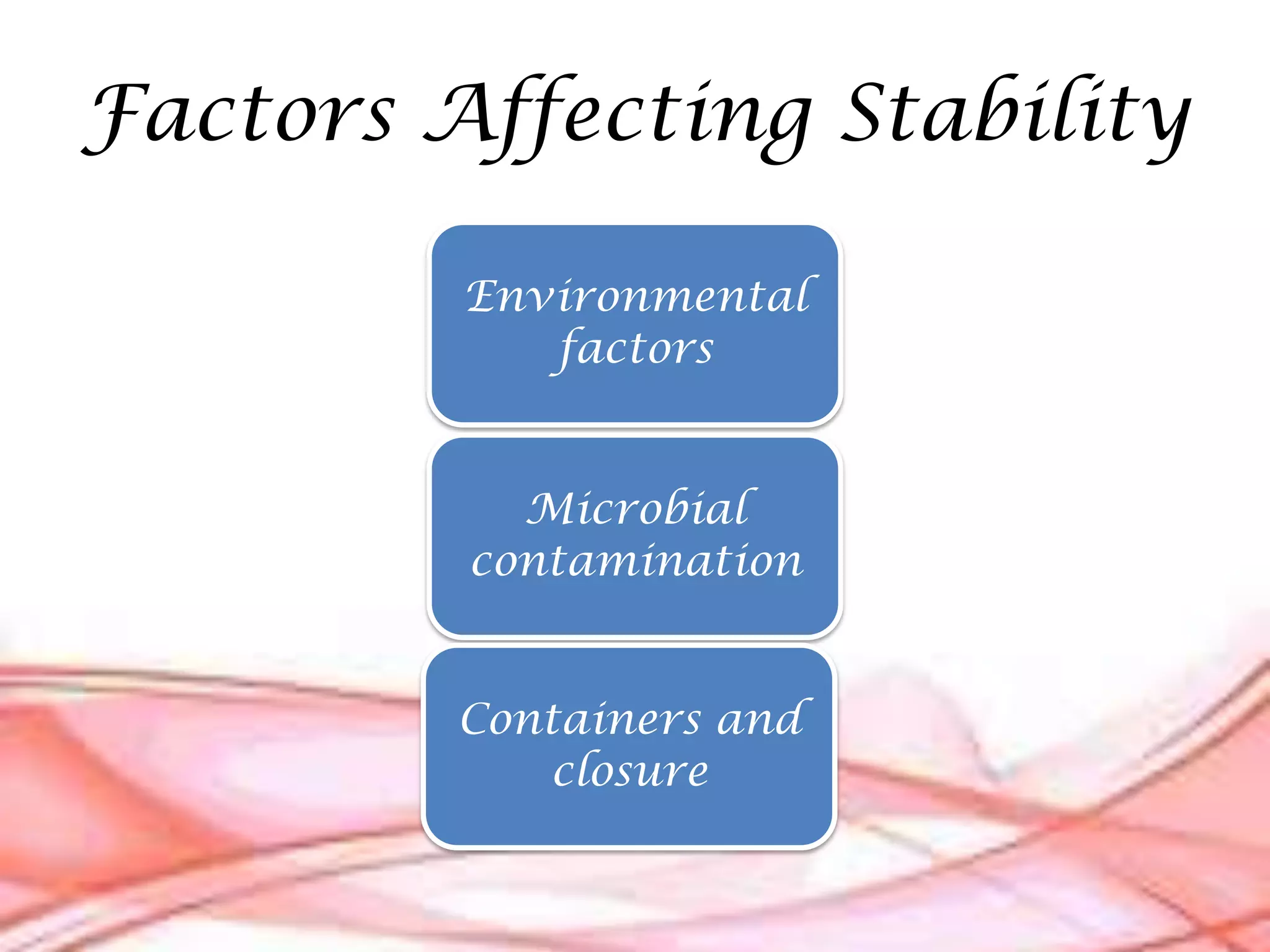
Factors Affecting Stability
Environmental
factors
Microbial
contamination
Containers and
closure
Environmental factors
Temperature

light

Moisture
Temperature
 3 types of storage temperatures
1.room temperature
2.cold temperature
3.Freeze storage
1.Room temperature:
 Upto 30/25o c
2.Cold temperature/Refrigerator storage:
 Upto 2-8o c
3.Freeze storage:
 Storage between -20 to -10o c
Light(photolysis)
 the shorter the wavelength more the energy is
absorbed per mole
It means: decomposition by light

 Various sources of light are sunlight, metal
halide lamps, fluorescent lamps, or other indoor
lighting sources.
 These reactions can be induced by exposure to
photolysis sources emitting in the 290–800 nm
region.
 Relationship between wavelength and

associated energy of various forms of light.
Type of
Wavelength
radiation:
board outers
U.V.
Visible

I.r.

Energy
Kcal mol-1

50 – 400
400 – 750

750 – 10,000

287 – 72
36 - 1
Photolysis is prevented by:
 Suitable packing in amber couloured bottles
 Card board outers
 Aluminum foil wrappers

MOISTURE
 It enhances the hydrolytic degradation
 Packing materials such as Glass and Plastic are
usually chosen to prevent exposure of drug
product to high humid conditions
Microbial Instability
Sources of microbial contamination

Water

gram-negative groups:
Pseudomonas,
Xanthamonas,
Flavobacterium

Air

Mould spores: Penicillium,
Aspergillus
Bacterial spores: Bacillus
spp. Yeasts

Raw materials
Starches
Pigments

Micrococci
Coliforms
Salmonella
Sources of Microbial
Contamination
Gums
Animal products

Actinomyces
Salmonella, Coliforms

Personnel

Coliforms,
Staphylococci,
Sterptococci
Packaging And Stability
1.Glass
 Glass is resistant to chemical and
physical change and is the most commonly used
material.
Limitations
1. Its alkaline surface

Overcome
use of Borosilicate glass

2. Ions may precipitate
the use of buffers
insoluble crystals from the
glass
3- Permits the transmission
of light which may
accelerate decomposition.

Amber coloured glass
Packing and Stability
2.PLASTICS
The problems with plastic are:
 Migration of the drug through the plastic into the
environment.

 Transfer of environmental moisture, oxygen, and
other elements into the pharmaceutical product.
 Leaching of container ingredients into the drug.

 Adsorption of the active drug or
excipients by the plastic.
Packing and Stability
3.Metals
 Various alloys and aluminum tubes may be utilized
as containers for emulsions, ointments, creams and
pastes.

 Limitation:

They

may

cause

corrosion

and

precipitation in the drug product.
 Overcome: Coating the tubes with polymers may
reduce these tendencies.
Packing and Stability
Rubber

 Rubber also has the problems of extraction of drug
ingredients and leaching of container ingredients.

 The

pretreatment

of

rubber

vial

stoppers

and

closures with water and steam reduces potential

leaching.
Types of degradations

Chemical

Physical

Biological
Chemical Degradation
1- Hydrolysis:
Hydrolysis means “splitting by water’’
Some functional groups subject
to Hydrolysis
Drug type

Examples

Esters

Aspirin, alkaloids
Dexmethasne sodium phosphate
Nitroglycerin

Lactones

Pilocarpine
Spironolactone

Amides

Chloramphenicol

Imides

Glutethimide

Malonic ureas

Barbiturates
Chemical Stability
2- Oxidation
Oxidation of inorganic and organic
compounds is explained by a loss of
electrons and the loss of a molecule of
hydrogen.

3-Photolysis
Physical Stability
Physical stability implies that:
 The formulation is totally unchanged throughout its
shelf life and has not suffered any changes by way of
appearance,

organoleptic

brittleness, particle size etc.
 It is significant as it affects:
1.pharmaceutical elegance
2.drug content uniformity
3.drug release rate.

properties,

hardness,
Physical Stability
Formulation

Likely physical
instability problems

Oral solutions 1- Loss of flavor
2- Change in taste
3- Presence of off
flavors due to
interaction with
plastic bottle
4- Loss of dye
5- Precipitation
6- discoloration

Effects
Change in
smell or feel
or taste
Formulation

Parenteral
solutions

Likely physical
instability
problems
1. Discoloration due to
photo chemical
reaction or
oxidation
2. Presence of
precipitate due to
interaction with
container or
stopper
3. Presence of
“whiskers”
4. Clouds due to:

(i) Chemical changes
(ii) The original
preparation of a
supersaturated

Effects

Change in
appearance and in
bio-availability
Physical stability
Formulation

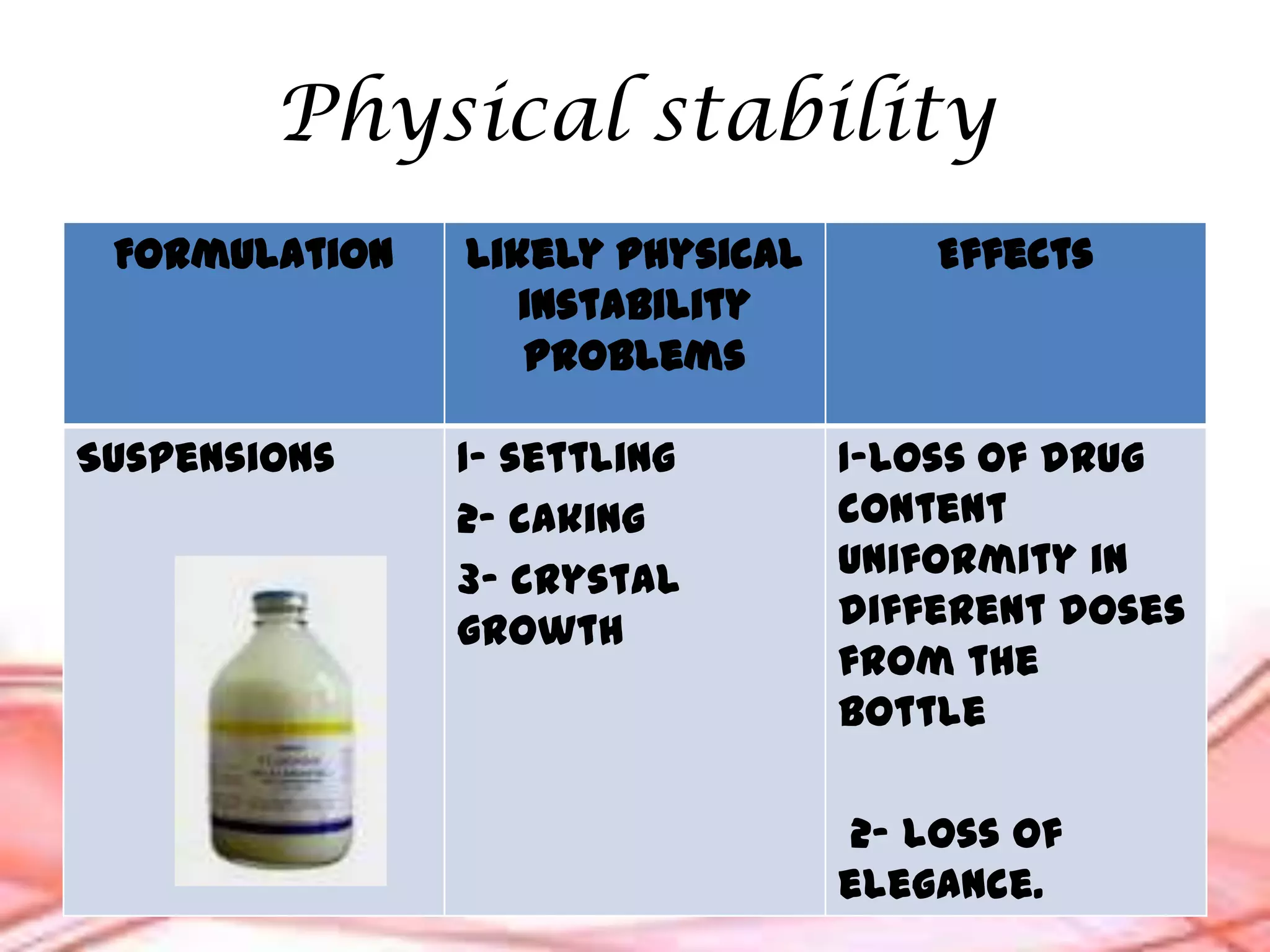
Suspensions

Likely physical
instability
problems
1- settling
2- caking
3- crystal
growth

Effects

1-Loss of drug
content
uniformity in
different doses
from the
bottle

2- loss of
elegance.
Physical stability
Formulation

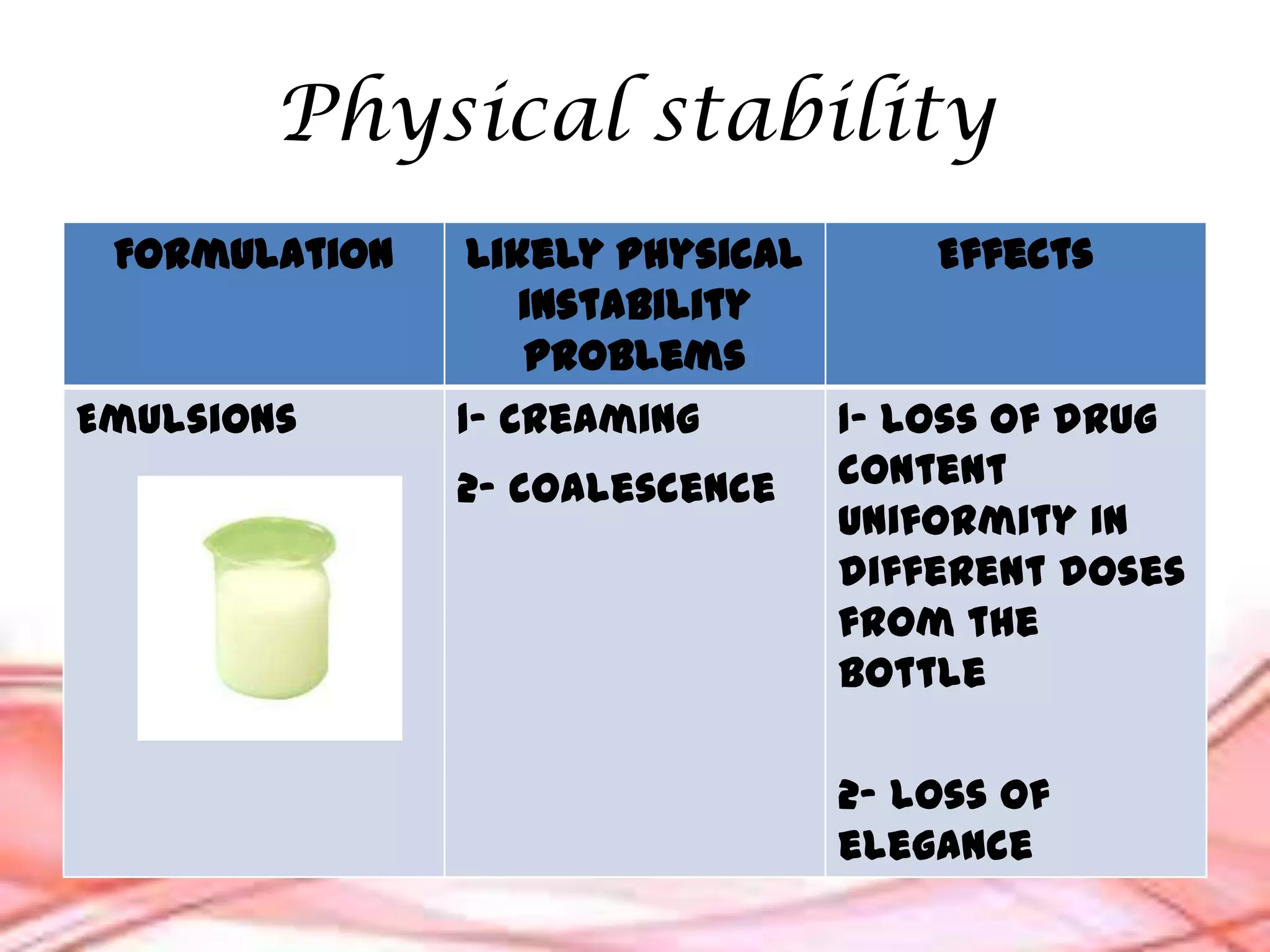
Emulsions

Likely physical
Effects
instability
problems
1- Creaming
1- Loss of drug
2- coalescence content
uniformity in
different doses
from the
bottle
2- loss of
elegance
Physical stability
Physical stability
Formulation

Semisolids
(Ointments and
suppositories)

Likely physical
Effects
instability
problems
1. Changes in:
1-Loss of drug
a) Particle size content
uniformity
b) Consistency
2. Caking or
coalescence

2- loss of
elegance

3. Bleeding

3-change in
drug release
rate.
Physical stability
Formulation

Tablets

Likely physical
instability
problems

Effects

Change in:
Change in
drug release
a) Disintegration
time
b) Dissolution
profile
c) Hardness
d) Appearance (soft
and ugly or
become very
hard)
Physical stability
Formulation

Capsules

Likely physical
instability
problems
Change in:
a) Appearance
b) Dissolution
c) Strength

Effects

Change in drug
release
Types of Stability Studies
1.Long-Term (Real-Time) Stability Testing

 Stability evaluation of the physical, chemical,
biological and microbiological characteristics of
a drug product

 duration of the shelf life
Accelerated stability Testing
 Studies designed to increase the rate of chemical
degradation or physical change(s) of a drug product

by using exaggerated storage conditions with the
purpose of monitoring degradation reactions.
 To evaluate the impact of short term excursions and
predicting

the

shelf-life

under

normal

storage

studies may

include

conditions.
 The design

of

accelerated

elevated temperature, high humidity and intense
light.
Methods Of Accelerated
Stability Testing In Dosage
forms
 Freeze Thaw test

 Centrifugal Test
 Shaking test
 Elevated Temperature test
Temperature and humidity
control
General storage conditions
study

Storage Conditions

Minimum Time Period
at Submission

Long term

25 ± 2°C / 60% RH ± 5%
Zone I,II.
30 ± 2°C / 35% RH ± 5%
Zone III.
30 ± 2°C / 60% RH ± 5%
Zone IV.

6 Months
6 Months
6 Months

Intermediate

30 ± 2°C / 60% RH ± 5%

6 Months

Accelerated

40 ± 2°C / 75 % RH ± 5%

6 Months
Products packed in semipermeable containers.
Study

Storage Conditions

Minimum Time Period
at Submission

Long term

25 ± 2°C / 40% RH ± 5%
zone I,II

6 Months

Long term

30 ± 2 ºC/ 60% RH ± 5%
zone III,IV

6 Months

Intermediate

30 ± 2°C / 60% RH ± 5%

6 Months

Accelerated

40 ± 2°C / NMT 25% RH

6 Months
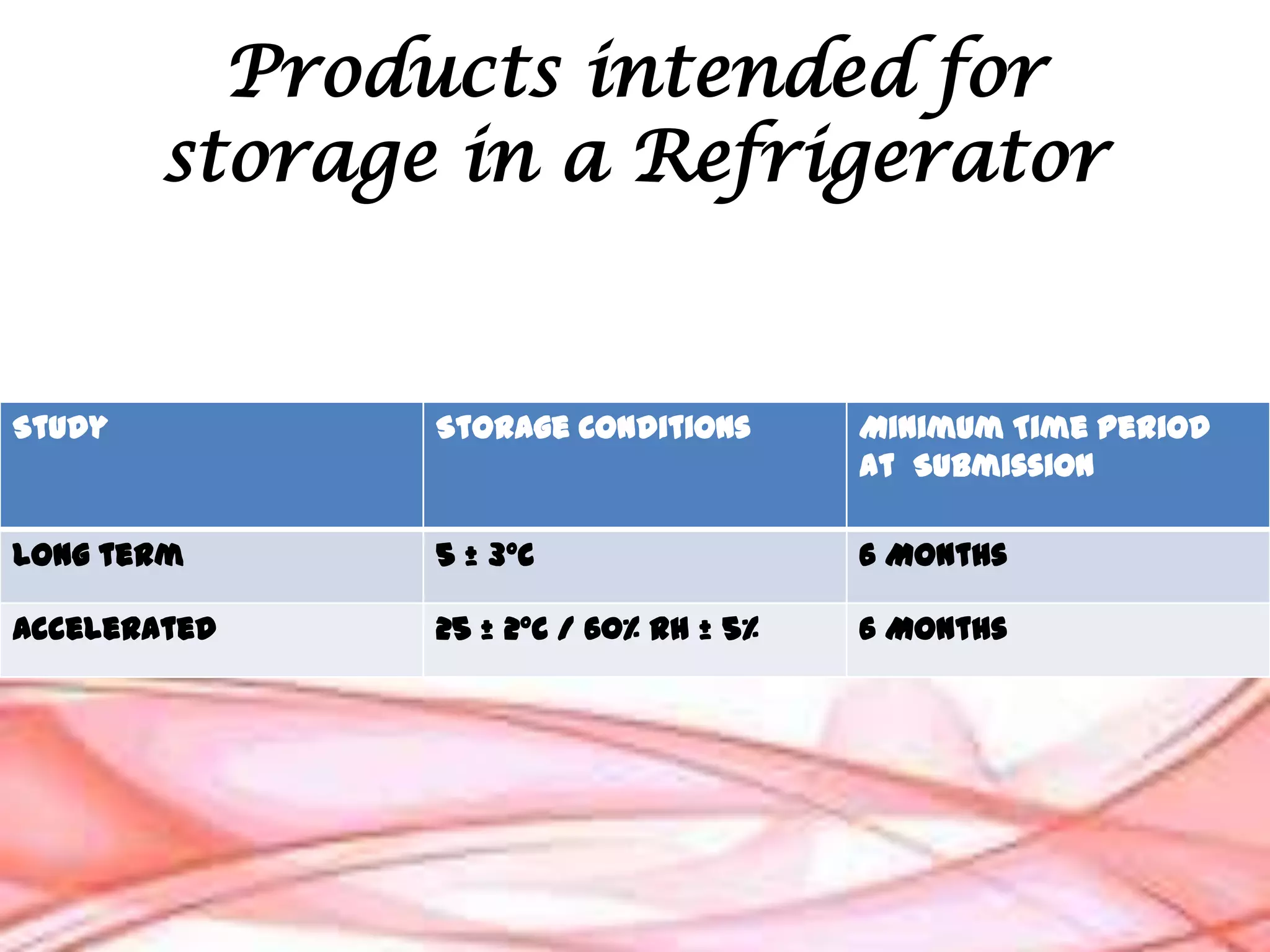
Products intended for
storage in a Refrigerator

Study

Storage Conditions

Minimum Time Period
at Submission

Long term

5 ± 3°C

6 Months

Accelerated

25 ± 2°C / 60% RH ± 5%

6 Months
Products intended for
storage in a freezer
Study

Storage Conditions

Minimum Time Period
at Submission

Long term

-20 ± 5°C

12 Months
Drug stability

Drug stability

  • 1.
    Drug stability Under theguidance of RAMESH BABU.J M.Pharm,Sr.assiatant professor By WILWIN
  • 2.
    CONTENTS 1) Definition 2) Adverseeffects of drug instability 3) Factors affecting drug stability 4) Types of drug degradation 5) Types of stability studies 6) Methods of accelerated stability testing in dosage forms 7) Temperature and humidity control
  • 3.
    Drug stabilty:It isthe capacity of a drug product to remain with in specifications established to ensure its identity ,strength ,quality and purity. Adverse effects of instability of drugs  Loss of active drug (e.g. aspirin hydrolysis, oxidation of adrenaline).  Loss of vehicle (e.g. evaporation of water from o/w creams, evaporation of alcohol from alcoholic mixtures).  Loss of content uniformity (e.g. creaming of emulsions, impaction of suspensions).  Loss of elegance (e.g. fading of tablets and coloured solutions).  Reduction in bioavailability (e.g. ageing of tablets resulting in a change in dissolution profile).  Production of potential toxic materials (e.g. breakdown products from drug degradation).
  • 4.
  • 5.
  • 6.
    Temperature  3 typesof storage temperatures 1.room temperature 2.cold temperature 3.Freeze storage 1.Room temperature:  Upto 30/25o c 2.Cold temperature/Refrigerator storage:  Upto 2-8o c 3.Freeze storage:  Storage between -20 to -10o c
  • 7.
    Light(photolysis)  the shorterthe wavelength more the energy is absorbed per mole It means: decomposition by light  Various sources of light are sunlight, metal halide lamps, fluorescent lamps, or other indoor lighting sources.  These reactions can be induced by exposure to photolysis sources emitting in the 290–800 nm region.
  • 8.
     Relationship betweenwavelength and associated energy of various forms of light. Type of Wavelength radiation: board outers U.V. Visible I.r. Energy Kcal mol-1 50 – 400 400 – 750 750 – 10,000 287 – 72 36 - 1
  • 9.
    Photolysis is preventedby:  Suitable packing in amber couloured bottles  Card board outers  Aluminum foil wrappers MOISTURE  It enhances the hydrolytic degradation  Packing materials such as Glass and Plastic are usually chosen to prevent exposure of drug product to high humid conditions
  • 10.
    Microbial Instability Sources ofmicrobial contamination Water gram-negative groups: Pseudomonas, Xanthamonas, Flavobacterium Air Mould spores: Penicillium, Aspergillus Bacterial spores: Bacillus spp. Yeasts Raw materials Starches Pigments Micrococci Coliforms Salmonella
  • 11.
    Sources of Microbial Contamination Gums Animalproducts Actinomyces Salmonella, Coliforms Personnel Coliforms, Staphylococci, Sterptococci
  • 12.
    Packaging And Stability 1.Glass Glass is resistant to chemical and physical change and is the most commonly used material. Limitations 1. Its alkaline surface Overcome use of Borosilicate glass 2. Ions may precipitate the use of buffers insoluble crystals from the glass 3- Permits the transmission of light which may accelerate decomposition. Amber coloured glass
  • 13.
    Packing and Stability 2.PLASTICS Theproblems with plastic are:  Migration of the drug through the plastic into the environment.  Transfer of environmental moisture, oxygen, and other elements into the pharmaceutical product.  Leaching of container ingredients into the drug.  Adsorption of the active drug or excipients by the plastic.
  • 14.
    Packing and Stability 3.Metals Various alloys and aluminum tubes may be utilized as containers for emulsions, ointments, creams and pastes.  Limitation: They may cause corrosion and precipitation in the drug product.  Overcome: Coating the tubes with polymers may reduce these tendencies.
  • 15.
    Packing and Stability Rubber Rubber also has the problems of extraction of drug ingredients and leaching of container ingredients.  The pretreatment of rubber vial stoppers and closures with water and steam reduces potential leaching.
  • 16.
  • 17.
    Chemical Degradation 1- Hydrolysis: Hydrolysismeans “splitting by water’’
  • 18.
    Some functional groupssubject to Hydrolysis Drug type Examples Esters Aspirin, alkaloids Dexmethasne sodium phosphate Nitroglycerin Lactones Pilocarpine Spironolactone Amides Chloramphenicol Imides Glutethimide Malonic ureas Barbiturates
  • 19.
    Chemical Stability 2- Oxidation Oxidationof inorganic and organic compounds is explained by a loss of electrons and the loss of a molecule of hydrogen. 3-Photolysis
  • 20.
    Physical Stability Physical stabilityimplies that:  The formulation is totally unchanged throughout its shelf life and has not suffered any changes by way of appearance, organoleptic brittleness, particle size etc.  It is significant as it affects: 1.pharmaceutical elegance 2.drug content uniformity 3.drug release rate. properties, hardness,
  • 21.
    Physical Stability Formulation Likely physical instabilityproblems Oral solutions 1- Loss of flavor 2- Change in taste 3- Presence of off flavors due to interaction with plastic bottle 4- Loss of dye 5- Precipitation 6- discoloration Effects Change in smell or feel or taste
  • 22.
    Formulation Parenteral solutions Likely physical instability problems 1. Discolorationdue to photo chemical reaction or oxidation 2. Presence of precipitate due to interaction with container or stopper 3. Presence of “whiskers” 4. Clouds due to: (i) Chemical changes (ii) The original preparation of a supersaturated Effects Change in appearance and in bio-availability
  • 23.
    Physical stability Formulation Suspensions Likely physical instability problems 1-settling 2- caking 3- crystal growth Effects 1-Loss of drug content uniformity in different doses from the bottle 2- loss of elegance.
  • 24.
    Physical stability Formulation Emulsions Likely physical Effects instability problems 1-Creaming 1- Loss of drug 2- coalescence content uniformity in different doses from the bottle 2- loss of elegance
  • 25.
  • 26.
    Physical stability Formulation Semisolids (Ointments and suppositories) Likelyphysical Effects instability problems 1. Changes in: 1-Loss of drug a) Particle size content uniformity b) Consistency 2. Caking or coalescence 2- loss of elegance 3. Bleeding 3-change in drug release rate.
  • 27.
    Physical stability Formulation Tablets Likely physical instability problems Effects Changein: Change in drug release a) Disintegration time b) Dissolution profile c) Hardness d) Appearance (soft and ugly or become very hard)
  • 28.
    Physical stability Formulation Capsules Likely physical instability problems Changein: a) Appearance b) Dissolution c) Strength Effects Change in drug release
  • 29.
    Types of StabilityStudies 1.Long-Term (Real-Time) Stability Testing  Stability evaluation of the physical, chemical, biological and microbiological characteristics of a drug product  duration of the shelf life
  • 30.
    Accelerated stability Testing Studies designed to increase the rate of chemical degradation or physical change(s) of a drug product by using exaggerated storage conditions with the purpose of monitoring degradation reactions.  To evaluate the impact of short term excursions and predicting the shelf-life under normal storage studies may include conditions.  The design of accelerated elevated temperature, high humidity and intense light.
  • 31.
    Methods Of Accelerated StabilityTesting In Dosage forms  Freeze Thaw test  Centrifugal Test  Shaking test  Elevated Temperature test
  • 32.
    Temperature and humidity control Generalstorage conditions study Storage Conditions Minimum Time Period at Submission Long term 25 ± 2°C / 60% RH ± 5% Zone I,II. 30 ± 2°C / 35% RH ± 5% Zone III. 30 ± 2°C / 60% RH ± 5% Zone IV. 6 Months 6 Months 6 Months Intermediate 30 ± 2°C / 60% RH ± 5% 6 Months Accelerated 40 ± 2°C / 75 % RH ± 5% 6 Months
  • 33.
    Products packed insemipermeable containers. Study Storage Conditions Minimum Time Period at Submission Long term 25 ± 2°C / 40% RH ± 5% zone I,II 6 Months Long term 30 ± 2 ºC/ 60% RH ± 5% zone III,IV 6 Months Intermediate 30 ± 2°C / 60% RH ± 5% 6 Months Accelerated 40 ± 2°C / NMT 25% RH 6 Months
  • 34.
    Products intended for storagein a Refrigerator Study Storage Conditions Minimum Time Period at Submission Long term 5 ± 3°C 6 Months Accelerated 25 ± 2°C / 60% RH ± 5% 6 Months
  • 35.
    Products intended for storagein a freezer Study Storage Conditions Minimum Time Period at Submission Long term -20 ± 5°C 12 Months