SOLUBILITY
and its
DETERMINATION
Prepared By:
Aman Dhamrait Pantlia
SOLUBILITY
o The solubility of a substance refers to the
amount of substance that passes into solution
to achieve a saturated solution at constant
temperature and pressure.
o Solubility= Maximum volume/mass of thesolute
volume of a solvent
2
SOLUBILITY
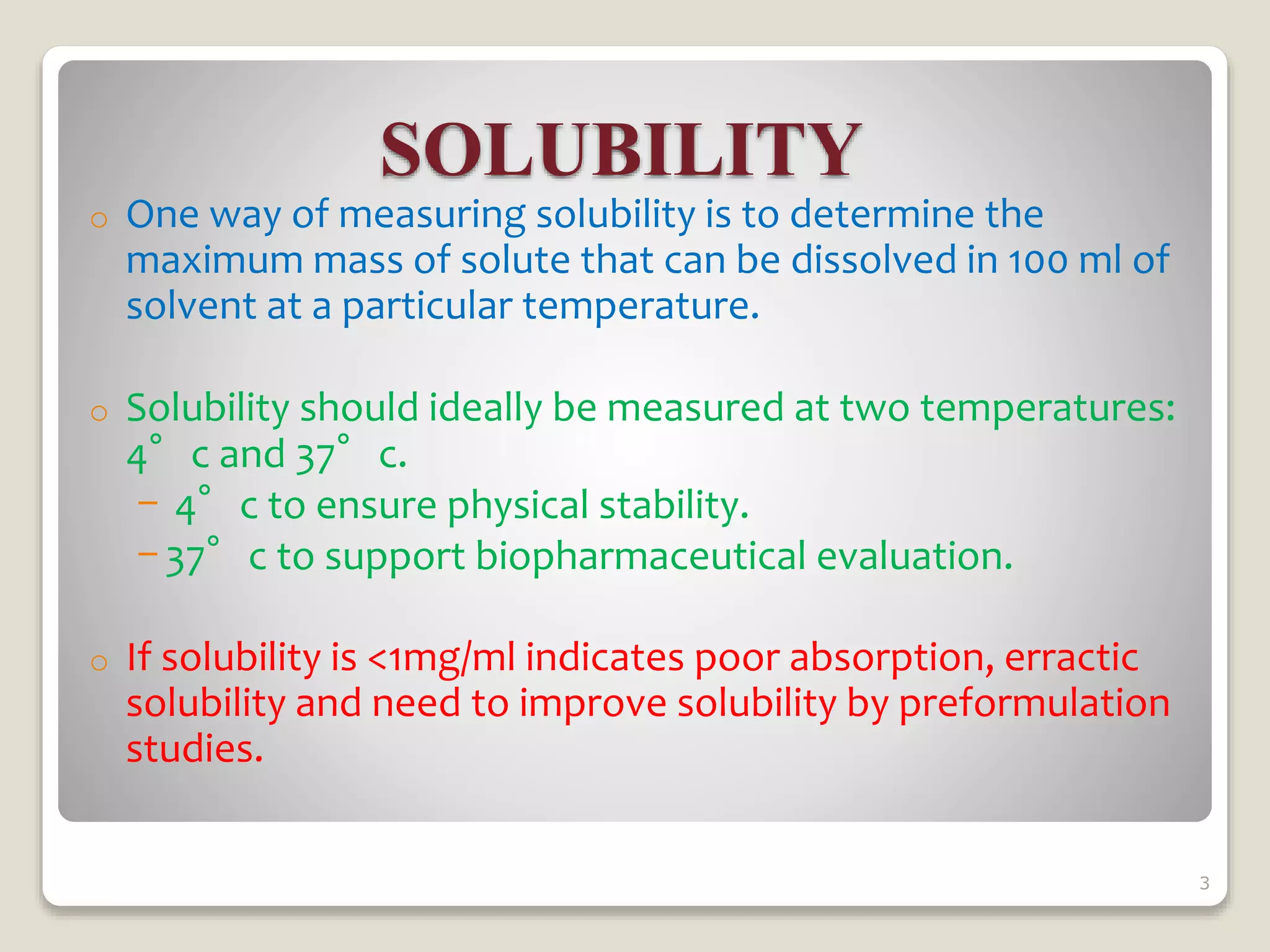
o One way of measuring solubility is to determine the
maximum mass of solute that can be dissolved in 100 ml of
solvent at a particular temperature.
o Solubility should ideally be measured at two temperatures:
4°c and 37°c.
- 4°c to ensure physical stability.
- 37°c to support biopharmaceutical evaluation.
o If solubility is <1mg/ml indicates poor absorption, erractic
solubility and need to improve solubility by preformulation
studies.
3
Reasons for Determining Solubility
o During recent years, considerable change in the
solubility of pharmaceutical R&D compounds and
drugs towards lower solubility.
o Clearly a trend towards higher percentages falling
into BCS class II (high permeability, low solubility)
and IV (low permeability, low solubility) is observed
o Solubilites of a drug represent the Bioavailability of
the drug.
o For efficient drug delivery
4
Types of SOLUBILITY
oQuantitative Solubility
oQualitative Solubility
5
SOLUBILITY
o Thermodynamic Solubility
o Kinetic solubility
6
USP & IP Solubility
Criteria
7
Description Parts of solvent required for one
part of solute
Very soluble < 1
Freely soluble 1 - 10
Soluble 10 - 30
Sparingly soluble 30 - 100
Slightly soluble 100 - 1000
Very slightly soluble 1000 - 10,000
Insoluble > 10,000
Biopharmaceutics Classification
system
8
Solubility Studies include
o Intrinsic Solubility
o pH solubility Profiling
o Solubility in Pharmaceutical solvent
o Effects of Surfactants
9
Intrinsic Solubility
Intrinsic solubility is the equilibrium solubility of the free acid
or free base form of an ionisable compound at a pH where it is
fully un-ionised. Equilibrium solubility is the concentration of
compound in a saturated solution when excess solid is present,
and solution and solid are at equilibrium.
10
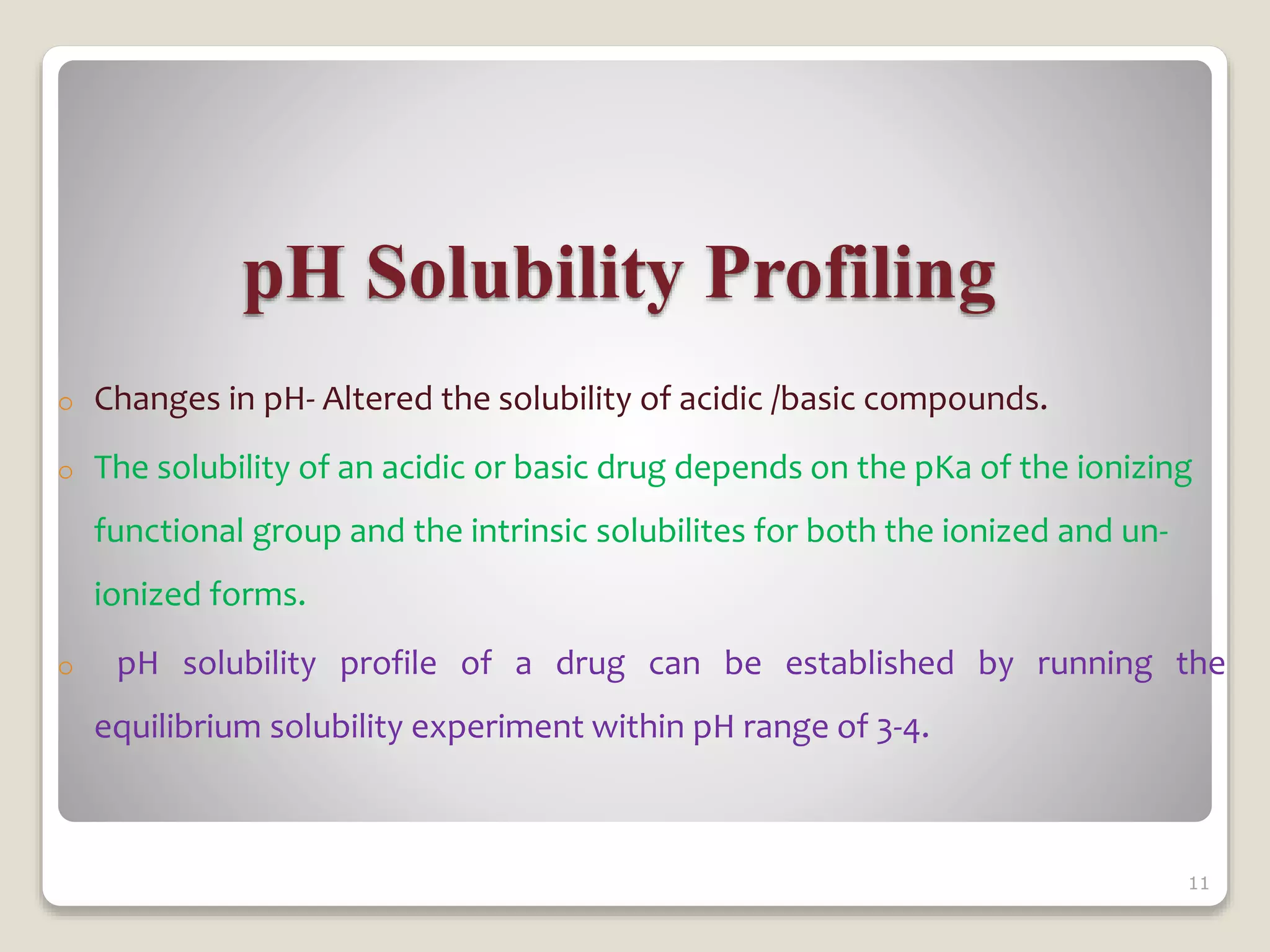
pH Solubility Profiling
o Changes in pH- Altered the solubility of acidic /basic compounds.
o The solubility of an acidic or basic drug depends on the pKa of the ionizing
functional group and the intrinsic solubilites for both the ionized and un-
ionized forms.
o pH solubility profile of a drug can be established by running the
equilibrium solubility experiment within pH range of 3-4.
11
Solubility in Pharmaceutical
solvents
o To enhance the solubility of Pharmaceutical products, add Co-solvents
e.g. ethanol, methanol
o By adding surfactants
12
Effect of Surfactants
o Surfactants are wetting agents that lower the surface tension of a
liquid, allowing easier spreading, and lower the interfacial tension
between two liquids.
o Surfactants are of two types:
Ionic Surfactnats:
− Cationic: e.g. Cetyl Trimethyl Ammonium Bromide ,Hexadecyl
Trimethyl Ammonium Bromide, and other Alkyltrimethyl Ammonium
Salts, Cetylpyridinium Chloride
− Anionic: e.g. Sodium Dodecyl Sulphate , Ammonium Lauryl Sulphate
and other alkyl sulfate salts, Sodium Lauryl Sulphate, also known as
Sodium Lauryl Ether Sulphate (SLES).
− Zwitterionic: e.g. Phospholipids, phosphatidylethanolamine,
phosphatidylcholine
13
Effect of Surfactants
o Non-Ionic Surfactants:
− water soluble: e.g. Long chain fatty acids, fatty alcohols
− water insoluble: e.g. spans
14
Solubility Analysis
o Preformulation solubility studies focus on drug
solvent system that could occur during the
delivery of drug candidate.
o For e.g. A drug for oral administration should be
examined for solubility in media having isotonic
chloride ion concentration and acidic pH.
15
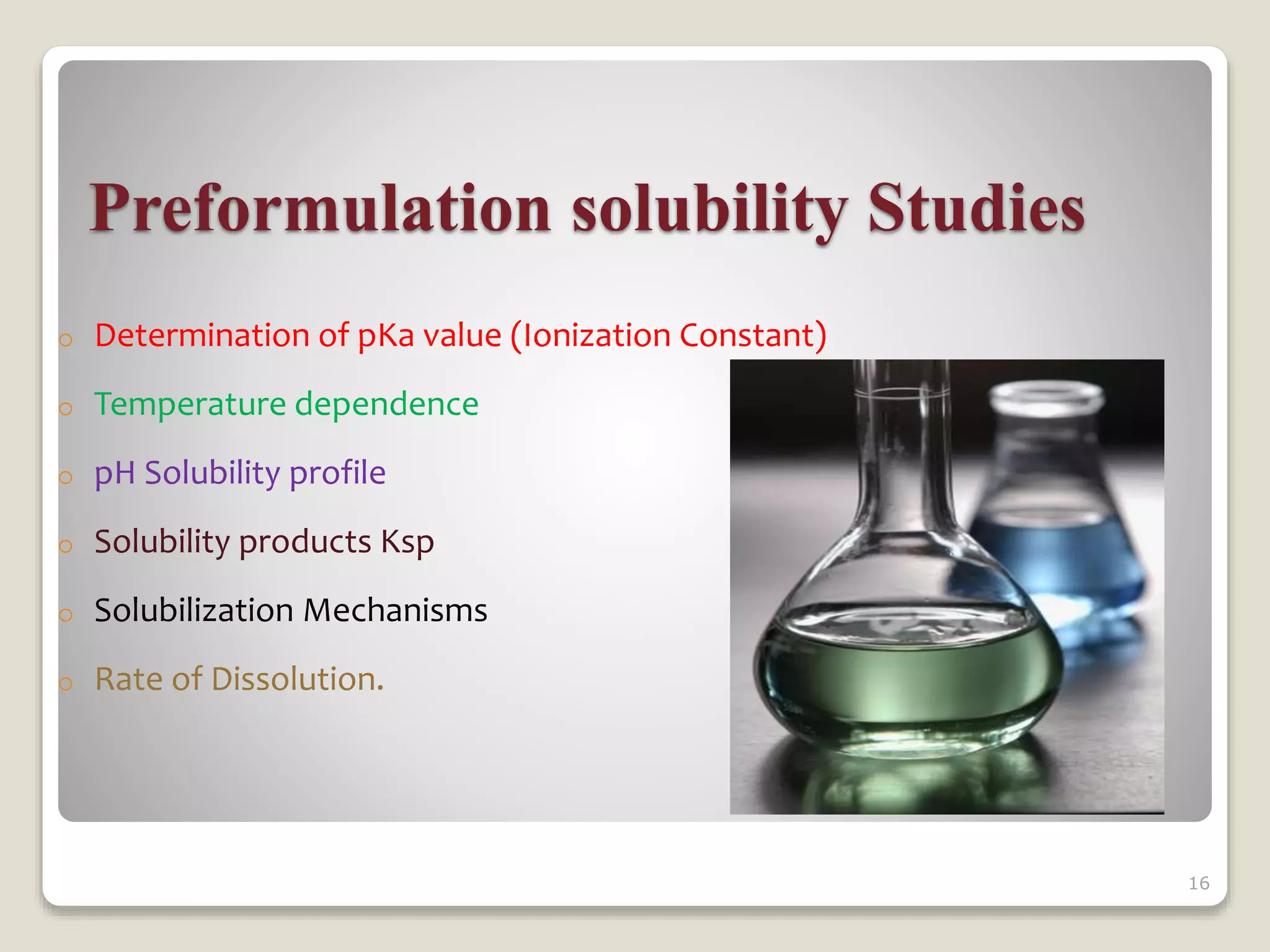
Preformulation solubility Studies
o Determination of pKa value (Ionization Constant)
o Temperature dependence
o pH Solubility profile
o Solubility products Ksp
o Solubilization Mechanisms
o Rate of Dissolution.
16
PKA Determination
Determination of the dissociation constant (pKa) for a drug
capable of ionization with in a pH range of 1 to 10 is
important, since solubility and absorption, can be altered
by orders of magnitude with changing pH.
o Determination of pKa value by Ultraviolet
spectroscopy
o By Potentiometric Titrations
17
pKa Determination
Can be calculated by Henderson Hasselbalch equation-
18
For basic drugs….pH= pKa+ log [unionized drug]
[ionized drug}
For acidic drugs….pH= pKa+ log [ionized drug]
[unionized drug}
Effect of temperature
o The heat of solution Hs, represents the heat
released or absorbed when a mole of solute is
dissolved in large quantity of solvent.
− Endothermic reaction
− Exothermic reaction
19
Solublization
o “Solubilization is defined as the spontaneous passage of poorly water
soluble solute molecules into an aqueous solution of a surfactants in
which a thermodynamically stable solution is formed ”.
o It is the process by which apparent solubility of an otherwise sparingly
soluble substance is increased by the presence of surfactant micelles .
o Solubilization of any material in any solvent depends on proper
selection of solubilising agents.
20
Partition Coefficient
o It is the ratio of unionized drug distributed between organic and
aqueous phase at equilibrium.
21
P o/w = ( C oil / C water )equilibrium
Dissolution
The dissolution rate of a drug substance in which surface
area is constant during dissolution is described by the
Noyes-Whitney equation:
22
dc = k (Cs-C)
dt
Determination of Solubilities
The following points should be considered:
o The solvent & solute must be pure.
o A saturated solution must be obtained before any solution is removed
for analysis.
o The method of separating a sample of saturated solution from
undissolved solute must be satisfactory.
o The method of analyzing solution must be reliable
o Temperature must be adequately controlled .
23
Method to determine solubility
Shake Flask Method
Advantages
o Most accurate method
o Accurate for broadest range of solutes
Disadvantages
o Time consuming (>30 min /sample)
o Difficult to detect small amount of undissolved solute
o Large amount of material is required
24
Methods to determine solubility
o Miniaturized shake-flask method
o Semi-automated Potentiometric acid/base titrations
o A computational screening model
o Miniature device
25
Analytical Methods for Solubility
Measurements
o HPLC ( High Performance Liquid Chromatography)
o UV (ultraviolet Spectroscopy)
o Fluorescence Spectroscopy
o Gas Chromatography
26
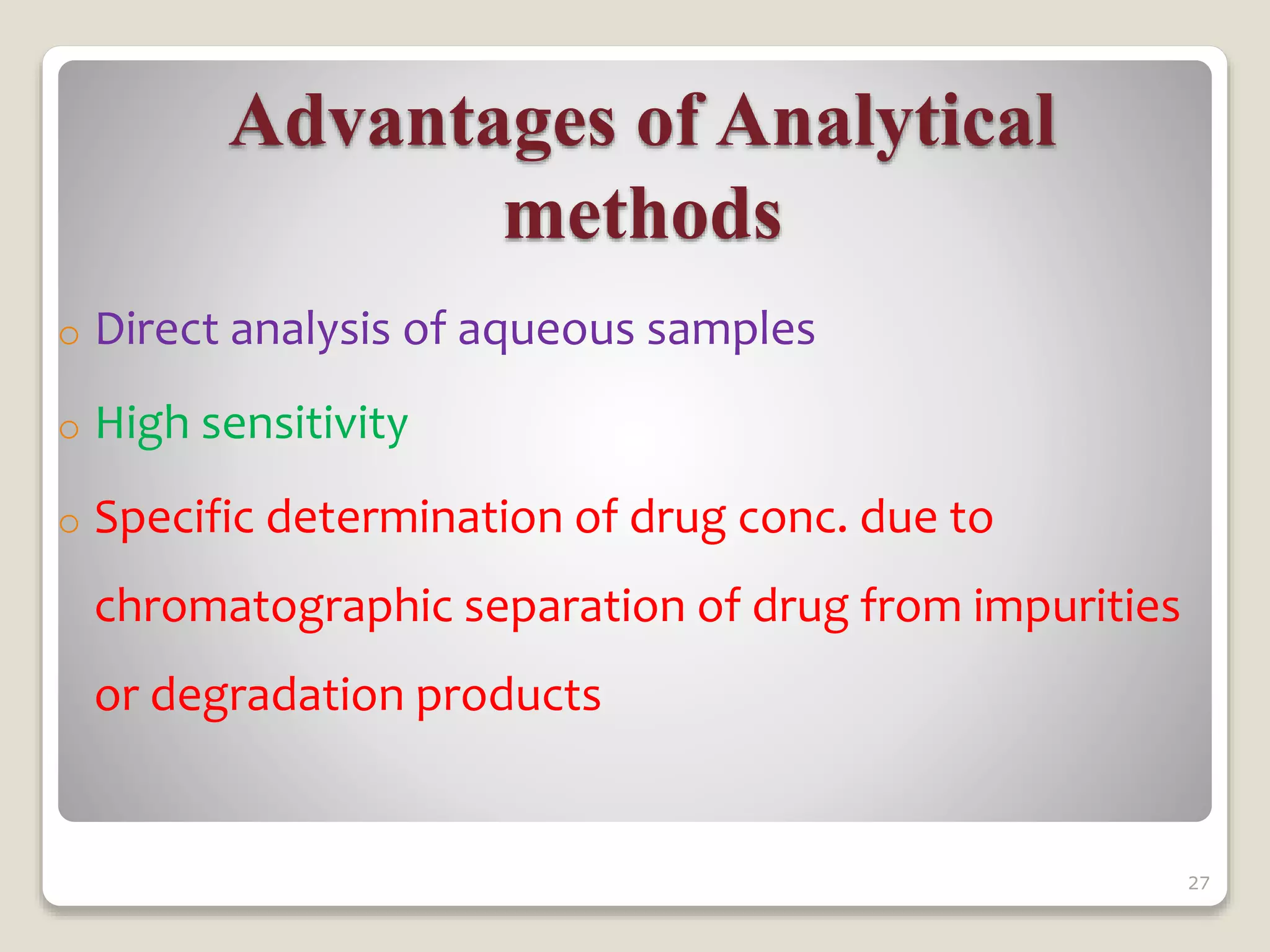
Advantages of Analytical
methods
o Direct analysis of aqueous samples
o High sensitivity
o Specific determination of drug conc. due to
chromatographic separation of drug from impurities
or degradation products
27
28

Solubility and its determination

  • 1.
  • 2.
    SOLUBILITY o The solubilityof a substance refers to the amount of substance that passes into solution to achieve a saturated solution at constant temperature and pressure. o Solubility= Maximum volume/mass of thesolute volume of a solvent 2
  • 3.
    SOLUBILITY o One wayof measuring solubility is to determine the maximum mass of solute that can be dissolved in 100 ml of solvent at a particular temperature. o Solubility should ideally be measured at two temperatures: 4°c and 37°c. - 4°c to ensure physical stability. - 37°c to support biopharmaceutical evaluation. o If solubility is <1mg/ml indicates poor absorption, erractic solubility and need to improve solubility by preformulation studies. 3
  • 4.
    Reasons for DeterminingSolubility o During recent years, considerable change in the solubility of pharmaceutical R&D compounds and drugs towards lower solubility. o Clearly a trend towards higher percentages falling into BCS class II (high permeability, low solubility) and IV (low permeability, low solubility) is observed o Solubilites of a drug represent the Bioavailability of the drug. o For efficient drug delivery 4
  • 5.
    Types of SOLUBILITY oQuantitativeSolubility oQualitative Solubility 5
  • 6.
  • 7.
    USP & IPSolubility Criteria 7 Description Parts of solvent required for one part of solute Very soluble < 1 Freely soluble 1 - 10 Soluble 10 - 30 Sparingly soluble 30 - 100 Slightly soluble 100 - 1000 Very slightly soluble 1000 - 10,000 Insoluble > 10,000
  • 8.
  • 9.
    Solubility Studies include oIntrinsic Solubility o pH solubility Profiling o Solubility in Pharmaceutical solvent o Effects of Surfactants 9
  • 10.
    Intrinsic Solubility Intrinsic solubilityis the equilibrium solubility of the free acid or free base form of an ionisable compound at a pH where it is fully un-ionised. Equilibrium solubility is the concentration of compound in a saturated solution when excess solid is present, and solution and solid are at equilibrium. 10
  • 11.
    pH Solubility Profiling oChanges in pH- Altered the solubility of acidic /basic compounds. o The solubility of an acidic or basic drug depends on the pKa of the ionizing functional group and the intrinsic solubilites for both the ionized and un- ionized forms. o pH solubility profile of a drug can be established by running the equilibrium solubility experiment within pH range of 3-4. 11
  • 12.
    Solubility in Pharmaceutical solvents oTo enhance the solubility of Pharmaceutical products, add Co-solvents e.g. ethanol, methanol o By adding surfactants 12
  • 13.
    Effect of Surfactants oSurfactants are wetting agents that lower the surface tension of a liquid, allowing easier spreading, and lower the interfacial tension between two liquids. o Surfactants are of two types: Ionic Surfactnats: − Cationic: e.g. Cetyl Trimethyl Ammonium Bromide ,Hexadecyl Trimethyl Ammonium Bromide, and other Alkyltrimethyl Ammonium Salts, Cetylpyridinium Chloride − Anionic: e.g. Sodium Dodecyl Sulphate , Ammonium Lauryl Sulphate and other alkyl sulfate salts, Sodium Lauryl Sulphate, also known as Sodium Lauryl Ether Sulphate (SLES). − Zwitterionic: e.g. Phospholipids, phosphatidylethanolamine, phosphatidylcholine 13
  • 14.
    Effect of Surfactants oNon-Ionic Surfactants: − water soluble: e.g. Long chain fatty acids, fatty alcohols − water insoluble: e.g. spans 14
  • 15.
    Solubility Analysis o Preformulationsolubility studies focus on drug solvent system that could occur during the delivery of drug candidate. o For e.g. A drug for oral administration should be examined for solubility in media having isotonic chloride ion concentration and acidic pH. 15
  • 16.
    Preformulation solubility Studies oDetermination of pKa value (Ionization Constant) o Temperature dependence o pH Solubility profile o Solubility products Ksp o Solubilization Mechanisms o Rate of Dissolution. 16
  • 17.
    PKA Determination Determination ofthe dissociation constant (pKa) for a drug capable of ionization with in a pH range of 1 to 10 is important, since solubility and absorption, can be altered by orders of magnitude with changing pH. o Determination of pKa value by Ultraviolet spectroscopy o By Potentiometric Titrations 17
  • 18.
    pKa Determination Can becalculated by Henderson Hasselbalch equation- 18 For basic drugs….pH= pKa+ log [unionized drug] [ionized drug} For acidic drugs….pH= pKa+ log [ionized drug] [unionized drug}
  • 19.
    Effect of temperature oThe heat of solution Hs, represents the heat released or absorbed when a mole of solute is dissolved in large quantity of solvent. − Endothermic reaction − Exothermic reaction 19
  • 20.
    Solublization o “Solubilization isdefined as the spontaneous passage of poorly water soluble solute molecules into an aqueous solution of a surfactants in which a thermodynamically stable solution is formed ”. o It is the process by which apparent solubility of an otherwise sparingly soluble substance is increased by the presence of surfactant micelles . o Solubilization of any material in any solvent depends on proper selection of solubilising agents. 20
  • 21.
    Partition Coefficient o Itis the ratio of unionized drug distributed between organic and aqueous phase at equilibrium. 21 P o/w = ( C oil / C water )equilibrium
  • 22.
    Dissolution The dissolution rateof a drug substance in which surface area is constant during dissolution is described by the Noyes-Whitney equation: 22 dc = k (Cs-C) dt
  • 23.
    Determination of Solubilities Thefollowing points should be considered: o The solvent & solute must be pure. o A saturated solution must be obtained before any solution is removed for analysis. o The method of separating a sample of saturated solution from undissolved solute must be satisfactory. o The method of analyzing solution must be reliable o Temperature must be adequately controlled . 23
  • 24.
    Method to determinesolubility Shake Flask Method Advantages o Most accurate method o Accurate for broadest range of solutes Disadvantages o Time consuming (>30 min /sample) o Difficult to detect small amount of undissolved solute o Large amount of material is required 24
  • 25.
    Methods to determinesolubility o Miniaturized shake-flask method o Semi-automated Potentiometric acid/base titrations o A computational screening model o Miniature device 25
  • 26.
    Analytical Methods forSolubility Measurements o HPLC ( High Performance Liquid Chromatography) o UV (ultraviolet Spectroscopy) o Fluorescence Spectroscopy o Gas Chromatography 26
  • 27.
    Advantages of Analytical methods oDirect analysis of aqueous samples o High sensitivity o Specific determination of drug conc. due to chromatographic separation of drug from impurities or degradation products 27
  • 28.