

REMOTE SENSING IMAGE FUSION APPROACH
BASED ON
BROVEY AND WAVELETS TRANSFORMS
By
Reham Abd El whaba Gharbia, PhD Student
Nuclear Materials authority, Egypt
SRGE 20-5–2014 Cairo Egypt
Scientific Research Group in Egypt
www.egyptscience.net
Overview
 Introduction
 The Objective
 The Brovey Transform
 The Wavelet Transform
 The Proposed Image Fusion Approach
 Experimental Results
 Conclusion And Future Work
Introduction
 Remote sensing has
 a huge amount of data
 different spatial resolution for panchromatic and
multispectral imagery
 For the optimum benefit of these characteristics. It
should be collected in a single image.
 There is no single system offers spatial or multispectral
resolution at the same time.
Introduction
 Image fusion is used to combine multi-image information in
one image which is more suitable to human vision or more
adapt to further image processing analysis.
 Recently, image fusion has become one of the focuses in
image processing field
The Objective
 Introduces a remote sensing image fusion approach based
on a modified version of the Brovey transform and wavelets
to reduce the spectral distortion in the Brovey transform
and spatial distortion in the wavelet transform.
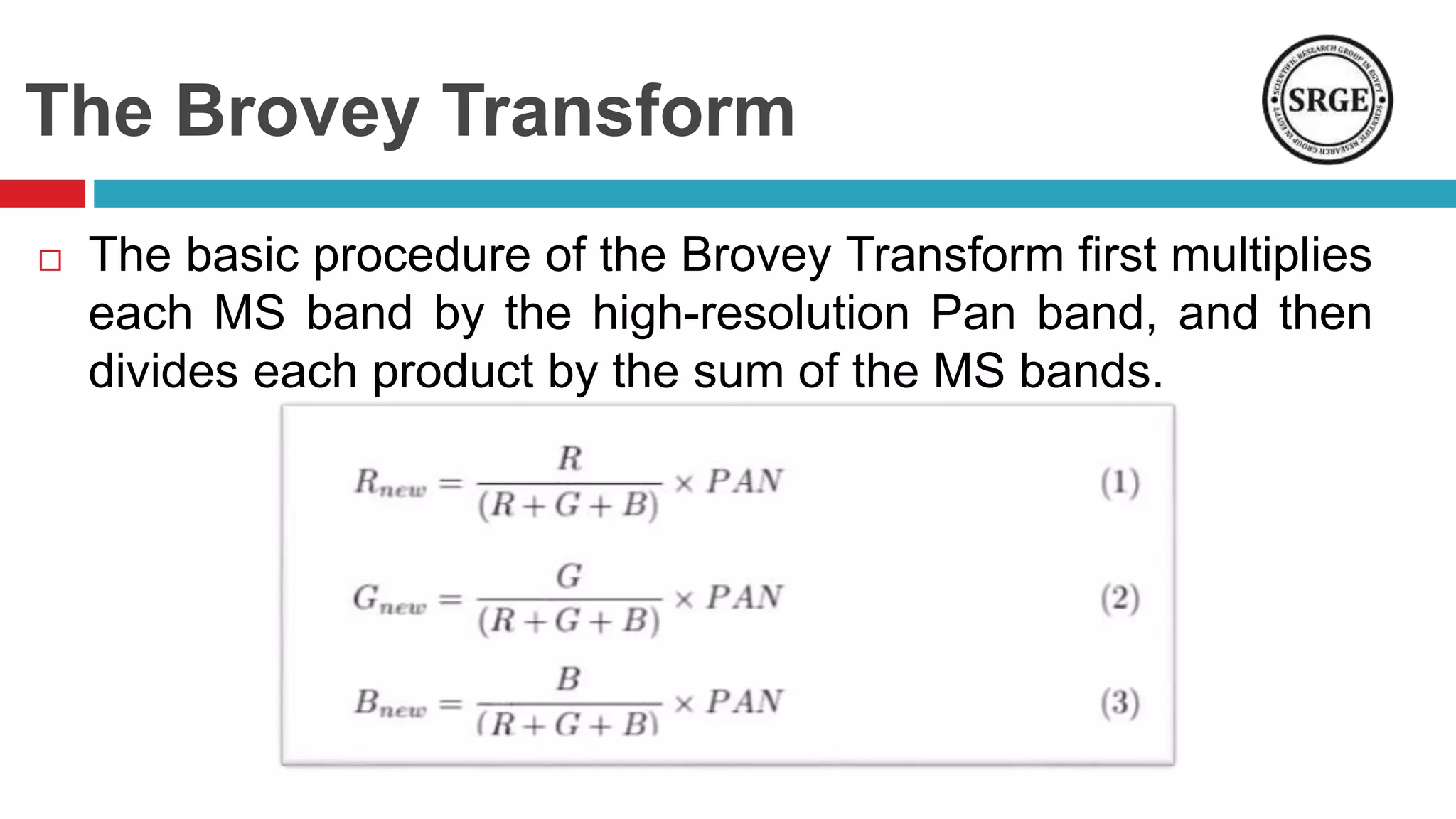
The Brovey Transform
 The basic procedure of the Brovey Transform first multiplies
each MS band by the high-resolution Pan band, and then
divides each product by the sum of the MS bands.
The Wavelet Transform
 wavelet image fusion
 decomposed the two input images separately into
approximate coefficients and detailed coefficients.
 high detailed coefficients of the multi-spectral image
are replaced with those of the pan image.
 The new wavelet coefficients of the multi-spectral
image are transformed with the inverse wavelet
transform to obtain the fusion multi-spectral image
The Proposed Image Fusion Approach
 Preprocessing stage
 Registration
 Upsampling
 Histogram matching
 Image fusion stage
The Proposed Image Fusion Approach
Fusion Algorithm
1: Apply the Brovey transform on the multispectral images (R, G, and B) and the panchromatic
image and produce new images (Rnew, Gnew and Bnew).
2: Decompose the high resolution image (i.e. Pan image) into into a set of low resolution
with the wavelet transform.
3: The wavelet transform with the same decomposition scale is applied to obtain the
Wavelet coefficients of the new image (Rnew, Gnew and Bnew).
4: Replace a low frequency of Pan image with low frequency of MS band at the level.
5:The Proposed wavelet coefficients fusion scheme is carried to reconstruct new image’s
wavelet
coefficients.
6: The reconstruct image wavelet coefficients.
7: The last output image is generated by applying inverse wavelet transform (IWT)
with reconstructed wavelet coefficients.
Experimental Results
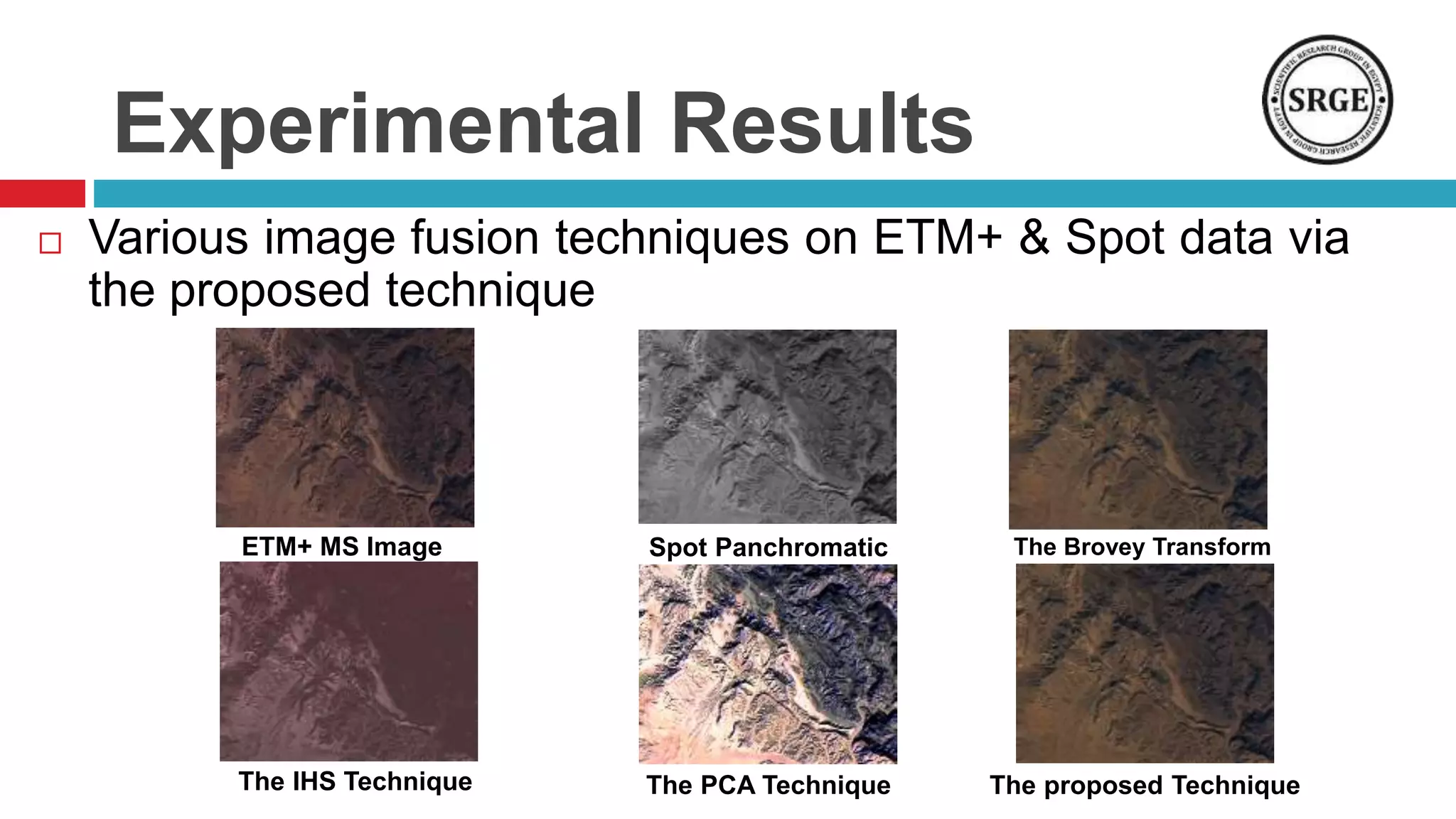
 Various image fusion techniques on MODIS & Spot data
via the proposed technique
MODIS MS Image Spot Panchromatic The Brovey Transform
The IHS Technique The PCA Technique The proposed Technique
Experimental Results
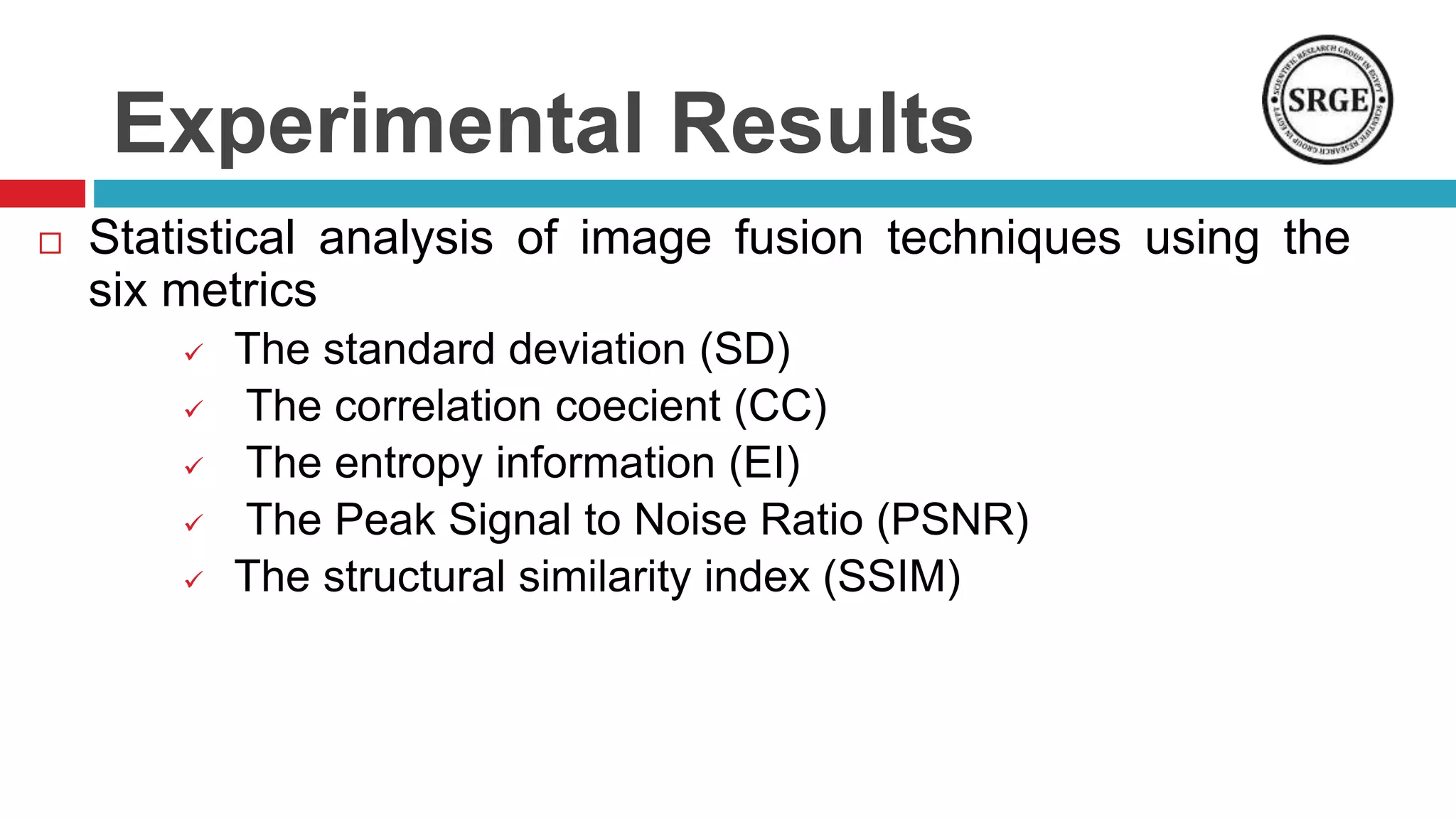
 Various image fusion techniques on ETM+ & Spot data via
the proposed technique
Spot Panchromatic
The IHS Technique The PCA Technique The proposed Technique
ETM+ MS Image The Brovey Transform
Experimental Results
 Statistical analysis of image fusion techniques using the
six metrics
 The standard deviation (SD)
 The correlation coecient (CC)
 The entropy information (EI)
 The Peak Signal to Noise Ratio (PSNR)
 The structural similarity index (SSIM)
Experimental Results
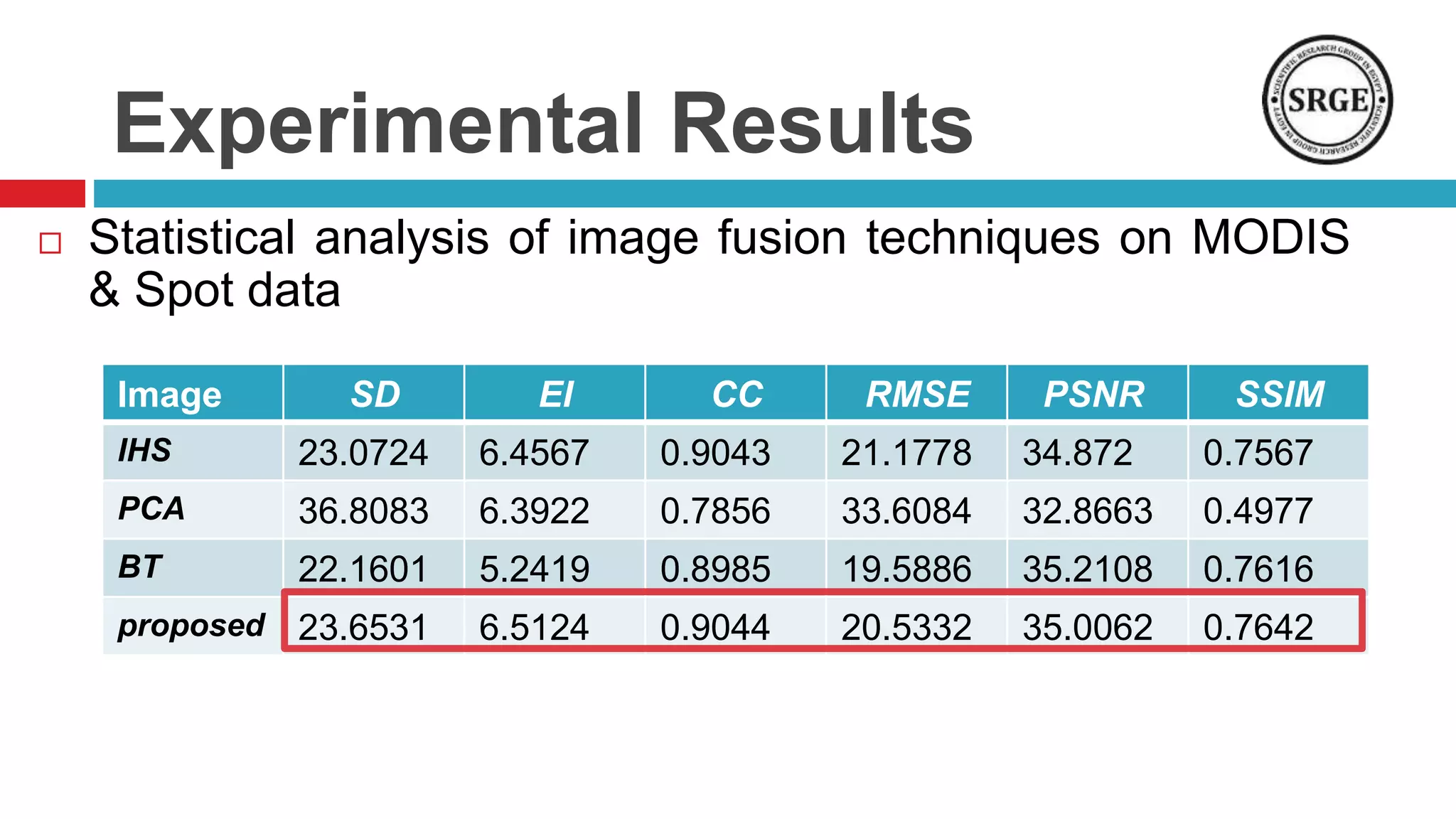
 Statistical analysis of image fusion techniques on MODIS
& Spot data
SSIMPSNRRMSECCEISDImage
0.756734.87221.17780.90436.456723.0724IHS
0.497732.866333.60840.78566.392236.8083PCA
0.761635.210819.58860.89855.241922.1601BT
0.764235.006220.53320.90446.512423.6531proposed
Experimental Results
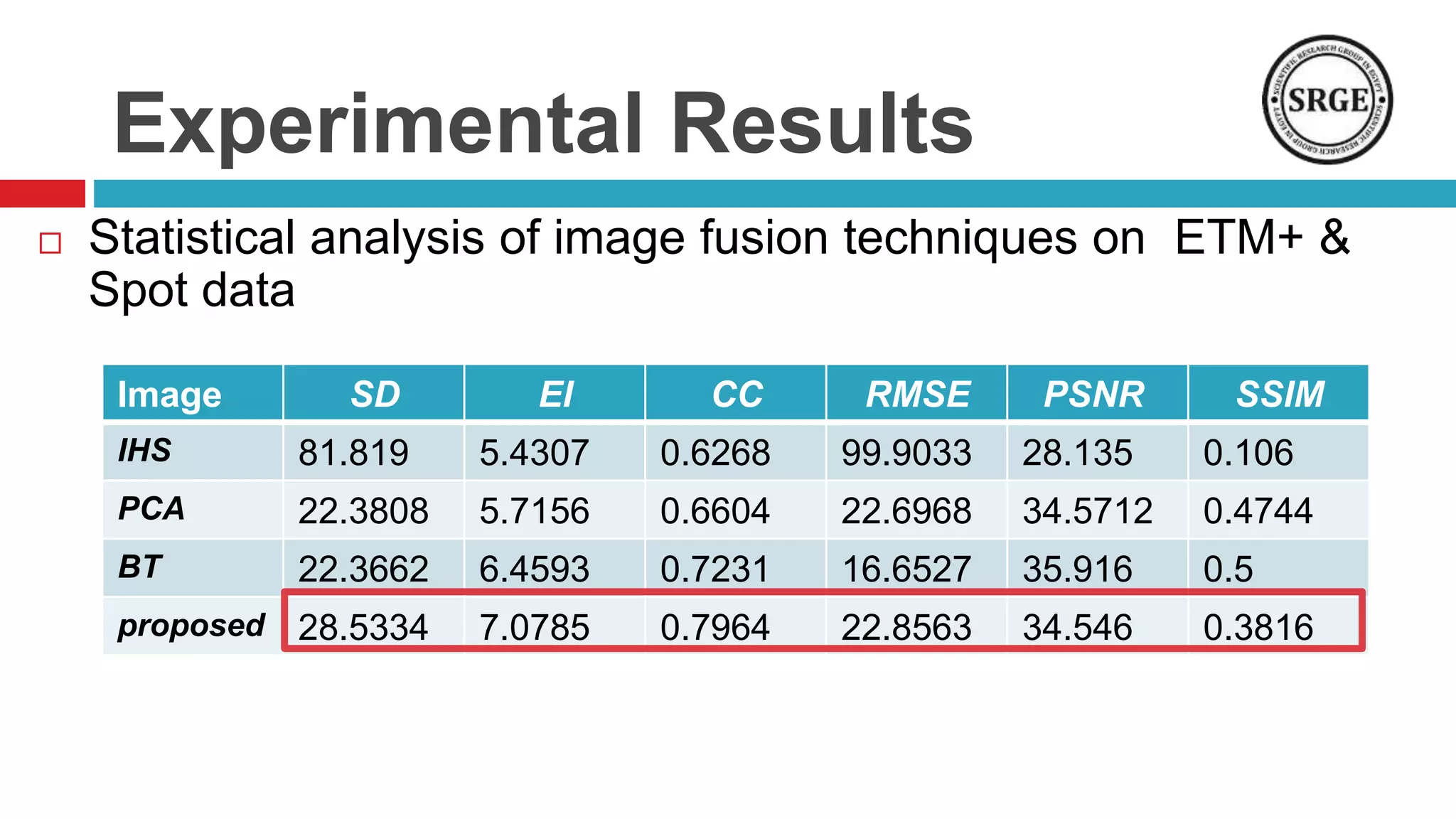
 Statistical analysis of image fusion techniques on ETM+ &
Spot data
SSIMPSNRRMSECCEISDImage
0.10628.13599.90330.62685.430781.819IHS
0.474434.571222.69680.66045.715622.3808PCA
0.535.91616.65270.72316.459322.3662BT
0.381634.54622.85630.79647.078528.5334proposed
Conclusion and Future works
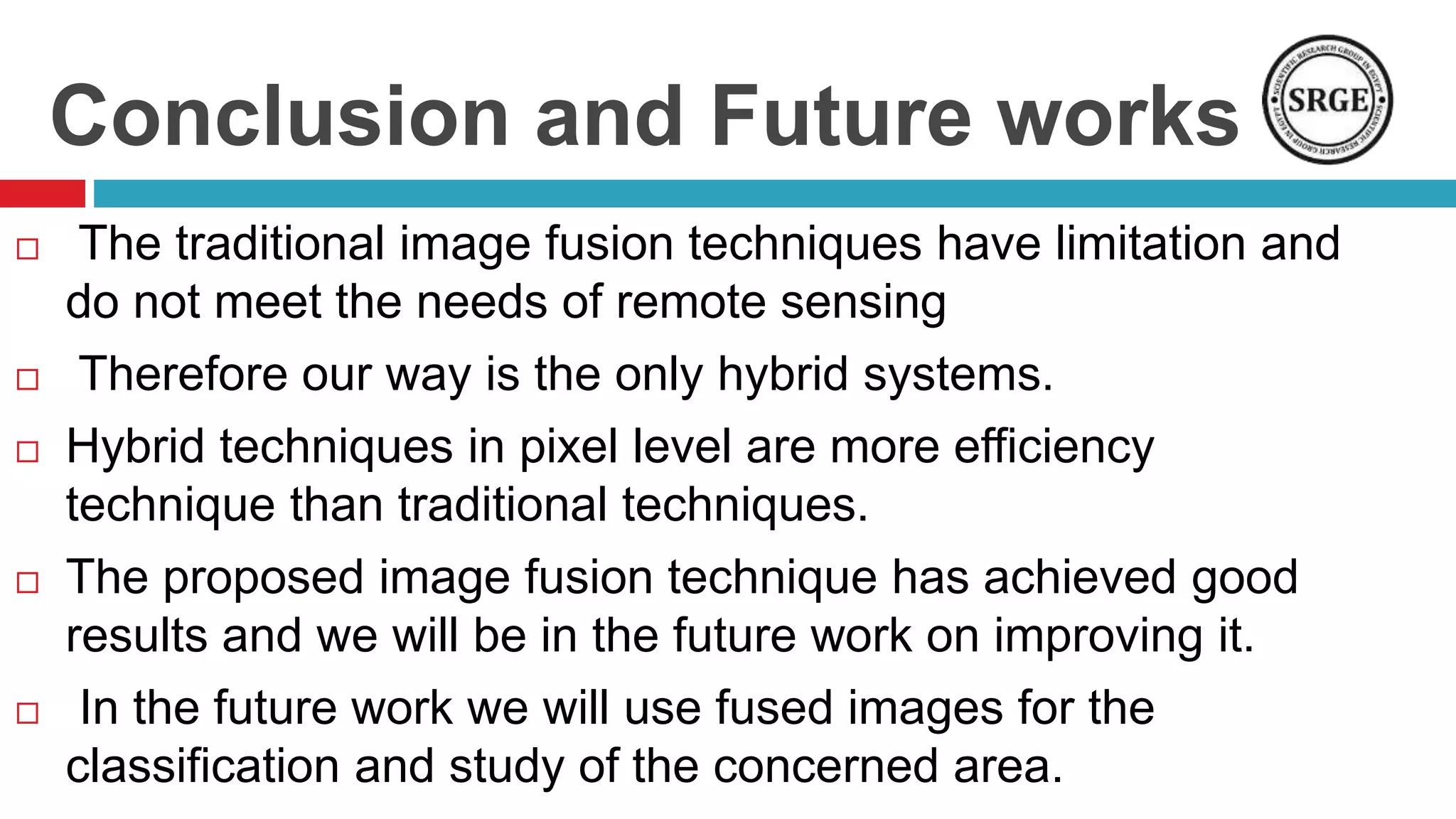
 The traditional image fusion techniques have limitation and
do not meet the needs of remote sensing
 Therefore our way is the only hybrid systems.
 Hybrid techniques in pixel level are more efficiency
technique than traditional techniques.
 The proposed image fusion technique has achieved good
results and we will be in the future work on improving it.
 In the future work we will use fused images for the
classification and study of the concerned area.
For further questions:
Reham Gharbia
Reham_ghrabia@yahoo.com

Ibica2014(p15)image fusion based on broveywavelet

  • 1.
    REMOTE SENSING IMAGEFUSION APPROACH BASED ON BROVEY AND WAVELETS TRANSFORMS By Reham Abd El whaba Gharbia, PhD Student Nuclear Materials authority, Egypt SRGE 20-5–2014 Cairo Egypt
  • 2.
    Scientific Research Groupin Egypt www.egyptscience.net
  • 3.
    Overview  Introduction  TheObjective  The Brovey Transform  The Wavelet Transform  The Proposed Image Fusion Approach  Experimental Results  Conclusion And Future Work
  • 4.
    Introduction  Remote sensinghas  a huge amount of data  different spatial resolution for panchromatic and multispectral imagery  For the optimum benefit of these characteristics. It should be collected in a single image.  There is no single system offers spatial or multispectral resolution at the same time.
  • 5.
    Introduction  Image fusionis used to combine multi-image information in one image which is more suitable to human vision or more adapt to further image processing analysis.  Recently, image fusion has become one of the focuses in image processing field
  • 6.
    The Objective  Introducesa remote sensing image fusion approach based on a modified version of the Brovey transform and wavelets to reduce the spectral distortion in the Brovey transform and spatial distortion in the wavelet transform.
  • 7.
    The Brovey Transform The basic procedure of the Brovey Transform first multiplies each MS band by the high-resolution Pan band, and then divides each product by the sum of the MS bands.
  • 8.
    The Wavelet Transform wavelet image fusion  decomposed the two input images separately into approximate coefficients and detailed coefficients.  high detailed coefficients of the multi-spectral image are replaced with those of the pan image.  The new wavelet coefficients of the multi-spectral image are transformed with the inverse wavelet transform to obtain the fusion multi-spectral image
  • 9.
    The Proposed ImageFusion Approach  Preprocessing stage  Registration  Upsampling  Histogram matching  Image fusion stage
  • 10.
    The Proposed ImageFusion Approach Fusion Algorithm 1: Apply the Brovey transform on the multispectral images (R, G, and B) and the panchromatic image and produce new images (Rnew, Gnew and Bnew). 2: Decompose the high resolution image (i.e. Pan image) into into a set of low resolution with the wavelet transform. 3: The wavelet transform with the same decomposition scale is applied to obtain the Wavelet coefficients of the new image (Rnew, Gnew and Bnew). 4: Replace a low frequency of Pan image with low frequency of MS band at the level. 5:The Proposed wavelet coefficients fusion scheme is carried to reconstruct new image’s wavelet coefficients. 6: The reconstruct image wavelet coefficients. 7: The last output image is generated by applying inverse wavelet transform (IWT) with reconstructed wavelet coefficients.
  • 11.
    Experimental Results  Variousimage fusion techniques on MODIS & Spot data via the proposed technique MODIS MS Image Spot Panchromatic The Brovey Transform The IHS Technique The PCA Technique The proposed Technique
  • 12.
    Experimental Results  Variousimage fusion techniques on ETM+ & Spot data via the proposed technique Spot Panchromatic The IHS Technique The PCA Technique The proposed Technique ETM+ MS Image The Brovey Transform
  • 13.
    Experimental Results  Statisticalanalysis of image fusion techniques using the six metrics  The standard deviation (SD)  The correlation coecient (CC)  The entropy information (EI)  The Peak Signal to Noise Ratio (PSNR)  The structural similarity index (SSIM)
  • 14.
    Experimental Results  Statisticalanalysis of image fusion techniques on MODIS & Spot data SSIMPSNRRMSECCEISDImage 0.756734.87221.17780.90436.456723.0724IHS 0.497732.866333.60840.78566.392236.8083PCA 0.761635.210819.58860.89855.241922.1601BT 0.764235.006220.53320.90446.512423.6531proposed
  • 15.
    Experimental Results  Statisticalanalysis of image fusion techniques on ETM+ & Spot data SSIMPSNRRMSECCEISDImage 0.10628.13599.90330.62685.430781.819IHS 0.474434.571222.69680.66045.715622.3808PCA 0.535.91616.65270.72316.459322.3662BT 0.381634.54622.85630.79647.078528.5334proposed
  • 16.
    Conclusion and Futureworks  The traditional image fusion techniques have limitation and do not meet the needs of remote sensing  Therefore our way is the only hybrid systems.  Hybrid techniques in pixel level are more efficiency technique than traditional techniques.  The proposed image fusion technique has achieved good results and we will be in the future work on improving it.  In the future work we will use fused images for the classification and study of the concerned area.
  • 17.
    For further questions: RehamGharbia Reham_ghrabia@yahoo.com