SIPNA
College of Engineering & Technology, Amravati
Digital Image Processing[7ET2]
Subject In-charge
Chapter :- I
Introduction to
Digital Image Processing
Signals and System
[4ET1]
Digital Signal Processing
[6ET4]
2
PRE-REQUISITES / PRIOR KNOWLEDGE
INTRODUCTION
Image Processing [DIP]
Processing images which are
digital in nature.
Digital
Enhancement
Segmentation
Restoration
Transformation
Filtering
Signal Converson
SYLLABUS OVERVIEW
Unit
1
Unit
2
Unit
3
Unit
4
Unit
5
Unit
6
SYLLABUS OVERVIEW
Unit-1 Introduction to Digital Image Processing:
Digital Image Fundamental, Elements of Visual Perception, Simple
Image Model, Sampling and Quantization, Basic Relationships
between Pixel ,Imaging Geometry, Gray scale image representation.
Unit-2 Image Transforms:
Introduction to the Fourier Transform, DFT, Properties of Two
Dimensional Fourier Transform, FFT, Hadamard, Harr, DCT, Slant
Transform.
Unit-3 Image Enhancement:
Basic Techniques, Enhancement by point processing, Spatial
Filtering, Enhancement in Frequency domain, histogram based
processing, homomorphic filtering.
Unit-4 Image Restoration:
Degradation model, Diagonalisation concept, Algebraic approach to
Restoration. Inverse filtering, Weiner (CNS) filtering Restoration in
Spatial domain, Basic morphological concept, morphological
principles, binary morphology, Basic concepts of erosion and
dilation.
Unit-5 Image Compression:
Fundamentals, Image compression models, Elements of Information
theory, Lossy and predictive methods, vector quantization, runlength
coding, Huffman coding, and lossless compression, compression
standards.
Unit-6 Image Segmentation:
Detection of discontinuities, Edge Linking and boundary detection,
Thresholding, Regional oriented Segmentation.
SYLLABUS OVERVIEW
ABOUT THE COURSE
Goals of this course:
• Introductory course: basic concepts, classical
methods, fundamental theorems
• Getting acquainted with basic properties of images
• Getting acquainted with various representations of
image data
• Acquire fundamental knowledge in processing and
analysis digital images
7
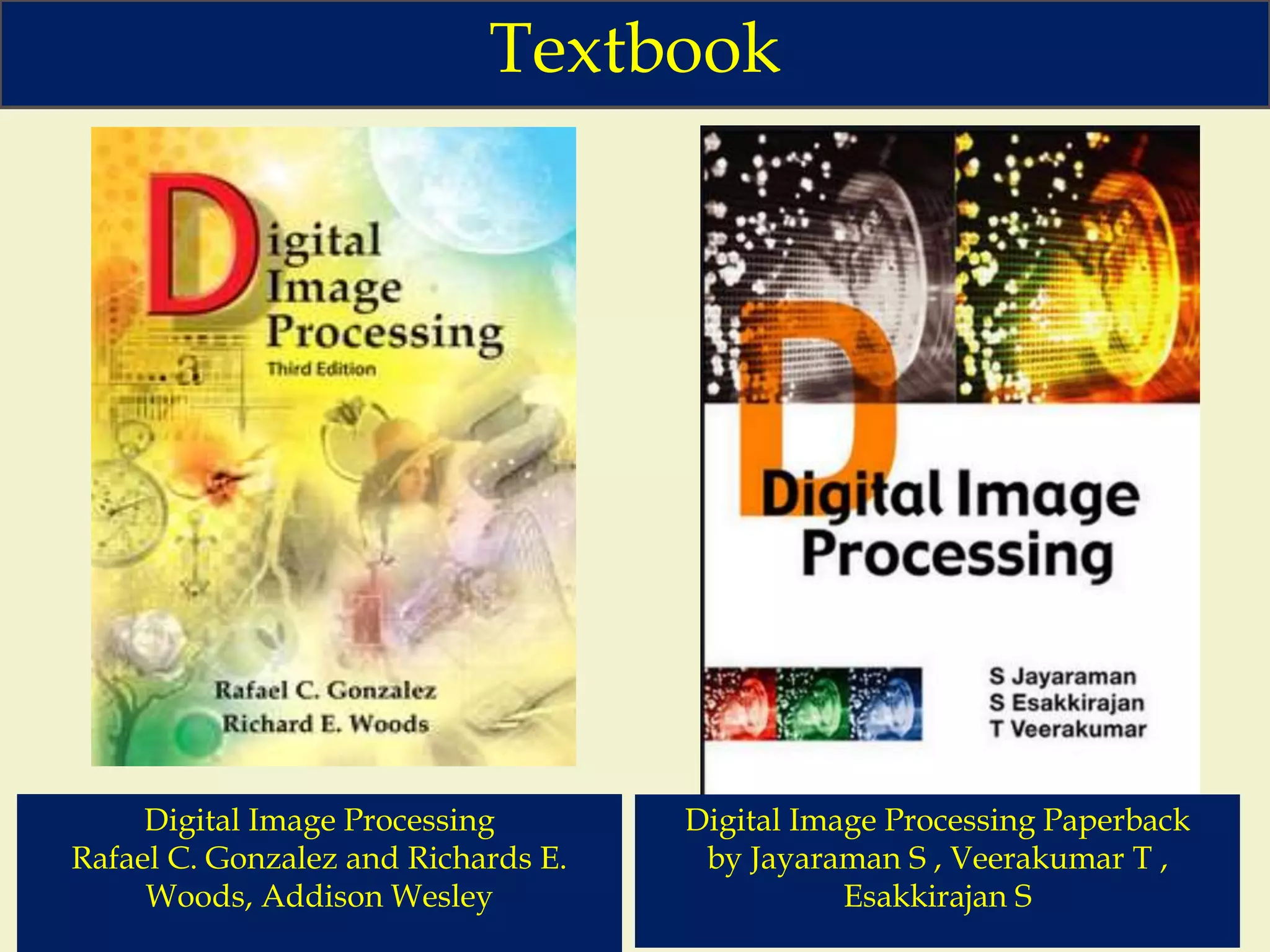
Digital Image Processing
Rafael C. Gonzalez and Richards E.
Woods, Addison Wesley
AdministrationTextbook
Digital Image Processing Paperback
by Jayaraman S , Veerakumar T ,
Esakkirajan S
UNIT I
Introduction
To
Digital Image Processing
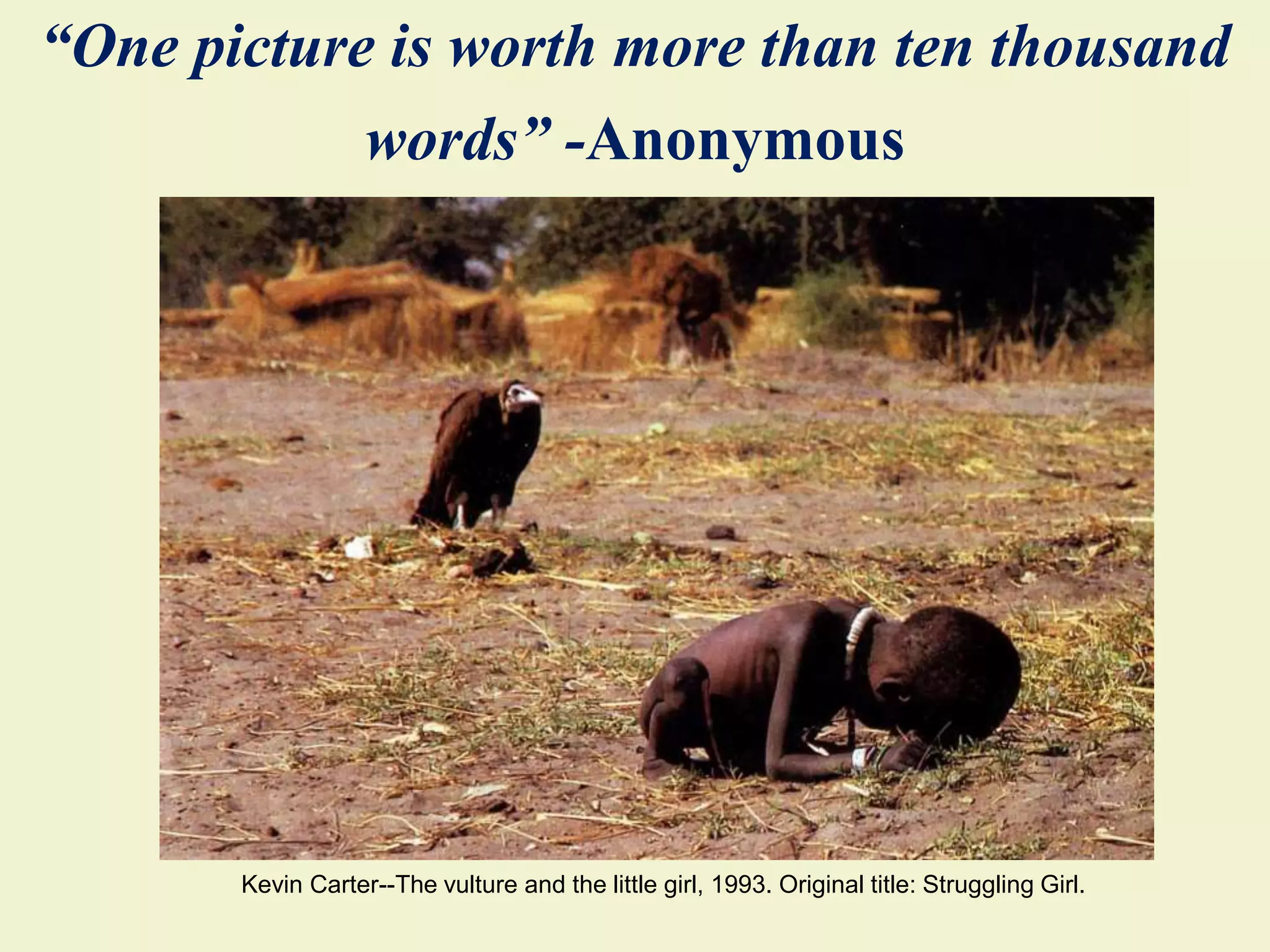
“One picture is worth more than ten thousand
words” -Anonymous
Kevin Carter--The vulture and the little girl, 1993. Original title: Struggling Girl.
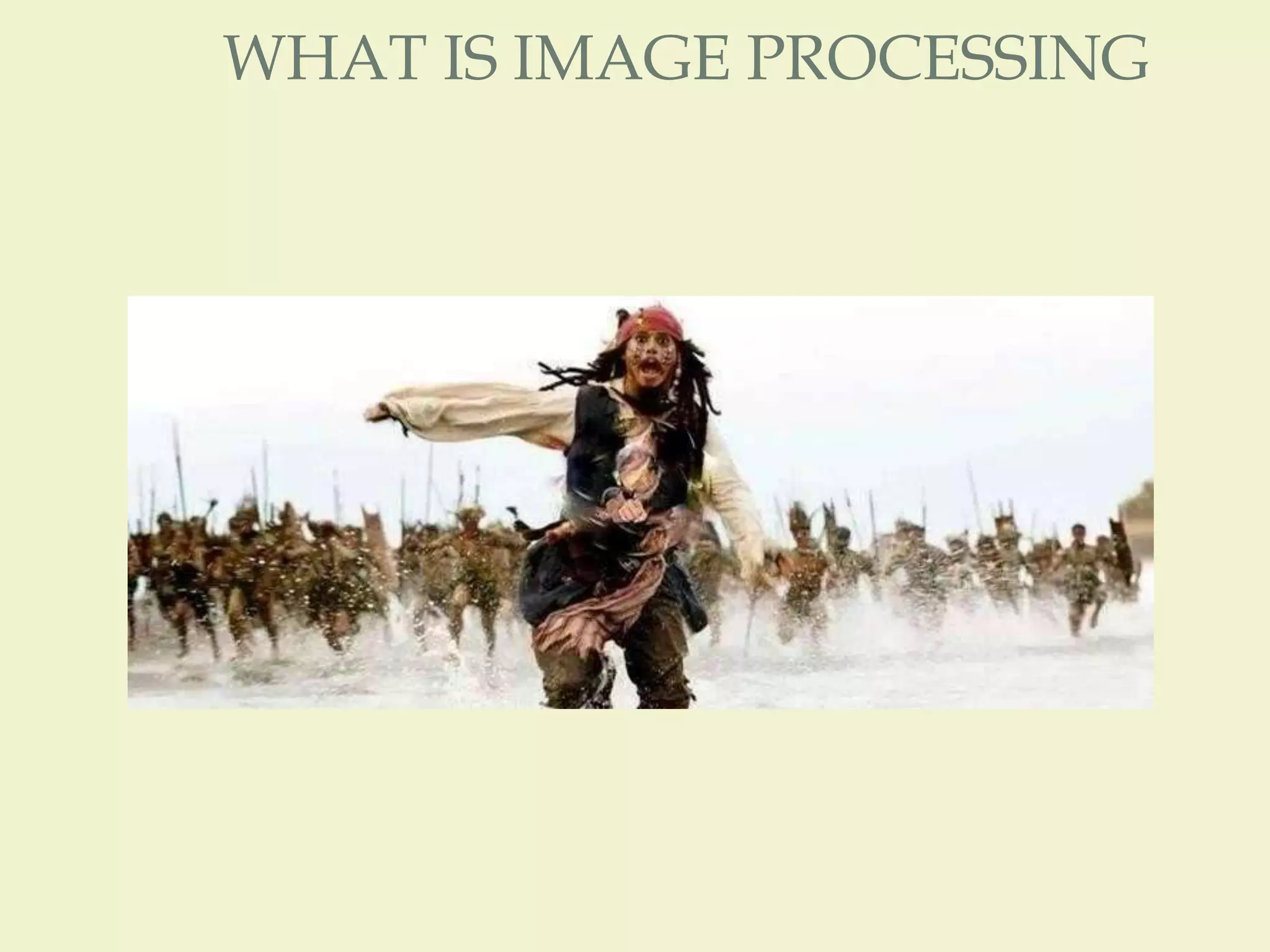
WHAT IS IMAGE PROCESSING
14
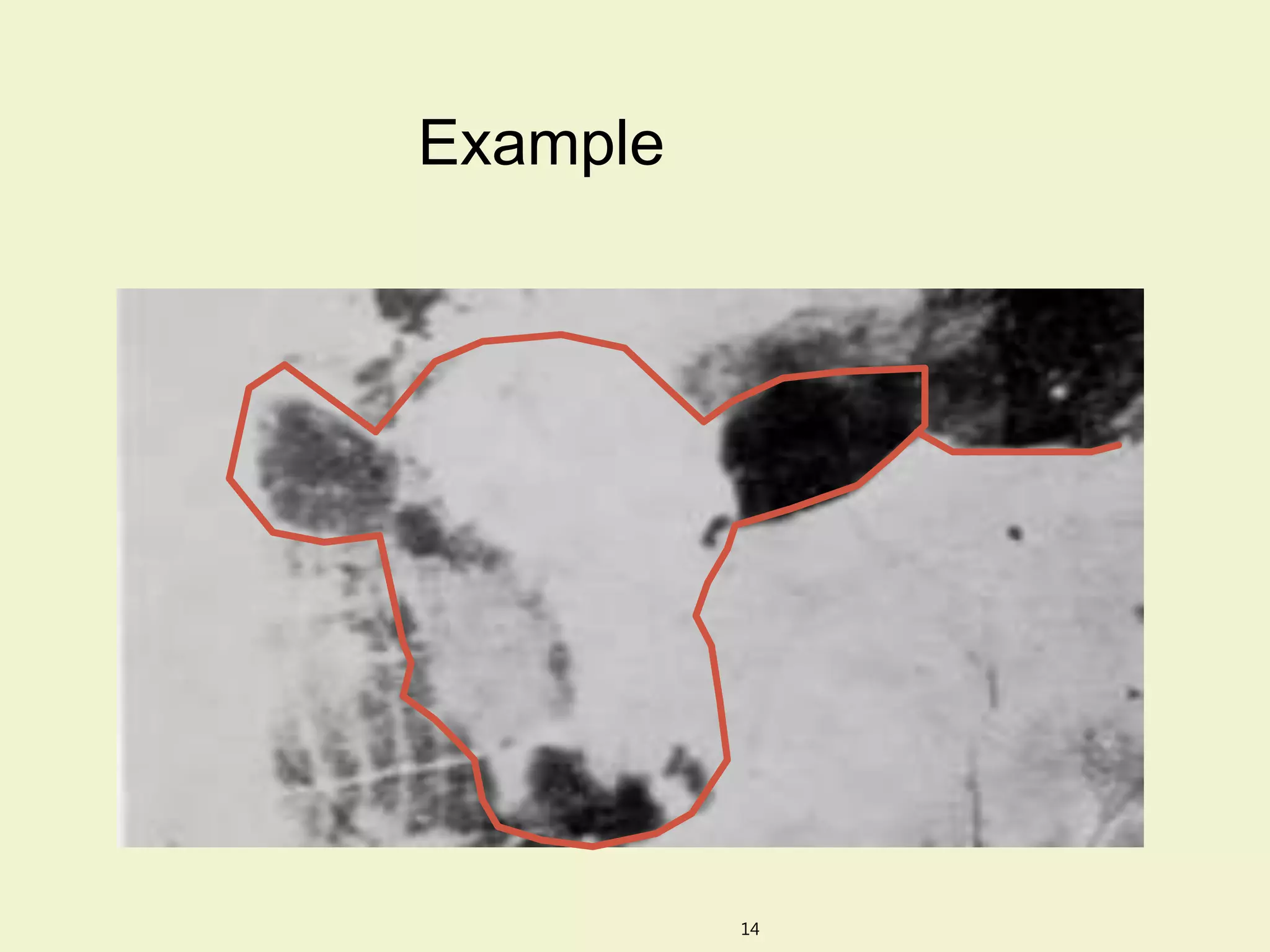
Example
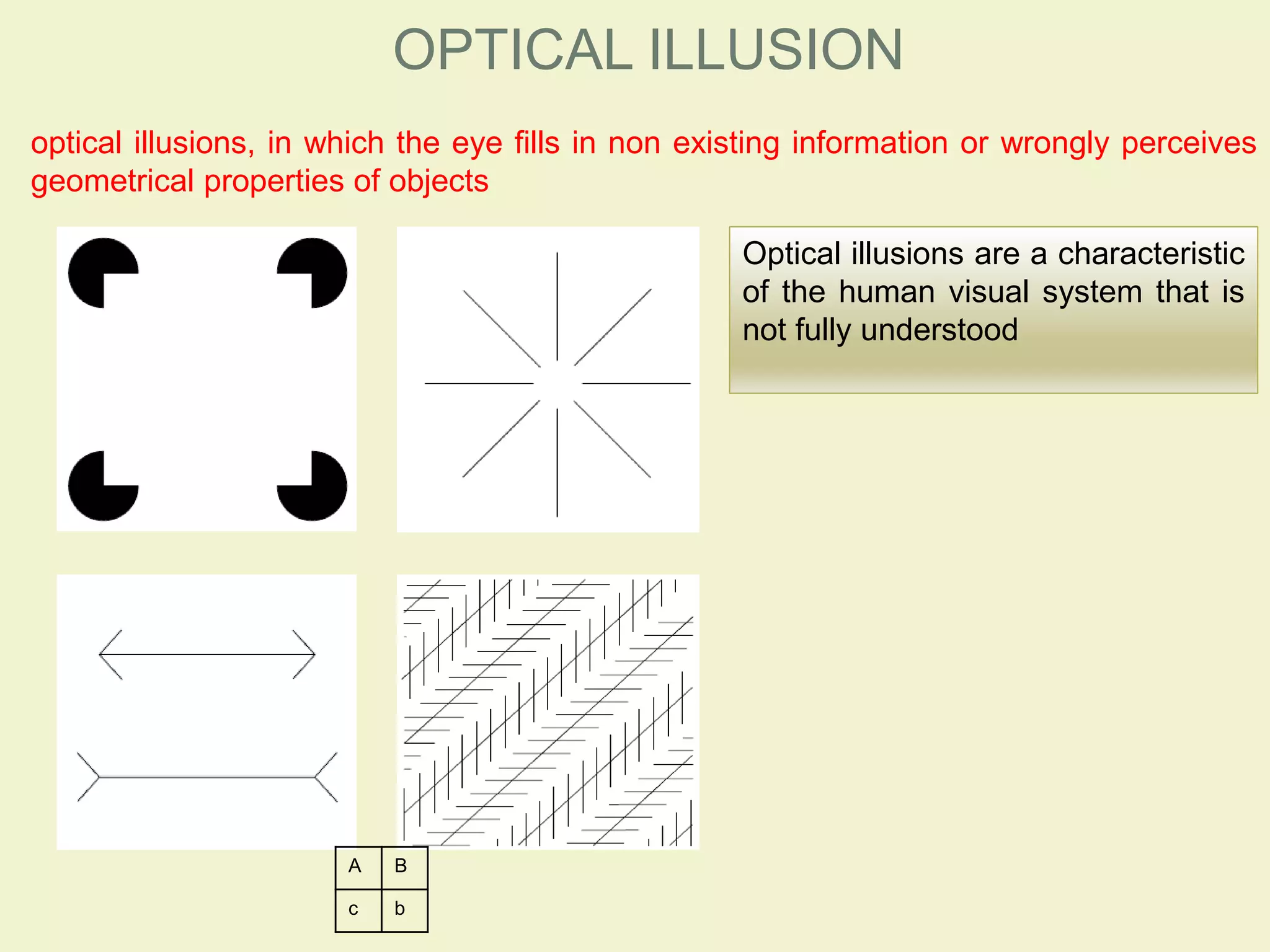
optical illusions, in which the eye fills in non existing information or wrongly perceives
geometrical properties of objects
OPTICAL ILLUSION
A B
c b
Optical illusions are a characteristic
of the human visual system that is
not fully understood
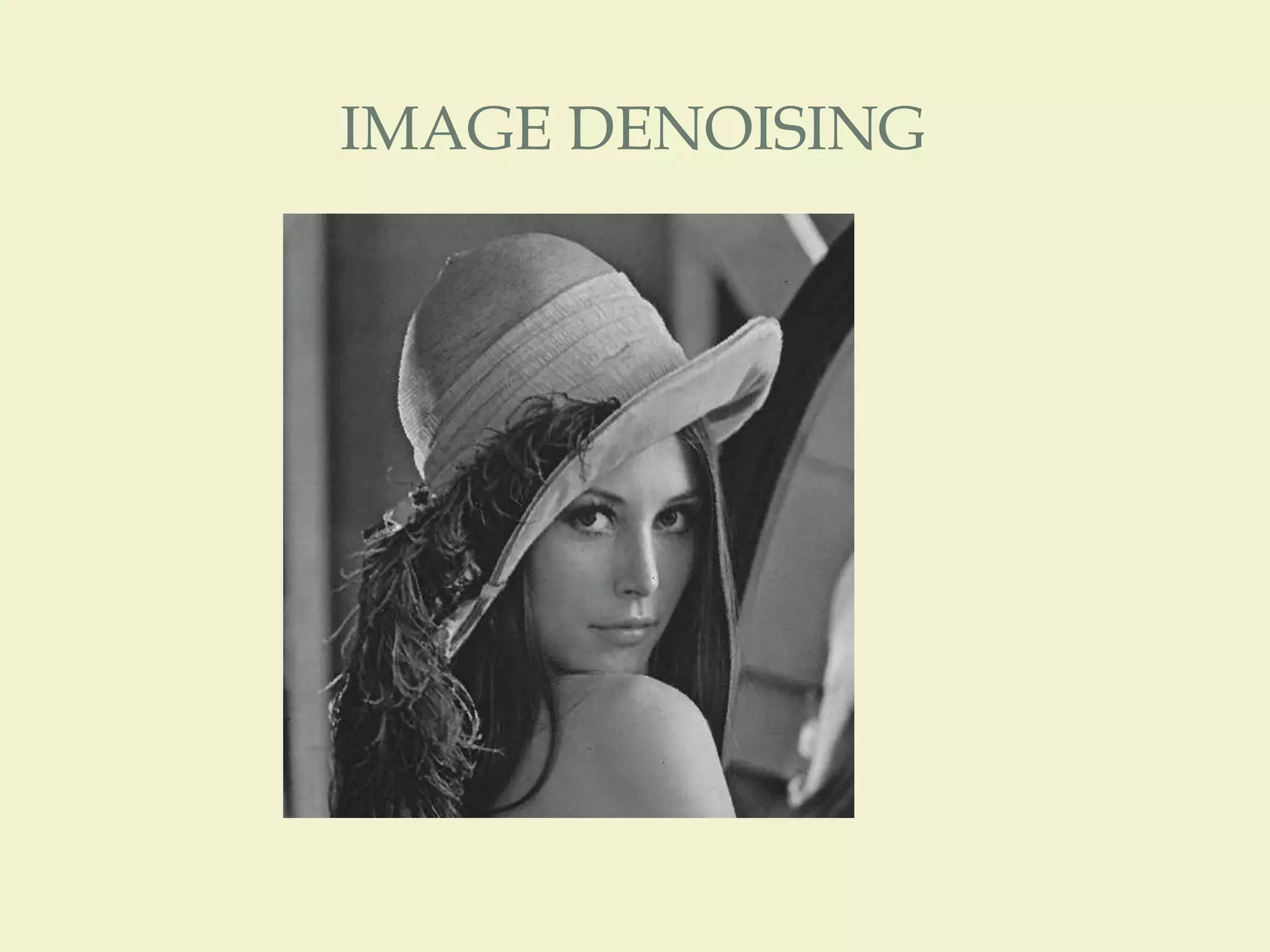
IMAGE DENOISING
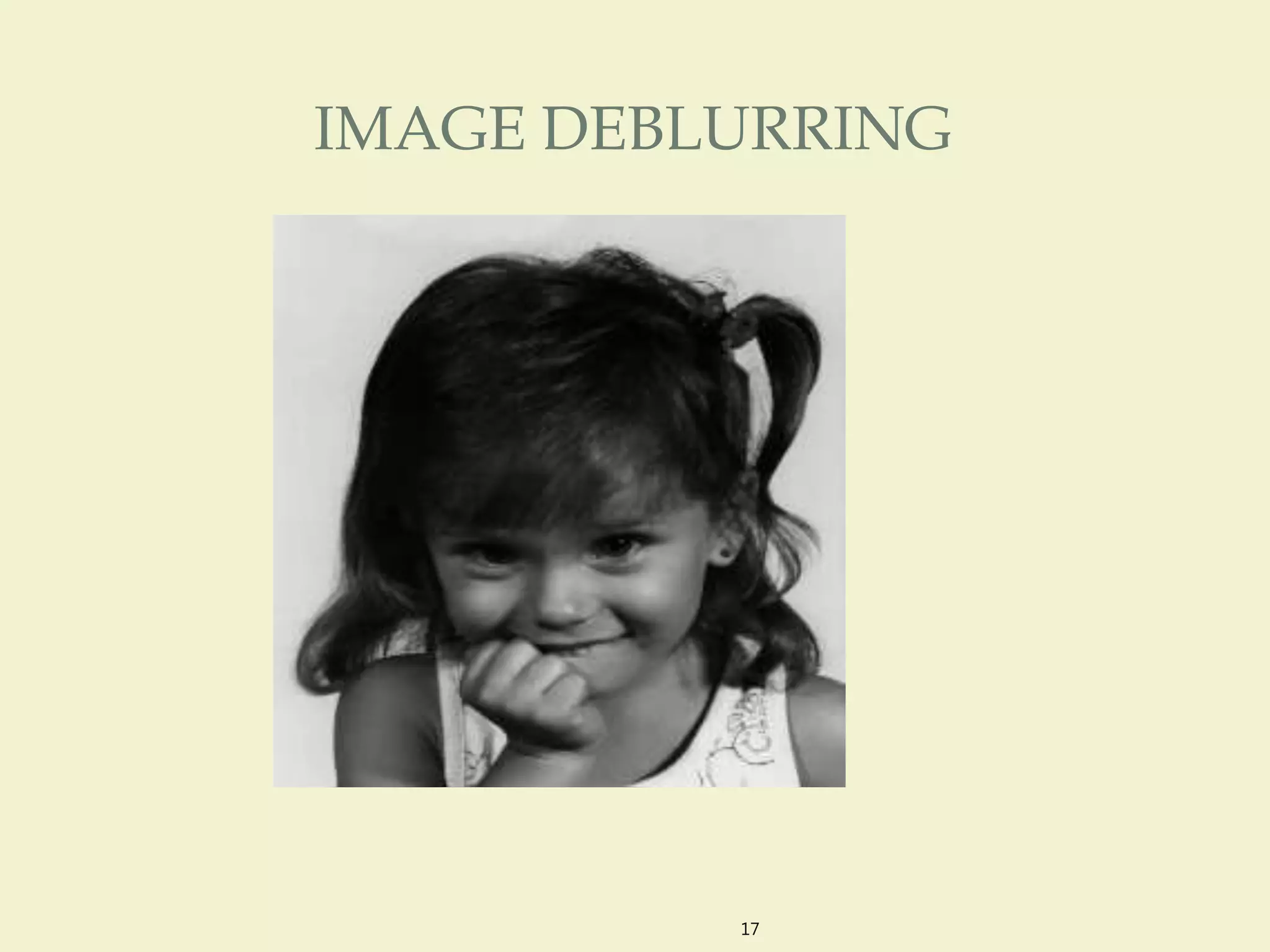
IMAGE DEBLURRING
17
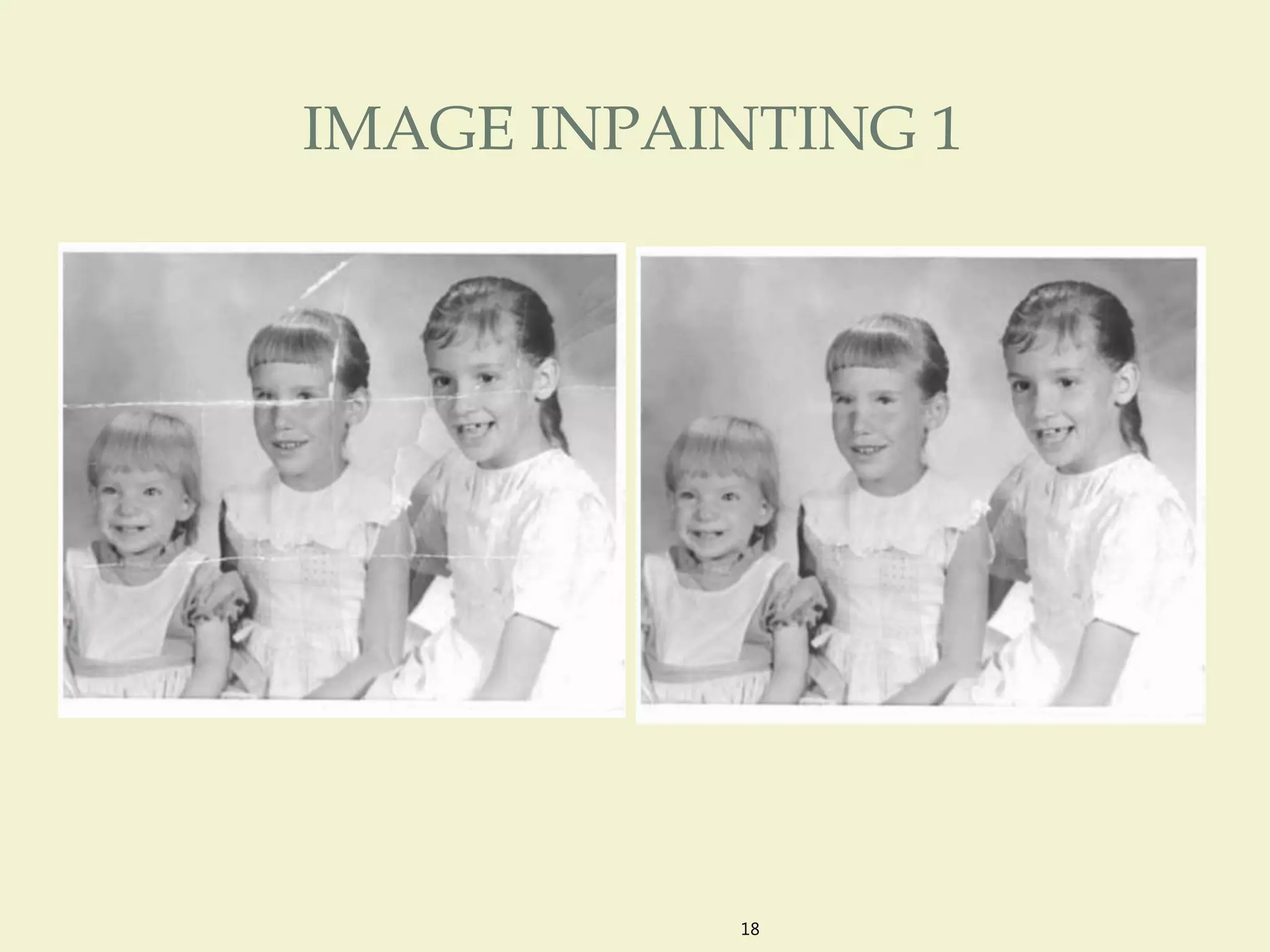
IMAGE INPAINTING 1
18
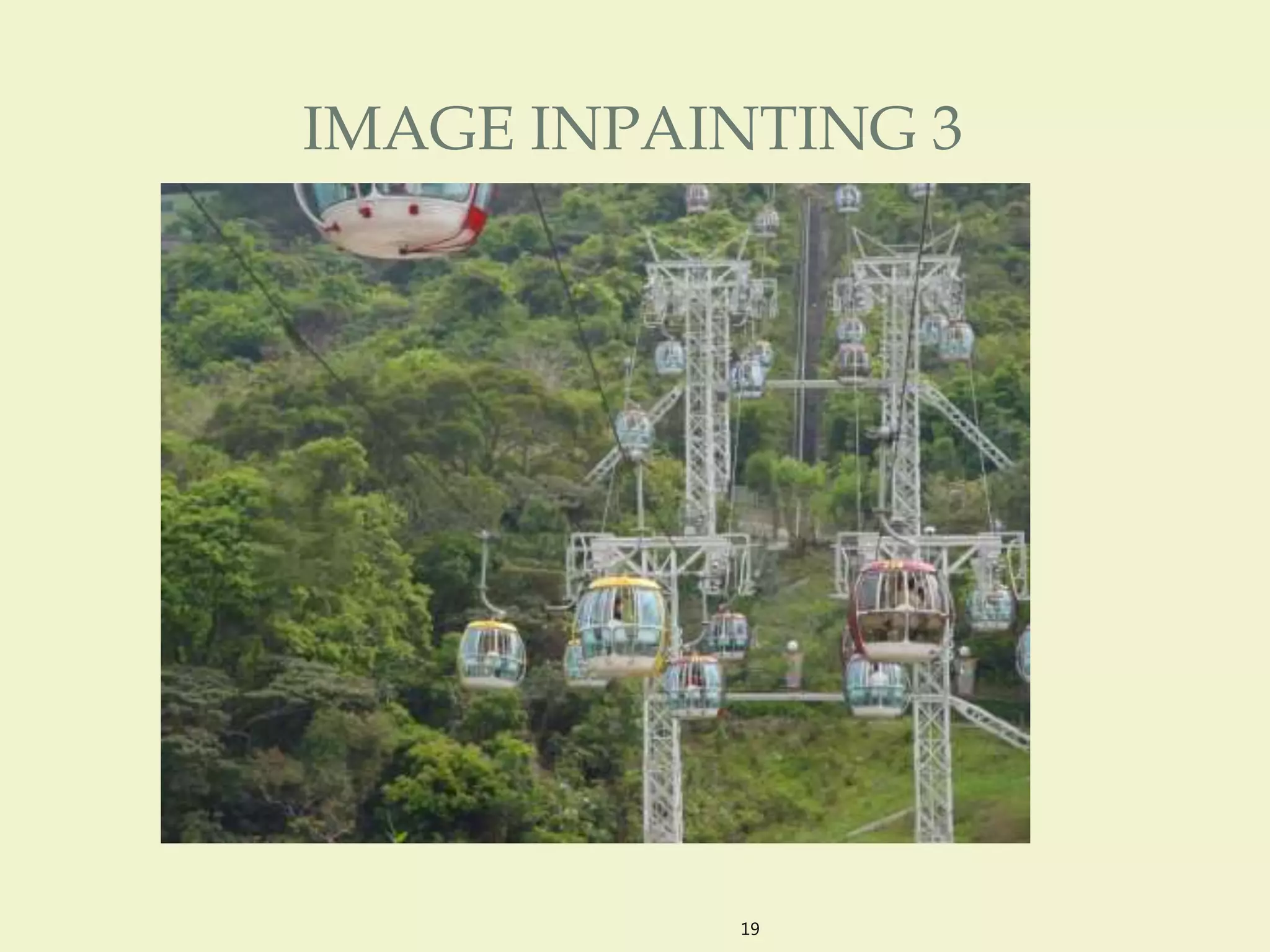
IMAGE INPAINTING 3
19
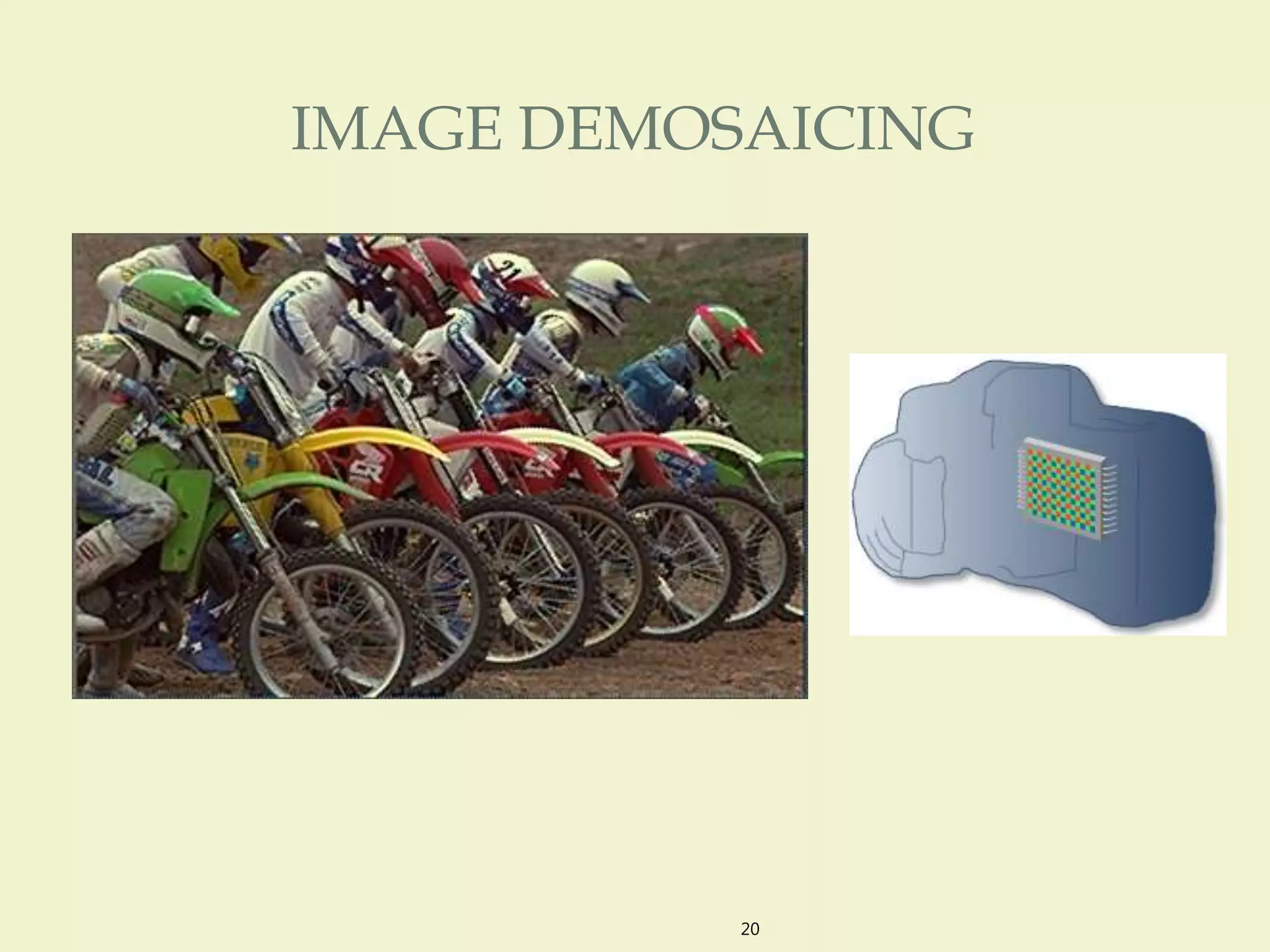
IMAGE DEMOSAICING
20
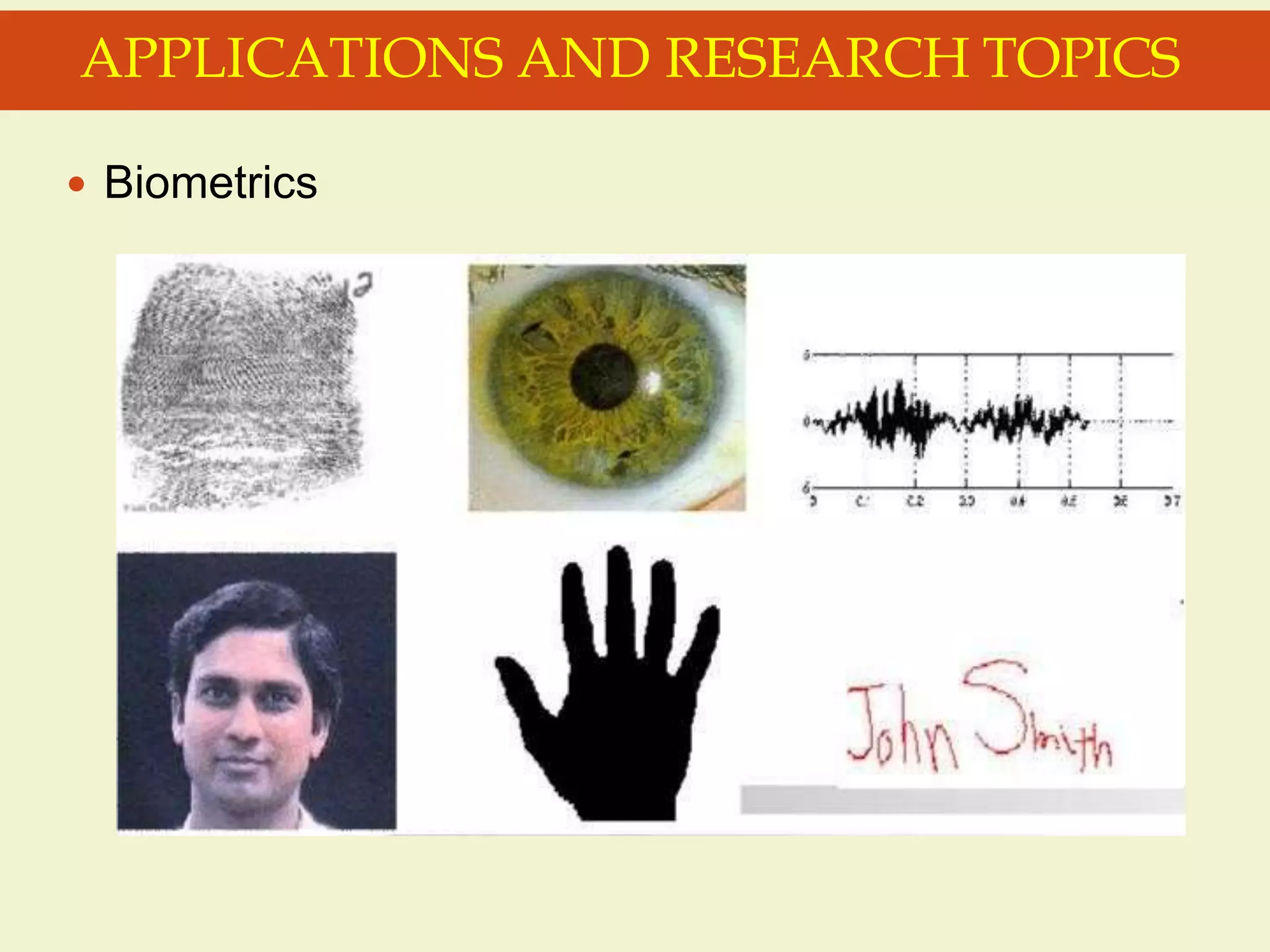
 Biometrics
APPLICATIONS AND RESEARCH TOPICS
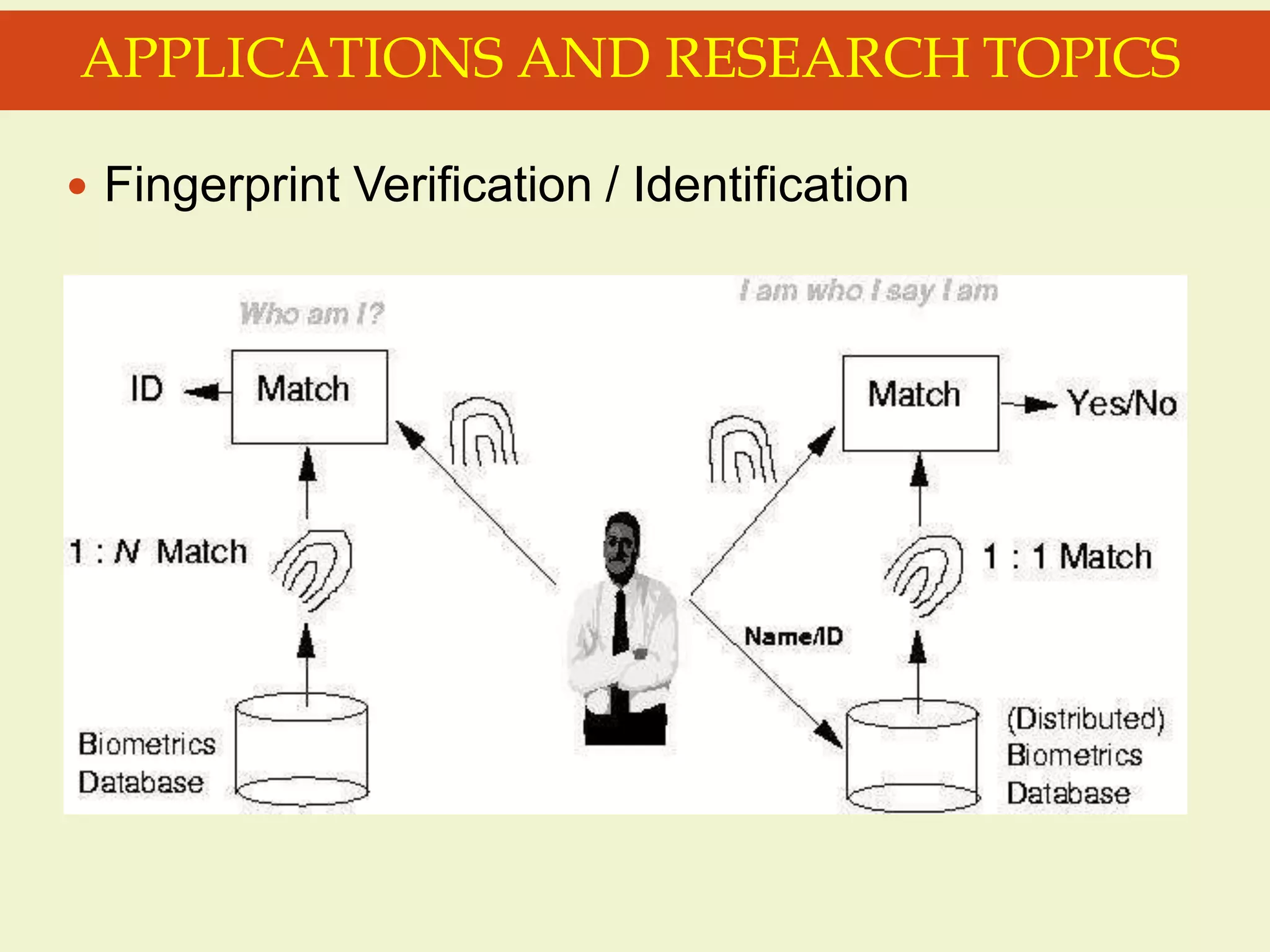
 Fingerprint Verification / Identification
APPLICATIONS AND RESEARCH TOPICS
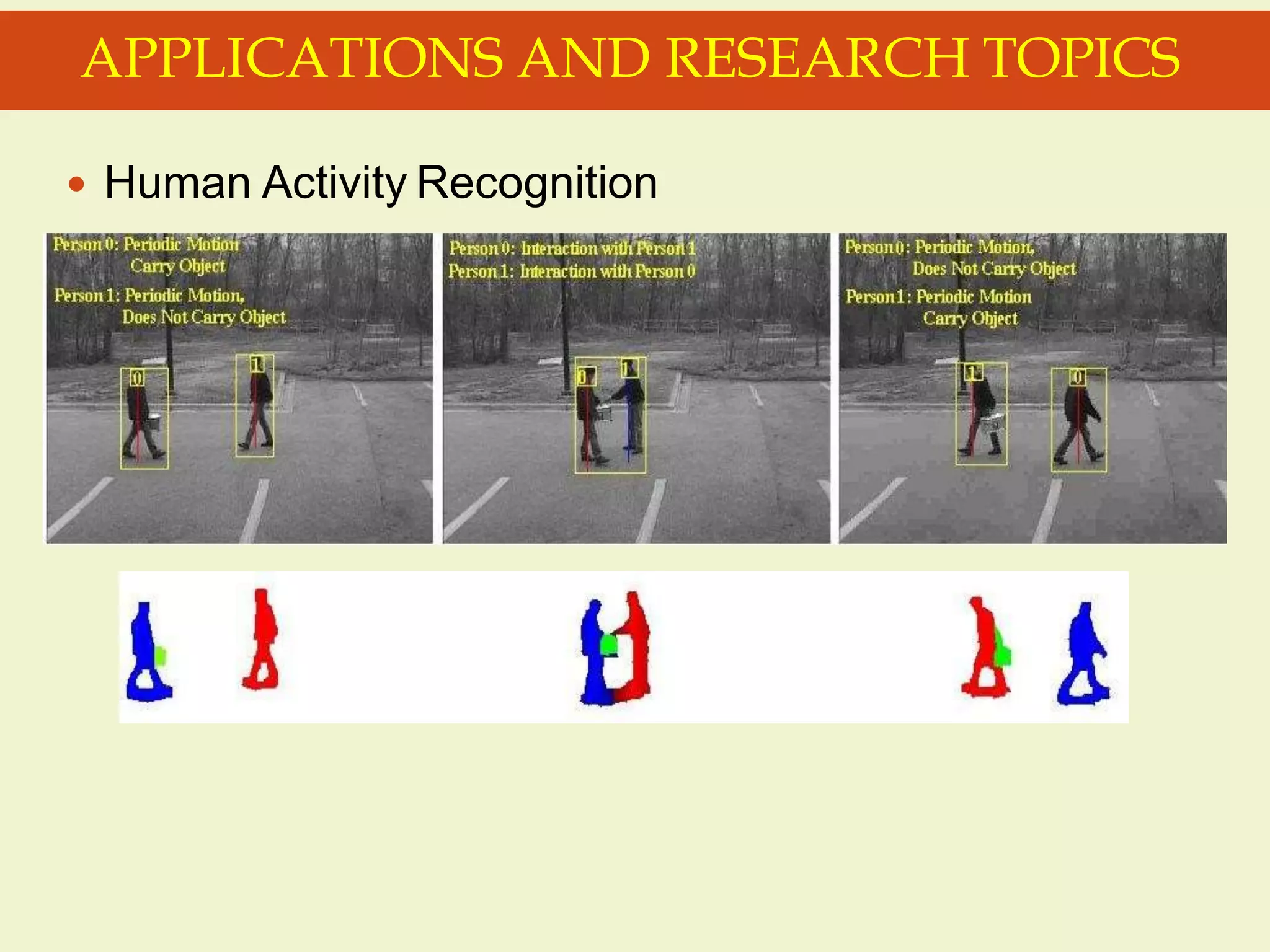
 Human Activity Recognition
APPLICATIONS AND RESEARCH TOPICS
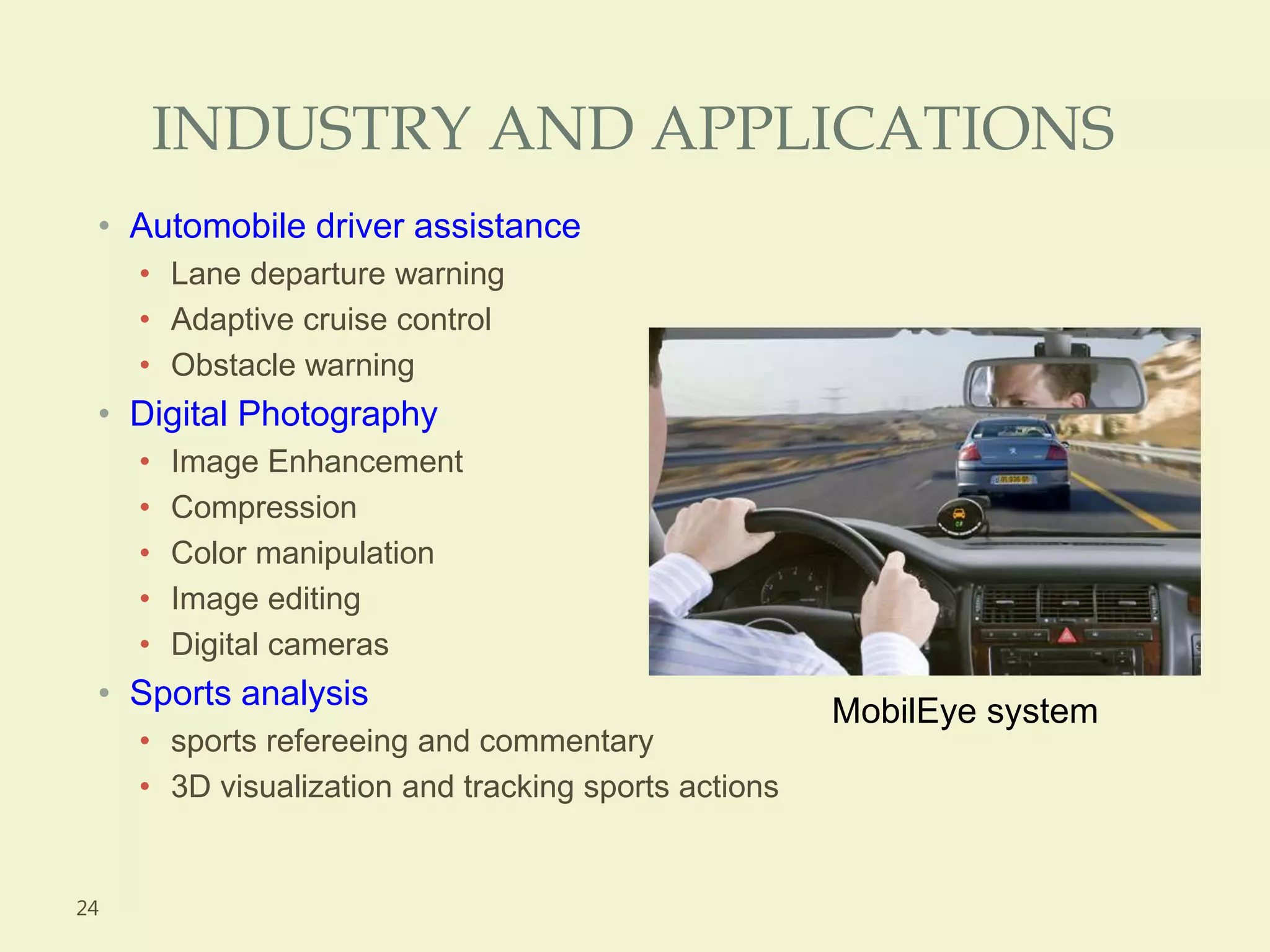
INDUSTRY AND APPLICATIONS
• Automobile driver assistance
• Lane departure warning
• Adaptive cruise control
• Obstacle warning
• Digital Photography
• Image Enhancement
• Compression
• Color manipulation
• Image editing
• Digital cameras
• Sports analysis
• sports refereeing and commentary
• 3D visualization and tracking sports actions
24
MobilEye system
• Film and Video
• Editing
• Special effects
• Image Database
• Content based image retrieval
• visual search of products
• Face recognition
• Industrial Automation and Inspection
• vision-guided robotics
• Inspection systems
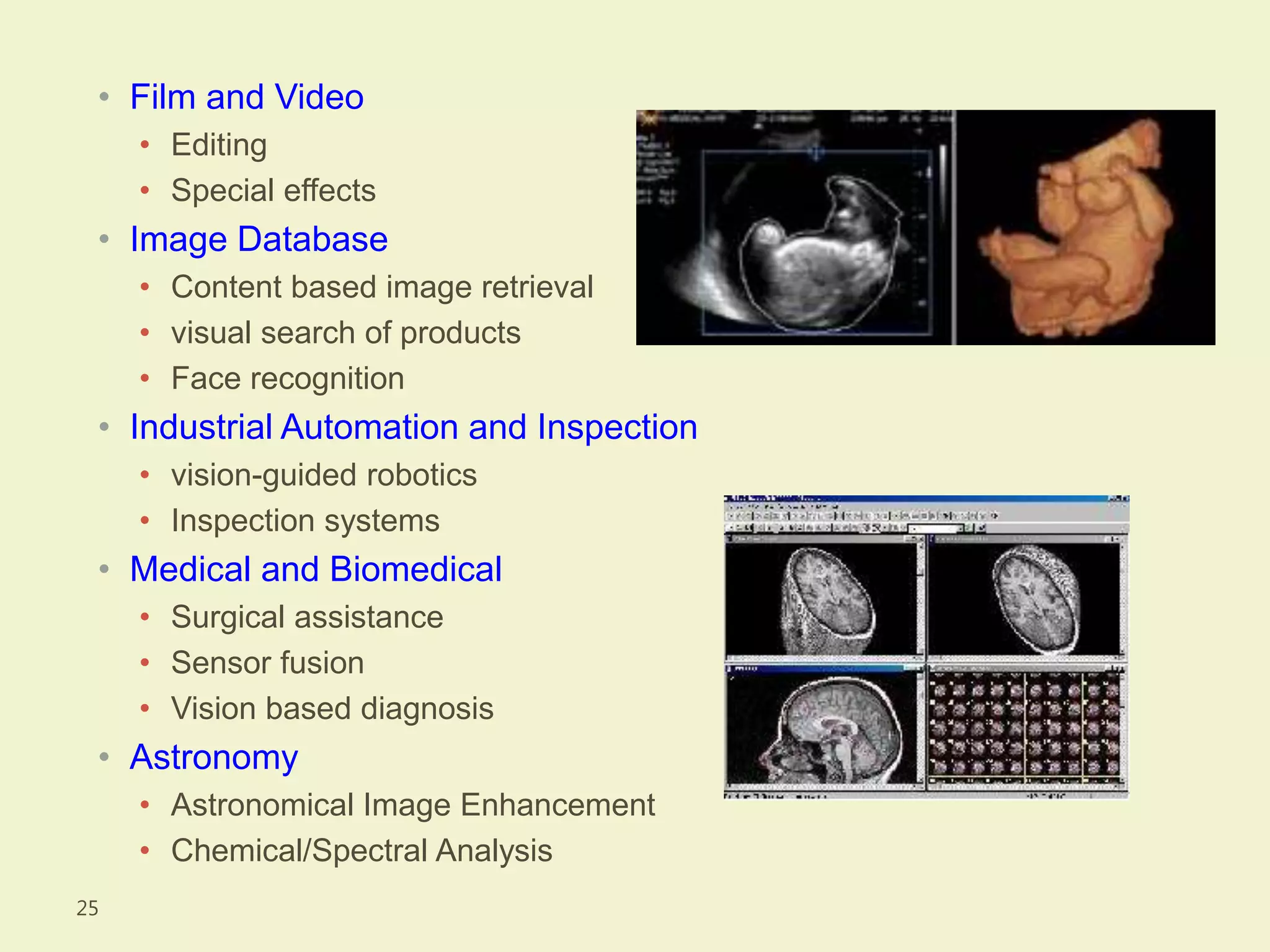
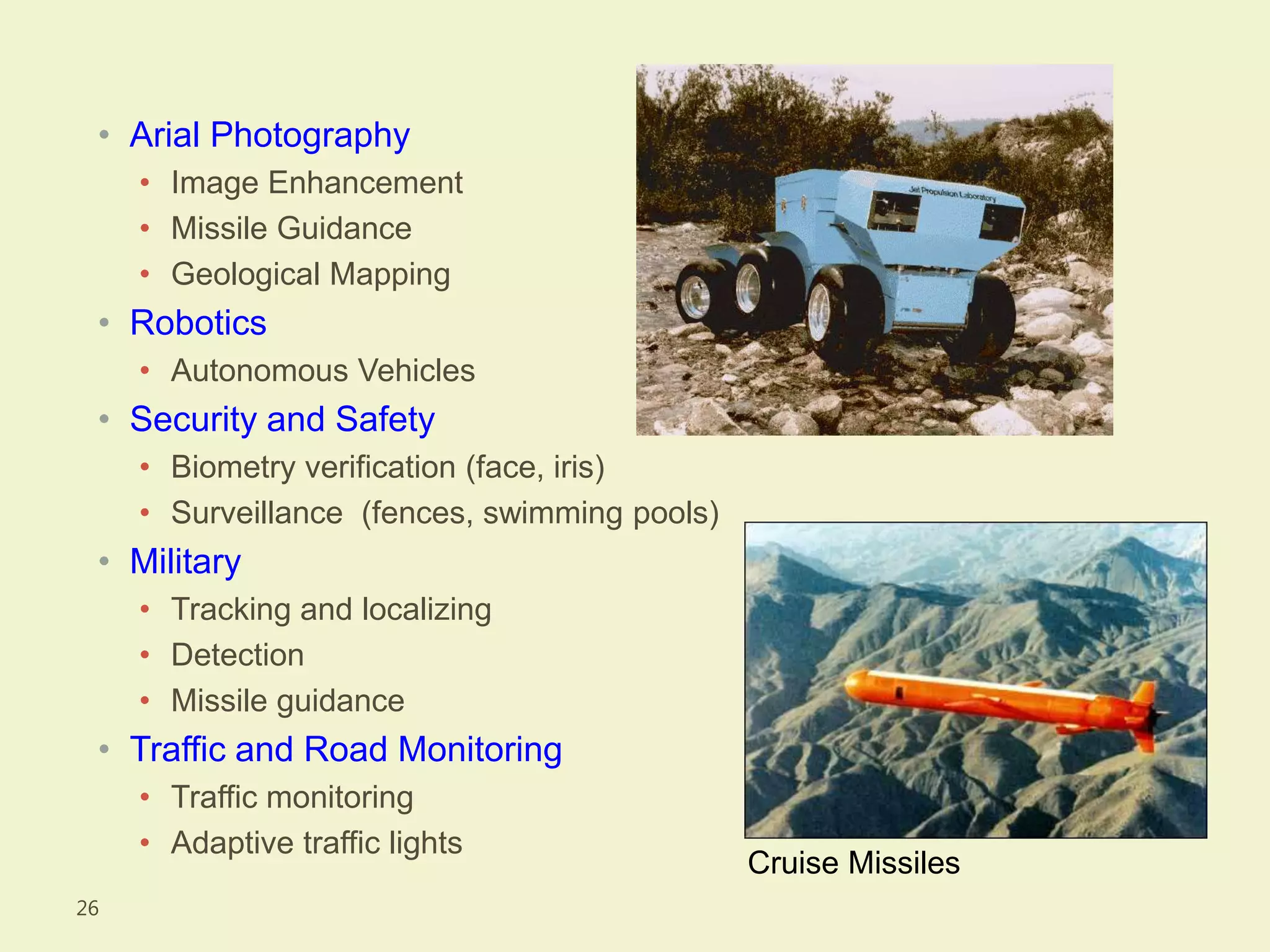
• Medical and Biomedical
• Surgical assistance
• Sensor fusion
• Vision based diagnosis
• Astronomy
• Astronomical Image Enhancement
• Chemical/Spectral Analysis
25
• Arial Photography
• Image Enhancement
• Missile Guidance
• Geological Mapping
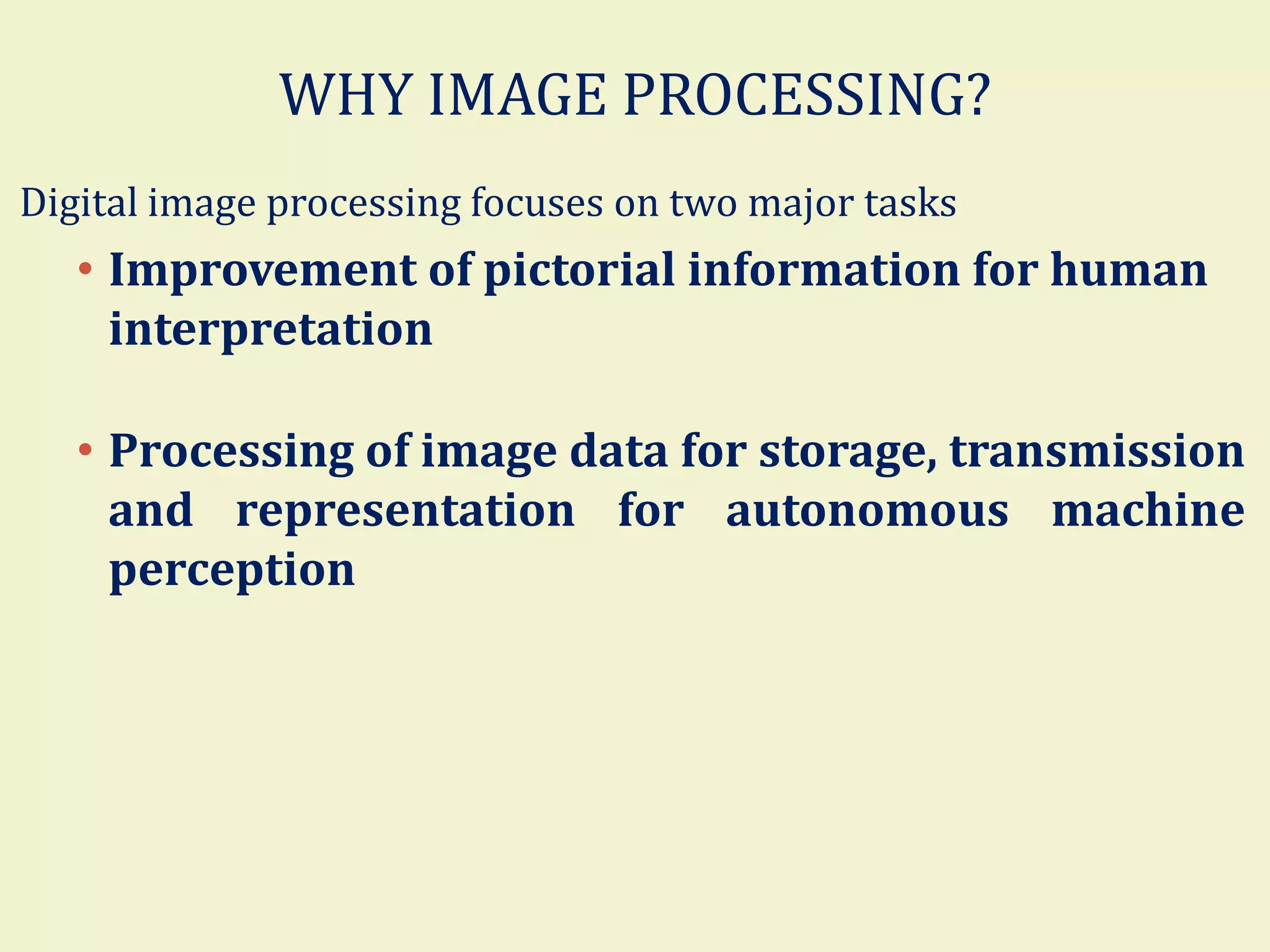
• Robotics
• Autonomous Vehicles
• Security and Safety
• Biometry verification (face, iris)
• Surveillance (fences, swimming pools)
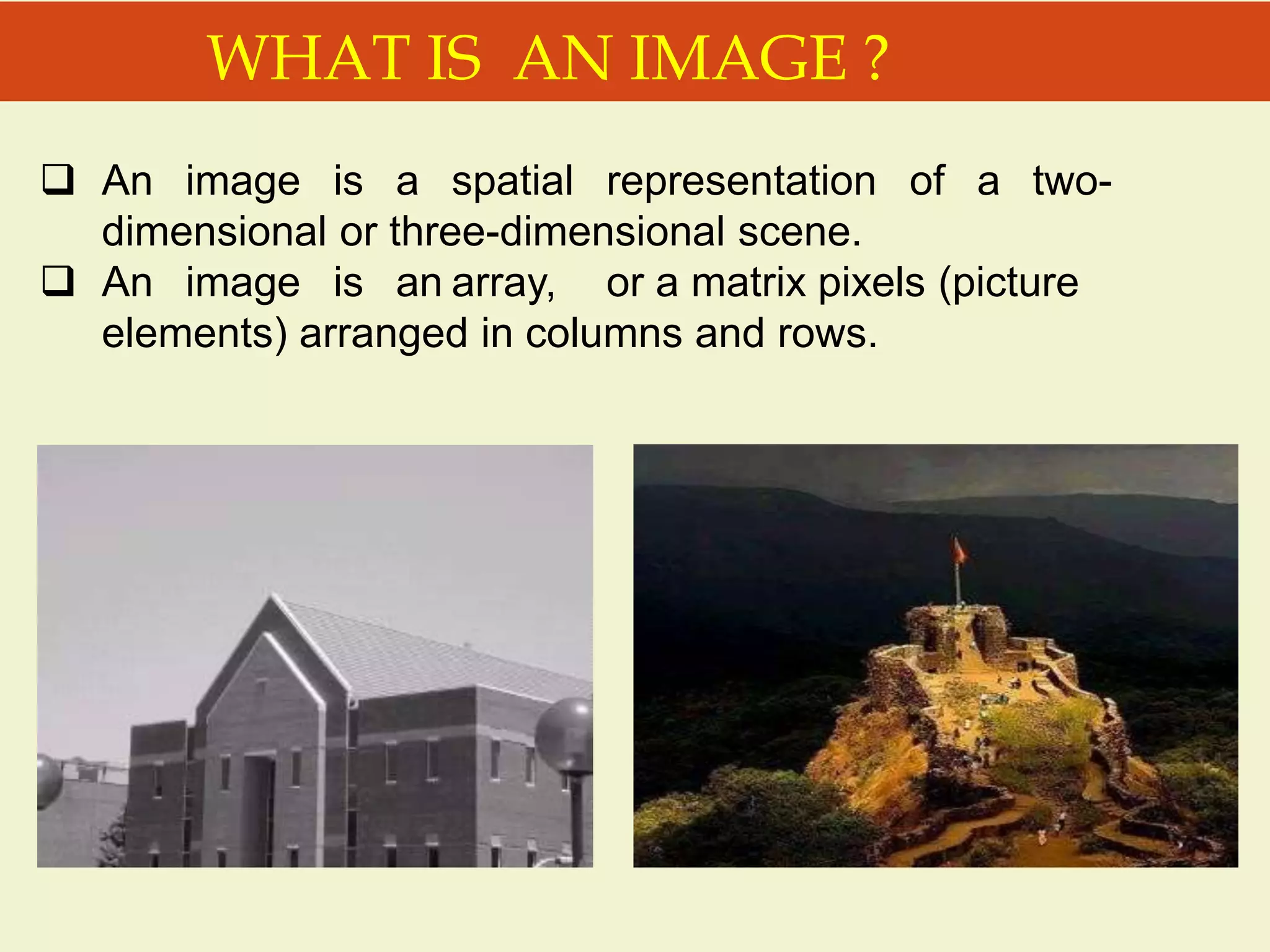
• Military
• Tracking and localizing
• Detection
• Missile guidance
• Traffic and Road Monitoring
• Traffic monitoring
• Adaptive traffic lights
26
Cruise Missiles
WHY IMAGE PROCESSING?
Digital image processing focuses on two major tasks
• Improvement of pictorial information for human
interpretation
• Processing of image data for storage, transmission
and representation for autonomous machine
perception
WHAT IS AN IMAGE ?
 An image is a spatial representation of a two-
dimensional or three-dimensional scene.
 An image is an array, or a matrix pixels (picture
elements) arranged in columns and rows.
WHAT IS AN IMAGE ?
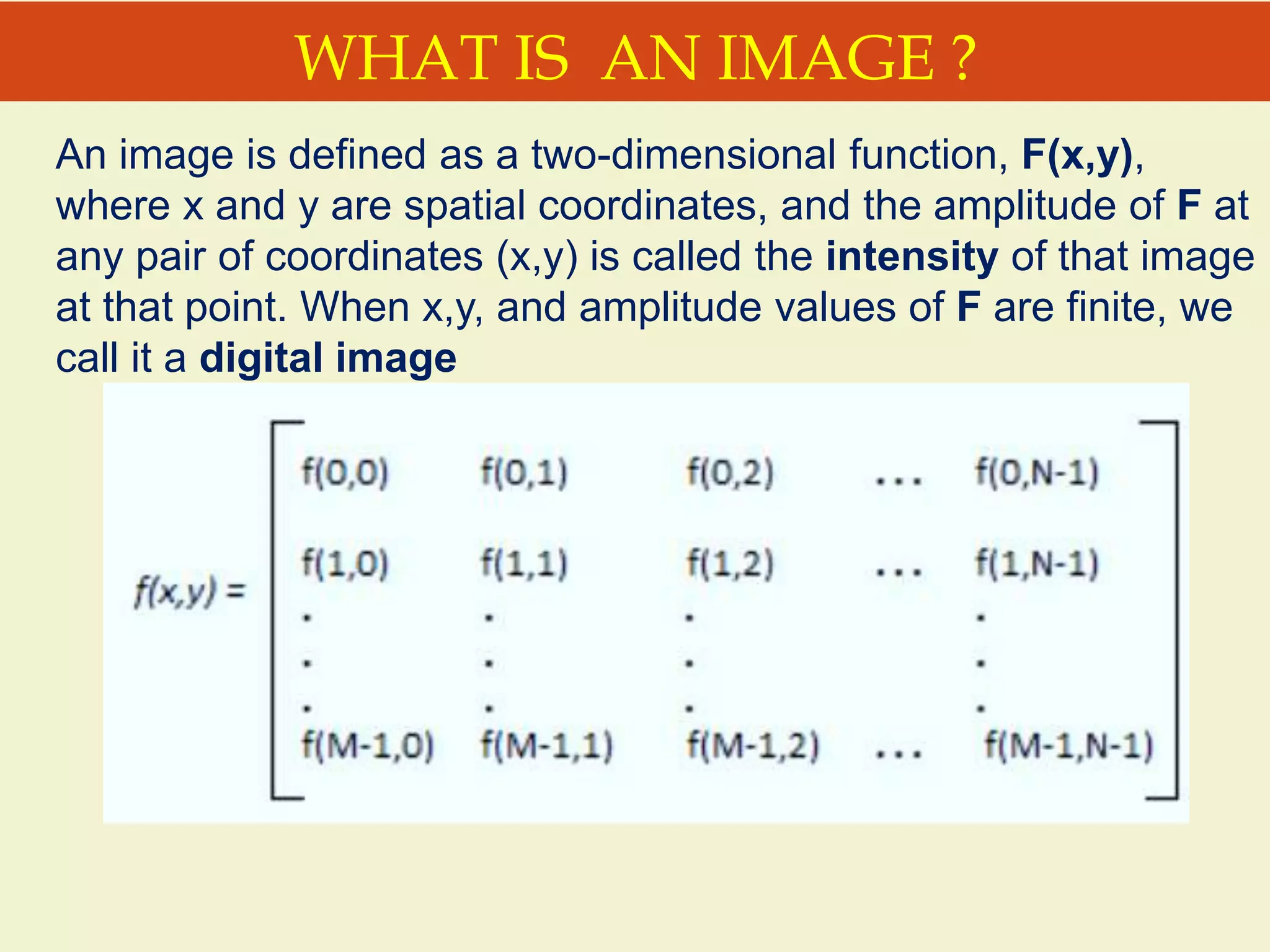
An image is defined as a two-dimensional function, F(x,y),
where x and y are spatial coordinates, and the amplitude of F at
any pair of coordinates (x,y) is called the intensity of that image
at that point. When x,y, and amplitude values of F are finite, we
call it a digital image
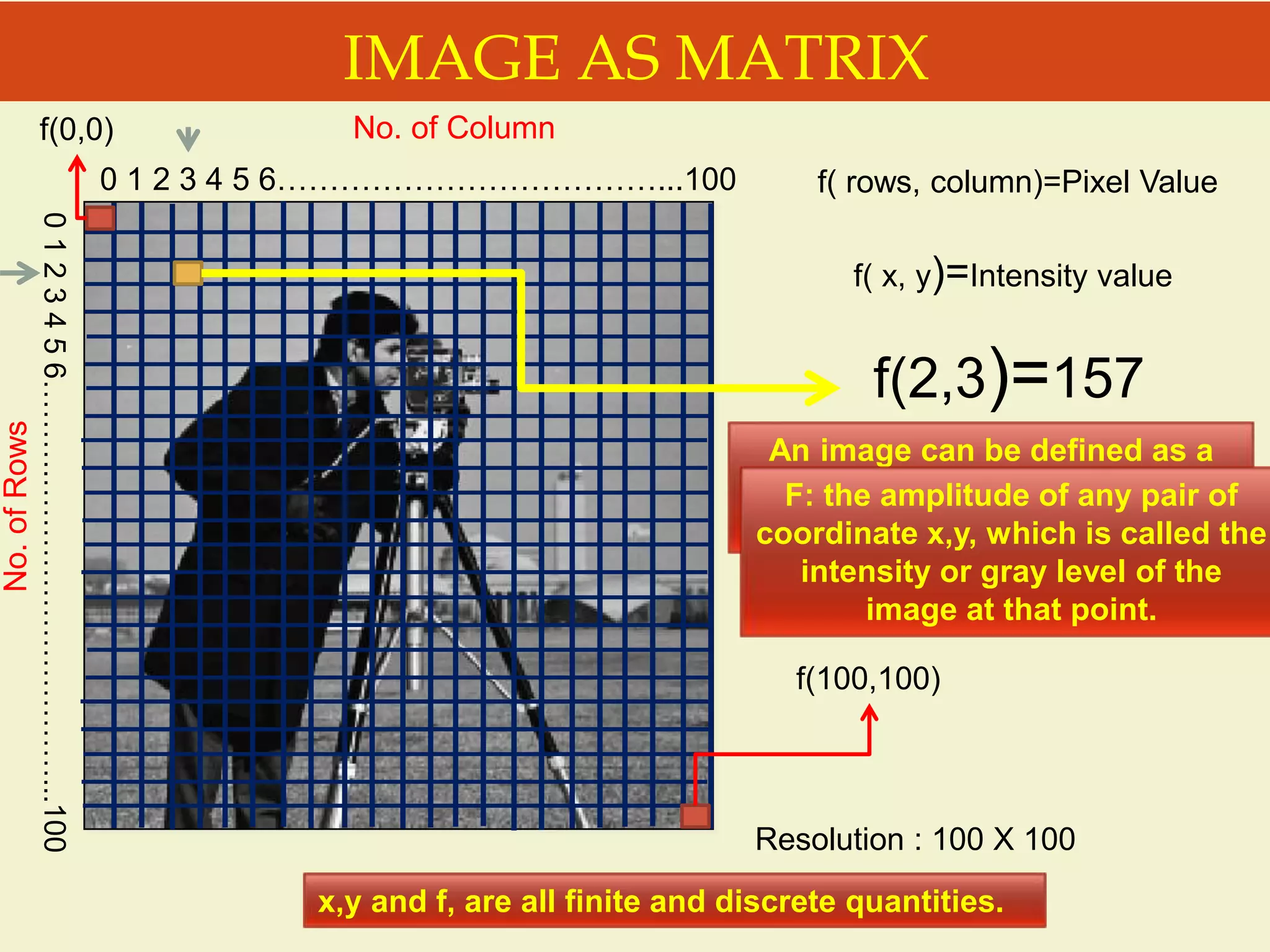
IMAGE AS MATRIX
0 1 2 3 4 5 6………………………………...100
0123456……….…………………………...100
No. of Column
No.ofRows
f( rows, column)=Pixel Value
f(2,3)=157
f( x, y)=Intensity value
Resolution : 100 X 100
f(100,100)
f(0,0)
An image can be defined as a
two-dimensional function f(x,y)
x,y: Spatial coordinate
F: the amplitude of any pair of
coordinate x,y, which is called the
intensity or gray level of the
image at that point.
x,y and f, are all finite and discrete quantities.
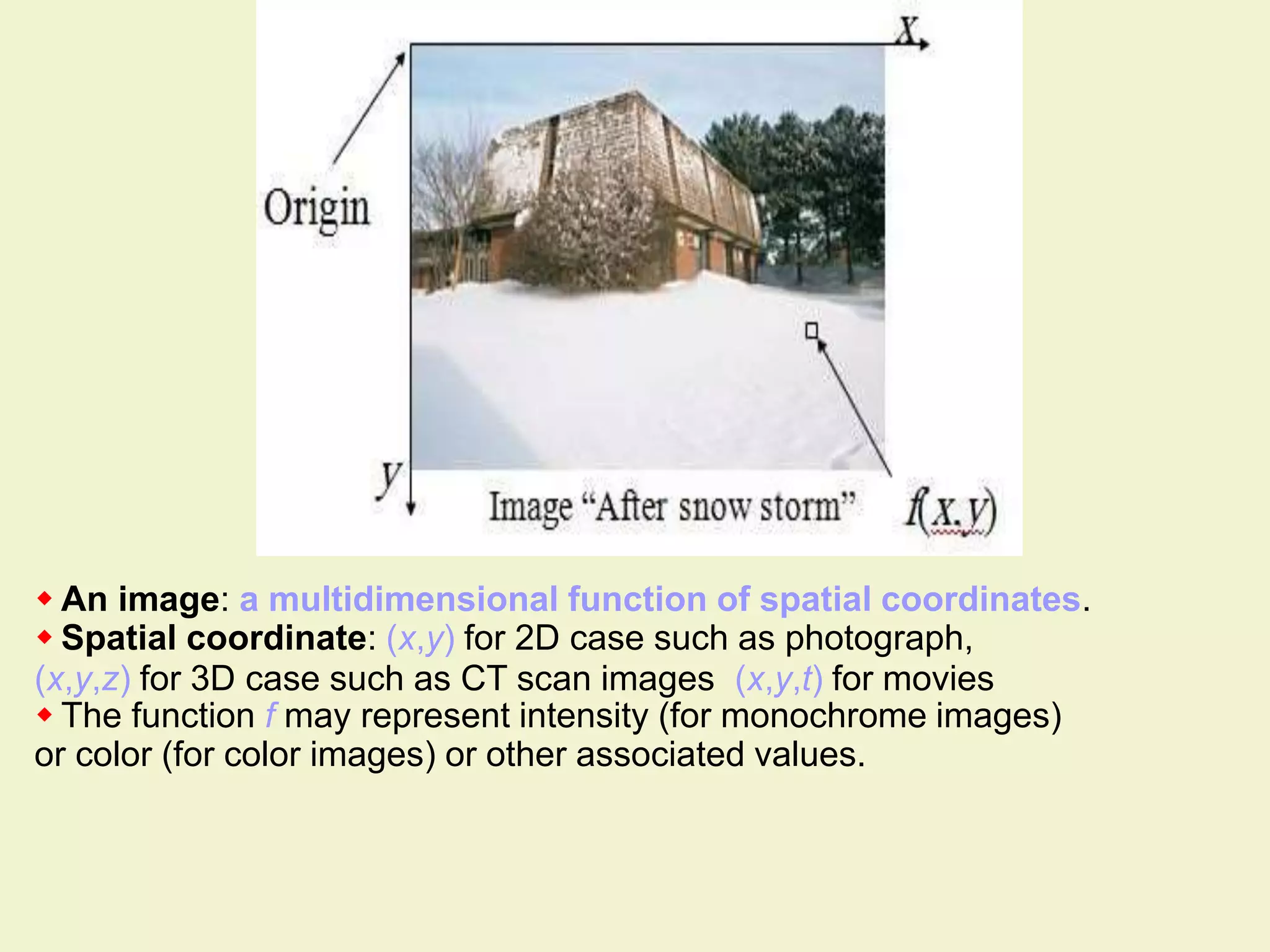
 An image: a multidimensional function of spatial coordinates.
 Spatial coordinate: (x,y) for 2D case such as photograph,
(x,y,z) for 3D case such as CT scan images (x,y,t) for movies
 The function f may represent intensity (for monochrome images)
or color (for color images) or other associated values.
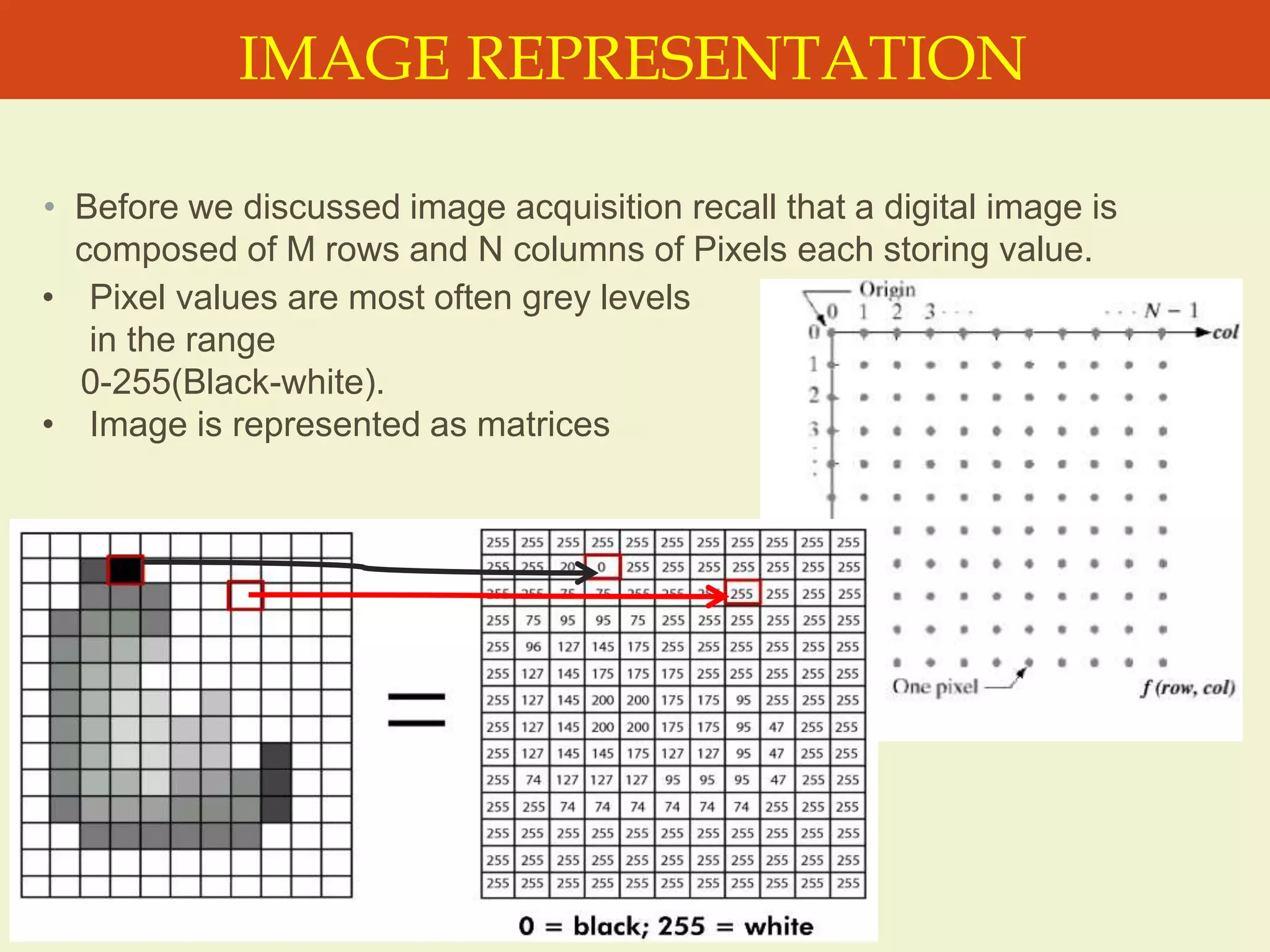
IMAGE REPRESENTATION
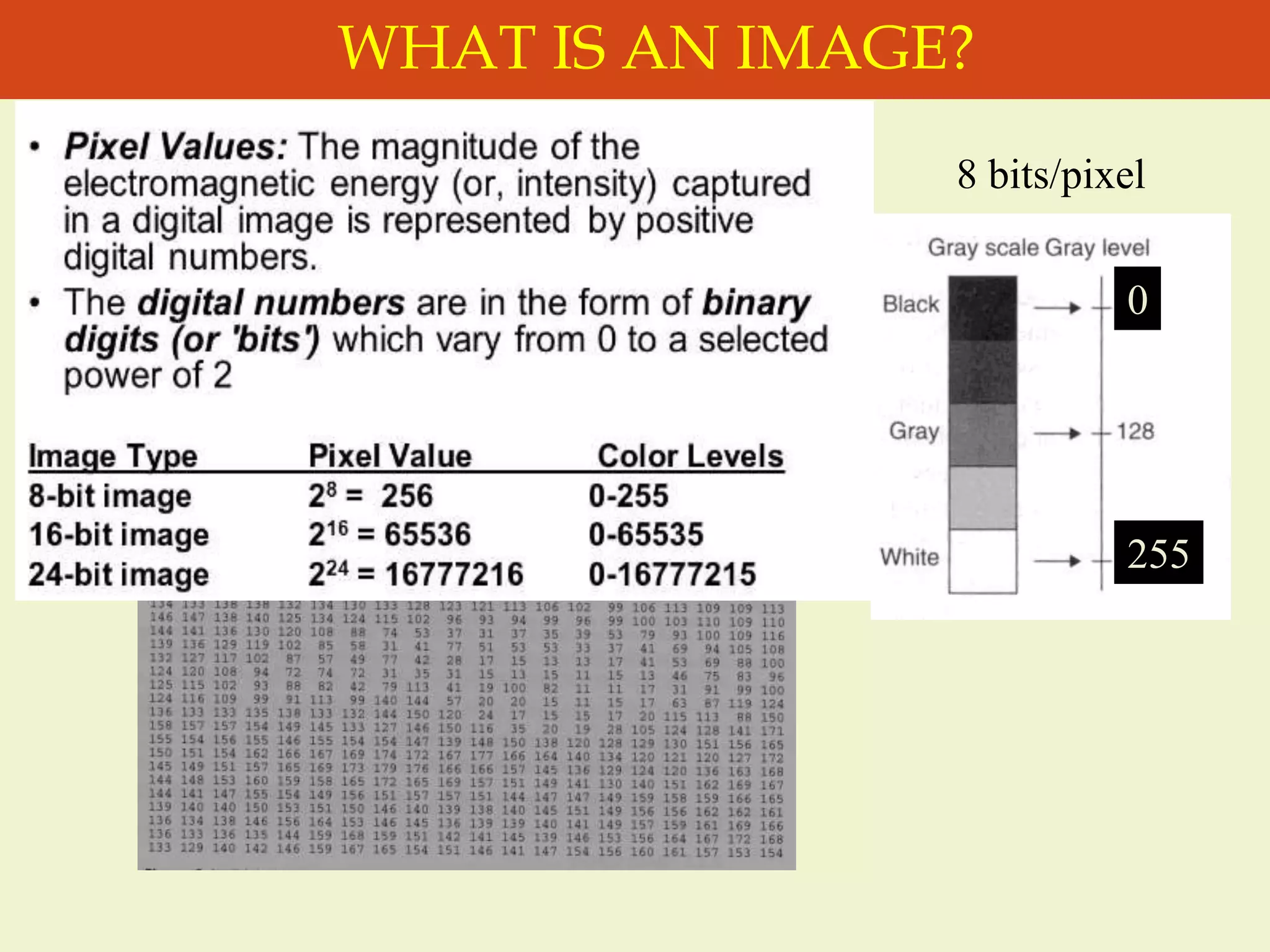
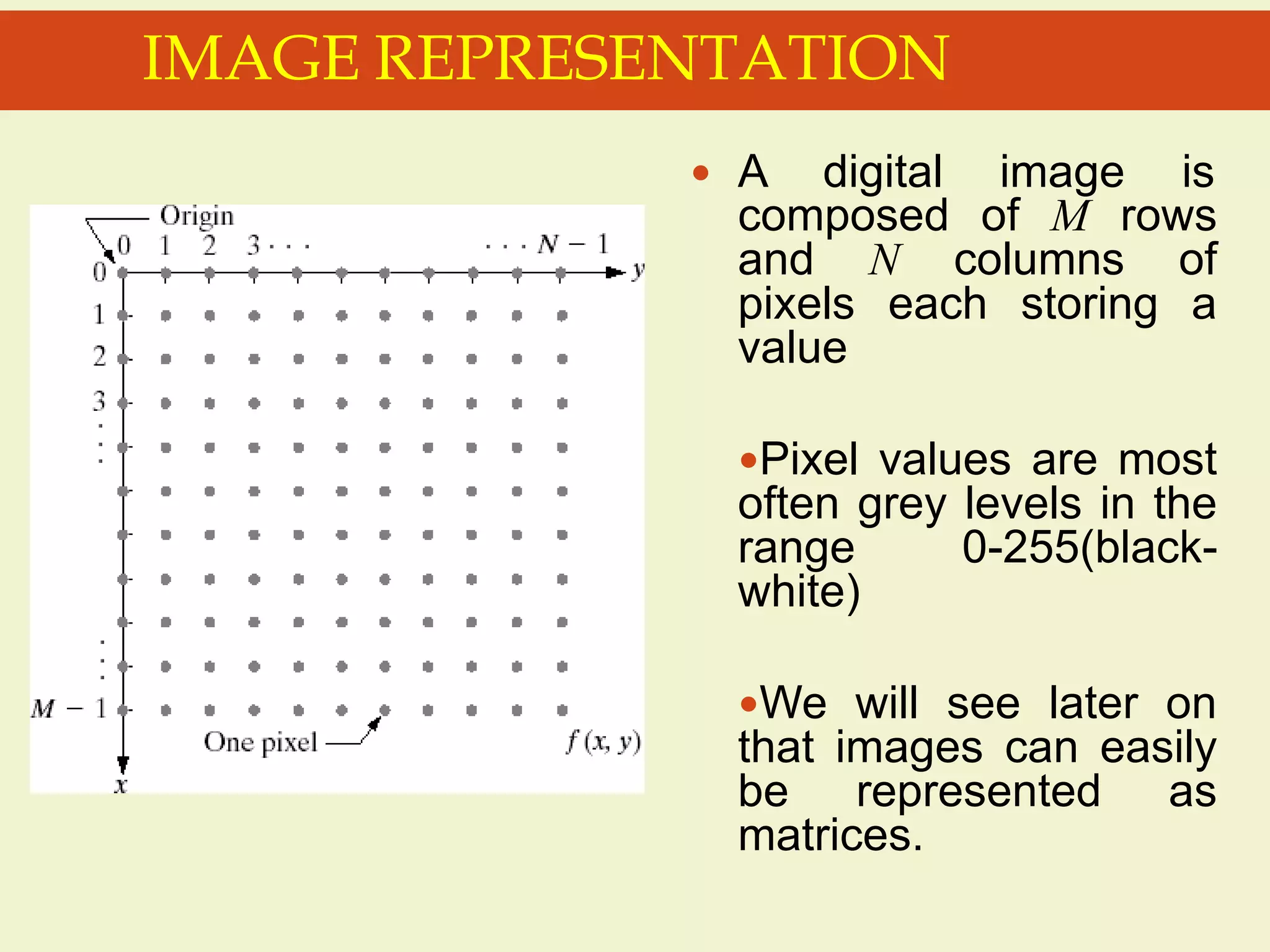
• Before we discussed image acquisition recall that a digital image is
composed of M rows and N columns of Pixels each storing value.
• Pixel values are most often grey levels
in the range
0-255(Black-white).
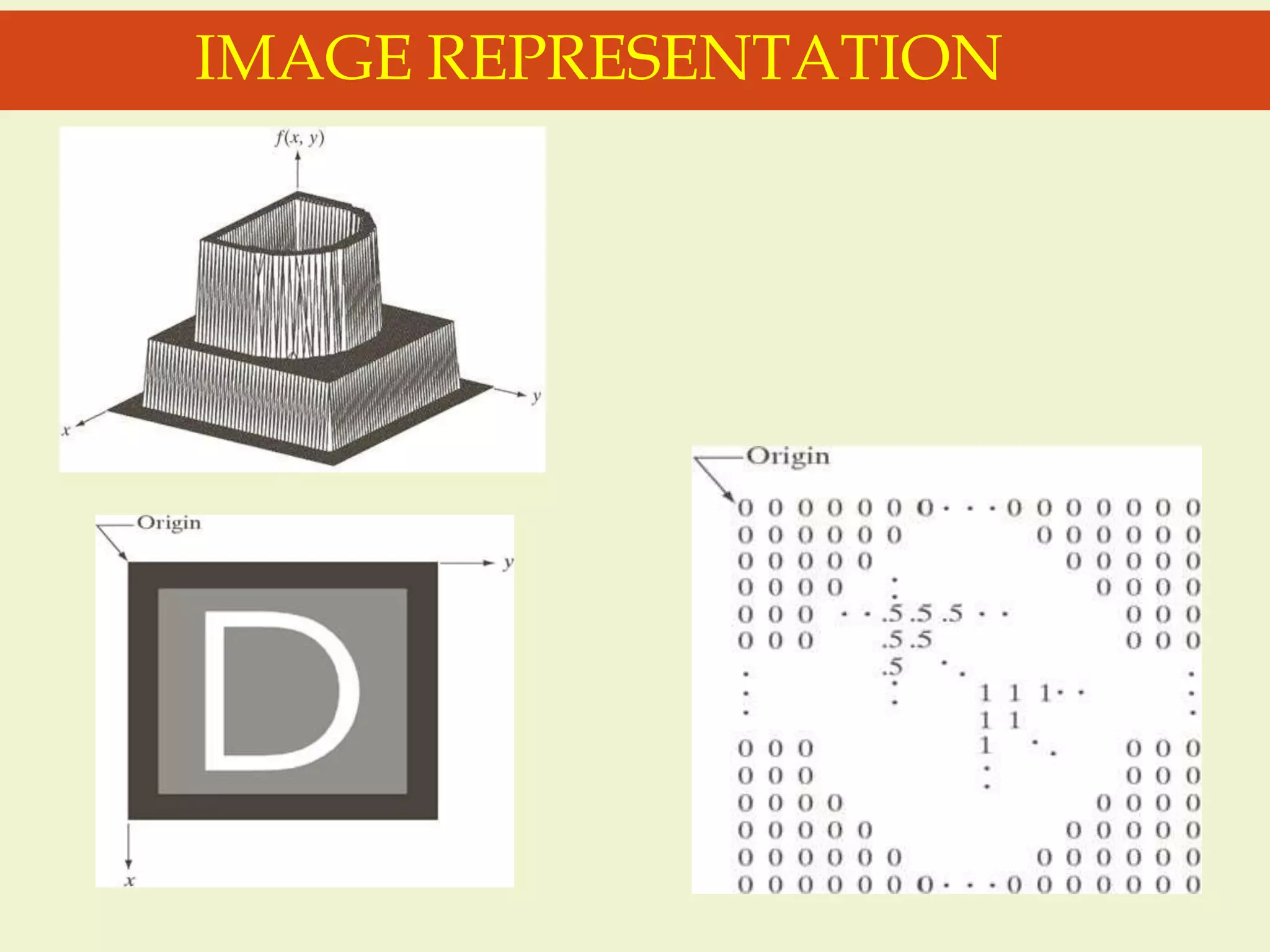
• Image is represented as matrices
8 bits/pixel
0
255
WHAT IS AN IMAGE?
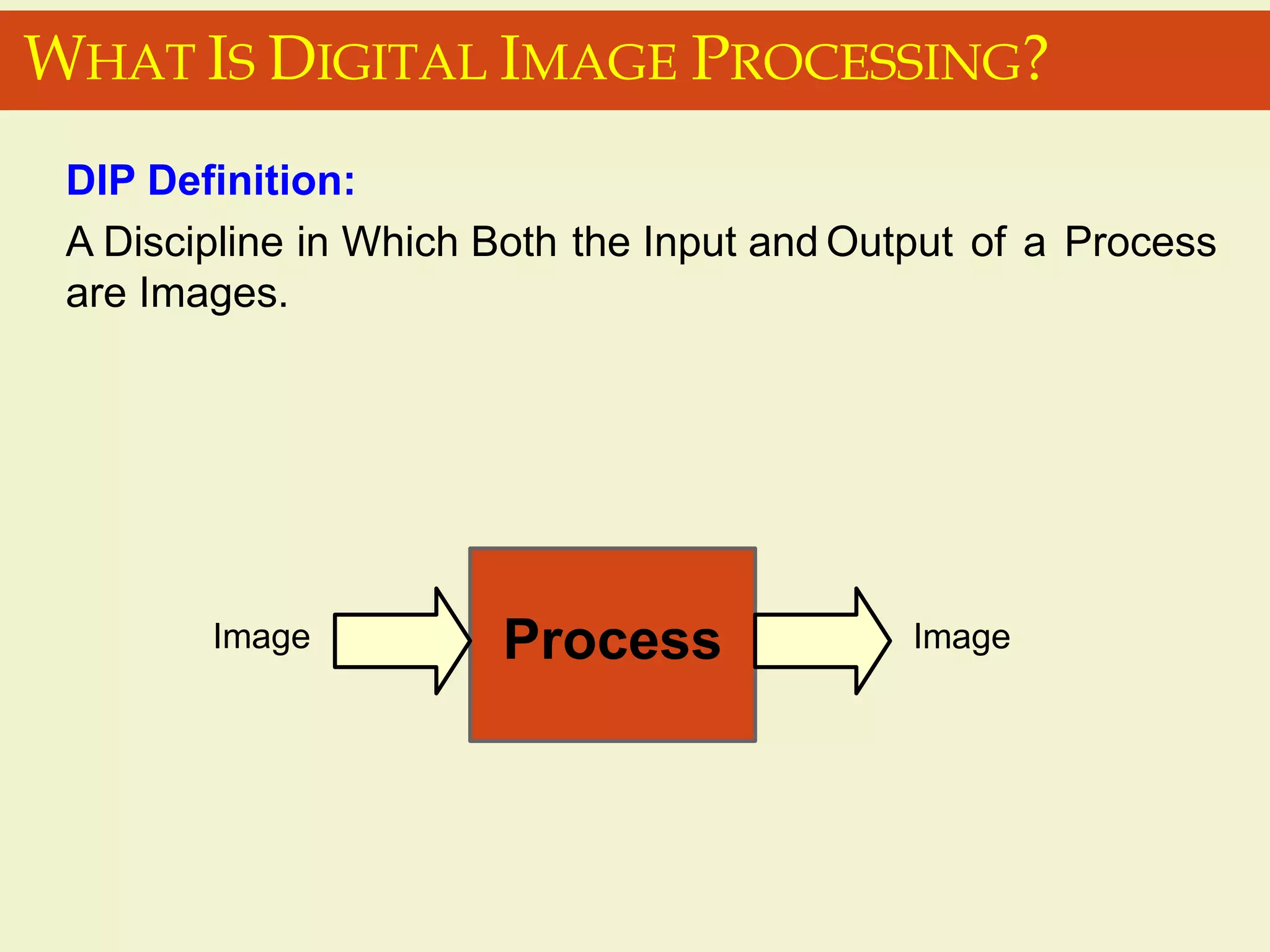
DIP Definition:
A Discipline in Which Both the Input and Output of a Process
are Images.
WHAT IS DIGITAL IMAGE PROCESSING?
ProcessImage Image
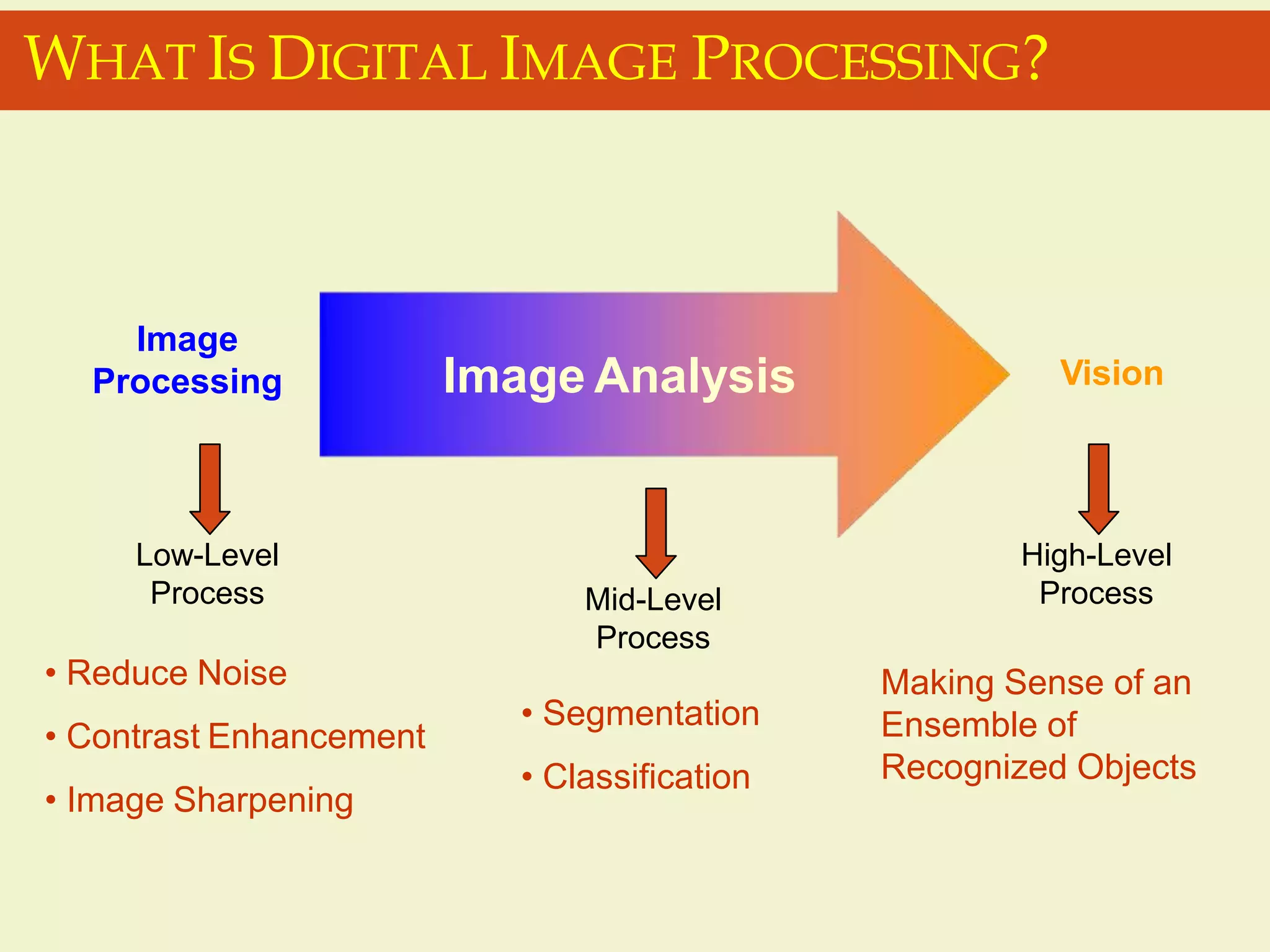
Image
Processing Vision
Low-Level
Process Mid-Level
Process
High-Level
Process
• Reduce Noise
• Contrast Enhancement
• Image Sharpening
• Segmentation
• Classification
Making Sense of an
Ensemble of
Recognized Objects
Image Analysis
WHAT IS DIGITAL IMAGE PROCESSING?
IMAGE PROCESSING BASICS
IMAGE REPRESENTATION
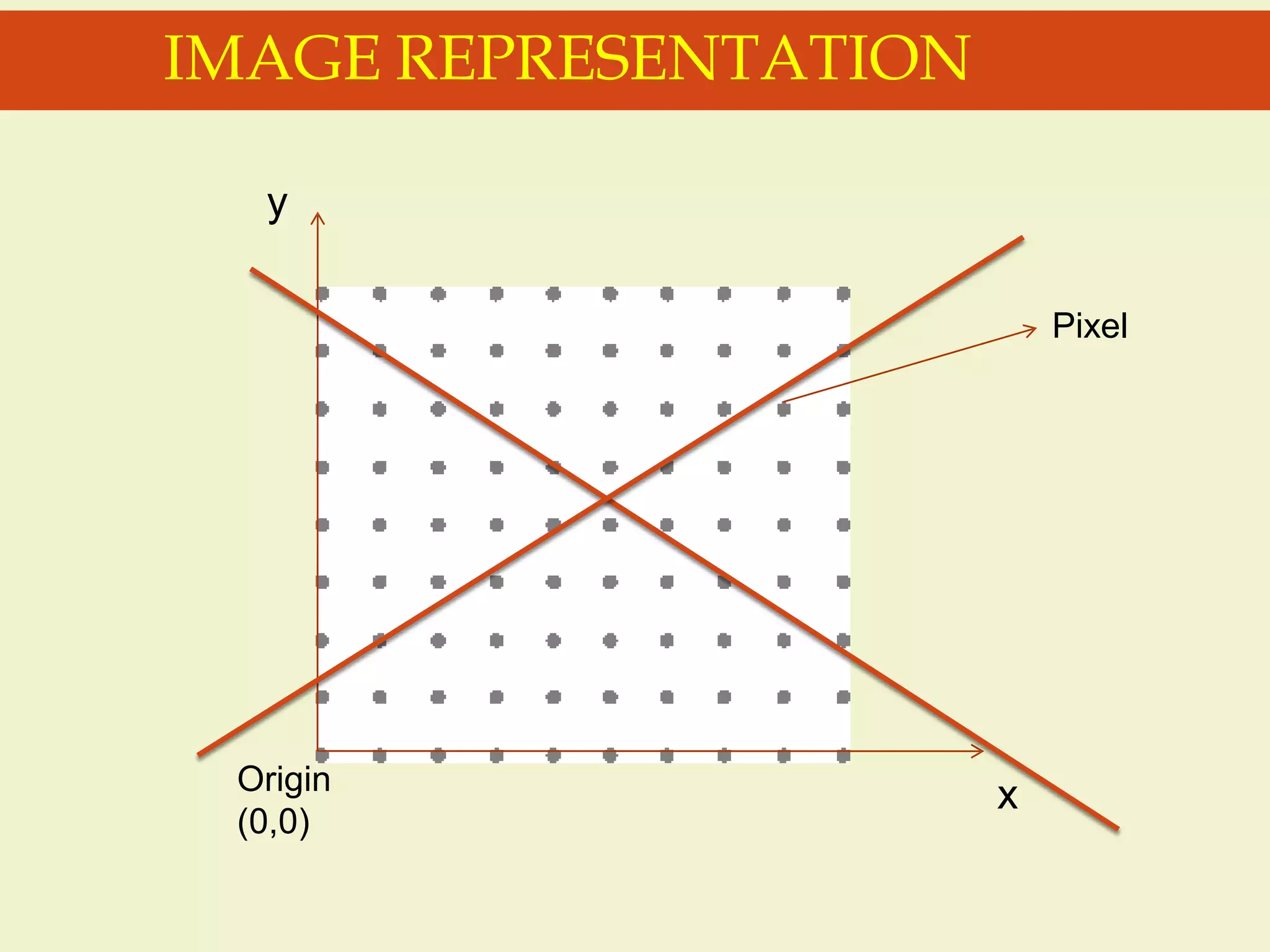
x
y
Origin
(0,0)
Pixel
 A digital image is
composed of M rows
and N columns of
pixels each storing a
value
Pixel values are most
often grey levels in the
range 0-255(black-
white)
We will see later on
that images can easily
be represented as
matrices.
IMAGE REPRESENTATION
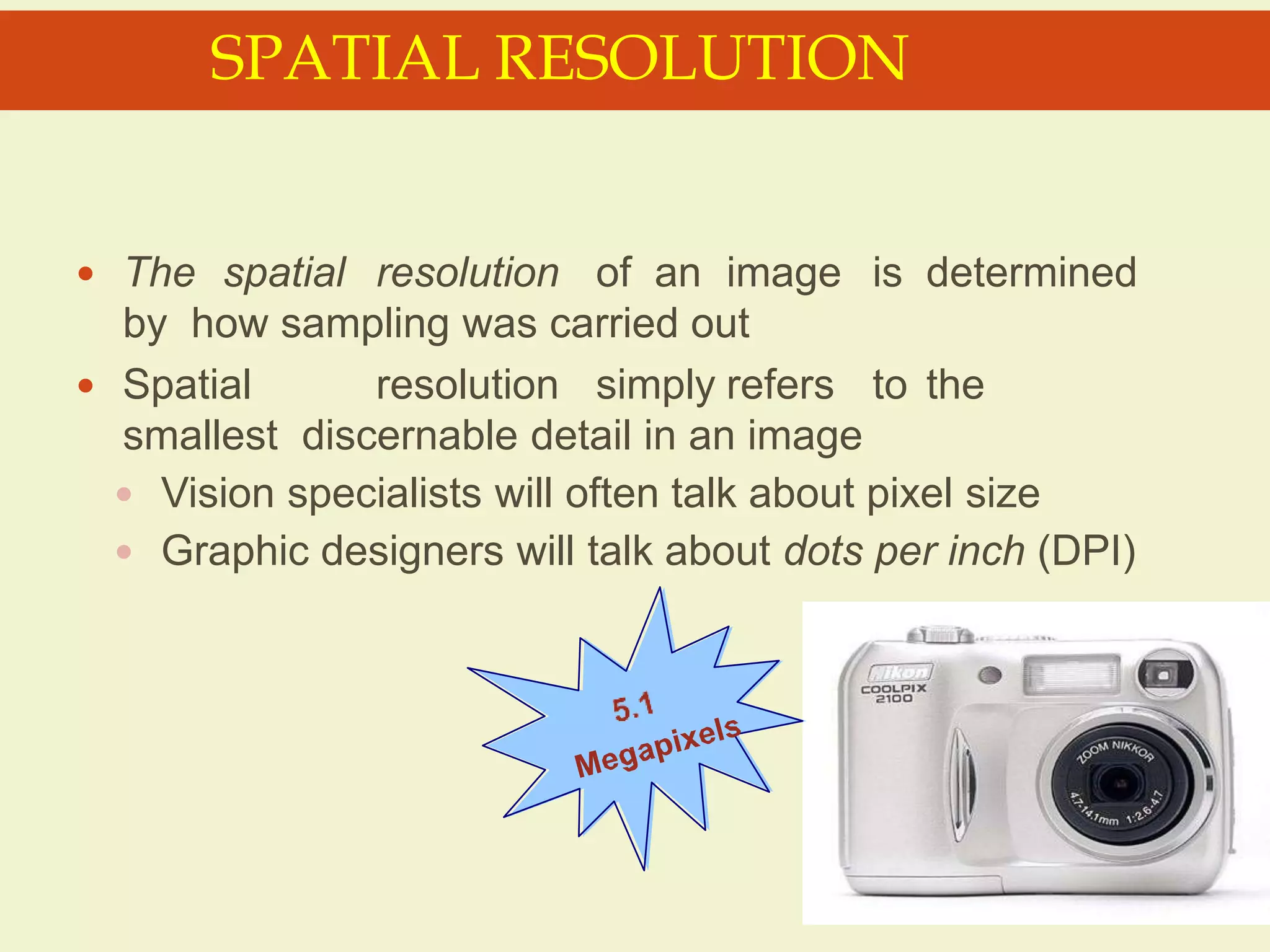
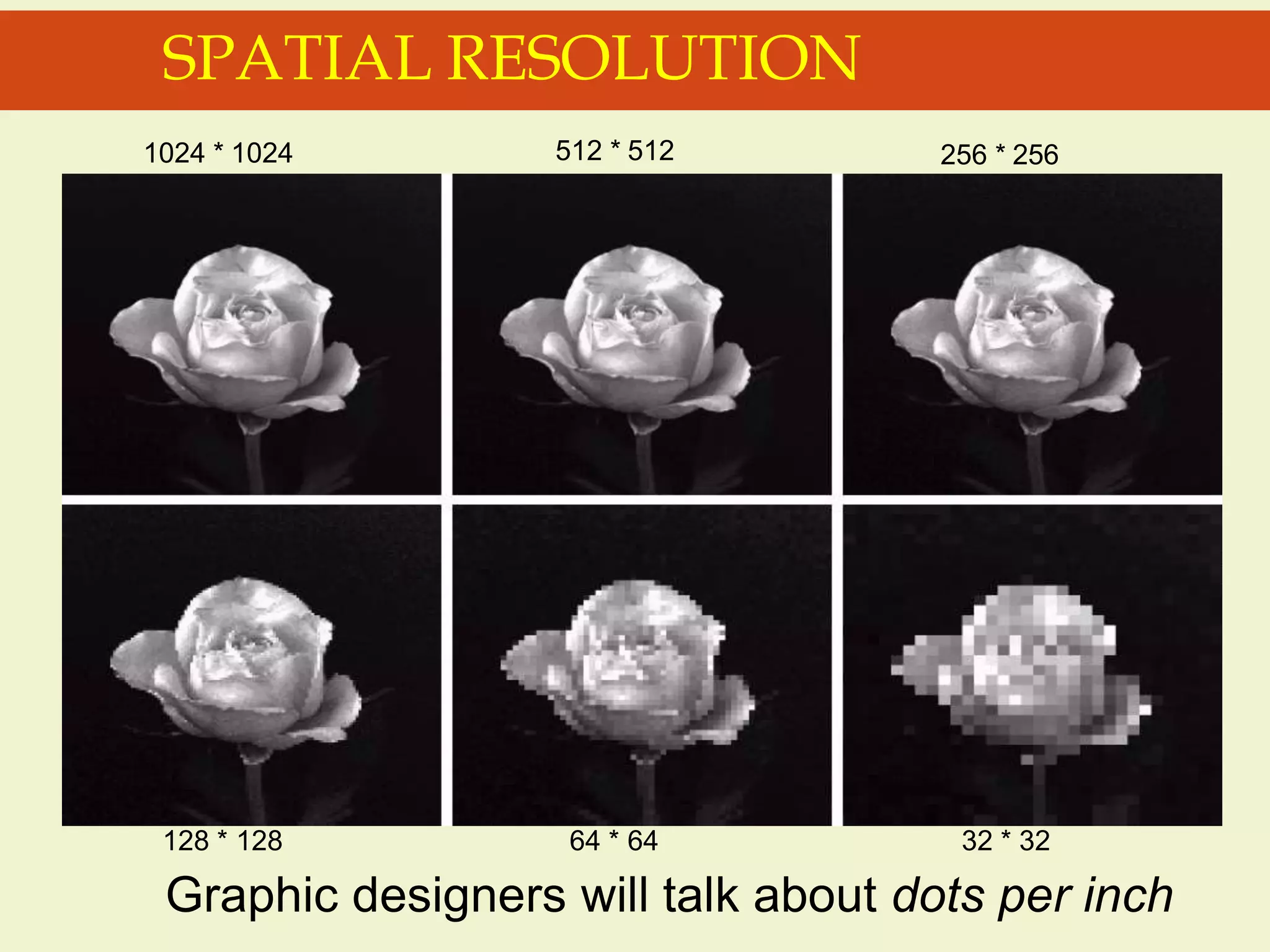
 The spatial resolution of an image is determined
by how sampling was carried out
 Spatial resolution simply refers to the
smallest discernable detail in an image
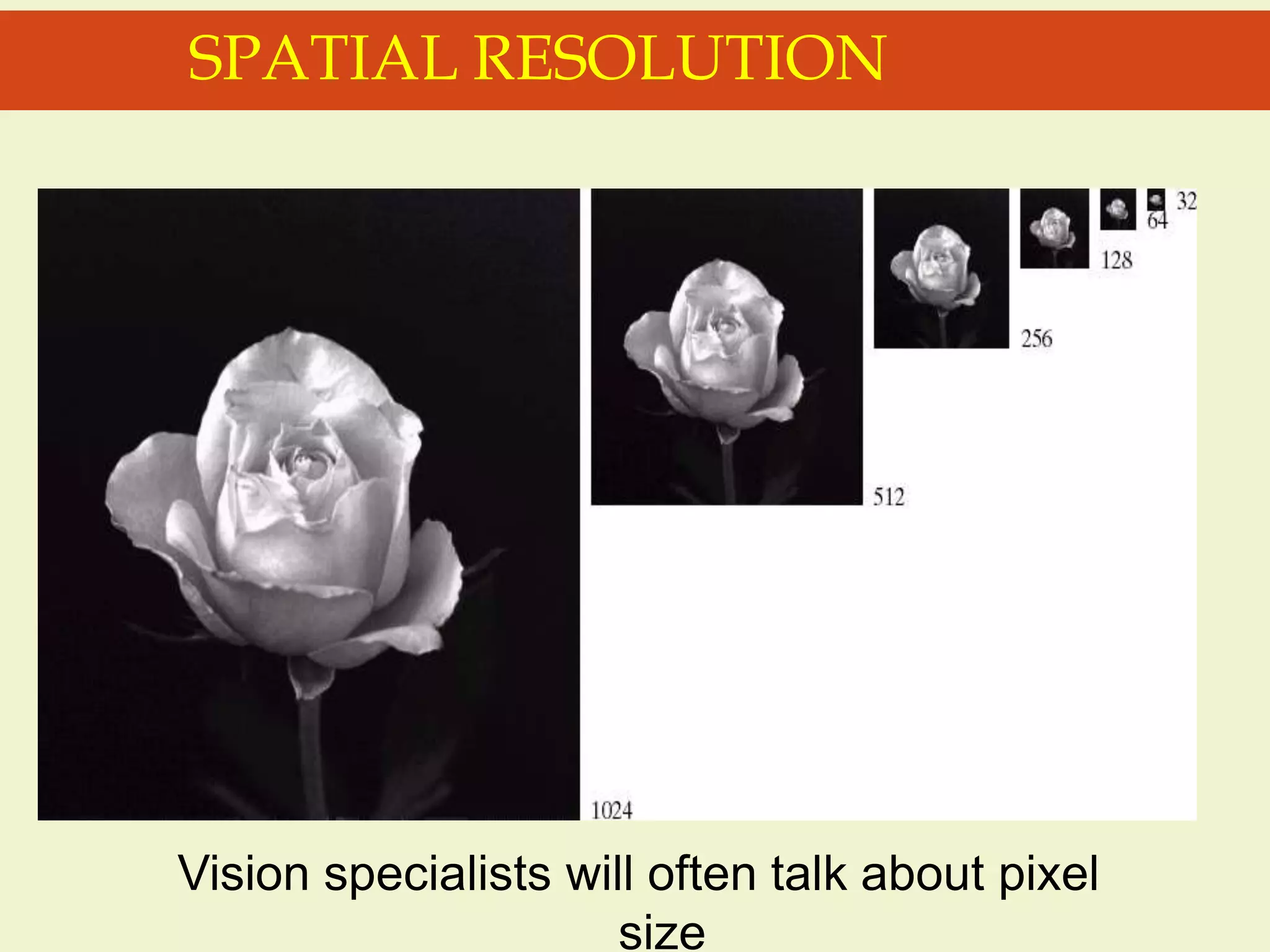
 Vision specialists will often talk about pixel size
 Graphic designers will talk about dots per inch (DPI)
SPATIAL RESOLUTION
SPATIAL RESOLUTION
Vision specialists will often talk about pixel
size
SPATIAL RESOLUTION
1024 * 1024 512 * 512 256 * 256
128 * 128 64 * 64 32 * 32
Graphic designers will talk about dots per inch
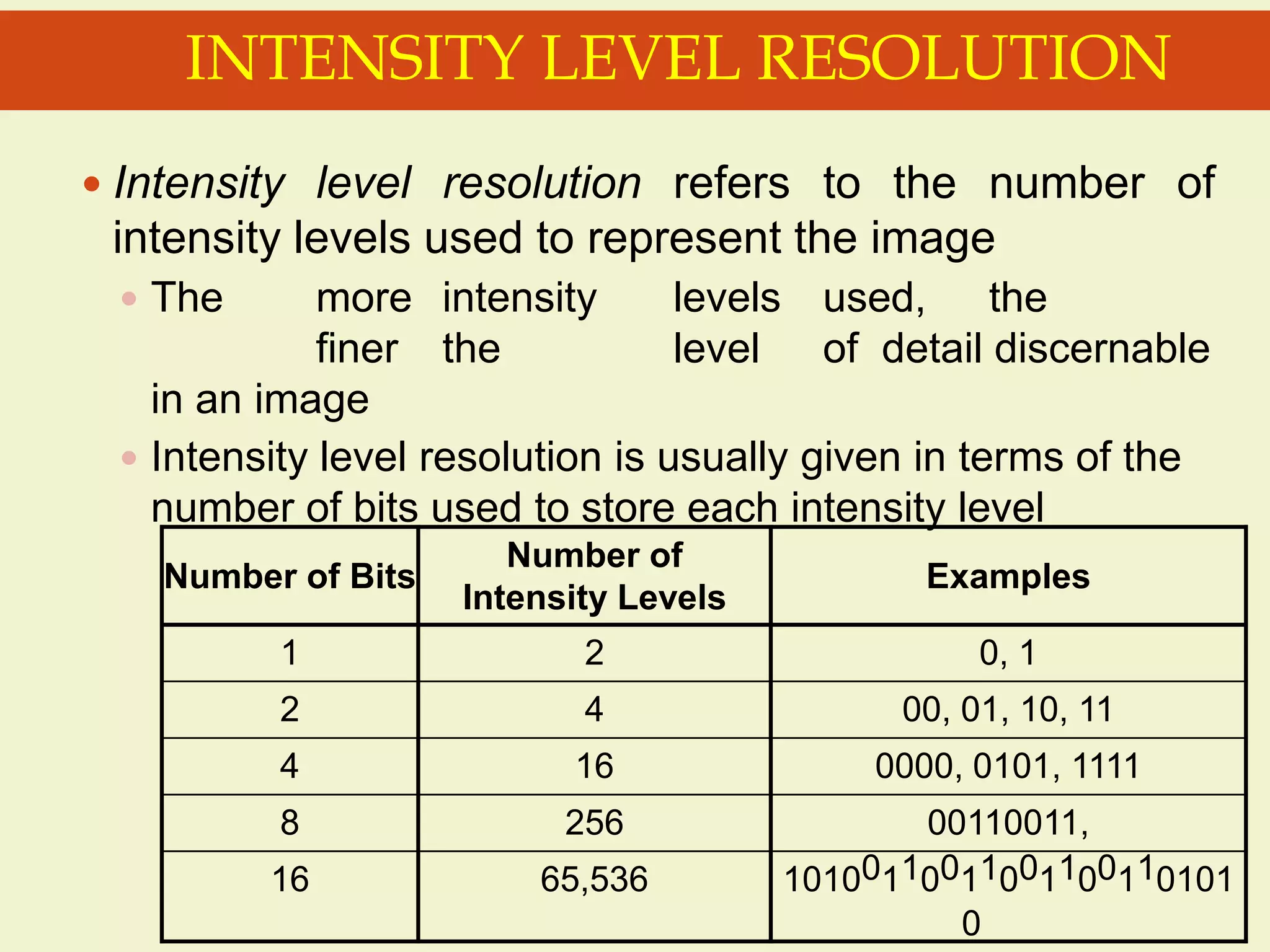
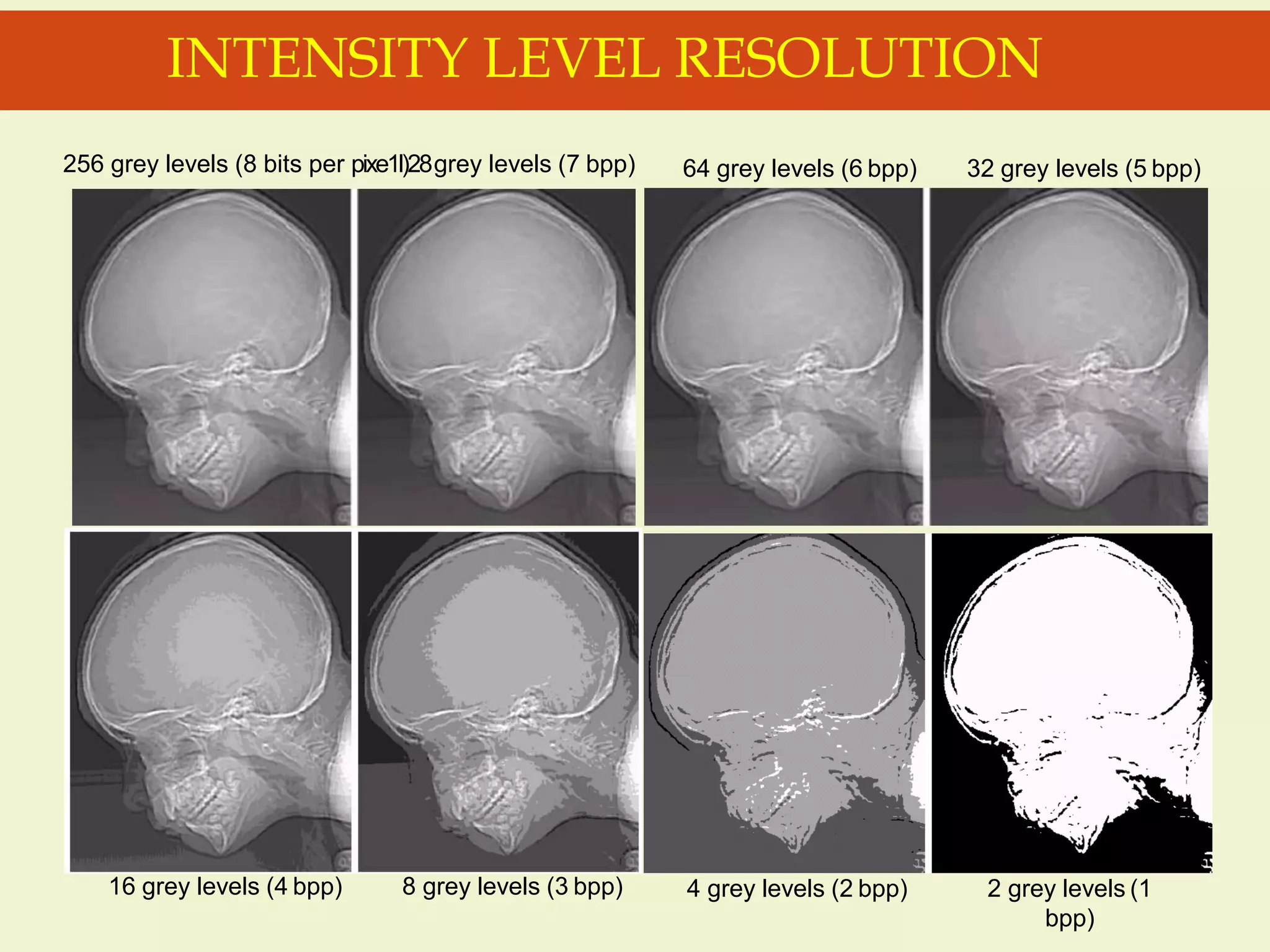
 Intensity level resolution refers to the number of
intensity levels used to represent the image
 The more intensity levels used, the
finer the level of detail discernable
in an image
 Intensity level resolution is usually given in terms of the
number of bits used to store each intensity level
INTENSITY LEVEL RESOLUTION
Number of Bits
Number of
Intensity Levels
Examples
1 2 0, 1
2 4 00, 01, 10, 11
4 16 0000, 0101, 1111
8 256 00110011,
16 65,536 10100110011001100110101
0
INTENSITY LEVEL RESOLUTION
64 grey levels (6 bpp) 32 grey levels (5 bpp)
16 grey levels (4 bpp) 8 grey levels (3 bpp) 4 grey levels (2 bpp) 2 grey levels (1
bpp)
256 grey levels (8 bits per pixe1l)28grey levels (7 bpp)
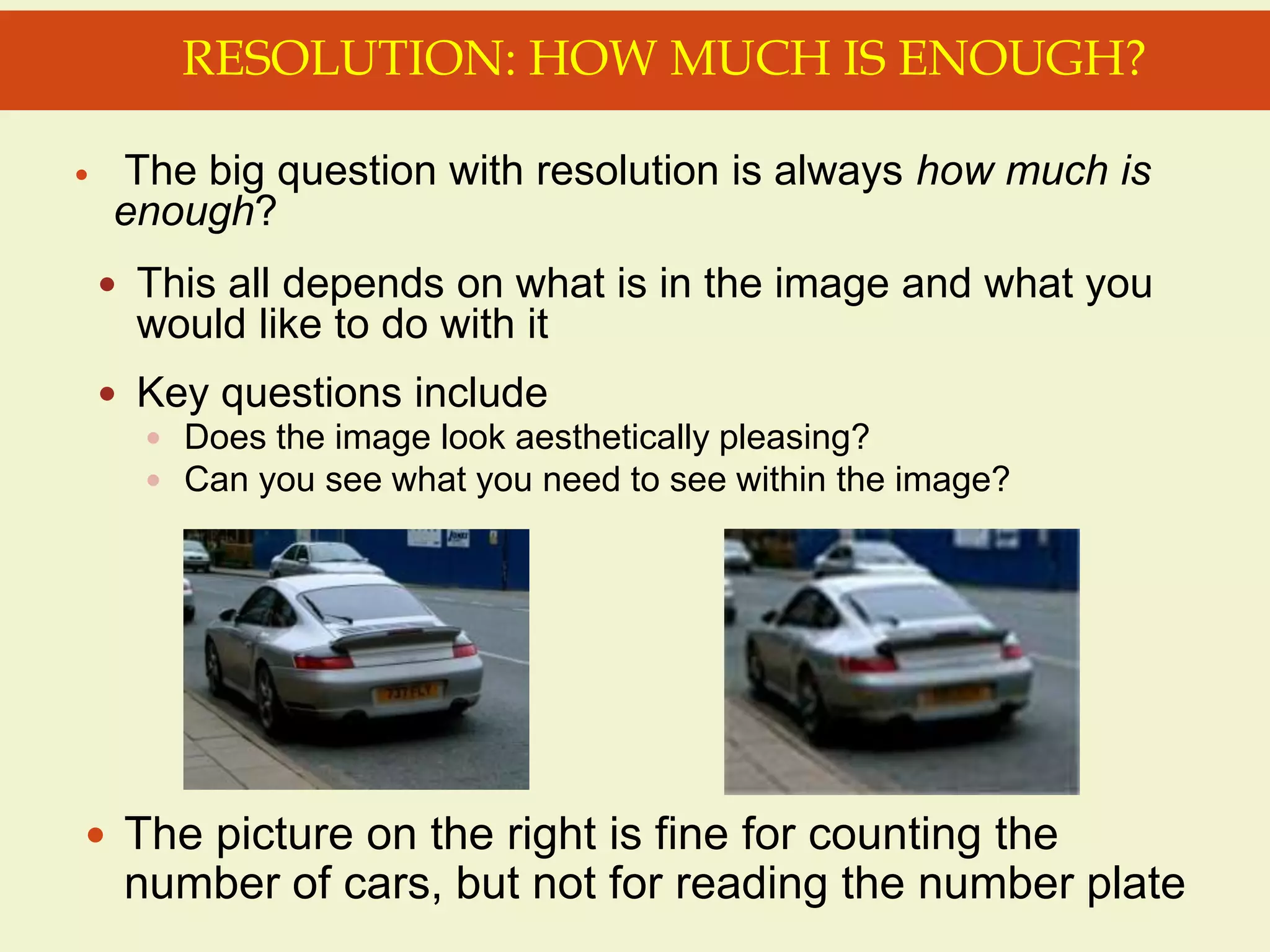
 The big question with resolution is always how much is
enough?
 This all depends on what is in the image and what you
would like to do with it
 Key questions include
 Does the image look aesthetically pleasing?
 Can you see what you need to see within the image?
RESOLUTION: HOW MUCH IS ENOUGH?
 The picture on the right is fine for counting the
number of cars, but not for reading the number plate
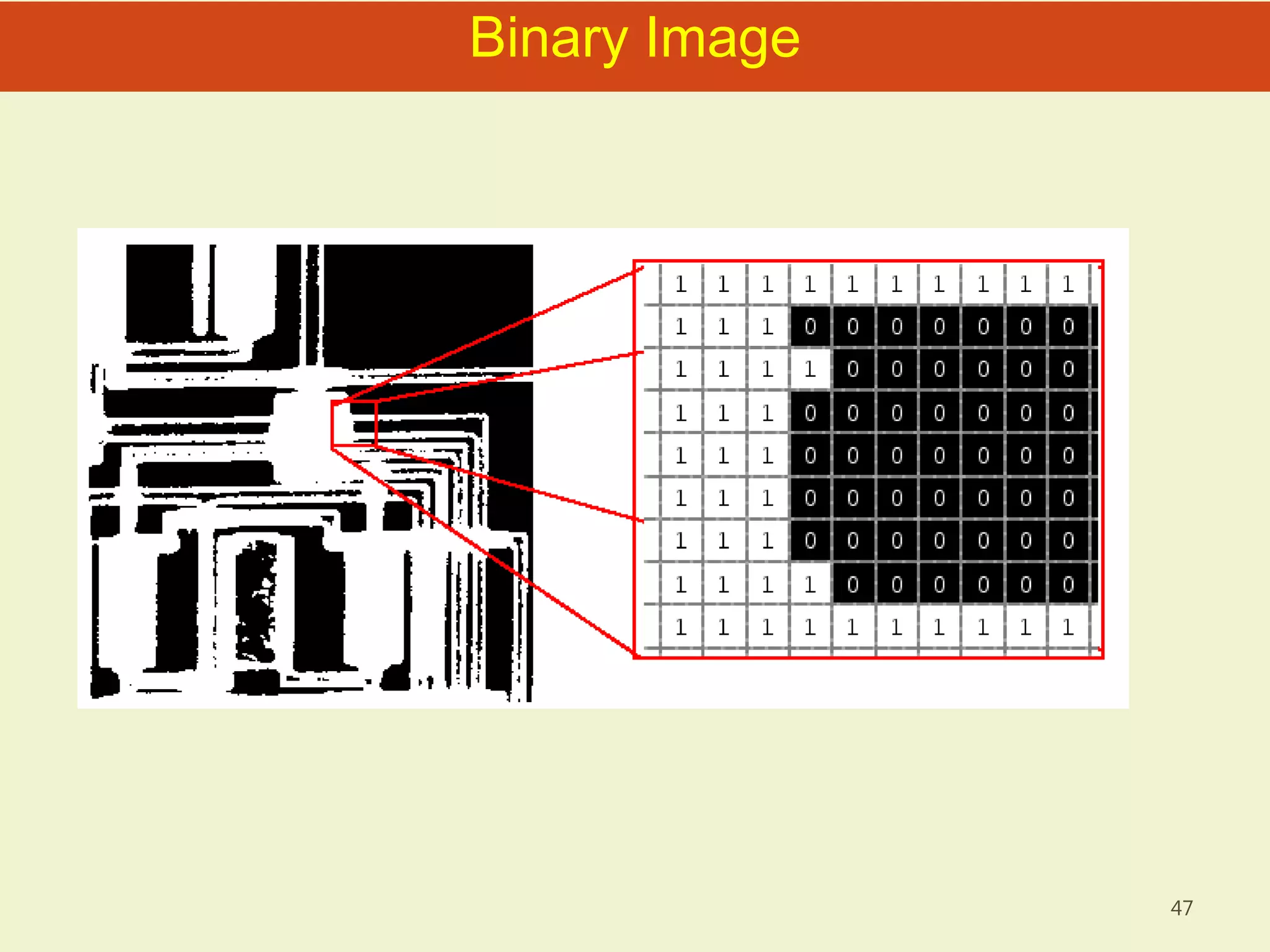
IMAGE TYPES
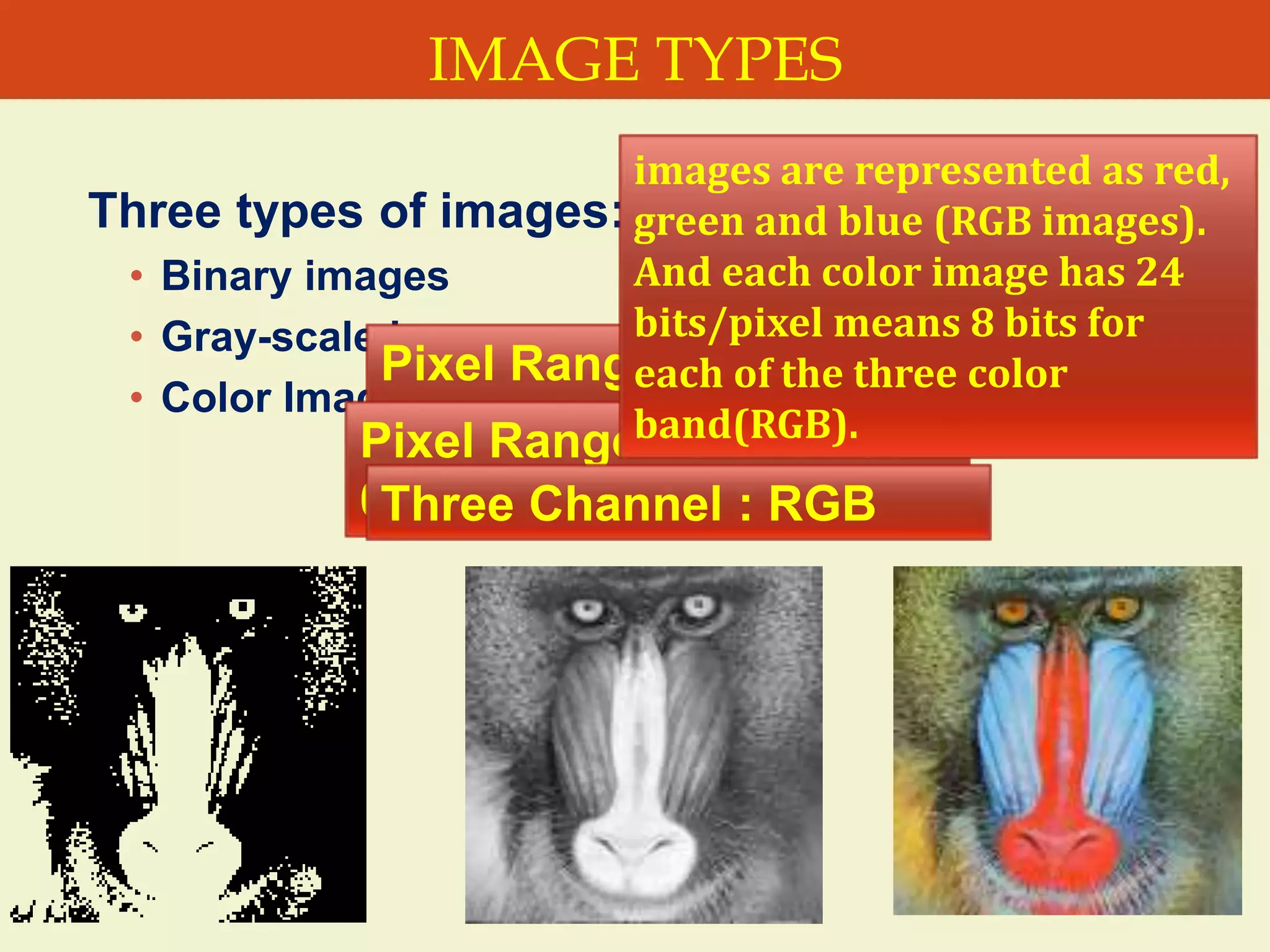
Three types of images:
• Binary images
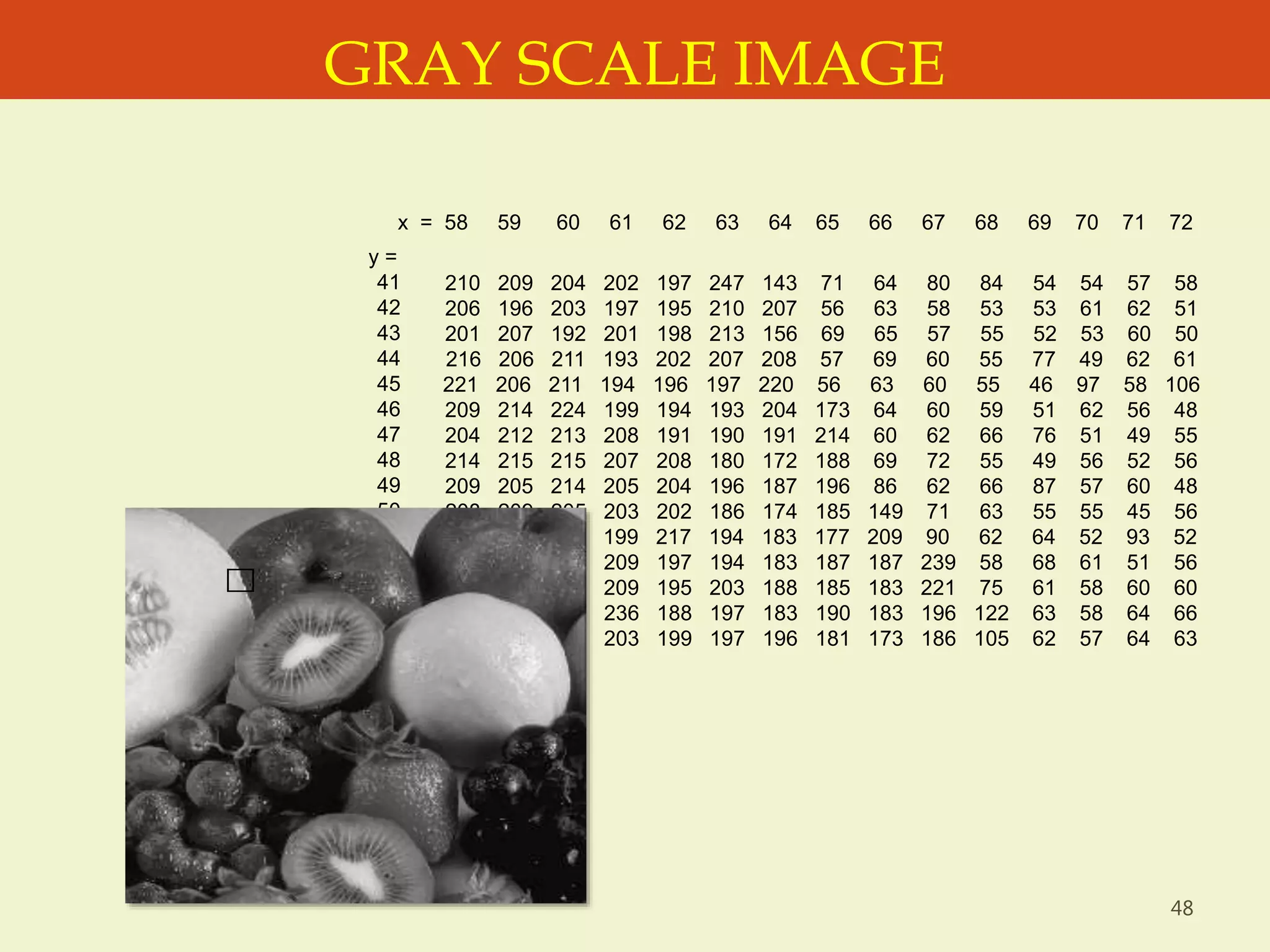
• Gray-scale images
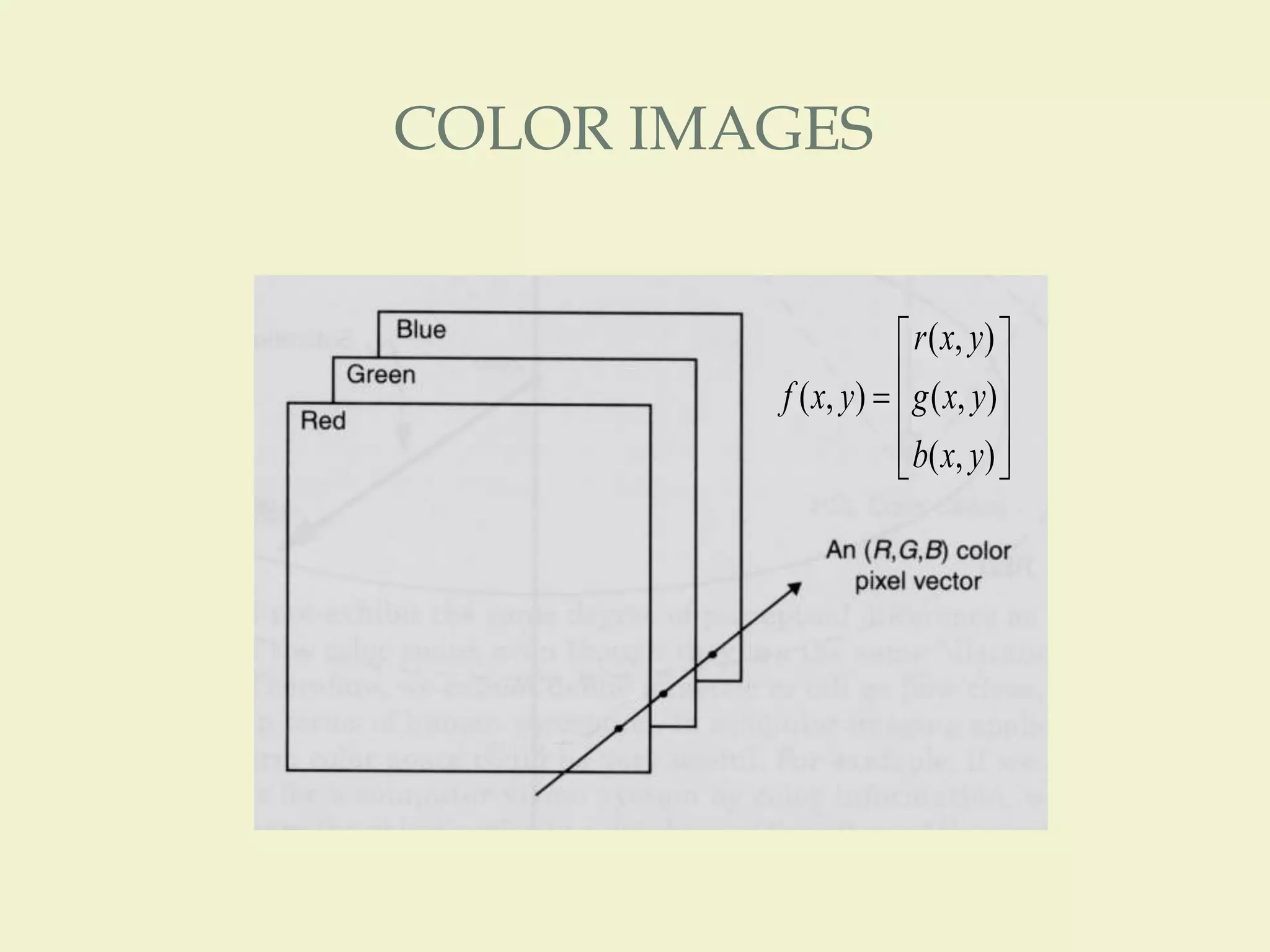
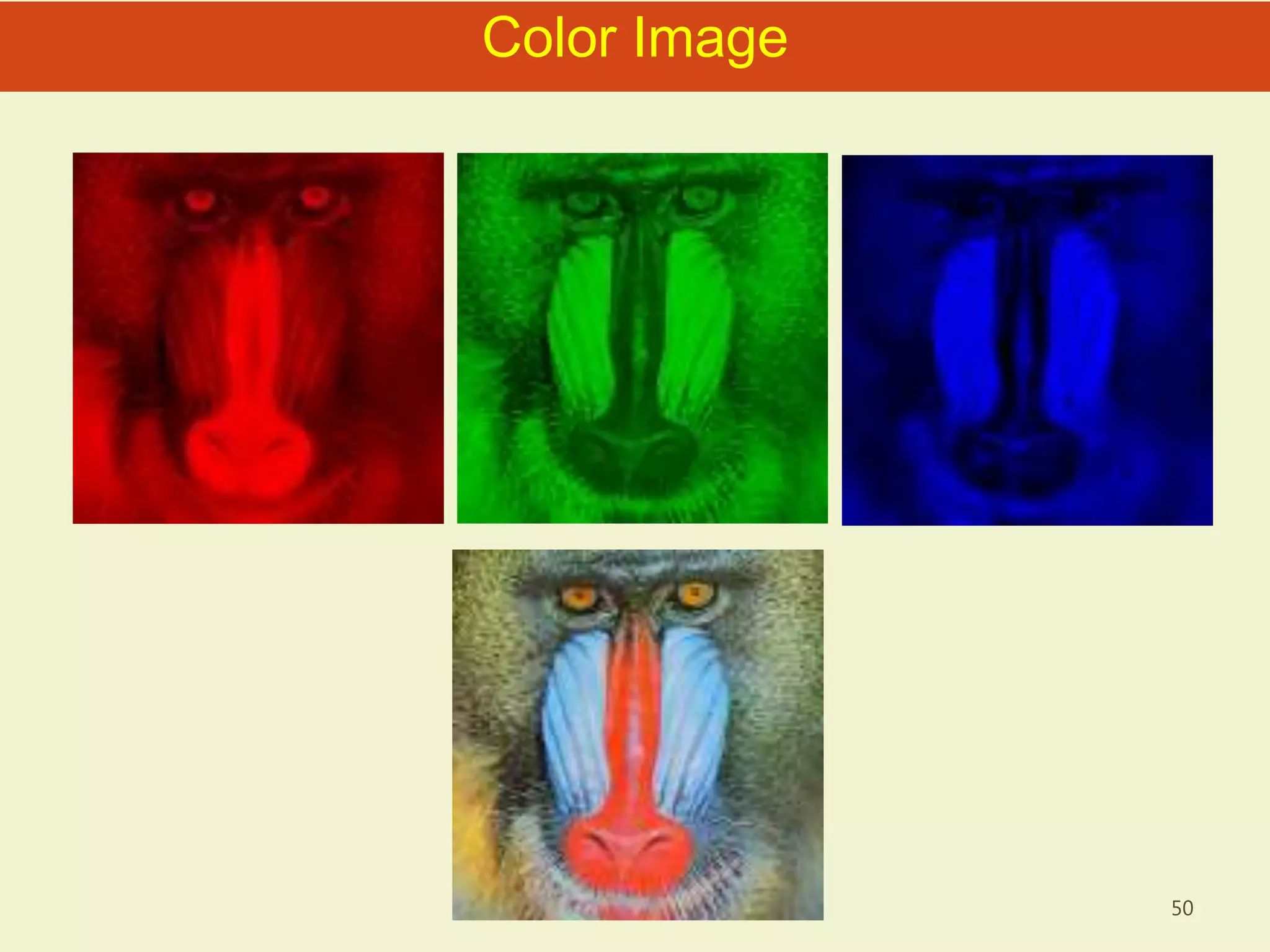
• Color Images
Pixel Range : 0 and 1
0-Black & 1- whitePixel Range : 0 and 255
0-Black & 255-WhiteThree Channel : RGB
images are represented as red,
green and blue (RGB images).
And each color image has 24
bits/pixel means 8 bits for
each of the three color
band(RGB).
47
Binary Image
48
210 209 204 202 197 247 143 71 64 80 84 54 54 57 58
206 196 203 197 195 210 207 56 63 58 53 53 61 62 51
201 207 192 201 198 213 156 69 65 57 55 52 53 60 50
216 206 211 193 202 207 208 57 69 60 55 77 49 62 61
221 206 211 194 196 197 220 56 63 60 55 46 97 58 106
209 214 224 199 194 193 204 173 64 60 59 51 62 56 48
204 212 213 208 191 190 191 214 60 62 66 76 51 49 55
214 215 215 207 208 180 172 188 69 72 55 49 56 52 56
209 205 214 205 204 196 187 196 86 62 66 87 57 60 48
208 209 205 203 202 186 174 185 149 71 63 55 55 45 56
207 210 211 199 217 194 183 177 209 90 62 64 52 93 52
208 205 209 209 197 194 183 187 187 239 58 68 61 51 56
204 206 203 209 195 203 188 185 183 221 75 61 58 60 60
200 203 199 236 188 197 183 190 183 196 122 63 58 64 66
205 210 202 203 199 197 196 181 173 186 105 62 57 64 63
x = 58 59 60 61 62 63 64 65 66 67 68 69 70 71 72
y =
41
42
43
44
45
46
47
48
49
50
51
52
53
54
55
GRAY SCALE IMAGE
COLOR IMAGES
( , )
( , ) ( , )
( , )
r x y
f x y g x y
b x y
 
 
 
  
50
Color Image
COLOR IMAGES
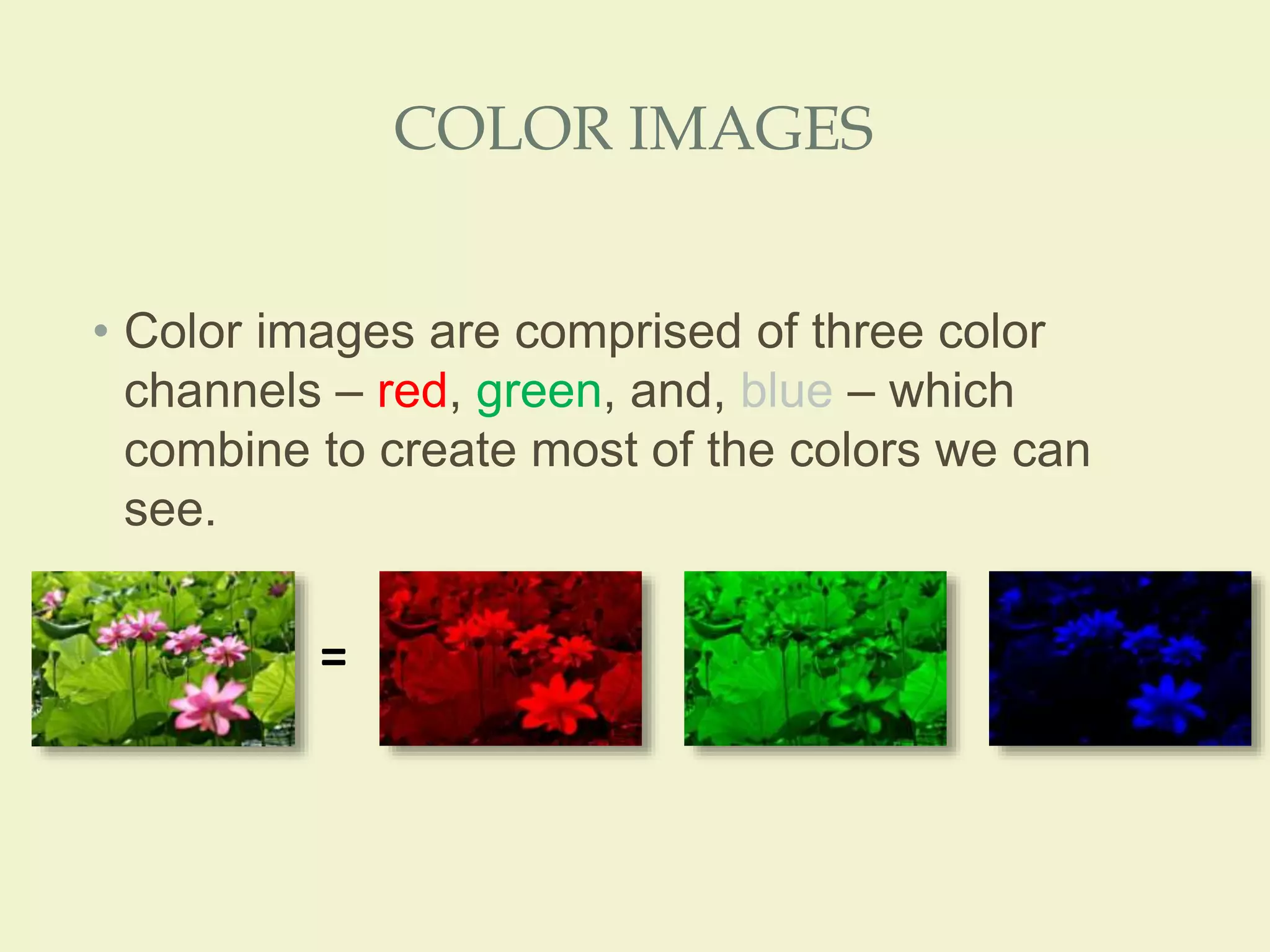
• Color images are comprised of three color
channels – red, green, and, blue – which
combine to create most of the colors we can
see.
=
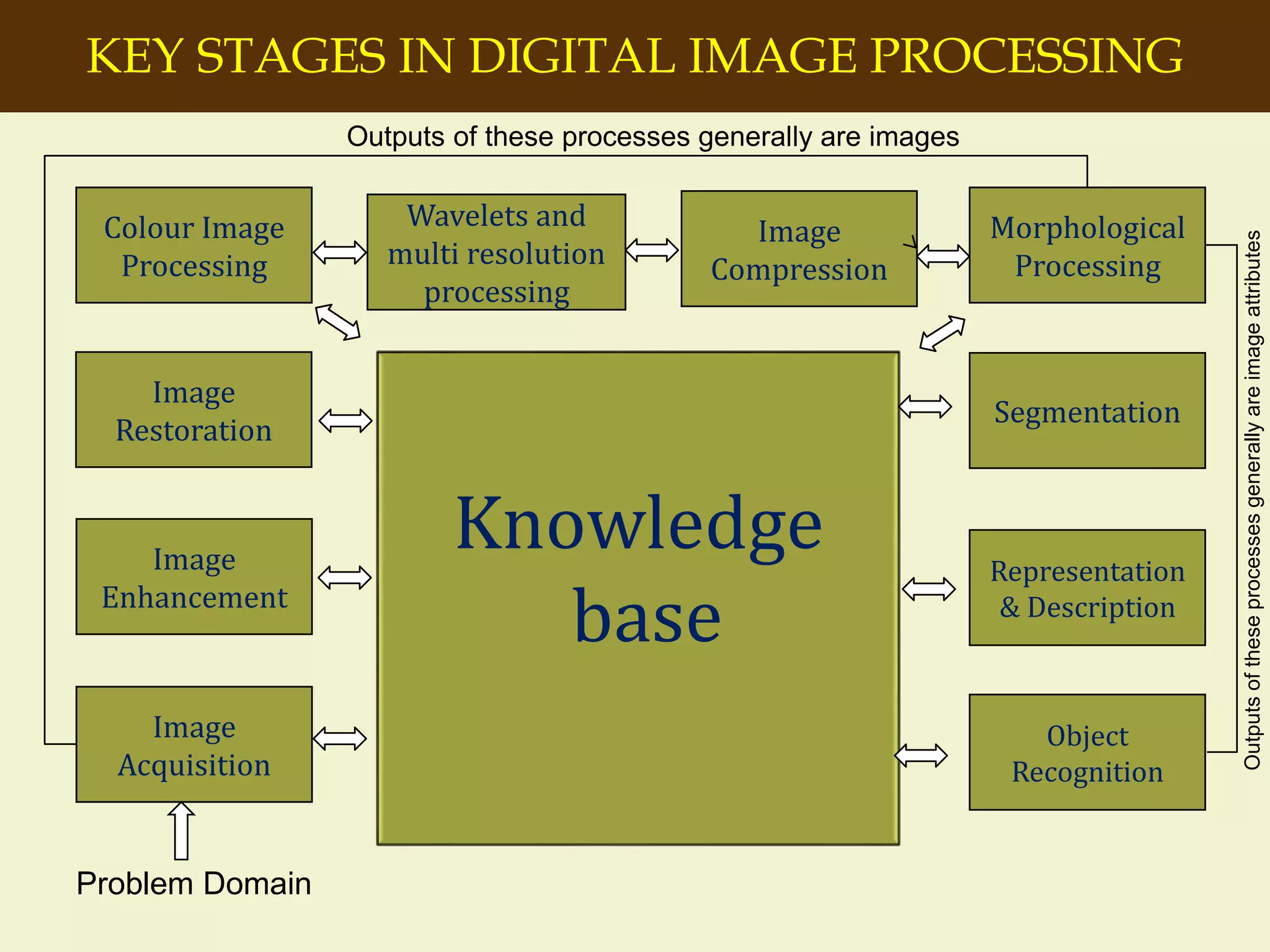
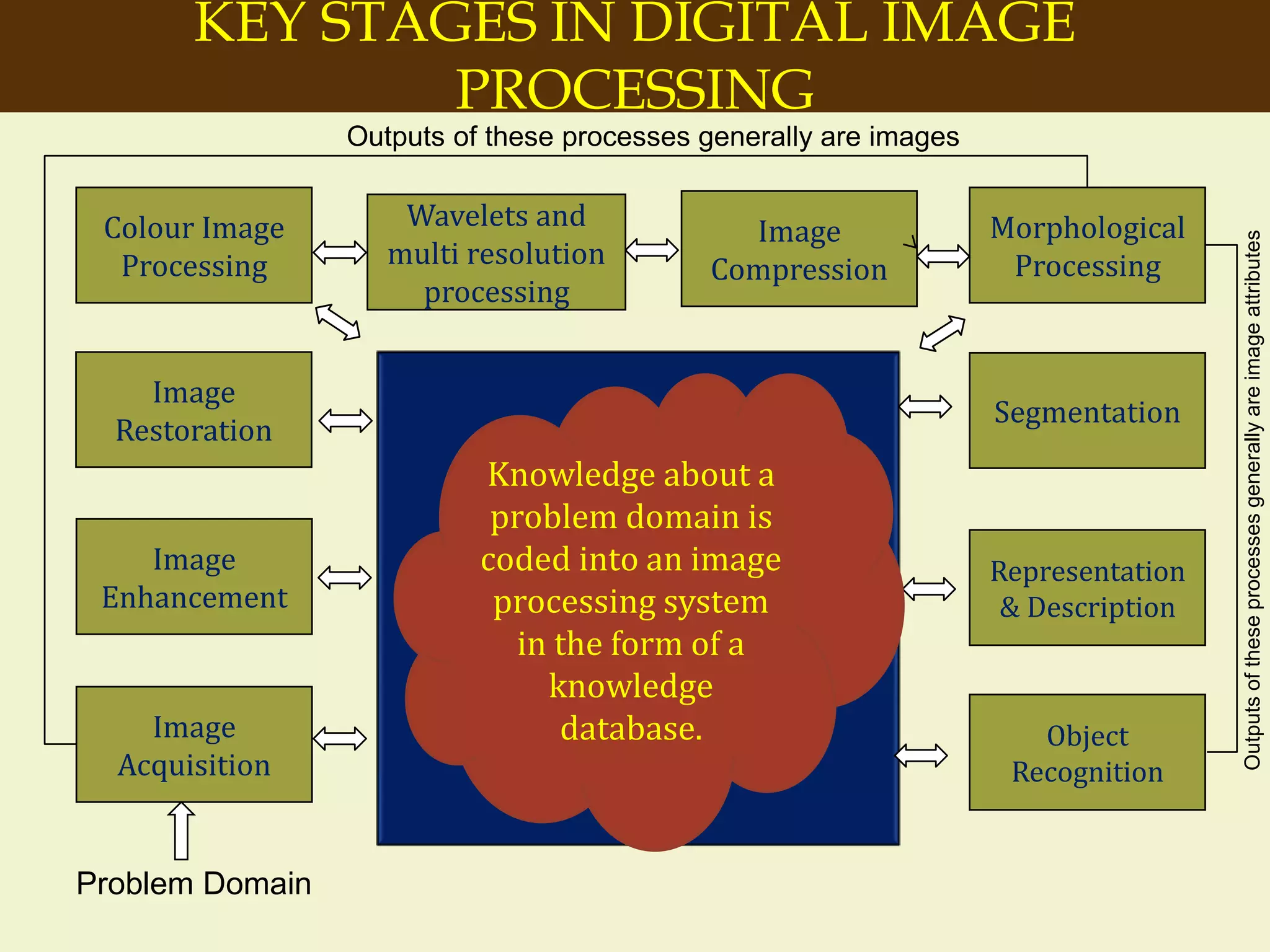
KEY STAGES IN DIGITAL IMAGE PROCESSING
Image
Acquisition
Colour Image
Processing
Wavelets and
multi resolution
processing
Segmentation
Object
Recognition
Image
Enhancement
Representation
& Description
Problem Domain
Image
Restoration
Morphological
Processing
Image
Compression
Knowledge
base
Outputs of these processes generally are images
Outputsoftheseprocessesgenerallyareimageattributes
IMAGE ACQUISITION
Image
Acquisition
Colour Image
Processing
Wavelets and
multi resolution
processing
Segmentation
Object
Recognition
Image
Enhancement
Representation
& Description
Problem Domain
Image
Restoration
Morphological
Processing
Image
Compression
Outputs of these processes generally are images
Outputsoftheseprocessesgenerallyareimageattributes
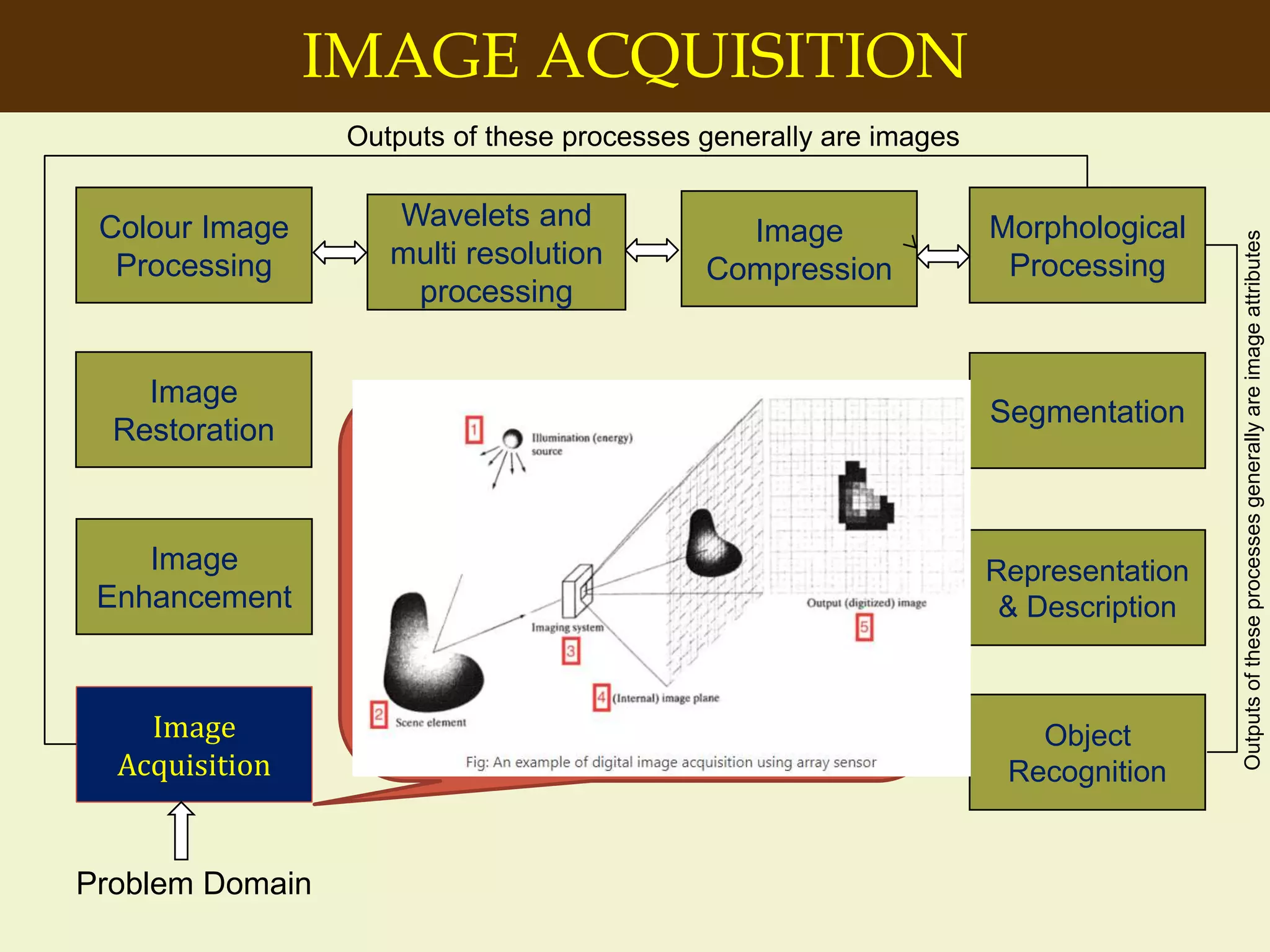
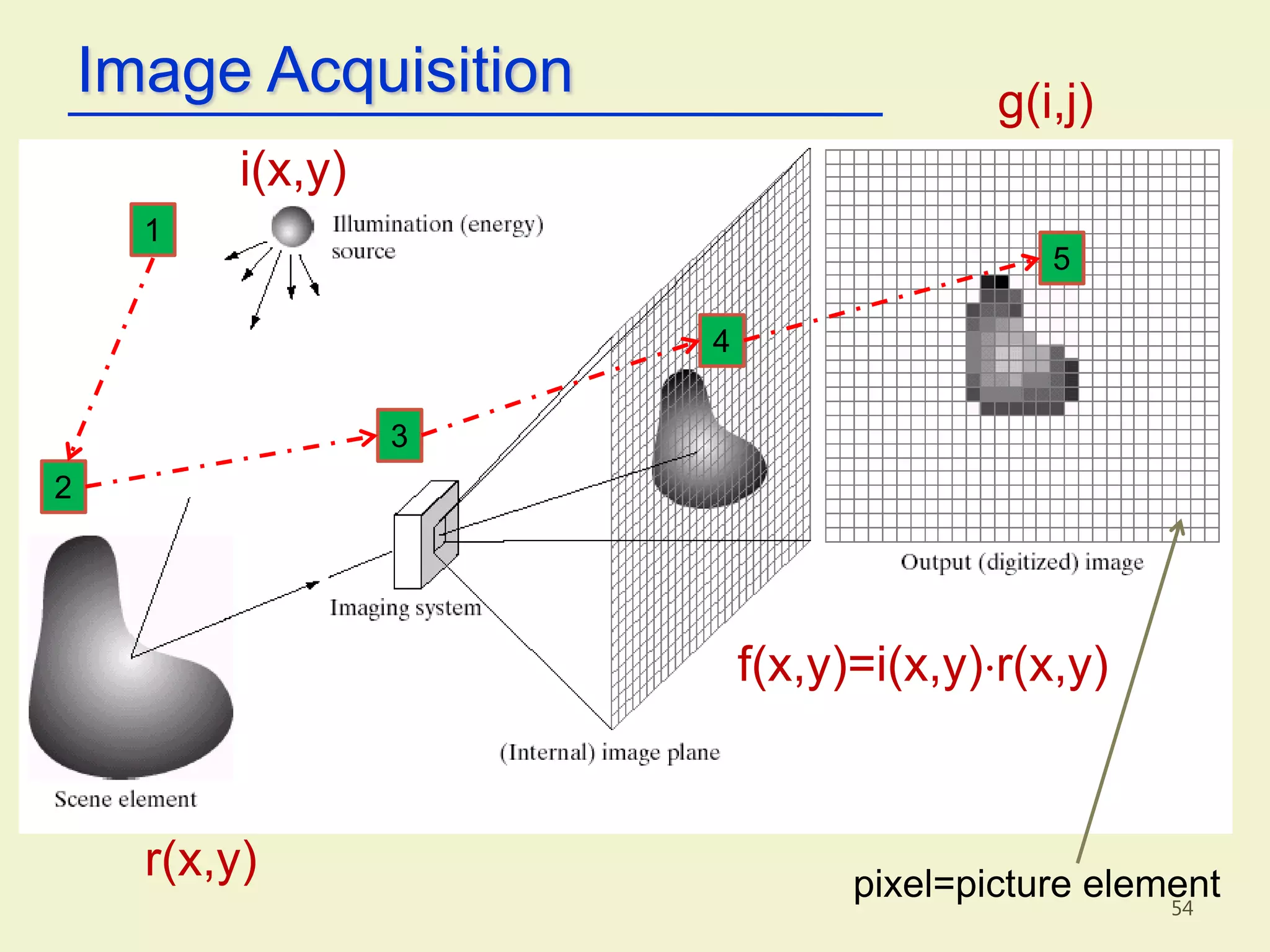
Action of retrieving an image from
some source, usually a hardware-
based source for processing.
Image is captured by a sensor (eg.
Camera), and digitized if the output of
the camera or sensor is not already in
digital form, using analogue-to-digital
convertor
54
i(x,y)
r(x,y)
f(x,y)=i(x,y)r(x,y)
g(i,j)
Image Acquisition
pixel=picture element
1
2
3
4
5
IMAGE ENHANCEMENT
Image
Acquisition
Colour Image
Processing
Wavelets and
multi resolution
processing
Segmentation
Object
Recognition
Image
Enhancement
Representation
& Description
Problem Domain
Image
Restoration
Morphological
Processing
Image
Compression
Outputs of these processes generally are images
Outputsoftheseprocessesgenerallyareimageattributes
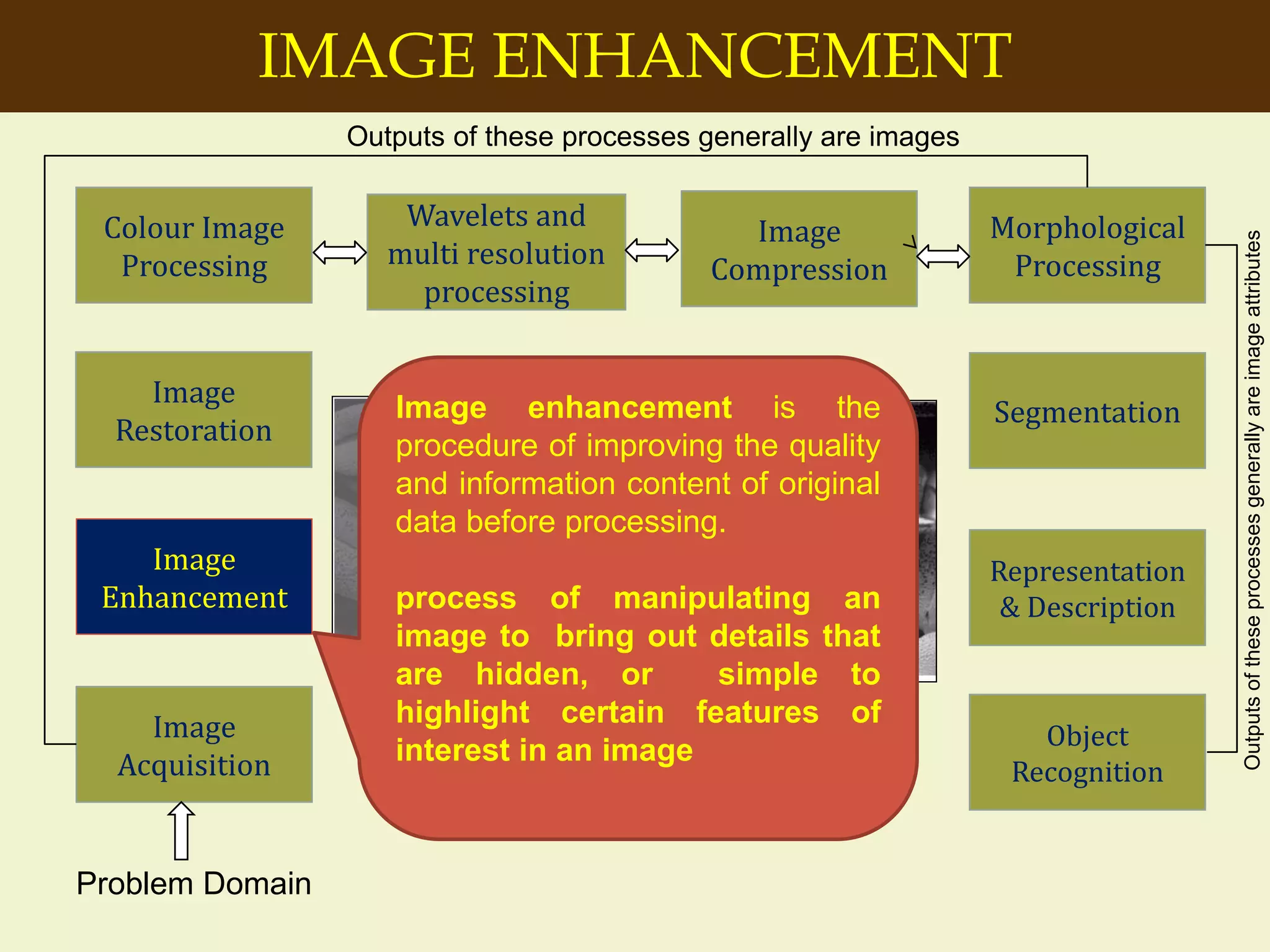
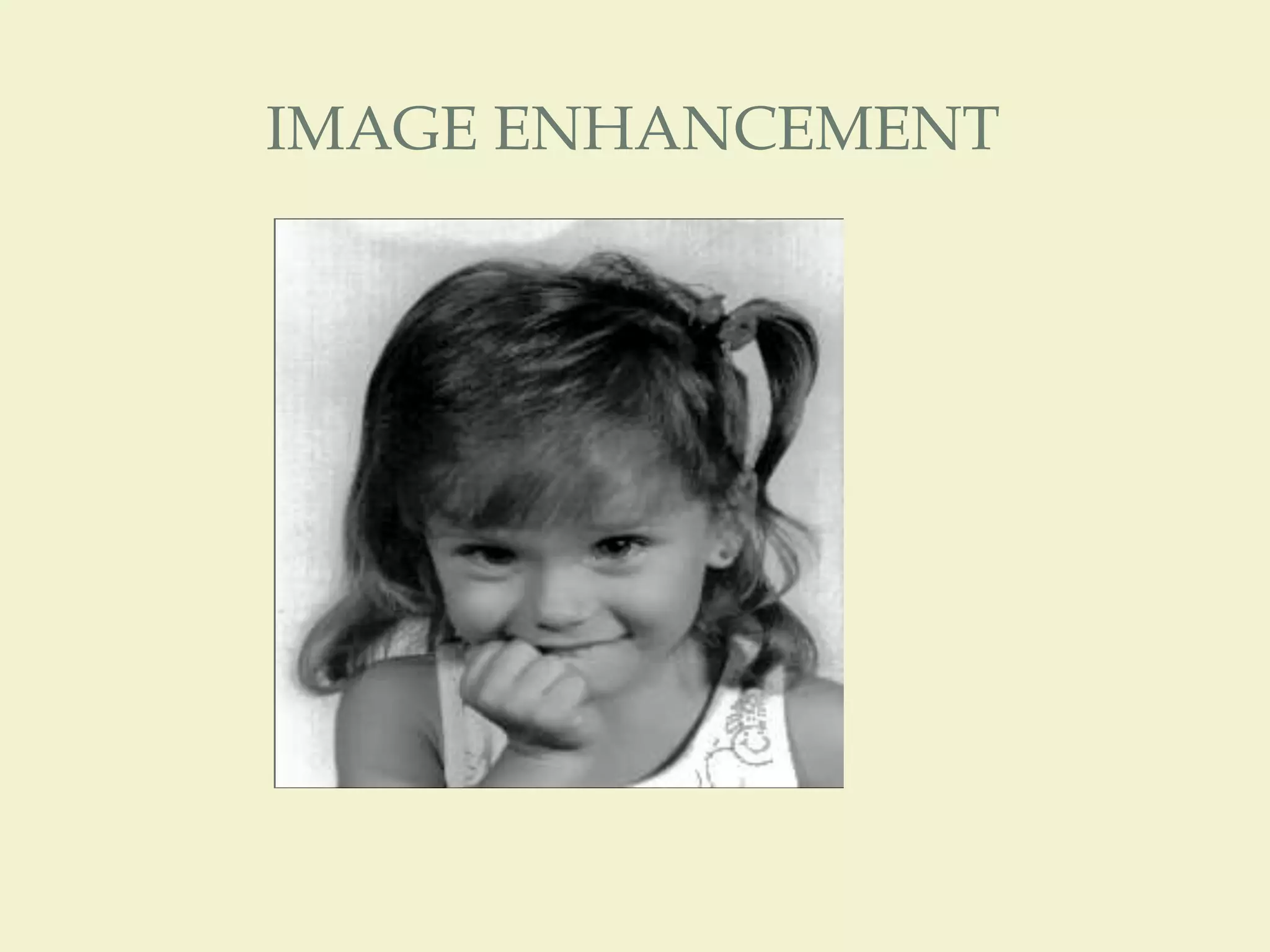
Image enhancement is the
procedure of improving the quality
and information content of original
data before processing.
process of manipulating an
image to bring out details that
are hidden, or simple to
highlight certain features of
interest in an image
IMAGE ENHANCEMENT
IMAGE RESTORATION
Image
Acquisition
Colour Image
Processing
Wavelets and
multi resolution
processing
Segmentation
Object
Recognition
Image
Enhancement
Representation
& Description
Problem Domain
Image
Restoration
Morphological
Processing
Image
Compression
Outputs of these processes generally are images
Outputsoftheseprocessesgenerallyareimageattributes
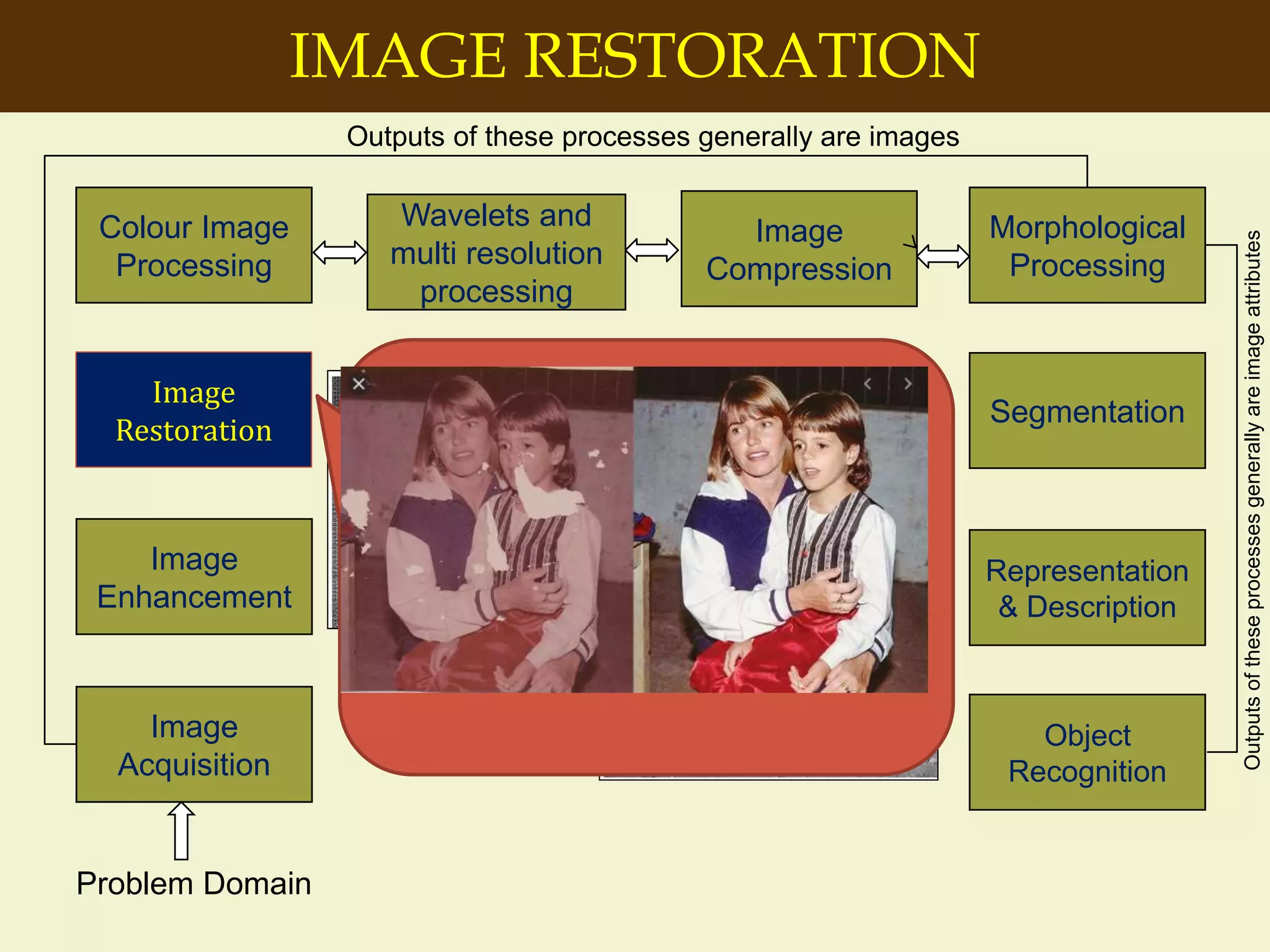
Improving the appearance of an image
Image restoration is the operation of
taking a corrupt/noisy image and
estimating the clean, original image.
Corruption may come in many forms
such as motion blur, noise and camera
mis-focus.
COLOUR IMAGE PROCESSING
Image
Acquisition
Colour Image
Processing
Wavelets and
multi resolution
processing
Segmentation
Object
Recognition
Image
Enhancement
Representation
& Description
Problem Domain
Image
Restoration
Morphological
Processing
Image
Compression
Outputs of these processes generally are images
Outputsoftheseprocessesgenerallyareimageattributes
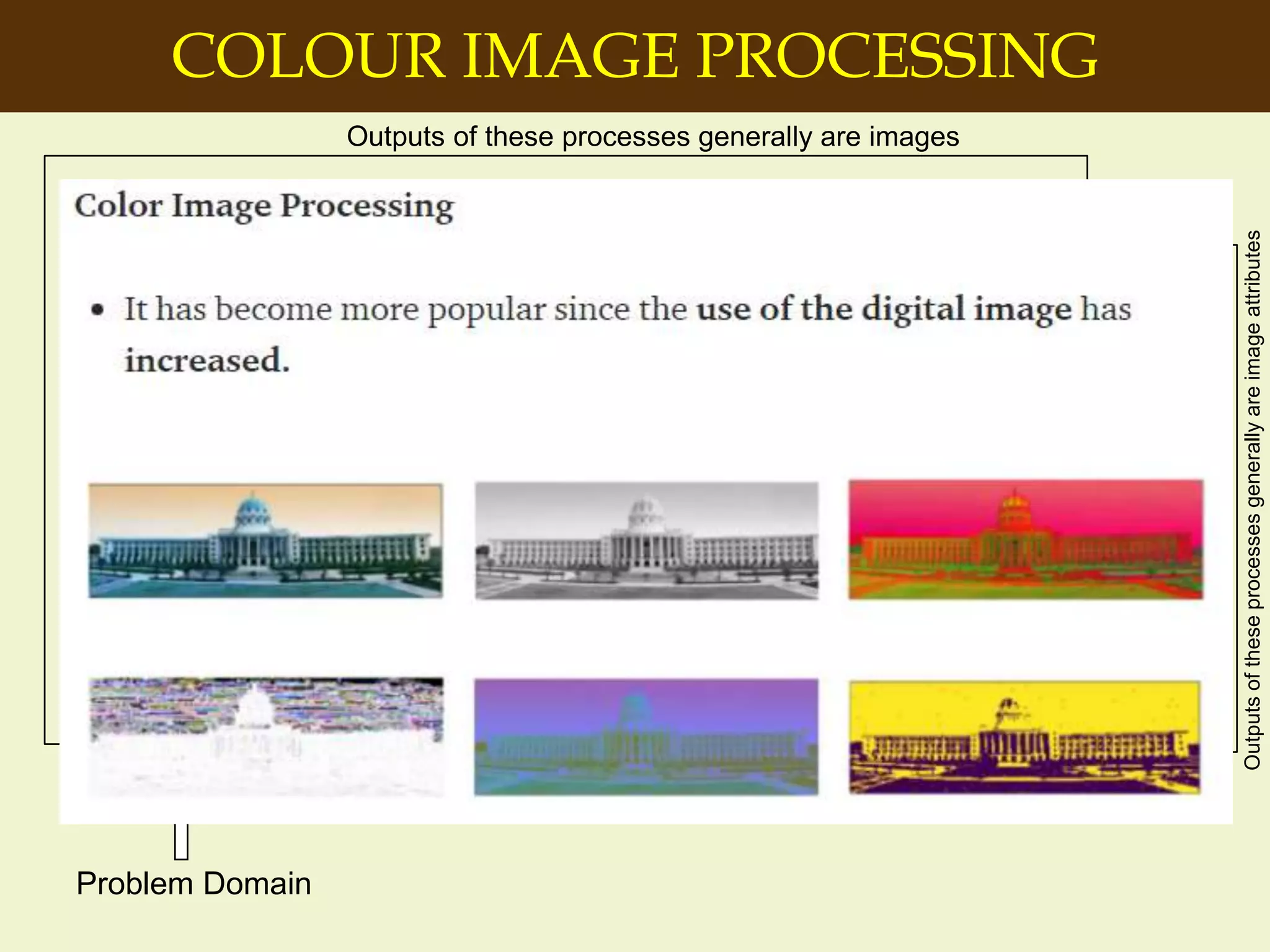
Use the colour of the image to extract
features of interest in an image
WAVELETS AND MULTI RESOLUTION
PROCESSING
Image
Acquisition
Colour Image
Processing
Wavelets and
multi resolution
processing
Segmentation
Object
Recognition
Image
Enhancement
Representation
& Description
Problem Domain
Image
Restoration
Morphological
Processing
Image
Compression
Outputs of these processes generally are images
Outputsoftheseprocessesgenerallyareimageattributes
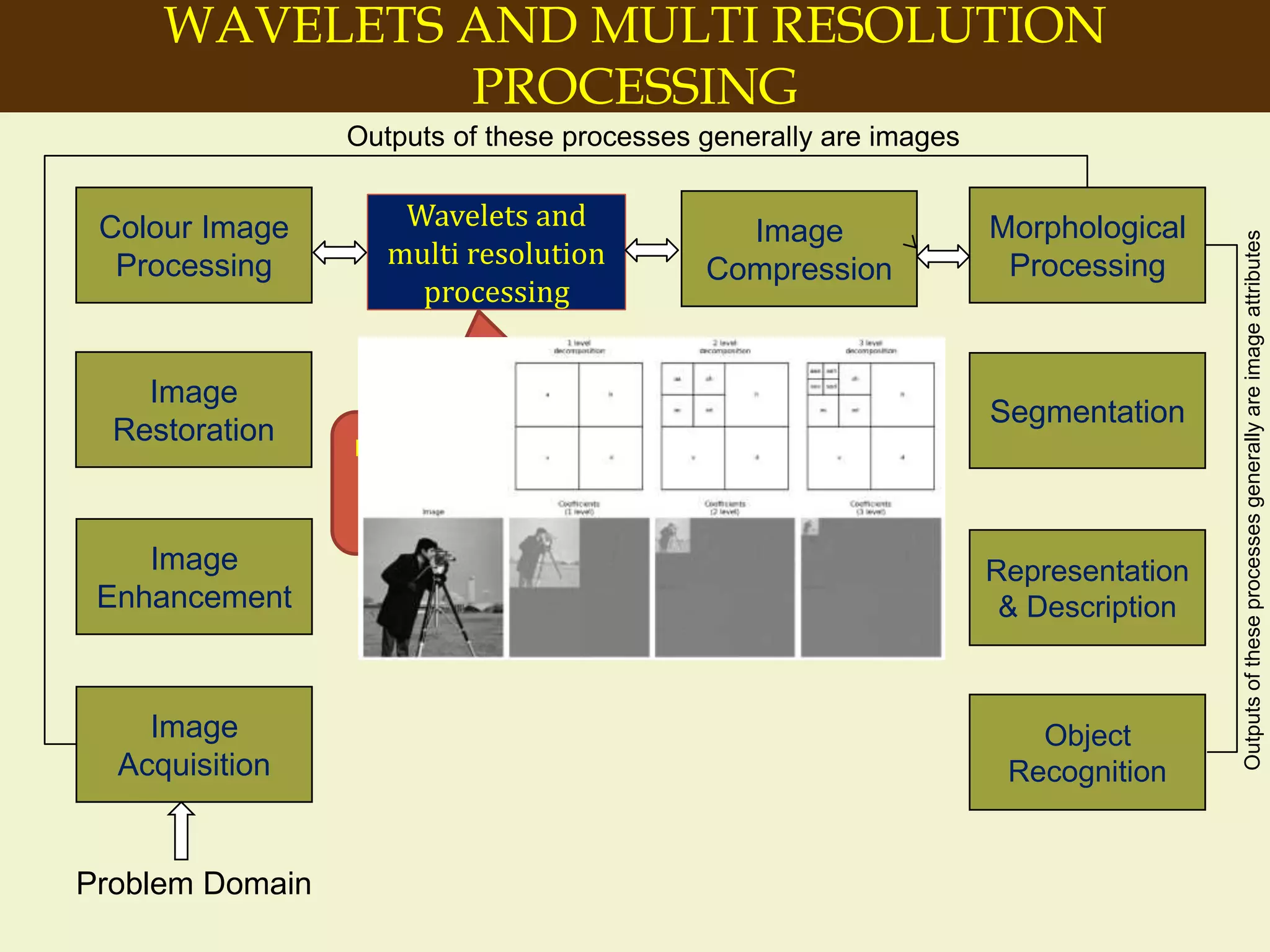
representing images in various degrees
of resolution. It is used for image data
compression.
IMAGE COMPRESSION
Image
Acquisition
Colour Image
Processing
Wavelets and
multi resolution
processing
Segmentation
Object
Recognition
Image
Enhancement
Representation
& Description
Problem Domain
Image
Restoration
Morphological
Processing
Image
Compression
Outputs of these processes generally are images
Outputsoftheseprocessesgenerallyareimageattributes
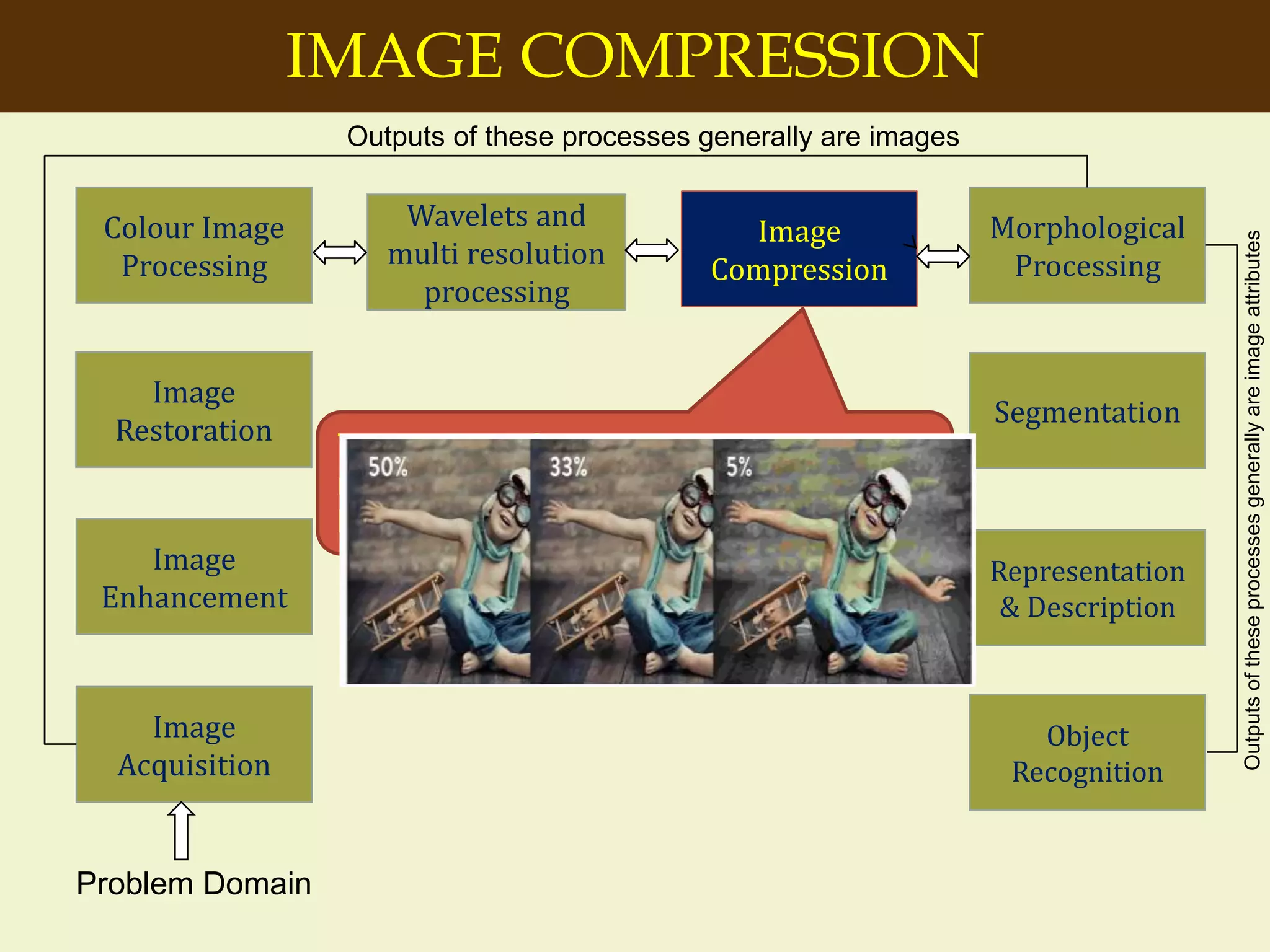
Techniques for reducing the storage
required to save an image or the
bandwidth required to transmit it.
MORPHOLOGICAL PROCESSING
Image
Acquisition
Colour Image
Processing
Wavelets and
multi resolution
processing
Segmentation
Object
Recognition
Image
Enhancement
Representation
& Description
Problem Domain
Image
Restoration
Morphological
Processing
Image
Compression
Outputs of these processes generally are images
Outputsoftheseprocessesgenerallyareimageattributes
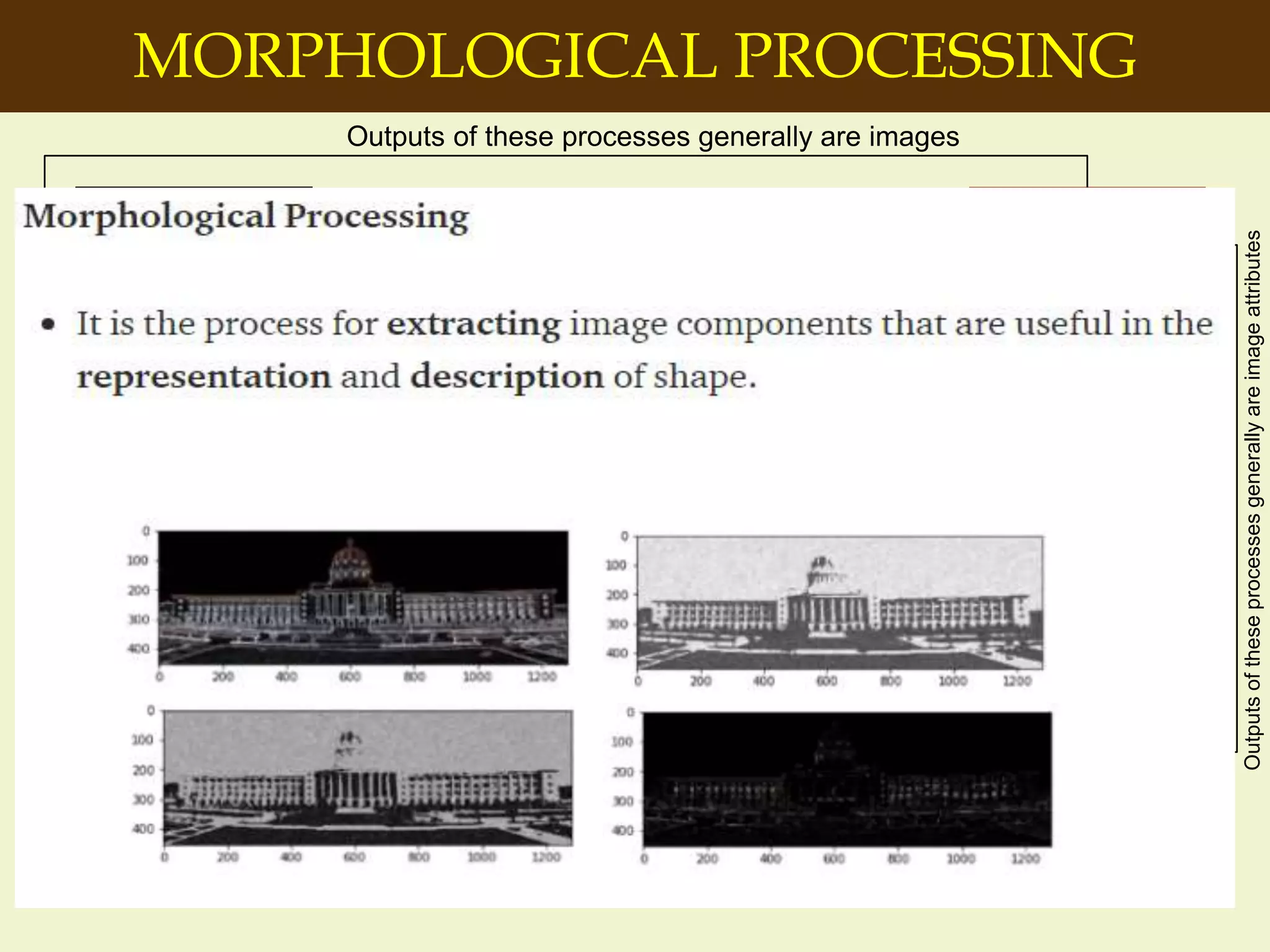
Tools for extracting image components
that are useful in the representation and
description of shape
In this step, there would be a transition
from processes that output images, to
processes that output image attributes.
SEGMENTATION
Image
Acquisition
Colour Image
Processing
Wavelets and
multi resolution
processing
Segmentation
Object
Recognition
Image
Enhancement
Representation
& Description
Problem Domain
Image
Restoration
Morphological
Processing
Image
Compression
Outputs of these processes generally are images
Outputsoftheseprocessesgenerallyareimageattributes
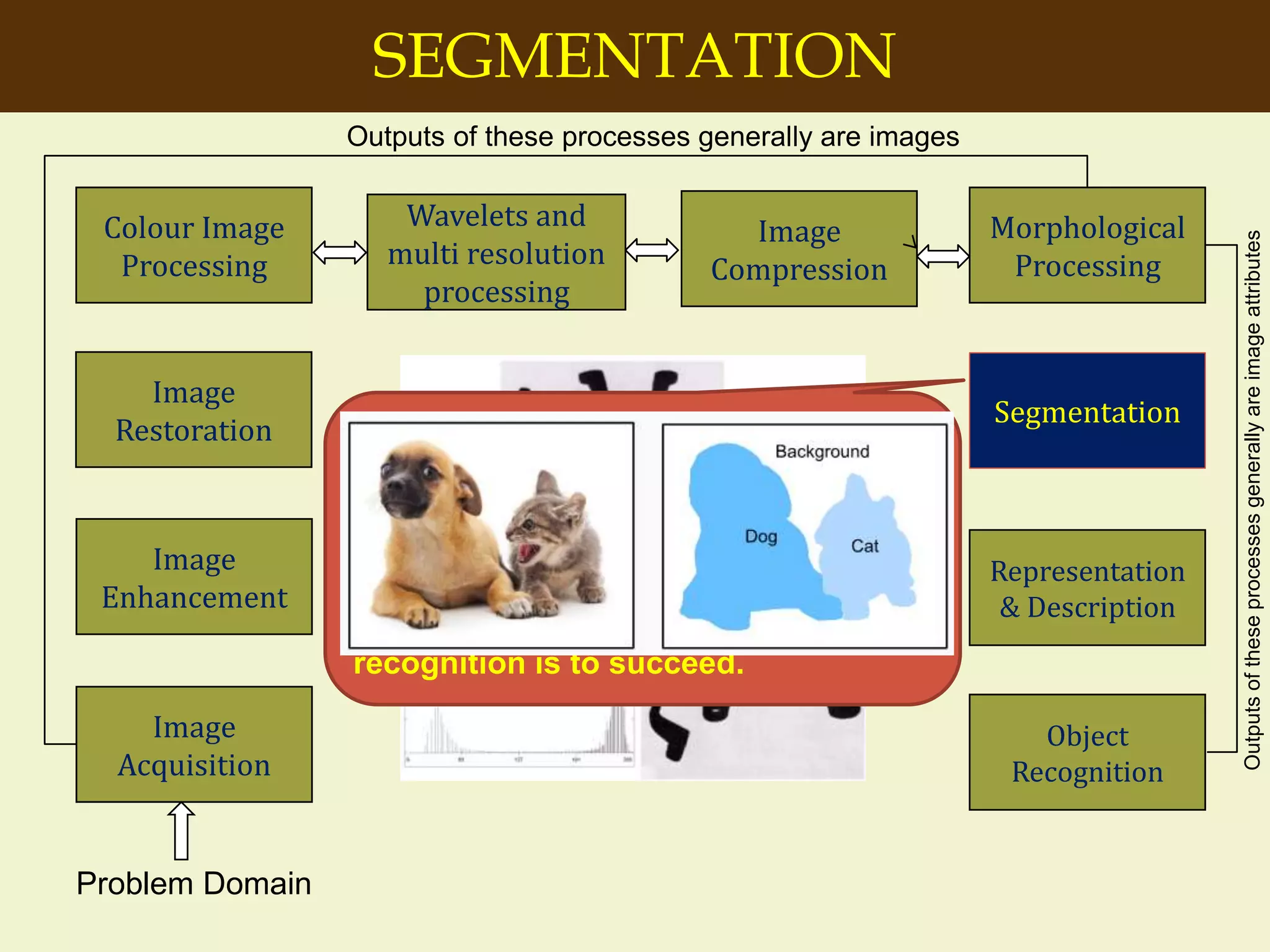
Segmentation procedures partition an
image into its constituent parts or
objects.
Important Tip: The more accurate the
segmentation, the more likely
recognition is to succeed.
REPRESENTATION & DESCRIPTION
Image
Acquisition
Colour Image
Processing
Wavelets and
multi resolution
processing
Segmentation
Object
Recognition
Image
Enhancement
Representation
& Description
Problem Domain
Image
Restoration
Morphological
Processing
Image
Compression
Outputs of these processes generally are images
Outputsoftheseprocessesgenerallyareimageattributes
-Make a decision whether the data
should be represented as a
boundary or as a complete region.
It is almost always follows the
output of a segmentation stage.
-Boundary Representation:
Focus on external shape
characteristics, such as corners
and inflections
-Region Representation: Focus
on internal properties, such as
texture or skeleton shape
OBJECT RECOGNITION
Image
Acquisition
Colour Image
Processing
Wavelets and
multi resolution
processing
Segmentation
Object
Recognition
Image
Enhancement
Representation
& Description
Problem Domain
Image
Restoration
Morphological
Processing
Image
Compression
Outputs of these processes generally are images
Outputsoftheseprocessesgenerallyareimageattributes
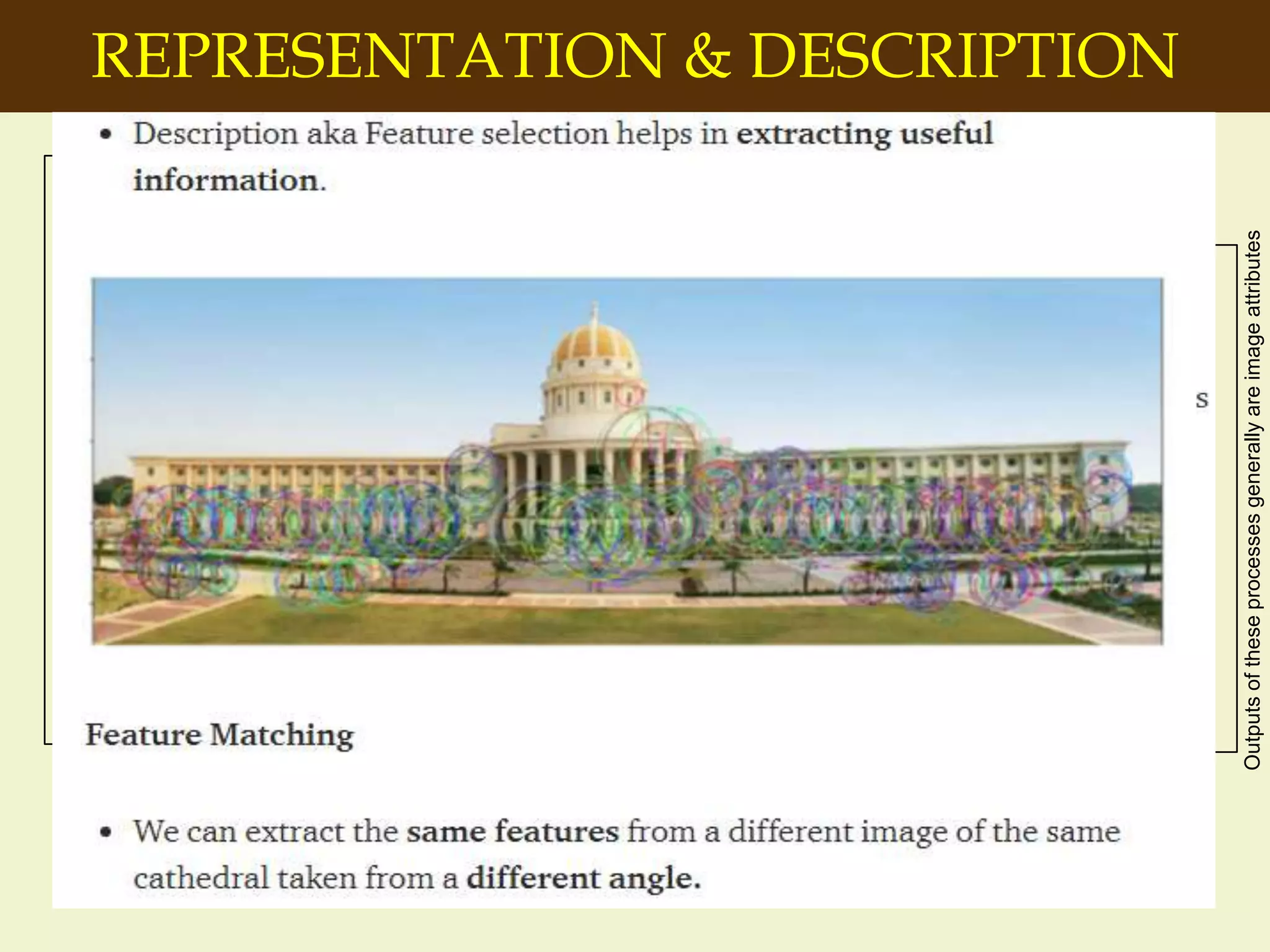
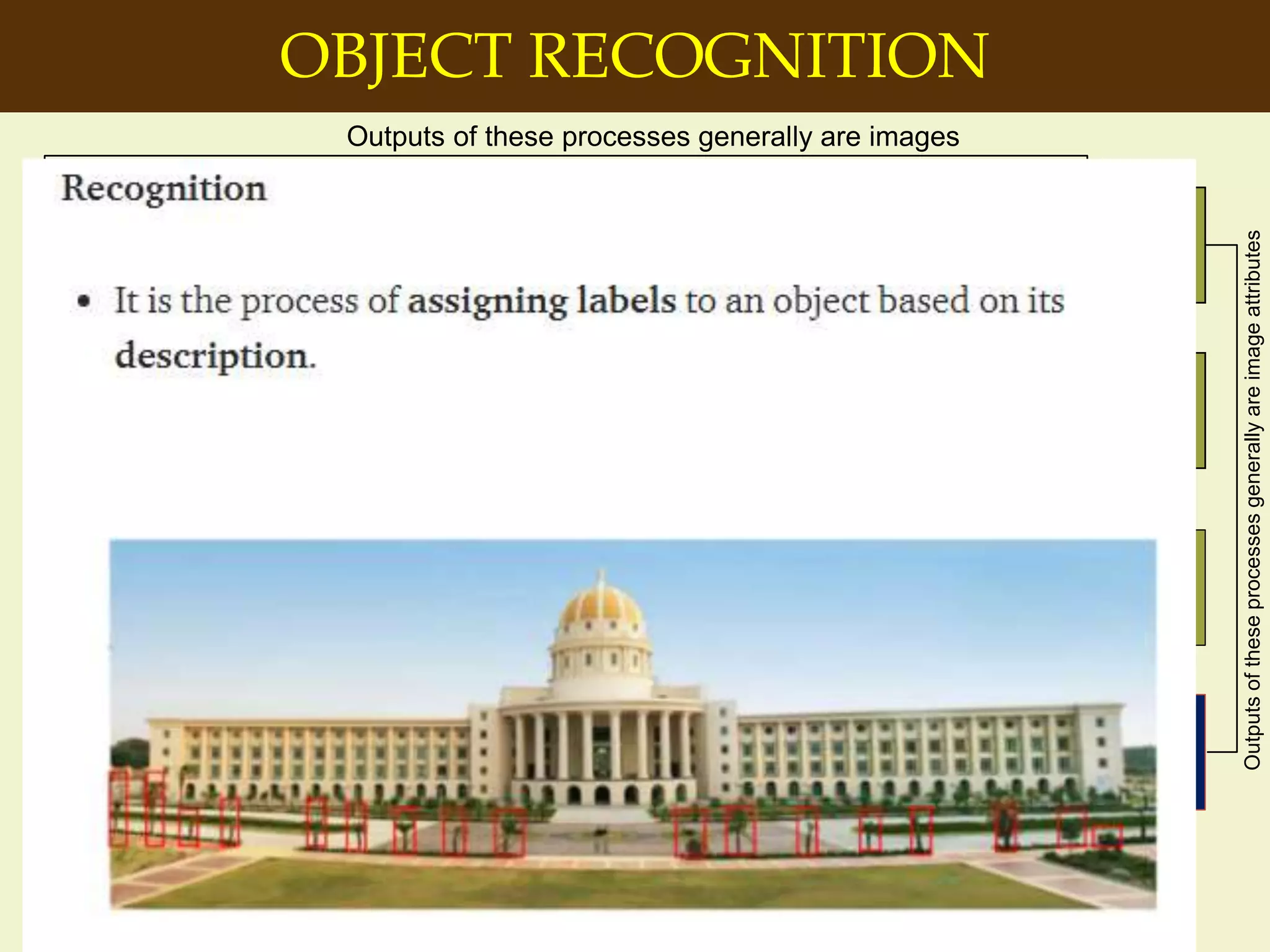
Object recognition is a computer vision
technique for
identifying objects in images or videos
Object recognition is a key output of
deep learning and machine learning
algorithms
KEY STAGES IN DIGITAL IMAGE
PROCESSING
Image
Acquisition
Colour Image
Processing
Wavelets and
multi resolution
processing
Segmentation
Object
Recognition
Image
Enhancement
Representation
& Description
Problem Domain
Image
Restoration
Morphological
Processing
Image
Compression
Knowledge
base
Outputs of these processes generally are images
Outputsoftheseprocessesgenerallyareimageattributes
Knowledge about a
problem domain is
coded into an image
processing system
in the form of a
knowledge
database.

introduction to Digital Image Processing

  • 1.
    SIPNA College of Engineering& Technology, Amravati Digital Image Processing[7ET2] Subject In-charge Chapter :- I Introduction to Digital Image Processing
  • 2.
    Signals and System [4ET1] DigitalSignal Processing [6ET4] 2 PRE-REQUISITES / PRIOR KNOWLEDGE
  • 3.
    INTRODUCTION Image Processing [DIP] Processingimages which are digital in nature. Digital Enhancement Segmentation Restoration Transformation Filtering Signal Converson
  • 4.
  • 5.
    SYLLABUS OVERVIEW Unit-1 Introductionto Digital Image Processing: Digital Image Fundamental, Elements of Visual Perception, Simple Image Model, Sampling and Quantization, Basic Relationships between Pixel ,Imaging Geometry, Gray scale image representation. Unit-2 Image Transforms: Introduction to the Fourier Transform, DFT, Properties of Two Dimensional Fourier Transform, FFT, Hadamard, Harr, DCT, Slant Transform. Unit-3 Image Enhancement: Basic Techniques, Enhancement by point processing, Spatial Filtering, Enhancement in Frequency domain, histogram based processing, homomorphic filtering.
  • 6.
    Unit-4 Image Restoration: Degradationmodel, Diagonalisation concept, Algebraic approach to Restoration. Inverse filtering, Weiner (CNS) filtering Restoration in Spatial domain, Basic morphological concept, morphological principles, binary morphology, Basic concepts of erosion and dilation. Unit-5 Image Compression: Fundamentals, Image compression models, Elements of Information theory, Lossy and predictive methods, vector quantization, runlength coding, Huffman coding, and lossless compression, compression standards. Unit-6 Image Segmentation: Detection of discontinuities, Edge Linking and boundary detection, Thresholding, Regional oriented Segmentation. SYLLABUS OVERVIEW
  • 7.
    ABOUT THE COURSE Goalsof this course: • Introductory course: basic concepts, classical methods, fundamental theorems • Getting acquainted with basic properties of images • Getting acquainted with various representations of image data • Acquire fundamental knowledge in processing and analysis digital images 7
  • 8.
    Digital Image Processing RafaelC. Gonzalez and Richards E. Woods, Addison Wesley AdministrationTextbook Digital Image Processing Paperback by Jayaraman S , Veerakumar T , Esakkirajan S
  • 9.
  • 10.
    “One picture isworth more than ten thousand words” -Anonymous Kevin Carter--The vulture and the little girl, 1993. Original title: Struggling Girl.
  • 11.
    WHAT IS IMAGEPROCESSING
  • 12.
    WHAT IS IMAGEPROCESSING
  • 13.
    WHAT IS IMAGEPROCESSING
  • 14.
  • 15.
    optical illusions, inwhich the eye fills in non existing information or wrongly perceives geometrical properties of objects OPTICAL ILLUSION A B c b Optical illusions are a characteristic of the human visual system that is not fully understood
  • 16.
  • 17.
  • 18.
  • 19.
  • 20.
  • 21.
  • 22.
     Fingerprint Verification/ Identification APPLICATIONS AND RESEARCH TOPICS
  • 23.
     Human ActivityRecognition APPLICATIONS AND RESEARCH TOPICS
  • 24.
    INDUSTRY AND APPLICATIONS •Automobile driver assistance • Lane departure warning • Adaptive cruise control • Obstacle warning • Digital Photography • Image Enhancement • Compression • Color manipulation • Image editing • Digital cameras • Sports analysis • sports refereeing and commentary • 3D visualization and tracking sports actions 24 MobilEye system
  • 25.
    • Film andVideo • Editing • Special effects • Image Database • Content based image retrieval • visual search of products • Face recognition • Industrial Automation and Inspection • vision-guided robotics • Inspection systems • Medical and Biomedical • Surgical assistance • Sensor fusion • Vision based diagnosis • Astronomy • Astronomical Image Enhancement • Chemical/Spectral Analysis 25
  • 26.
    • Arial Photography •Image Enhancement • Missile Guidance • Geological Mapping • Robotics • Autonomous Vehicles • Security and Safety • Biometry verification (face, iris) • Surveillance (fences, swimming pools) • Military • Tracking and localizing • Detection • Missile guidance • Traffic and Road Monitoring • Traffic monitoring • Adaptive traffic lights 26 Cruise Missiles
  • 27.
    WHY IMAGE PROCESSING? Digitalimage processing focuses on two major tasks • Improvement of pictorial information for human interpretation • Processing of image data for storage, transmission and representation for autonomous machine perception
  • 28.
    WHAT IS ANIMAGE ?  An image is a spatial representation of a two- dimensional or three-dimensional scene.  An image is an array, or a matrix pixels (picture elements) arranged in columns and rows.
  • 29.
    WHAT IS ANIMAGE ? An image is defined as a two-dimensional function, F(x,y), where x and y are spatial coordinates, and the amplitude of F at any pair of coordinates (x,y) is called the intensity of that image at that point. When x,y, and amplitude values of F are finite, we call it a digital image
  • 30.
    IMAGE AS MATRIX 01 2 3 4 5 6………………………………...100 0123456……….…………………………...100 No. of Column No.ofRows f( rows, column)=Pixel Value f(2,3)=157 f( x, y)=Intensity value Resolution : 100 X 100 f(100,100) f(0,0) An image can be defined as a two-dimensional function f(x,y) x,y: Spatial coordinate F: the amplitude of any pair of coordinate x,y, which is called the intensity or gray level of the image at that point. x,y and f, are all finite and discrete quantities.
  • 31.
     An image:a multidimensional function of spatial coordinates.  Spatial coordinate: (x,y) for 2D case such as photograph, (x,y,z) for 3D case such as CT scan images (x,y,t) for movies  The function f may represent intensity (for monochrome images) or color (for color images) or other associated values.
  • 32.
    IMAGE REPRESENTATION • Beforewe discussed image acquisition recall that a digital image is composed of M rows and N columns of Pixels each storing value. • Pixel values are most often grey levels in the range 0-255(Black-white). • Image is represented as matrices
  • 33.
  • 34.
    DIP Definition: A Disciplinein Which Both the Input and Output of a Process are Images. WHAT IS DIGITAL IMAGE PROCESSING? ProcessImage Image
  • 35.
    Image Processing Vision Low-Level Process Mid-Level Process High-Level Process •Reduce Noise • Contrast Enhancement • Image Sharpening • Segmentation • Classification Making Sense of an Ensemble of Recognized Objects Image Analysis WHAT IS DIGITAL IMAGE PROCESSING?
  • 36.
  • 37.
  • 38.
     A digitalimage is composed of M rows and N columns of pixels each storing a value Pixel values are most often grey levels in the range 0-255(black- white) We will see later on that images can easily be represented as matrices. IMAGE REPRESENTATION
  • 39.
  • 40.
     The spatialresolution of an image is determined by how sampling was carried out  Spatial resolution simply refers to the smallest discernable detail in an image  Vision specialists will often talk about pixel size  Graphic designers will talk about dots per inch (DPI) SPATIAL RESOLUTION
  • 41.
    SPATIAL RESOLUTION Vision specialistswill often talk about pixel size
  • 42.
    SPATIAL RESOLUTION 1024 *1024 512 * 512 256 * 256 128 * 128 64 * 64 32 * 32 Graphic designers will talk about dots per inch
  • 43.
     Intensity levelresolution refers to the number of intensity levels used to represent the image  The more intensity levels used, the finer the level of detail discernable in an image  Intensity level resolution is usually given in terms of the number of bits used to store each intensity level INTENSITY LEVEL RESOLUTION Number of Bits Number of Intensity Levels Examples 1 2 0, 1 2 4 00, 01, 10, 11 4 16 0000, 0101, 1111 8 256 00110011, 16 65,536 10100110011001100110101 0
  • 44.
    INTENSITY LEVEL RESOLUTION 64grey levels (6 bpp) 32 grey levels (5 bpp) 16 grey levels (4 bpp) 8 grey levels (3 bpp) 4 grey levels (2 bpp) 2 grey levels (1 bpp) 256 grey levels (8 bits per pixe1l)28grey levels (7 bpp)
  • 45.
     The bigquestion with resolution is always how much is enough?  This all depends on what is in the image and what you would like to do with it  Key questions include  Does the image look aesthetically pleasing?  Can you see what you need to see within the image? RESOLUTION: HOW MUCH IS ENOUGH?  The picture on the right is fine for counting the number of cars, but not for reading the number plate
  • 46.
    IMAGE TYPES Three typesof images: • Binary images • Gray-scale images • Color Images Pixel Range : 0 and 1 0-Black & 1- whitePixel Range : 0 and 255 0-Black & 255-WhiteThree Channel : RGB images are represented as red, green and blue (RGB images). And each color image has 24 bits/pixel means 8 bits for each of the three color band(RGB).
  • 47.
  • 48.
    48 210 209 204202 197 247 143 71 64 80 84 54 54 57 58 206 196 203 197 195 210 207 56 63 58 53 53 61 62 51 201 207 192 201 198 213 156 69 65 57 55 52 53 60 50 216 206 211 193 202 207 208 57 69 60 55 77 49 62 61 221 206 211 194 196 197 220 56 63 60 55 46 97 58 106 209 214 224 199 194 193 204 173 64 60 59 51 62 56 48 204 212 213 208 191 190 191 214 60 62 66 76 51 49 55 214 215 215 207 208 180 172 188 69 72 55 49 56 52 56 209 205 214 205 204 196 187 196 86 62 66 87 57 60 48 208 209 205 203 202 186 174 185 149 71 63 55 55 45 56 207 210 211 199 217 194 183 177 209 90 62 64 52 93 52 208 205 209 209 197 194 183 187 187 239 58 68 61 51 56 204 206 203 209 195 203 188 185 183 221 75 61 58 60 60 200 203 199 236 188 197 183 190 183 196 122 63 58 64 66 205 210 202 203 199 197 196 181 173 186 105 62 57 64 63 x = 58 59 60 61 62 63 64 65 66 67 68 69 70 71 72 y = 41 42 43 44 45 46 47 48 49 50 51 52 53 54 55 GRAY SCALE IMAGE
  • 49.
    COLOR IMAGES ( ,) ( , ) ( , ) ( , ) r x y f x y g x y b x y         
  • 50.
  • 51.
    COLOR IMAGES • Colorimages are comprised of three color channels – red, green, and, blue – which combine to create most of the colors we can see. =
  • 52.
    KEY STAGES INDIGITAL IMAGE PROCESSING Image Acquisition Colour Image Processing Wavelets and multi resolution processing Segmentation Object Recognition Image Enhancement Representation & Description Problem Domain Image Restoration Morphological Processing Image Compression Knowledge base Outputs of these processes generally are images Outputsoftheseprocessesgenerallyareimageattributes
  • 53.
    IMAGE ACQUISITION Image Acquisition Colour Image Processing Waveletsand multi resolution processing Segmentation Object Recognition Image Enhancement Representation & Description Problem Domain Image Restoration Morphological Processing Image Compression Outputs of these processes generally are images Outputsoftheseprocessesgenerallyareimageattributes Action of retrieving an image from some source, usually a hardware- based source for processing. Image is captured by a sensor (eg. Camera), and digitized if the output of the camera or sensor is not already in digital form, using analogue-to-digital convertor
  • 54.
  • 55.
    IMAGE ENHANCEMENT Image Acquisition Colour Image Processing Waveletsand multi resolution processing Segmentation Object Recognition Image Enhancement Representation & Description Problem Domain Image Restoration Morphological Processing Image Compression Outputs of these processes generally are images Outputsoftheseprocessesgenerallyareimageattributes Image enhancement is the procedure of improving the quality and information content of original data before processing. process of manipulating an image to bring out details that are hidden, or simple to highlight certain features of interest in an image
  • 56.
  • 57.
    IMAGE RESTORATION Image Acquisition Colour Image Processing Waveletsand multi resolution processing Segmentation Object Recognition Image Enhancement Representation & Description Problem Domain Image Restoration Morphological Processing Image Compression Outputs of these processes generally are images Outputsoftheseprocessesgenerallyareimageattributes Improving the appearance of an image Image restoration is the operation of taking a corrupt/noisy image and estimating the clean, original image. Corruption may come in many forms such as motion blur, noise and camera mis-focus.
  • 58.
    COLOUR IMAGE PROCESSING Image Acquisition ColourImage Processing Wavelets and multi resolution processing Segmentation Object Recognition Image Enhancement Representation & Description Problem Domain Image Restoration Morphological Processing Image Compression Outputs of these processes generally are images Outputsoftheseprocessesgenerallyareimageattributes Use the colour of the image to extract features of interest in an image
  • 59.
    WAVELETS AND MULTIRESOLUTION PROCESSING Image Acquisition Colour Image Processing Wavelets and multi resolution processing Segmentation Object Recognition Image Enhancement Representation & Description Problem Domain Image Restoration Morphological Processing Image Compression Outputs of these processes generally are images Outputsoftheseprocessesgenerallyareimageattributes representing images in various degrees of resolution. It is used for image data compression.
  • 60.
    IMAGE COMPRESSION Image Acquisition Colour Image Processing Waveletsand multi resolution processing Segmentation Object Recognition Image Enhancement Representation & Description Problem Domain Image Restoration Morphological Processing Image Compression Outputs of these processes generally are images Outputsoftheseprocessesgenerallyareimageattributes Techniques for reducing the storage required to save an image or the bandwidth required to transmit it.
  • 61.
    MORPHOLOGICAL PROCESSING Image Acquisition Colour Image Processing Waveletsand multi resolution processing Segmentation Object Recognition Image Enhancement Representation & Description Problem Domain Image Restoration Morphological Processing Image Compression Outputs of these processes generally are images Outputsoftheseprocessesgenerallyareimageattributes Tools for extracting image components that are useful in the representation and description of shape In this step, there would be a transition from processes that output images, to processes that output image attributes.
  • 62.
    SEGMENTATION Image Acquisition Colour Image Processing Wavelets and multiresolution processing Segmentation Object Recognition Image Enhancement Representation & Description Problem Domain Image Restoration Morphological Processing Image Compression Outputs of these processes generally are images Outputsoftheseprocessesgenerallyareimageattributes Segmentation procedures partition an image into its constituent parts or objects. Important Tip: The more accurate the segmentation, the more likely recognition is to succeed.
  • 63.
    REPRESENTATION & DESCRIPTION Image Acquisition ColourImage Processing Wavelets and multi resolution processing Segmentation Object Recognition Image Enhancement Representation & Description Problem Domain Image Restoration Morphological Processing Image Compression Outputs of these processes generally are images Outputsoftheseprocessesgenerallyareimageattributes -Make a decision whether the data should be represented as a boundary or as a complete region. It is almost always follows the output of a segmentation stage. -Boundary Representation: Focus on external shape characteristics, such as corners and inflections -Region Representation: Focus on internal properties, such as texture or skeleton shape
  • 64.
    OBJECT RECOGNITION Image Acquisition Colour Image Processing Waveletsand multi resolution processing Segmentation Object Recognition Image Enhancement Representation & Description Problem Domain Image Restoration Morphological Processing Image Compression Outputs of these processes generally are images Outputsoftheseprocessesgenerallyareimageattributes Object recognition is a computer vision technique for identifying objects in images or videos Object recognition is a key output of deep learning and machine learning algorithms
  • 65.
    KEY STAGES INDIGITAL IMAGE PROCESSING Image Acquisition Colour Image Processing Wavelets and multi resolution processing Segmentation Object Recognition Image Enhancement Representation & Description Problem Domain Image Restoration Morphological Processing Image Compression Knowledge base Outputs of these processes generally are images Outputsoftheseprocessesgenerallyareimageattributes Knowledge about a problem domain is coded into an image processing system in the form of a knowledge database.