Presented By,
J. Steffi
T. Navis
R. Gayathri
Manonmaniam Sundaranar University
Tirunelveli - 12
M.Phil. Computer Science
2017
 An image is a spatial representation of a two dimensional
or three dimensional scene.
 A digital image is composed of a finite number of
elements, each of which has a particular location and value.
 A digital image are classified into three types,
 Black/White or Binary image
 Gray-scale image
 Color/RGB image
 A digital image processing is a method to perform some
operations on an image, in order to get an enhanced image
or to extract some useful information from it.
 The digital image processing methods used in various
areas, such as :
 Medical imaging
 Astronomy
 Remote Earth resource observation
 The basic digital image processing methods are,
 Image Enhancement
 Image Restoration
 Image Compression
 Image Segmentation
 An Image Enhancement is the process of manipulating or
adjusting digital image so that the result is more suitable for
display or further image analysis.
 For example, you can remove noise, sharpen, smooth or
brighten an image, make it easier to identify key features.
 Image enhancement methods operate in,
• Spatial domain
- manipulating the pixel data
• Frequency domain
- modifying the spectral component
 Spatial domain refers to the image plane itself.
 Image processing methods in this category are based on
direct manipulation of pixels in an image.
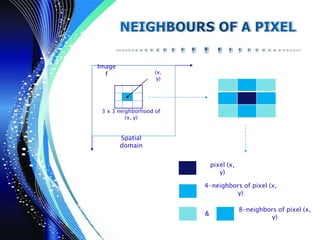
(x,
y)
3 x 3 neighborhood of
(x, y)
Image
f
Spatial
domain
pixel (x,
y)
4-neighbors of pixel (x,
y)
8-neighbors of pixel (x,
y)
&
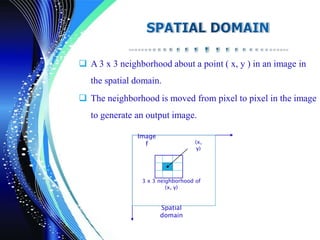
 A 3 x 3 neighborhood about a point ( x, y ) in an image in
the spatial domain.
 The neighborhood is moved from pixel to pixel in the image
to generate an output image.
(x,
y)
3 x 3 neighborhood of
(x, y)
Image
f
Spatial
domain
 Two principal categories of spatial domain processing are
• Intensity Transformation
• Spatial Filtering
 Intensity transformation operate on single pixels of an
image, principally for the purpose of contrast manipulation
and image threshold.
 Spatial filtering deals with performing operations, such as
image sharpening, by working in a neighborhood of every
pixel in an image.
 The spatial domain process can be denoted by the expression,
g ( x, y ) = T [ f ( x, y ) ]
 Here,
 x and y are spatial ( plane ) coordinates
 ( x, y ) is the intensity/gray level the image at that point
 f ( x, y ) is the input image
 g ( x, y ) is the output image
 T is an operator
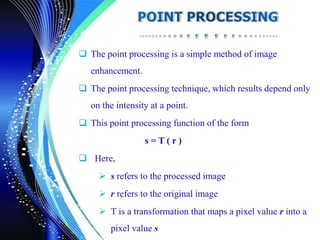
 The point processing is a simple method of image
enhancement.
 The point processing technique, which results depend only
on the intensity at a point.
 This point processing function of the form
s = T ( r )
 Here,
 s refers to the processed image
 r refers to the original image
 T is a transformation that maps a pixel value r into a
pixel value s
 The point processing function is also called as intensity
transformation or gray - level mapping function.
 The point processing functions can be further categorized
into two types.
 They are as follow :
 Linear Functions
 Non – Linear Functions
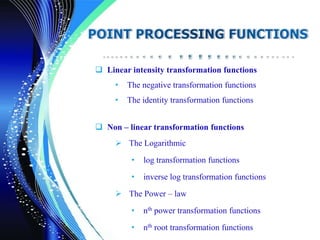
 Linear intensity transformation functions
• The negative transformation functions
• The identity transformation functions
 Non – linear transformation functions
 The Logarithmic
• log transformation functions
• inverse log transformation functions
 The Power – law
• nth power transformation functions
• nth root transformation functions
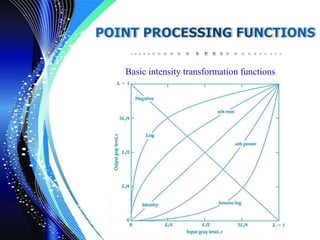
Basic intensity transformation functions
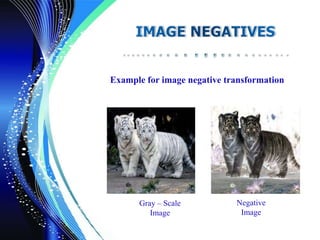
 The negative of an image with intensity levels in the range
[0, L-1] is obtained by using the negative transformation.
 The negative transformation is given by the following expression,
s = ( L - 1 ) – r
 s is a negative image
 L has a maximum gray level range of values 0 to 255
 r is an original gray-scale image
 Reversing the intensity levels of an image in this manner
produces the equivalent of photographic negative.
 This type of processing is particularly suited for enhancing white
or gray detail embedded in dark regions of an image.
Gray – Scale
Image
Negative
Image
Example for image negative transformation
 The general form of the log transformation is,
s = c log ( 1 + r )
where, c is constant, and it is assumed that r >= 0.
 The log transformation maps a narrow range of low input
gray level values into a wider range of output values.
 The inverse log transformation performs the opposite
transformation.
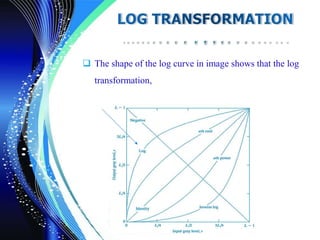
 The shape of the log curve in image shows that the log
transformation,
 Log functions are particularly useful when the input
gray level values may have an extremely large range
of values.
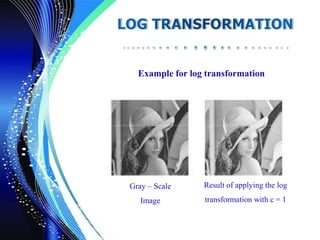
 The following example shows the result of applying
the log transform into a gray-scale image is used to
reveal more detail.
Gray – Scale
Image
Result of applying the log
transformation with c = 1
Example for log transformation
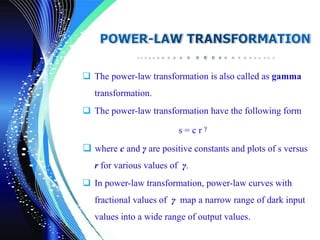
 The power-law transformation is also called as gamma
transformation.
 The power-law transformation have the following form
s = c r γ
 where c and γ are positive constants and plots of s versus
r for various values of γ.
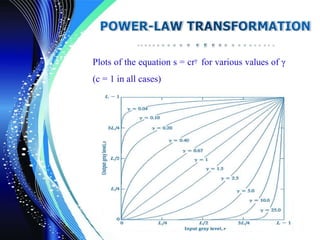
 In power-law transformation, power-law curves with
fractional values of γ map a narrow range of dark input
values into a wide range of output values.
Plots of the equation s = crγ for various values of γ
(c = 1 in all cases)
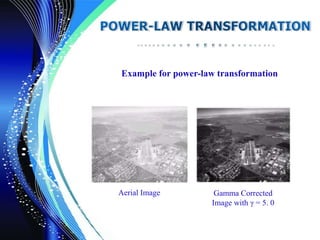
Example for power-law transformation
Aerial Image Gamma Corrected
Image with γ = 5. 0
Image Enhancement - Point Processing

Image Enhancement - Point Processing

  • 1.
    Presented By, J. Steffi T.Navis R. Gayathri Manonmaniam Sundaranar University Tirunelveli - 12 M.Phil. Computer Science 2017
  • 2.
     An imageis a spatial representation of a two dimensional or three dimensional scene.  A digital image is composed of a finite number of elements, each of which has a particular location and value.  A digital image are classified into three types,  Black/White or Binary image  Gray-scale image  Color/RGB image
  • 3.
     A digitalimage processing is a method to perform some operations on an image, in order to get an enhanced image or to extract some useful information from it.  The digital image processing methods used in various areas, such as :  Medical imaging  Astronomy  Remote Earth resource observation
  • 4.
     The basicdigital image processing methods are,  Image Enhancement  Image Restoration  Image Compression  Image Segmentation
  • 5.
     An ImageEnhancement is the process of manipulating or adjusting digital image so that the result is more suitable for display or further image analysis.  For example, you can remove noise, sharpen, smooth or brighten an image, make it easier to identify key features.
  • 6.
     Image enhancementmethods operate in, • Spatial domain - manipulating the pixel data • Frequency domain - modifying the spectral component  Spatial domain refers to the image plane itself.  Image processing methods in this category are based on direct manipulation of pixels in an image.
  • 7.
    (x, y) 3 x 3neighborhood of (x, y) Image f Spatial domain pixel (x, y) 4-neighbors of pixel (x, y) 8-neighbors of pixel (x, y) &
  • 8.
     A 3x 3 neighborhood about a point ( x, y ) in an image in the spatial domain.  The neighborhood is moved from pixel to pixel in the image to generate an output image. (x, y) 3 x 3 neighborhood of (x, y) Image f Spatial domain
  • 9.
     Two principalcategories of spatial domain processing are • Intensity Transformation • Spatial Filtering  Intensity transformation operate on single pixels of an image, principally for the purpose of contrast manipulation and image threshold.  Spatial filtering deals with performing operations, such as image sharpening, by working in a neighborhood of every pixel in an image.
  • 10.
     The spatialdomain process can be denoted by the expression, g ( x, y ) = T [ f ( x, y ) ]  Here,  x and y are spatial ( plane ) coordinates  ( x, y ) is the intensity/gray level the image at that point  f ( x, y ) is the input image  g ( x, y ) is the output image  T is an operator
  • 11.
     The pointprocessing is a simple method of image enhancement.  The point processing technique, which results depend only on the intensity at a point.  This point processing function of the form s = T ( r )  Here,  s refers to the processed image  r refers to the original image  T is a transformation that maps a pixel value r into a pixel value s
  • 12.
     The pointprocessing function is also called as intensity transformation or gray - level mapping function.  The point processing functions can be further categorized into two types.  They are as follow :  Linear Functions  Non – Linear Functions
  • 13.
     Linear intensitytransformation functions • The negative transformation functions • The identity transformation functions  Non – linear transformation functions  The Logarithmic • log transformation functions • inverse log transformation functions  The Power – law • nth power transformation functions • nth root transformation functions
  • 14.
  • 15.
     The negativeof an image with intensity levels in the range [0, L-1] is obtained by using the negative transformation.  The negative transformation is given by the following expression, s = ( L - 1 ) – r  s is a negative image  L has a maximum gray level range of values 0 to 255  r is an original gray-scale image  Reversing the intensity levels of an image in this manner produces the equivalent of photographic negative.  This type of processing is particularly suited for enhancing white or gray detail embedded in dark regions of an image.
  • 16.
    Gray – Scale Image Negative Image Examplefor image negative transformation
  • 17.
     The generalform of the log transformation is, s = c log ( 1 + r ) where, c is constant, and it is assumed that r >= 0.  The log transformation maps a narrow range of low input gray level values into a wider range of output values.  The inverse log transformation performs the opposite transformation.
  • 18.
     The shapeof the log curve in image shows that the log transformation,
  • 19.
     Log functionsare particularly useful when the input gray level values may have an extremely large range of values.  The following example shows the result of applying the log transform into a gray-scale image is used to reveal more detail.
  • 20.
    Gray – Scale Image Resultof applying the log transformation with c = 1 Example for log transformation
  • 21.
     The power-lawtransformation is also called as gamma transformation.  The power-law transformation have the following form s = c r γ  where c and γ are positive constants and plots of s versus r for various values of γ.  In power-law transformation, power-law curves with fractional values of γ map a narrow range of dark input values into a wide range of output values.
  • 22.
    Plots of theequation s = crγ for various values of γ (c = 1 in all cases)
  • 23.
    Example for power-lawtransformation Aerial Image Gamma Corrected Image with γ = 5. 0